The New York Times’ Silencing of Mental Health Experts
Dr. Bandy X. Lee
The New
York Times Editorial Board published an exceptional,
big-picture view of the current presidency with the image
that follows.
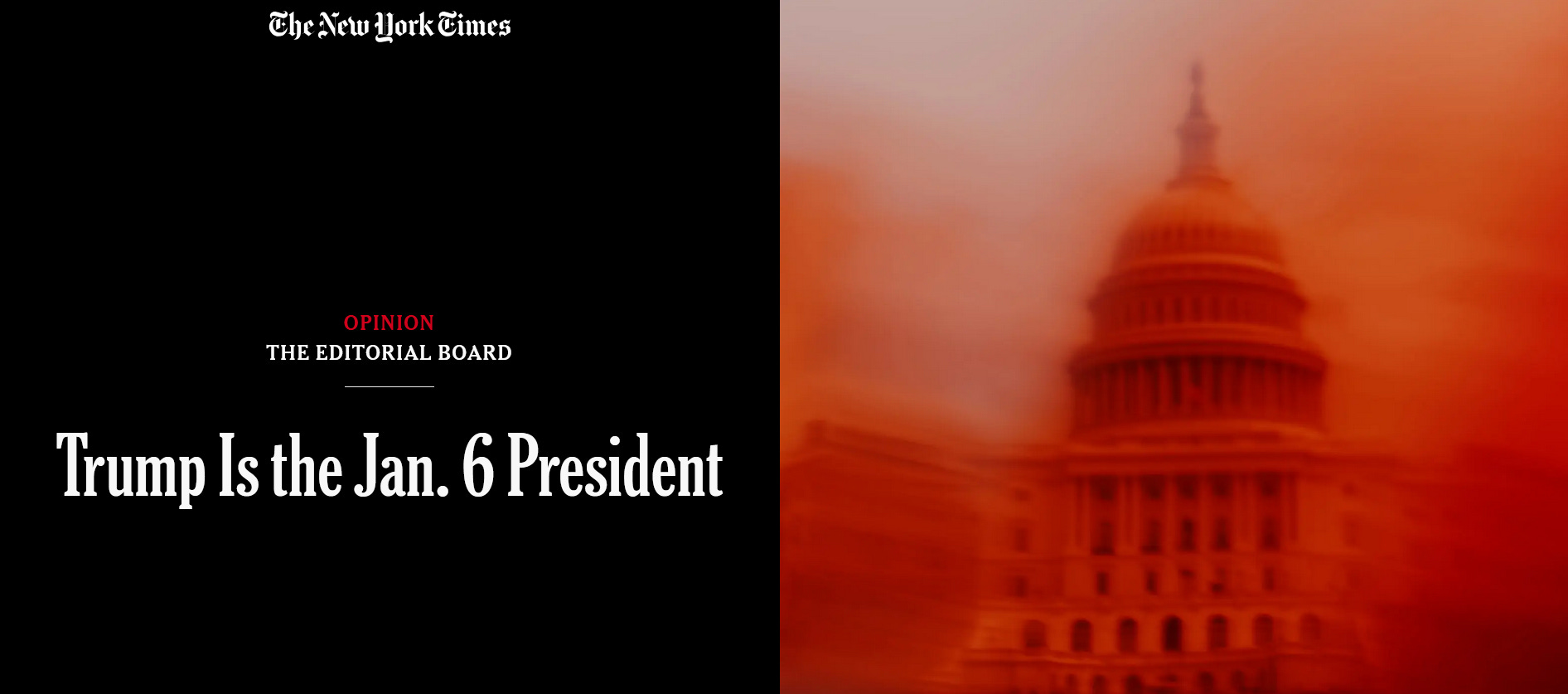
This has been the perspective of mental health experts from the beginning, as we concern ourselves with underlying dangerousness or unfitness, far before consideration of political affiliation or societal rank. Medical facts are facts, which this article does an admirable job in presenting.
However, it should go further and acknowledge, however
inconvenient, its contribution to our current predicament. The editorial notes
about January 6, 2021:
It was a day that should live in infamy. Instead, it was the
day President Trump’s second term began to take shape.
I would go further back: the true day of infamy occurred
when the same Times Editorial Board—unfortunately—caused us to
go from being the number one topic of national conversation to being blacked
out of all major media. With this, the nation went from a true possibility of
addressing a mental health crisis with a mental health intervention, to the
current dystopian distortion of reality itself.
This took a concerted effort, defying public demand and
reversing the uncommon openness toward the subject of mental health that the
media displayed—when I was invited onto all the major network
and cable news programs and interviewing fifteen hours a day, week after week.
This astonishing absence of stigma reversed course, once the American
Psychiatric Association (APA), under the “leadership” of past president Jeffrey
Lieberman, aggressively spread disinformation about us.
This was partly in response to an earlier January 6—when
the Guardian invited me to contribute a piece and published it
in 2018—which, like all other articles by or about us at the time, became the
number one article read that day, week, and weekend. I explained:
The Dangerous Case of Donald Trump: 27 Psychiatrists and Mental Health Experts Assess a President [keeps] within the letter of the Goldwater rule…. the personal health of a public figure is her private affair—until, that is, it becomes a threat to public health.
We were at the height of public demand, with my book being
an instant and unprecedented New York Times bestseller of its
kind. I was eventually invited to meet with more than fifty U.S. Congress
members, who stated that they depended on us to “educate the public medically,”
so that they could “intervene politically”—and indeed a Congressional bill was
rapidly gaining ground. This bill would have created an “other body” that
included psychiatrists, to replace the cabinet for implementing the
Twenty-Fifth Amendment, a provision for a president who is unable to perform
the duties of office.
To this day I am convinced that, without the intervention of
the APA and the Times, we would have succeeded in having a
rational, mental health intervention for a mental health problem. And instead
of becoming the most bewildering “Banana Republic” the world has seen, we would
have been globally praised for handling a difficult situation, setting
standards for other nations.
As I had stated in the Guardian, we spoke up at the threshold of threat, applying the most conservative parameters of “the Goldwater rule”: according to scholars of the “rule”, professional responsibility to educate the public kicks in when there is merely benefit to society, far before actual threat.
Nevertheless, upon meeting with Lieberman,
the Times Editorial Board issued
a piece that began the media blackout of mental health experts. I would not
be surprised if Lieberman dictated the article, for it contained his distinctly
pejorative language, as well as his extreme interpretation of “the Goldwater
rule,” unshared
by an overwhelming majority of surveyed psychiatrists. It said:
Unfortunately, a number of psychiatrists … who should know better have increasingly taken up the Trump-is-crazy line. In “The Dangerous Case of Donald Trump,” released last October, [the authors] concluded that Mr. Trump presents a grave and immediate danger to the safety of America and the world. No argument there, but why do we need to hear it from psychiatrists relying on their professional credentials? Dr. Bandy Lee … said the authors are “assessing dangerousness, not making a diagnosis”…. There’s a good reason the profession established an ethical guideline in 1973, known as the Goldwater Rule….
It was published opposite the only full-page psychiatrist
opinion on Donald Trump the Times would allow, authored by
Lieberman and entitled: “Maybe
Trump is Not Mentally Ill. Maybe He’s Just a Jerk.”
The APA’s earlier press release also contained Lieberman’s
denigrating language:
Armchair psychiatry or the use of psychiatry as a political tool is the misuse of psychiatry and is unacceptable and unethical…. APA is ready to make recommendations from among our 37,000 psychiatrist members, physicians who have the … objectivity to perform a thorough and apolitical evaluation. Using psychiatry for political or self-aggrandizing purposes is stigmatizing for our patients and negatively impacts our profession.
“Armchair psychiatry,” “use of psychiatry as a political tool,” and “political or self-aggrandizing purposes” were phrases Lieberman repeatedly used to speak, write, and “tweet” about us far before the press release, apparently upset that Congress members consulted us and not he (hence the “recommendations” and, when a historian remarked that my book included the most eminent living psychiatrists, he denigrated them as, “They’re not so eminent”).
He did not recognize that he was violating “the Goldwater rule” when
imputing motives to us without basis, and that he was stigmatizing an entire
field through silencing, since all research points to silence as
the main contributor to stigma.
Nevertheless, before the disinformation could be corrected,
we were entirely blacked out of the major media within two or three weeks,
never to return.
The recent Times editorial is correct when
it says:
Jan. 6, 2021 … was indeed a turning point, but not the one it first seemed to be…. It heralded a culture of political unaccountability.
Before the unaccountability for violence, there was an
unaccountability for unfitness. January 6 itself did not have to be. Expertise
exists so that we do not have to live through pandemics, insurrections, wars,
and other consequences before preventing them. The responsibility of ethical
health professionals is to act on the knowledge they have to protect the
public, and the role of the press is accurately to report concerns, not to
participate in actively suppressing a growing popular movement.
I believe there is still the possibility of correct intervention, and therefore mitigation of damages, were the New York Times brave enough to admit its mistake, and the APA to correct the misperceptions it promulgated, before being—along with Lieberman—well-rewarded with federal funds.
Dr. Lee is a forensic psychiatrist and violence expert
who also holds a master’s in divinity. She primarily worked with
maximum-security prisoners and public-sector patients, before she became known
to the public through her 2017
Yale conference and book that
alerted against dangerous leadership. In 2019, she organized a major
National Press Club Conference on the theme of, “The Dangerous State
of the World and the Need for Fit Leadership.” In 2024, she followed up
with another
major Conference, “The More Dangerous State of the World and the Need for
Fit Leadership.” She published another book on
dangerous leadership that has recently been expanded,
in addition to a volume on how
dangerous signs in a leader spreads and two critical statements on dangerous leadership.
As many of the dangers she warned against unfolded—including millions of
unnecessary pandemic deaths, the propagation of political violence, the
exacerbation of economic inequality, the destruction of the climate, the
replacement of international collaboration with hostile competition, a renewed
and accelerated nuclear arms race, and a global emboldening of brutal dictators
that led to brutal warfare and genocide—she has advocated for another way. Now,
the author of the internationally-acclaimed textbook, Violence;
over 100 peer-reviewed articles and chapters; 17 scholarly books and journal
special issues; and over 300 opinion editorials, is developing a curriculum to
help humanity rise above its destructive course and to embrace, “One World or
None.”