A small number of loud bigots (and at least one school committee member) pound away at the rights of transgender, gender-diverse, and transitioning students.
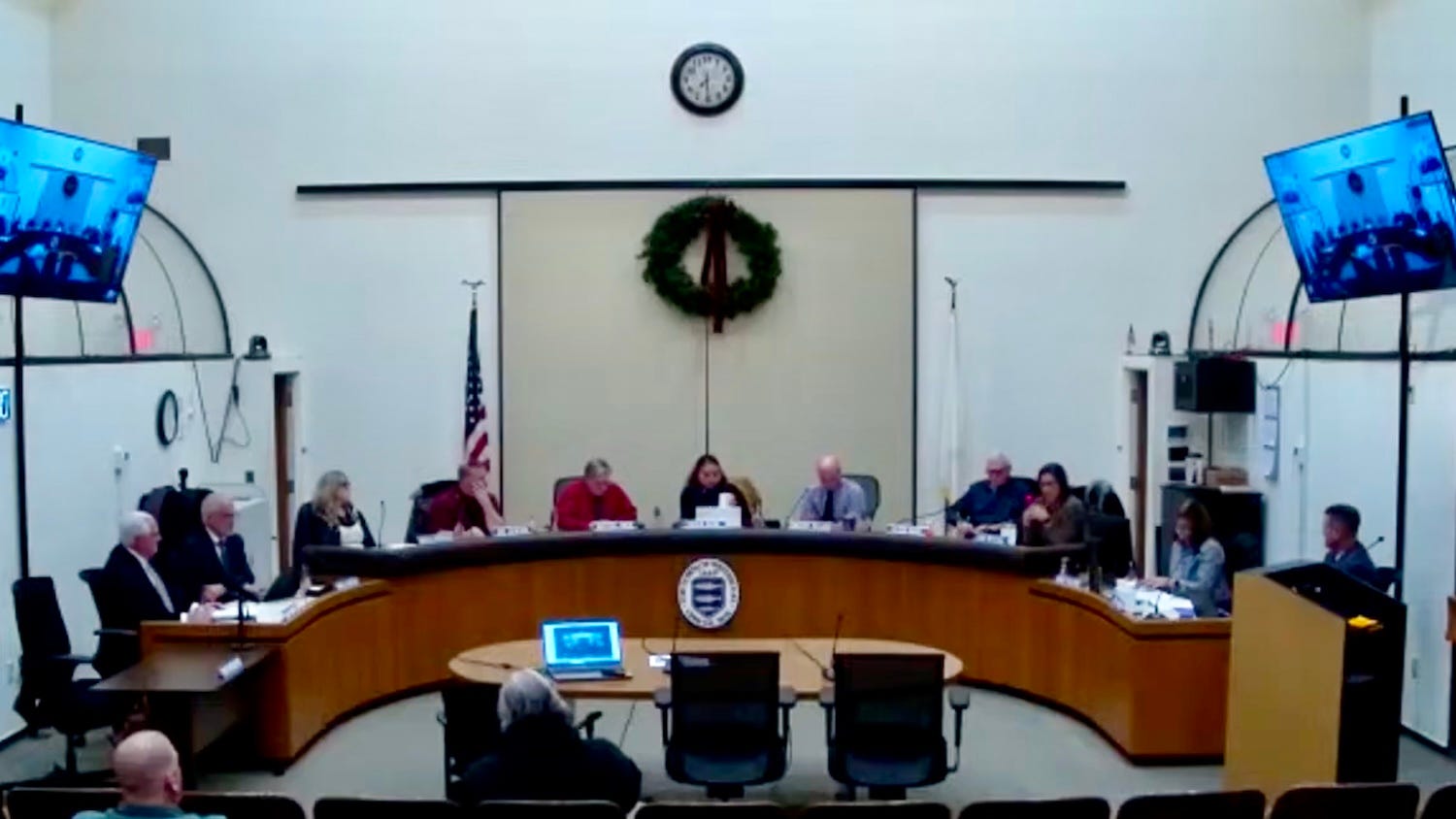
From the amount of time I spend attending and covering the Westerly School Committee and hearing the nonstop anti-transgender rhetoric, one might think that this is somehow a major issue in the town. The best I can tell? It’s not.
Instead, a small number of Christian nationalist bigots, chief among them Westerly resident Robert Chiaradio, cycle through the same litany of imagined grievances like a skipping record. Chiaradio, I think, gets so much airplay because one of the members of the Westerly School Committee, Lori Wycall, keeps adding agenda items to the meeting with the intent of somehow circumventing Rhode Island state law and opening the door to abusing the rights of transgender students.
To understand what follows, you need to know that at the
November 19 Westerly School Committee meeting, the minutes of the November 5
meeting were amended so that quotation marks were placed around the term
“biological males” as used by Robert Chiaradio during his comments. This was
done because the term is demeaning to trans people and has no scientific
meaning. [See this footnote.1] Chiaradio opposed the quotation marks.
Robert Chiaradio: A speaker asked this body to
amend the minutes of the November 5 meeting by placing quotation marks around
the term “biological male” as I used it at that meeting to describe males who
are confused about their sexual identities. The speaker deemed the term
derogatory.
I ask anyone in this room with a modicum of common sense,
what is derogatory about this term - “biological male” - as used in reference
to the above-mentioned population?
Is it unpopular with some people? Yes, it is.
Does it describe the group in a manner in which it doesn’t
wish to be described, or those who support it don’t wish it to be described?
Yes.
Does it belittle, diminish, or disparage anyone in the
group, or show a critical or disrespectful attitude toward anyone in this
group? No, it does not.
The term is truthful, honest, and sincere to all
populations. I submit to you that calling males identifying as females,
“females,” belittles and diminishes real, honest-to-goodness females and
disrespects them. That’s what gets lost in all of this. And your desire to
minimize and manipulate the truth. Not only are people like myself (who, like
it or not, are truth-tellers) disparaged, lied about, threatened, et
cetera (which I don’t care about), but our real females, Westerly’s
real girls, are diminished and marginalized, as was the case in 2024 … where a
“biological male” played against Westerly’s girls - an incident that this
superintendent and many in power continue to deny.
Later in the minutes of the November 19 meeting, during the
consent agenda, Mr. Killam, in true gutless fashion, I might add, made a motion
to amend the November 5 minutes to, as the speaker requested, place quotation
marks around the term “biological male.” Without Mrs. Wycall and Mr. Jackson,
the motion passed five-to-nothing.
Ms. Dunn even said, We will do our best not to reinforce
negative language.” Negative language? I ask you, what is negative, Ms. Dunn,
about the term “biological male” being used to describe males who are confused
with their sexual identities? Is it better to affirm a lie and call them
females? There is only one way to describe them, and that is the truthful way,
but the majority of this committee and its superintendent have an aversion to
truth, and have for at least the last five plus years. To you, it’s not the
truth that matters. It’s not the law that matters. It’s your agenda that
matters. I’m not surprised at Ms. Goathals or Ms. Dunn or even Mr. Ober, but
Mr. Nero, you’re just a flat-out disappointment who’s afraid to do the right
thing.
Mr. Killam, I cannot figure you out. I think your heart is
in the right place, but you lack courage. You’re a pleaser. You’re not a
leader. You actually amended the minutes because you didn’t want this committee
associated with a truthful term. What is derogatory about the truth? Truth is
not subjective; it is not malleable. Truth is not debatable. Truth is absolute.
It is objective. It is immutable and irrefutable. It’s not my truth or your
truth, but the truth. If you people up there on the dais care about the
population being discussed here, you will stop affirming this lie and help them
get the mental health counseling they need, like I am doing. You know what the
truth is, but the truth finishes a distant third with this crew, behind agenda
fulfillment and cowardice. Shame on those of you who perpetuate this lie. Thank
you.
Committee Chair Leslie Dunn: Is there anyone
else who would like to address the committee? Seeing none, I will ask if
committee members wish to respond.
Committeemember Timothy Killam: Okay, so first
of all, let’s talk a couple things... I made the motion to [put the term] in
quotes because it was [Robert Chiaradio’s] statement - that’s what the
discussion was.
If you’re going to ask me if I feel that the term
“biological male” or “biological female” is derogatory, my answer is “No, it is
not.” And if you actually dig deeper, as I did today, you kind of end up in a
rabbit hole. I went to the Rhode Island Department of Education (RIDE)’s
guidance on transgender and gender nonconforming students - I know that’s a
whole other battle - but in numerous places, RIDE lists students as “biological
male” or “biological female.” It’s just a term our department of ed uses, so I
don’t think it’s derogatory.
It may be used in a derogatory manner in some instances, but
the overall term “biological male or female,” no, I do not feel that it is
that.
I want to make it clear that this is not why I changed the
minutes, not at all. I changed them because it wasn’t clear what the statement
meant. But I can tell you that maybe I was wrong, because you could have just
watched the video and seen it for yourself. Very simple. Maybe that’s what we
need to do: start scaling back our minutes. [For example,] tonight, “Mr.
Chiaradio spoke, discussion ensued.” That’s all [the minutes] need to say. You
can watch it on video if you want to.
Committeemember Lori Wycall: Tim, thank you for answering that way. I think, in general, amending the minutes based on one person - I don’t think it should have been done, and if I were here, I would’ve voted not to amend the minutes solely based on the principle of doing it, which is kind of what you addressed. To the point of “what was amended and why” is a completely different topic that I’m sure all of you know I would not have agreed with, and which, I don’t think, should have happened.
[To Chiaradio] Thank you for coming to the
podium.
Leslie Dunn: I will respond directly to what was
asked of me. Similar to what has already been said here: A comment being made
to refer to people who are transgender, gender nonconforming, whatever term
sits with you - to classify that as “they have mental health issues, and we
need to help them” is not a statement I would agree with.
That being said, when the sentiment of how you’re presenting
your point of view is to make people feel othered and make people feel like the
way that they identify in their life is not, because it doesn’t align with your
views, is not appropriate, and somehow, they’re inappropriate. I think it’s
important to distinguish that that’s not a reflection of the general feeling of
- I want to say this community, and I want to say this district. So I was in
favor of amending it to reflect the person speaking and how they feel, as
they’re using this terminology.
With that being said, I do think it gets into a slippery
slope when you start amending minutes and such. Maybe the way we move forward
is to change how those minutes are recorded and posted, because, as Mr. Killam
said, you can go online and see what was and wasn’t said, and exactly how
people feel.
So I thank you, as always, for coming and bringing your point forward. I don’t regret my decision or the way that I voted. I don’t regret supporting the statement that was made, and you know that we can agree to disagree - that we have very different viewpoints on how this all matters within our district, families, and community. That’s all I have on that.
Leslie Dunn: Our next item here, under new
business, is we have RIIL (Rhode Island
Interscholastic League) Rules and Regulations - articles two and
three. Ms. Wycall, I believe this was something that you had requested. Do you
want to open this next agenda item up for us?
Lori Wycall: Yes. With the changes made to the
RIIL Rules and Regulations back in March (kind of quietly, and I don’t think
many school districts realized it), some wording was removed from the
“eligibility regulations.” They placed the onus on each district independently.
I felt we needed to have something in place as a district because the way the
rules and regulations are worded now, it’s up to the principals. Now that RIIL
covers both the middle school and the high school, it’s up to two separate
principals, representing two separate age groups, to make decisions. If the
principal were to change at any point, things could change based on their
viewpoints or how they want to proceed. So I thought, for the sake of having
consistency in the district amongst the schools and from year to year, we
should have something in place, whether it’s protocol, policy, or something
that simply indicates how we would designate who is eligible for sports.
My opinion is that we should specifically look at boys’
sports and girls’ sports, and if we have designated co-ed teams, that could
also be a category. And this really, in my opinion, doesn’t have anything to do
with the transgender topic that will not go away. This has more to do with
common sense and protecting students on every level. We wouldn’t want a girl
who’s a fantastic football player to be playing on the boys’ varsity high
school football team. That’s not safe for anybody, and it’s not fair for the
boys. We wouldn’t want a boy, regardless of their gender identity. That has
nothing to do with it. The State of Massachusetts has a law that says a boy can
play on a girls’ team if no boys’ team is available. For example: field hockey.
If a high school didn’t have a boys’ field hockey team, they would allow any
boy to play on the girls’ team. And that’s not safe, as we know.
I think we should have something [written down] so that
everybody’s following the same thing. I understand there is an “unwritten
policy” or “way” things are handled, but it’s not in writing, so people don’t
know. I know there was confusion this year with one of the high school teams
-specifically the girls’ soccer team - as to how they were going to prepare for
a game, whether or not there was going to be a boy playing on the other team.
I would think that, for consistency, protection, and for
administrators tasked with making these decisions. We need something that lets
everyone know what they need to do to handle a situation.
Leslie Dunn: I just have a question for
[Superintendent Dr. Mark] Garceau. Given that it’s up to the principals at each
building, my question is, have they come to you looking for guidance on this?
Do you feel like they have a good handle on whether it’s a case-by-case basis
or if they need a written protocol, should the concern arise of eligibility
playing and all of those things?
Superintendent Mark Garceau: The principals
haven’t come to me about this being a concern, no.
Lori Wycall: Has anybody in the district come to
you asking how you should handle this, how coaches should handle this?
Superintendent Garceau: I have had conversations
with the athletic director, and the message was: We expect the coaches to do
whatever they need to do to ensure our players’ safety.
Lori Wycall: Did you indicate what “safe” meant
in this situation?
Superintendent Garceau: Not specifically, no.
Lori Wycall: I remember a conversation where you
told me that girls being safe playing, whether it was a field that had ruts,
rain puddles, and everything else, that you would forfeit a game because the
field condition weren’t safe, and that you would also forfeit a game if the
girls were forced to play against a boy, because that wasn’t safe.
Superintendent Garceau: No, you’re
mischaracterizing that conversation.
Lori Wycall: Okay. Please tell us all what you
said.
Superintendent Garceau: When I met with the
athletic director about this, the conversation was about if a team shows up to
a venue, and for whatever reason, our coach feels that playing places our
players - male or female - in an unsafe situation, and they decide to either
sit players out or request of another coach that they sit players out, or offer
to forfeit the match -[as long as] it’s based on issues of student safety, I
would more than likely support that coach. That’s what the conversation was.
The analogy of an unsafe playing surface, sure. If a coach
shows up and decides, regardless of what any officials on the site say,
regardless of what parents say, that the playing surface is unsafe, and decides
to take any of those measures - sit players or forfeit - I would likely support
that.
[You and I] won’t be there. This will be at five o’clock in
Chepachet or someplace. If for any reason - lightning is predicted or a player
on another team, in the opinion of the coach, presents an undue risk - because
all sports comes with a degree of risk - and the coach, in the interest of all
student’s safety - decides that somebody should sit, the game should be
forfeited, or that other arrangements be made - s long as they make that
decision in accordance with the law. They do it in the best interest of student
safety; we will support that decision. That’s the conversation we had with the
athletic director, and that’s the conversation you and I had.
Lori Wycall: This specifically came into our
conversation, and you’re denying that right now?
Superintendent Garceau: No, ma’am. I will say
this again. I’ll say this publicly and clearly: if a transgender student is on
an opposing team, or playing on our team, and a coach feels like that creates
an unsafe situation, transgender or any reason, the coach is expected to do
whatever they have to do to keep our players safe.
Lori Wycall: Do you feel that a boy playing on a
girls’ sports team is unsafe for the girls?
Superintendent Garceau: Not in every instance.
It’s a case-by-case issue. How does having a transgender student or a male
student running a cross-country race against girls make anybody unsafe?
Lori Wycall: Okay, so unsafe or unfair?
Superintendent Garceau: Potentially unfair. So
again, if the coach shows up and feels that what’s going to happen is going to
be an unfair contest - the coach is in the best position to make that decision
- the coach is going to pick up the phone and call the athletic director. The
athletic director is going to call RIIL and say, “Here’s what we’re going to
do.” And if it’s based on either of those quantifiers: safety or fairness, we
will likely support the coach in that.
Lori Wycall: Biologically speaking, it would
never be fair to have a boy or a male playing against a female
Superintendent Garceau: And we’ve never had that
situation.
Lori Wycall: That’s not my point. The point is,
when it happens, a principal has to know how to handle it. We need something in
writing so they know what to do.
Superintendent Garceau: If the committee wants
to vote on a policy about that, we’ll certainly follow that. The recommendation
from [RIIL] is to follow the law. We haven’t been presented with the situation.
I know it’s been alleged that the Moses Brown team had a “biological male” on
their team. No one has ever brought that to our attention, other than a
community member. Not the athletic director, not the coaches
Lori Wycall: The athletic director knows it’s
true. You know it’s true.
Superintendent Garceau: If I had documentation
of it, I would know it was true, Lori. I don’t know if it’s true.
Lori Wycall: The athletic director knows. He
looked at the roster this year to see if they would have to cancel their senior
night game because it was against Moses Brown.
Superintendent Garceau: I don’t know that that
took place last year.
Lori Wycall: Well, this is taking place, and if
you don’t know about it, then I don’t know what to tell you, but I believe we
need to have, as a district, for consistency, and for the purpose of having our
principals and coaches know what they’re supposed to do in a situation.
Superintendent Garceau: So, if I could ask you:
We’re playing a soccer match against Tiverton, and the Tiverton team shows up,
and our coach believes there’s a transgender person on the other team. What do
you want our coach to do?
Lori Wycall: I would like them to forfeit the
game
Superintendent Garceau: If they feel it puts our
kids at undue risk or creates an unfair advantage for the other team, I would
expect that and support them. I don’t know how I could be more clear about it,
really.
Lori Wycall: Well, we expect our kids to keep
their cell phones in their backpacks, but now we’re writing a policy for that.
So maybe we need to have a policy for this.
Superintendent Garceau: And again, if the
committee puts one in place, we will certainly enforce it.
Lori Wycall: Well then, I would once again like
to make a motion that we put something in writing that indicates the
eligibility of boys for boys’ sports, girls for girls’ sports - except co-ed
sports or sports that are intramural and aren’t of a competitive nature.
Because it’s happening across the country, where boys are competing with and
injuring girls, taking scholarships, and taking titles. I mean, we have all
seen it, and to just keep sitting back and say, well, it hasn’t happened here.
That’s really not the point. The point is that we should be doing the right
thing to protect our girls. What if the volleyball team played a team with a
boy on it and won the state champs? That’s taking something away from our
players.
Superintendent Garceau: I understand your point,
but again, and I know you don’t want to hear this, but that hasn’t happened.
And if it did, and we showed up to a venue and because of who was on the other
side of the net that created an unsafe situation, or there was a problem with
the lighting in the gym, or the officials, or if there was any reason that our
coaches felt that our kids were being placed in an unsafe or unfair
circumstance. They made the decision based on that criterion; we would support
them in that. That’s the conversation I had with the athletic director.
Fortunately, we haven’t had that circumstance arise.
Lori Wycall: Well, it is fortunate, but it’s not
doing the right thing, just waiting for something to happen. We have all kinds
of policies in place to prevent kids from doing things and to set guidelines,
so everybody knows what they can and can’t do.
For us, where this has now been put in our lap by the RIIL,
to sit back and not do anything that’s going to protect girls, that’s going to
protect the boys, that’s going to be fair with them and their competition -
just to sit back because nothing’s ever happened? So we’re going to wait for a
coach, who maybe isn’t paying attention or doesn’t agree that playing against a
“biological” or playing against a boy on a girl’s sports team is not safe, and
then somebody gets injured, we’re going to be sued as a district. Then we’re
going to have a student who’s been hurt, and we’re going to be in trouble as a
district.
Superintendent Garceau: You mentioned the cell
phones. So yes, we need a cell phone policy because it’s the law. It’s also
against the law to discriminate against kids based on gender identity. I know
Title IX doesn’t address that. Title IX is silent on gender identity. Rhode
Island law is not though. Rhode Island law forbids discrimination against
transgender and gender nonconforming students. So, if you use the example of a
female playing on the boys’ football team, if a female tried out for and made
the football team, and this committee said, “No, we’re not going to allow that.
We’re not going to allow you to play.” You violate the law
Lori Wycall: The Rhode Island law that you
referred me to. RIGL 11-24-2 does not cover public schools. It does not cover
public schools. There’s no case law. There’s no case law.
Superintendent Garceau: Our attorneys tell us
that it does, Lori. So...
Lori Wycall: I’ve had multiple attorneys tell me
it doesn’t. [To Attorney William Nardone]: Bill, do you have an opinion for
this body? Does the attorney have an opinion?
Superintendent Garceau: If there’s a policy you
want to see written, we will certainly follow it.
Lori Wycall: Could I ask our solicitor what his
opinion of that Rhode Island general law is? If he has one.
Attorney William Nardone: If you’re referencing
the statute in Title 11, first of all, the heading of that section of the law,
that chapter, is criminal offenses. We’re not talking about criminal offenses.
The next section references homicide. We’re not talking about that. It does
talk about discrimination. My quick reading of it, and I couldn’t find any
specific case law referencing it, is that it does not apply to public schools.
Nowhere in the statute itself does it reference public schools. Nowhere is the
word public school capitalized. The subsection references hotels, places of
public assembly, movie theaters, and similar venues. So, again, I haven’t done
in-depth research, but from my quick look, that’s my analysis.
Lori Wycall: Another attorney that I spoke with
said that RIDE tried to utilize that RIGL in the case, and the court would not
hear it. They did not agree that it applied to public schools. It’s my opinion.
It’s what my research has brought to light.
I motion that our superintendent prepare a draft policy for
our review, indicating boys’ and girls’ eligibility for boys’ and girls’
specific sports teams, except for co-ed or intramural sports.
Leslie Dunn: We have a motion and a second.
Discussion?
Angela Goethals: I want to start by saying, Ms.
Wycall, that the issues you raised were safety and fairness. Even though you
insisted that it had nothing to do with transgender athletes, you continue to
focus on transgender athletes. It’s a little bit disingenuous that you say
you’re talking about safety and fairness. Yet, you’re focusing only on issues
of safety and fairness as they apply to transgender athletes. That’s my first
point. My second point, in response to Dr. Garceau’s comments: It sounds to me
as though it’s pretty clear that if there’s any risk to the safety of our
student athletes at all, then a determination would be made.
You’re saying it’s about safety and fairness, yet you want
specific language about transgender athletes.
Lori Wycall: Well...
Angela Goethals: Let me finish, if you don’t
mind. The second: We had the football team in this evening [for a team
acknowledgment] and not to get into opinions, but, watching that team walk and
shaking all those kids’ hands, there was a wide [variety] of physical attributes
on that team, so if you’re talking about safety and fairness as it’s related to
gender, I saw a huge array of different body types and heights, and the
appearance of different levels of physical strength and prowess.
Lori Wycall: I specifically referenced the
Massachusetts law that indicates boys can play on girls’ sports teams. I don’t
want the word transgender anywhere in the policy. I’d like it to say boys and
girls are male and female. This was brought up before: when we had the girls’
basketball team, about the different heights of the girls. I don’t care about
that. If boys and girls are developing differently, and we have a freshman
who’s five feet tall and a senior who’s six two, they’re still boys. They’re
biologically built differently than girls, that’s a fact, and it has nothing to
do with transgender. So, I am not being disingenuous. Thank you.
Michael Ober: We’ve discussed this before, at
least once, if not twice, if not five times. Nothing’s really changed. We’re
going to leave it to the people in charge of our sports to determine whether
it’s safe or fair. That’s not going to change. The only thing we would do is
create more confusion because it’s not boy/girl, it’s transgender too. People
who are transgender identify as transgender girl or transgender boy, whether we
like it or not. So [a policy] would not clear up anything because if we
eliminate “transgender,” then we eliminate dealing with the issue. I trust our
coaches to determine that the game is going to be safe and fair, regardless of
what the issue is, whether it’s field safety, whether they think that they have
students who are using substances that improve their ability, whether it’s a
unfair fielding advantage, whether it’s unfair referees, whether it’s anything
they have the responsibility of doing - I trust them, they do a good job. If
they don’t do a good job, then they can be removed.
Committeemember Joe Jackson: Even aside from the
subject, male, female, transgender, this doesn’t say coaches, it says
principals. The policy needs to be a little clearer than what we got from the
RIIL. Just based on that, if it’s going to be up to the athletic director,
great. Just write something that says the principals defer their authority on
this subject to the athletic director, who will make the best decision in each
case. Otherwise, as Lori brought up during her points, you’ve got different
principals at different schools, possibly making different decisions.
We don’t actually have a policy, so that’s a good place to
start. [Lori Wycall] said she doesn’t want “transgender” in the policy, and I
agree with that a hundred percent. It shouldn’t be about that specifically, but
start with who’s actually going to be deciding because right now, according to
this, it’s the principals that have anything to do with the decisions...
Superintendent Garceau: Principals are
responsible for all eligibility decisions,
Joe Jackson: It needs a little bit of amending,
at least, and then these points can be brought up in further discussions.
Committeemember Peter Nero: What you explained
tonight, Dr. Garceau, if you could codify that with your coaches about safety
in writing, plain and simple, exactly what you said tonight?
Superintendent Garceau: That’s what I wrote to
the athletic director.
Peter Nero: I was 265 pounds when I played
football in high school. I was a big boy. Sometimes it’s not fair, even amongst
being on the football team and so forth. So get with your coaches and
principals and make sure everybody’s on the same page. Codify it in writing and
make sure it’s there.
Committeemember Timothy Killam: I guess I’m kind
of in a couple of places on this. I understand what Mr. Jackson is saying,
because the principals aren’t at the games. They’re not there, so I agree that
this setup is kind of odd.
I could propose it in two ways. Number one, and I think Ms.
Wycall said it, but let’s just drop the adjective. We don’t need “transgender,”
we don’t need “biological,” just boys and girls. Fine. Just drop it because
we’re not talking about a transgender policy.
The other thing is: Now that we have a policy subcommittee,
do we take this and refer it to them for discussion, then come back to us with
some recommendations? I don’t think we just drop this. No, I think maybe bring
it to them. They discussed the cell phone policy, which we clearly have to
address, and ultimately, we have to deal with this.
It’s kind of embarrassing that, talk about the rabbit hole,
I went down looking at agendas and stuff like that for this school committee,
and if you look at 10 years ago versus right now, we keep having the same damn
agenda items over and over and over. 10 years ago, that didn’t happen. They put
something on the agenda, they made a decision, and they got business done. The
problem is we’re not getting anything done. We just keep going in these
circles. So I say we refer this to the policy subcommittee, tighten it up as
Mr. Jackson suggested, and maybe we can all come together and agree on it.
Leslie Dunn: I can agree with a few things here.
I could get behind language that is very clear and specific, stating that we
leave it to our coaches to make decisions for our athletes, ensuring they are
safe and fair. What I take issue with is everybody saying we’re not saying
“transgender.” We’re saying “boys and girls.” Then we’re going to come back to
somebody asking: What do you mean by boys? What do you mean by girls? Is it
biological? We’re going to get to that. That’s why I feel like this is the
beginning, where it sounds okay, the language sounds like “that’s not bad,
we’re just making sure it’s clear.” And then, next thing you know, “We didn’t
mean for it to go this far. We didn’t mean for it to be more than possibly a
girl being added to our boys’ football team.”
So I don’t see harm in making sure there’s language. It’s
helpful to our coaches and principals when they’re making these determinations.
But when we start adding too much language, we’re going to get into trouble,
because we’re really leaving it to interpretation. Even in the case that’s been
presented, of being unsure if there was a student who was transgender playing,
for all the students and coaches involved to walk onto the field and make that
accusation, whether it’s true or not, one, it could be outing someone. Two, it
could also not be true and cause damage there.
So I don’t agree with the particular motion that was
presented, but I could get behind making very specific language - a sentence or
two - reinforcing safety and fairness. With that being said, we have a motion
on the floor.
Lori Wycall: My motion is to ask the
superintendent to draft a policy indicating who’s eligible for boys’ sports,
girls’ sports, co-ed teams, and intramural sports, excluding co-ed teams and
intramural sports.
Timothy Killam: I look at it this way: We’re
asking him to make a draft. We don’t have to approve it if people don’t want
it. Let’s do a draft. Let’s write something up and go from there. I don’t see
the harm in drafting something. Then you can vote yes or no once it’s in front
of you.
Angela Goethals: I want to clarify. There are the
issues of safety and fairness, and of eligibility, which seem somewhat parallel
but not the same. I want to be clear that we’re talking about safety and
fairness in each athletic event. The eligibility question seems somewhat
outside of that conversation. I understand your point, Tim, and it’s well
taken. What’s the harm in a draft? I would prefer personally to see Mr.
Jackson’s suggestion that we look at what’s there and clarify based on the
criteria that you brought up, Ms. Wycall, the safety and the fairness, and then
go from there.
[VOTE]
Leslie Dunn: The motion passes five to two. We
will ask the superintendent to draft language for our review regarding
eligibility and sports team composition.
Superintendent Garceau: I pulled up this email,
Ms. Wycall. I want to respond to the other conversation about the soccer game.
On March 5 I emailed the athletic director, I said, “Good morning. Did we
actually have a trans student from Moses Brown compete on a team opposing one
of ours? I’m trying to verify the latest claims for Mr. Chiaradio. Thank you.”
His response, same day, March 5, was that there is no way for me to verify that
claim. Transgender athletes do not have any mandate to declare as such to the
school or RIIL. He made that claim after he played Moses Brown, and I believe
he reached out to them directly. I don’t believe he received any information
from them. I have no verification that it happened.
Lori Wycall: Okay, that’s fine. I get it. I get
it, Mark, okay? You completely misrepresented our conversation, so I am glad
you can read an email to me right now to prove the point that you didn’t know
that - that’s your stand. I accept it.
Superintendent Garceau: The email about the
conversation you and I had was immediately after the email where I...
Lori Wycall: The conversation that you and I had
had to do with your conversation with him before this school year?
Superintendent Garceau: No, it wasn’t before the
school year.
Lori Wycall: It was at our September 3rd
meeting,
Superintendent Garceau: If it was, it was within
days before that. And in the email, I said just what I said here: if the
coaches show up at a venue and find it unsafe, we will support their decision,
regardless of what it is. That’s it.
Lori Wycall: And if we were playing a team with
a boy on it, we wouldn’t play ‘em because it’s not safe for our girls. You said
that to me.
Superintendent Garceau: That would be the
coach’s determination. But he and I also talked about how it’s not the same in
all instances. It’s not the same in all sports. It’s not the same if a boy is
playing in the net in a soccer match. Case by case.
Lori Wycall: It’s fine. It’s fine. Gotcha.
Leslie Dunn: Next up, we have our next open
forum.
Attorney Jennifer Wood: Good evening. I’m sorry
to do this to you. You’re so close to the end. My name is Jennifer Wood, and
I’m the Executive Director at the Rhode Island Center for Justice.
The question arose as to what the Rhode Island state law on discrimination
against transgender students is, and I shared this with your group in
September, I believe. We have a contemporary analysis of all of the statutes
that prohibit discrimination in Rhode Island public schools. It was issued on
August 19, 2025. I’ll email it to your legal counsel so that you can share it
with all of you. It is Jane Doe versus the Rhode Island Commissioner of
Elementary and Secondary Education.
In that decision, the judge upheld the Rhode Island state
laws that prohibit discrimination based on transgender or gender nonconforming
status in all Rhode Island public schools. Under the Rhode Island
Interscholastic League framework, Westerly Public Schools certainly can adopt a
policy as was discussed this evening for determining eligibility on your sports
teams, and only to the extent that that policy does not discriminate against
transgender students, which would be a violation of Rhode Island state law
pursuant to this very contemporary court decision.
Your school committee, however, has no authority to adopt a
policy for your principals or coaches to determine who can play on other
schools’ sports teams. The eligibility determination is for your teams, not for
other teams. And in fact, you cannot authorize your principals or coaches to
discriminate against students based on their transgender status if they are
playing for other schools.
So there are some guardrails in place here that would govern
your next conversations about any policies you may adopt regarding eligibility
on your own teams. There’s no authority to adopt any policy about who plays on
anyone else’s team, and certainly that would not create a platform for
discrimination against students from other school districts. There are also
some weird references in the Rhode Island Interscholastic League policy to
nondelegable duties that reside only with the principals, not with coaches. So
I would encourage you to consider that as you move forward with any policy
formation. Thank you, and thank you for your patience.
Robert Chiaradio: I know [Clerk] Rose [Falcone]
will quote me correctly here. The superintendent is a terrible liar. He should
be better at it because he’s been doing it for eight years by now. He should be
better. RIDE’s Transgender protocol is in direct violation of Federal Law in
Title IX. That is indisputable. Our girls are being discriminated against based
on sex. Yet, according to Mr. Nero, the fence-sitter, we should wait to see
what the Supreme Court does, instead of doing the job you were elected to do. I
cannot stand fence sitters. The Rhode Island Interscholastic League knew it was
violating the law. Why the hell do you think that they gave the responsibility
- or extended the principal’s eligibility responsibility - to include gender?
Why do you think they did that? To cover their own behinds. That’s why they did
it.
The principal’s job number one is student safety. That’s
this committee’s job, too—one of them. And you’re failing them miserably. I’ll
cite again the October 2nd girls soccer game versus Moses Brown. And that guy
knows damn well that it happened. And so does your soccer coach, and so does
your athletic director. They know it happened. Westerly lost four to one. I’m
not going to out the kid. I have the kid’s name. That’s not the deal. That’s
not what I’m going to do. But it happened, and you know it happened.
No law in Rhode Island mandates that biological boys
identifying as girls be allowed to play against girls athletically, no law
whatsoever. She [Jennifer Wood] knows that. The word came down from Angélica
Infante-Green and Attorney General Peter Neronha to the
superintendents, and they were told to lie to you, which she has done, as
usual. There is, however, Title IX, a federal law since 1972, which has banned
sex-based discrimination. Here’s your policy. No Westerly Middle or High School
team will be comprised of both “biological boys” and “biological girls” unless
it is so advertised and designated as a co-ed team. Westerly Middle and High
School girls will have separate athletic teams for boys and girls
“biologically.” Three, for safety and fairness reasons, no Westerly Middle or
High School “biological female” team will compete against any team that
includes a “biological male.” And finally, for safety and fairness reasons, no
Westerly Middle or High School “biological female” athlete will compete against
any individual who was a “biological male.” You say it hasn’t happened here. It
has, and you know it. Your current protocol says it can, and it will continue
to happen.
Westerly resident Diane Goldsmith: I live in
Westerly. I grew up before Title IX. I was an athlete, and I am so tired of the
myth that women are weaker, frail, or unable to compete. It is a sexist
stereotype, and it hits hard on every girl. If you have a girl athlete in your
world and you think it’s okay to teach her that she is not as good as boys,
that’s a terrible thing to teach her and a worse thing to teach boys. Boys who
believe that it’s a bad thing, for example, to wrestle a girl in their own
weight range and lose, because that’s embarrassing. I have a stepdaughter and a
son-in-law. She was a Division III college basketball player. He was a hockey
player. They’re both big sports people in their marriage. They played sports
together all the time. She beat him at basketball.
She was a much better runner. Her records in marathons were
much better. He beat her in tennis sometimes, but they were competitive enough.
Many girls compete against boys and have done so in our neighborhoods and
basketball groups. Geno Auriemma, with the Yukon Huskies, has the women
practice against men. Do you honestly believe he would do that if he thought
they would get hurt any more than normal? Of course not. Division one athletes
are very valuable. It is a pernicious lie; if you know anything about statistics,
you know that athletic ability in men and women, boys and girls, follows a bell
curve. They overlap. Yes, the highest-rated elite men would win. But that’s not
what we’re talking about. We’re talking about giving kids the opportunity to
play on teams.
The most famous, probably, anti-trans athlete, Riley Gaines,
became an activist when she tied in fifth with a transgender woman. Four other
women have already beaten her. She still would’ve been fifth if that person
hadn’t been there. Most transgender kids playing on teams - we don’t know their
names. They’re sitting on the second bench. They want to be athletes. And if
you design a policy that tells every girl in this school district that they
can’t play with boys - I can’t tell you. Title IX was supposed to bring us up
and give us the opportunities that boys have. There’s no reason that a really
good girl shouldn’t play football if she’s capable.
Angela Goethals: Does anyone remember the Nike
ad campaign “Run like a girl”? Yeah, me too. To the attorney, thank you for
coming back and for your legal expertise and clarification of what the law
actually says. Ms. Goldsmith, thank you so much for speaking, always speaking
with passion, truth, and compassion. And to Mr. Carillo in the back there.
We’ve been talking a lot about safety tonight, safety of our athletes, and what
I still don’t understand is why your voice is the only voice that I’m hearing
on this topic. I know my email inbox is not flooded with concerned parents who
are fearful for their daughter’s safety in our buildings, bathrooms, campuses,
or on our athletic fields. So, respectfully, the dialogue you said you were
interested in is most certainly a monologue, because I’m only hearing your
voice.
Michael Ober: Thank you, Mr. Chiaradio. Peter,
you’re a fence. I’m a potted plant. So we have something in common. We sit
still. Mr. Chiaradio, next time you come, say you know the name and present it.
We have a long history in this country of people coming up saying, I have these
names. Tell us the names. Tell us. We will follow up on it. We will see you
come here and tell the superintendent he’s lying. Show us the name, and then we
can ask the question.
How insulting it is that you’re telling the girls’ soccer
team that one transgender girl beat their entire team. Moses Brown has a good
athletic program. They beat us because they were better. That’s how sports
work. One good player can have an impact, but they can’t beat an entire team.
Peter Nero: I said one or two months ago that we
can go around in circles, but the Supreme Court’s going to rule on this, just
like Roe v. Wade; it can go back on the agenda. We can go around and around in
circles and call each other all kinds of names, and you can be emphatic about
it. But the bottom line is: We follow the laws. The laws are what they are. The
Supreme Court changes it. That’s when we go back to the table.
Leslie Dunn: I do just want to say thank you to
everybody who spoke, and I do appreciate hearing from Jennifer Wood and
Diane Goldsmith for putting those reminders out there for us.
To Mr. Chiaradio: You don’t have to take this, but
respectfully, the name-calling of committee members, I think, is a little bit
unnecessary to get your point across. That’s just my personal opinion. I don’t
think your fight is with the district. I think this is something that has been
attached to a larger concern you clearly have, but your fight is not with the
district. These stories and it’s the same story every single time - to make the
point of who’s not protected, who is protected, who’s wrong, who’s a liar, all
of these things. Quite frankly, it’s the latest run on the hamster wheel, and
respectfully, let’s move on to something else. With that being said, I will
seek a motion to adjourn.
1 As S. Baum writes here:
The terms “biological male” and “biological female” have
no universal medical definition. Some may use it interchangeably with phrases
like “sex assigned at birth,” but ultimately, it reinforces the patently false
notion that there are two binary and immutable sexes, and that there are always
clear-cut distinctions between them. In other words, this verbiage is not only
demeaning to trans people; reporters never seem to describe cisgender people as
“identifying” as male or female. Even more than that, this language is deeply
unscientific.
“Extensive research confirms that sex and
gender are complex and cannot be reduced to simplistic “biological” categories.
Using these phrases [’biological male’ and ‘biological female’] to target trans
people is not a matter of accuracy but of animus — language wielded to
stigmatize and deny transgender and nonbinary people’s right to live openly and
safely,” GLAAD’s Guide to Anti-LGBTQ Online Hate and Disinformation explains.
SteveAhlquist.news is a reader-supported publication. To
receive new posts and support my work, consider becoming a free or paid
subscriber.

