Menu Bar

Home           Calendar           Topics          Just Charlestown          About Us
Showing posts with label Civil rights. Show all posts

Monday, July 27, 2026

The antifa terrorism threat the Trump administration describes does not exist

But since when is being imaginary not a feature in Trump's rants?

Jason M. Blazakis, Middlebury College

The State Department on July 16, 2026, hosted what officials billed as a ministerial on the resurgence of left-wing political terrorism.

Secretary of State Marco Rubio invited representatives from more than 60 countries to Washington to hear an argument that many of them appear not to believe: that a transnational far-left terrorist movement called antifa threatens the democratic world. 

At the event, allies were asked to mobilize against that enemy despite nations like the Netherlands and Germany politely noting to their host that they cannot find evidence of any such group.

Some intelligence analysts have declined to brief on antifa at interagency meetings because they do not regard it as a serious counterterrorism threat.

As a terrorism scholar who spent a decade running the State Department office that designates terrorist organizations, I understand their confusion. The threat the administration describes does not exist in the form the administration describes it.

Antifa is not a group

Jan. 6 insurrectionist and former Republican state
Rep. Justin Price claims Antifa and not him stormed the Capitol
As I and others have written before, antifa is not a group. It is a movement and an ideology, a loose commitment to opposing fascism. In its most organized form, it amounts to scattered local collectives like Rose City Antifa in Portland, Oregon.

There is no membership roll, no command hierarchy and no funding structure. There is no leader of antifa – the Trump administration has not named one – and there is no record of deadly attacks attributed to a U.S.-based organization called antifa.

Groups like the Islamic State group and al-Qaida have killed tens of thousands of people and have a documented chain of command. Antifa does not. You cannot decapitate a movement with no head, and you cannot sanction an organization that does not exist.

As such, the Trump administration created one.

Friday, July 3, 2026

USA! USA!

Americans are not as well off as people in peer nations

Stephen Bagwell, University of Missouri-St. Louis and Susan Randolph, University of Connecticut

As the United States celebrates the 250th anniversary of its Declaration of Independence, the global data we collect and analyze shows that the country is failing to “promote the general Welfare,” as the Constitution’s framers promised a little more than a decade later.

We are scholars of human rights. Alongside the Human Rights Measurement Initiative, a nonprofit that tracks how well more than 200 countries and territories are meeting the human rights commitments their governments have made, we annually update scores measuring whether people can actually get the basics of a decent life, such as healthcare, adequate food and a quality education.

The latest data our team has amassed shows that the U.S. is falling short compared with what it could achieve, given its US$32 trillion economy. This is not a one-year blip – the U.S. has been underperforming for the past 25 years.


Tuesday, June 30, 2026

Will Trump succeed at blocking you from voting by mail?

The Executive Order to Restrict Vote by Mail: Trump is still trying to suppress your vote

Joyce Vance

Republican voters regularly use mail-in voting. Nearly one in five registered Republicans vote by mail. Trump himself uses it. But in his role as president, he has an almost pathological dislike for the practice. One in four Democrats votes by mail.

Data on who votes by mail suggests that many Americans like it and have confidence in it. For instance, States United reports that 40% of voters who are 65 and over vote by mail. And in 2024, 905,343 members of the military and Americans living abroad voted by mail.

Trump has defended casting his own ballots by mail, saying he did it “because I’m president” and “I had a lot of different things” to do. But when others do it, there is cheating. In essence, the attacks on voting by mail have become a convenient, if false, vehicle for keeping the voter fraud narrative Trump loves to push on the front burner.

Trump has been trying to end Americans’ ability to vote by mail. His most recent effort, after several failed ones, started with a new executive order he signed on March 31 of this year: “ENSURING CITIZENSHIP VERIFICATION AND INTEGRITY IN FEDERAL ELECTIONS.” It’s a plot to transfer control over who gets to vote from the states, who have that authority under the Constitution, to the federal government, which does not.

We discussed the EO here when it came out. At the time, I wrote, “The point emerges early on. This is not an EO about ensuring election integrity. It’s an effort to let politicians, namely this president, influence election outcomes instead of letting voter elect their chosen representatives.” The Postal Service responded by promulgating new rules requiring states to turn over their voter rolls to the administration. A failure to comply with that rule would cost states the ability to mail ballots to their voters, because only people appearing on official Trump-approved voter rolls generated after vetting the state rolls will be eligible to have ballots mailed to them. If states don’t turn over their lists, no mail ballots.

It would have been unimaginable for the Carter, Clinton, Obama or Biden administrations to restrict voting like this. Even for the Reagan or Bush administrations. The federal government is going to prevent states from using the U.S. Mail to send out ballots, unless the states let the federal government decide who is eligible to vote—under rules set by each state. It’s rank voter suppression, removing decision making authority from the states and vesting it in the Trump administration, which has repeatedly demonstrated its interest in winning, even if that means keeping Democrats from voting or refusing to count their votes when they do.

Saturday, June 27, 2026

AFL-CIO sets ambitious goal of organizing 2 million more workers and two labor experts discuss how this could be done

Big goals call for commitment, planning and organizing

By Don McIntosh

Liz Shuler and Fred Redmond were re-elected to lead the AFL-CIO.
| Photo courtesy AFL-CIO

The AFL-CIO held its 30th national convention June 7-10 in Minneapolis. Among the highlights, delegates re-elected incumbent leadership and passed a resolution pledging to bring 2 million more workers into unions by 2032.

The AFL-CIO is a federation of 65 unions that total 9.8 million members in all. 

In its latest annual disclosure to the Department of Labor, the AFL-CIO reported 14.8 million members, but that figure includes just under 5 million who signed up to be members of Working America, the AFL-CIO’s 22-year-old community and political organizing affiliate; those individuals aren’t represented by a collective bargaining agreement, aren’t required to pay dues, and don’t consider themselves union members.....

In the last four years, the AFL-CIO has grown by 2.4 million members thanks mostly to the re-affiliation of 2-million-member Service Employees International Union (SEIU) and the addition of seven smaller unions, most notably of professional athletes. The union share of the U.S. workforce overall has stayed about the same, dropping from 10.1% in 2022 to 10.0% in 2025. It’s estimated there are about 14.7 million union members in the United States in total, and two-thirds of those are in unions affiliated with the AFL-CIO. The AFL-CIO doesn’t organize workers directly but tries to support organizing by affiliated unions. 

Besides the officer elections on Day 1, much of the convention consisted of speeches and panel discussions, but delegates also ratified without debate a series of resolutions that set official AFL-CIO policy. Those included:

  • Resolution 2, pledging to initiate a mass training program to provide basic organizing skills, tactics and strategy to working people who want to organize; and to grow unions by at least 2 million workers by 2032
  • Resolution 3, committing to dismantle systemic racial- and gender-based barriers to employment, prioritize the fight for pay equity especially for women of color, support access to gender-affirming health care, and center the voices of Black, Asian American, Native Hawaiian and Pacific Islander, Latino, LGBTQIA+, indigenous, immigrant and women workers
  • Resolution 4, demanding a pathway to citizenship for immigrant workers regardless of legal status; and calling on Congress to rescind funding for mass deportations
  • Resolution 25, calling on state and federal regulators to address anti-competitive mega-mergers between major employers
  • Resolution 26, opposing electronic shelf labels and so-called “surveillance pricing” by grocery retailers

How the US Labor Movement Can Revive Itself and Help Save Democracy

Stephen Lerner and Joseph A. Mccartin from These Times

The US labor movement, like the nation at large, stands at a crossroads. The next few years might well determine whether the United States fully descends into an era of electoral autocracy, where democracy has withered and authoritarianism becomes the political norm. This period is also likely to set the future trajectory of the union movement’s power and influence, as the state of democracy and organized labor have long been deeply intertwined.

For decades, the right-wing forces set on steadily eroding our democracy have worked in tandem with a pro-corporate movement that has increasingly marginalized organized labor, creating a ballooning crisis for the working class. Yet this politically hazardous moment also represents an opportunity to overcome deep-seated institutional inertia, drawing elements of a cautious labor movement out of their defensive crouch, and helping unions devise forms of struggle that might both revive the labor movement and renew American democracy.

Donald Trump’s second term has, in a way, broken a spell. For years, the pre-Trump status quo kept labor locked in a pattern of slow decline even as democracy was increasingly stifled and abridged by voter suppression, gerrymandering, filibusters, and the overweening power of organized money. But the decades-old dysfunctional status quo that gave rise to Trumpism is now crumbling under the weight of the most lawless, antidemocratic, rights-trampling administration this country has seen since the 19th century.

History suggests that fighting to defend and revive democracy in its moment of maximum peril can create a window of opportunity for labor. Past experience—in the United States and other nations—teaches us that, when unions fight to defend democracy and win, they position themselves for periods of explosive growth and increased worker power. It is imperative that the US labor movement grasp this lesson and seize the window of opportunity before it’s too late.

Moving Beyond Magical Thinking

It’s clear that the crisis facing US democracy is deepening. Over the past year, immigrants and the neighbors and coworkers who stood in solidarity with them endured murderous paramilitary occupations in Minneapolis, Chicago, and other cities across the country. The nation has been plunged into war in Iran without prior input from Congress. The president has even suggested the federal government should seize control of the upcoming midterm elections from the states.

Saturday, June 20, 2026

Trump finds new way to hurt immigrants and their families

The ICE-ification of Financial Regulation: steal their savings, especially the money they planned to send to their families at home

by Philip Mattera, director of the Corporate Research Project of Good Jobs First for the Dirt Diggers Digest

For more than half a century following the passage of the Bank Secrecy Act of 1970, financial institutions have been required to monitor certain customer transactions to thwart money laundering. The USA PATRIOT Act, passed in response to the 9/11 attacks, created additional rules designed to thwart terrorist financing.

Now the Trump Administration is starting to enlist banks in a more questionable form of information gathering involving the immigration status of their customers. For months, there have been reports that the administration is planning to require banks to determine whether customers are U.S. citizens.

That has not yet happened, but a recent executive order from the White House takes a step in that direction by advising banks to “be attentive to the credit risks posed by the extension of mortgage and auto loans, credit cards, and other consumer credit to the inadmissible and removable alien population.”  The order calls on the Treasury Department and financial regulators such as the Fed and the FDIC to develop changes to the Bank Secrecy Act to address this supposed risk.

This sounds like a prelude to more explicit rules that would bar banks from doing business with undocumented immigrants.

Sunday, May 31, 2026

Rhode Island needs to pass bills to codify the Voting Right Act into RI law

We are at Code Red for Democracy

On May 21st, 2026, the Rhode Island Voting Rights Act Campaign (RI VRA) hosted a lobby day at the State House to promote the Rhode Island Voting Rights Act (H8334/S3143) and its ten amendments. As group leaders in the campaign, and after experiencing actions and lobbying by over 100 people for the passage of the bill, we invite you to join the urgent Code Red for Democracy call.

As community leaders, we are calling on the Rhode Island General Assembly to pass the RI VRA and all 10 amendments before the session ends in June. There is extreme urgency.

Voting rights are being attacked across the country, both at the state and federal levels. The recent United States Supreme Court decision in Louisiana v. Callais gutted the federal Voting Rights Act. Action needs to be taken now. Rhode Islanders cannot afford to have their voting rights put at risk. The way to do this is to pass the Rhode Island Voting Rights Act and its ten amendments before the session ends, and implement the bill immediately upon passage.

“Standing inside the Rhode Island State House alongside Common Cause, The Womxn Project, the RI Coalition of Black Women, The Women’s Fund, Clean Water Action, and members of Alpha Kappa Alpha, Delta Sigma Theta and Zeta Phi Beta sororities, lobbying for the codification of the Voting Rights Act into Rhode Island law, was a surreal and sobering moment — because sixty-one years ago, my grandparents already fought and won this battle,” says Shahidah Ali, the Political Action Committee Chair of the RI Coalition of Black Women.

Yet here we are again.

Friday, May 22, 2026

The FBI Has Established a “Payback Squad” to Target Trump Foes — Report

Composed of agents who are deeply loyal to Trump

By Chris Walker

This article was originally published by Truthout

The FBI has reportedly established a team of agents, informally known as a “payback squad,” that is tasked with pursuing investigations (and eventually charges) against individuals perceived to be the political enemies of President Donald Trump. 

NOTUS reported on the details of the so-called payback squad, citing four individuals with knowledge of its existence, including two current government officials, a former official, and another person with an understanding of how it operates. 

According to the report, the agents who are part of the squad are deeply loyal, as they “know what they’re signing up for,” the publication stated. 

The payback squad was formed about a year ago. The squad was assembled to pursue Trump’s political foes, similar to the way the FBI has targeted former FBI Director James Comey, who was indicted last month over accusations that he had made a threat to the president’s life.

Comey — who was fired by Trump in 2017 in what was widely perceived as political retribution — faces criminal charges based on his posting a supposedly “threatening” picture of seashells on social media last year. The shells were arranged in the numbers “86” and “47.”

86 is a commonly used restaurant term that means to “throw out” or “get rid of,” while 47 refers to Trump, the 47th U.S. president. Trump has claimed the number is used to express a desire to see another person killed.

The Department of Justice (DOJ) alleges that Comey “knowingly and willfully made a threat to take the life of, and to inflict bodily harm upon the President of the United States,” even though Comey immediately removed the post when people made that inference, and issued a public apology, too.

A senior FBI official denied that the group uses the “payback squad” name, but confirmed that an advisory team for FBI Director Kash Patel was formed last year to target and discredit federal officials who took part in investigations against Trump.

Sunday, May 17, 2026

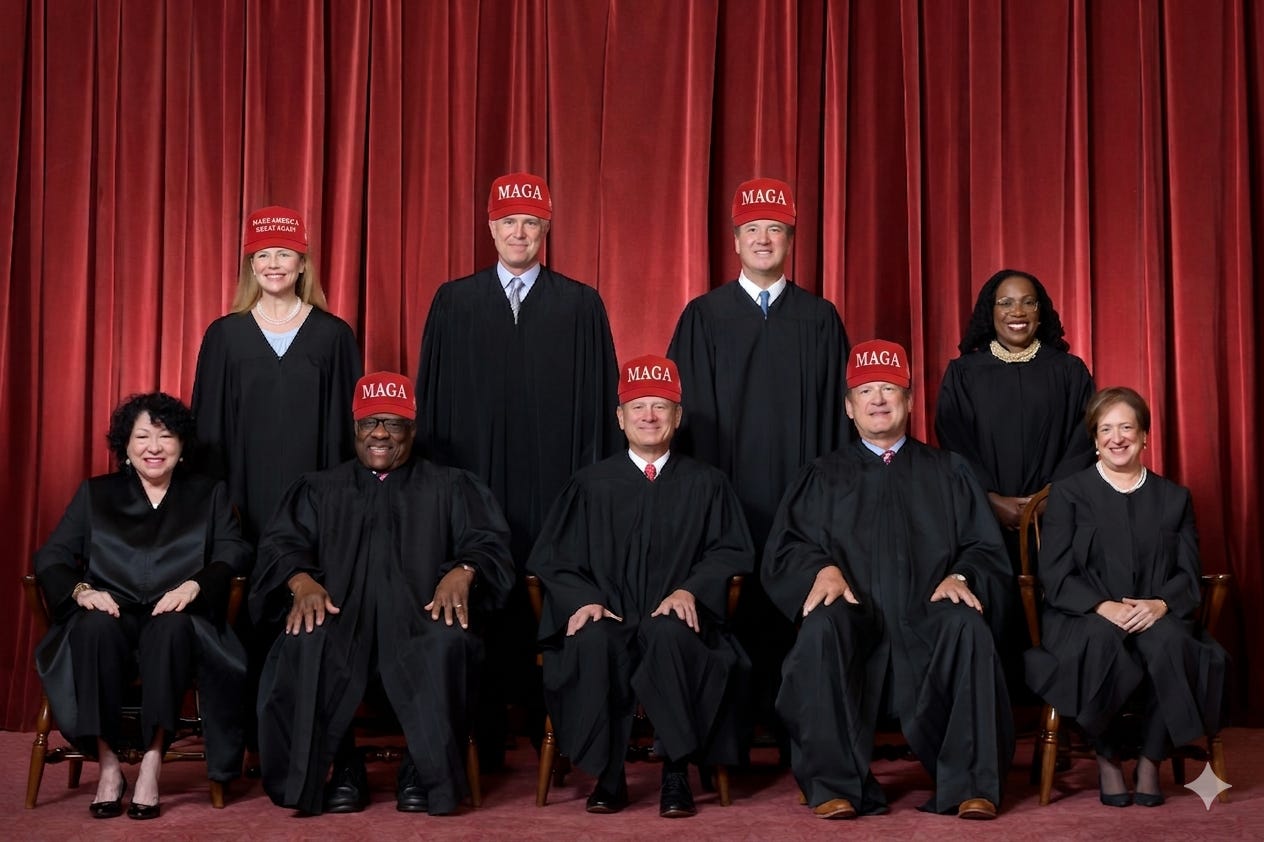
MAGA Supreme Court Okays G.O.P. Overthrow of American Democracy

Disenfranchising 40% of a state’s citizens cannot be reconciled with representative democracy

Mitchell Zimmerman

The Supreme Court gave a “two-fer” to white supremacists and proponents of Republican autocracy: First, six right-wing justices completed the erasure of the crowning achievement of the 1960s Civil Rights Movement, the Voting Rights Act. Second, in the same case, Louisiana v. Callais, the right-winger judges approved of states shaping legislative districts that deny the opposing party any role in government.

In essence, the Supreme Court okayed the destruction of Congress as an instrument of American democracy.

The Fifteenth Amendment to the Constitution was enacted and ratified five years after the Civil War. The Amendment confirmed – in principle – that African-American citizens have the right to vote and to have their votes count.

So said the Constitution. But for almost a century the former Confederate states negated African-Americans’ right to vote.

The Voting Rights Act put an end to the myriad legal schemes Southern white politicians had used to disenfranchise Black Americans

The Fifteenth Amendment also gave Congress the power to enforce its mandate. After years of struggle over civil rights – after peaceful demonstrators in Birmingham confronted snarling police dogs, mass arrests and lethal bombing, after hundreds of nonviolent students worked for freedom in Mississippi in the face of murder, assaults and the burning of Black churches, after peaceful marchers for voting rights returned to Selma after being clubbed by state troopers and ridden down by racist possemen – Congress tackled the white supremacist obstacles to African-American voting.

The Voting Rights Act of 1965 put an end to the myriad legal schemes that Southern white politicians had used to disenfranchise Black Americans and terminated the ploys used to deny African-Americans a fair opportunity to elect representatives of their choice.

Wednesday, May 6, 2026

Defending Rhode Island children from Trump's anti-trans witch hunt

Child Advocate seeks to block federal government subpoena for private medical records of minors

SteveAhlquist.news

Attorneys for the Lawyers’ Committee for Rhode Island (LCRI) and the American Civil Liberties Union of Rhode Island (ACLU) have today filed an emergency motion to quash a subpoena issued by the U.S. Department of Justice (DOJ) seeking the sensitive private medical records of minor patients who have received medical treatment for gender dysphoria at Rhode Island Hospital. [See: DOJ Files In Texas To Force RI Hospital To Hand Over Trans Patient Lists In Judge Shopping Move 1,800 Miles Away

Amazingly, the DOJ’s request to enforce the subpoena for these records was both filed and approved on Thursday – on the same day, without an opportunity for response – by a judge in Texas, not Rhode Island. The motion filed this morning argues that court intervention is “immediately necessary . . . to protect the constitutional privacy rights of Rhode Island’s children.”

Today’s motion was filed in the U.S. District Court in Rhode Island on behalf of the state’s Child Advocate. The motion calls the subpoena an “unprecedented intrusion into the private medical information of children, many of whom are among the most vulnerable in our state’s care,” that “cannot be justified by any legitimate law enforcement purpose.”

Sunday, May 3, 2026

Trump DOJ Slammed for Indictment of Anti-Hate Group

‘Craven Attempt to Silence Dissent’ 

Jake Johnson for Common Dreams

The civil rights and progressive advocacy community is rallying to the defense of the Southern Poverty Law Center after President Donald Trump’s Justice Department indicted the organization on Tuesday on multiple counts of wire fraud and other charges, which the group has condemned as false and politically motivated.

The Justice Department, led by Acting Attorney General Todd Blanche—who previously served as Trump’s personal attorney—said Tuesday that a grand jury in Montgomery, Alabama returned an indictment charging SPLC with “11 counts of wire fraud, false statements to a federally insured bank, and conspiracy to commit concealment money laundering.” 

The Justice Department accused SPLC, which specializes in monitoring extremist groups and movements, of “funding” far-right white supremacist organizations such as the Ku Klux Klan by paying people to infiltrate them and gather information.

Bryan Fair, SPLC’s interim chief executive, said the Trump DOJ’s “false allegations” won’t “shake our resolve to fight for justice and ensure the promise of the civil rights movement becomes a reality for all.” Fair noted that SPLC no longer works with paid informants but emphasized that they “risked their lives to infiltrate and inform on the activities of our nation’s most radical and violent extremist groups.”

Allied civil rights organizations spoke out in defense of the SPLC and warned that the Trump administration’s legal assault on the group is part of a broader attack on those who oppose the far-right and work to protect democracy.

EDITOR'S NOTE: Cathy and I have been longtime supporters of the Southern Poverty Law Center. As for the "crimes" brought against the SPLC by Trump's Justice Department, there is a long and Constitutional practice called "salting" where paid informants are placed within targeted organizations for the purpose of gathering damaging information. Unions do it. Journalists do it. Rightwing groups did it to smear Planned Parenthood. They ran into trouble when they peddled altered videos.  - Will Collette

Tuesday, April 28, 2026

Why Trump can’t just decree changes to voting by mail

Former federal judge explains how Trump’s executive order is ‘a solution looking for a problem’

John E. Jones III, Dickinson College

John Jones knows about voter suppression. Currently the president of Dickinson College, Jones – nominated in 2002 by President George W. Bush and confirmed unanimously by the U.S. Senate – served for almost two decades as a federal court judge. In that role, Jones presided over a case, filed just prior to the November 2020 presidential election, in which a conservative legal foundation sued Pennsylvania’s top election official, alleging that she had allowed 21,000 dead people to remain on the voter rolls. The group asked Jones to stop those people from voting.

Jones denied the request. “In an election where every vote matters, we will not disenfranchise potentially eligible voters based solely upon the allegations of a private foundation,” he wrote in his memorandum on the case. In this interview with The Conversation politics and legal affairs editor Naomi Schalit, Jones discusses Donald Trump’s March 31, 2026, executive order to wrest control of mail-in voting from states and give it to the U.S. Postal Service and the Department of Homeland Security; how the constitutional design of U.S. voting bars such federal control; and how Trump’s order would disenfranchise voters and is now the subject of lawsuits by voting rights groups and 23 states.

Article 1, Section 4, of the Constitution says, “The Times, Places and Manner of holding Elections for Senators and Representatives, shall be prescribed in each State by the Legislature thereof; but the Congress may at any time by Law make or alter such Regulations.” When you saw the executive order by the president, what did you think?

My first thought was, this executive order is dead on arrival. It assumes two problems that really don’t exist.

States are empowered under Article 1, Section 4, of the Constitution to conduct elections and set the time, place and manner of those elections.

The president’s March order asserts that states don’t maintain active and appropriate voter rolls. That’s just not true. State after state takes that very, very seriously, and it’s a principle of federalism that states are given the responsibility for conducting elections. This includes maintaining accurate voter rolls, which, despite the noise to the contrary, states have historically done very well.

The second inaccuracy that undergirds this executive order is that there is rampant fraud in mail-in voting. There is absolutely no evidence to show that that is true.

Donald Trump has repeatedly claimed there is pervasive fraud in mail-in voting, despite a lack of evidence.