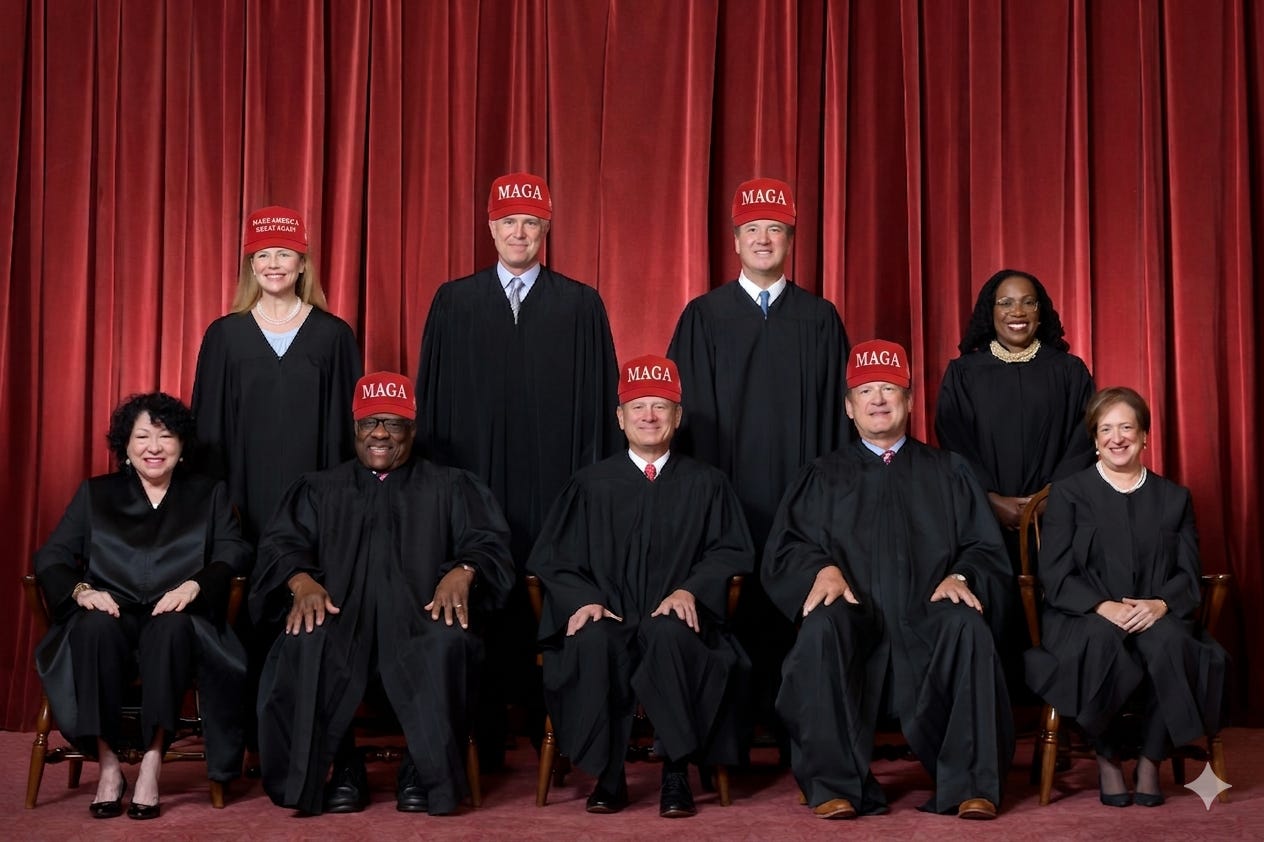
They put their thumb on the scale for the 2026 election
By Gerald E. Scorse

The deciding six were Chief Justice Roberts and Justices Alito,
Barrett, Gorsuch, Kavanaugh and Thomas. Definitely and positively, all six
realized the message they were sending to candidates and their big-money
organizational contributors: You can do whatever you want; the campaign
spending limits of the past 55 years have become past history.

“As a result,” she wrote, “a donor will be able to give
a party as much as half a million dollars (as compared to the $7,000 he can
give directly to the candidate) to cover the candidate’s bills. And the
candidate can seek just such a donation.”
The public was all in for Kagan. By huge margins, Democrats and Republicans alike opposed the
decision. Only 25 percent of GOPers approved, compared to 22 percent of
Democrats. On every other decision this term, the approval difference between
the major parties was over 30 percent.
An ecstatic Donald Trump responded in his
over-the-top Truth Social style: “The Supreme Court just took
restrictions off political spending! A BIG WIN FOR REPUBLICANS and…the First
Amendment!”
It absolutely was a major win for Republicans. While
individual Democrats are out-raising their GOP rivals heading into the
midterms, the Republicans have a $600 million advantage for the kind of campaign
financing just greenlighted by the Court.
As for Trump’s First Amendment “WIN,” here’s a sharply
different view from Michael Waldman, president and CEO at the
Brennan Center for Justice at NYU Law: “[The] campaign finance ruling is part
of the Roberts Court’s 16-year drive to destroy anti-corruption laws.
From Citizens United forward, these justices have ushered in
an era of massive money in politics.” The court not only overrode Congress, it
went “against the wishes of the vast majority.”
Lawyer and former Congressman Colin Allred was even more
scornful: “The Supreme Court term that just ended was, in my
considered legal opinion, one of the worst in modern history.”
Let’s finish up by circling back to the beginning, when six
injudicious justices ignored an eternal political truth. That truth was
glaringly obvious to two major figures from America’s past, Thomas Paine and
George Washington.
Paine made tax proposals that would have limited
income to the equivalent of about $27 million in today’s dollars. He saw the
limit as a necessary guardrail; for him, extreme wealth gave the rich an
“overgrown influence” and was “one of the principal sources of corruption at
elections.” For Paine, money and politics made for a toxic mix.
It wasn’t big money that worried George Washington, it was
anything at all. Washington “was always very reluctant to accept any
kind of gift because he was afraid people might interpret it as a bribe.”
Conclusion: Six smart Supremes made a supremely stupid decision.





.webp)