Menu Bar

Home           Calendar           Topics          Just Charlestown          About Us

Tuesday, March 31, 2026

Reflections on Cesar Chavez Day 2026

How to change culture (for Dolores and all the others)

Cheryl Brown

The other day I listened to Nick Cave and the Bad Seeds’ 1996 recording of “Knoxville Girl,” a traditional ballad about a girl from my hometown who got pummeled to death with a stick by her lover and dumped into the Tennessee River. The lyrics are typical of many a handed-down English folk song in that it features the violent murder of a sweet, young, not-so-innocent thing. 

Scots-Irish and English immigrants (settlers who may have been indentured servants, religious and economic refugees, colonizers, possibly all of the above) brought the seeds of this song to the US and then unto Appalachia. Besides Nick Cave, the Louvin Brothers, Lemon Drops, BR549, Outlaws, and many others have covered “Knoxville Girl.” 

I suspect some don’t even think twice about singing from the point of view of the murderer who is sitting in jail feeling sorry for himself. Perhaps this song was once meant to scare young people off from fooling around before wedlock, but it often come across, at least to me, as more sympathetic to a man grieving for the loss of his freedom rather than the loss of a young woman’s life. Perspective means everything. Anyway the words are at the bottom of this post so see for yourself.

Although I grew up hearing a lot of folk music, I only really learned about the lineage of murder ballads my first year back in the States, when I spent my second semester at Friends World College doing an apprenticeship and self-guided study on urban Appalachians, migration, and culture. My advisor was an ethnomusicologist who supported my investigations of country music on juke boxes in downtown Cincinnati dive bars. Grandma Bonnie Blanton Vance kinda territory. I learned as much from the other patrons’ stories as I did from the lyrics we sang along to over shots and beers. 

For part of my apprenticeship at the Urban Appalachian Council, I put to good use skills I had honed organizing punk shows helping out with the musical and storytelling stages of the annual Appalachian Festival. Because I was once again behind the scenes and not in the audience, I got to meet the likes of the Dillards, Dry Branch Fire Squad, Rich Kirby, Sparky and Rhonda Rucker, and Sheila Kay Adams, whose version of “Knoxville Girl” is one of the best I’ve heard, sung in the true ol’ timey way. 

I got to work with some of the godfathers and godmothers of the Cincinnati hillbilly music scene, one of whom invited me to his house after the festival to confess he had fallen in love with me, a 22- year-old less than half his age. I went because a group of us had been meeting there to plan the thing. After that, I withdrew and was never involved with that group of people again.

A few years later, I went to grad school in Washington DC and wasted hours that should have been dedicated to writing about the impact of structural adjustment policies imposed by the International Monetary Fund on poor people in poor countries, instead browsing the library stacks which held rare books full of old songs collected by jobless artists dispatched by the Works Progress Administration to the Third World hollers of Southern Appalachia. 

I formed a band and found my voice while working out harmonies and writing lyrics that were basically revenge fantasies in which the fair maiden gets revenge on the man who led her down the proverbial path in the woods to a muddy, soon bloody riverbank. 

My songs weren’t nearly as good as Hazel Dickens and Alice Gerrard’s recordings of feminist folk songs from the 1960s and 70s, but can be seen as stemming from that tradition, with the addition of the electric guitars and distortion pedals of 1980s punk and 1990s shoegaze. Changing culture takes decades of work over many generations. 

I’ve often thought that by getting me out of Knoxville when I was a jaded and angry 15-year-old punk, my parents steered me off a bad trajectory. I was able to get a much better education and came to understand the world in ways that I simply could not had I stayed in my hometown. I gained perspectives that East Tennessee preachers and some of my schoolteachers tried to shield me from, because such knowledge liberates one from the narrow cultural, political, and religious grips in which they wanted to keep me and the other Knoxville girls.

EDITOR'S NOTE: Cheryl and I have been friends for 30 years, meeting early on in her organizing career and staying in touch through the years. What Cheryl doesn't mention is her deep family ties to Rhode Island and that she has moved back to Rhode Island after a long organizing stint in California.  - Will Collette

Elementary

Let's go!

Rhode Island Republicans introduce legislation to wipe out renewable energy programs

The Rhode Island GOP's anti-green agenda

By Rob Smith / ecoRI News staff

There’s a debate in the General Assembly this year on how best to tackle electricity prices.

It’s no secret energy prices in Rhode Island have been high for years; state officials have little power over the price of natural gas used to run power plants and heat homes.

But a conservative faction within the General Assembly has been arguing that it’s time to roll back the state’s climate and renewable energy programs, which are funded via charges collected every month on residents’ electricity bills.

House Minority Leader Rep. Michael Chippendale, R-Foster, has introduced a package of legislation designed to eliminate many of the state-mandated charges on utility bills to deliver relief to ratepayers. He denied the legislation was meant to end renewable energy programs in Rhode Island.

“Each of these may have been created with good intentions,” Chippendale said during a House Corporation Committee bill hearing Thursday. “But each and every legislator in this building is hearing from our constituents that they cannot afford to pay their increasing electricity bills with good intentions. It requires money, and a lot of it.”

Smith Hill Republicans aren’t the only elected officials backing rollbacks to renewable energy and climate programs. Gov. Dan McKee proposed rollbacks to the programs as part of his budget, although the most optimistic savings Rhode Island households can expect is $15 a month, according to estimates from the state Office of Management and Budget.

McKee proposed capping the state’s energy efficiency programs to $75 million per year, capping net metering program costs, and pushing back the deadlines for Renewable Energy Standard requirements out to 2050. The governor in his budget announcement said it would save ratepayers $1 billion over five years.

Here’s a breakdown of rollback legislation:

H7139 would require all changes to the Renewable Energy Growth Program (sometimes referred to as RE Growth) be approved by the General Assembly, instead of the Public Utilities Commission.

H7174 would repeal the energy efficiency charge, which funds the program that allows Rhode Island Energy to offer rebates, free weatherization services, and other initiatives that help ratepayers use less energy, in its entirety.

H7176 would repeal the Renewable Energy Growth Program entirely.

H7177 would end the net metering program, used to finance solar arrays, and prohibit any state subsidies for consumer heat pump purchases.

H7523 would place a five-year moratorium on the Renewable Energy Growth and energy efficiency program charges.

Influencers promoting prescription drugs on social media pose public health risks

Don't listen to medical advice from internet idiots

By Sanjukta Mondal, Medical Xpress

Edited by Sadie Harley, reviewed by Robert Egan

In today's world, attention is increasingly focused on social media and its influencers, a shift reflected in the industry's rapid growth and a global market projected to surpass $32 billion. The marketing teams of pharmaceutical companies regularly partner with influencers who are guaranteed to grab the attention of hundreds of thousands, sometimes even millions, to promote their medications—even prescription drugs. Researchers in a JAMA Network Open study warn that such advertisements might put public health at risk.

The researchers conducted a systematic scoping review, sifting through existing studies on influencers promoting prescription drugs to pinpoint the risks, evaluate current regulations, and explore how this fast-growing trend can be better managed.

They uncovered a worrying pattern. Influencer promotions carried a high risk of misinformation, as many shared health advice beyond their expertise, often exaggerating a drug's benefits while leaving out important side effects.

There's little people can do to prevent this, as current regulations, such as those from the FDA and FTC, are often vague and difficult to enforce on social media. On top of that, these promotions are written in so cleverly that they blur the line between a genuine personal story and a paid advertisement, making it hard for a regular person to tell the difference.

Demoralized CDC Workforce Reels From Year of Firings, Funding Cuts, and a Shooting

Once the world's greatest public health agency, gutted by Trump, Musk and Bobby Jr.


On the coffee table at her home in Atlanta, Sarah Boim has a pile of documents from her old job at the Centers for Disease Control and Prevention. They are printouts of her employment records.

Boim lost her job in the first big wave of CDC firings — more than 1,000 people were suddenly let go last February.

“This is the termination letter. I also printed off my performance review from 2024,” she said. “I knew I wouldn’t have access to it, and everything was so chaotic that I needed proof of what was happening.”

Boim worked in the National Center for Environmental Health/Agency for Toxic Substances and Disease Registry, handling communications about radon, substances known as forever chemicals, lead poisoning, and other health threats.

Rereading her termination letter, she still can’t believe what it says.

“The agency finds you are not fit for continued employment because your ability, knowledge, and skills do not fit the agency’s current needs, and your performance has not been adequate to justify further employment at the agency,” the emailed letter reads.

“And that floored me,” Boim said, “because my performance was rated outstanding, and I even got a raise. It was just deeply insulting. So I was more upset than I think I was prepared to be.”

The Trump administration later brought back some of the workers who were fired in the first round, but it has also cut more staff and funding.

The CDC has been without a permanent director for more than six months. Recently the Trump administration made Jay Bhattacharya the CDC’s interim director, while he also runs the National Institutes of Health.

The leadership uncertainty comes amid a year of disruption and dismissals at the Atlanta-based institution, from which more than 3,000 public health workers are now gone. That includes staffers the Trump administration terminated and workers who accepted early retirement.

Ripple effects of the turmoil are still hitting the Atlanta region.

By the end of 2025, the CDC had lost roughly a quarter of its workforce.

Monday, March 30, 2026

UPDATED: Legal problems could block Stefan Pryor's return to Rhode Island government

Secretary in name only?

By Nancy Lavin, Rhode Island Current

UPDATE: Despite the issues detailed below, Pryor was confirmed by the Rhode Island Senate on April 1. Not an April Fool's Joke even though Pryor's several prior appointments didn't do much to improve life in Rhode Island.   - Will Collette

Since August, Stefan Pryor has spearheaded the state’s economic development strategy, including distribution of millions of dollars in incentives for businesses, researchers and recent college graduates.

But the Rhode Island Senate has not yet confirmed Pryor as state commerce secretary, more than seven months after Gov. Dan McKee’s nomination. And questions linger over the legality of Pryor’s authority to act without legislative approval, including by the Senate’s own legal counsel.

“We don’t believe the statutory authority exists,” Greg Paré, a spokesperson for Senate President Valarie Lawson, said in an interview Wednesday. 

John Marion, executive director for Common Cause Rhode Island, a nonpartisan watchdog group, voiced similar doubts during an initial confirmation hearing for Pryor before the Senate Committee on Commerce Tuesday night.

“Many department directors can serve on an interim basis, but commerce is not one of them,” Marion told the panel. 

Marion referenced the state statute empowering the governor to fill cabinet-level vacancies on an interim basis until Senate confirmation. It lists 11 director roles as eligible for interim appointments, but not commerce secretary. And, it expressly prohibits anyone beyond the 11 named department directors from taking on the job on an interim basis. 

The law doesn’t lay out consequences for interim directors who take the job before Senate confirmation. In Pryor’s case, the Senate is expected to give its blessing next week following the commerce committee’s vote Tuesday to advance the nomination.

Paré said the initial confirmation hearing was delayed due to scheduling issues, noting the commerce committee has only met once before this year, on March 10. 

Concerns over Pryor’s ability to serve in the $238,597-a-year job before Senate confirmation surfaced in August, as first reported by Providence Business News. McKee’s office insisted, and still does, that the appointment was legitimate, pointing to past precedent and the governor’s constitutional authority.

Changed his mind for some reason

April 18: Fishing Moon Festival

What can dogs tell us about how robots can locate objects?

Gestures may be as important as words

Brown University

Whether in the kitchen or on a workshop floor, robot assistants that can fetch items for people could be extremely useful. Now, a team of Brown University researchers has developed a way of making robots better at figuring out exactly which items a user might want them to retrieve.

The new approach enables robots to use inputs from both human language and gesture as they reason about how to locate and retrieve target objects. In a study that will be presented on Tuesday, March 17, during the International Conference on Human-Robot Interaction in Edinburgh, Scotland, the researchers show that the approach had an 89% success rate in finding the correct object in complex environments, outperforming other object retrieval approaches.

“Searching for things requires a robot to navigate large environments,” said Ivy He, a graduate student at Brown and the study’s lead author. “With current technology, robots are pretty good at identifying objects, but when the environment is cluttered, things are moving around or things are hidden by other objects, that makes things much more difficult. So this work is about using both language and gesture to help in that search task.”

The research makes use of an approach to robot planning called a POMDP (partially observable Markov decision process), a mathematical framework that allows a robot to reason under uncertainty. In the real world, robots rarely have a perfect understanding of the world. Different types of objects can look similar. There may be more than one of a particular object in a room. Items might be partially or completely hidden from view.

New vaccine against Lyme disease seeking approval. Will Bobby Jr. give it?

Lyme disease vaccine shows over 70% efficacy in phase 3 trial

Not perfect but good enough

Laine Bergeson

An experimental six-strain Lyme vaccine has demonstrated more than 70% efficacy in preventing Lyme disease in people aged five years and older, according to a statement yesterday from Pfizer. 

Despite falling short of its primary statistical goal in a phase 3 randomized controlled clinical trial, in part because fewer than expected Lyme disease cases were reported during the study period, the vaccine showed about 70% to 73% efficacy in preventing confirmed Lyme disease after a four-dose series. In a secondary analysis, the vaccine did meet the statistical goal. 

The vaccine, being developed by Pfizer and Valneva, was studied at sites in areas of high Lyme disease incidence in the United States, Canada, and Europe.

Pfizer said the reduction in infections is “clinically meaningful” and indicated that the companies will submit the vaccine for regulatory approval. If approved, it would be the first Lyme vaccine available for humans in more than two decades.

Trump once again votes by mail in Florida election even though he claims mail voting is cheating

It makes sense though when you remember Trump IS a cheater

Julia Conley

Donald Trump has been escalating his push for the US Senate to pass sweeping legislation that would ban universal mail-in voting, spreading misinformation about mailed ballots, and slamming the system as “cheating”—but amid his efforts, he found time recently to cast his own ballot by mail for the latest time in Florida’s special legislative election.

Voter records in Palm Beach County showed Trump cast his ballot by mail before early voting ended Sunday in state House and Senate races in Florida.

It’s at least the second time that the president has voted by mail in Florida; he did so in 2020 as well.

“I can vote by mail,” he told reporters at the time. “I’m allowed to.”

That same year, he aggressively promoted the baseless notion that voting by mail—a system long used in states run by both Republicans and Democrats, including Utah and Washington—would lead to election fraud.

Numerous US courts found no evidence of fraud in the 2020 election, in which more voters relied on voting by mail due to the Covid-19 pandemic.

Sunday, March 29, 2026

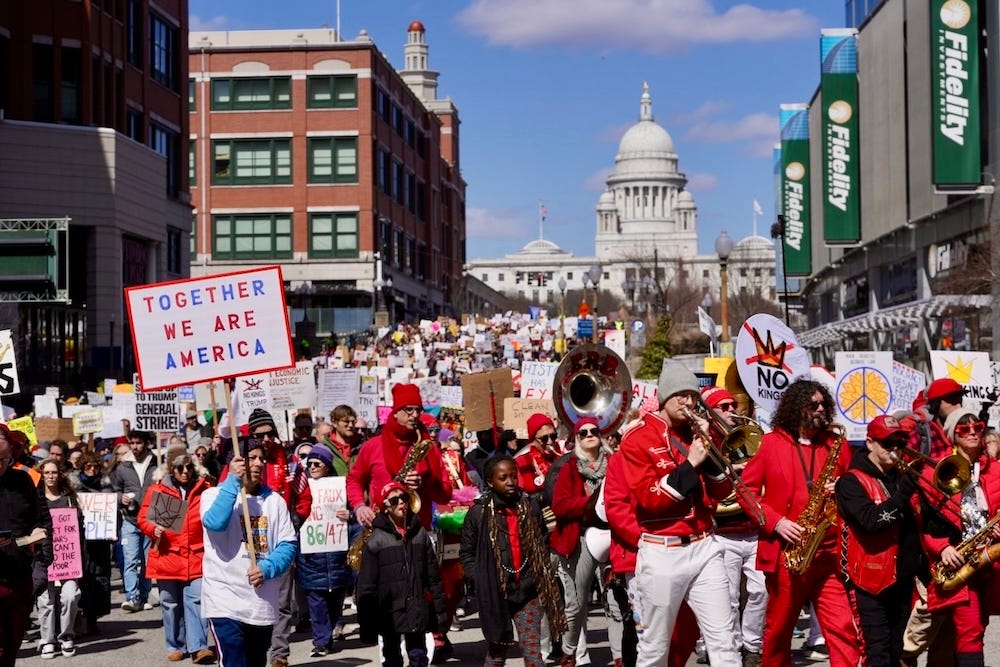
The third, and largest "No Kings" protest draws thousands to the Rhode Island State House

Huge turn-outs at events throughout Rhode Island

Steve Ahlquist


The third “No Kings” protest in Providence brought thousands of people to the Rhode Island State House on Saturday as part of a “nationwide day of action to say, clearly and collectively: No Thrones. No Crowns. No Kings.” The event, which ran from 1 to 4 pm, was co-emceed by Sajo Jefferson and Aiyah Josiah-Faeduwor.

The event started with some music by the Raging Grannies.

Here’s the video: No Kings PVD - March 28, 2026

Asa Peters, a member of the Mashpee Wampanoag Tribe, gave what he hoped would be more than just a simple land acknowledgement:

“I was asked to go deeper than just acknowledging the land, so I want to share the history of the United States, this pattern of violence and control over people along certain power dynamics, racial, or religious lines. It was something new to these lands. To ground you, this region we live in has been inhabited by some of my ancestors for around 12,000 or 13,000 years, after the recession of the glacier in the last ice age.

“Over these last 12 or 13,000 years, the people that lived here had been building long-term community responsibility and trusting spiritual bonds to all the other living things that are here - the plants, animals, fungi, and even the stones. Things we learn from and support in what we do every day. In King Philip’s War and the Pequot War in Connecticut, the people witnessed some of the most brutal violence. The colonizers introduced a new level of violence that had not been conceived of as possible.

How other countries deal with child rape


Trump brags about his MAGA billionaires buying the news media and stifling opposition

Trump claims victory in his war on the First Amendment

Legislation Would Fold CRMC into DEM, Remaking Controversial Executive Council Into an Advisory Board

One way to deal with a dysfunctional agency

By Rob Smith / ecoRI News staff

Mergers and acquisitions isn’t usually a process that applies to the public sector, but under proposed legislation this year it is something that could happen with the state’s environmental agencies.

Rhode Island government splits environmental management and protection into two separate agencies. Broadly, the Department of Environmental Management handles much of the state’s interior, oversees air and water permits, and oversees the state’s food production.

The Coastal Resources Management Council has jurisdiction over developments within 200 feet of Rhode Island’s coastline and 3 miles out to sea, an area that covers all of Narragansett Bay and most of Block Island Sound.

New legislation (H7996/S3082) proposes to merge the two entities, with CRMC — as the smaller of the two agencies — becoming a bureau within DEM. CRMC’s director would become a deputy director within DEM, and the politically appointed board that oversees the coastal agency would be transformed into an advisory body with little decision-making power.

For advocates of the legislation, the bills kill two birds with one stone. The controversial 10-member CRMC board is nerfed, and the state’s two environmental agencies receive a synergistic boost by joining forces. CRMC’s executive director would go from a position confirmed by the Senate to one hired by DEM.

Why mosquitoes always find you and how they decide to attack

Mosquitoes aren’t following each other—they’re all zeroing in on the same deadly combination of breath and dark targets.

Georgia Institute of Technology

A picture of mosquito trajectories around a person
in a mosquito chamber. Credit: Georgia Tech/MIT
After closely tracking hundreds of mosquitoes swarming around a human subject and analyzing 20 million data points, researchers from Georgia Tech and the Massachusetts Institute of Technology developed a mathematical model that predicts how female mosquitoes fly toward people to feed.

This research offers the first detailed visualization of mosquito flight behavior and provides measurable data that could improve trapping and control methods. Beyond being irritating, mosquitoes spread dangerous diseases such as malaria, yellow fever, and Zika, which together cause more than 700,000 deaths each year.

The team also launched an interactive public website that lets users explore mosquito movement and behavior.

What Trump's "reorganization" has done to the Interior Department

Chaos

This article originally appeared on Inside Climate News, a nonprofit, non-partisan news organization that covers climate, energy and the environment. Sign up for their newsletter here.

One year into Donald Trump’s second term, the Department of the Interior is in turmoil, hobbling many of the agencies overseeing the country’s public lands and waters. 

Not only has Interior lost some 11,000 employees, or more than 17 percent of its workforce, it is also reeling from a drastic centralization of personnel: Last May, almost 5,500 staff from the department’s component agencies were moved into the office of the Interior secretary, Doug Burgum. 

That shift has created a hostile work culture, made staff less efficient and broken important lines of communication, former Interior employees say. According to an Inside Climate News analysis of federal workforce data released by the Office of Personnel Management, almost 1,800 workers have left Burgum’s office since the reorganization—the vast majority opting to retire or quit.

As a whole, the federal workforce shrank by about 12 percent in the first year of the second Trump administration. Some parts of the government, such as the Environmental Protection Agency, which shed 24 percent of its employees, have suffered bigger losses. But Burgum’s reorganization is unique, with wide ripple effects. 

Under an order signed on April 17, Burgum confirmed plans to absorb administrative staff from Interior’s component agencies, including workers responsible for human resources, training, information technology, contracting and communications. The Inside Climate News analysis shows sudden staff losses in the next month at agencies including the Bureau of Reclamation; the U.S. Geological Survey; the Bureau of Land Management; the Office of Surface Mining Reclamation and Enforcement; and the Fish and Wildlife Service that correspond to the swelling of Burgum’s own staff.

The stated goal was efficiency. “This unification effort will accelerate technology advancements and enhance the Department’s ability to deliver on our core mission,” Burgum’s order said. 

But Interior staff reorganized into Burgum’s office who later left say they encountered a hostile, inefficient work culture designed to push people out. Russell Vought, the powerful director of the federal Office of Management and Budget, said in a private speech between Trump’s two terms that “we want the bureaucrats to be traumatically affected” by going to work, ProPublica reported in 2024.

Saturday, March 28, 2026

Why do Americans hate each other while Canadians love each other?

Could it have something to do with our politics? With the sociopath in the Oval?

Robert Reich

survey released on March 5 by the Pew Research Center finds that 53 percent of American adults describe the morality and ethics of our fellow citizens as “bad” (ranging from “somewhat bad” to “very bad”).

This puts Americans way out front of other nations on the we-hate-our-compatriots scale. In the 24 other countries polled by Pew, most people called their fellow citizens somewhat good or very good.

At the opposite end of the spectrum from the United States is Canada, where 92 percent say their fellow Canadians are good, while just 7 percent say they’re bad.

Why are we so down on our fellow citizens? It may have something to do with our politics.

Some 30 years ago, my dear friend the late Republican Senator Alan Simpson told me Democrats viewed Republicans as stupid and Republicans viewed Democrats as evil. “I’d rather be in the stupid party,” he chuckled.

I asked him why Republicans saw Democrats as evil.

He took a deep breath. “Religion.”

I said I didn’t understand.

“It’s the Christian right,” he said, as if talking to a five-year-old. “Since Reagan, my party has been a magnet for religious conservatives and Christian fundamentalists, where it’s all about good and evil. Too bad, pal. You’re on the evil side.”

That was 30 years ago. Since then, the divide has only sharpened.

In 2012, Mitt Romney told supporters that “47 percent” of Americans would vote for Obama no matter what because they’re “dependent upon government ... believe that they are victims ... believe the government has a responsibility to care for them ... [and] pay no income tax.”

Insulting 47 percent of Americans was no way to win an election. It was also no way to unite the country.

Then in 2016, Hillary Clinton described half of Trump’s supporters as a “basket of deplorables.” Also no way to win or to foster mutual trust.

Once Trump took office, dislike of our fellow citizens soared.

Before he entered the White House, 47 percent of Republicans and 35 percent of Democrats said people in the opposing party were “immoral.”

By 2022, after years of Trump’s venom: 72 percent of Republicans and 63 percent of Democrats called people in the opposing party “immoral.”

Since he’s been back in the Oval, it’s gotten even worse. 

Welcome to the USA

Big Oil has moved on from ‘greenwashing.’

Here’s industry's new playbook.

Kate Yoder, Senior Staff Writer

"This story was originally published by Grist. Sign up for Grist's weekly newsletter here."

Remember when the fossil fuel industry couldn’t stop talking about climate change? In 2020, when oil prices plunged in response to the COVID-19 pandemic, Big Oil promoted efforts to cut carbon emissions and trumpeted various energy “innovations”: transforming algae into fuel (Exxon Mobil), capturing carbon (Chevron), and producing green hydrogen (BP). 

Critics deemed it “greenwashing” — highlighting small sustainable investments to distract people from the pollution at the core of their business.

It didn’t take long for oil companies to move on from those old talking points. When Russia invaded Ukraine in 2022, supply disruptions drove oil prices up, and oil giants switched to a new message: Fossil fuels are essential to “energy security,” and they’re here to stay. 

That’s according to a new report from Clean Creatives, an initiative pressuring PR companies and advertisers to stop working with fossil fuel clients, that analyzed more than 1,800 advertisements, press releases, and social media campaigns from BP, Shell, Exxon, and Chevron between 2020 and 2024. 

research shows government benefits help low‑income people find jobs

Food aid doesn’t make people loafers

Claudia Strauss, Pitzer College

Millie Morales believes in hard work.

“I feel that as an American citizen, we all have a great opportunity to be able to improve our life,” the 58-year-old woman explained in an interview I conducted with her in 2025. “Are you willing to put in the work, or are you not?”

Morales, whose name I changed to protect her privacy, was a stay-at-home mom devoted to caring for her large family. After her divorce, she worked at social service agencies and enrolled at a local college. Then her ex-husband stopped paying for child support, and she and her eight children faced eviction.

She said she is very grateful for the government benefits she received for the first time, including the Supplemental Nutrition Assistance Program, which helps low-income Americans buy groceries.

Those benefits made it possible for her to keep putting food on the table and remain housed until she earned a college degree and obtained jobs that could pay those bills. Now she assists families dealing with difficult medical decisions, a job that makes her feel she is able to help others through hard times in their lives.

Is the FBI Investigating Environmental Activists?

Anyone supporting issues disapproved by Trump is suspect

FBI Director Kash Patel may have other priorities
This article originally appeared on Inside Climate News, a nonprofit, non-partisan news organization that covers climate, energy and the environment. Sign up for their newsletter here.

The group in the Brooklyn studio seemed harmless. There was a graduate student, a Yiddish teacher, a hairdresser. Fifteen people had gathered on a Wednesday night for a training offered by Extinction Rebellion NYC and Climate Defiance, two climate activist groups that engage in nonviolent civil disobedience and theatrical protest.

They sat in metal folding chairs eating pizza, surrounded by banners and art supplies, discussing how to gain a crowd’s attention without prompting immediate boos.

Yet their actions have apparently drawn the attention of federal counterterror investigators. Last month, an FBI agent arrived at the door of a former member, who was not at the Brooklyn meeting, saying she had questions about Extinction Rebellion.

Environmental activists have long drawn scrutiny from the FBI. But the recent visit appeared to place this group on the leading edge of the Trump administration’s use of law enforcement against what many civil liberties advocates say are constitutionally protected acts of protest and free speech.

After last year’s killing of conservative activist Charlie Kirk, President Donald Trump issued a national security memorandum titled “Countering Domestic Terrorism and Organized Political Violence.” The memo asserted that the killing and other attacks, such as the attempted assassination of Trump and the slaying of a health care executive in 2024, were “a culmination of sophisticated, organized campaigns” designed to intimidate and influence public policy.

It linked these acts with “anti-Americanism, anti-capitalism, and anti-Christianity,” among other views, and directed the FBI’s Joint Terrorism Task Forces to “coordinate and supervise a comprehensive national strategy to investigate, prosecute, and disrupt entities and individuals engaged in acts of political violence and intimidation designed to suppress lawful political activity or obstruct the rule of law.”

Many civil liberties advocates viewed the memorandum as an overly broad assault on political opposition, and it came as the Department of Homeland Security deployed increasingly aggressive tactics against people observing and protesting immigration raids.

Now, the FBI visit may be a sign the Department of Justice is broadening the administration’s scope, said Dana Fisher, director of the Center for Environment, Community and Equity at American University.

Friday, March 27, 2026

How Robert F. Kennedy Jr.’s Vaccine Agenda Risks a Resurgence of Deadly Childhood Plagues

Many children will die because of Bobby Jr.'s obsession
By Patricia Callahan

Dr. Adam Ratner hovered over a gravely ill infant in a New York City intensive care unit on a grim day in 2022. The 3-month-old girl spiked a fever two days earlier and had become lethargic. Soon she was having seizures and struggling to breathe.

She didn’t register Ratner’s towering frame or the bright hospital lights. Her eyes stared up and to the right, eerily frozen. 

He ran his hand over the soft spot on her head, which should have been flat. Instead, it bulged, a sign that too much fluid was building up inside her skull. 

The baby’s life was in danger, and Ratner needed to figure out why. He worried the culprit was bacterial meningitis, an infection of the membranes that protect the brain.

What came back on her lab tests was something out of the history books.

The infant’s meningitis was caused by invasive Haemophilus influenzae type b, or Hib, a type of bacteria that used to kill nearly 1,000 children a year in the U.S. A shot introduced in the late 1980s was so effective that Ratner, a veteran pediatric infectious disease doctor, was among the generations of physicians who had never seen a case. But the baby’s parents, Ratner learned, had chosen not to vaccinate her.

Disheartened, he told his colleagues, “This should be a never event.”

It wasn’t. The following year, Ratner treated another infant with Hib, then another, each of them unvaccinated. Two went home, but one had to be discharged to a rehabilitation facility. That 5-month-old boy had huge black pupils that didn’t respond to light, and he needed a ventilator to breathe. Ratner and his colleagues noted an “absence of brain stem reflexes,” indicating severe damage.

The U.S. government took a half century to build a vaccination system that shielded children from such a fate. Its success depended on two fundamental pillars: parents trusting in vaccines and children having access to them. Both are now in peril, thanks in no small part to the man steering America’s health policy.

Health and Human Services Secretary Robert F. Kennedy Jr., who founded an antivaccine group and once likened the immunization of children to a holocaust, is transforming a government that long championed the lifesaving benefits of shots into one that spreads doubts about their safety here and abroad. 

Kennedy is also considering changes that could prompt the few companies that make vaccines for American kids to abandon the U.S. market, leaving parents who want the shots unable to get them.

The threat to vaccine access reaches across the globe after Kennedy yanked the government’s $1.6 billion pledge to the aid group that provides shots for the world’s poorest children. For decades, the U.S. had funded such work not just as a humanitarian mission but as a way to keep Americans safe from unchecked contagions.

Use your imagination

Tomorrow!

RI Democratic Party hires former Magaziner aide as executive director

State Dems staff up going into the midterm elections

By Nancy Lavin, Rhode Island Current

Katherine Riordan, a former press assistant for U.S. Rep. Seth Magaziner, has been tapped as the Rhode Island Democratic Party’s new executive director.

The state’s Democratic party announced Riordan’s hiring in its weekly email newsletter on Friday. Riordan, who most recently worked in communications for Democratic congressman Magaziner, fills the full-time, paid leadership role left open after Sam Bader left in December 2025. 

Bader, who worked for three years for the Democratic party, including one year as its director, took a new job as campaign manager for Kim Ahern, a candidate for state attorney general.

Riordan, a Rhode Island native and University of Rhode Island graduate, was chosen through a nationwide search that drew candidates from across the country, Liz Beretta-Perik, party chair, said in an email.

“Katherine applied for and was offered the position because of her vast experience in communications, organization and public service,” Beretta-Perik said. “Her experience and energy will be critical as we begin a pivotal election season working to keep Rhode Island Blue.”

A job posting still up on the party’s website lists a $70,000 to $100,000 salary, with a minimum of four years of campaign or related work experience. 

Researchers develop biodegradable, plant‑based packaging from natural fibers – new research

The on-going search for a safe and practical plastic substitute

J. Carson Meredith, Georgia Institute of Technology

Jie Wu, an engineering graduate student, was studying a type of striking white beetle found in Southeast Asia and attempting to figure out how to mimic its brilliant color when an unexpected discovery upended the experiment.

Jie and I had been hoping to identify naturally occurring whitening pigments that could be used in paper and paints. The beetle’s white exoskeleton is made from a compound called chitin, which is a type of carbohydrate – one that is also commonly found in crab and lobster shells.

First, Jie extracted chitin nanofibers from crab shells obtained from food waste that are chemically the same as those found in the white beetles. But instead of creating a white material as intended, Jie produced dense, transparent films. The nanofibers more readily assembled in tightly packed films than in the porous structures Jie desired.

Two white beetles
An attempt to mimic the striking white color
of Cyphochilus beetles led researchers to a
unique discovery.
 
Olimpia1lli/Wikimedia CommonsCC BY-NC-ND

On a whim, Jie measured the rate at which oxygen passed through the film. The result was astonishing: The barrier allowed less oxygen through than many existing packaging plastics.

That serendipitous finding in 2014 shifted my team of engineering students’ focus from color to packaging. We asked whether natural materials could rival the performance of common plastics. In the years since, our team has used this discovery to create biodegradable films that offer a more sustainable and effective alternative to plastic packaging.

Challenges of plastic packaging

Plastic packaging is commonly used to protect food, pharmaceuticals and personal care products. These plastics keep out moisture and oxygen from the air, so products stay fresh and safe.

Most packaging has several layers that work together to keep air out, but these layers hinder reuse and recycling efforts. As a result, most of this plastic barrier packaging is discarded to landfills as single-use materials.

Many researchers have sought alternatives that are renewable, biodegradable or recyclable, yet just as effective. At Georgia Tech, my team of students and post-docs has spent more than a decade tackling this problem. This journey began with that beetle.

Pandemic deaths in the US were higher than previously reported

Why the early U.S. COVID-19 death toll may be 155,000 higher

By Mike Stobbe

Edited by Andrew Zinin

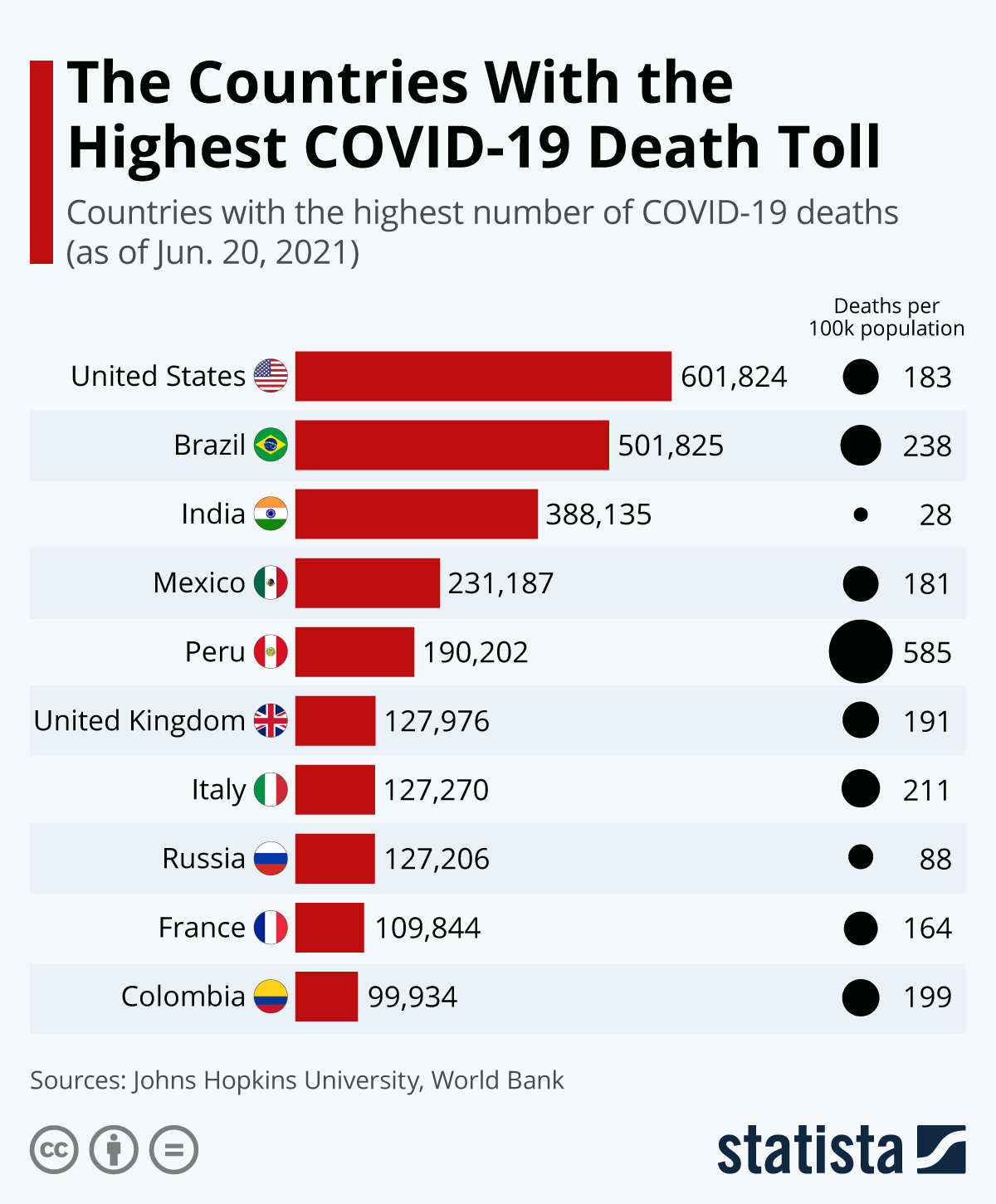
Infographic: The Countries With the Highest COVID-19 Death Toll | Statista You will find more infographics at Statista

The COVID-19 pandemic's early death toll was much higher than the official U.S. count, according to a new study that spotlights dramatic disparities in the uncounted deaths.

About 840,000 COVID-19 deaths were reported on death certificates in 2020 and 2021. But a group of researchers—using a form of artificial intelligence—estimate that as many as 155,000 unrecognized additional deaths likely occurred in that time outside of hospitals. That would mean about 16% of COVID-19 deaths went uncounted in those years.

The overall findings, published Wednesday by the journal Science Advances, were close to estimates from other studies of pandemic deaths during that time. But the authors of the new study tried to determine exactly which deaths were more likely to be missing from the official tallies.

The answer: The undiagnosed dead were more likely to be Hispanic people and other people of color, who had died in the first few months of the pandemic, and who had been in certain states in the South and Southwest—including Alabama, Oklahoma and South Carolina.

Thursday, March 26, 2026

Under Donald Trump, ‘Everything Is for Sale’

Trump Exploits 250th Anniversary of US Independence for Yet Another Grift

Jake Johnson for Common Dreams

Allies of the Trump administration, in partnership with the White House, are reportedly using the upcoming 250th anniversary of the adoption of the Declaration of Independence as another opportunity to solicit deep-pocketed donors, enticing them with promises of access to the president and other rewards.

The New York Times reported Sunday that donors who give at least $1 million to Freedom 250—a group announced by Donald Trump in December—have been promised a path to “gain access to, and seek favor with, a president who has maintained a keen interest in fundraising, and a willingness to use the levers of government power to reward financial supporters,” including through his crypto scam and ballroom project.

Trump has described Freedom 250 as a “public-private partnership” dedicated to organizing “a celebration of America like no other” later this year. Listed as official corporate sponsors of the initiative are prominent corporate names, including ExxonMobil, Mastercard, and Palantir.

The Times obtained a donor solicitation document circulated by Meredith O’Rourke, Trump’s top fundraiser. Donors who give at least $1 million to Freedom 250 “will receive prominent logo placement at Freedom 250 events,” which are expected to include UFC fights and an IndyCar race.

Freedom 250 appears to have been created to dodge oversight that applies to America250, a bipartisan congressional commission formed to plan official celebrations of the nation’s semiquincentennial.

Woof!

Trivia Night with Sam Wilcox our next state Senator (hopefully)

From Charlestown State Rep. Tina Spears


NEWS FROM THE RE-ELECTION CAMPAIGN FOR TINA SPEARS

MARCH 2026

Updates from the State House

LEGISLATIVE UPDATE

Meeting the Moment: What I am Introducing


My focus this 2026 legislative session reflects a strong and growing commitment to meeting the real needs of communities.


Each week, starting next week, I'll be highlighting bills introduced by myself and colleagues, that illustrate a coordinated effort to improve quality of life, expand equity, and protect vulnerable populations across the state.


Topics will include healthcare access, disability inclusion, environmental resilience, and child safety.


I'll also give you ways you can help, so stay tuned!


TINA ABOUT TOWN

Below, Tina hard at work at the RI State House, meeting with folks from University of Rhode Island.

Our next Tea with Tina will be April 4, 2026.

We'll be discussing HB 7485 with special guest Andrew Kettle, Chief, Charlestown Ambulance Rescue. This bill aims to improve ambulance services by requiring insurance to reimburse for care even when no transport to a hospital occurs. This legislation supports community paramedicine and “treatment in place” models, aiming to lower costs and improve care access, particularly in rural areas. Come out, ask questions, and be part of the discussion!


10-12 noon @ Caf Bar in The Venue, 5153 Old Post Road, Charlestown

Want to volunteer on Tina's re-election campaign? Contact us here. We have lots of fun and we'll keep Tina in the State House!

If you'd like to donate to Tina's re-eelction campaign, please make personal checks payable to:
The Friends of Tina Spears
82 Hillside Drive
Charlestown, RI 02813


Or click HERE to contribute online or scan the QR code