
Showing posts with label bugs. Show all posts
Showing posts with label bugs. Show all posts
Monday, July 27, 2026
Monday, July 20, 2026
How to avoid tick bites in your yard or while hiking in the woods, and what to do if one starts feasting on you
Tick bites are not good for you
 |
| Ticks can be tiny. An adult deer tick is on the left and a nymph of the same species is on the right, both sitting on an adult’s finger. CDC |
Each year, deer ticks alone cause an estimated 476,000 new U.S. cases of Lyme disease, which can do long-term damage to a person’s joints, heart and nervous system. You may be hearing about the lone star tick, as well – it can trigger Alpha Gal syndrome, which can leave infected people allergic to red meat and its byproducts, including certain vaccines, medications and products with gelatin.
Several other tick-borne illnesses, including Heartland virus disease, Powassan virus disease, babesiosis and anaplasmosis, can cause serious health problems and, in severe cases, even death.
2026 has been a tough year, with emergency room visits linked to tick bites running high going into summer.
So how can you avoid getting bitten, and what preventive measures actually work? I’m the co-director of the Tick-Borne Disease Center at Binghamton University. Here are some of the questions my team hears – and some advice:
1. Why should I worry about ticks, and how do I know if I’ve been infected?
Ticks can really pack a punch when it comes to how sick they make you. Lyme disease and anaplasmosis, both caused by bacteria that deer ticks can carry, are the most common tick-borne diseases we see in the U.S.
About 70% to 80% of people with Lyme disease will see a rash develop that often looks like a bull’s-eye, and they’ll experience flu-like symptoms, such as a fever, chills, body aches and fatigue. Antibiotics can control the infection, but only if the disease is quickly treated.


Friday, July 17, 2026
Zapping lanternflies
URI entomologist suggests novel removal technique to help tackle invasive pest
 |
| Jack Whitney ’26 demonstrates the SLF vacuum technique; URI researchers say it can help tackle invasive spotted lanternfly. (URI Photo / Dana Terrill) |
Most of the student researchers in Lisa Tewksbury’s Biocontrol Lab at the University of Rhode Island were born after the film “Ghostbusters” came out in theaters, but they’re experimenting with an iconic technique from the popular 1984 movie as part of efforts to stop a local invasive pest leaving its own destructive, oozy impact on agriculture around the state, including local vineyards.
Tewksbury,
an entomologist in URI’s Department of Plant
Sciences and Entomology, conducts research on biological control of species
which can put local crops at risk. She says donning a URI-inspired version of
the iconic vacuum pack could help Rhode Islanders do battle with the
aggressive spotted
lanternfly, one persistent planthopper making inroads in the northeastern
U.S.
Tewksbury says that residents of impacted areas could even
use this approach at home, deploying a handheld vacuum, then carefully
disposing of the captured insects afterward.
Wednesday, July 15, 2026
How to prevent New World screwworm infestations in cats and dogs
Protect your pet from Trump-Musk screw-up

Two of the 34 animals sickened by NWS since early
June are dogs. One dog was infested in New Mexico, and a second
dog was sickened in Texas.
Most animals in the United States have
a low risk of being affected. Pets are at elevated risk if they
live in areas with documented NWS cases, including Lea County, New Mexico,
and the Texas counties of Brewster, Crocket, Edwards, Gillespie, Jim Hogg,
LaSalle, Medina, Pecos, Sutton, Terrell, Tom Green, Uvalde, and Zavala.
Something out of a horror movie
Screwworm infestations sound like something out of a horror
movie: They occur when the adult fly Cochliomyia hominivorax lays
eggs in a wound or body opening of a warm-blooded animal. When the eggs hatch,
they devour the animal’s flesh.
Infestations can cause severe tissue damage, serious
infections, and death, especially if not detected and treated early.
For many pet owners, the thought of screwworms attacking
their dogs and cats is horrifying.
The good news is that there are ways to prevent and treat
infestations— and your dogs and cats may already be using them.
Friday, July 10, 2026
West Nile Virus Detected in Providence
Early arrival

The virus was found in a mosquito sample collected by DEM in Providence
on June 29 and tested by the Rhode Island State Health Laboratories. The
other mosquito samples collected statewide showed no signs of Eastern Equine Encephalitis (EEE)
virus, Jamestown Canyon Virus (JCV), or
additional WNV. Check RIDOH’s arboviral surveillance data webpage for
weekly test results.
Rhode Island’s risk
level for WNV is medium statewide. WNV is the main mosquito-borne
disease in the US. While most people with WNV don’t get sick, about one in five
people who are infected develop a fever and other symptoms. There are no
vaccines to prevent or medications to treat WNV in people. For more information
about WNV, visit www.health.ri.gov/wnv.
To learn ways to prevent mosquito bites and the diseases
carried by mosquitoes, please visit health.ri.gov/mosquito. For mosquito
control info, visit dem.ri.gov/mosquito.
For more information on DEM programs and initiatives,
visit www.dem.ri.gov. Follow DEM on Facebook, Twitter/X
(@RhodeIslandDEM), or Instagram (@rhodeisland.dem) for timely updates. Sign up here to receive the latest
press releases, news, and events from DEM's Public Affairs Office to your
inbox.
Monday, June 22, 2026
Trump and Musk’s DOGE “saved” $15 million by cutting a program to prevent the spread of screwworm that will now take $1 billion to fix
Make Musk pay
Stephen
Prager for Common Dreams

The annual US Department of Agriculture (USDA) spending to combat the
flesh-eating insects only amounted to about $15 million per year. But along with
about $382 million aimed at combating animal-borne illnesses around the globe,
it was terminated in March 2025 as part of DOGE’s effort to root out what it
described as government “waste.”
But now, with the pests bearing down on Texas and New Mexico,
and at least 12 infections already identified in the US as of Tuesday,
the Trump
administration is spending at least $1 billion to fight the outbreak.
Last week, during a Senate hearing, Secretary of Agriculture
Brooke Rollins attempted to
shift blame for the screwworm outbreak onto the Biden
administration, while portraying herself and President Donald Trump as
proactive in response to reports last spring that the insects were rapidly
climbing through Central
America.
Rollins said she asked Trump for “$1 billion to build a significant
facility” in Texas that would breed hundreds of millions of sterilized male
screwworm flies, a method that had been used to keep them contained in South
America for decades. “Without hesitation, a couple questions, he said, ‘go.’”
That facility is expected to release around 300 million
sterile flies per week. But it is not expected to be fully operational until
the end of 2027.
In addition to the $15 million cut to monitoring the spread
of the bugs from Panama, the Houston Chronicle reported that DOGE paused plans for a
facility in Mexico that the Biden administration had authorized in 2024 as part
of a $165 million emergency package to fight screwworm.
Saturday, June 20, 2026
The scent of supper
Can mosquitoes learn to love DEET?
.webp)
But research published
yesterday in the Journal of Experimental Biology suggests that
mosquitoes may learn to associate the smell of DEET with dinner—and start
gravitating toward it instead of away from it. The findings challenge long-held
assumptions about how DEET works and what mosquitoes may be capable of
learning.
Training changed how mosquitoes react to DEET
For the study, researchers from the University of Tours in
France and Virginia Tech examined whether female Aedes aegypti mosquitoes,
the species that spreads dengue, Zika, yellow fever, and chikungunya, could
learn to associate DEET with a food reward.
The team used a form of Pavlovian conditioning in which
mosquitoes feed on warm blood through an artificial membrane. Twenty seconds
into their meal, the researchers released DEET into the feeding enclosure—a
process they repeated three more times before exposing the mosquitos to DEET
but no food reward.
When the trained mosquitos caught a whiff of DEET alone, more than 60% of them tried to feed again, displaying what researchers termed a “biting attempt response” (BAR). That’s compared with roughly 20% of untrained mosquitoes who performed BAR when exposed to DEET alone.
In another experiment, mosquitoes were given a choice
between two human hands. One hand was treated with DEET, and one was untreated.
All of the untrained mosquitoes avoided the DEET-treated hand. Trained
mosquitoes, however, were significantly more likely to orient toward the
treated hand.
Monday, June 15, 2026
Trump screwed up
Cut funding of program to detect and block screwworm infections

The
first two detections were announced last week were in Zavala,
Texas, but the three new detections show the insect has infiltrated more
territory in the United States, including La Salle County, Texas (two calves),
Gillespie County, Texas (goat), and now Lea County, New Mexico (dog).
Confirmed NWS infections in animals are also now
farther from the US border with Mexico, which has reported more than 27,000
cases through June 3, according to USDA data.

This situation is evolving, and we expect new information
to emerge.
“This situation is evolving, and we expect new information
to emerge as our investigation continues,” said Dudley
Hoskins, USDA undersecretary for marketing and regulatory programs. “USDA is
committed to sharing what we learn quickly, accurately, and transparently so
animal owners and local communities have the information they need to stay
vigilant.
“We are working closely with our partners in New Mexico,
Texas, and across the region to ensure we identify, contain, and respond to any
potential cases as swiftly as possible.”
Sunday, May 10, 2026
URI forester offers tips on tree safety, protection and observation
On keeping your trees healthy
 |
| URI’s Plant Diagnostic Laboratory assesses symptoms of beech leaf disease and other plant issues. (URI Photo / Keiddy Urrea-Morawicki) |
A forestry extension specialist at the University of Rhode Island, Christopher Riely works with faculty and students across campus, and off-campus partners, to help improve Rhode Island’s forests and the wildlife they support. A certified arborist and forester, Riely answers some questions about local trees for Arbor Day which was on April 24.
Do you have any tips for tree safety for residents — things to check for tree weakness after the winter, or safety tips for home yard work as people start getting out in their yards more?
The early spring before trees have fully leafed out is a
good time to check for damage that trees may have sustained over the winter.
However, as bark is more easily damaged during this time of higher sap flow,
pruning at this time can make trees more susceptible to disease. The dormant
season is the best time for pruning, especially the late winter when cuts will
heal soon thereafter when trees start growing again.
April and May are good months for planting trees and shrubs so they can start to get established before the hot summer months that usually bring drought stress. Planted trees should be watered regularly at least through their first growing season in a new location. While it’s best to avoid planting during the summer months, larger trees, such as those that come from nurseries balled and burlapped, can be also planted in the early-to-mid fall.
Tuesday, May 5, 2026
Warmer temps bring soaring tick populations – here’s how to stay safe from Lyme disease
I HATE ticks!
Lakshmi Chauhan, University of Colorado Anschutz Medical Campus
 |
| Northeast and Upper Midwest states have the highest incidence of Lyme disease, according to the Centers for Disease Control and Prevention in 2023. Centers for Disease Control and Prevention |
Spring’s warmer weather lures people outdoors – and into possible contact with ticks that spread Lyme disease.
Already, the 2026 tick season is booming. On April 23, the Centers for Disease Control and Prevention warned that emergency room visits due to tick bites are at their highest level since 2017. That may portend an especially severe season for Lyme disease and other tick-borne illnesses.
State health departments reported more than 89,000 cases of Lyme disease in 2023, the last year for which data is available. But public health experts believe that close to 500,000 people in the U.S. get Lyme disease every year.
As an infectious disease doctor with experience treating some of this infection’s long-term outcomes, I know that Lyme disease can be tricky because people often don’t notice tick bites and may overlook early symptoms of an infection. But left untreated, the infection can cause serious lingering – and even permanent – health issues.
Here’s what you need to know about Lyme disease to stay safe this season:
Tuesday, April 21, 2026
URI bee specialists share information for insect enthusiasts of all ages
Mind your bee’s and q’s
 |
| Bees are small but play a big role in our environment. (URI Photos / Casey Johnson) |
For Steven Alm and Casey Johnson, it’s a bug’s world every day in the University of Rhode Island Bee Lab. With a new exhibit on insects opening at Roger Williams Park Zoo in Providence, they could not be happier to see a new generation of insect enthusiasts get an up-close look at their small subjects of study.
Part of URI’s Plant
Sciences and Entomology department, Alm and Johnson answered
questions on the local bee population for zoo visitors who may be interested in
learning more after their day at the park:
Which bees are most common here in Rhode Island?
We know the most about our bumble bees because they are
large and fairly easy to identify. The Common Eastern Bumble Bee is our most
prevalent bumble bee here. We also have good numbers of sweat, mining, digger,
and cellophane bees.
We have recorded more than 280 bee species in Rhode Island,
past and present; they are incredibly diverse with different needs. Some
species have evolved to only collect pollen from certain plant families or even
a single plant species. This means they are closely linked to these plants and
will disappear if the plant disappears.
The Southeastern Blueberry Bee, for instance, forages only on blueberry, lupine or redbud and nests only in loose, sandy soil. This bee was recorded in Rhode Island for the first time in 2024. The Macropis Cuckoo Bee was thought to be extinct for nearly 60 years until it was rediscovered in Nova Scotia in 2004. Since then, it has been recorded in a handful of U.S. states, including one specimen collected here in Rhode Island in 2024.
Monday, March 30, 2026
New vaccine against Lyme disease seeking approval. Will Bobby Jr. give it?
Lyme disease vaccine shows over 70% efficacy in phase 3 trial
Not perfect but good enough
.webp)
Despite falling short of its primary statistical goal in a
phase 3 randomized controlled clinical trial, in part because fewer than
expected Lyme disease cases were reported during the study period, the vaccine
showed about 70% to 73% efficacy in preventing confirmed Lyme disease after a
four-dose series. In a secondary analysis, the vaccine did meet the statistical
goal.
The vaccine, being developed by Pfizer and Valneva, was
studied at sites in areas of high Lyme disease incidence in the United States,
Canada, and Europe.
Pfizer said the reduction in infections is “clinically
meaningful” and indicated that the companies will submit the vaccine for
regulatory approval. If approved, it would be the first Lyme vaccine available
for humans in more than two decades.
Sunday, March 29, 2026
Why mosquitoes always find you and how they decide to attack
Mosquitoes aren’t following each other—they’re all zeroing in on the same deadly combination of breath and dark targets.
Georgia Institute of Technology
After closely tracking hundreds of mosquitoes swarming
around a human subject and analyzing 20 million data points, researchers from
Georgia Tech and the Massachusetts Institute of Technology developed a
mathematical model that predicts how female mosquitoes fly toward people to
feed.
A picture of mosquito trajectories around a person
in a mosquito chamber. Credit: Georgia Tech/MIT
This research offers the first detailed visualization of
mosquito flight behavior and provides measurable data that could improve
trapping and control methods. Beyond being irritating, mosquitoes spread
dangerous diseases such as malaria, yellow fever, and Zika, which together
cause more than 700,000 deaths each year.
The team also launched an interactive public website that
lets users explore mosquito movement and behavior.
Friday, March 27, 2026
Researchers develop biodegradable, plant‑based packaging from natural fibers – new research
The on-going search for a safe and practical plastic substitute
J. Carson Meredith, Georgia Institute of Technology
.webp)
Jie and I had been hoping to identify naturally occurring whitening pigments that could be used in paper and paints. The beetle’s white exoskeleton is made from a compound called chitin, which is a type of carbohydrate – one that is also commonly found in crab and lobster shells.
First, Jie extracted chitin nanofibers from crab shells obtained from food waste that are chemically the same as those found in the white beetles. But instead of creating a white material as intended, Jie produced dense, transparent films. The nanofibers more readily assembled in tightly packed films than in the porous structures Jie desired.
 |
| An attempt to mimic the striking white color of Cyphochilus beetles led researchers to a unique discovery. Olimpia1lli/Wikimedia Commons, CC BY-NC-ND |
On a whim, Jie measured the rate at which oxygen passed through the film. The result was astonishing: The barrier allowed less oxygen through than many existing packaging plastics.
That serendipitous finding in 2014 shifted my team of engineering students’ focus from color to packaging. We asked whether natural materials could rival the performance of common plastics. In the years since, our team has used this discovery to create biodegradable films that offer a more sustainable and effective alternative to plastic packaging.
Challenges of plastic packaging
Plastic packaging is commonly used to protect food, pharmaceuticals and personal care products. These plastics keep out moisture and oxygen from the air, so products stay fresh and safe.
Most packaging has several layers that work together to keep air out, but these layers hinder reuse and recycling efforts. As a result, most of this plastic barrier packaging is discarded to landfills as single-use materials.
Many researchers have sought alternatives that are renewable, biodegradable or recyclable, yet just as effective. At Georgia Tech, my team of students and post-docs has spent more than a decade tackling this problem. This journey began with that beetle.
Sunday, March 15, 2026
Scared of Spiders? The Real Nightmare Is a World Without Them
We NEED spiders, believe it or not
By University of Massachusetts Amherst
 |
| Lead author Wes Walsh, his tattoo of Agelenopsis pennsylvanica (the Pennsylvanian grass spider) and one of the inspirations for this study, a live Platycryptus undatus (tan jumping spider). Credit: Wes Walsh |
As
global biodiversity declines in what some researchers call the “insect
apocalypse,” two ecologists at the University
of Massachusetts Amherst set out to evaluate how insects and arachnids
are faring across the United States. What they found was not reassurance, but a
striking lack of basic information.
Their study, recently published in PNAS,
underscores the urgent need to better measure, safeguard, and recognize the
value of insects and arachnids as a foundation of planetary health.
“Insects and arachnids are fundamental for human society,” says Laura Figueroa, assistant professor of environmental conservation at UMass Amherst and the paper’s senior author.
“They help with pollination and biological control of pests; they can serve as monitors of air and water quality, and they have worked their way deeply into many cultures throughout the world”— think of Aragog in the Harry Potter book series, for example.
“Many
people care about popular charismatic animals on the planet, like lions and
pandas, which, justly, have received international conservation attention.
Given that insects and arachnids don’t usually get the same attention, we
wanted to know how they were doing.”
Monday, February 23, 2026
DEM announces spring activities schedule
Great education programs for young and old
Starts early in March

Aquatic Resource Education Program
Youth Fly Fishing Day
Fly fishing isn’t just for adults – this introductory class
is designed for youth ages 10-15. Volunteers from Trout Unlimited, Rhody Fly
Rodders, and United Fly Tyers of Rhode Island will teach students about the
equipment needed to fly fish, how to tie flies, how to cast a fly rod, fishing
techniques, and more. Lunch is provided. A parent or guardian must be present
for the duration of the class.
Registration is required; registration opens March 9.
- Date:
Saturday, April 18
- Time:
9 AM – 3 PM
- Location:
Addieville East Farm, Mapleville, RI
- Registration:
For more information and to register, email sean.martin@dem.ri.gov
Introduction to Freshwater Fly Fishing
Learn the art of fly fishing! Volunteers from Trout
Unlimited, Rhody Fly Rodders, and United Fly Tyers of Rhode Island will teach
participants what equipment is needed, how to tie flies and knots, how to cast
and so much more. Equipment and lunch are provided. Families with children 10
and older are welcome. Space is limited; registration is required and
opens April 13.
- Date:
Saturday, May 30
- Time:
9 AM – 3 PM
- Location:
Addieville East Farm, Mapleville, RI
- Registration:
Email kimberly.sullivan@dem.ri.gov.
- Cost:
$30 per person
Monday, February 2, 2026
When forests disappear, mosquitoes don’t—they adapt, and increasingly, they bite us.
When the trees are gone, they come for you
Frontiers

https://www.flickr.com/photos/marcelinodias/
In the rapidly disappearing Atlantic Forest, mosquitoes are
adapting to a human-dominated landscape. Scientists found that many species now
prefer feeding on people rather than the forest’s diverse wildlife. This
behavior dramatically raises the risk of spreading dangerous viruses such as
dengue and Zika. The findings reveal how deforestation can quietly reshape
disease dynamics.
Running along Brazil's coastline, the Atlantic Forest
supports an extraordinary range of life, including hundreds of species of
birds, amphibians, reptiles, mammals, and fishes. Much of that richness has
been lost. Human development has reduced the forest to roughly one third of its
original size. As people move deeper into once intact habitats, wildlife is
pushed out, and mosquitoes that once fed on many different animals appear to be
shifting their attention toward humans, according to a study published in Frontiers
in Ecology and Evolution.
"Here we show that the mosquito species we captured in
remnants of the Atlantic Forest have a clear preference for feeding on
humans," said senior author Dr. Jeronimo Alencar, a biologist at the
Oswaldo Cruz Institute in Rio de Janeiro.
"This is crucial because, in a environment like the
Atlantic Forest with a great diversity of potential vertebrate hosts, a
preference for humans significantly enhances the risk of pathogen
transmission," added co-author Dr. Sergio Machado, a microbiology and
immunology researcher at the Federal University of Rio de Janeiro.
Saturday, January 10, 2026
Viral outbreaks are always on the horizon – here are the viruses an infectious disease expert is watching in 2026
Are we prepared? What do YOU think?

Old viruses are constantly evolving. A warming and increasingly populated planet puts humans in contact with more and different viruses. And increased mobility means that viruses can rapidly travel across the globe along with their human hosts.
As an infectious diseases physician and researcher, I’ll be keeping an eye on a few viruses in 2026 that could be poised to cause infections in unexpected places or in unexpected numbers.
Influenza A – on the cusp of a pandemic
Influenza A is a perennial threat. The virus infects a wide range of animals and has the ability to mutate rapidly. The most recent influenza pandemic – caused by the H1N1 subtype of influenza in 2009 – killed over 280,000 people worldwide in its first year, and the virus continues to circulate today. This virus was often called swine flu because it originated in pigs in Mexico before circulating around the world.
Most recently, scientists have been monitoring the highly-pathogenic avian influenza H5N1 subtype, or bird flu. This virus was first found in humans in southern China in 1997; wild birds helped spread the virus around the world. In 2024, the virus was found for the first time in dairy cattle in the U.S. and subsequently became established in herds in several states.
The crossover of the virus from birds to mammals created major concern that it could become adapted to humans. Studies suggest there have already been many cow-to-human transmissions.
In 2026, scientists will continue to look for any evidence that H5N1 has changed enough to be transmitted from human to human – a necessary step for the start of a new influenza pandemic. The influenza vaccines currently on the market probably don’t offer protection from H5N1, but scientists are working to create vaccines that would be effective against the virus.
Saturday, October 18, 2025
How to identify animal tracks, burrows and other signs of wildlife in your neighborhood
What's in your backyard?
 |
| Tree squirrels can excavate small holes all over a yard to hide seeds and nuts or when searching for them. Ground squirrels also create burrows. Snowmanradio/Wikimedia Commons, CC BY |
Your neighborhood is home to all sorts of amazing animals, from racoons, squirrels and skunks to birds, bugs and snails. Even if you don’t see them, most of these creatures are leaving evidence of their activities all around you.
Paw prints in different shapes and sizes are clues to the visitors who pass through. The shapes of tunnels and mounds in your yard carry the mark of their builders.
Even the stuff animals leave behind, whether poop or skeletons, tells you something about the wilder side of the neighborhood.
I’m a zoologist and director of the Hefner Museum of Natural History at Miami University of Ohio, where we work with all kinds of wildlife specimens. With a little practice, you’ll soon notice a lot more evidence of your neighborhood friends when you step outside.
What makes those animal tracks?
You can learn a lot from a nice, crisp paw print.
The dog family, including coyotes and foxes, can be differentiated from the cat family by the shape of their palm pads — triangular for dogs, two lobes at the peak for cats.
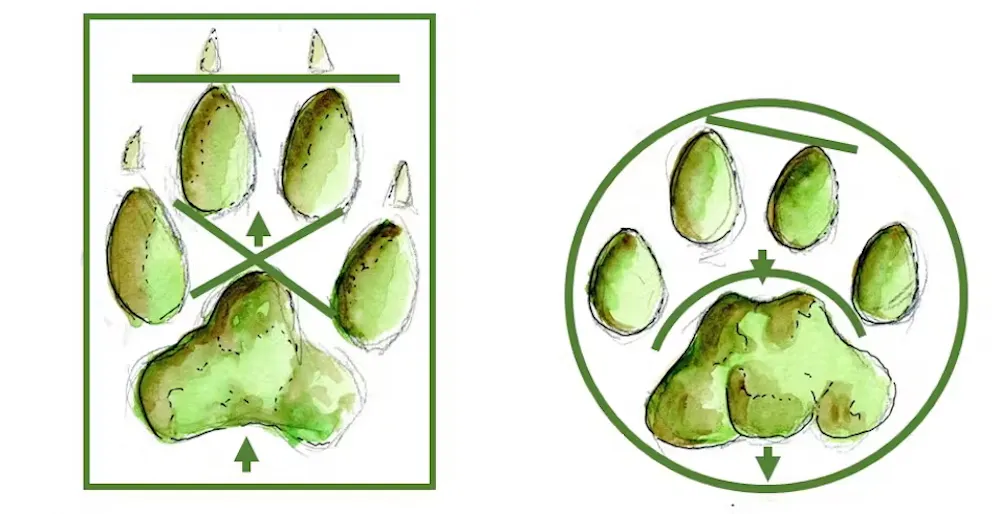 |
| Canid tracks, left, are roughly rectangular, with the tips of the middle two toes aligned. They often, but don’t always, show claw marks. The pad has an indentation on the back and a projection on the front, with the space between the pad and the toes forming an X. Felid tracks, right, are roughly circular, with the tip of one toe extending slightly farther than all other toes. They seldom show claw marks. The pad has three lobes on the back and an indentation on the front, with the space between the pad and toes forming a curve. Steven Sullivan, CC BY-NC-ND |
Both opossums and raccoons leave prints that look like those of a tiny human, but the opossum thumb is held at nearly right angles to the rest of the fingers.
 |
| Opossum, left, and raccoon tracks. Like humans, opossums have opposable thumbs. Steven Sullivan |
Not all prints are so clear, however.
Invasive rats and native squirrels have prints that often look pretty similar to each other. Water erosion of a skunk print left in mud might connect the toe tips to the palm, making it look more like a raccoon. And prints left in winter slush by the smallest dog in the neighborhood can grow through freezing and thawing to proportions that make people wonder whether wolves have returned to their former haunts.
There are good reference books where you can learn more about track analysis, and it can be fun to go down the rabbit hole of collecting and studying prints.
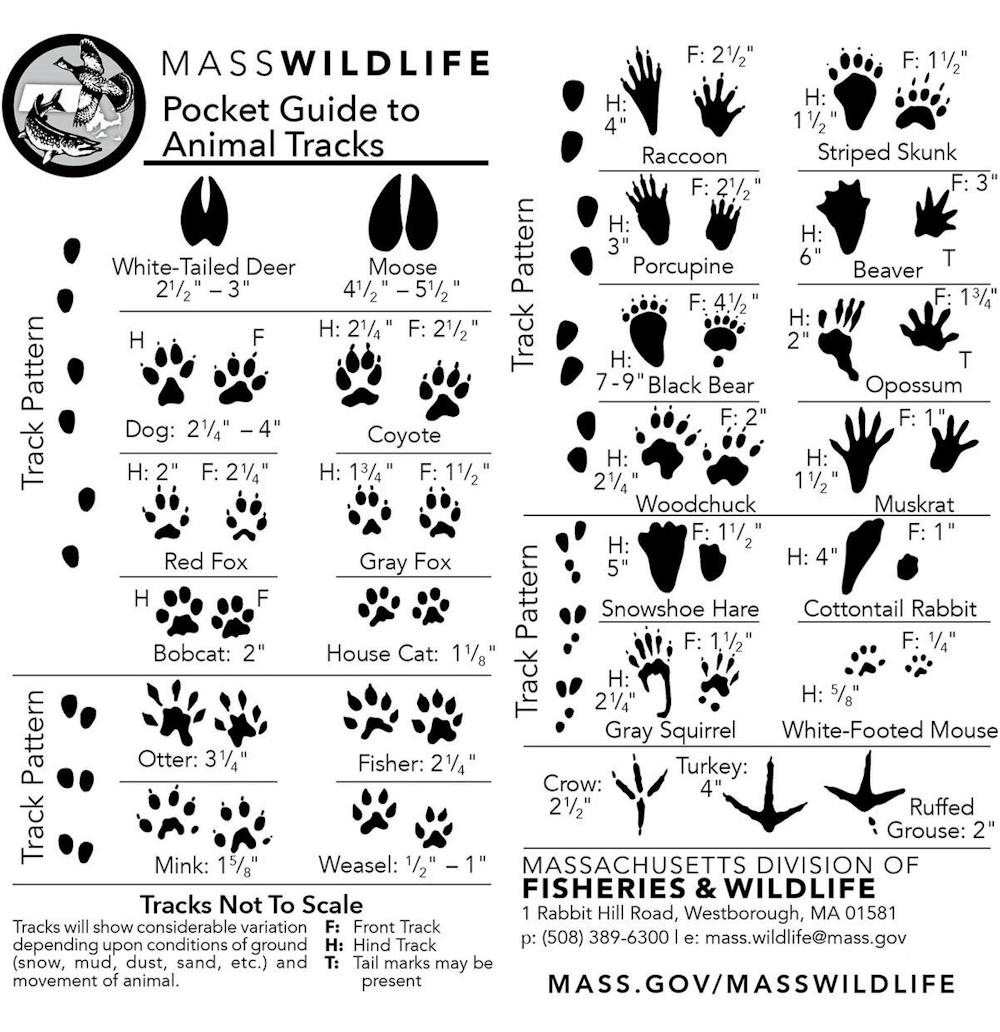 |
| Examples of many types of animal tracks found in the Northeast and other parts of North America. Massachusetts Division of Fisheries and Wildlife |
Friday, October 3, 2025


Subscribe to:
Posts (Atom)