Menu Bar

Home           Calendar           Topics          Just Charlestown          About Us

Saturday, January 31, 2026

US Catholic bishops draw the line: ‘We ask — for the love of God and the love of human beings, which can’t be separated — vote against renewing funding for such a lawless organization’

Tipping point: ICE murders and kidnapping of children

Aleja Hertzler-McCain, Religious News Service

(RNS) — After immigration enforcement officials shot several people and killed two U.S. citizens, U.S. Catholic bishops have used increasingly urgent language in opposing the Trump administration’s immigration policies in recent days.

Cardinal Joseph Tobin of Newark, New Jersey, called on U.S. members of Congress to oppose a funding bill that includes money for the Department of Homeland Security, which oversees Immigration and Customs Enforcement.

“We ask — for the love of God and the love of human beings, which can’t be separated — vote against renewing funding for such a lawless organization,” Tobin said in a webinar hosted by Faith in Action on Sunday (Jan. 25). 

Tobin also used stark language to describe immigration enforcement actions, saying, “We mourn for our world, for our country, that allows 5-year-olds to be legally kidnapped and protesters to be slaughtered.”

Right here

News Flash!

"What's that smell?"

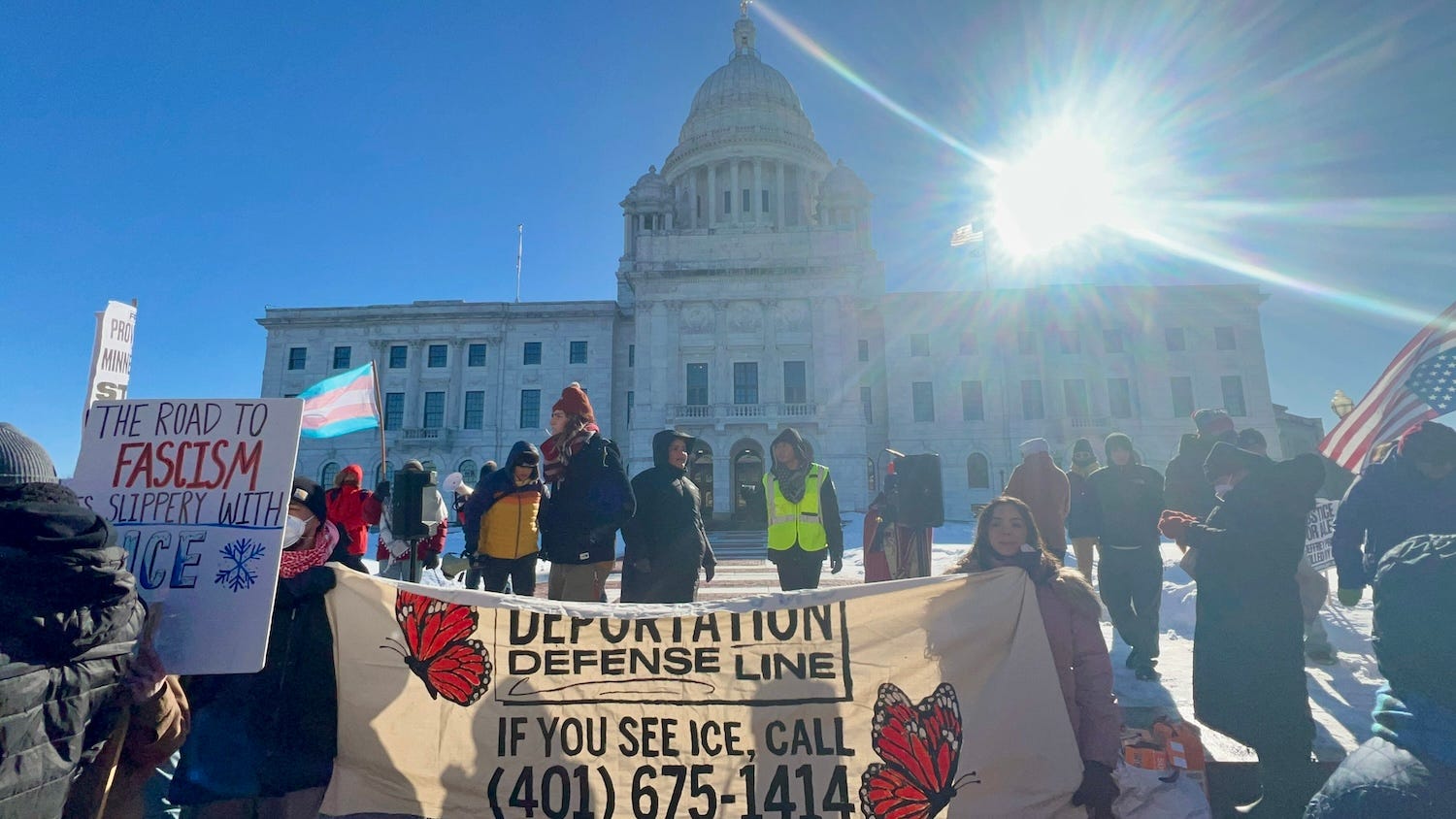
Thousands of Rhode Island students walk out as part of a nationwide shutdown and general strike

Good turn-out for Rhode Island protest

Steve Ahlquist

Over two thousand people, mostly students from Rhode Island universities, colleges and high schools, rallied and marched outside the Rhode Island State House on Friday as part of a nationwide shutdown, walk-out, and general strike called by the Somali Student Association of the University of Minnesota in response to the Customs and Border Protection (CBP) murder of Alex Pretti and the escalating campaign of ICE (Immigration and Customs Enforcement) terror.

Participating schools included, among many others, Brown University, the University of Rhode Island (URI), the Rhode Island School of Design (RISD), Johnson & Wales University, Roger Williams University, Rhode Island College (RIC), and the Community College of Rhode Island (CCRI), The Wheeler School, Moses Brown School, Lincoln School and Providence, East Greenwich, and Barrington Public Schools.

The event began with a short speaking program before marching through downtown Providence and returning to the State House. For more information, see: ICE Out! National Day of Action: Protest in Providence as part of the national shutdown to stop ICE’s reign of terror

Here’s the video: https://www.youtube.com/watch?v=I9zdPTB_94M

Science does not support Bobby Jr. and Trump on rollback of childhood vaccines

No link found between routine childhood vaccines, aluminum adjuvants, and epilepsy risk

Laine Bergeson

Routine childhood vaccinations, nor the aluminum used as vaccine adjuvants, are not associated with an increased risk of epilepsy in young children, according to a new case-control study published this week in The Journal of Pediatrics. 

The study, led by a team from the Marshfield Clinic Research Institute in Marshfield, Wisconsin, examined whether being up to date on recommended vaccines or having higher cumulative exposure to vaccine-related aluminum was linked to the development of epilepsy in children under age four. 

Analyzing a decade of pediatric health data from the Vaccine Safety Datalink, which is a collaboration between the Centers for Disease Control and Prevention and several health care sites that monitor vaccine safety, the team identified 2,089 children diagnosed as having epilepsy from age 1 year to less than 4 years and matched them with 20,139 children without epilepsy based on age, sex, and health care site. 

Most participants were boys (54%) and between the ages of 1 year and 23 months (69%). White non-Hispanics composed the largest ethnicity group in the study (40%).

Raimondo in name only

Republican Robert Raimondo announces gubernatorial campaign

By Nancy Lavin, Rhode Island Current

Republican Robert Raimondo, 58, of North Kingstown, announces his gubernatorial bid at a sparsely attended campaign kickoff at Brewed Awakenings Coffee House in Warwick on Thursday, Jan. 22, 2026. (Photo by Laura Paton/Rhode Island Current)

Is Rhode Island ready for another Governor Raimondo?

Robert Raimondo hopes so. The North Kingstown Republican formalized his bid for the governor’s seat in a kickoff event at Brewed Awakenings Coffee House in Warwick Thursday morning. Aside from regular coffeehouse customers, the event drew two attendees, a Rhode Island Current photographer and a cameraperson for WPRI-TV 12.

Unlike former Gov. Gina Raimondo, who Robert said is a distant cousin, Robert Raimondo is a political newcomer. He’s never run for office before, and moved back to Rhode Island in October with the express purpose of fulfilling his lifelong dream to serve as state governor, he said in an interview Thursday.

The 58-year-old had not even registered to vote in the state at the time he filed his campaign paperwork in November, the Providence Journal reported. He has since registered. 

Friday, January 30, 2026

Trump’s DOJ admits DOGE Employees May Have Improperly Accessed Social Security Data With Aim to ‘Overturn Election Results’

The only surprise is that they are admitting it

Brad Reed for Common Dreams

The US Department of Justice acknowledged last week that two members of the Department of Government Efficiency may have improperly accessed Social Security data at the request of an unidentified organization whose goal is challenging US election results.

In a court filing dated January 16, the DOJ revealed that the unidentified organization last March reached out to two DOGE employees, who were working at the Social Security Administration (SSA), and requested that they “analyze state voter rolls that the advocacy group had acquired.”

“The advocacy group’s stated aim was to find evidence of voter fraud and to overturn election results in certain states,” the DOJ wrote. “In connection with these communications, one of the DOGE team members signed a ‘Voter Data Agreement,’ in his capacity as an SSA employee, with the advocacy group.”

The filing said that SSA has “not yet seen evidence that SSA data were shared with the advocacy group,” but that it had reviewed emails indicating that “DOGE team members could have been asked to assist the advocacy group by accessing SSA data to match to the voter rolls.”

Steven Miller's neighborhood

Wow! Trump takes a beating in new poll

Majority feels Trump is dishonest, incompetent as well as mentally and physically unfit

Will Trump sue the Pew Research Center for $10 billion or just have Kristi Noem arrest the staff?

Read the report here: Confidence in Trump Dips [in 2026], and Fewer Now Say They Support His Policies and Plans | Pew Research Center

Make it $50,000 and then maybe...if I can throw stuff at the screen


How swearing makes you stronger

Always worked for me

By American Psychological Association

edited by Stephanie Baum, reviewed by Robert Egan

Letting out a swear word in a moment of frustration can feel good. Now, research suggests that it can be good for you, too: Swearing can boost people's physical performance by helping them overcome their inhibitions and push themselves harder on tests of strength and endurance, according to research published by the American Psychological Association.

"In many situations, people hold themselves back—consciously or unconsciously—from using their full strength," said study author Richard Stephens, Ph.D., of Keele University in the U.K. "Swearing is an easily available way to help yourself feel focused, confident and less distracted, and 'go for it' a little more."

The article appears in the journal American Psychologist.

How swearing impacts physical performance

Previous research by Stephens and others has found when people swear, they perform better on many physical challenges, including how long they can keep their hand in ice water and how long they can support their body weight during a chair push-up exercise.

"That is now a well replicated, reliable finding," Stephens said. "But the question is—how is swearing helping us? What's the psychological mechanism?"

He and his colleagues believed that it might be that swearing puts people in a disinhibited state of mind.

"By swearing, we throw off social constraint and allow ourselves to push harder in different situations," he said.

How bad will Charlestown's weekend weather be?

Most likely not as bad as last week.

But the cold can be deadly - Providence man dies in the cold

By Will Collette

Compared to the foot of snow that fell on Charlestown last week, this weekend's supposed "Bomb Cyclone" is almost certainly going to be mild. But the deep freeze continues. 

The National Weather Service forecast shows that we will not reach the freezing mark until Monday or Tuesday when the daily high temperatures are expected to top out at 32 and 33 degrees respectively. It will continue to be cold through next week, bad news for heating bills.

The 10 AM NOAA snow forecast is for a range of zero to three inches in Westerly through Monday, though it is theoretically possible (6-15%) we could match last weekend. Unless there is a major shift in the storm track, I like our odds.


Cold kills man in Providence

Statement from the Rhode Island Council of Churches

The Rhode Island State Council of Churches is deeply saddened to learn of the death of a man found on a sidewalk in downtown Providence early Wednesday morning. Our condolences are with his loved ones and community. According to police, first responders were called to Washington Street just before 5 am after a report of concern for an individual outside during freezing temperatures. They located an unresponsive man who was pronounced dead at the scene.

We are told that the greatest commandment is to “Love the Lord your God with all your heart and with all your soul and with all your mind,” and that the second is like it, “to love your neighbor as yourself.” This has been the key principle of faith guiding our service to our communities and to one another.

Rhode Island continues to lack the essential infrastructure and coordinated response needed to ensure that no one in our community freezes to death on the coldest nights of the year. In response to this ongoing crisis, Operation No One Dies is putting out a call for immediate, concrete collaboration.

No single organization can solve this alone. It is only through committed partnership and shared accountability that we can build a system strong enough to prevent future deaths. We urge every sector partner to join us in a commitment to working collaboratively to implement these lifesaving measures.

“Truly I tell you, just as you did not do it to one of the least of these, you did not do it to me.” To take God seriously is to take God’s concerns seriously.

- From SteveAhlquist.news

Filming ICE is legal but exposes you to digital tracking (or DEATH) – here’s how to minimize the risk

ICE Barbie Kristi Noem calls video a form of "domestic terrorism" after ICE agents murder Alex Pretti 

That's unconstitutional

Nicole M. Bennett, Indiana University

In Minneapolis, 37-year-old Alex Pretti,
a VA nurse, moments before being knocked
to the ground by ICE agents and executed 
When an Immigration and Customs Enforcement agent shot and killed Renee Nicole Good in south Minneapolis on Jan. 7, 2026, what happened next looked familiar, at least on the surface. 

Within hours, cellphone footage spread online and eyewitness accounts contradicted official statements, while video analysts slowed the clip down frame by frame to answer a basic question: Did she pose the threat federal officials claimed?

What’s changed since Minneapolis became a global reference point for bystander video in 2020 in the wake of George Floyd’s murder is how thoroughly camera systems, especially smartphones, are now entangled with the wider surveillance ecosystem.

I am a researcher who studies the intersection of data governance, digital technologies and the U.S. federal government. The hard truth for anyone filming law enforcement today is that the same technologies that can hold the state accountable can also make ordinary people more visible to the state.

Recording is often protected speech. But recording, and especially sharing, creates data that can be searched, linked, purchased and reused.

Video can challenge power. It can also attract it.

Targeting the watchers

Documentation can be the difference between an official narrative and an evidence-based public record. Courts in much of the U.S. have recognized a First Amendment right to record police in public while they perform official duties, subject to reasonable restrictions. For example, you can’t physically interfere with police.

However, that right is uneven across jurisdictions and vulnerable in practice, especially when police claim someone is interfering, or when state laws impose distances people must maintain from law enforcement actions – practices that chill filming.

While the legal landscape of recording law enforcement is important to understand, your safety is also a major consideration. In the days after Good’s killing, Minneapolis saw other viral clips documenting immigration enforcement and protests, along with agents’ forceful engagement with people near those scenes, including photographers.

It’s difficult to know how many people have been targeted by agents for recording. In Illinois in late 2025, the U.S. Press Freedom Tracker, operated by advocacy group Freedom of the Press Foundation, documented multiple incidents in which journalists covering ICE-facility protests reported being shot with crowd-control munitions or tackled and arrested while filming.

These incidents underscore that documentation isn’t risk-free. There is an additional layer of safety beyond the physical to take into account: your increased risk of digital exposure. The legal right to record doesn’t prevent your recording from becoming data that others can use.

Thursday, January 29, 2026

Charlestown Citizens Alliance has another phony issue

Platner has a million dollar grievance…it’s about her million dollar grift

By Will Collette

After a period of quiet, the Charlestown Citizens Alliance (CCA) de facto leader Ruth Platner has gotten around to complaining about a November vote by the Town Council to issue a $1.05 million bond drawn from the voter-approved 2015 $2 million open space bond fund.

Platner has been kvetching about this matter for the past few months indicating that only she has the right to make any decisions about this bond funding.

That bond referendum was approved by the narrowest of margins - 11 votes. Rather than use the bond authority for the purpose voters intended, Planning Commissar Platner went on a buying spree, spending more than a million dollars in CASH from the town's General Fund to shop for land usually at inflated prices and often as a favor to a CCA client.

Around 60% of Charlestown is already protected
Platner’s actions were contrary to what the bond referendum actually said. However, that didn’t matter since the CCA-controlled Town Council gave Platner anything she wanted from the town's deliberately bloated surplus, essentially Platner's slush fund.

In 2022, CCA financial mismanagement – which included Ruth’s slush fund and shady land deals – led voters to strip the CCA of Town Council control. No more blank checks. Voters completed the CCA’s ouster in 2024.

The winners of the 2022 and 2024 elections, Charlestown Residents United (CRU), worked diligently to repair the financial damage caused by 10 years of CCA reign. According to data from the RI Auditor General, they succeeded.

However, there was a remaining piece of unresolved business - the over a million in cash taken from the town’s General Fund for land deals, instead of using the bond as intended by Charlestown voters in 2015.

Town Council President Deb Carney (CRU) sought to redress these improper purchases by pushing for the town to issue a million-dollar bond from the 2015 open space bond authorization to pay back the town’s General Fund. Her resolution passed by a 3-1 vote.

Platner (left) giving former Town Council President
Tom Gentz his instructions. Photo by Will Collette
Contrary to the foggy claims made by Platner (and dissenting Council member Stephen Stokes), this is NOT new spending. It balances the books and corrects the CCA’s mistake, putting the money back where it belongs.

Platner says – with no evidence - the CRU majority has some nefarious scheme in mind for the $1.05 million.

This latest CCA-concocted phony issue is entirely of Ruth Platner’s creation. She was the one who decided after the 2015 bond passed not to use it and instead draw cash for her land grabs. 

Her motive? Clearly, she wants to keep that $2 million bond authority untouched as a future source of cash for her shady land deals.

Each time between 2015 and 2022 that Platner came up with a new land deal, she proclaimed voters had given her a mandate (by 11 votes) to buy land regardless of need or, most tellingly, the price. Leaving the bond authority untouched permitted Platner to use it as her excuse for more land deals, provided of course that the CCA held a Town Council majority.

Just about everyone in Charlestown loves open space. I know I do. That's why Charlestown has so much of it - about 60% of all land in town. See the town map, above.

But few, other than the CCA, want to continue to add more land blindly and stupidly. Opponents of Platner's open space Über Alles approach want future town land deals to be strategic and priced right.

Platner pines for the days when the CCA controlled the Council because that meant that SHE controlled the Council. In this year’s election, she hopes to get that control back.

She just managed to get her stooge, Bonnita Van Slyke, back onto the Council by getting 39% of the vote in Charlestown’s December 2 Special Election.

Consider this the opening salvo for the 2026 Charlestown municipal election. As they have during their history in Charlestown, expect the CCA to fire off more lies and concoct more fake issues to retake power. Let’s not let them get away with it.

Connect the dots

We MUST take away grandpa's car keys

Yet another loony Trump Truth Social post. From last night.
OK, this one falls apart starting with the fact that Barack Obama was NOT President in 2020 - Donald Trump was.

Raccoons break into liquor stores, scale skyscrapers and pick locks – studying their clever brains can clarify human intelligence, too

Our on-going war with trash pandas

Kelly LambertUniversity of Richmond

The moment you look away from those adorable eyes,
these mischievous creatures will sneak out of your lab. 
Joshua J. Cotten/UnsplashCC BY-SA
When a curious raccoon broke into an Ashland, Virginia, liquor store in December 2025, sampled the stock and passed out on the bathroom floor, the story went viral within minutes. 

The local animal shelter’s Facebook post was picked up by national and international outlets and quickly inspired raccoon-themed cocktails, “trashed panda” merchandise and even a cameo on “Saturday Night Live.”

For me, the story hit close to home. 

The store that hosted this inebriated bandit sits just blocks from the small behavioral neuroscience laboratory where I began investigating raccoon brains about 15 years ago. Although the so-called drunken raccoon made questionable decisions after breaking into the liquor store, the species – Procyon lotor – is known for its impressive intelligence, curiosity and problem-solving skills.

Despite being one of the most intriguing mammals living alongside humans, raccoons have avoided the scientific spotlight. Why aren’t more neuroscientists and psychologists studying raccoons? What have researchers missed about the mammalian brain by focusing on rodents instead?

Someone had a good time.

ICE Out! protest in Providence tomorrow

Protest in Providence as Part of National Shutdown to Stop ICE’s Reign of Terror

Where: RI State House

When: Friday, January 30th at 2 PM

From Beka Yang, rebekahbyang@gmail.com, (410) 402-0602

In Providence, more than one thousand demonstrators will gather at the Rhode Island State House at 2 pm for a rally and march as part of the nationwide shutdown on Friday, January 30th. After hundreds of thousands of Minnesotans led the first general strike in the U.S. in 70 years this past Friday, federal agents murdered VA ICU nurse Alex Pretti in cold blood the very next day. In response to this escalating campaign of ICE terror, the Somali Student Association of the University of Minnesota has called for a nationwide shutdown on Friday, January 30th with the call: “No Business as Usual! – No School, No Work, and No Shopping.”

Hundreds of organizations have answered the call and are preparing actions all across the country. The growing list of endorsers can be found at: https://nationalshutdown.org 

Students across Rhode Island are organizing walkouts to join the protest at the State House, including high school students from across the Providence Public Schools as well as the Wheeler School, East Greenwich, Moses Brown, Barrington, the Lincoln School. College students from Brown University to URI are also walking out. 

Immigrant rights organizations in Rhode Island have taken up the call and endorsed the national day of action, including the Immigrant Coalition of Rhode Island, Refugee Dream Center, and the Rhode Island Deportation Defense Network. Faith leaders and congregations of local churches and mosques have also pledged their support for the day of action, and will be mobilizing together as participants. Local businesses in and around Providence are putting up signs promoting the national day of action, and have pledged to close outright and instead participate in the mobilization.

This day of action will be a powerful demonstration of the increasingly militant resistance to the Trump administration's full-scale assault on our most basic rights. ICE, CBP, other federal agencies, and local police collaborators are waging a war on immigrants and citizens who dissent or just happen to be racially profiled. In addition to the horrific murders of Alex Pretti, Renée Good, Silverio Villegas González, and Keith Porter Jr., these enforcers of Trump's racist agenda have subjected the people of this country to brutal kidnappings and deportations; arbitrary arrest and imprisonment; forcible, warrantless entry into homes and workplaces; shootings with live ammunition and with "less than lethal" weapons causing severe and permanent injuries; and targeted reprisals for political expression and community organizing. 

Trump gets his wish - U.S. Rep. Omar assaulted

Trump has all but marked her for death

Jon Queally

Democratic Congresswoman Ilhan Omar of Minnesota was assaulted on Tuesday evening during a town hall event in Minneapolis by a man who squirted some kind of liquid from a syringe on the lawmaker amid heightened tensions in the state and following a series of baseless allegations and intensifying insults directed at her by US President Donald Trump.

During public remarks to local constituents—just as she called for ICE to be abolished and that Secretary of Homeland Security Kristi Noem should “resign of face impeachment”—video footage of the attack shows a man wearing a black jacket sitting in the front row abruptly rise from his seat and lunge toward Omar’s podium as he sprays something at her with a syringe in his right hand.

While apparently unharmed, Omar first backs away before charging at the man, before he is tackled by security, and other bystanders intervene.

Watch: Rep. Ilhan Omar (D-MN) assaulted during town hall meeting: "Here's the reality that people like this ugly man don't understand; we are Minnesota strong and we will stay resilient in the face of whatever they might throw at us." pic.twitter.com/Ud5l3yP4lQ
— CSPAN (@cspan) January 28, 2026

“Oh my god,” someone off camera can be heard saying, “He sprayed something on her.”

Maintaining her composure after the man was subdued, Omar said, “Here’s the reality that people like this ugly man don’t understand; we are Minnesota strong, and we will stay resilient in the face of whatever they might throw at us.”

According to the Star Tribune:

Minneapolis police said officers saw a man use a syringe to spray an unknown liquid at Omar. They immediately arrested him and booked him at the county jail for third-degree assault, spokesperson Trevor Folke said in an email. Police also said forensic scientists responded to the scene.

Trump’s EPA Could Limit Its Own Ability to Use New Science to Strengthen Air Pollution Rules

Assuming they WANT to strengthen air pollution rules

Ethylene oxide was once considered an unremarkable pollutant. The colorless gas seeped from relatively few industrial facilities and commanded little public attention. 

All that changed in 2016, when the Environmental Protection Agency completed a study that found the chemical is 30 times more carcinogenic than previously thought.

The agency then spent years updating regulations that protect millions of people who are most exposed to the compound. In 2024, the EPA approved stricter rules that require commercial sterilizers for medical equipment and large chemical plants to slash emissions of ethylene oxide, which causes lymphoma and breast cancer.

It was doing what the EPA has done countless times: revising rules based on new scientific knowledge.

Now, its ability to do that for many air pollutants is under threat. 

In government records that have flown under the radar, Donald Trump’s EPA said it is reconsidering whether the agency had the legal authority to update those rules. 

Chemical companies and their trade organizations have argued that the EPA cannot reevaluate hazardous air pollution rules to account for newly discovered harms if it has revised them once already.

It doesn’t matter if decades have passed or new information has emerged. 

Wednesday, January 28, 2026

ICE violence against women is increasingly visible — and largely untracked

Not an accident, not a coincidence

This story was originally reported by Candice Norwood of The 19th. Meet Candice and read more of their reporting on gender, politics and policy.


A mother shoved to the ground in front of her children in the hallways of a immigration courthouse in New York. A young woman pulled from her car and handcuffed on a busy street in Key Largo, Florida. A child care worker dragged out of her workplace in Chicago, in front of parents and children. A pregnant woman yanked by one arm through the snowy streets of Minneapolis. 

In each of these cases, the aggressors were men working for Immigration and Customs Enforcement (ICE) and their actions were caught on video widely shared online. 

Then came Renee Nicole Good.

The 37-year-old mother of three and her wife had dropped off their 6-year-old son at school and were blocks away from home when they stopped by an ICE protest to “support their neighbors,” according to Good’s wife, Becca. People had gathered to blow whistles and shout to alert nearby residents about ICE’s presence in Minneapolis’ Central neighborhood.

Video taken at the scene from different angles and analyzed by multiple news outlets shows Good trying to leave as an ICE agent grasps at the driver-side door handle of her car. A second agent, later identified as Jonathan Ross, was standing toward the front of the car. He fired at least three shots aimed at Good as she attempted to drive away. An agent can be heard saying in one of the videos, “Fucking bitch” after the shots were fired.

Good was killed. 

Trump and Vice President JD Vance have, without evidence, accused Good of attacking Ross and justified his actions as self-defense. 

There is no database tracking when ICE agents use force against women. But a growing number of videos captured throughout the first year of the second Trump administration offer some insight into the violent encounters that women have experienced: broken car windows, yanking, shoving, pepper-spraying and shootings, all of them out in the open and available on social media. 

ICE agents’ history of violence against men, women and transgender people in detention facilities has been documented. Gender-based violence researchers told The 19th that the widespread visibility of physical violence against women in public spaces does not happen in a vacuum and goes hand-in-hand with the policies and messaging coming from the administration.

The visible attacks shared online come on the heels of President Donald Trump insulting women reporters as “piggy” and “ugly” and downplaying the severity of domestic violence. They also come at a time when reproductive rights and access to gender-affirming care have been significantly restricted, and as funding for gender-based violence services and research centering women and LGBTQ+ people has been stripped. 

“All of these things converge to entrap women and make more violence in their lives and have fewer ways for them to escape the violence,” said Dr. Carolyn West, a professor of psychology at the University of Washington Tacoma. “So, it's not just the violence in your home, it's the violence in your workplace, it's the violence in the larger community. It's state-sponsored violence; all of these things converging together.”

“State-sponsored violence,” as West refers to it, is a term used by researchers to discuss violence perpetrated by government authorities, including local and federal police and ICE agents. 

Between 1999 and 2015, the percentage of women who made up the population of people experiencing police use of force increased from 13 percent to 25 percent according to an analysis by the nonprofit think tank Prison Policy Initiative. 

A study published in the journal for the National Academy of Sciences, based on data from 2013 to 2018, found that Indigenous women and girls experienced a lifetime risk of 4 per 100,000 potentially being killed by police, while the rate for Black women and girls ranged from 2.4 to 5.4 per 100,000; the rate for White women and girls was 2 deaths per 100,000. A 2022 survey of LGBTQ+ people found that 25 percent said they were verbally assaulted during their most recent encounter with police, 13.4 percent said they were sexually harassed and 12.8 percent said they were physically assaulted. 

Data tracking use of force by members of law enforcement is underreported and not standardized across the thousands of law enforcement agencies throughout the country, so what is available does not fully reflect the scope of the issue. 

For example, the most recent data from government sources, news and academic analysis do not capture specific rates of force among immigration officials against women. One report, by the American Immigration Council, indicates that ICE encounters and arrests with women increased from the end of the Obama administration through the beginning of Trump’s first term. Scenes of Latinas on the receiving end of violence by ICE agents are more common among recent online videos, in part because about half of all immigrants in the United States are from Latin America. 

This dearth of more complete data is more apparent in the current Trump administration, researchers said. Over the course of the last year, executive orders on gender and diversity, equity, inclusion and accessibility banned the use of certain words. As a result, federal departments and some advocacy groups that cater to marginalized populations removed these words from information in their grant applications and on their websites.

“I'm writing something now and I’ve got seven configurations of the word gender that can't be used in a grant application,” said Dr. Earl Smith, a professor of women and gender studies at the University of Delaware.

West stated that the lagging research and support for data create a vicious cycle: without updated data, it becomes impossible to show there is a problem, she said.

“It's almost like a willful ignorance,” West said. “If we can not collect the data, if we defund all these programs, and if nobody's counting, then there’s the gaslighting that says, ‘Well, there's no data to say there’s a problem.’”

This has been part of the challenge when speaking about violence by ICE agents since the start of the second Trump administration, researchers said. Without comprehensive tracking, it is difficult to demonstrate a pattern of behavior and its effects. Still, as immigration enforcement escalates to unprecedented levels during the second Trump administration, unbothered by objections and court challenges by state and city leaders, the increasing presence of online videos depicting violent ICE encounters with women has caught public attention, fueling outrage and protest that, at times, has led to more violence.

Six days after the fatal shooting of Good, a video shared and liked by thousands on the social media site Bluesky shows ICE agents in Minneapolis breaking the car window, cutting the seatbelt and forcibly removing a woman of color from her car as she screams, “I’m disabled.” 

In another video, a woman can be heard saying “shame on you” to an ICE agent in Minneapolis. In response, the officer says, “Have you all not learned from the past couple of days?" presumably referring to Good’s killing. He then appears to grab the woman’s phone out of her hand.

Reflecting on this dynamic, Hillary Potter, an associate professor of Women and Gender Studies at the University of Colorado Boulder, said, “I wonder how much of that culture of machismo, toxic masculinity, whatever you want to call it, is impacting how ICE agents are treating women in the field.”

Potter and other researchers agreed that violence against Black, Brown and LGBTQ+ women has been normalized for years. Good was a White queer woman who was killed while participating in a neighborhood protest to show solidarity with immigrant communities. In Minneapolis, Latinos, Somalis and Hmong people have been the main targets of ICE enforcement actions. 

“This is new to the current generation of folks looking in,” Smith said. “But Black folks for sure, Somalis, for sure, Hmong people in Minneapolis — they know the deal. They've been abused for years.”

Trump, meanwhile, has called Good “very violent” and “very radical,” and said she was “very, very disrespectful to law enforcement” before she was shot dead. It is a similar kind of language he has used to vilify immigrants of color and justify his administration’s pursuit.

“We've seen countless numbers of marginalized women, transgender women, who have been brutalized by law enforcement,” West said. “So it's really interesting to me at this time that White people are seeing that they're not going to be protected either. Your Whiteness and your femaleness is not going to protect you, not from these systems.”

The Golden Rule

"Thank you for your attention to this matter" where Trump lays out major part of his plan to disrupt 2026 election

That's presuming he doesn't just outright cancel the 2026 elections

Trump’s ass-backward “affordability” agenda

Here’s a REAL affordability agenda

Robert Reich


The latest gauge on inflation showed prices increasing 2.7 percent in December compared with the same period a year ago. Food prices were up 3.1 percent. (Reminder: Trump was elected on two issues: bringing prices down, especially food, and avoiding foreign entanglements.)

Trump traveled to Detroit to deliver an address to the Detroit Economic Club. It was about “affordability” and he filled it with lies — such as Americans aren’t paying for his tariffs (of course they are) and inflation was “way, way, down” (it’s about the same as it was when he took office).

And he insisted that “affordability” is a “fake word by Democrats.” Unfortunately for Trump, “affordability” has become even more politically potent than immigration or crime. And in his first year at the helm, he’s made America less affordable.

He’s also been putting forward some ass-backward ideas for bringing down prices that will actually increase them. His biggest: Fire the current chair of the Federal Reserve Board and install a chair who’ll lower interest rates — and thereby, in Trump’s addled brain, bring down the costs of borrowing to buy homes and cars. (In his speech today, he called Fed chair Jerome Powell Powell, a “jerk.”)

Trump’s decision to open up a criminal investigation of Powell is a bizarre escalation of his pressure campaign against the central bank to cut interest rates. And it’s truly ass-backwards. Without an independent Fed committed to using interest rates to fight inflation, everyone who buys or sells or invests will have to assume the risk of runaway prices in the future. The result is a risk “premium” that makes everything more expensive instead of more affordable.

What should be done to make America more affordable? Ten commonsense initiatives:

Pawcatuck polluted by PFAS from old textile mill "hotspots"

Can these sites be cleaned up?

By Mackensie duPont Crowley

Jarod Snook collected water samples from sites that were previously
 identified as PFAS “hotspots.” (Photos courtesy of Jarod Snook)

A study led by University of Rhode Island Graduate School of Oceanography alumnus Jarod Snook, Ph.D. ’25, identified a long-term source of PFAS, or “forever chemicals,” entering the Pawcatuck River from two historically contaminated textile mill waste retention ponds located in Bradford and Westerly, Rhode Island.

Published in the scientific journal Environmental Science & Technology Water, the study was co-authored by members of the Lohmann Lab at the Graduate School of Oceanography, including Assistant Professor Jitka Becanova, Marine Research Associate Simon Vojta, and Professor Rainer Lohmann.

Using a combination of environmental sampling techniques and modeling, the team characterized how PFAS stored in pond sediments continue to migrate into, and be deposited within, the river decades after textile operations ceased.

In fact, one of the study’s key findings is that sediment at one of the ponds could continue releasing PFAS into the Pawcatuck River for more than 100 years, highlighting the long-term nature of the contamination and a problem that will persist unless steps are taken to remediate.

Environmental and human impacts

PFAS, a group of manufactured chemicals that have been used in industry and consumer products since the 1940s, do not readily break down and can build up in people, animals, and the environment over time. They can persist for decades and travel long distances, moving from inland rivers like the Pawcatuck to coastal waters and the Atlantic Ocean.

When PFAS enter a river, they can contaminate water and sediments, accumulate in aquatic organisms, disrupt local ecosystems, and pose risks to humans and wildlife through drinking water and seafood consumption. The Pawcatuck River is widely used for recreation and fishing, creating potential exposure pathways for Rhode Island residents and raising concerns about long-term health impacts.

“Rhode Islanders value their aquatic environment,” said Snook. “Keeping it free from pollution is part of that value. We hope this study sheds light on the PFAS issue affecting the Pawcatuck River so that action can be taken to remediate contamination at its source.”

Rhode Island Community Food Bank's 'Status on Hunger' report finds record levels of food insecurity in the state

One-third of Rhode Island households don't have enough food

Steve Ahlquist


“I wish that I could stand here today and tell you that we are close to ending hunger, but quite the opposite is true. Hunger exists, and hunger persists,” said Melissa Sobolik, CEO of the Rhode Island Community Food Bank. “And honestly, hunger has gotten worse over the last five years. In fact, according to our Status on Hunger report, one in three Rhode Island households is food insecure. That means they don’t know where their next meal is coming from.”

During last fall’s federal government shutdown, the Food Bank served a record number of people through its statewide network of 137 member agencies. While the shutdown has ended, the need remains at record levels. Food Insecurity Awareness Day, held in the Rhode Island State House Library on Tuesday, was billed as a “rallying cry of support for the thousands of Rhode Islanders who struggle to put food on their tables.”

“The data is bleak,” continued Sobolik. “In November, when the federal government shut down and brought SNAP benefits to a screeching halt, the urgency of this crisis was brought into clear focus. More than 102,000 Road Islanders needed food more than ever before in the history of the Food Bank, and each one of them, each one of us, has a story. We have hopes and dreams. No one ever says, ‘I want to be hungry or food insecure when I grow up.’ Yet they are. One is one too many, let alone 102,000.

“… the community’s response during the shutdown was incredibly generous and heartwarming. First-time donors rushed to our aid, longtime donors increased their contributions, but the bottom line is that we cannot fundraise or run a food bank our way out of this. Hunger in Rhode Island is too big a problem for any one organization to solve, yet hunger is solvable. There is enough food produced in the U.S. to feed every single person - they don’t have access to it. We need meaningful policy change and robust investment to truly make progress toward ending hunger. That’s especially true today when the business of food banking has been permanently transformed.

“We used to rely primarily on donated food, and now that only makes up 29% of our inventory. Another third comes from the federal government as commodities. And the final third is purchased, allowing us to focus our dollars on safe, local, healthy, and culturally responsive food. That food no sooner fills our shelves than it is distributed to those in need across the state through our incredible network of 137 member agencies.

“We haven’t ended hunger yet, but we can. I wholeheartedly believe that if any state can end hunger, it’s Rhode Island, but it’s going to take every single one of us to do so.

“What can you do? You can donate food to your local food pantry. You can donate funds to the food bank so we can leverage our purchasing power and stretch your dollar further. You can support Governor McKee’s FY ‘27 budget that includes $2 million in funding for the Food Bank, and you can vote on behalf of Rhode Islanders who need it the most by supporting House Bill 7259 and Senate Bill 2237.”

Key findings of the Status on Hunger report:

  • Demand for emergency food assistance reached historic highs in 2025, with more than 102,000 Rhode Islanders seeking help during the fall federal government shutdown alone, which paused SNAP benefits.
  • Food insecurity affects one in three Rhode Island households, remaining significantly higher than pre-pandemic levels and disproportionately impacting Hispanic/Latino and Black households.
  • Federal nutrition program disruptions directly increased reliance on the charitable food network, forcing the Food Bank, pantries, and meal sites to serve as the federal safety net’s safety net.
  • The charitable food system has undergone a structural shift, with purchased food now the largest source of inventory, reflecting sustained demand and the limits of donated supply.
  • Upcoming SNAP policy changes threaten to increase hunger and further demand, shifting costs to states and reducing benefits for thousands of households beginning in 2025 and continuing into 2026.

SteveAhlquist.news is a reader-supported publication. To receive new posts and support my work, consider becoming a free or paid subscriber.