Menu Bar

Home           Calendar           Topics          Just Charlestown          About Us
Showing posts with label Social Security. Show all posts

Sunday, July 26, 2026

MAGA declaring war on seniors — and it could be their downfall

Is Trump testing to see how much he can take away from seniors before they rebel?

Alex Henderson

According to data from the Roper Center at Cornell University, 50 percent of U.S. seniors — those who are 65 or older — voted for Donald Trump in 2024 compared to 49 percent for Democratic presidential nominee Kamala Harris

The senior vote was close in 2024, and seniors, Roper says, played an important role in getting Trump past the finish line. But according to Salon's Heather Digby Parton, seniors could be the ones who doom Republicans in the 2026 midterms.

Parton notes that because so many seniors vote GOP, "it's always been a mystery" to her "why Republicans have always been so bent on destroying the safety net that brought the elderly out of poverty and assured them a baseline level of subsistence and medical care." And she points that crucial safety-net programs used by seniors — Social Security and Medicare — came from liberal Democratic presidents.

"From the moment Franklin D. Roosevelt signed the Social Security Act in 1935 to the day Lyndon B. Johnson signed the Medicare and Medicaid Act 30 years later," Parton explains, "the right has been trying to destroy them. In the early days, it sprang from their obsession with anti-communism, arguments that the country couldn't afford it, and that individuals and their families are rightfully responsible for their own care in old age.

“In a 1961 radio address — 20 years before he became president — Ronald Reagan said, 'One of the traditional methods of imposing statism or socialism on a people has been by way of medicine' ... Before Medicare was created, only 54 percent of elderly people had health insurance, and that could be cancelled without cause when they got sick — which, as you know, tends to happen when you get old."

Parton continues, "Three years after it was enacted, 96 percent of people over 65 had hospital insurance. It was literally a life saver. Over the years, Medicaid, created at the same time to assist people living below the poverty line, came to cover many of the health expenses that Medicare didn't for elderly people, most importantly for nursing homes and caregivers. The GOP has been hacking away at these vital programs ever since, and yet, senior citizens have been voting for them in greater numbers than any other age cohort."

Wednesday, June 24, 2026

They don't want you to know the REAL reason Social Security is in trouble

But I'm going to tell you anyway

Robert Reich

The trustees of the Social Security fund said Tuesday that the fund will be depleted by late 2032, a year earlier than the trustees’ projection last year of 2033. If nothing is done, benefits will automatically be cut six years from now.

The common understanding is that Social Security’s shortfall is due to the huge postwar baby boom, now retiring, and to America’s increasing life expectancy. The usual recommended fix is to reduce Social Security benefits or raise the age of eligibility. As Speaker of the House Mike Johnson, warned Monday, “entitlement programs” like Social Security “have to be adjusted and fixed.” He said Republicans will introduce a plan to do that. Brace yourselves.

I used to be a Social Security trustee, and I call bullsh*t.

The baby boom can’t be blamed for Social Security’s shortfall. The Greenspan Commission, which in 1983 recommended the reforms that Congress then made — raising Social Security payroll taxes and also raising the eligibility age for collecting Social Security benefits — knew all about the baby boom and figured it into its calculations. (Early boomers like me can now start collecting full benefits at age 66; late boomers born after 1960 have to wait until they’re 67 to collect full benefits.)

Americans’ increasing life expectancy isn’t at fault, either. While wealthier Americans are living longer, that’s not the case for lower-income Americans. The Urban Institute estimates that life expectancy in the top 20 percent of income-earners is 91 years for people born in the 1990s, four years more than people born in the 1950s. Yet the life expectancy in the lowest 20 percent of income-earners is fewer than 80 years.

So what’s the real cause of the Social Security shortfall? What did Greenspan’s commission fail to predict? Widening inequality.

Remember, the Social Security payroll tax applies only to earnings up to a certain cap. This year, that cap is $184,500. Earnings at or below this amount are taxed at 12.4 percent. The cap rises every year according to a formula roughly matching inflation.

Thursday, June 18, 2026

Sen. Victoria Gu gives her review on the recently ended General Assembly session

Highlights from a productive session 

By Victoria Gu

Dear Friends and Neighbors, 

We’ve finished another legislative session! After many nights of long committee hearings, bill sponsors and committee chairs work on their bill edits, and June is when bills can be approved for votes in committee and then gain final passage in the House & Senate. 

New Leadership: In the past month the RI House of Representatives also elevated Majority Leader Blazejewski to the position of House Speaker and Majority Whip Katie Kazarian to the position of House Whip. Congratulations to them and the outgoing Speaker Joseph Shekarchi for their years of service.

Bills I Passed

Shoreline Access Disclosure for Oceanfront Property Rentals:

The House & Senate passed my bill S-2734A to help make sure renters and short-term rental guests understand Rhode Island’s shoreline access rights.

Part of the motivation for this bill came from seeing some short-term rental listings advertise a “private beach,” even though Rhode Island law protects public shoreline access up to 10 feet above the recognizable high tide line. This bill helps make sure visitors and tenants get clear information about those rights before they stay at an oceanfront property. 

Food is Medicine: The General Assembly has passed my Food as Medicine bill, which creates a task force to design a Medicaid pilot program that uses medically tailored meals or other nutritional supports  to improve the health of patients with chronic, diet-related conditions. 

Food insecurity is strongly linked to many of the most costly preventable chronic diseases, including diabetes, cardiovascular disease, and obesity, which drive enormous health care spending. 

Medicaid accounts for about one-third of our state budget and is growing at an estimated 6% per year. Our budget will have a growing deficit unless we look at evidence-based programs like food as medicine.

60 Days Advance Notice of Home Insurance Non-Renewals: Insurance companies are being a lot more selective about the location and the condition of the houses they insure, declining to cover homes in coastal areas or with older roofs or water heaters. The bill that Rep. Azzinaro and I passed requiring 60 days’ advance notice will help homeowners find alternative insurance coverage and find tradespeople if they need to fix something at their house in order to continue insurance coverage.

Spotlight: Youth Mental Health

988 on Student & Staff Ids: Last week the General Assembly passed a bill Rep Earl Read & I sponsored to put suicide prevention and substance use crisis hotline numbers directly on student and school staff ID cards. At a time when young people are facing growing mental health challenges, we need to promote awareness of resources like 988.

The General Assembly also passed a youth crisis response service bill that codifies a successful pilot program into law. The program helps kids in crisis by getting them fast, specialized care with behavioral health clinicians (avoiding unnecessary emergency room visits) and connecting families to ongoing support.

Thank you to constituents who wrote to me about the importance of funding 988: This year, the Senate also advanced a separate bill by Senator Melissa Murray to protect the long-term funding of Rhode Island's 988 crisis line and BH Link services. More than 90% of 988 calls are resolved through phone support alone, connecting people with trained counselors before a crisis escalates. The bill stalled in the House, but we hope to pass it next year. More info here

Looking ahead: Vote for the Green Bond this Nov & Op-Ed on Managed Retreat

We got an extra $5 million for climate resiliency in the Green Bond which will be on the ballot in November! Annually, each town can apply for grants from this pool of funding to strengthen their infrastructure. One example: Westerly received funding for a flood wall around a pump station for the wastewater treatment plant. 

Managed Retreat: These photos I took in South Kingstown show how shoreline armoring—like rock walls and elevated structures—disrupt the dynamic beach ecosystem and make it harder for people to walk along the beach. As sea levels rise and more coastal property owners build hard structures to protect against erosion, the public part of the beach gets narrower, and in these pictures, it has become impossible to pass along the shoreline.

That's why we need to plan ahead before the next major storm. Instead of repeatedly rebuilding in areas that face increasing flood and erosion risks, towns can identify safer places for homes and infrastructure over the long term. Read more about our work to help Rhode Island communities prepare for rising seas and protect public access to our shoreline: 

https://www.providencejournal.com/story/opinion/columns/2026/04/18/rhode-islands-managed-retreat-plan-for-rising-seas-opinion/89628806007/

Budget Highlights

  • 62-65 year old early retirees will now get the same exemptions from Social Security tax as people 65 and older. Seniors still must have incomes under $107,000 for single filers and $133,750 for married filers in tax year 2025, to qualify.
  • Child Tax Credit - see this press release
  • Rural Health Transformation Grant - RI received over $150 million in the first year of this federal program and will use it to implement innovative programs like Community Paramedicine - see this website for more information. Stay tuned for more healthcare highlights and impacts of HR1 on our healthcare system

Senate Highlights

  • Labor Protections: We passed many noteworthy bills like S-2921

to give domestic workers the same protections under the Fair Employment Practices Act (FEPA) as other Rhode Island workers.

  • Immigration bills: see this press release and another for protecting constitutional rights
  • Education Funding Formula: only minor changes this year by increasing the “student success factor” - which is an additional amount of funding for each low-income student - from 40% to 43%. We will need to monitor the new Senate commission to study the funding formula, specifically the one suggested by the Blue Ribbon Commission
  • Status of CRMC reform bill: The bill that passed last year required the Governor to appoint members with expertise in coastal matters. There are some new members that the Senate confirmed this year with expertise with civil engineering, coastal wetlands, law, etc. but it remains to be seen whether the political dynamic will change and I still support the overall reform that would restructure CRMC so it’s similar to DEM, with a staff and director making the decisions instead of a politically appointed all-volunteer council.
  • Status of Bottle Deposit & Recycling bills: The bill that passed last year began the first stage which is a needs-assessment to look at our recycling system as a whole. That is still in progress

Thursday, May 28, 2026

Retirees Are Worried About the Cost of Healthcare – and Who Can Blame Them?

Rising premiums, deductibles, co-pays, supplemental coverage and out of pocket costs hurt

Alicia H. Munnell 

The 10-percent increase in Medicare Part B premiums for 2026 has reignited concerns about how much Social Security and total income people will have after they cover their out-of-pocket (OOP) health spending.  Fortunately, my colleague Matt Rutledge has updated earlier research to answer precisely that question.

Even though retirees ages 65+ have Medicare, they still face considerable costs. In the case of Medicare Part A, which covers inpatient hospital care and is financed primarily by payroll taxes, beneficiaries face cost-sharing. Medicare Part B, which covers physician and outpatient hospital services, and Part D, which covers prescription drugs, are partly financed by premiums and include further cost-sharing. 

Because Medicare’s OOP costs are often substantial, many enrollees buy supplemental coverage, which may include additional premiums. Finally, many services, such as dental, vision, and hearing, are not covered by Medicare.

To identify total out-of-pocket healthcare costs, Matt used the 2018, 2020, and 2022 Health and Retirement Study (HRS). The sample included respondents who were ages 65+ and were receiving both Social Security and Medicare. In terms of expenditures, the HRS captures prescription drugs, special facilities, surgery, and medical visits to doctors, hospitals, and dentists. It also includes self-reported premiums paid for Medicare Part D, Medicare Advantage, and private supplemental plans. Medicare Part B income-related premiums were estimated based on the individual’s income. 

The central finding was the percentage of Social Security left after paying out-of-pocket health costs and how those results changed over the three surveys. As shown in Figure 1, the median percentage remaining in 2022 after medical OOP spending was 71 percent for Social Security benefits and 88 percent for total income. And these percentages were virtually unchanged over the three surveys.

In other words, OOP takes a big chuck of retirees’ resources, and the 10-percent increase in Medicare Part B premium suggests no relief on the horizon.

Sunday, April 19, 2026

“More bombs, less of everything else” is a tough campaign platform.

Trump's Total War Budget

Noah Berlatsky

Donald Trump called for the culmination of a 45-year Republican dream and did so in a way designed to do maximum damage to the GOP — not to mention the country.

That dream is the utter destruction of the US safety net and the unlimited expansion of the US military.

“The United States can’t take care of daycare,” Trump blustered during a speech to faith leaders. “That has to be up to a state. We’re fighting wars. Medicaid, Medicare — they can do it on a state basis. We have to take care of one thing: military protection. But all these little scams that have taken place, you have to let states take care of them.”

Two days later, Trump proposed a 2027 fiscal year budget with a defense spending increase of 42 percent, or $445 billion, to a staggering total of $1.5 trillion. The budget calls for reducing non-defense spending by 10 percent through the elimination of “woke, weaponized, and wasteful programs” — including steep cuts to the Internal Revenue Service, Environmental Protection Agency, NASA, and defunding the National Endowment for Democracy. Trump also called for massive budget cuts to the National Institutes of Health.

Democrats have said the document is dead on arrival — though Trump hopes to pass a big chunk of it through reconciliation without Democratic votes.

The budget does not, at least initially, include cuts to Medicare, Medicaid, or Social Security. It also does not include funding for Trump’s war against Iran, which he also hopes to pass through a reconciliation process without Democratic support. But it points the way clearly toward a distinctively Republican future for America — one in which the populace is transformed into an impoverished mass of hunger and disease, emitting occasional hoarse pleas for castoffs from oligarchs.

Patty Murray, the top democrat on the Senate appropriations committee, said it is a “bleak and unacceptable” vision. It’s one that is likely to be incredibly unpopular, throwing a lead anchor to the GOP’s already rapidly sinking midterm prospects.

Tuesday, March 3, 2026

Even though undocumented immigrants can't collect Social Security, SSA plans to give ICE details about beneficiary appointments

ICE terrorism coming to Social Security offices

Jake Johnson

Leaders at the Social Security Administration are reportedly instructing agency employees to provide Immigration and Customs Enforcement with information about in-person beneficiary appointments.

Wired reported that the instructions were “recently communicated verbally to workers at certain SSA offices.” 

The outlet quoted an unnamed employee with direct knowledge of the orders who said that “if ICE comes in and asks if someone has an upcoming appointment, we will let them know the date and time.”

Undocumented immigrants are not eligible for Social Security benefits, though they do contribute tens of billions of dollars per year to the program through payroll taxes. Noncitizens can qualify for Social Security, but Wired noted that they are “required to appear in person to review continued eligibility of benefits.”

Friday, January 30, 2026

Trump’s DOJ admits DOGE Employees May Have Improperly Accessed Social Security Data With Aim to ‘Overturn Election Results’

The only surprise is that they are admitting it

Brad Reed for Common Dreams

The US Department of Justice acknowledged last week that two members of the Department of Government Efficiency may have improperly accessed Social Security data at the request of an unidentified organization whose goal is challenging US election results.

In a court filing dated January 16, the DOJ revealed that the unidentified organization last March reached out to two DOGE employees, who were working at the Social Security Administration (SSA), and requested that they “analyze state voter rolls that the advocacy group had acquired.”

“The advocacy group’s stated aim was to find evidence of voter fraud and to overturn election results in certain states,” the DOJ wrote. “In connection with these communications, one of the DOGE team members signed a ‘Voter Data Agreement,’ in his capacity as an SSA employee, with the advocacy group.”

The filing said that SSA has “not yet seen evidence that SSA data were shared with the advocacy group,” but that it had reviewed emails indicating that “DOGE team members could have been asked to assist the advocacy group by accessing SSA data to match to the voter rolls.”

Sunday, January 11, 2026

No, Trump Did Not End Taxes on Social Security

Don't be gullible - Trump is lying. AGAIN.

Martin Burns and Mary Liz Burns

Watching Donald Trump’s speech on national television and Vice President JD Vance’s remarks at the Turning Point event in Arizona, we identified with Bill Murray in the movie Groundhog Day. For those who have not seen the movie, Murray plays a TV weatherman who is trapped reliving the same day, day after day. 

We felt exactly like Murray when both Trump and Vance claimed once again that they ended taxes on Social Security.

Time after time, fact-checkers and news outlets have pointed out that contrary to Trump and Vance’s claims, the “One Big Beautiful Bill” (OBBB) did not eliminate taxes on Social Security. Most recently, Factcheck.org on December 18 reported that:

Trump called the One Big Beautiful Bill Act he signed in July “perhaps the most sweeping legislation ever passed in Congress” and touted provisions that include “no tax on tips, no tax on overtime, and no tax on Social Security for our great seniors.” (As we have said, fewer seniors would pay taxes on Social Security benefits, but millions of Americans would still have to pay.)

Friday, January 9, 2026

Social Security Administration ‘In Turmoil’ as New Reporting Details Damage Done by Trump Cuts

Fierce resistance prevented Trump and Musk from doing even more damage

Brad Reed for Common Dreams

Florida Sen. Rick Scott (R).
In 2003, Scott's company was busted for Medicare and
Medicaid fraud and paid the largest fine in
US history. Despite this, Florida keeps reelecting him.
An in-depth report published by the Washington Post on Tuesday offers new details about the damage being done to the Social Security Administration during Donald Trump’s second term.

The Post, citing both internal documents and interviews with insiders, reported that the Social Security Administration (SSA) is “in turmoil” one year into Trump’s second term, resulting in a customer service system that has “deteriorated.”

The chaos at the SSA started in February when the Trump administration announced plans to lay off 7,000 SSA employees, or roughly 12% of the total workforce.

This set off a cascade of events that the Post writes has left the agency with “record backlogs that have delayed basic services to millions of customers,” as the remaining SSA workforce has “struggled to respond to up to 6 million pending cases in its processing centers and 12 million transactions in its field offices.”

The most immediate consequence of the staffing cuts was that call wait times for Social Security beneficiaries surged to an average of roughly two-and-a-half hours, which forced the agency to pull workers employed in other divisions in the department off their jobs.

However, the Post‘s sources said these employees “were thrown in with minimal training... and found themselves unable to answer much beyond basic questions.”

One longtime SSA employee told the Post that management at the agency “offered minimal training and basically threw [transferred employees] in to sink or swim.”

Sunday, October 26, 2025

Social Security COLA will be less than the cost of living

At 2.8%, it will be lower than the 3% inflation figure published by Trump

By Jacob Fischler, Rhode Island Current

The 75 million Americans who receive Social Security benefits will see a 2.8% increase in payments next year, the Social Security Administration said Friday. 

The cost-of-living adjustment is just below the inflation rate of 3% announced by the Bureau of Labor Statistics, also on Friday. 

The adjustment is lower than the average over the past decade, but higher than last year’s. The average adjustment for the past 10 years is 3.1%, including a 2.5% increase last year. On average, beneficiaries’ monthly payments will rise by about $56, the SSA said.

Beneficiaries include people who receive Old-Age, Survivors and Disability Insurance, as well as Supplemental Security Income.

Sunday, October 19, 2025

Elon Musk Should Pay the Same Social Security Taxes You Do

Pop the cap, save Social Security

By Jim Hightower 

My life goals have never included making a lot of money… and I’ve certainly succeeded in that regard. Yet I do consider myself rich. Not Wall Street rich, but rich in the modest sense of being middle-class and able to make ends meet.

It’s not my good looks that puts me in this lucky zone, but one particular public asset that has long been serving the common good for decades, lifting millions of workaday Americans to some decent level of shared prosperity: Social Security.

Plutocratic elites and their political puppets constantly wail that Social Security is a socialist scam, a wasteful giveaway to old people. But regular folks know that’s hokum, since nearly all of us pay into the plan every month of our working lives. In short, it’s our money!

Moreover, each of our Social Security accounts steadily build up. The most valuable financial asset for 9 out of 10 American families, is not their houses or Aunt Tillie’s will — it’s their Social Security holdings. Even for rock-solid, middle-class families, Social Security provides for about a third of their total lifetime wealth.

When right-wingers screech that “fiscal prudence” demands they slash the program’s benefits, that’s bank-robber code for looting wealth you’ve banked for years in this people’s retirement system. There is absolutely no excuse for such thievery.

Especially since an honest, fair, and simple adjustment would keep the program fully funded in perpetuity. If billionaires and other extremely wealthy Americans paid Social Security taxes at the same rate the rest of us do, a study found, we wouldn’t just be able to continue the program. We’d be able to increase the benefits.

Rather than letting gazillionaires like Elon Musk put practically none of their massive incomes into this egalitarian effort to provide a decent retirement for all, make them pay Social Security taxes exactly like regular workers do.

OtherWords columnist Jim Hightower is a radio commentator, writer, and public speaker. This op-ed was distributed by OtherWords.org.

Thursday, September 18, 2025

The Untold Saga of What Happened When DOGE Stormed Social Security

Unneeded, unhelpful and still there

By Eli Hager for ProPublica

Steve Chan in Pro Bono Photo

Reporting Highlights

  • Missed Opportunity: Some Social Security officials said they welcomed DOGE — the agency needs a technological overhaul — only to see DOGE ignore them and prioritize quick (often empty) wins.
  • Internal Revolt: Leland Dudek, the agency’s then acting chief, helped DOGE at first, then tried to resist when he saw what it was doing, Dudek said in 15 hours of candid interviews.
  • DOGE Lives On: Multiple former DOGErs have taken permanent roles at the Social Security Administration, and Senate-confirmed Commissioner Frank Bisignano has embraced its approach.

These highlights were written by the reporters and editors who worked on this story.

On Feb. 10, on the third floor of the Social Security Administration’s Baltimore-area headquarters, Leland Dudek unfurled a 4-foot-wide roll of paper that extended to 20 feet in length. It was a visual guide that the agency had kept for years to explain Social Security’s many technological systems and processes. The paper was covered in flow charts, arrows and text so minuscule you almost needed a magnifying glass to read it. Dudek called it Social Security’s “Dead Sea Scroll.”

Dudek and a fellow Social Security Administration bureaucrat taped the scroll across a wall of a windowless executive office. This was where a team from the new Department of Government Efficiency was going to set up shop.

DOGE was already terrifying the federal bureaucracy with the prospect of mass job loss and intrusions into previously sacrosanct databases. Still, Dudek and a handful of his tech-oriented colleagues were hopeful: If any agency needed a dose of efficiency, it was theirs. “There was kind of an excitement, actually,” a longtime top agency official said. “I’d spent 29 years trying to use technology and data in ways that the agency would never get around to.”

The Social Security Administration is 90 years old. Even today, thousands of its physical records are stored in former limestone mines in Missouri and Pennsylvania. Its core software dates back to the early 1980s, and only a few programmers remain who understand the intricacies of its more than 60 million lines of code. The agency has been talking about switching from paper Social Security cards to electronic ones for two decades, without making it happen.

DOGE, billed as a squad of crack technologists, seemed perfectly designed to overcome such obstacles. And its young members were initially inquisitive about how Social Security worked and what most needed fixing. Several times over those first few days, Akash Bobba, a 21-year-old coder who’d been the first of them to arrive, held his face close to Dudek’s scroll, tracing connections between the agency’s venerable IT systems with his index finger. Bobba asked: “Who would know about this part of the architecture?”

Before long, though, he and the other DOGErs buried their heads in their laptops and plugged in their headphones. Their senior leaders had already written out goals on a whiteboard. At the top: Find fraud. Quickly.

Wednesday, September 3, 2025

DOGE dopes may have dumped your Social Security number and info onto the internet

Whistleblower Warns of Possible Risks to Americans’ Social Security Information 

The Government Accountability Project submitted a protected whistleblower disclosure to the Office of Special Counsel and congressional committees with grave allegations of data security lapses that put over 300 million Americans’ social security information at risk. 

Whistleblower Charles Borges, the Chief Data Officer (CDO) at the Social Security Administration (SSA), disclosed reports that Department of Government Efficiency (DOGE) officials employed by SSA have created a live copy of the country’s Social Security information in a cloud environment that circumvents oversight. 

Should bad actors gain access to this cloud environment, Americans may be susceptible to widespread identity theft, lose vital healthcare and food benefits, and the government could be responsible for re-issuing every American a new Social Security number. 

Charles Borges began serving as the CDO of SSA and leading the Office of Analytics, Review, and Oversight on January 27, 2025, responsible for the safety, integrity, and security of the public’s data at SSA. His position requires full visibility into data access, data exchange, and cloud-based environments. 

Since DOGE’s founding in January 2025, DOGE officials have sought to access the American public’s Social Security data, purportedly to address claims of fraud. A lawsuit was filed to stop DOGE’s access to the data which resulted in the court issuing a temporary restraining order on March 20, 2025 that was in effect until June 6, 2025. 

Mr. Borges’ disclosure describes multiple instances of wrongdoing at SSA progressing from a circumvention of the court’s order in March 2025 to approval of high-risk activities outside of normal review and approval procedures by July 2025. 

Mr. Borges details how DOGE personnel appeared to have given themselves authorization to create a copy of SSA’s entire live set of data on the American public without any independent security or oversight mechanisms in place. 

Wednesday, August 20, 2025

Senator Whitehouse warns of $500 billion in mandatory Medicare cuts hidden in Trump's Big, Beautiful Bill

"Republicans took a bank shot at Medicare"

Steve Ahlquist

United States Senator Sheldon Whitehouse joined Pawtucket Mayor Donald GrebienRhode Island Office of Healthy Aging Director Maria Cimini, and dozens of seniors at Pawtucket’s Leon Mathieu Senior Center to highlight the hidden Medicare cuts resulting from the recently passed One Big Beautiful Bill Act.

“I’m here to talk about what I consider to be the three pillars of economic security for most Americans: Medicaid, Medicare, and Social Security,” said Senator Whitehouse. “The Trump administration is making a move against each of them. 

We know about the Medicaid cuts because Republicans passed what I call the Big, Beautiful for Billionaires Bill, which cuts hundreds of millions of dollars from Medicaid. Republicans were tricky about it, so they moved the cuts for people until after the next election, so you’re not going to see the cuts until then. 

Who will see the cuts? Hospitals, nursing homes, health centers, and everybody who has to plan for next year’s funding. Women & Infants Hospital is already anxious about what will happen to its finances, and it’s not like our hospitals and healthcare providers are doing great already. There’s already talk about a healthcare crisis in Rhode Island, and these looming Medicaid cuts will make it worse.

“What they’re doing to Social Security is trying to bolex up its operations. They sent in DOGE [Department of Government Efficiency] to damage the operation of Social Security, and drive out the people who work there, make the trains run on time, and make the systems work. They’ve messed around in the computer systems, and they're continuing to put pressure on people to leave.

To me, their plan is to so disable the administration of Social Security that at some point, they don’t make payments, even if it’s briefly. Then they say, ‘Aha, there’s been a foul-up in Social Security. We need to take it over,’ and in will come the private equity folks and tech bros. It’s a backdoor way to privatize Social Security - by creating an emergency that you can then send in your private sector billionaire friends to solve. They then get access to all that data about people. They get access to all that money in the Social Security accounts.

“The third one we’re here to talk about today is Medicare. I suspect everybody here depends on Medicare. Now, there’s no mention of Medicare in the Big, Beautiful for Billionaires Bill, but if you know how a pool table works, there’s something called a bank shot. You don’t go directly at it, you bounce it off the bumper. Republicans took a bank shot at Medicare because they know there’s an existing law that says if you run up the debt so much, mandatory cuts to all sorts of things across the board are triggered, one of which is Medicare.

“Republicans added over $4 trillion to the debt in the Big, Beautiful Bill. That number is so big that it triggers the rule that requires cuts to Medicare. They don’t mention Medicare in the bill, but they also don’t prevent these cuts. It is on automatic pilot, which we want to prevent. That’s why people like me are going around the country pointing this out - so Republicans will realize they made a bad mistake and will back off so we can get them to protect Medicare instead of taking this bank shot to hit Medicare.

Sunday, August 17, 2025

Despite assurances, Trump chips away at Americans’ earned Social Security benefits.

Trump’s Continuing War on Social Security

Martin Burns and Mary Liz Burns for Common Dreams

Despite Donald Trump’s assurances that he will not touch Social Security (or Medicare or Medicaid for that matter), his war against Social Security marches on step by step. 

Politico reported last week that “Treasury Secretary Scott Bessent on Wednesday framed the president’s new ‘Trump accounts’ as a transformative tool for long-term wealth building and a ‘backdoor for privatizing Social Security.’” 

Not surprisingly, Bessent walked back his comments and Trump defenders put out statements pointing to Trump’s promises to defend Social Security.

While many are quite understandably focused on the macro level, the Trump administration is making it harder for Social Security beneficiaries to access their benefits. 

Last week, the Social Security Administration (SSA) announced that beneficiaries will not be able to perform simple tasks on the phone, such as change their address or check the status of their benefits. Instead, people are forced to go online to verify their identity or visit an already-overburdened Social Security field office.

Top of Form

Bottom of Form

All of this might seem familiar to you. Earlier this year, SSA announced similar rules only to have to back off after an uproar from Congress and advocacy groups. Guessing that this fleeting retreat offered them an opportunity, SSA put forth these similar rules in midsummer hoping that people were not paying attention. 

Sunday, July 20, 2025

Don’t Believe Trump’s Disinformation Campaign About His Budget Bill and Social Security

Trump's bill DOES NOT eliminate income tax on Social Security but DOES undercut the program's financial stability

Martin Burns and Mary Liz Burns for Common Dreams

Over the summer, GOP members of Congress and the Trump administration—particularly Donald Trump—will try to sell the American people on his “One Big Beautiful Bill” (OBBB). One of the claims that will be made is that the legislation ends taxes on Social Security. Ending taxation of Social Security benefits was one of the major campaign promises made by Trump when he was campaigning for reelection.

Contrary to claims made by the White House, the president himself, and GOP members of Congress, the OBBB does not end taxation of Social Security. 

As MSNBC reporting points out, it is procedurally impossible to enact changes in Social Security through the process of reconciliation:

Top of Form

Bottom of Form

First and foremost, the idea that the megabill (OBBB) eliminates federal taxes on Social Security—a claim Trump has made repeatedly of late—is plainly false. In fact, congressional Republicans relied on the budget reconciliation process to advance the package, and it’s procedurally impossible to change Social Security through this complex process.

Take a moment to let this fact register with you. It is impossible to enact the kind of Social Security changes that Trump and his supporters claim.

Saturday, July 12, 2025

Trump’s “One Big Beautiful Bill Act” Is Speeding Up Social Security Insolvency

The cuts could be as deep as $18,000 per year for a typical married couple, the report found.

By Chris Walker , Truthout

A new report examining the effects of Donald Trump’s “One Big Beautiful Bill Act” (OBBBA) shows that it will cause Social Security funds to be depleted more quickly, resulting in significant benefit cuts for new retirees starting in the next decade.

The analysis from the Committee for a Responsible Federal Budget, a nonpartisan watchdog group that provides insight and advice on federal spending measures, finds that there is “only a little more than seven years” until the Social Security trust fund reaches insolvency.

Concerns over the solvency of Social Security have been discussed for quite some time. However, OBBBA accelerates the rate at which insolvency will be reached, the report pointed out, stating:

The law dictates that when the trust funds deplete their reserves, payments are limited to incoming revenues. For the Social Security retirement program, we estimate that means a 24 percent benefit cut in late 2032, after the enactment of OBBBA.

For the average dual-income couple retiring in 2033, those cuts would amount to more than $18,000 in fewer benefits annually.

The bill will accelerate depletion of Social Security and Medicare’s trust funds by a year, according to an analysis.

Trump frequently promised during the 2024 presidential campaign that he wouldn’t touch Social Security. Yet this outcome is exactly what the Committee for a Responsible Federal Budget predicted in October 2024, with the organization stating that Trump’s tax and economic proposals would lead to benefit cuts within six years.

New Pell Center poll shows little overlap between RI Republicans and Democrats on the health of U.S. democracy, the economy, and immigration policy.

Dan McKee's approval rating continues to tank

Pell Center, Salve Regina University 

Download full report here. 

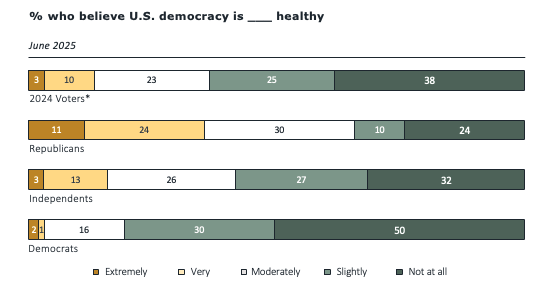
Well over half of registered voters in Rhode Island believe the United States democracy is not healthy, though the level of concern varies by political party, according to a new survey from Salve Regina University’s Pell Center. 

The survey was directed by Pell Center Associate Director and Fellow Katie Sonder and fielded by Embold Research between June 16-22, 2025.  It gathered responses from 804 registered voters in Rhode Island, with a modeled margin of error of 3.6 percent. 

Survey respondents are those registered to vote in Rhode Island who voted in the 2024 presidential election. The survey results show large divides between the major political parties, highlighting two very different lived realties between Democrats and Republicans.

Over half of registered Democrats agree that the United States is operating as a democracy, but 80% say it is not healthy and 94% believe we are facing a constitutional crisis. Democrats perceive a decline in the strength of the checks and balance system, which likely bolsters their sense of democratic backsliding. Only one-third (32%) agree the system is strong while 64% agree that country has fallen into dictatorship. 

Republicans, on the other hand, are seven times more likely to agree that our democracy is healthy than they were in the June 2024 Voices of Value survey. Well over three-quarters of Republicans (83%) say policies from the Trump administration have helped them personally and the percent who agree that polarization has increased dropped by 15 percentage points between June 2024 (86%) and June 2025 (71%).

While all respondents tapped disinformation and fake news as a leading contributor to political polarization, just as they did in the June 2024 survey, the percent who believe political leaders add to the schism has increased.