Menu Bar

Home           Calendar           Topics          Just Charlestown          About Us
Showing posts with label Bernie Sanders. Show all posts

Friday, July 31, 2026

Voters Are Realizing that Trump Doesn’t Care About Them

He has his own priorities

Mark Schauer for Common Dreams

This month, the bipartisan 21st Century ROAD to Housing Act became law—without Donald Trump’s signature, exactly as he’d threatened. It’s a small, recent example of a much bigger habit: Trump keeps showing voters exactly how little he thinks of them. 

The bill wasn’t controversial at all. It was negotiated by both parties’ top committee members and aimed squarely at lowering housing costs. 

But Trump let it sit for weeks rather than sign it, hoping to extract an unrelated voter-suppression bill in return.

At this point, childish behavior from the president shouldn’t be surprising.

In his first inaugural address, Trump claimed to be the champion of America’s “forgotten men and women.” But it was a lie from the start. He never cared about the poor and marginalized. 

He cared about cutting taxes for his friends; scapegoating immigrants for the struggles of the working class; and restoring a mythical era of American “greatness” characterized by the supremacy of straight, white, Christian males.

Although his lie was obvious, it was also effective. In 2016, Trump won around one-eighth of voters who’d supported Sen. Bernie Sanders (I-Vt.) in the Democratic primaries. In 2024, he significantly increased his share of the Black and Hispanic vote. 

Wednesday, June 24, 2026

They don't want you to know the REAL reason Social Security is in trouble

But I'm going to tell you anyway

Robert Reich

The trustees of the Social Security fund said Tuesday that the fund will be depleted by late 2032, a year earlier than the trustees’ projection last year of 2033. If nothing is done, benefits will automatically be cut six years from now.

The common understanding is that Social Security’s shortfall is due to the huge postwar baby boom, now retiring, and to America’s increasing life expectancy. The usual recommended fix is to reduce Social Security benefits or raise the age of eligibility. As Speaker of the House Mike Johnson, warned Monday, “entitlement programs” like Social Security “have to be adjusted and fixed.” He said Republicans will introduce a plan to do that. Brace yourselves.

I used to be a Social Security trustee, and I call bullsh*t.

The baby boom can’t be blamed for Social Security’s shortfall. The Greenspan Commission, which in 1983 recommended the reforms that Congress then made — raising Social Security payroll taxes and also raising the eligibility age for collecting Social Security benefits — knew all about the baby boom and figured it into its calculations. (Early boomers like me can now start collecting full benefits at age 66; late boomers born after 1960 have to wait until they’re 67 to collect full benefits.)

Americans’ increasing life expectancy isn’t at fault, either. While wealthier Americans are living longer, that’s not the case for lower-income Americans. The Urban Institute estimates that life expectancy in the top 20 percent of income-earners is 91 years for people born in the 1990s, four years more than people born in the 1950s. Yet the life expectancy in the lowest 20 percent of income-earners is fewer than 80 years.

So what’s the real cause of the Social Security shortfall? What did Greenspan’s commission fail to predict? Widening inequality.

Remember, the Social Security payroll tax applies only to earnings up to a certain cap. This year, that cap is $184,500. Earnings at or below this amount are taxed at 12.4 percent. The cap rises every year according to a formula roughly matching inflation.

Wednesday, January 14, 2026

Stephen Miller lays out Trump rationale for military action to seize Greenland

In ‘Unhinged’ Rant, Miller Says US Has Right to Take Over Any Country For Its Resources

Julia Conley for Common Dreams

Miller's wife Katie tweeted this map. Kinda says it all
“Belligerent” was how one Democratic lawmaker described a diatribe given by top White House adviser Stephen Miller on CNN Monday evening regarding the Trump administration’s right to take over Venezuela—or any other country—if doing so is in the supposed interest of the US.

To Sen. Bernie Sanders (I-Vt.), however, Miller was simply providing viewers with “a very good definition of imperialism” as he described the worldview the administration is operating under as it takes control of Venezuela and eyes other countries, including Greenland, that it believes it can and should invade.

“This is what imperialism is all about,” Sanders told CNN‘s Jake Tapper. “And I suspect that people all over the world are saying, ‘Wow, we’re going back to where we were 100 years ago, or 50 years ago, where the big, powerful countries were exploiting poorer countries for their natural resources.’”

The senator spoke to Tapper shortly after Miller’s interview, in which the news anchor asked whether President Donald Trump would support holding an election in Venezuela days after the US military bombed the country and abducted President Nicolás Maduro and his wife.

Miller refused to directly engage with the question, saying only that it would be “absurd and preposterous” for the US to install Venezuelan opposition leader María Corina Machado as the leader of the country, before asking Tapper to “give [him] the floor” and allow him to explain the White House’s view on foreign policy.

“The United States is using its military to secure our interests unapologetically in our hemisphere,” said Miller. “We’re a superpower and under President Trump we are going to conduct ourselves as a superpower. It is absurd that we would allow a nation in our backyard to become the supplier of resources to our adversaries but not to us.”

Instead of “demanding that elections be held” in Venezuela, he added, “the future of the free world depends on America to be able to assert ourselves and our interests without an apology.”

Sunday, December 21, 2025

Merry Christmas, veterans. Trump VA to Eliminate Up to 35,000 Healthcare Jobs This Month despite chronic under-staffing

“We must expand the VA, not hollow it out.”

Jake Johnson

Before the end of the year, the Trump administration is planning to eliminate up to 35,000 healthcare jobs at the Department of Veterans Affairs, a chronically understaffed agency that has already lost tens of thousands of employees to the White House’s sweeping assault on the federal workforce.

The Washington Post reported over the weekend that the targeted positions—many of which are unfilled—include doctors, nurses, and support staff. A spokesperson for the VA, led by former Rep. Doug Collins (R-Ga.), described the jobs as “mostly Covid-era roles that are no longer necessary.”

VA workers, veterans advocates, and a union representing hundreds of thousands of department employees disputed that characterization as the agency faces staff shortages across the country.

Tuesday, September 2, 2025

Health leaders, medical groups: CDC leader exodus puts nation's health at risk

Americans will die due to Bobby Junior's destruction of the agency

Lisa Schnirring

As news broke lof the ouster of newly confirmed Centers for Disease Control and Prevention (CDC) Director Susan Monarez, PhD, and the resignations of some of the agency's top scientists, reactions came fast and furious from public health leaders, professional groups, and lawmakers.

The upheaval at the CDC comes just weeks after a gunman attacked the campus, reportedly fueled by grievances about the COVID vaccine. 

The CDC has also been rocked by watered-down COVID vaccine recommendations that came from Health and Human Services (HHS) Secretary Robert F. Kennedy Jr. and his surrogates who have announced new reviews of autism causes and COVID vaccines, both hot-button issues of Kennedy and other vaccine critics.

Michael Osterholm, PhD, MPH, director of the Center for Infectious Disease Research and Policy (CIDRAP) at the University of Minnesota, publisher of CIDRAP News, said the loss of top CDC staff is the result of failed leadership of extremists at HHS, which oversees the CDC. "These departures are a serious loss for America. They make our country less safe and less prepared for public health emergencies." 

Saturday, July 26, 2025

The $50 Million Venetian Wedding of Robber Baron Jeff Bezos

Today's robber barons revel in a new Gilded Age

Elliott Negin for Common Dreams

With all the fawning coverage of Jeff Bezos’ storybook $50 million Venetian wedding, the news media lost sight of fact that Bezos—the third-richest person in the world—is hardly worthy of veneration. He’s been exploiting Amazon workers for years.

Historians have drawn parallels between the Gilded Age of the late 19th century and what we are experiencing today. Like the first Gilded Age, Gilded Age 2.0 is marked by increasing economic inequality, the concentration of wealth in the hands of a few, and a rise in populism and social unrest.

Top of Form

Bottom of Form

Jeff Bezos fits the profile of a latter-day robber baron to a T. Like the ruthless tycoons of yore, his business practices are unethical, he has amassed a vast fortune on the backs of his workers, and he has brutally stifled competition and controlled markets.

Amazon terrorizes its workers

With their manifestly unsafe working conditions, Amazon warehouses are a 21st-century version of a Gilded Age sweatshop. Despite the company’s claims that it protects its workforce, an 18-month investigation released last December by a Senate committee led by Sen. Bernie Sanders (I-Vt.) found that the nation’s second-largest private-sector employer risks its workers’ health and safety by prioritizing speed and profit, and it is doing quite well on that score. Last year, the company outpaced Walmart, the largest private-sector employer, by netting $59.2 billion—a 95 percent increase from 2023.

Monday, March 31, 2025

Trumps Billionaire Commerce Secretary: Only 'Fraudsters' Will Complain If Social Security Checks Don't Arrive

Yeah, MAGA. Yeah Jim Mageau. You won't miss your Social Security checks, right?

Jessica Corbett for Common Dreams

Maybe HE won't miss his checks
As U.S. President Donald Trump's temporary leader of the Social Security Administration threatened to shut down the agency over an unfavorable court ruling on Friday, the billionaire commerce secretary came under fire for suggesting that only "fraudsters" will complain if they don't get their earned benefits.

U.S. Commerce Secretary Howard Lutnick appeared on All-In—a podcast hosted by "four billionaire besties"—on Thursday. A brief clip of his interview, which lasted an hour and 45 minutes, made the rounds on social media Friday.

Lutnick told two of the hosts that if the SSA didn't send out checks this month, his 94-year-old mother-in-law "wouldn't call and complain," but "a fraudster always makes the loudest noise, screaming, yelling, and complaining."

Critics were quick to point out Lutnick's wealth. As More Perfect Union posted, "His net worth is estimated at $2 billion."

Richard Phillips, pensions and tax policy director for U.S. Senate Committee on Health, Education, Labor, and Pensions Ranking Member Bernie Sanders (I-Vt.), called the commerce secretary's comments "shameful."

"Nearly 40% of seniors rely on Social Security for a majority of their income and nearly 1 in 7 rely on it for more than 90% of their income," according to Phillips. "These people would call due to missing checks because their very survival depends on it."

Wednesday, October 2, 2024

Here are big companies that pay less taxes than they pay their top executives

Trump tax cuts - the gift that keeps on giving to Big Business

Jake Johnson for Common Dreams

A group of congressional Democrats and Independent Sen. Bernie Sanders on Friday highlighted dozens of profitable U.S. corporations that have paid their executives more than they've paid in federal income taxes in recent years, a problem that the lawmakers attributed in large part to former President Donald Trump's massive tax-cut package that Republicans are working to extend.

"In the first five years following the 2017 giveaway, 35 companies raked in $277 billion in domestic profits and paid their executives $9.5 billion—more than they paid in federal income taxes," the lawmakers noted in letters to each of the companies, pointing to recent research by the Institute for Policy Studies and Americans for Tax Fairness.

Tuesday, February 13, 2024

Americans Deserve Fairer Social Security Taxes

We need two raises: Raise the cap on income subject to Social Security tax and the floor for payment of income tax on Social Security 

By Gerald E. Scorse 

Social Security has been a financial rock for seniors ever since benefits first began flowing in 1940. For decades though, for those above an income threshold, pieces of that rock have been chiseled away: a 1983 law makes up to 50 percent of benefits subject to federal income taxes. 

Levying a tax on benefits was a new idea at the time, promoted as one of the ways to help save Social Security for future generations. The system’s trust fund was only months away from running out of money, and revenue from the tax would be dedicated to keeping the program solvent. 

The reform was overwhelmingly approved by Congress and signed into law by President Reagan. As he said at the signing, it “demonstrates for all time our nation’s ironclad commitment” to Social Security. 

It also demonstrates, in 2024, the unfairness of never adjusting the income threshold for inflation. When the levy first began, fewer than 10 percent of recipients had to pay taxes on any of their benefits. Today that number has risen to roughly 56 percent. Putting it simply, a threshold that hasn’t changed in 40 years is forcing millions of retirees with modest incomes to pay higher taxes than they should. 

Now let’s look at Social Security’s second unfairness, letting workers with huge incomes pay lower taxes than they should. Ironically, the only fair thing about this unfairness is that an annual adjustment is made. 

Most workers pay Social Security taxes on every dollar they make. Big earners, though, avoid those taxes by the billions: there’s a dollar cap on earnings subject to the Social Security tax. The cap rises yearly at the same rate as average wages. This year’s cap is $168,000, up from $160,200 in 2023. 

Friday, February 2, 2024

Let's Control All Drug Prices

It’s past time to regulate profiteering.

SONALI KOLHATKAR


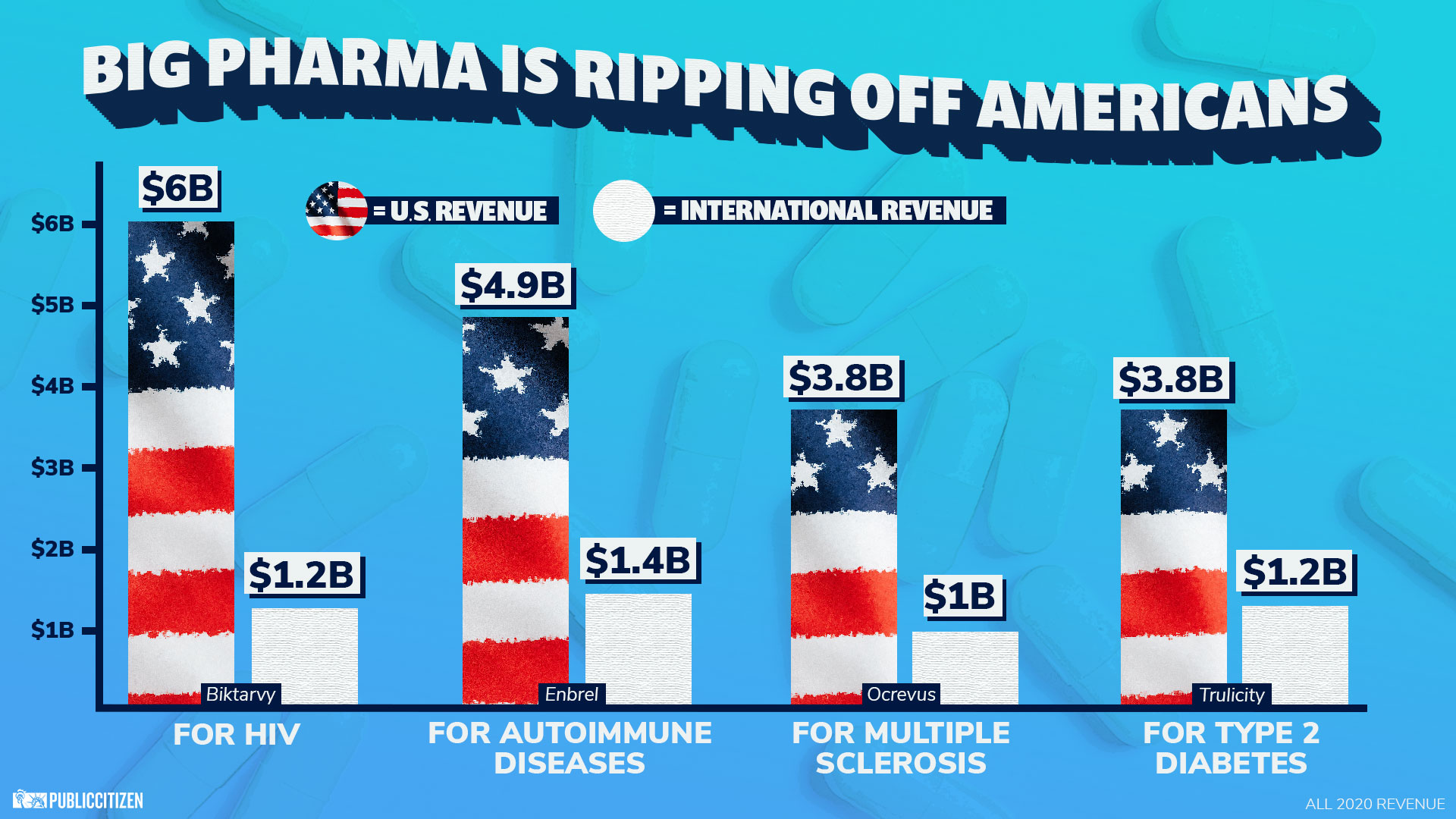
Major pharmaceutical companies in the United States are battling with Vermont Senator Bernie Sanders over an issue that is at the heart of whether we value human wellbeing over corporate profits. As chair of the Senate Committee on Health, Education, Labor, and Pensions (HELP), Sanders has vowed to force CEOs of pharmaceutical companies to publicly answer for why their drug prices are so much higher than in other nations. 

He plans to bring a committee vote to subpoena them. The subpoenas are necessary because—brazenly—the CEOs of Johnson & Johnson and Merck have simply refused to testify to the HELP committee. What are they afraid of?

In a defensive-sounding letter to Sanders, an attorney for Johnson & Johnson accused the Senator of using committee hearings to “punish the companies who have chosen to engage in constitutionally protected litigation.” 

The letter does not specify the litigation in question—perhaps because it would sound so ridiculous and would reveal the company’s real agenda. Last July, the company, along with Merck and Bristol Myers Squibb sued the Biden administration for allowing the Medicare program to regulate prescription drug prices.

It appears that Johnson & Johnson and Merck are indeed afraid of being questioned by lawmakers about drug-profiteering in the U.S.

One pharmaceutical expert, Ameet Sarpatwari of Harvard Medical School explained to the New York Times that, “The U.S. market is the bank for pharmaceutical companies… There’s a keen sense that the best place to try to extract profits is the U.S. because of its existing system and its dysfunction.” Another expert, Michelle Mello, a professor of law and health policy at Stanford university, told the Times, “Drugs are so expensive in the U.S. because we let them be.”

In other words, it’s been a free-for-all for pharmaceutical companies in the U.S. In 2003, then-President George W. Bush signed a Medicare reform bill into law, promising help for seniors struggling to pay for medications, but that law stripped the federal government of its power to negotiate drug prices for Medicare’s participants. It was a typically Republican, Orwellian move: promise help to ordinary people and deliver the exact opposite.

Saturday, November 11, 2023

Why are US politicians so old?

And why do they want to stay in office?

Mary Kate CaryUniversity of Virginia

When former President Bill Clinton showed up at the White House in early 2023, he was there to join President Joe Biden to celebrate the 30th anniversary of the Family and Medical Leave Act. It was hard to avoid the fact that it had been three decades since Clinton was in office – yet at 77, he’s somehow three years younger than Biden.

Biden, now 80 years old, is the first octogenarian to occupy the Oval Office – and his main rival, former President Donald Trump, is 77. A Monmouth University poll taken in October 2023 showed that roughly three-quarters of voters think Biden is too old for office, and nearly half of voters think Trump is too old to serve.

My former boss, President George H.W. Bush, happily chose not to challenge Clinton again in the 1996 election. If he had run and won, he would have been 72 at the 1997 inauguration. Instead, he enjoyed a great second act filled with humanitarian causes, skydiving and grandchildren. 

Bush’s post-presidential life, and American ideals of retirement in general, raise the question of why these two men, Biden and Trump – who are more than a decade and a half beyond the average American retirement age – are stepping forward again for one of the hardest jobs in the world.

Wednesday, November 1, 2023

Whose Advantage?

Letting private insurance run Medicare Advantage cost us dearly

By Philip Mattera, director of the Corporate Research Project for the Dirt Diggers Digest 

Fraud Magazine illustration by Jonathan Bartlett

Progressive Democrats such as Bernie Sanders have long promoted Medicare for All as the solution to the country’s health insurance problems. 

Given the popularity of Medicare among the seniors it serves, extending the program to other age groups has a great deal of appeal.

The problem, though, is that Medicare is not a single program. It is an assortment of coverage options that can be bewildering to those turning 65 and to participants during the open enrollment period each year when they must decide whether to stick with their current plan or jump to another. The 2024 open enrollment period began on October 15th and ends December 7th.

Seniors are currently being bombarded with coverage offers, not from the federal government, which oversees Medicare, but from the private insurance companies which have gained a significant foothold in a nominally public program.

Wednesday, September 6, 2023

Ex-Biden Official Gabe Amo Defeats Progressive Aaron Regunberg in Rhode Island

Regunberg says it's his last election run

JAKE JOHNSON

Former Biden administration official Gabe Amo won the special Democratic primary for an open U.S. House seat in Rhode Island's 1st Congressional District on Tuesday, defeating frontrunner Aaron Regunberg, an ex-state representative who was backed by Sen. Bernie Sanders and Rep. Alexandria Ocasio-Cortez.

Regunberg's loss to Amo, who served as deputy director of the White House Office of Intergovernmental Affairs, was seen as a significant disappointment for progressives in the heavily blue district previously represented by Rep. David Cicilline (D-R.I.), who stepped down earlier this year.

If Amo defeats Republican Gerry Leonard in November, he will be the first Black person to ever represent Rhode Island in Congress.

Cicilline did not endorse in the crowded primary race, but Rep. Rosa DeLauro (D-Conn.)—a friend and political ally of Cicilline—backed Regunberg, as did the Congressional Progressive Caucus PAC, the Working Families Party, Our Revolution, Friends of the Earth Action, and other progressive organizations.

Thursday, October 27, 2022

GOP "solutions" will make inflation worse

If cutting corporate tax rates and making billionaires wealthier actually fixed inflation, it would have been fixed ages ago.

By Peter Certo 

My wife and I recently had the tremendous misfortune of needing to buy a car. Car prices, you may know, reached an all-time high this year.

There are now rumblings of a gradual decline, but rising interest rates will likely offset any savings. So with our beloved but rickety 2006 Altima facing another cruel Midwestern winter alone, we bit the bullet and bought a newer used car before those rates could get any higher.

For us it was the capstone of a year we spent, like anyone else, shelling out more for gas, groceries, and everything else. It’s this kind of inflation that’s giving even the fringiest Republican candidates an edge going into this year’s midterms.

But if Republicans ride inflation to victory, experts warn their “solutions” will make it worse.

Saturday, October 15, 2022

Crucial Choices Ahead for Beloved, Besieged Social Security

Time to lift the income cap? 

By Gerald Scorse, Guest Columnist 

“It was the best of times, it was the worst of times.” That famous phrase from Charles Dickens sums up the double-edged sword hanging over the roughly 63 million Americans now getting monthly retirement payouts from Social Security. 

Their 2022 COLA (cost-of-living adjustment) rose by 5.9%, the biggest jump in nearly 40 years. The 2023 increase, just announced, came in at an even-higher 8.7%. That’s the best of times. The worst of times, getting ever closer, is the date when the Social Security trust fund runs out of money—and those higher benefits this year and next will likely wipe out the fund earlier than the current estimate of 2034. 

Adding to the problem, the nation’s demographics have created their own double-edged sword. For years, a combination of higher life expectancies and lower birth rates has been lowering the ratio of workers who pay in to beneficiaries who take out. 

Putting everything together, Congress will be forced to act to keep benefits from shrinking to only 78% of the currently scheduled amounts. There’s little doubt that lawmakers won’t let that happen, but plenty of doubt over the direction their fixes will take. 

Even though Social Security is hugely popular, only the most optimistic expect a bipartisan solution. Everything will likely hinge on which party is in charge, and the ideas backed by the two parties differ sharply. Democrats want more generous benefits; the GOP, under the guise of saving Social Security, would effectively cut them. 

Let’s review the major ideas. Then let’s consider two further reforms—both aimed at high-income Americans—to help prevent any shortfall and put the system on a sound fiscal basis. 

Friday, July 9, 2021

Trumplicans want 'Chaos and Inability to Get Stuff Done'

In Leaked Video, GOP Congressman admits what we all already know - there is no intent of working across the aisle. It's all posturing."

JAKE JOHNSON, STAFF WRITER for Common Dreams

Newly leaked video footage of a recent event hosted by the right-wing group Patriot Voices shows Republican Rep. Chip Roy of Texas openly admitting that his party wants "18 more months of chaos and the inability to get stuff done" as President Joe Biden, a bipartisan group of senators, and congressional Democrats work to pass climate and infrastructure legislation.

"Honestly, right now, for the next 18 months, our job is to do everything we can to slow all of that down to get to December of 2022," Roy says in the clip, referring to the month after that year's midterm elections. Republicans need to flip just a handful of seats to take back the House and Senate.

"I don't vote for anything in the House of Representatives right now," Roy says in response to an audience member's question about the sweeping infrastructure and safety-net package that Democrats are planning to pass unilaterally alongside a White House-backed bipartisan deal.

In the video that emerged Tuesday, the Texas Republican dismisses the Democratic reconciliation package—which progressives hope will include at least $6 trillion in spending on climate programs, Medicare expansion, and other priorities left out of the bipartisan plan—as "liberal garbage."

Watch the video, which was posted by Lauren Windsor of The Undercurrent:

Thursday, July 1, 2021

Unrig the Tax Code Now

Leaked IRS data proves the rumors are true: Many billionaires pay no income taxes. Will that spur reform?

SARAH ANDERSON

Senate Majority Leader Mitch McConnell, R-Ky. Jacquelyn Martin/AP
Recently leaked data revealed that Amazon CEO Jeff Bezos and several other U.S. billionaires have paid zero federal income taxes in some past years.

This has Senate Minority Leader Mitch McConnell up in arms—but not because of what the scandal reveals about our rigged tax system. Instead, McConnell wants to go after the whistleblowers who exposed the scandal.

.

"Whoever did this ought to be hunted down and thrown into jail," McConnell said in a radio interview.

What I suspect really bothers McConnell is that this data is likely to increase the pressure on him and other lawmakers to raise taxes on the wealthy. For the first time in decades, serious proposals to do just that are actually on the table in Washington. And the timing couldn't be better.

Poor and low-income Americans have paid the biggest price for the pandemic, while U.S. billionaires have seen their fortunes increase by more than $1 trillion. Now is the moment for America's ultra-rich to contribute their fair share to an economic recovery that will make the nation stronger in the face of future crises.

How are billionaires getting away with paying so little to Uncle Sam now? A key reason is that our current tax system rewards wealth, not work.

Friday, March 26, 2021

Something to talk about on your next Zoom meeting

Zoom paid $0 in federal income taxes on 4,000% profit increase during pandemic

"If you paid $14.99 a month for a Zoom Pro membership, you paid more to Zoom than it paid in federal income taxes even as it made $660 million in profits last year."

By Jake Johnson, staff writer for Common Dreams 

The U.S.-based online video chat platform Zoom has seen its profits skyrocket by 4000% during the Covid-19 pandemic thanks to the growing reliance on remote work and schooling, but an analysis by the Institute on Taxation and Economic Policy finds that the company didn't pay a dime in federal corporate income taxes on its 2020 windfall.

The reason, according to ITEP senior fellow Matthew Gardner, lies mainly in Zoom's "lavish use of executive stock options," a common tactic of big corporations looking to skirt their federal tax obligations.

"Companies that compensate their leadership with stock options can write off, for tax purposes, huge expenses that far exceed their actual cost," Gardner explained. "This is a strategy that has been leveraged effectively by virtually every tech giant in the last decade, from Apple to Facebook to Microsoft. Zoom's success in using stock options to avoid taxes is neither surprising nor (currently) illegal."

Zoom reported $660 million in pre-tax profits in 2020, a massive leap from its 2019 pre-tax profits of $16 million. Eric Yuan, Zoom's founder and CEO, accurately described 2020 an as "unprecedented year" for the nine-year-old company in its latest earnings report.

Wednesday, February 24, 2021

Working Families Party: Nearly one year into pandemic, RI billionaire’s wealth continues to climb

RI's richest man and only billionaire is doing fine during the pandemic. Most of us don't 

By the  Working Families Party 


Harvard Business School alumnus
The net worth of private-equity executive Jonathan Nelson, Rhode Island’s richest man and lone billionaire, jumped by $180 million, or 10% over the course of the pandemic, according to a new report by Americans for Tax Fairness (ATF), Health Care for America Now (HCAN) and the Rhode Island Working Families Party

The $180 million in pandemic profits of the state’s richest resident could make up over one-third of the state’s projected $400 – $500 million fiscal year 2022 budget gap, and still leave him as wealthy as he was when the pandemic hit 10 months ago.  

Between March 18 – the rough start date of the pandemic shutdown, when most federal and state economic restrictions were put in place – and January 29, Nelson’s fortune rose from $1.8 billion to $2 billion between March 18 and Jan 29, based on this analysis of Forbes data. 


Nelson’s private gain is a sharp contrast to the severe health and economic crises hitting average Rhode Islanders. 


Over the same 10 months, close to 113,754 state residents fell ill with the coronavirus, 2,144 died from it and 290,100 lost jobs in the accompanying recession. 


23,716 Rhode Islanders residents were collecting unemployment the week of Jan. 4, and late last year, 80,000 adult state residents, or 11%, reported going hungry over the past week. The figure for households with children was 14%.


While federal lawmakers debate more cash payments to people and families in the next relief package, Nelson has amassed enough new wealth during the pandemic, a  $180 million surge, to send every one of the state’s 1,059,361 residents a relief check of roughly $170 each. A family of four would get $680.