Menu Bar

Home           Calendar           Topics          Just Charlestown          About Us
Showing posts with label income inequality. Show all posts

Wednesday, April 1, 2026

A recent poll found that 80% of American respondents viewed wealth inequality as a problem

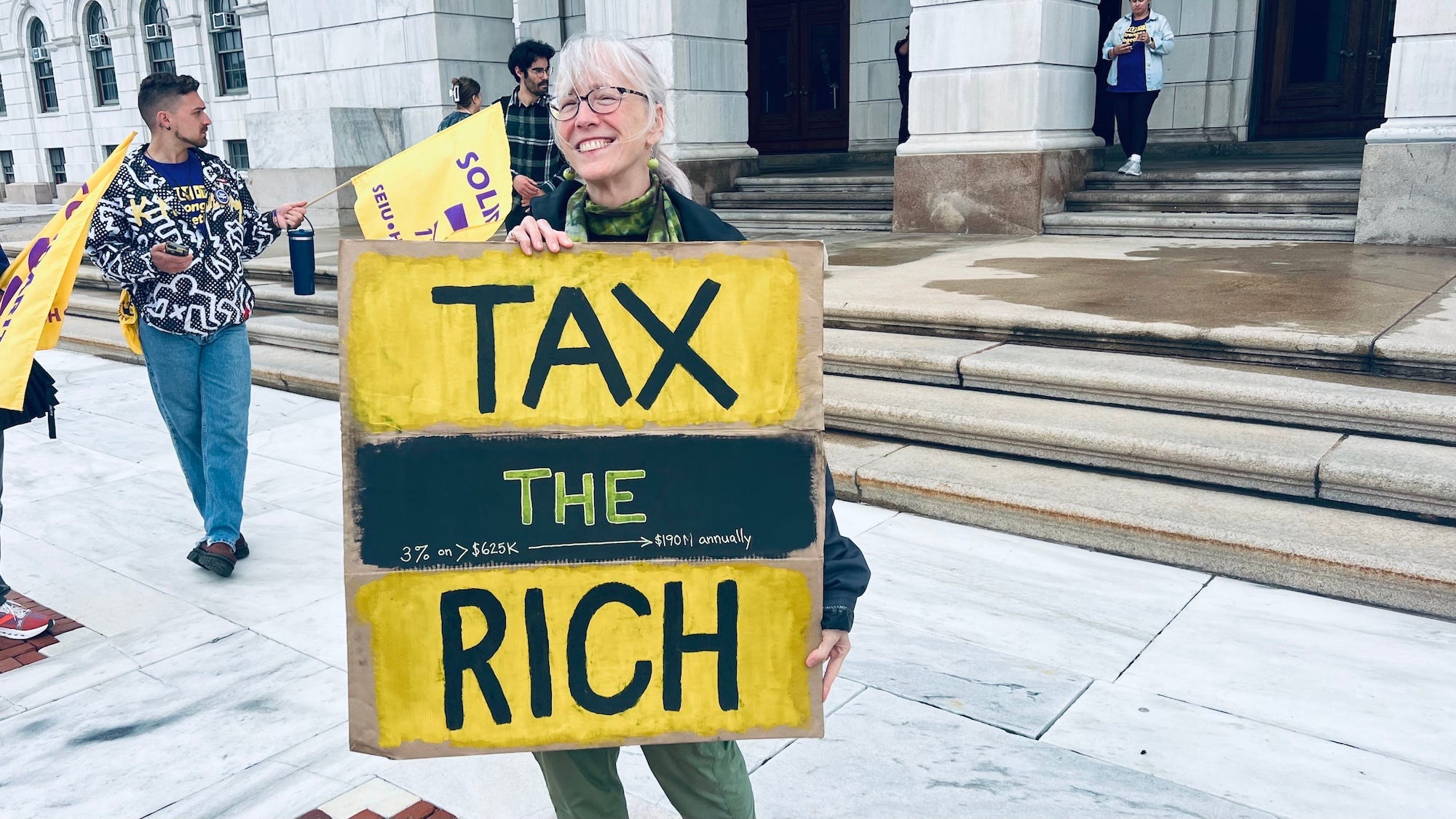
Yes, It’s Time to Tax the Rich

Lawrence Wittner for Common Dreams

With the deadline for paying federal income taxes fast approaching, the thoughts of American taxpayers turn naturally toward the age-old question: Why isn’t there a fairer tax system?

Currently, in fact, campaigns for state tax-the-rich legislation are flourishing in California, Colorado, New York, Oregon, Rhode Island, Texas, and Virginia, and have already succeeded in getting such legislation adopted in Massachusetts and Washington. Similarly, in Congress, Sen. Elizabeth Warren (D-Mass.) and Rep. Pramila Jayapal (D-Wash.) have introduced the Ultra-Millionaire Tax Act, while Sen. Bernie Sanders (I-Vt.) and Rep. Ro Khanna (D-Wash.) are sponsoring the Make Billionaires Pay Their Fair Share Act. The tax-the-rich proposals range from increasing the tax rate for the very highest annual income earners, to instituting an annual wealth tax on the very richest Americans, to a combination of both.

Although the most affluent Americans, like other Americans, have always paid taxes to fund public services, the dispute has been over how much they should pay. Sales taxes and property taxes place a heavy burden on people of modest means, but a much lighter burden on the wealthy. Therefore, the wealthy have tended to favor these generators of public revenue and to oppose a progressive income tax, under which the rich would pay at a higher rate than the poor. A lengthy political battle for a tax system based upon ability to pay led to passage of the 16th Amendment to the US Constitution, which empowered Congress to levy an income tax.

Initially, the new income tax, though progressive, was rather small-scale. But as the federal government took on new and costly tasks―particularly funding US participation in two world wars and the Cold War―the federal income tax grew accordingly. By 1944, the official tax rate for the highest income earners stood at 94%―although, thanks to deductions, loopholes, and the rate’s confinement to the top increment of their income, the richest Americans actually paid at a much lower rate.

Tuesday, March 24, 2026

Trump's whoppers about oil and gas prices

Big Oil wins. You lose.

Noah Berlatsky

“The United States is the largest Oil Producer in the World, by far, so when oil prices go up, we make a lot of money,” Donald Trump boasted on Truth Social.

Oil prices are, of course, going up because Trump launched an illegal war of aggression against Iran without considering the (incredibly obvious) possibility that Iran might retaliate by closing the Strait of Hormuz. Gas prices have spiked 60 cents this month as oil hit $100 a barrel, and Energy Secretary Chris Wright refused to rule out the possibility oil might even rise to $200 a barrel.

Trump’s blasé trumpeting of the virtues of rising prices is in part simple fecklessness — he’s a liar who insists everything he does is brilliant and awesome.

But Trump’s decision to attack Iran and put upward pressure on prices at home puts him a political pickle, since he excoriated Biden for the high cost of gas during the 2024 campaign. In fact, the day before he launched his war, Trump preened about how far prices had fallen. But suddenly high prices are good, because as long as Trump is shuffling gaseously from Mar-a-Lago to the White House, it’s always an orange utopia in America.

To some degree, though, Trump’s love of high prices is sincere. Our current fascist president is a crony capitalist and loves the idea of screwing consumers, who he sees as suckers and marks. He identifies with the wealthy and likes it when the rich get richer. His populist mouth noises have always been a put on — as an instinctual oligarch, he gets a little shiver of pleasure whenever he can harm the little guy.

Thursday, February 26, 2026

Why U.S. middle-aged adults report more loneliness and poorer health than peers abroad

Midlife crisis is complicated in the US

By Arizona State University

Edited by Sadie Harley, reviewed by Robert Egan

Americans born in the 1960s and early 1970s report higher loneliness and depressive symptoms and show poorer memory and physical strength than earlier generations. Such declines are largely absent in peer countries, particularly in Nordic Europe, where outcomes have improved over time.

In a new study, psychologist Frank J. Infurna of Arizona State University and co-authors, analyzed survey data from 17 countries seeking to identify why U.S. trends diverge from other wealthy nations.

"The real midlife crisis in America isn't about lifestyle choices or sports cars. It's about juggling work, finances, family, and health amid weakening social supports," Infurna said. "The data make this clear."

The findings, published in Current Directions in Psychological Science, point the way to likely solutions for individuals and U.S. society.

Monday, February 16, 2026

Cancer is becoming a global crisis shaped less by biology than by inequality, risk exposure, and access to care.

“Impending Disaster”: Scientists Warn That Cancer Deaths Are Surging Worldwide

By The Lancet

Global cancer diagnoses and deaths rose sharply between 1990 and 2023, even as treatments improved and prevention efforts expanded. Without swift action and focused investment, projections indicate that 30.5 million people will be newly diagnosed with cancer and 18.6 million will die from the disease in 2050, with more than half of new cases and nearly two thirds of deaths occurring in low- and middle-income countries (LMICs), according to a major analysis by the Global Burden of Disease Study Cancer Collaborators published in The Lancet.

Although the total number of cancer cases and deaths is expected to climb significantly from 2024 to 2050, there is a more nuanced picture beneath those totals. When cancer incidence and mortality are adjusted for age, global rates are not projected to rise. This indicates that much of the increase is being driven by population growth and the expanding proportion of older adults worldwide.

Even so, this trend falls well short of the United Nations Sustainable Development Goal (SDG) of cutting premature deaths from non-communicable diseases, including cancer, by one third by 2030.

Thursday, February 12, 2026

The wealthiest 15 billionaires in America saw their wealth grow over 30 percent in 2025.

America’s Wealthiest Are Getting Even Richer

By Chris Mills Rodrigo


The top 15 wealthiest people in America are part of a very, very exclusive club: those with over $100,000,000,000 in net worth. After double checking those zeroes, we can confidently say that yes, there are 15 centi-billionaires living among us.

And, according to a new Institute for Policy Studies analysis of data from the Forbes real time billionaire list, the combined wealth of that 12-figure club grew from $2.4 trillion to $3.1 trillion over the course of 2025.

For context, that 30.3 percent rate of growth outpaced both the S&P 500 (16 percent) and billionaires in general (20.8 percent) over the last year. To put it succinctly, the wealthiest Americans are accumulating capital faster than everyone else.

The top 15 wealthiest billionaires aren’t the only ones doing well for themselves. Our analysis found that found that the number of U.S. billionaires increased from 813 with combined wealth of $6.7 trillion at the end of 2024 to 935 U.S. billionaires with combined assets of $8.1 trillion.

Saturday, January 17, 2026

The Trump Administration’s $3 Meal: ‘A Piece of Chicken, a Piece of Broccoli, Corn Tortilla, and One Other Thing’

Maybe they expect you to add roadkill and lard

Jessica Corbett

The Trump administration was again blasted for grocery prices this week after Agriculture Secretary Brooke Rollins discussed the new federal dietary guidelines during a NewsNation appearance.

“We’ve run over 1,000 simulations,” Rollins said in a clip shared on social media by journalist Aaron Rupar on Wednesday. “It can cost around $3 a meal for a piece of chicken, a piece of broccoli, corn tortilla, and one other thing.”

“So there is a way to do this that actually will save the average American consumer money,” Rollins continued, pushing back against host Connell McShane’s inquiry about whether the new guidelines expect people to spend more money on food.

The Guardian noted that “data from the consumer price index, as referenced by McShane, showed that food prices kept rising in December, increasing by 0.7%, the biggest month-to-month jump since October 2022. Prices for produce rose 0.5%, coffee increased by 1.9%, and beef went up 1% over the month and 16.4% compared with a year earlier.”

Responding to the clip, Chasten Glezman Buttigieg, an author and teacher married to former Democratic Transportation Secretary Pete Buttigieg, said, “Private jets and tax breaks for them and their rich friends, and one piece of broccoli *AND* a tortilla for you!”

Saturday, January 10, 2026

Five ways to become a billionaire

None have anything to do with “free market” capitalism

Robert Reich

One of the most notable characteristics of 2025 has been the shamelessness of the billionaire class and the conspicuousness of its corruption.

For many years, whenever I’ve warned that an increasing portion of the nation’s wealth is falling into the hands of an ever-smaller number of people, the moneyed interests have responded: “But that’s just the free market,” or “the free market has decided they deserve it.”

Rubbish. There’s no such thing as a “free market” to begin with. Today’s so-called “free market” is the outcome of political decisions over monopolization, labor organization, private property, finance, trade, taxes, and much more.

Who’s behind these political decisions? Increasingly, the same small number of ultra-rich who have gained disproportionate influence over our politics. They’ve created five ways for themselves to accumulate a billion dollars or more.

1. First, exploit a monopoly.

Does Jeff Bezos deserve his billions because he founded and built Amazon?

No. Amazon is a monopolist with nearly 40 percent of all e-commerce retail sales in America. In addition, Amazon is protected by a slew of patents granted by the U.S. government.

In 2023, the U.S. government — through the Federal Trade Commission and 17 states— charged Amazon with illegally maintaining a monopoly by crushing competition, inflating prices, and harming consumers through anticompetitive practices like punishing sellers who offer lower prices elsewhere. (The trial is currently scheduled to begin in 2027.)

If the government fully enforced anti-monopoly (antitrust) laws and didn’t give Amazon such broad patents, Bezos would be worth far less.

If anti-monopoly laws were enforced, other titans of high tech would be worth far less, too — among them, Elon Musk, Meta’s Mark Zuckerberg, Apple’s Tim Cook, and Oracle’s Larry Ellison.

Saturday, January 3, 2026

Whatever Happened to Trump’s ‘Golden Age’ for American Workers?

Trump NEVER intended to help working people - he just lied and said he would

By Lawrence S. Wittner

Although Donald Trump’s Department of Labor announced in April 2025 that “Trump’s Golden Age puts American workers first,” that contention is contradicted by the facts.

Indeed, Trump has taken the lead in reducing workers’ incomes. One of his key actions along these lines occurred on March 14, 2025, when he issued an executive order that scrapped a Biden-era regulation raising the minimum wage for employees of private companies with federal contracts. Some 327,300 workers had benefited from Biden’s measure, which produced an average wage increase of $5,228 per year. With Trump’s reversal of policy, they became ripe for pay cuts of up to 25 percent.

America’s farmworkers, too―many of them desperately poor―are now experiencing pay cuts caused by the Trump administration’s H-2A visa program, which is bringing hundreds of thousands of foreign agricultural workers to the United States under new, lower-wage federal guidelines. The United Farm Workers estimates that this will cost U.S. farm workers $2.64 billion in wages per year. 

As in the past, Trump and his Republican Party have blocked any increase in the federal minimum wage―a paltry $7.25 per hour―despite the fact that it has not been raised since 2009 and, thanks to inflation, has lost 30 percent of its purchasing power. By 2025, this wage had fallen below the official U.S. government poverty level.

Furthermore, the Trump administration is promoting subminimum wages for millions of American workers. 

Although the Biden administration had abolished the previous subminimum wage floor for workers with disabilities by bringing them up to the federal minimum wage level, the Trump Labor Department has restored the subminimum wage. In addition, the Trump administration is proposing to strip 3.7 million home-care workers of their current federal minimum wage guarantee.

Trump’s Labor Department has also scrapped the Biden plan to expand overtime pay rights to 4.3 million workers who had previously lost eligibility for it thanks to inflation. 

And it is promoting plans to classify many workers as independent contractors, thereby depriving such workers of key labor rights, including minimum wages and overtime pay.

Not surprisingly, the U.S. Bureau of Labor Statistics reported on December 18, 2025 that, from November 2024 to November 2025, the annual growth of the real wages (wages adjusted for inflation) of American workers had fallen to 0.8 percent.

Friday, November 21, 2025

5 Reasons Trump’s Economy Stinks and 10 Things the Dems Should Do About It

Finally, the public seems to get how badly Trump has trashed the economy

Robert Reich in Inequality Media

Donald Trump claimed last week on social media that “Our economy is BOOMING, and Costs are coming way down,” and that “grocery prices are way down.

Rubbish.

How do I know he’s lying? Official government statistics haven’t been issued during the shutdown—presumably to Trump’s relief (the White House said Wednesday that the October jobs and Consumer Price Index reports may never come out).

But we can get good estimates of where the economy is now, based on where the economy was heading before the shutdown and recent reports by private data firms.

First, I want to tell you what we know about Trump’s truly sh*tty economy. Then I’ll suggest 10 things that Democrats should pledge to do about it.

1. Prices Continue to Rise as Real Wages Fall

Saturday, November 8, 2025

American oligarchs cash in on Trump

10 Richest Americans Have Gained $700 Billion in Wealth Since Trump Reelection

Jake Johnson

New research published November 3 shows that the 10 richest people in the United States have seen their collective fortune grow by nearly $700 billion since Donald Trump secured a second term in the White House and rushed to deliver more wealth to the top in the form of tax cuts.

The billionaire wealth surge that has accompanied Trump’s return to power is part of a decades-long, policy-driven trend of upward redistribution that has enriched the very few and devastated the working classOxfam America details in Unequal: The Rise of a New American Oligarchy and the Agenda We Need.

Between 1989 and 2022, the report shows, the least rich US household in the top 1% gained 987 times more wealth than the richest household in the bottom 20%.

As of last year, more than 40% of the US population was considered poor or low-income, Oxfam observed. In 2025, the share of total US assets owned by the wealthiest 0.1% reached its highest level on record: 12.6%.

The Trump administration—in partnership with Republicans in Congress—has added rocket fuel to the nation’s out-of-control inequality, moving “with staggering speed and scale to carry out a relentless attack on working-class families” while using “the power of the office to enrich the wealthy and well-connected,” Oxfam’s new report states.

“The data confirms what people across our nation already know instinctively: The new American oligarchy is here,” said Abby Maxman, president and CEO of Oxfam America. “Billionaires and mega-corporations are booming while working families struggle to afford housinghealthcare, and groceries.”

“Now, the Trump administration and Republicans in Congress risk turbocharging that inequality as they wage a relentless attack on working people and bargain with livelihoods during the government shutdown,” Maxman added. “But what they’re doing isn’t new. It’s doubling down on decades of regressive policy choices. What’s different is how much undemocratic power they’ve now amassed.”


Thursday, October 9, 2025

Billionaires could soon face more taxing times

Consensus builds for taxing the rich

By Gerald E. Scorse 

Billionaires, beware: Thousands of your countrymen are focusing hard on reining in your riches. All of them, including large numbers of millionaires, want you to pay higher taxes. They want a twenty-first century America with less income inequality and more tax fairness.

Something like the America of decades ago, before the laws started leaning toward high-income taxpayers. (And they’re still leaning that way: see the gifts handed out to the rich in the Big Unbeautiful Bill rammed through by the GOP earlier this year.)

The posse that’s pursuing billionaires includes tax experts, scholars, investigative journalists, Democratic lawmakers, and two groups devoted especially to tax reform. One is Patriotic Millionaires, self-defined as “a collection of wealthy Americans fighting against the destabilizing concentration of wealth and power in the United States.” The other has a name that needs no definition, Tax the Greedy Billionaires.  Rep. Greg Casar (D-TX) sums up its mission in eight words: “Tax the billionaires instead of funding the billionaires.”

Here are a few glimpses of what they’re all seeing—and what they’d like to be seeing instead.

Patriotic Millionaires underscores the country’s growing inequality and a tax code that deserves most of the blame: “Those who are already rich can make money in ways that are subject to income taxes at lower rates or don’t count as ‘income’ at all.” As a result, “Billionaires now pay lower effective tax rates than all other income groups.” Because of this, “The U.S. tax system has enabled a concentration of wealth so extreme that it threatens our economy, our democracy and the planet.”

Tax the Greedy Billionaires sounds an equally loud alarm. “America’s wealth inequality has reached a dangerous tipping point. The richest Americans have captured our government, rigging the rules in their favor and amassing unprecedented concentrations of wealth and power….The American Dream can’t survive in a system where unlimited wealth for the few destroys opportunity for all.”

Tuesday, September 23, 2025

More Rhode Island children lived in poverty in 2024, new data shows

Encyclopedia of facts about kids in Rhode Island

By Alexander Castro, Rhode Island Current

Rhode Island had a higher percentage of children living in poverty in 2024 than any other New England state, according to an analysis of new census data.

Last year, the Ocean State’s child poverty rate rose from 13.4% to 16.3%, which made it the highest in New England. The Ocean State ranked 33rd nationally, according to new American Community Survey (ACS) data analyzed by Rhode Island KIDS COUNT.

The survey conducted annually by the U.S. Census Bureau counted 32,549 children experiencing poverty, up from the 26,901 children in 2023.

In 2024, the federal poverty threshold was defined as $26,650 for a family of three with one adult and two children, and $32,150 for a family of four with two adults and two children.

While this ACS data does not offer more granular breakdowns — like the percentage of children living in deep poverty, defined as living with less than half of the federal threshold — Rhode Island KIDS COUNT’s Executive Director Paige Parks said the news is still a cause for concern.

“I think sometimes in Rhode Island, we may feel like we are different than other states,” Parks said. “New England is very much known for doing well in many rankings, but this is where we are not, and we cannot ignore how many children are living in poverty in Rhode Island. I mean, we rank last in all of New England.”

KIDS COUNT examines the ACS estimates every year as one dataset which informs its annual Factbook, a compendium of data on children in Rhode Island and their wellbeing. The Rhode Island outfit of KIDS COUNT is one state-level affiliate of the nationwide Annie E. Casey Foundation, which collects data and produces similar reports in all 50 states. 

EDITOR'S NOTE: My congratulations to Kids Count RI for their extraordinary efforts to amass the data. However, their encyclopedic approach makes it difficult to actually understand and act on this data. Unlike the annual HousingWorks databook, there are no municipality-specific summaries. Before I retired, I was a strategic researcher for the labor and environmental movements and frequently taught the craft to novice researchers. I cautioned them against what I called "the data dump" where you assemble an impressive amount of research that is so big that no one can actually use it. More important than simply collecting information is to appropriately analyze it and then present it in a form that is useable.  HousingWorks does that, but Kids Count does not, in my opinion.   - Will Collette

Monday, September 22, 2025

It's way past time for the General Assembly to Tax the Rich

Republicans in Washington are gutting the social safety net, and Rhode Islanders will suffer.

A person holding a sign

AI-generated content may be incorrect.

Economic Progress Institute Executive Director Weayonnoh Nelson-Davies, Esq., detailed the litany of harms caused by the One Big Beautiful Bill Act in a letter to legislative leaders urging the Rhode Island General Assembly to reconvene a special legislative session this fall.

Here’s the letter:

“I urge you to call for a Special Fall Legislative Session to take proactive action against federal cuts and forecasted state budget challenges.

“The passage of the federal One Big Beautiful Bill Act has set into motion devastating cuts to programs and services that hundreds of thousands of Rhode Islanders depend on, while extending tax breaks for the wealthiest. Rhode Island faces significant and immediate threats to health care access, food security, and our state budget. While some may argue that this is not an urgent situation necessitating the call to reconvene for a special fall session, because some federal cuts are one or two years down the road, we must be proactive in securing sufficient revenue to protect Rhode Islanders and the systems and programs upon which they rely, particularly in light of the projected $300 million state budget deficit for FY27. It is important to understand that some Rhode Islanders may experience existential challenges long before the general assembly is able to put responses into motion, likely at the close of the next legislative session, 10 months from now, with effects that might take six months to two years to be realized. Without swift action, these cuts will harm our residents, destabilize our budget, and exacerbate inequities in 2026 and beyond.

Monday, September 1, 2025

What do Starbucks, Home Depot, Walmart, Lowe's and Amazon have in common?

CEOs Are Getting Richer. Everyone Else Is Falling Behind.

By Sarah Anderson 

The gap between CEO compensation and median worker pay at Starbucks hit 6,666 to 1 last year.

In other words, to make as much money as their CEO made in 2024, typical baristas would’ve had to start brewing macchiatos around the time humans first invented the wheel.

Starbucks is the worst offender, but jaw-dropping gaps are the norm among America’s leading low-wage corporations. CEOs of the 100 S&P 500 firms with the lowest median wages — a group I call the “Low-Wage 100” — have enjoyed skyrocketing pay over the past six years.

As a group, these CEOs now earn 632 times more than their median employees, I found in a new report for the Institute for Policy Studies. Their pay has risen nearly 35 percent since 2019 in absolute terms, while their median worker pay hasn’t even kept up with the U.S. inflation rate.

CEOs are in effect getting richer while their workers fall further and further behind.