Looking behind Trump's cratering polls

Trump’s approval ratings have reached historic lows. He’s polling lower than he did at the same point in his first term, and he suffers net-negative approval ratings in all but nine states. Americans overwhelmingly reject him, his policies, and his job performance as president.
In fact, if the
third of Americans who comprise his bedrock base of red-hatted MAGAs are held
aside, the rest of the nation is now nearly unified in deeming Trump’s second
term a failure, if not a disaster.
No matter the pollster or topic, no matter how questions are
phrased nor the subgroup of Americans tracked, Trump and his policies are
disfavored, even despised. His numbers were bad before he started his reckless
Iran war and they have fallen further since. And most recent approval ratings
came before Trump began circulating images that likened him to
Jesus. (More on that at the end.)
Per pollster G.
Elliott Morris, comparing Trump to other recent presidents 15 months into their
terms confirms how badly the public rates him. At -21.6 net negative approval,
Trump lags behind Joe Biden (-10.8), Barack Obama (+2.3), and a post-9/11
George W. Bush (+57.0) at comparable points of their terms. In fact, Trump
already lags more than 8 points behind the 15-month mark of his own first term
(-13.3).
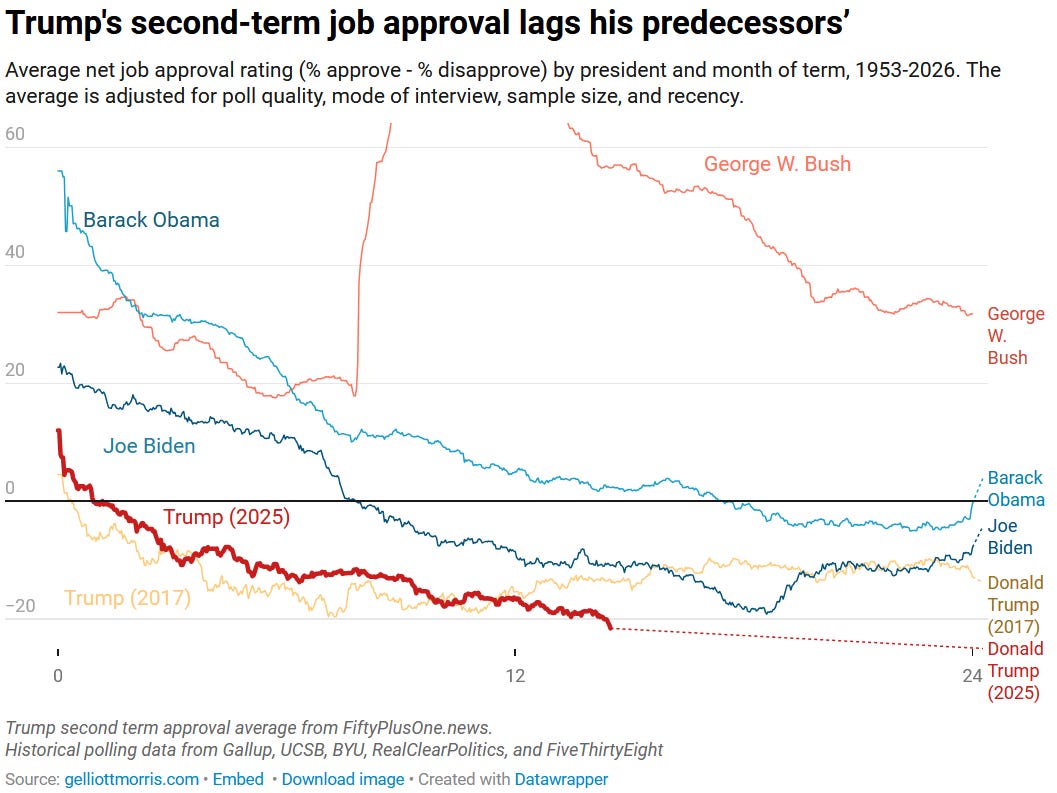
Even if his current term is treated as a second term — when presidents tend to experience declining approval — the comparisons are still grim.
At the end of the first year of their second terms, only the
Watergate-addled Nixon had a lower net approval number, -29.6, than the -16.2
net disapproval Trump had at the end of his fifth combined year in office. And
that low rating came three months ago, before the ICE/CBP shootings in
Minneapolis and the Iran war eroded Trump’s support by another five points and
counting.
Strongly disapproved
Let’s start with Trump’s overall approval ratings.
A couple weeks ago, UMass-Amherst delivered Trump
his worst approval/disapproval splits to date, with 62 percent disapproving his
performance and just 33 percent approving, a net -29 approval rate.
Reuters/IPSOS has Trump doing slightly
better at net -26, with 62 percent of Americans disapproving to just
36 percent approving, and a new CBS/YouGov
poll this week came in at -22 net, 61 percent to 39 percent. The
Economist’s latest
results show a record low net negative approval of -20 for their
survey. Even Napolitan News Service’s conservative-tilted pollster RMG
Research pegs
Trump at 58 percent to 40 percent, or -18 net disapproval. Overall,
per Silver
Bulletin’s weighted composite model, Trump is net -16, 56 percent to 40
percent.
More remarkable is that Nate Silver’s poll-of-polls shows
that, of those 57%, fully 47% of Americans strongly disapprove.

Bottom line? Trump has lost the country. And half of
Americans are beyond having soured on him — they’re sick of him.
Key demos and issues
Trump’s bottom-of-the-barrel support is shrinking among
almost every demographic.
Pundits marveled at Trump’s ability in 2024 to cobble
together a winning electoral coalition that eluded previous Republican
presidential nominees — adding younger and non-white voters to his core
strength among white working-class folks.
Now, he’s bleeding support among all three groups.
Among voters aged 18-34, he’s plunged from
a mere -15 approval split the month after he took office in February 2025 to
-60 now. After surveying data from seven polls, analyst Henry Olsen found that
Trump’s support among Hispanic voters has returned to levels comparable to
2020, when Joe Biden carried the demographic by a comfortable 33-point margin,
a huge swing relative to Trump’s small, 5-point margin of defeat among
Hispanics in 2024.
Even the white working-class voters whom pundits declared
dead to Democrats forever, have turned against Trump: The CNN/SSRS, Fox News,
and NPR/Marist polls, all of which reported double-digit positive favorability
ratings for him shortly after taking office in 2025, now show Trump slightly
underwater with this key demographic subgroup. According to CNN’s Harry Enten,
who computed a then-and-now composite rating of Trump’s approval with WWC
voters, Trump has fallen
34 points, from +32 to -2, between February 2025 and today.
As for policy, Trump is net negative on almost every issue
except crime and the border RMG shows Trump
net negative on issues that won him the 2024 election, including inflation
(-24), the economy (-21), and even immigration (-7). But RMG is a
Trump-favorable outlier. The latest UMass poll has
Trump faring far worse on similar issues: -25 on immigration, -36 on tariffs,
-31 on jobs, and a whopping -47 on inflation. Fox News’ late March poll confirmed
that “80 percent of respondents said they were concerned about gas prices, and
86 percent concerned about inflation and high prices.”
ICE and Iran
Trump’s handling of immigration and Iran obliterated almost
all of his remaining non-MAGA support.
Before Iran, Trump began leaking support from citizens
furious about radical use of masked DHS goons to terrorize citizens and
non-citizens alike. The images and stories from Minneapolis this winter caused
Americans to reevaluate their support for his immigration policies. By the
first week of February, 65 percent of all Americans — including 71 percent of
independents and even 27 percent of Republicans — told NPR
that ICE’s enforcement actions had “gone too far.”
And then came the Iran war.
No other issue has so turned Americans, including many
diehard Trumpers, against him. From social media influencers like Breck “Patriotic Blonde”
Worsham to veteran conservative voices like “American Conservative”
magazine’s Scott
McConnell, notable Trump supporters have publicly rebuked him. Some admit
they regret or are ashamed to have voted for him in the past three elections.
Initially low support for Trump’s Iran war has drifted still
lower. Pew reports Trump’s
Iran disapproval at 61 percent, with 44 percent strongly disapproving.
CNN shows Trump’s
Iran approval at just 33 percent, with 66 percent disapproving, including 54
percent strongly opposed. The Fox News poll taken at the end of March showed
Trump’s net Iran rating at -18, four points worse than the net -14 margin in
Fox’s poll taken at the start of the war.
And the latest CBS/YouGov poll makes
clear that Americans blame the Trump Administration specifically for the mess
in Iran. Roughly three-fifths of Americans said the administration has “not
clearly explained its goals” for the war (66 percent), has been changing “what
they claim those goals are” (64 percent), and “does not have a clear plan” for
what they’re doing in Iran (62 percent).
Americans also worry about endangering the lives of their
fellow countrymen, whether in uniform or not. Overall, NPR reports that 86
percent of Americans are concerned American lives will be at risk, and
three-quarters of citizens oppose sending troops into Iran. According to CNN,
among non-MAGA Republicans, 56 percent oppose and 20 percent favor sending
troops to Iran. Heck, even MAGA Republicans by a 7-point margin, 32 percent to
25 percent, object to putting boots on the ground.
More broadly, Trump’s incessant threats and aggressive
actions against Venezuela, Cuba, Greenland, Canada, and now Iran have convinced
three-fifths of Americans that he’s a reckless steward of US foreign and
military affairs. In fact, “33 percent now say they approve of his handling of
the role of commander in chief. That’s down eight points from a January poll
taken in the immediate aftermath of US military action in Venezuela and five
points below his previous presidential low,” writes CNN’s
Ariel Edwards-Levy. “About six in 10 say he has gone too far in trying to
expand America’s power over other countries, little changed since January.”
In short, trust in Trump to lead our nation and our troops
has cratered.
Dragging down the GOP
Trump’s problems are now a political-electoral albatross
hanging around the Republican Party’s neck.
Every three months, Gallup asks Americans if they “lean
more” toward either the Democratic or Republican parties. Typically, about 10
percent of Americans say neither, with the other 90 percent split evenly
between the two major parties. Parties tend to peak following a presidential
win: Democrats led Republicans by nine points, 49-40, in the fourth quarter of
2020 after Joe Biden’s win, and Republicans led Democrats by four points,
47-43, in the last poll of 2024 following Trump’s victory.
The latest Gallup recent result, for the first quarter of
2026? It has the Democrats leading by 10 points, 49
to 39 percent.
With the midterms seven months away, Trump is clearly a
liability for Republicans facing reelection. The recent CNN/SRSS poll showed
a 10-point enthusiasm advantage for the Democrats: 84 percent of Democrats are
enthusiastic to vote, just 74 percent of Republicans. Although they may be so
disgruntled they stay home this November, so-called “double-haters” — Americans
who dislike both parties — favor the Democrats by a whopping 31 points, 55
percent to 24 percent.
Nowhere to go but down
Perhaps Trump has hit rock bottom, with nowhere to go but
up. But history suggests otherwise.
Barring a major crisis to which Trump responds with dramatic
leadership — not likely, given his poor response to covid and present
misadventure in Iran — his public support at best will stabilize at his
current, dismal levels. But his numbers may fall further, for two reasons.
First, Trump is saddled with the same economic problems he
used to skewer Biden and then beat Harris in 2024. Trump won a second term in
large part because incumbent parties in 2023 and 2024 across the free world —
left, right, and center — were electoral casualties of persistent, post-covid
inflation. Trump blamed Biden-Harris for high gas and grocery prices, then
harvested votes from discontented Americans.
But Trump voters failed to notice that his two signature
promises — removing the immigrant labor supply that keeps domestic prices low,
and imposing tariffs that raise import prices — are inherently inflationary.
And now crude oil prices are surging amid uncertainty about Trump’s Iran war
and control of the vital Strait of Hormuz.
Days before he attacked Iran, Trump bragged during his State
of the Union address about low gas prices. He wanted the credit, but now he
owns all the blame for the surge in prices since. Because the trucking firms
that deliver goods to grocery stores and retailers also pay more for gas, those
costs get passed along to consumers. On cue, the OECD last week revised its
estimate for the 2026 US inflation rate upward 1.2 points, from 3.0 percent to
4.2 percent.
“Bidenflation” is now “Trumpflation.”
The other reason Trump is unlikely to rebound is
presidential fatigue, the phenomenon wherein voters tire of second-term
presidents.
The fact that Trump’s second term is non-consecutive only
exacerbates that issue: Although he’s technically only starting his sixth
combined year in office, it feels like he’s been around longer because,
well, he has been. Trump did not slink into retirement after
leading the January 6 attack on the US Capitol: He has remained the central
figure of American politics for a decade, including through Biden’s intervening
four years.
In short, Americans are sick and tired of Trump. And with
almost three years left in his second term, he is unlikely to gain strength in
the months and years ahead — a reality that may make him more desperate and
dangerous than ever.
As for the Jesus imagery he posted on Truth Social and then
deleted? Well, the new CBS/YouGov poll asked Americans about that, too. Fully
47 percent strongly dislike it, and another 12 percent somewhat dislike it. At
this point, even Jesus would have a hard time resurrecting Trump’s public
approval.
Thanks for reading Public Notice. This post is public so
feel free to share it.
Tom Schaller is professor of political
science at UMBC, and author of five books, including New York Times
bestseller White
Rural Rage.

