Menu Bar

Home           Calendar           Topics          Just Charlestown          About Us
Showing posts with label Elizabeth Warren. Show all posts

Tuesday, March 24, 2026

Trump's whoppers about oil and gas prices

Big Oil wins. You lose.

Noah Berlatsky

“The United States is the largest Oil Producer in the World, by far, so when oil prices go up, we make a lot of money,” Donald Trump boasted on Truth Social.

Oil prices are, of course, going up because Trump launched an illegal war of aggression against Iran without considering the (incredibly obvious) possibility that Iran might retaliate by closing the Strait of Hormuz. Gas prices have spiked 60 cents this month as oil hit $100 a barrel, and Energy Secretary Chris Wright refused to rule out the possibility oil might even rise to $200 a barrel.

Trump’s blasé trumpeting of the virtues of rising prices is in part simple fecklessness — he’s a liar who insists everything he does is brilliant and awesome.

But Trump’s decision to attack Iran and put upward pressure on prices at home puts him a political pickle, since he excoriated Biden for the high cost of gas during the 2024 campaign. In fact, the day before he launched his war, Trump preened about how far prices had fallen. But suddenly high prices are good, because as long as Trump is shuffling gaseously from Mar-a-Lago to the White House, it’s always an orange utopia in America.

To some degree, though, Trump’s love of high prices is sincere. Our current fascist president is a crony capitalist and loves the idea of screwing consumers, who he sees as suckers and marks. He identifies with the wealthy and likes it when the rich get richer. His populist mouth noises have always been a put on — as an instinctual oligarch, he gets a little shiver of pleasure whenever he can harm the little guy.

Saturday, February 21, 2026

RFK Jr. Made Promises in Order to Become Health Secretary. He’s Broken Many of Them.

Biggest lies were about vaccines and research


One year after taking charge of the nation’s health department, Health and Human Services Secretary Robert F. Kennedy Jr. hasn’t held true to many of the promises he made while appealing to U.S. senators concerned about the longtime anti-vaccine activist’s plans for the nation’s care.

Kennedy squeaked through a narrow Senate vote to be confirmed as head of the Department of Health and Human Services, only after making a number of public and private guarantees about how he would handle vaccine funding and recommendations as secretary.

Here’s a look at some of the promises Kennedy made during his confirmation process.

The Childhood Vaccine Schedule

In two hearings in January 2025, Kennedy repeatedly assured senators that he supported childhood vaccines, noting that all his children were vaccinated.

Sen. Elizabeth Warren (D-Mass.) grilled Kennedy about the money he’s made in the private sector from lawsuits against vaccine makers and accused him of planning to profit from potential future policies making it easier to sue.

“Kennedy can kill off access to vaccines and make millions of dollars while he does it,” Warren said during the Senate Finance Committee hearing. “Kids might die, but Robert Kennedy can keep cashing in.”

Warren’s statement prompted an assurance by Kennedy.

“Senator, I support vaccines,” he said. “I support the childhood schedule. I will do that.”

Days later, Sen. Bill Cassidy of Louisiana, chair of the Senate Health, Education, Labor, and Pensions Committee, declared Kennedy had pledged to maintain existing vaccine recommendations if confirmed. Cassidy, a physician specializing in liver diseases and a vocal supporter of vaccination, had questioned Kennedy sharply in a hearing about his views on shots.

“If confirmed, he will maintain the Centers for Disease Control and Prevention’s Advisory Committee on Immunization Practices’ recommendations without changes,” Cassidy said during a speech on the Senate floor explaining his vote for Kennedy.

A few months after he was confirmed, Kennedy fired all the incumbent members of the vaccine advisory panel, known as ACIP, and appointed new members, including several who, like him, oppose some vaccines. The panel’s recommendations soon changed drastically.

Sunday, January 11, 2026

Big Oil tells Trump they won’t go into Venezuela without big bucks from US taxpayers

The grift goes on

Brett Wilkins

ExxonMobil’s CEO told Donald Trump that Venezuela is currently “uninvestible” following the US invasion and kidnapping of President Nicolás Maduro, underscoring fears that American taxpayers will be left footing the bill for the administration’s goal of exploiting the South American nation’s vast petroleum resources.

Trump had hoped to convince executives from around two dozen oil companies to invest in Venezuela after the president claimed US firms pledged to spend at least $100 billion in the country. However, Trump got a reality check during Friday’s White House meeting, as at least one Big Oil CEO balked at committing financial and other resources in an uncertain political, legal, and security environment.

“If we look at the legal and commercial constructs and frameworks in place today in Venezuela today, it’s uninvestable,” ExxonMobil CEO Darren Woods told Trump during the meeting. “Significant changes have to be made to those commercial frameworks, the legal system. There has to be durable investment protections, and there has to be a change to the hydrocarbon laws in the country.”

There is also skepticism regarding Trump’s promise of “total safety” for investors in Venezuela amid deadly US military aggression and regime change.

However, many of the executives—who stand to make billions of dollars from the invasion—told Trump that they remain eager to eventually reap the rewards of any potential US takeover of Venezuela’s vast oil resources.

The oil executives’ apparent aversion to immediate investment in Venezuela—and Trump’s own admission that the American people might end up reimbursing Big Oil for its efforts—prompted backlash from taxpayer advocates.

Tuesday, July 15, 2025

'Unforgivable': FEMA Missed Thousands of Calls from Texas Flood Victims After Noem Fired the people who answer the phones

A preview of what will happen when it's Charlestown's turn to deal with a disaster

Stephen Prager for Common Dreams

Outrage continues to grow against U.S. Secretary of Homeland Security Kristi Noem over her response to the deadly floods that ravaged Texas last week.

According to a Friday report from The New York Timesmore than two-thirds of phone calls to the Federal Emergency Management Agency (FEMA) from flood victims went unanswered after Noem allowed hundreds of contractors to be laid off on July 5, just a day after the nightmare storm.

According to The Times, this dramatically hampered the ability of the agency to respond to calls from survivors in the following days:

On July 5, as floodwaters were starting to recede, FEMA received 3,027 calls from disaster survivors and answered 3,018, or roughly 99.7 percent, the documents show. Contractors with four call center companies answered the vast majority of the calls.

That evening, however, Noem did not renew the contracts with the four companies, and hundreds of contractors were fired, according to the documents and the person briefed on the matter.

The next day, July 6, FEMA received 2,363 calls and answered 846, or roughly 35.8 percent, according to the documents. And on Monday, July 7, the agency fielded 16,419 calls and answered 2,613, or around 15.9 percent, the documents show.

Calling is one of the primary ways that flood victims apply for aid from the disaster relief agency. But Noem would wait until July 10—five days later—to renew the contracts of the people who took those phone calls.

Tuesday, June 3, 2025

Trump and Musk's snipe hunt for Social Security fraud

Musk hunt for Social Security fraud is a sham

Jake Johnson for Common Dreams

Tesla cyber truck crash WITHOUT Elon Musk in it
An internal Trump administration document reportedly shows that anti-fraud checks recently installed at the Social Security agency have found just two cases of potentially improper benefit claims out of more than 110,000—a rate of 0.0018%.

The documents, first reported Thursday by Nextgov/FCW, further undercut Donald Trump and billionaire Elon Musk's narrative that Social Security is brimming with fraud. Musk falsely claimed in March that "40% of the calls into Social Security were fraudulent."

The anti-fraud checks for Social Security have been applied only to benefit claims made over the phone. According to the internal document, "No significant fraud has been detected from the flagged cases." Earlier this year, amid widespread outrage, the Social Security Administration (SSA) walked back a proposal to scrap many of its phone-based benefit claim services.

Nextgov/FCW noted Thursday that the Trump administration's deployment of the anti-fraud tools beginning last month "did cause delays, as SSA changed its phone procedures to add the checks on the backend."

Saturday, April 12, 2025

How Trump and Musk are marching America into fascism

When Fascism Comes to America

Bill Durston for Common Dreams

There's a relatively obscure quotation, sometimes attributed to the 20th-century American author Sinclair Lewis, that reads, "When fascism comes to America, it will be wrapped in the flag and carrying a cross."

Although no one’s actually sure that Sinclair Lewis ever wrote or said this, his 1935 novel, It Can't Happen Here, centers around a flag-hugging, Bible-thumping politician named Berzelius (”Buzz”) Windrip. 

Despite having no particular leadership skills other than the ability to mesmerize large audiences by appealing to their baser instincts (and to bully those people who aren’t so easily mesmerized), Windrip is elected President of the United States. 

Shortly after Windrip takes office, through a flurry of executive orders, appointments of unqualified cronies to key governmental positions, and then a declaration of martial law, Windrip quickly makes the transition from a democratically elected president to a brutal, fascist dictator. The novel’s title, It Can’t Happen Here, refers to the mindset of key characters in the novel who fail to recognize Windrip’s fascist agenda before it’s too late.

Written almost a century ago during the rise of fascism in Europe prior to World War II, It Can’t Happen Here is disturbingly prescient today. Buzz Windrip’s personal traits, his rhetoric, and the path through which he initially becomes the democratically elected U.S. president, and soon afterward, the country’s first full-fledged fascist dictator, bear an uncanny resemblance to the personality traits and rhetoric of Donald Trump and the path through which he has come thus far to be the 47th President of the United States, and through which he appears to be on course to become our country’s first full-fledged…. But no! It can’t happen here! Or can it?

Trump’s uncanny resemblance to the fictional dictator in Sinclair Lewis’s 1935 novel is disconcerting. The far more important concern, though, is the degree to which Trump resembles real-life fascist dictators, past and present. A study of notorious 20th- century fascist dictators, including Hitler and Mussolini, concluded that they and their regimes all had several characteristics in common. (The current regimes of Vladimir Putin in Russia, Xi Jinping in China, and Kim Jong Un in North Korea also share these characteristics.)

Friday, March 14, 2025

Trump CFPB Drops Cases Against Companies Accused of Cheating Consumers

President Musk and King Donald continue to promote fraud and abuse by letting corporate criminals off the hook

Jessica Corbett

Pawel Kuczynski
Consumer advocates slammed the Trump administration for dropping various enforcement actions against companies accused of activities that include ripping off savings account holders, illegally collecting on student loans, and engaging in an unlawful mortgage broker kickback scheme.

The Consumer Financial Protection Bureau's notices of voluntary dismissal came as the U.S. Senate Committee on Banking, Housing, and Urban Affairs held a hearing for Jonathan McKernan, President Donald Trump's pick to lead the CFPB—which Accountable.US executive director Tony Carrk has called "a gift to big banks and special interests."

While the former Federal Deposit Insurance Corporation board member awaits confirmation from the GOP-controlled Senate, Trump and Russell Vought, the CFPB's temporary leader, have wasted no time trying to gut the agency and undo the work of its former director, Rohit Chopra, who oversaw cases against the following companies:

  • Capital One, accused of cheating millions of banking customers out of more than $2 billion in interest;
  • Heights Finance, accused of loan-churning practices that harvested hundreds of millions of dollars in costs and fees;
  • Pennsylvania Higher Education Assistance Agency (PHEAA), accused of collecting on student loans discharged in bankruptcy and sending false information to credit reporting companies;
  • Rocket Homes, accused of providing incentives to real estate agents and brokers who steered homebuyers toward its loans; and
  • Vanderbilt Mortgage & Finance, accused of trapping people in risky loans for manufactured homes.

Wednesday, October 2, 2024

Here are big companies that pay less taxes than they pay their top executives

Trump tax cuts - the gift that keeps on giving to Big Business

Jake Johnson for Common Dreams

A group of congressional Democrats and Independent Sen. Bernie Sanders on Friday highlighted dozens of profitable U.S. corporations that have paid their executives more than they've paid in federal income taxes in recent years, a problem that the lawmakers attributed in large part to former President Donald Trump's massive tax-cut package that Republicans are working to extend.

"In the first five years following the 2017 giveaway, 35 companies raked in $277 billion in domestic profits and paid their executives $9.5 billion—more than they paid in federal income taxes," the lawmakers noted in letters to each of the companies, pointing to recent research by the Institute for Policy Studies and Americans for Tax Fairness.

Monday, April 1, 2024

What’s to stop chip-making giant from shoveling taxpayer grants into more stock buybacks?

Stock buybacks don't create jobs

LES LEOPOLD for Common Dreams

Intel, the largest chip maker in America, with 2023 revenues of $54 billion, has just been awarded an $8.5 billion grant from the federal CHIPS and Science Act, plus $11 billion in favorable loans.

In addition to badly needed microchips, Intel produces totally useless stock buybacks. On its website the company proudly proclaims to have spent $152 billion on stock buybacks since 1990. That’s not a typo: $152,000,000,000. Which is why I call it "Stock Buybacks Я Us."

Intel took $152 billion of its revenues, some portion of which could have been used for R&D and building new microchip facilities in the U.S. as well as paying workers more, and instead funneled it to its largest Wall Street stockholders and corporate executives, enriching the top fraction of the top one percent.

A company repurchasing its own shares sees earnings per share rise because there are fewer shares in circulation. Share prices rise, though nothing new is made, and the largest stockholders, including top Intel executives, cash out with eye-popping profits. Intel CEO Pat Gelsinger hauled in $179 million in 2021, most of it coming from stock-related compensation.

Stock buybacks are a form of stock manipulation, which is why they were outlawed by the Securities and Exchange Commission after the Great Depression, up until deregulation in 1982, that limited buybacks to two percent of profits. Now it’s all the buybacks your corporation can eat, with nearly 70 percent of all corporate profits going to this form of stock manipulation.

So, why are we giving Intel another $8 billion?

Tuesday, February 21, 2023

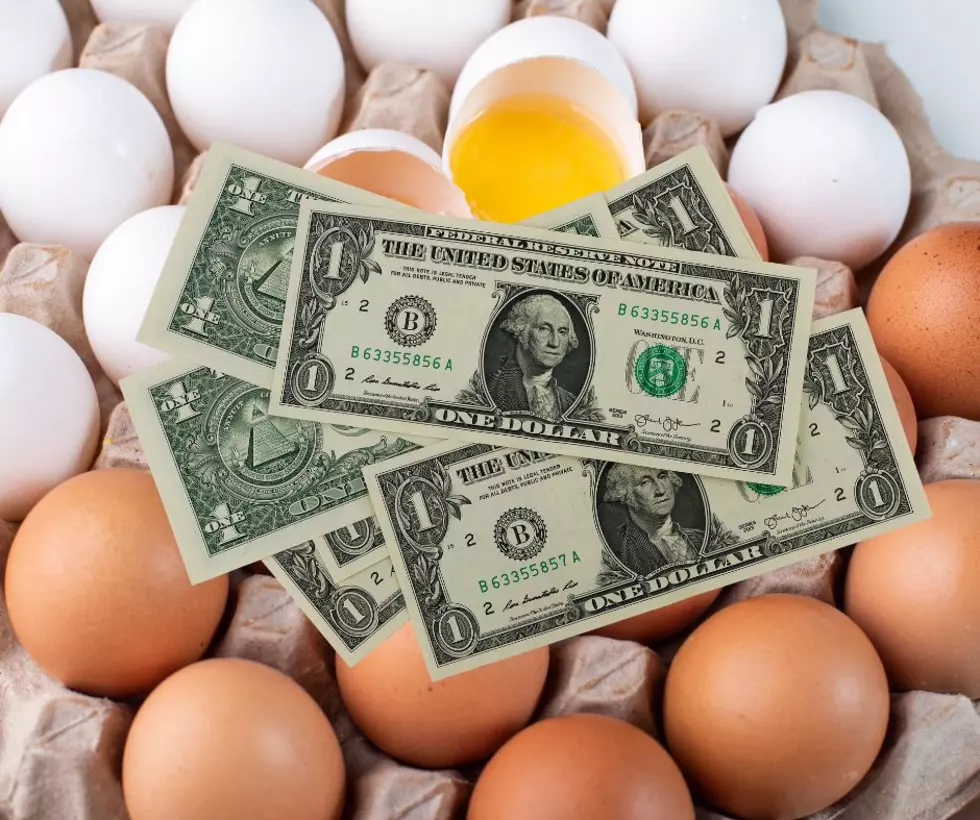
Pushing the egg industry to explain insane increase in price

Warren and Porter Demand Answers From Big Egg Over 'Massive Spike' in Prices

JAKE JOHNSON for Common Dreams

Sen. Elizabeth Warren and Rep. Katie Porter on Thursday demanded answers from the five largest egg producers in the United States over recent price surges that companies have blamed on an avian flu outbreak—a narrative that advocates view as an effort to distract attention from rampant profiteering in the industry.

Warren (D-Mass.) and Porter (D-Calif.) invoked that criticism in letters to Rose Acre Farms, Cal-Maine Foods, Hillandale Farms, Versova Management, and Daybreak Foods, writing that they are concerned by the "massive spike" in prices and "the extent to which egg producers may be using fears about avian flu and supply shocks as a cover to pad their own profits at the expense of American families."

Saturday, October 15, 2022

Crucial Choices Ahead for Beloved, Besieged Social Security

Time to lift the income cap? 

By Gerald Scorse, Guest Columnist 

“It was the best of times, it was the worst of times.” That famous phrase from Charles Dickens sums up the double-edged sword hanging over the roughly 63 million Americans now getting monthly retirement payouts from Social Security. 

Their 2022 COLA (cost-of-living adjustment) rose by 5.9%, the biggest jump in nearly 40 years. The 2023 increase, just announced, came in at an even-higher 8.7%. That’s the best of times. The worst of times, getting ever closer, is the date when the Social Security trust fund runs out of money—and those higher benefits this year and next will likely wipe out the fund earlier than the current estimate of 2034. 

Adding to the problem, the nation’s demographics have created their own double-edged sword. For years, a combination of higher life expectancies and lower birth rates has been lowering the ratio of workers who pay in to beneficiaries who take out. 

Putting everything together, Congress will be forced to act to keep benefits from shrinking to only 78% of the currently scheduled amounts. There’s little doubt that lawmakers won’t let that happen, but plenty of doubt over the direction their fixes will take. 

Even though Social Security is hugely popular, only the most optimistic expect a bipartisan solution. Everything will likely hinge on which party is in charge, and the ideas backed by the two parties differ sharply. Democrats want more generous benefits; the GOP, under the guise of saving Social Security, would effectively cut them. 

Let’s review the major ideas. Then let’s consider two further reforms—both aimed at high-income Americans—to help prevent any shortfall and put the system on a sound fiscal basis. 

Tuesday, February 1, 2022

Nukes are not the answer to the climate crisis

Experts Say Nuclear Energy as Climate Solution Is Total 'Fiction'

JESSICA CORBETT

As global scientists continue to warn of the urgent need to keep fossil fuels in the ground, a quartet of European and U.S. experts on Tuesday made a comprehensive case for why nuclear power should be not be considered a solution to the climate crisis.

While the experts recognize in their joint statement that "the climate is running hot," they push back forcefully against those who argue nuclear could be a "partial response to the threat of global heating."

With four signatories—Paul Dorfman, former secretary of the U.K. government's Committee Examining Radiation Risks of Internal Emitters; Greg Jaczko, former chairman of the U.S. Nuclear Regulatory Commission; Bernard Laponche, former director general of France's energy management agency; and Wolfgang Renneberg, former head of the reactor safety, radiation protection, and nuclear waste at Germany's environmental ministry—the statement comes as a direct challenge to a nuclear industry trying to bill itself as a reliable part of the world's transition to a more sustainable energy system.

Thursday, October 28, 2021

We Need to Tax the Billionaires Right Now

This moment may not last to make sure the outrageously wealthy pay their fair share.

SARAH ANDERSON,  CHUCK COLLINS

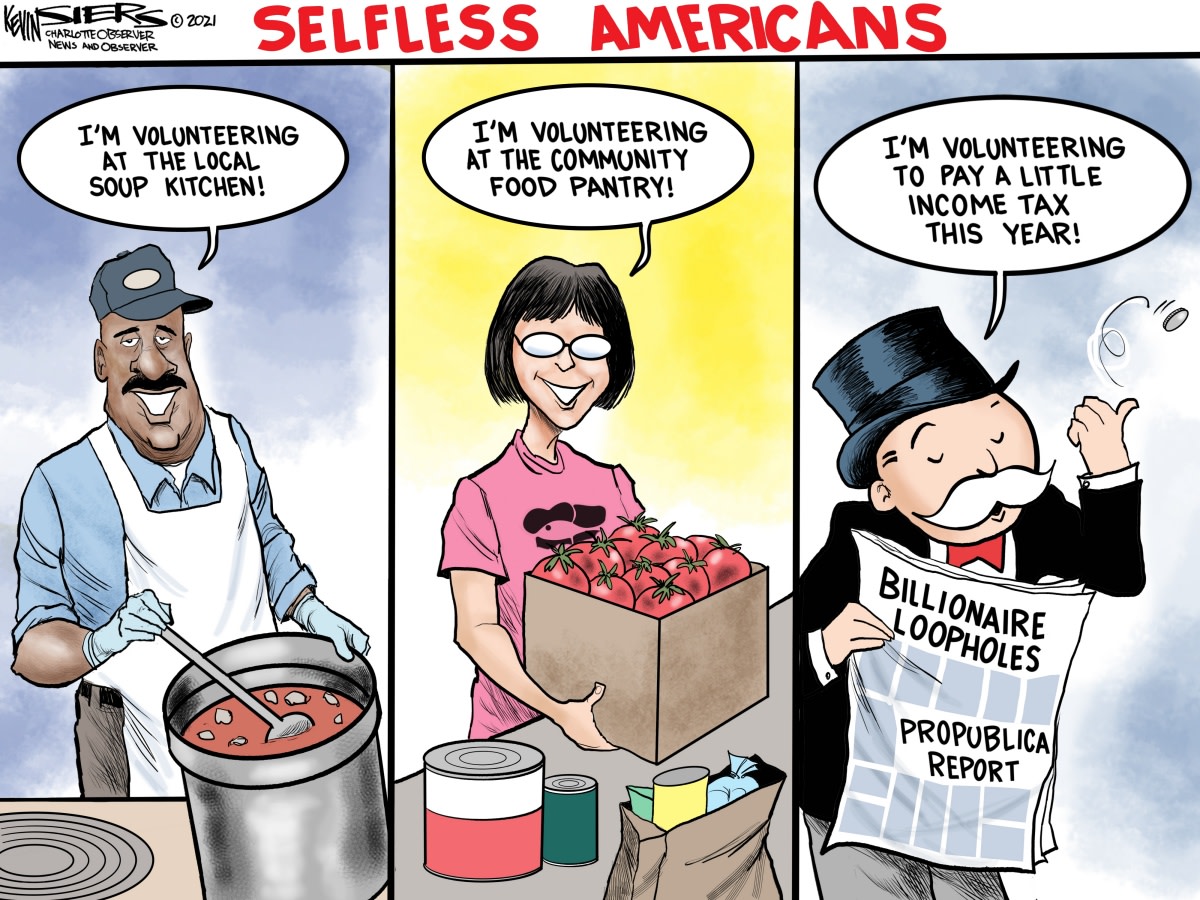
Illustration by Kevin Siers on Cagle Cartoons.
We are in a historic (and potentially very brief!) political moment when progressives have a real shot at winning a path-breaking tax on the nation’s super-wealthy.

Just over the past week, a billionaire wealth tax proposal has suddenly moved from the edge to the very center of the negotiating table for President Biden’s sweeping Build Back Better agenda.

What explains the shift? The reasons are both negative and positive.

On the negative side: Kyrsten Sinema.

Last week, the Arizona Senator took a break from high-roller fundraising to inform her colleagues that she opposes even partially undoing the tax rate cuts on corporations and wealthy individuals that Republicans enacted (and she voted against) in 2017. 

This sent Democrats scrambling for new revenue sources, and Senator Elizabeth Warren and others are sounding optimistic that Sinema might be open to a billionaire tax.

Again on the negative side: pandemic profiteering.

U.S. billionaires have run wild during the crisis, making themselves nearly impossible to defend. Since March 2020, their combined wealth has ballooned by over $2.1 trillion, a gain of 70 percent, according to research by Americans for Tax Fairness and the Institute for Policy Studies. And instead of deploying their fortunes for good on this planet, billionaires have captured headlines with their outer space adventures.

In the positive side: activists taking on the billionaire class.

Many groups that once focused exclusively on poverty are now tackling the top end of the inequality problem and demanding that the rich pay their fair share of expanded child tax credits, universal pre-K, affordable home care, and the many other vital investments in the Build Back Better plan.

Tuesday, July 20, 2021

Whitehouse and Warren want investigation of super-rich tax dodges

How do Jeff Bezos, Elon Musk, Michael Bloomberg and other uber-wealthy avoid taxes?

by Jesse Eisinger, Paul Kiel and Jeff Ernsthausen for ProPublica

Series:
The Secret IRS Files

Inside the Tax Records of the .001%

Two prominent members of the Senate Finance Committee are calling for an investigation into tax avoidance by the ultrawealthy, citing ProPublica’s Secret IRS Files series.

In a letter, Elizabeth Warren (D-Mass.) and Sheldon Whitehouse (D-R.I.) wrote to the committee’s chairman, Ron Wyden (D-Ore.), that the “bombshell” and “deeply troubling” report requires an investigation into “how the nation’s wealthiest individuals are using a series of legal tax loopholes to avoid paying their fair share of income taxes.” 

The senators also requested that the Senate hold hearings and develop legislation to address the loopholes’ “impact on the nation’s finances and ability to pay for investments in infrastructure, health care, the economy, and the environment.”

Last month ProPublica began publishing a series of stories about tax avoidance among the ultrawealthy, based on a vast trove of tax data concerning thousands of the wealthiest American taxpayers and covering more than 15 years. 

ProPublica conducted an unprecedented analysis that compared the ultrawealthy’s taxes to the growth in their fortunes, calculating that the 25 richest Americans pay a “true tax rate” of just 3.4%.

Thursday, July 1, 2021

Unrig the Tax Code Now

Leaked IRS data proves the rumors are true: Many billionaires pay no income taxes. Will that spur reform?

SARAH ANDERSON

Senate Majority Leader Mitch McConnell, R-Ky. Jacquelyn Martin/AP
Recently leaked data revealed that Amazon CEO Jeff Bezos and several other U.S. billionaires have paid zero federal income taxes in some past years.

This has Senate Minority Leader Mitch McConnell up in arms—but not because of what the scandal reveals about our rigged tax system. Instead, McConnell wants to go after the whistleblowers who exposed the scandal.

.

"Whoever did this ought to be hunted down and thrown into jail," McConnell said in a radio interview.

What I suspect really bothers McConnell is that this data is likely to increase the pressure on him and other lawmakers to raise taxes on the wealthy. For the first time in decades, serious proposals to do just that are actually on the table in Washington. And the timing couldn't be better.

Poor and low-income Americans have paid the biggest price for the pandemic, while U.S. billionaires have seen their fortunes increase by more than $1 trillion. Now is the moment for America's ultra-rich to contribute their fair share to an economic recovery that will make the nation stronger in the face of future crises.

How are billionaires getting away with paying so little to Uncle Sam now? A key reason is that our current tax system rewards wealth, not work.

Wednesday, February 24, 2021

Working Families Party: Nearly one year into pandemic, RI billionaire’s wealth continues to climb

RI's richest man and only billionaire is doing fine during the pandemic. Most of us don't 

By the  Working Families Party 


Harvard Business School alumnus
The net worth of private-equity executive Jonathan Nelson, Rhode Island’s richest man and lone billionaire, jumped by $180 million, or 10% over the course of the pandemic, according to a new report by Americans for Tax Fairness (ATF), Health Care for America Now (HCAN) and the Rhode Island Working Families Party

The $180 million in pandemic profits of the state’s richest resident could make up over one-third of the state’s projected $400 – $500 million fiscal year 2022 budget gap, and still leave him as wealthy as he was when the pandemic hit 10 months ago.  

Between March 18 – the rough start date of the pandemic shutdown, when most federal and state economic restrictions were put in place – and January 29, Nelson’s fortune rose from $1.8 billion to $2 billion between March 18 and Jan 29, based on this analysis of Forbes data. 


Nelson’s private gain is a sharp contrast to the severe health and economic crises hitting average Rhode Islanders. 


Over the same 10 months, close to 113,754 state residents fell ill with the coronavirus, 2,144 died from it and 290,100 lost jobs in the accompanying recession. 


23,716 Rhode Islanders residents were collecting unemployment the week of Jan. 4, and late last year, 80,000 adult state residents, or 11%, reported going hungry over the past week. The figure for households with children was 14%.


While federal lawmakers debate more cash payments to people and families in the next relief package, Nelson has amassed enough new wealth during the pandemic, a  $180 million surge, to send every one of the state’s 1,059,361 residents a relief check of roughly $170 each. A family of four would get $680.

Wednesday, December 9, 2020

Biden could cancel student debt

Will he?

By Sarah AndersonMargot Rathke 

From the Huffington Post

Washington is abuzz with ideas for actions the Biden-Harris administration could take that would not require congressional approval. One of the buzziest: canceling student debts owed to the federal government.

The Department of Education owns about 92 percent of the $1.6 trillion in student loans Americans owe. Many legal scholars say the department has the authority to wipe these burdens away with the stroke of a pen.

“This is the single most effective executive action available to provide massive consumer-driven stimulus,” Senator Elizabeth Warren wrote in a Washington Post op-ed.

Back in September, Warren joined with Senate Democratic Leader Chuck Schumer to call on the next president to cancel up to $50,000 in federal student debt for every borrower in the United States. That would eliminate loan obligations for more than three-quarters of the approximately 44 million Americans with student debts.


Thursday, August 13, 2020

Class war is as American as apple pie

Fight for economic equality is as old as America itself
Daniel Mandell, Truman State University


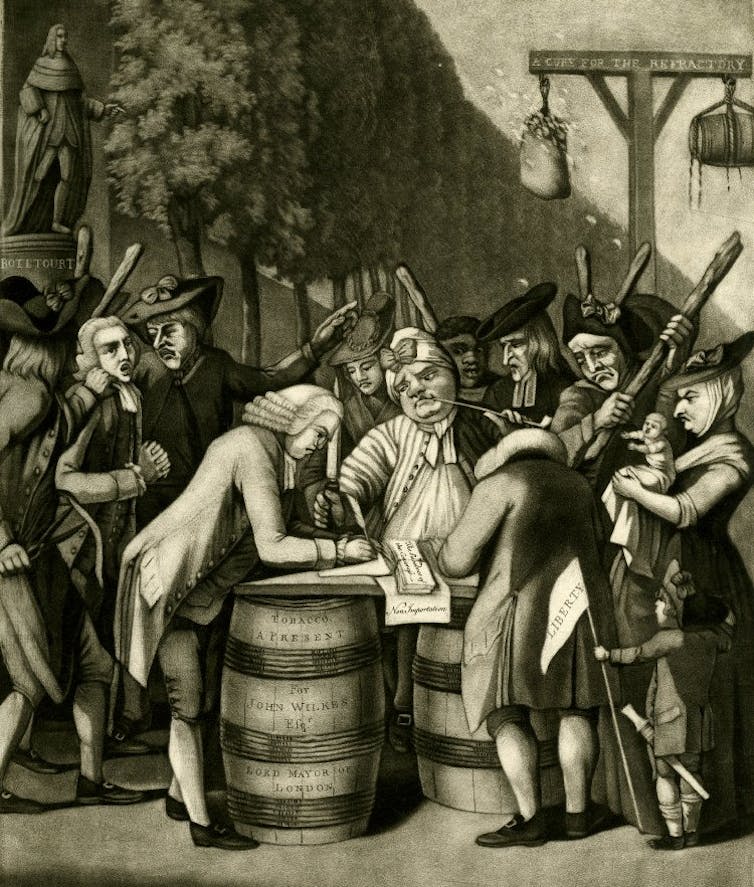
In a 1775 cartoon, a British cartoonist mocks how wealthy
elites were compelled by ordinary Americans to respect trade
and price regulations. Philip Dawe/Wikimedia Commons 
Americans are increasingly worried about the rising tide of economic inequality, as fewer control more wealth. 

For the origins of these concerns, commentators usually point to the Gilded Age at the end of the 19th century, when a few men gained immense wealth and power in the U.S. and workers suffered extreme poverty.

But fears of great wealth and the need for economic equality go back to the country’s origins.

Wealth as a danger to the nation

By the 1700s, Anglo-Americans generally believed that the best government was a republic that would ensure the public good by avoiding concentrated wealth. 

The British political tradition limited voting to men who owned property; about 20% in England, but 50% to 80% in their American colonies.

In 1773, as the colonies drew closer to revolt, New Haven minister Benjamin Trumbull urged elected officials to keep property “equally divided,” to not allow “a few persons to amass all the riches and wealth of a country.” 

Four months after the Declaration of Independence, the Pennsylvania Packet newspaper reported a proposal for the state’s legislature to tax wealth, “lessening property when it becomes excessive in individuals.”

During the war for independence, there were widespread state and local efforts to regulate prices of goods and services. The rules drew on this new egalitarian ideal and medieval assumptions that a community could set prices for necessities.


Thursday, July 9, 2020

Trump’s insulin plan – yet another trick on senior citizens

Don’t hold your breath waiting for your “savings”
By Will Collette

3272 Best Trump images in 2020 | Trump, Politics, Anti trumpAs a seventy year old diabetic on insulin, I was very interested in Donald Trump’s May 26 announcement that he had negotiated a terrific deal to “cap” the cost of insulin for people on Medicare at $35 a month.

He said he had worked out a fabulous deal with Big Pharma, insurance companies and Medicare. 

Now he is bestowing the fruits of his deal-making skills on older people, a major part of Trump’s 2016 voting bloc, but according to polls, are now abandoning him in droves.

In his announcement, Trump said:  
"If you don’t take insulin, I just wrote this down, you go blind, stroke, amputation, kidney failure and other things. So we’re getting it out…I hope the seniors are going to remember it, because Biden was the one who put us into the jam because they didn’t know what they were doing. They were incompetent….I don’t use insulin. Should I be? Huh? I never thought about it, but I know a lot of people are very badly affected.”
And why not: after all, Trump took hydroxychloroquine to prevent COVID-19 when medical experts and scientists said hydroxychloroquine not only doesn’t prevent COVID-19 but was also a dangerous and ineffective treatment for the disease. Maybe injecting a few hundred units of insulin would be just the thing to clear the fog out of his brain.

Surgeon General Dr. Jerome Adams had to come up to answer continuing questions to Trump about why he thought he should take insulin:
“Your body, Mr. President, actually makes insulin endogenously and people such as you and I, we make our own insulin. So yes we do utilize insulin, but we make it ourselves.”
But this little display of Trump’s medical acuity was just a sideshow. The real question is whether his announcement has any substance to reduce the brutally high cost of insulin - due in large part to actions by Trump's Health and Human Services Secretary Alex Azar, who ran leading insulin producer, Eli Lilly (see graphic, above left). 

Spoiler alert: this plan is too little, too late.


Wednesday, April 8, 2020

How Big Pharma Is Getting Ready To Blackmail Americans

Congress, Trump open the way for drug companies to charge sky-high prices.
By Alicia Mundy

Coronavirus (COVID-19) | DOJ | Department of JusticeThe $2.2 trillion coronavirus relief bill that Congress hastily passed and Donald Trump signed into law deliberately creates new price gouging opportunities for drug companies.

Left out of the relief bill was language from a 1980 law that requires drug companies to charge “reasonable” prices for pharmaceuticals developed with government financial help. Companies that charge unreasonable prices, or hold back on making their inventions available, can be stripped of monopoly rights.

Without this language companies that develop coronavirus vaccines or cures using federal funding can jack up prices for any COVID-19 cure or vaccine with no legal limits. 

Imagine the price gouging possibilities for a life-saving vaccine or cure. All other countries with modern economies have laws to protect against price gouging.

The message to those who can’t afford expensive vaccines and cures: Tough luck because if you get sick you may die.

Unless Congress and the Trump administration enact a new law to protect the public from price-gouging expect drug companies to charge the highest monopoly price that they can extract from government, health insurance firms and individuals. The message to those who can’t afford expensive vaccines and cures: Tough luck because if you get sick you may die.