Menu Bar

Home           Calendar           Topics          Just Charlestown          About Us
Showing posts with label Ronald Reagan. Show all posts

Sunday, July 26, 2026

MAGA declaring war on seniors — and it could be their downfall

Is Trump testing to see how much he can take away from seniors before they rebel?

Alex Henderson

According to data from the Roper Center at Cornell University, 50 percent of U.S. seniors — those who are 65 or older — voted for Donald Trump in 2024 compared to 49 percent for Democratic presidential nominee Kamala Harris

The senior vote was close in 2024, and seniors, Roper says, played an important role in getting Trump past the finish line. But according to Salon's Heather Digby Parton, seniors could be the ones who doom Republicans in the 2026 midterms.

Parton notes that because so many seniors vote GOP, "it's always been a mystery" to her "why Republicans have always been so bent on destroying the safety net that brought the elderly out of poverty and assured them a baseline level of subsistence and medical care." And she points that crucial safety-net programs used by seniors — Social Security and Medicare — came from liberal Democratic presidents.

"From the moment Franklin D. Roosevelt signed the Social Security Act in 1935 to the day Lyndon B. Johnson signed the Medicare and Medicaid Act 30 years later," Parton explains, "the right has been trying to destroy them. In the early days, it sprang from their obsession with anti-communism, arguments that the country couldn't afford it, and that individuals and their families are rightfully responsible for their own care in old age.

“In a 1961 radio address — 20 years before he became president — Ronald Reagan said, 'One of the traditional methods of imposing statism or socialism on a people has been by way of medicine' ... Before Medicare was created, only 54 percent of elderly people had health insurance, and that could be cancelled without cause when they got sick — which, as you know, tends to happen when you get old."

Parton continues, "Three years after it was enacted, 96 percent of people over 65 had hospital insurance. It was literally a life saver. Over the years, Medicaid, created at the same time to assist people living below the poverty line, came to cover many of the health expenses that Medicare didn't for elderly people, most importantly for nursing homes and caregivers. The GOP has been hacking away at these vital programs ever since, and yet, senior citizens have been voting for them in greater numbers than any other age cohort."

Sunday, April 19, 2026

“More bombs, less of everything else” is a tough campaign platform.

Trump's Total War Budget

Noah Berlatsky

Donald Trump called for the culmination of a 45-year Republican dream and did so in a way designed to do maximum damage to the GOP — not to mention the country.

That dream is the utter destruction of the US safety net and the unlimited expansion of the US military.

“The United States can’t take care of daycare,” Trump blustered during a speech to faith leaders. “That has to be up to a state. We’re fighting wars. Medicaid, Medicare — they can do it on a state basis. We have to take care of one thing: military protection. But all these little scams that have taken place, you have to let states take care of them.”

Two days later, Trump proposed a 2027 fiscal year budget with a defense spending increase of 42 percent, or $445 billion, to a staggering total of $1.5 trillion. The budget calls for reducing non-defense spending by 10 percent through the elimination of “woke, weaponized, and wasteful programs” — including steep cuts to the Internal Revenue Service, Environmental Protection Agency, NASA, and defunding the National Endowment for Democracy. Trump also called for massive budget cuts to the National Institutes of Health.

Democrats have said the document is dead on arrival — though Trump hopes to pass a big chunk of it through reconciliation without Democratic votes.

The budget does not, at least initially, include cuts to Medicare, Medicaid, or Social Security. It also does not include funding for Trump’s war against Iran, which he also hopes to pass through a reconciliation process without Democratic support. But it points the way clearly toward a distinctively Republican future for America — one in which the populace is transformed into an impoverished mass of hunger and disease, emitting occasional hoarse pleas for castoffs from oligarchs.

Patty Murray, the top democrat on the Senate appropriations committee, said it is a “bleak and unacceptable” vision. It’s one that is likely to be incredibly unpopular, throwing a lead anchor to the GOP’s already rapidly sinking midterm prospects.

Tuesday, April 14, 2026

Surprising truths about America’s tax history

"The Price of Democracy"

By Gerald Scorse

The more things change, the more they stay the same. Taxes, for instance, have been changing and staying the same ever since Reagan and the 1980s: They’ve been heaven for corporations and the rich, purgatory or worse for everybody else.

Now comes a groundbreaking book that looks back not just decades but centuries. It’s Vanessa A. Williamson’s The Price of Democracy: The Revolutionary Power of Taxation in American History. The surprises never stop coming.

Surprise No. 1, the Boston Tea Party. We’ve been brainwashed into believing that taxes were the cause. Not so; the Sons of Liberty were actually opposing the bailout of the “too big to fail” East India Company. As Samuel Adams warned, the bailout was “introductive to Monopolies.” 

Williamson says the colonists never objected to paying taxes. “To the extent the American Revolution was about taxation,” she writes, “it was about the desire of Americans to tax themselves…"

Come 1787, the new America had to decide what its own tax policies would be. Next surprise, the framers of the Constitution agreed that the wealthy few had to be protected from the masses. Listen to this from Alexander Hamilton: 

“All communities divide themselves into the few and the many. The first are the rich and well-born, the other the mass of the people.” As Hamilton saw it, the people “seldom judge or determine right.”

Thomas Paine saw things the other way around.  

Everybody knows that Paine helped ignite the American Revolution. Not many know that he wanted a tax revolution as well. Paine worried about the “overgrown influence” of wealth, calling it “one of the principal sources of corruption at elections.” He wanted marginal income tax rates, topping out at 100%.  Echoing Paine, an early New York newspaper proposed that “men should by every fair means be legally prevented from becoming exorbitantly rich”.

Saturday, March 28, 2026

Why do Americans hate each other while Canadians love each other?

Could it have something to do with our politics? With the sociopath in the Oval?

Robert Reich

survey released on March 5 by the Pew Research Center finds that 53 percent of American adults describe the morality and ethics of our fellow citizens as “bad” (ranging from “somewhat bad” to “very bad”).

This puts Americans way out front of other nations on the we-hate-our-compatriots scale. In the 24 other countries polled by Pew, most people called their fellow citizens somewhat good or very good.

At the opposite end of the spectrum from the United States is Canada, where 92 percent say their fellow Canadians are good, while just 7 percent say they’re bad.

Why are we so down on our fellow citizens? It may have something to do with our politics.

Some 30 years ago, my dear friend the late Republican Senator Alan Simpson told me Democrats viewed Republicans as stupid and Republicans viewed Democrats as evil. “I’d rather be in the stupid party,” he chuckled.

I asked him why Republicans saw Democrats as evil.

He took a deep breath. “Religion.”

I said I didn’t understand.

“It’s the Christian right,” he said, as if talking to a five-year-old. “Since Reagan, my party has been a magnet for religious conservatives and Christian fundamentalists, where it’s all about good and evil. Too bad, pal. You’re on the evil side.”

That was 30 years ago. Since then, the divide has only sharpened.

In 2012, Mitt Romney told supporters that “47 percent” of Americans would vote for Obama no matter what because they’re “dependent upon government ... believe that they are victims ... believe the government has a responsibility to care for them ... [and] pay no income tax.”

Insulting 47 percent of Americans was no way to win an election. It was also no way to unite the country.

Then in 2016, Hillary Clinton described half of Trump’s supporters as a “basket of deplorables.” Also no way to win or to foster mutual trust.

Once Trump took office, dislike of our fellow citizens soared.

Before he entered the White House, 47 percent of Republicans and 35 percent of Democrats said people in the opposing party were “immoral.”

By 2022, after years of Trump’s venom: 72 percent of Republicans and 63 percent of Democrats called people in the opposing party “immoral.”

Since he’s been back in the Oval, it’s gotten even worse. 

Thursday, July 31, 2025

Cognitive collapse and the nuclear codes: When leaders lose control

What could go wrong with a "stable genius" with his finger on the trigger?

University of Otago

A shocking study reveals that many leaders of nuclear-armed nations—including US presidents and Israeli prime ministers—were afflicted by serious health problems while in office, sometimes with their conditions hidden from the public. 


From dementia and depression to addiction and chronic diseases, these impairments may have affected their decision-making during pivotal global crises.

Many former leaders of the world's nine nuclear-armed nations were impaired by health conditions while in office, raising concerns over their decision-making abilities while they had access to nuclear weapon launch codes, a study from the University of Otago, New Zealand, has found.

The study analyzed the health information of 51 deceased leaders of nuclear-armed countries: China, France, India, Israel, North Korea, Pakistan, Russia, the United Kingdom and the United States. 

Eight of the leaders died from chronic disease while still in office, five from heart attacks or strokes. Many of the leaders had multiple serious health issues while in office, including dementia, personality disorders, depression and drug and alcohol abuse.

The research was led by Professor Nick Wilson, from the Department of Public Health at the University of Otago, Wellington - Ōtākou Whakaihu Waka, Pōneke, with Associate Professor George Thomson and independent researcher Dr Matt Boyd. 

Professor Wilson says that of the leaders who left office while still alive, 15 had confirmed or possible health issues which likely hastened their departure.

"Probably all of this group of 15 leaders had their performance in office impaired by their health conditions. In some cases, the degree of impairment was profound, such as in the case of two former Israeli Prime Ministers: Ariel Sharon, who became comatose after suffering a stroke in office, and Menachem Begin, whose depression was so severe he spent his last year as leader isolated in his home. 

Impairment during crises was also seen in the case of Richard Nixon's bouts of heavy drinking - including during a nuclear crisis involving the Middle East.

"There have also been occasions where health information about leaders has been kept secret at the time."

Saturday, July 19, 2025

Trump 2.0 is deploying new surveillance methods to extend its authoritarian power

Big Brother Donald Is Watching You

Rebecca Gordon for TomDispatch

Sometime in the late 1980s, I was talking with a friend on my landline (the only kind of telephone we had then). We were discussing logistics for an upcoming demonstration against the Reagan administration’s support for the Contras fighting the elected government of Nicaragua. We agreed that, when our call was done, I’d call another friend, “Mary,” to update her on the plans. I hung up.

But before I could make the call, my phone rang.

“Hi, this is Mary,” my friend said.

“Mary! I was just about to call you.”

“But you did call me,” she said.

“No, I didn’t. My phone just rang, and you were on the other end.”

It was pretty creepy, but that was how surveillance worked in the days of wired telephone systems. Whoever was listening in, most likely someone from the local San Francisco Police Department, had inadvertently caused both lines to ring, while preparing to catch my coming conversation with Mary. Assuming they’d followed the law, arranging such surveillance would have involved a number of legal and technical steps, including securing a wiretapping warrant. They’d have had to create a physical connection between their phones and ours, most likely by plugging into the phone company’s central office.

Government surveillance has come a long way since then, both technically and in terms of what’s legally possible in Donald Trump’s United States and under the John Roberts Supreme Court.

All the President’s Tech

Government agencies have many ways of keeping tabs on us today. The advent of cellular technology has made it so much easier to track where any of us have been, simply by triangulating the locations of the cell towers our phones have pinged along the way.

If you watch police procedurals on television (which I admit to doing more than is probably good for me), you’ll see a panoply of surveillance methods on display, in addition to cellular location data. 

It used to be only on British shows that the police could routinely rely on video recordings as aids in crime solving. For some decades, the Brits were ahead of us in creating a surveillance society. Nowadays, though, even the detectives on U.S. shows like Law and Order SVU (heading for its 27th season) can usually locate a private video camera with a sightline to the crime and get its owner to turn over the digital data.

Facial recognition is another technology you’ll see on police dramas these days. It’s usually illustrated by a five-second interval during which dozens of faces appear briefly on a computer monitor. The sequence ends with a final triumphant flourish—a single face remaining on screen, behind a single flashing word: “MATCH.”

Saturday, June 14, 2025

Trump to Workers: Drop Dead

Job Safety Budget Just $3.68 per Worker 

By Jordan Barab, Confined Space

In Washington DC, the classical way to attempt to hide bad news is to announce it late Friday afternoon.  And the Trump administration never disappoints: Late Friday afternoon (May 30), the administration dumped its detailed FY 2026 budget proposals for four federal worker safety agencies.

If budgets are the monetary expression of an organization’s values, Trump’s message to workers is: Drop Dead.

The administration’s budget requests that Congress impose devastating cuts on the Occupational Health and Safety Administration, the similar Mine Safety agency, the research arm called the National Institute for Occupational Safety and Health and the elimination of the Chemical Safety Board.

Before I get into the depressing details, remember that Trump’s request is only the first piece of the final puzzle: We still need to see the House and Senate budget proposals, and then what comes out in the final bill. The new fiscal year begins on October 1, although Congress has not met that deadline in almost 30 years.

As we expected, OSHA faces serious budget cuts under Trump’s proposal (see the chart below): an 8% cut overall from FY 2025, the current federal budget year.

Staffing will be reduced from 1,810 to 1,587, 223 people or 12.3%. These staff cuts are expected to come through “attrition,” which seems to mean no layoffs or firings.

Wednesday, June 4, 2025

Deregulation. Privatization. Tax cuts. Free trade. Stagnant pay for most. A soaring stock market for the top.

These are all self-inflicted wounds

Robert Reich for Inequality Media

I rarely ask you to look at charts. Today is an exception. This one is from the Economic Policy Institute. It compares the typical American’s pay starting just after World War II (light blue line) with the nation’s increasing productivity since then (dark blue).

The chart shows the widening divergence between the rise of pay and the yields from productivity.


In the first three decades after World War II, the typical American’s pay rose in tandem with the nation’s growing productivity. The benefits from higher productivity were broadly shared.

But then, starting in the late 1970s and dramatically after 1980, pay barely grew, even as productivity continued to soar. The benefits from higher productivity went increasingly to the top.

Why?

I’ve been looking into this question for a long time.

I’ve also been living it, as head of policy for the Federal Trade Commission under Jimmy Carter, secretary of labor in the Clinton administration, and an economic adviser to Obama. I’ve chronicled this in my upcoming memoir, Coming Up Short.

Much of the answer has to do with a giant upward shift in power.

It started in 1971, with a memo written for the U.S. Chamber of Commerce by Lewis Powell exhorting corporations to play a far more active role in American politics. They did, and their increasingly active role paid off, at least for their CEOs and top investors.

It continued through Reagan’s tax cuts and deregulation, his legitimization of union bashing, and the emergence of corporate raiders who insisted that corporations maximize shareholder value above all else.

And onward through George H.W. Bush and Bill Clinton’s North American Free Trade Agreement, their support for China’s accession to the World Trade Organization, and their deregulation of Wall Street.

And then through George W. Bush’s tax cut — again, mainly for big corporations and wealthy individuals — and Barack Obama’s bailout of Wall Street after it nearly destroyed the world economy.

Deregulation. Privatization. Tax cuts. Free trade. Stagnant pay for most. A soaring stock market for the top.

That’s the legacy of neoliberalism.

It also brought us Trump — who exploited the anger and resentment stirred up by all this and pretended to be a strongman on the side of the working class (while quietly giving the emerging American oligarchy everything else it wanted, including a giant tax cut; he’s readying another as you read this).

Friday, May 30, 2025

No confidence in Trump economic plan causes US credit rating to drop

Credit agencies know a bad risk when they see one

Robert Reich for Inequality Media

Last Friday, the credit rating of the United States was downgraded. Moody’s, the ratings firm, announced that the U.S. government’s rising debt levels will grow further if the Trump Republican package of new tax cuts is enacted. This makes lending to the United States riskier.

(Moody’s is the third of three major credit-rating agencies to downgrade the credit rating of the United States.)

So-called “bond vigilantes” are being blamed. They’ve already been selling the U.S. government’s debt, as the Republican tax package moves through Congress. They’re expected to sell even more, driving long-term interest rates even higher to make up for the growing risk of holding U.S. debt.

Some right-wing Republicans in Congress have already used the Moody’s downgrade to justify deeper spending cuts in Medicaid, food stamps, and other social programs that lower-income Americans depend on.

Just follow the money. The real cause is the growing political power of the super-rich and big corporations...

But, hello? There’s a far easier way to reduce the federal debt. Just end the Trump tax cuts that mainly benefit the wealthy and big corporations — and instead raise taxes on them.

I’m old enough to remember when America’s super-rich financed the government with their tax payments. Under President Dwight Eisenhower — hardly a left-wing radical — the highest marginal tax rate was 91 percent. (Even after all tax credits and deductions were figured in, the super-rich paid way over half their top marginal incomes in taxes.)

But increasingly — since the Reagan, George W. Bush, and Trump 1 tax cuts — tax rates on the super-rich have plummeted.

Saturday, May 24, 2025

Musk and Trump get all the attention but in the Trump regime, incompetence is a job requirement.

A cabinet of dunces

David R. Lurie


With rare exceptions, you must be a rich white male, totally loyal to Trump and cruel. Being corrupt, stupid or incompetent is not a problem. Credit: Mark Schiefelbein

As the second Trump administration passed its 100 day mark, pundits expressed awe at the “astonishing” amount the president had purportedly accomplished.

Trump and his cronies have certainly engaged in more flagrantly illegal and wantonly destructive activities than any modern presidential administration, and in a strikingly brief time. But as we head toward the sixth month of Trump 2.0, it is becoming increasingly clear how little there is to it apart from self-enrichment and nihilism.

In his second term in office, Trump is, truly, being Trump. He’s rigorously demanding that the government be “operated” the way he conducted business for decades — that is, solely and exclusively for short-term gain and self-aggrandizement. The result, it is becoming clear, is a regime that leaves chaos in its wake instead of creating anything approaching the foundation for a legacy.

Thus, far from setting out to institutionalize a sustainable right-wing revolution — like Ronald Reagan did, with some pernicious success — Trumpers are engaged in a project directed at sabotaging as much of the nation’s government and destroying as much of its economic and political power, as possible.

While the consequences of this nihilistic assault are likely to be catastrophic, the hopeful possibility is they could also be remarkably short-lived.

The incompetence is the point

Noem, earning her nickname "ICE Barbie."
Best known for bragging about shooting her puppy
To meet his nihilistic standards, Trump has systematically stocked the government with cronies that he demands perform incompetently.

For instance, during Senate testimony this week, Trump Homeland Security Secretary Kristi Noem declared that the habeas corpus clause, a bedrock constitutional guarantee against illegal detention, protects the “constitutional right that the president has to be able to remove people from this country." (Watch below.)

In this and other contexts, Noem — who purportedly manages the agency responsible for carrying out Trump’s lynchpin immigration policies — has established that she’s not simply a bad faith actor, but also a genuinely and willfully stupid person.

She’s not alone. Profound inability and/or unwillingness to perform competently are job requirements for service as a senior member of the Trump regime.

Democratic senators who voted to confirm the few Trump cabinet nominees who had minimal qualifications for their jobs — such as Secretary of State Marco Rubio and Treasury Secretary Scott Bessent — have appeared shocked to see these Trump officials strenuously endeavoring to be just as incompetent, and morally obtuse, as Noem. But they should not have been surprised.

In an administration in which the sole consistent goals are valorizing Trump and making him as rich as possible, any official who demonstrates an ability to effectively administer and carry out the business of the US government is viewed with profound suspicion. On the other hand, those who are willing to learn incompetence and moral obtuseness are promoted.

Trump is now, absurdly, speaking of Rubio as his potential successor to the presidency. This comes after the longtime Russia hawk and promoter of American international leadership has become the willing instrument of Trump’s campaign to undermine it and turn our nation’s longstanding allies into enemies, aligning the United States with pariah nations like Russia and undemocratic ones like El Salvador. 

Rubio is also serving as the figurehead of Trump’s shambolic gutting of American soft power infrastructure that has left vast numbers of children around the world at risk of starving as food rots in warehouses, and HIV sufferers to die in desperation for lack of lifesaving medication.

Trump has similarly rewarded Bessent — who business leaders claimed was well positioned to serve as a steward of the American economy because of his experience working for George Soros — for choosing to become a pathetic stooge whose primary function is to make nonsensical claims in support of his boss’s full bore assaults on the US economy.

Most recently, Bessent was heard parroting Dear Leader by contending that the panic in the bond markets induced by Trump’s irrational and constantly shifting tariffs — and the resulting increases in interest rates — should be of no concern to consumers because oil prices are falling. Left out of that “analysis” is the reality that oil prices have declined rapidly in anticipation of a potential recession.

Nobody, including the credit rating agency Moody’s — which just downgraded the US government’s longstanding AAA credit rating — takes anything Bessent says seriously anymore. But his deep and abiding commitment to being willfully stupid on Trump’s behalf has resulted in the president affording him increasing “responsibility” for what passes as MAGA economic “policy.”

Nihilism as a job requirement

Most of the cronies Trump has placed “in charge” of other critical agencies of the US government did not have to learn to be stupid like Rubio and Bessent. Instead, they were chosen precisely because had established track records of being lazy, ignorant, incurious, and morally obtuse, thus giving Trump confidence they would not bat an eye as the institutions they are charged with administering are destroyed. The examples are becoming chillingly familiar.

Robert F. Kennedy Jr. was selected to “head” the Department of Health and Human Services — a sprawling agency responsible for everything from Medicare and Medicaid to pharmaceutical regulation and food assistance — precisely because he’s a conspiratorial wacko who’s perfectly willing to preside over the dismantlement of much of the federal healthcare infrastructure so long as he’s given free rein to pursue his paranoid assaults on vaccinations, fluoride, and lifesaving medical treatments.

This week, Kennedy angrily declared to a Senate subcommittee that he denied daycare funding to the children of working parents (even as he and Trump threaten to deny Medicaid to people who don’t work) because Sen. Patty Murray is somehow responsible for Americans suffering from an “epidemic of chronic disease,” a contention so bizarre and defamatory that it led the presiding Republican senator to intervene and bring an end to Kennedy’s rant. 

Pam Bondi was selected be the nation’s attorney general because she’s happy to devote her term to serving as a near daily guest on Fox News, where she proudly describes the efforts of Trump cronies to break nearly every core function of the Department of Justice, including its policing of financial crimes, government corruption, flouting of environmental laws, and violations of civil and voting rights.

Meanwhile, Linda McMahon, a pro wrestling mogul who has no apparent knowledge or interest in the activities of the Department of Education she was chosen to “administer,” is content to serve as figurehead of the illegal Trump scheme to dismantle that department without congressional approval. 

In the process, she’s happily presiding over a rapidly growing cascade of chaos as uncertainty grows over the administration of the federal government’s massive student loan program. Often entirely unexplained delays and cancellations of grants to educational institutions are already contributing to the collapse of colleges and universities, and causing hardships in many already underfunded local school districts.

For her part, Noem — whose mélange of utter laziness and amorality makes her the ideal type of a Trump crony — is doing her best to exacerbate actual disasters. Apparently anticipating that it would please Trump, she declared that she will — once again, entirely illegally — dismantle the Federal Emergency Management Agency, which is primarily responsible for coordinating and assisting in relief efforts by other federal agencies, without establishing any replacement for it.

As Rep. Jared Moskowitz, who led Florida’s Director of Emergency Management in the wake of a major hurricane, has warned, Noem’s actions have already set the stage for the potential disappearance of some rural communities, which are unlikely to have the resources required to recover from future hurricanes.

Once again, this is not simply bad governance — it is systematic stupidity. And Trump, who has praised Noem’s gutting of FEMA, loves it.

Monday, December 30, 2024

Jimmy Carter’s human rights focus helped dismantle the Soviet Union

A century of service

Robert C. Donnelly, Gonzaga University

Former President Jimmy Carter, who died on Dec. 29, 2024, at age 100 at his home in Plains, Georgia, was a dark horse Democratic presidential candidate with little national recognition when he beat Republican incumbent Gerald Ford in 1976.

The introspective former peanut farmer pledged a new era of honesty and forthrightness at home and abroad, a promise that resonated with voters eager for change following the Watergate scandal and the Vietnam War.

His presidency, however, lasted only one term before Ronald Reagan defeated him. Since then, scholars have debated – and often maligned – Carter’s legacy, especially his foreign policy efforts that revolved around human rights.

Critics have described Carter’s foreign policies as “ineffectual” and “hopelessly muddled,” and their formulation demonstrated “weakness and indecision.”

As a historian researching Carter’s foreign policy initiatives, I conclude his overseas policies were far more effective than critics have claimed.

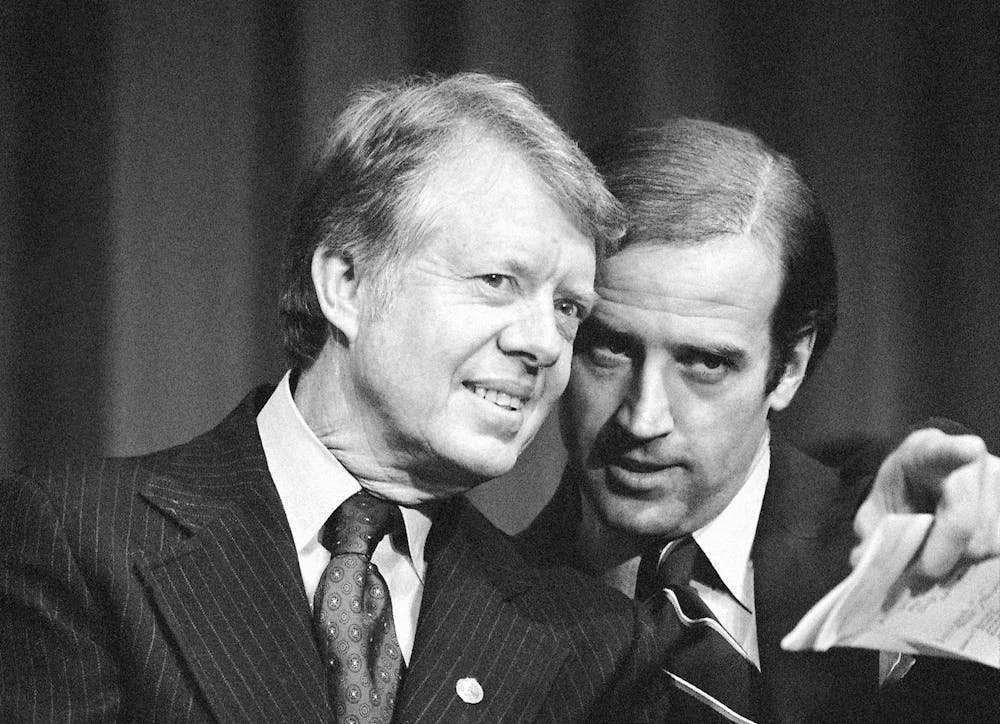
Two men in suits and ties, talking with their heads close.
President Jimmy Carter listens to Sen. Joseph R. Biden, D-Del.,
 as they wait to speak at fund raising reception in Wilmington,
Del. on Feb. 20, 1978.
 AP Photo/Barry Thumma, File

EDITOR'S PERSONAL NOTE: In 1978, I was offered a job in Washington to work at the Legal Services Corp. Cathy and I went down to DC to talk about what we should do. We were sitting in the rooftop restaurant of the Hotel Washington overlooking the White House when Jimmy Carter's motorcade returned to the White House from the signing of the Camp David accords. I looked at Cathy and said, "Yeah, we could get used to this." She nodded and we spent most of the rest of our careers in DC returning to live in Charlestown in 2002. Thank you, Mr. President, for the inspiration.     - Will Collette

Wednesday, June 26, 2024

Beware the Republican Plot to Replace US Democracy With a New Confederacy

Trump’s MAGA GOP solely wants to seize absolute political and economic power.

THOM HARTMANN in ThomHartmann.Com

Have you noticed how rarely Republicans talk about actual issues?

They rant about brown people pouring over the southern border but refuse to even discuss what could be done about it. In fact, when the Senate came up with a workable solution, Republicans in the House killed it at the insistence of former U.S. President Donald Trump. No policies, no solutions other than a Nazi-like roundup of 11 million people and a series of concentration camps.

They complain about the state of the economy, but have no arguments about what can be done to enhance the economy other than more tax cuts for billionaires, who are already paying a pathetic average 3.4% income tax.

They whine that our students aren’t doing well but refuse to engage in any serious discussion about how to take us back to the era when America had the newest and most successful public education system in the world.

They’ll yell about prescription drug prices and the high cost of insurance, but their only policy suggestion is to end Obamacare and Medicaid.

They love to slander Back Lives Matter and big cities with large Black populations but refuse to even entertain a conversation about healing the racial divide in this country; instead, their efforts are directed toward outlawing or decertifying Black History classes, as just happened in South Carolina.

All of this is because the GOP is now a post-politics party.

The reason why is simple and straightforward: The people who’ve captured the Republican Party envision a day when they won’t have to even pretend that they’re engaging in good-faith political discussions or negotiations because they will have outlawed, sidelined, or intimidated their opposition into impotence and silence.

They’re using our political system this election year, in other words, so they can seize enough power to destroy our political system.

And they have a model they’re using for what they want to replace it with: the Confederacy.

Thursday, May 23, 2024

Trump's corporate tax cuts paved the way for inflation

He made it more profitable for companies to gouge us. 

By Lindsay Owens 

Next year, when key provisions of Donald Trump’s 2017 tax breaks to the wealthy and corporations expire, we have an opportunity to get our money back.

I’m not just talking about all the foregone tax revenue we’ve lost because the rich have paid so little since 2017 — though we should get that back, too. I’m talking about the money families have lost to corporate price gouging.

Let me explain.

In 2017, Republicans slashed the corporate tax rate from 35 percent to 21 percent, giving massive corporations their biggest tax windfall since Ronald Reagan was president. A few years later, as Americans emerged from a global pandemic, these same corporations drove up prices for families.

While inflation hamstrung workers and families, it didn’t make a dent in corporate profits. In fact, as many CEOs boasted themselves, it’s been a boon. Companies simply passed rising costs along to consumers — and then some, bringing in record profits as a result.

All told, corporate profit margins skyrocketed to 70 year-highs. And by the end of 2023, when Americans were beyond fed up, after-tax corporate profits hit an all-time record high of $2.8 trillion. My organization, Groundwork Collaborative, recently found that corporate profits drove over 50 percent of inflation in the second and third quarters of last year.

Sunday, May 19, 2024

What happened to the middle class in the United States? The rich ate it.

The income inequality gap grew larger as the middle class shriveled up

FRANCES MOORE LAPPÉ in Common Dreams

Almost 90 percent of us think of ourselves as being “middle class,” but we’re way off. In 1970, 62 percent of Americans did qualify; but by 2021, our shrinking middle class was down to 42 percent. By 2022, the value of our minimum wage has fallen by 40 percent since the late 60s.

And our poverty rate? Today, at 12.4 percent, it’s the highest among almost all 38 OECD nations. Only the newest member, Costa Rica, suffers a higher poverty rate.

So, how did our view of ourselves become so distorted?

We were once indeed primarily middle class because we had stepped up to tackle poverty. In the late 1950s, our official poverty rate was about 22 percent, but Lyndon Johnson’s War on Poverty cut that rate in half, hitting a low of 11 percent in 1973. Then Reaganism struck, and by 1983 poverty had spread to nearly 15 percent.

And now?

While our official rate is indeed lower, it is still high and misses millions struggling to meet essential needs.

Our path to this sad outcome began in the 1980s. Reversing the War on Poverty, Reagan began dismantling welfare protections while slashing taxes on the ultrarich. Capturing the tenor of the time, in the 1987 film “Wall Street”, Gordon Gekko declared “greed is good.”

Reaganomics paved the way for today’s shocking inequality.