Menu Bar

Home           Calendar           Topics          Just Charlestown          About Us
Showing posts with label Richard Nixon. Show all posts

Monday, August 17, 2026

Donald Trump has made US$2.2 billion in his second term.

Is this normal?

Benjamin Quail, Queen's University Belfast

At the end of June – in the run-up to America’s celebration of the 250th anniversary of the signing of the Declaration of Independence – Donald Trump staged the White House’s first-ever professional sporting event. And while the UFC Freedom 250 evening of mixed martial arts was ostensibly part of the July 4 jamboree, Trump took the opportunity to promote his family’s business interests.

Fighters were paid bonuses in US$1 stablecoins, the cryptocurrency owned by the Trump family, while the event itself cost a reported US$60 million, much of which was taxpayers’ money.

The US president’s ability to make money while in office has been a focus of attention since his financial reports for 2025 were made public at the end of June. His reported revenue jumped from US$622 million in 2024 to US$2.2 billion in 2025, the first year of his second term.

While he and his family claim that there is no conflict of interest, there is little doubt that Trump has been able to profit from his position. But how does his financial gain as president stack up with some of his recent predecessors?

The Kennedy family were famously wealthy. The family’s patriarch, Joseph Kennedy, put some of his money into trusts for his children, allowing John Fitzgerald, Robert Francis and generations of future Kennedys to pursue politics without financial worry or conflicts between business and public service.

Kennedy’s successor Lyndon B. Johnson owned significant land and a small media empire in Austin, Texas with his wife Lady Bird, all of which was put into a blind trust and officially controlled without the Johnsons’ involvement while he was in office.

During the 1972 election cycle, Time magazine reported that incumbent president, Richard Nixon had improved his finances by just over US$300,000 during his first presidential term, noting that he was “not yet a millionaire”. Most of Nixon’s financial assets were tied up in property and his civil service pension.

Jimmy Carter’s famous peanut farm assets were put into a trust when he won office, and he left the presidency in $1m of debt following droughts in Georgia. Ronald Reagan, who succeeded Carter and was not a businessmen but a film actor-turned-politician, came to office with some assets. His assets – valued in 1981 at about US$4 million, mainly made up of his two properties – were also held in trust while he was in office.

George W. Bush made almost US$15m selling his stake in the Dallas-based Texas Rangers baseball franchise in 1998, while he served as governor of Texas. Barack Obama earned money from royalties on book sales while in office, but both he and Bill Clinton have amassed considerable wealth since leaving office.

None of these presidents appeared to leverage their presidency or their image to earn money while in office in the way that Trump has during his second term. Instead, they tended towards waiting until the post-presidency years.

Friday, July 24, 2026

Why Trump’s move to gut the Endangered Species Act likely won’t hold up in court

Trump seems to hate all animals

Patrick Parenteau, Vermont Law & Graduate School

Tiny chicks and an egg in a nest
Piping plovers lay their eggs on the ground. They
became an endangered species as development encroached
on their habitat and made it harder for their chicks
to survive. Under the Same Moon/Flickr, CC BY
The Trump administration has decided that destroying the habitat of endangered species is not harmful.

Think about that.

Habitat loss is the No. 1 reason species become endangered. Red-cockaded woodpeckers need mature long-leaf pine forests to reproduce. Endangered western monarch butterflies depend on pesticide-free milkweed for food. Pacific salmon must have clean, cool rivers for spawning. If coastal water becomes too polluted, manatees will starve.

Yet, on July 14, 2026, the U.S. Department of Interior formally rescinded the so-called harm rule under the Endangered Species Act, removing language that has protected species from losing millions of acres of habitat.

As a law professor who has followed these issues for over five decades and litigated early cases under the Endangered Species Act, I believe this effort to gut the nation’s premier wildlife conservation law is unjustified and unlawful.

I see several reasons the rule change is not likely to survive the legal challenges that have already begun.

Friday, July 10, 2026

Why Is He Using the Communist Trump Card?

He's run out of other cards.

Robert Reich for Inequality.org

The cover of “Is This Tomorrow,” an anti-communist comic
book published in 1947, suggests the chaos and ruin
that would follow a communist takeover of the United
States. The publications reflected a fevered politics that
prevailed after World War II and through the 1950s.
(Image via Wikimedia Commons)
Trump has run out of cards to play in the midterm elections, which is why he’s now talking about the “communist menace.”

He can’t talk about the economy, because prices continue to rise faster than wages, which means most Americans are getting poorer. He can’t talk about foreign policy, because his war in Iran has been a debacle, his tariffs are an utter failure, and he obviously hasn’t settled the war in Ukraine on “Day 1.” He can’t talk about immigration, because his raids and mass deportations have become so unpopular.

So, facing the midterm elections, what’s left?

He’s resorting to the oldest of right-wing tropes — accusing Democrats (especially a rising generation of new, young, vigorous Democratic politicians) of being commies.

He kicked off America’s 250th anniversary celebrations on Friday with a speech at Mount Rushmore extolling American culture and warning of a resurgence of the “communist menace.” With the granite faces of four of his predecessors behind him, Trump took aim at what he called “radicals” and “extremists.”

“There is now a resurgence of the communist menace in our land, including from newcomers to our country who embrace ideas totally opposed to our way of life and our great success. You can be a communist, or you can be a patriot. You cannot be both.”

Oh, please.

For years, Trump has been trying to scare Americans about progressive Dems who advocate Medicare for All, universal childcare, free public higher education, and higher taxes on the super-wealthy to pay for them (all of which the rising young Democrats are advocating).

But he hasn’t gotten anywhere because these initiatives are supported by most Americans.

So now he’s throwing the commie label at the wall and seeing if it sticks.

Communism was the scare word used by right-wingers after World Wars I and II to crack the whip on the left. It provoked witch hunts and ruined careers.

It made former Wisconsin Senator Joe McCarthy a one-man bomb squad in the early 1950s, when he rid
iculed the “pitiful squealing” of “those egg-sucking phony liberals” who “would hold sacrosanct those Communists and queers,” and forced American citizens to “name names.”

McCarthyism was a by-product of the Republican Party’s postwar effort to eradicate the New Deal. The GOP had portrayed the midterm election of 1946 as a “battle between Republicanism and communism,” and the Republican National Committee chairman claimed that the federal bureaucracy was filled with “pink puppets.”

Southern segregationist Democrats joined in the red-baiting. Mississippi senator Theodore Bilbo, a Klansman who filibustered to block anti-lynching legislation, described multiracial labor unions’ advocacy for civil rights as the work of “northern communists.” 

Thursday, July 9, 2026

League of Rhode Island Businesses: Republican business owners seeking power by subverting campaign finance rules and misleading voters

Behind the mask

Tom Sgouros

Things are seldom dull in the world of politics. This year, Rhode Island has seen the creation of the “League of Rhode Island Businesses,” an organization running several candidates for the General Assembly, many in Democratic primaries. League founder Dave Levesque, who owns the Brewed Awakenings coffee shops in Cranston, Johnston, and Warwick, is a Republican pro-gun activist who feels his point of view is underrepresented at the State House.

You can see a “Lively” interview with him where he calls women’s rights and the repeal of Roe v. Wade “little bitty issues” and tries valiantly to avoid saying that Joe Biden was elected President in 2020. (Kudos to Bill Bartholomew for pursuing him on the points.)

(Full interview here.)

Levesque was to be a featured speaker at a “Rhode Island First” rally planned for this past May, featuring Roger Stone. Yes, that Roger Stone, the treasonous fop with a Nixon tattoo on his back, was sentenced to prison for covering up for Donald Trump’s campaign collusion with Russian operatives in 2016. Trump commuted his sentence, leaving him free to become centrally involved in the 2021 “Stop the Steal” event that led to the January 6 assault on Congress.

Levesque’s League has embraced an innovative strategy to fund its candidates. They created 40 different PACs — one statewide and one for each city and town in Rhode Island — and when you donate through the League web page, it automatically distributes your donation among them so that you can totally evade the disclosure rules for campaign donations. 

To me, the remarkable part is that they boast, right there on the website, that they are doing this to evade disclosure requirements. 

 According to the state Board of Elections, what they are doing is indeed legal. It is a loophole in Rhode Island campaign finance law that allows a single organization to control multiple PACs. The League is not the only organization doing this, and a few unions control multiple PACs, as do Amica Insurance and Bally’s. 

Presumably, this is why a bill to close this loophole failed in the General Assembly this year. 

⟵ But for the sake of comparison, here is a chart of information from the Board of Elections showing all the organizations who control multiple PACs. (Thank you, Nancy Lavin, of the Rhode Island Current.) Sometimes a difference in degree becomes a difference in kind, and I marvel that any union would lobby to preserve this kind of disadvantage.

As Levesque has explained, the organizing base of the League is the pro-gun activists who show up to the state house every year to lobby against any proposed regulation of guns. Their website features lots of calls to action like this one.

As the League, they embrace more issues than just guns. They also inveigh against taxes, road tolls, and business regulation. In other words, standard Republican stuff. However, try as I might, I cannot find the word “Republican” anywhere on their website, or on any of the websites of candidates they endorse.

To be clear, there’s nothing wrong with advocating for positions I do not agree with. Obviously, I think people who hold positions I disagree with are misguided (that’s what it means), but go ahead and take those positions and defend them. 

What’s remarkable about the League is the extent to which its candidates seek to obscure those positions, mainly by running in Democratic primaries on an essentially Republican platform.

Take Kevin Hoyle, for instance, a candidate in the Democratic primary for House District 32 in North Kingstown. Here’s how he introduces himself on Facebook, an image he included in an email exchange with me.

Challenged to endorse the state’s Democratic Party platform, Hoyle emailed me a detailed list of where he agrees and where he does not. 

I suspect he thought this would end a conversation about what kind of Democrat he actually is by allowing him to say he agrees with most of it. 

But his endorsement is filled with cautions and careful wording, such as saying “Recent IPCC reports may change some of this” in response to the platform’s Environment and Climate section, or noting that investment in transportation and infrastructure is important but not through taxes. 

He supports the party platform on voting rights, but felt it was important to emphasize that he only wants voting rights for citizens. Imagining that there is anyone out there advocating for voting rights for non-citizens is a standard part of the MAGA fever dream, of course. Hoyle even included a strange hedge on the civil rights plank, questioning its use of the word “equitable”.

As an exercise in power, running very conservative, if not covertly Republican, candidates in September’s Democratic primary is not a terrible strategy. As we have seen all too well, many voters are not inclined to do much research on the candidates they vote for, and it is relatively straightforward to mislead them. 

Blake Filippi, who was the Republican leader in the House from 2018 to 2022, first won his seat in a Democratic primary in 2014. After defeating Donna Walsh, one of the leaders of Progressive Charlestown, he was unopposed in November and promptly disaffiliated upon his election. Eventually, he became the House Minority leader, successfully — and repeatedly — winning re-election while never using the word “Republican” on his campaign website. You can say this is essentially dishonest, but you can also say, hey, it worked.

EDITOR'S NOTE: While Rep. Donna Walsh was a Progressive Charlestown favorite and I personally work with Donna on issues and her campaigns, she never had any official connection to Progressive Charlestown.  - Will Collette

So this is the League of Rhode Island Businesses: Republican business owners who are seeking power by subverting campaign finance rules and misleading voters. Hoyle is not the only such candidate, and with the lure of plenty of untraceable money to spend, the League has recruited several others, including Mark Mesrobian in Narragansett and North Kingstown; Vanessa Lopez in Pawtucket; Brian Coogan in East Providence; and Leah Boisclair in Charlestown and Westerly. These are all going to be well-funded campaigns, and here’s hoping that money is not enough in the state’s Democratic primaries.

A guest post by Tom Sgouros, Public policy nerd and data scientist. Currently at work on projects in public finance, immunology, astronomy, and information theory. Also a bus rider.

SteveAhlquist.news is a reader-supported publication. To receive new posts and support my work, consider becoming a free or paid subscriber.

Saturday, August 2, 2025

What did he know, and when did he know it?

Trump learns nothing from history: it's the coverup that gets you

Robert Reich

Here are the two contradictions lying at the heart of the contretemps over Trump and Jeffrey Epstein:

1. As early as May, Trump knew his name was in the Epstein files. Attorney General Pam Bondi and her deputy informed Trump at a meeting in the White House that his name appeared “multiple times.”

But on July 15, when a journalist asked Trump, “Did [Bondi] tell you at all that your name appeared in the files?” Trump responded, “No, no.”

2. Bondi said in February that Epstein’s client list was “sitting on my desk right now to review.”

But on July 7, the Justice Department stated that a thorough review had turned up no list of Epstein’s clients.

Neither of these is evidence that Trump was involved in Epstein’s activities with underage girls. But together they suggest a cover-up — which can kill a presidency.

Exhibit A: Nixon. Of Tricky Dick the oft-repeated question was “What did he know, and when did he know it?” That’s being asked of Trump now.

Like Nixon, Trump is trying to cover up his cover-up. One day after The Wall Street Journal revealed that a letter bearing Trump’s name that was included in a 2003 birthday album for Epstein, Trump sued the Journal, calling the letter “nonexistent” and claiming the article defamed him.

Trump’s problem is that so many Americans — including most of his MAGA base — believed that, once back in the Oval Office, he’d expose a powerful global elite centered on pedophilia. But what if Trump is part of that elite?

Some of Trump’s senior staff — such as Dan Bongino, deputy director of the FBI — built their reputations on exposing that supposed elite. Bongino now says the decision not to release the Epstein files has eroded his credibility among his supporters.

Poor fellow. Bongino became a successful podcaster and media personality precisely because he fueled conspiracy theories linking pedophilia, Epstein, and the global elite.

Another of the deepening ironies here is that Trump’s effort to target his enemies has blurred the line between the White House and the Justice Department — making it harder for Trump to distance himself from the Department’s sudden reversal on releasing the Epstein files, thereby adding to the specter of a cover-up.

The appearance of a cover-up gets even worse now that the House of Representatives has left for its August recess a day earlier than expected because Speaker Mike Johnson — a close ally of Trump — wanted to stop a bipartisan discharge petition that would have forced a vote on the release of the Epstein files.

Senate Republicans may be more open to a bipartisan investigation. Missouri Senator Josh Hawley, a member of the Senate Judiciary Committee, says, “Whatever the bottom line is, I’m in favor of releasing it.” Hawley also suggests a joint committee made up of House members and senators to get to the bottom of the growing issue.

Recall that Nixon faced a joint committee of Congress that sought to “get to the bottom” of Watergate.

Epsteingate won’t end because members of Congress go home for August recess. Just the opposite. Because it remains unresolved, more stories will emerge suggesting a cover-up. Republican town halls will be filled with such charges.

Trump hasn’t learned the essential lesson of Watergate: When the public senses a cover-up, you have no choice but to expose everything. Otherwise, the cover-up metastasizes into a “cancer on the White House,” in John Dean’s infamous phrase.

Thursday, July 31, 2025

Cognitive collapse and the nuclear codes: When leaders lose control

What could go wrong with a "stable genius" with his finger on the trigger?

University of Otago

A shocking study reveals that many leaders of nuclear-armed nations—including US presidents and Israeli prime ministers—were afflicted by serious health problems while in office, sometimes with their conditions hidden from the public. 


From dementia and depression to addiction and chronic diseases, these impairments may have affected their decision-making during pivotal global crises.

Many former leaders of the world's nine nuclear-armed nations were impaired by health conditions while in office, raising concerns over their decision-making abilities while they had access to nuclear weapon launch codes, a study from the University of Otago, New Zealand, has found.

The study analyzed the health information of 51 deceased leaders of nuclear-armed countries: China, France, India, Israel, North Korea, Pakistan, Russia, the United Kingdom and the United States. 

Eight of the leaders died from chronic disease while still in office, five from heart attacks or strokes. Many of the leaders had multiple serious health issues while in office, including dementia, personality disorders, depression and drug and alcohol abuse.

The research was led by Professor Nick Wilson, from the Department of Public Health at the University of Otago, Wellington - Ōtākou Whakaihu Waka, Pōneke, with Associate Professor George Thomson and independent researcher Dr Matt Boyd. 

Professor Wilson says that of the leaders who left office while still alive, 15 had confirmed or possible health issues which likely hastened their departure.

"Probably all of this group of 15 leaders had their performance in office impaired by their health conditions. In some cases, the degree of impairment was profound, such as in the case of two former Israeli Prime Ministers: Ariel Sharon, who became comatose after suffering a stroke in office, and Menachem Begin, whose depression was so severe he spent his last year as leader isolated in his home. 

Impairment during crises was also seen in the case of Richard Nixon's bouts of heavy drinking - including during a nuclear crisis involving the Middle East.

"There have also been occasions where health information about leaders has been kept secret at the time."

Friday, July 25, 2025

Trump's Magnet of Malevolence

Trump's inner circle egg him on

Robert Reich

The conventional explanation for why Trump’s second term is far more extreme than his first (which was extreme enough) is that the guardrails are now gone.

The people who occupied significant roles in the White House and Cabinet during his first administration — who talked him out of (or subverted) his illegal and unconstitutional cravings — are no longer there. In their places are loyalists who will do whatever he wants.

But this conventional view overlooks a more important explanation.

He’s more extreme this time because he’s attracted people around him who are also extreme and pushing him to new levels of malevolence.

I’ve served under three presidents and advised a fourth. In every case, I’ve seen the same pattern: A president acts as a magnet, drawing into the highest levels of his administration people who not only share his values but amplify them.

When a president wants to do a decent job — at the least, respecting democracy, the Constitution, and the rule of law — the magnet produces an administration of people who respect our institutions of self-government.

But when a president is malevolent, those drawn to him are among the most fanatical and dangerous in the land.

Sunday, March 9, 2025

Coastal economies rely on NOAA, from Maine to Florida, Texas and Alaska – even if they don’t realize it

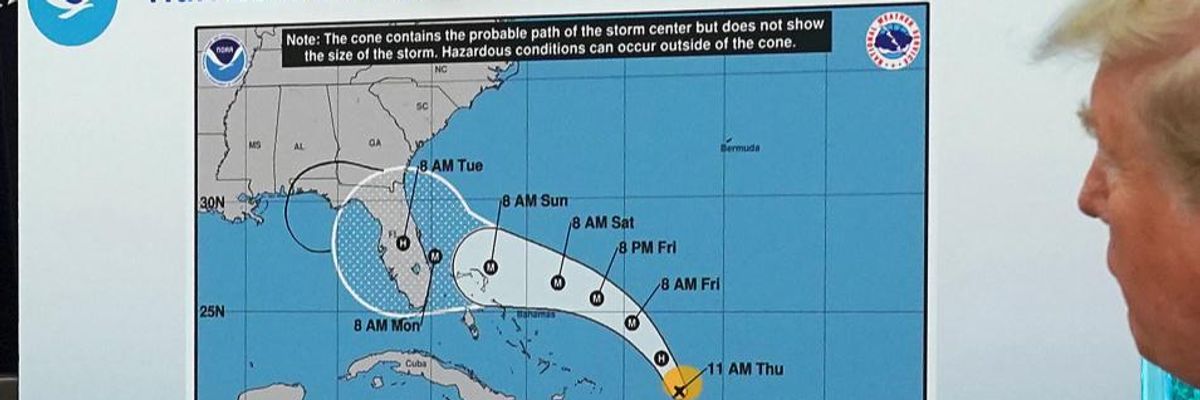
When you need a better forecast than Donald Trump's Sharpie

Christine Keiner, Rochester Institute of Technology

Healthy coastal ecosystems play crucial roles in the U.S. economy, from supporting multibillion-dollar fisheries and tourism industries to protecting coastlines from storms.

They’re also difficult to manage, requiring specialized knowledge and technology.

That’s why the National Oceanic and Atmospheric Administration – the federal agency best known for collecting and analyzing the data that make weather forecasts and warnings possible – leads most of the government’s work on ocean and coastal health, as well as research into the growing risks posed by climate change.

The government estimates that NOAA’s projects and services support more than one-third of the nation’s gross domestic product. Yet, this is one of the agencies that the Trump administration has targeted, with discussions of trying to privatize NOAA’s forecasting operations and disband its crucial climate change research.

As a marine environmental historian who studies relationships among scientists, fishermen and environmentalists, I have seen how NOAA’s work affects American livelihoods, coastal health and the U.S. economy.

Here are a few examples from just NOAA’s coastal work, and what it means to fishing industries and coastal states.

Wednesday, December 25, 2024

Have an abiding faith in the common sense and good-heartedness of most Americans.

We the People Will Prevail

Robert Reich 

Friends,

The holidays provide an apt time to pause and assess where we are.

You have every reason to be worried about what happens after January 20. Many people could be harmed.

Yet I continue to have an abiding faith in the common sense and good-heartedness of most Americans, despite the outcome of the election.

Many traditional Democratic voters did not vote — either because they were upset about the Biden administration’s support for Benjamin Netanyahu or they were unmoved by Kamala Harris. Others chose Trump because their incomes have gone nowhere for years and they thought the system needed to be “shaken up.”

An explanation is not a justification.

There have been times when I doubted America. I think the worst was 1968, with the assassinations of Martin Luther King Jr. and then Bobby Kennedy, the riots and fires that consumed our cities, the horrific Democratic convention in Chicago along with protests and violent police response, the election of the dreadful Nixon, and the escalating carnage of Vietnam.

It seemed to me then that we had utterly lost our moral compass and purpose.

But the Watergate hearings demonstrated to me that we had not lost it. Democrats and Republicans worked together to discover what Nixon had done.

I had much the same feeling about the brilliant work done by the House’s special committee to investigate January 6, 2021, including chair Bennie Thompson and vice chair Liz Cheney.

I think it important not to overlook the many good things that happened under the Biden-Harris administration — the most aggressive use of antitrust and most pro-union labor board I remember, along with extraordinary legislative accomplishments.

When I think about what’s good about America, I also think about the jurors, the prosecutors, and the judge in Trump’s trial in Manhattan, who took extraordinary abuse. Their lives and the lives of their families were threatened. But they didn’t flinch. They did their duty.

I think about our armed services men and women. Our firefighters and police officers. Our teachers and social workers. Our nurses who acted with such courage and dedication during the pandemic. I think about all the other people who are putting in countless hours in our cities and towns and states to make our lives better.

A few days ago, I ran into an old friend who’s spending the holidays running a food kitchen for the unhoused.

“How are you?” she asked, with a big smile.

“Been better,” I said.

“Oh, you’re still in a funk over the election,” she said. “Don’t worry! We’ll do fine. There’s so much work to do.”

“Yes, but Trump is …”

She stopped me, her face turning into a frown. “Nothing we can do about him now, except get ready for his regime. Protect the people who’ll be hurt.”

“You’re right.”

After a pause she said, “We had to come to this point, you know.”

“What do you mean?”

“Biden couldn’t get done nearly enough. The reactionary forces have been building for years. They’re like the pus in an ugly boil.”

“That’s the worst metaphor I’ve heard!” I laughed.

“The boil is on our collective ass,” she continued, laughing along with me. “And the only way we get up enough courage to lance the boil is for it to get so big and so ugly and so mean that no one can sit down!”

“I don’t know whether you’re an optimist or a pessimist,” I said, still laughing.

“Neither,” she explained, turning serious. “A realist. I’ve had it with wishy-washy Democratic ‘centrists.’ A few years of the miserable Trump administration and we can get back to the real work of the country.”

“I hope you’re right.”

“And now have to get back to work. Lots of people to feed! Merry Christmas, Happy Hanukah, Happy New Year!”

With that, she was gone.

Robert Reich is the Chancellor's Professor of Public Policy at the University of California, Berkeley, and a senior fellow at the Blum Center for Developing Economies. He served as secretary of labor in the Clinton administration, for which Time magazine named him one of the 10 most effective cabinet secretaries of the twentieth century. His book include: "Aftershock" (2011), "The Work of Nations" (1992), "Beyond Outrage" (2012) and, "Saving Capitalism" (2016). He is also a founding editor of The American Prospect magazine, former chairman of Common Cause, a member of the American Academy of Arts and Sciences, and co-creator of the award-winning documentary, "Inequality For All." Reich's newest book is "The Common Good" (2019). He's co-creator of the Netflix original documentary "Saving Capitalism," which is streaming now.

Friday, December 6, 2024

How Trump Plans to Seize the Power of the Purse From Congress

He said he's be a "Dictator on Day One"

By Molly Redden for ProPublica


Donald Trump is entering his second term with vows to cut a vast array of government services and a radical plan to do so. Rather than relying on his party’s control of Congress to trim the budget, Trump and his advisers intend to test an obscure legal theory holding that presidents have sweeping power to withhold funding from programs they dislike.

“We can simply choke off the money,” Trump said in a 2023 campaign video. “For 200 years under our system of government, it was undisputed that the president had the constitutional power to stop unnecessary spending.”

His plan, known as “impoundment,” threatens to provoke a major clash over the limits of the president’s control over the budget. The Constitution gives Congress the sole authority to appropriate the federal budget, while the role of the executive branch is to dole out the money effectively. But Trump and his advisers are asserting that a president can unilaterally ignore Congress’ spending decisions and “impound” funds if he opposes them or deems them wasteful.

Trump’s designs on the budget are part of his administration’s larger plan to consolidate as much power in the executive branch as possible. This month, he pressured the Senate to go into recess so he could appoint his cabinet without any oversight. (So far, Republicans who control the chamber have not agreed to do so.) His key advisers have spelled out plans to bring independent agencies, such as the Department of Justice, under political control.

If Trump were to assert a power to kill congressionally approved programs, it would almost certainly tee up a fight in the federal courts and Congress and, experts say, could fundamentally alter Congress’ bedrock power.

“It’s an effort to wrest the entire power of the purse away from Congress, and that is just not the constitutional design,” said Eloise Pasachoff, a Georgetown Law professor who has written about the federal budget and appropriations process. “The president doesn’t have the authority to go into the budget bit by bit and pull out the stuff he doesn’t like.”

Trump’s claim to have impoundment power contravenes a Nixon-era law that forbids presidents from blocking spending over policy disagreements as well as a string of federal court rulings that prevent presidents from refusing to spend money unless Congress grants them the flexibility.

In an op-ed, tech billionaire Elon Musk and former Republican presidential candidate Vivek Ramaswamy, who are overseeing the newly created, nongovernmental Department of Government Efficiency, wrote that they planned to slash federal spending and fire civil servants. 

Some of their efforts could offer Trump his first Supreme Court test of the post-Watergate Congressional Budget and Impoundment Control Act of 1974, which requires the president to spend the money Congress approves. The law allows exceptions, such as when the executive branch can achieve Congress’ goals by spending less, but not as a means for the president to kill programs he opposes.

Trump and his aides have been telegraphing his plans for a hostile takeover of the budgeting process for months. Trump has decried the 1974 law as “not a very good act” in his campaign video and said, “Bringing back impoundment will give us a crucial tool with which to obliterate the Deep State.”

Musk and Ramaswamy have seized that mantle, writing, “We believe the current Supreme Court would likely side with him on this question.”

Saturday, May 4, 2024

College administrators are falling into a tried and true trap laid by the right

Deja vu all over again

Lauren Lassabe ShepherdUniversity of New Orleans

A student is arrested during a pro-Palestinian demonstration
at the University of Texas at Austin on April 24, 2024.
 Brandon Bell/Getty Images
Interrogations of university leaders spearheaded by conservative congressional representatives. Calls from right-wing senators for troops to intervene in campus demonstrations. Hundreds of student and faculty arrests, with nonviolent dissenters thrown to the ground, tear-gassed and tased.

We’ve been here before. In my book “Resistance from the Right: Conservatives and the Campus Wars in Modern America,” I detail how, throughout the 1960s and into the 1970s, conservative activists led a counterattack against campus antiwar and civil rights demonstrators by demanding action from college presidents and police.

They made a number of familiar claims about student protesters: They were at once coddled elitists, out-of-state agitators and violent communists who sowed discord to destroy America. Conservatives claimed that the protests interfered with the course of university activities and that administrators had a duty to guarantee daily operations paid for by tuition.

Back then, college presidents routinely caved to the demands of conservative legislators, angry taxpayers and other wellsprings of anticommunist outrage against students striking for peace and civil rights.

Today, university leaders are twisting themselves in knots to appease angry donors and legislators. But when Columbia University President Minouche Shafik called in the NYPD to quell protests, she was met with a firm rebuke from the American Association of University Professors.

If the past is any indication, the road ahead won’t be any easier for college presidents like Shafik.

Thursday, November 30, 2023

Kissinger dead at 100, whose legacy includes untold dead

Kissinger and realpolitik in US foreign policy

Jarrod HayesUMass Lowell

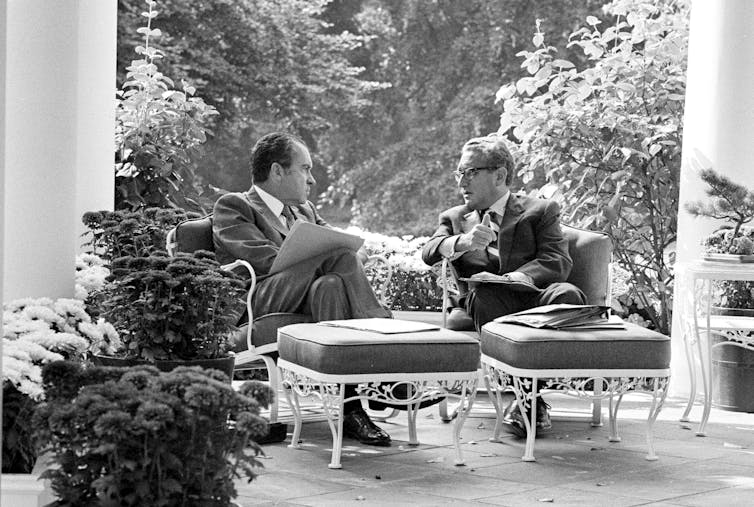
President Richard Nixon, left, speaks with national security
adviser Henry Kissinger at the White House in
September 1972. AP Photo
Henry Kissinger, who died on Nov. 29, 2023, at age 100, exercised more than 50 years of influence on American foreign policy.

I am a scholar of American foreign policy who has written on Kissinger’s service from 1969 to 1977 as national security adviser and secretary of state under the Nixon and Ford administrations. I have seen how his foreign policy views and actions played out for good and, mostly, for ill.

When Kissinger entered government as Richard Nixon’s national security adviser, he espoused a narrow perspective of the national interest, known as “realpolitik,” primarily centered on maximizing the economic and military power of the United States.

This power- and transactionalist-oriented approach to foreign policy produced a series of destructive outcomes. They ranged from fomenting coups that put in place murderous dictatorships, as in Chile, to killing unarmed civilians, as in Cambodia, and alienating potential allies, as in India.

Wednesday, November 29, 2023

Trump's Similarities to Hitler Prove It Certainly Could 'Happen Here'

We must stop being bashful about calling Trump a fascist - the shoe fits

THOM HARTMANN Common Dreams

The Nazis in America are now “out.” This morning, former Republican Joe Scarborough explicitly compared Trump and his followers to Hitler and his Brownshirts on national television. They’re here.

At the same time, America’s richest man is retweeting antisemitism, rightwing influencers and radio/TV hosts are blaming “Jews and liberals” for the “invasion” of “illegals” to “replace white people,” and the entire GOP is embracing candidates and legislators who encourage hate and call for violence.

Are there parallels between the MAGA takeover of the GOP and the Nazi takeover of the German right in the 1930s?

It began with a national humiliation: defeat in war. For Germany, it was WWI; for America it was two wars George W. Bush and Dick Cheney lied us into as part of their 2004 “wartime president” re-election strategy (which had worked so well for Nixon with Vietnam in 1972 and Reagan with Grenada in 1984).

Hitler fought in WWI but later blamed Germany’s defeat on the nation being “stabbed in the back” by liberal Jews, their fellow travelers, and incompetent German military leadership.

Trump cheered on Bush’s invasion of Iraq, but later lied and claimed he’d opposed the war. Both blamed the nation’s humiliation on the incompetence or evil of their political enemies.

The economic crisis caused by America’s Republican Great Depression had gone worldwide and Hitler used the gutting of the German middle class (made worse by the punishing Treaty of Versailles) as a campaign issue, promising to restore economic good times.

Trump pointed to the damage forty years of neoliberalism had done to the American middle class and promised to restore blue-collar prosperity. Hitler promised he would “make Germany great again”; Trump campaigned on the slogan: “Make America Great Again.”

Both tried to overthrow their governments by violence and failed, Hitler in a Bavarian beer hall and Trump on January 6th. Both then turned to legal means to seize control of their nations.

Hitler’s scapegoats were Jews, gays, and liberals. “There are only two possibilities,” he told a Munich crowd in 1922. “Either victory of the Aryan, or annihilation of the Aryan and the victory of the Jew.”

He promised “I will get rid of the ‘communist vermin’,” “I will take care of the ‘enemy within’,” “Jews and migrants are poisoning Aryan blood,” and “One people, one nation, one leader.”

Trump’s scapegoats were Blacks, Muslims, immigrants, and liberals.

Tuesday, August 8, 2023

Why do Republicans inflict so much harm on their own people?

And why do they take it? 

By Thom Hartmann for the Independent Media Institute 

By Christopher Weyant
Supreme Court Justice Elena Kagan was pulling no punches in calling out her six Republican colleagues on the Supreme Court in the student loan case, Biden v Nebraska

None of the Republican states suing would have lost a penny had Biden’s student loan forgiveness program gone forward; there was no injured party and therefore no standing to even be before the Court.

“[T]he Court,” she wrote, “by deciding this case, exercises authority it does not have. It violates the Constitution.”

Additionally, the law being debated (the HEROES Act) specifically gave the administration the power — it’s literally spelled out in the statute — to forgive student debt. Which is why Kagan called out the radical Republicans for rewriting a law authored by Congress and signed by a president, a power that is not found anywhere in the Constitution.

“That is no proper role for a court,” Kagan wrote. “And it is a danger to a democratic order.”

But six Republicans on the Court blew up the program anyway, replacing the power and authority of the United States Senate, House of Representatives, and the President with their own.

So, why would Republican state Attorneys General bring such a lawsuit to try to deny millions of students in their own states debt relief? Why would six Republicans on the Supreme Court go along with such a stupid thing?

Particularly when our 30-year experiment with the G.I. Bill shows that for every $1 the federal government invests in college-educating young people, we as a nation get back $7 in tax revenue and economic benefit (as I noted at length here on July 3rd)?

Similarly, why would Republicans fight tooth and nail to filibuster passage of the PRO Act (legislation that gives workers the right to easily form or join a union) that had already passed the House? If a corporation is organized money, why do they believe it’s wrong for workers to have a small bit of power by organizing themselves and protecting their labor?  

Thursday, August 3, 2023

Criminal law expert explains new charge based on Trump's role in Jan. 6 insurrection

Using ‘dishonesty, fraud and deceit’ to cling to power

Gabriel J. ChinUniversity of California, Davis

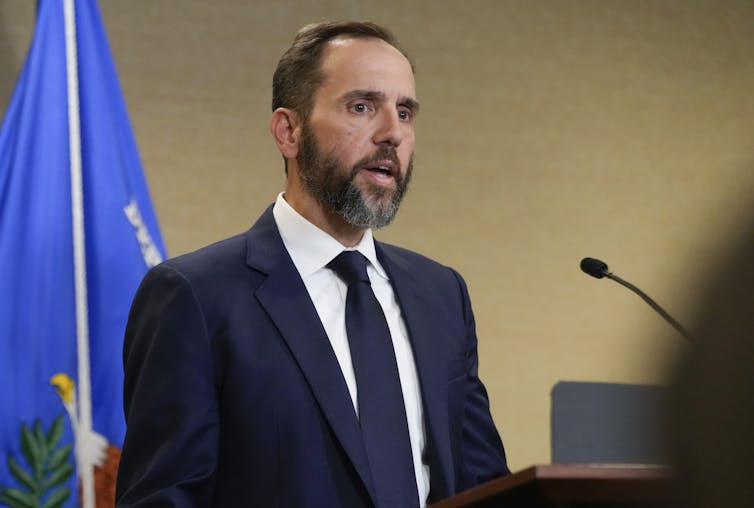
Special Counsel Jack Smith announces the second federal
indictment of Donald Trump on Aug. 1, 2023.
 AP Photo/Jacquelyn Martin
The Justice Department announced its second federal indictment of former president Donald J. Trump on Aug. 1, 2023. The charges are groundbreaking and not just because a former president is facing multiple criminal charges.

It’s because these are the first federal charges alleging a former president effectively attempted a particular kind of coup, called an auto-coup, in which he attempted to keep himself in power by illegal means.

The indictment lists four felony charges. All of them rely on the same facts and boil down to the same set of five allegations, many of which have been previously reported.

All of the charges rest on the claim that Trump and his co-conspirators knew the former president lost the 2020 election, and that his claims of fraud and voting irregularity made before and on Jan. 6, 2021 were unfounded.

Three counts in this new indictment allege conspiracies: There is conspiracy to defraud the government; to obstruct an official proceeding – in this case, counting the electoral votes on Jan. 6, 2021; and against the rights of the voters to cast ballots and have them fairly and honestly counted.

The remaining count alleges obstruction of an official proceeding – namely, tallying the electoral vote. The document states that Trump allegedly had the help of six co-conspirators, including four lawyers, a Justice Department official and a political consultant.

None of them are charged in the indictment, and they are identified by number, not name. This could mean one or more of these people are cooperating with the Justice Department, but not necessarily.

The indictment charges that all of Trump’s many claims of election irregularities “were false, and the Defendant knew that they were false.”

I am a scholar of criminal law and procedure. While Trump is facing multiple other charges, this indictment contains the most serious charges he has faced thus far.

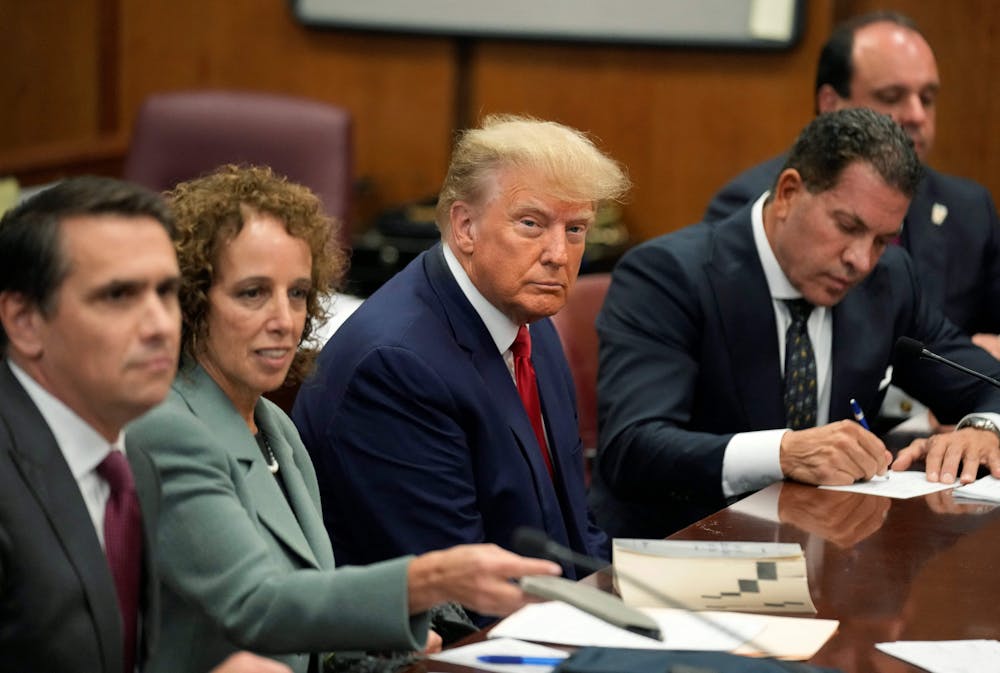
Five people sitting on one side of a table with papers on the table in front of them.
Former President Donald Trump with his attorneys inside the
courtroom during his arraignment at the Manhattan
Criminal Court on April 4, 2023.
 Seth Wenig/POOL/AFP via Getty Images
In another case, Trump is being charged in New York with falsifying business records, which is, to some extent, a technical offense. 

And the Justice Department has charged him in Florida with illegally keeping national security documents, but there is no allegation they were disclosed to foreign agents or represented much more than souvenirs.

This indictment, by contrast, alleges that Trump knowingly worked to hold on to an office he knew he was not entitled to.