Menu Bar

Home           Calendar           Topics          Just Charlestown          About Us
Showing posts with label anti-semitism. Show all posts

Wednesday, December 17, 2025

Trump Administration asking universities to provide lists of Jews.

This is never a good thing.

Beth Kissileff

(RNS) — Timothy Snyder, a historian of the Holocaust and Eastern European tyranny, has a tip for dealing with authoritarianism: “Don’t obey in advance.” 

So, when the university that granted me my doctorate and educated four generations of my family was asked by the Trump administration in July for lists of Jewish faculty members, I held my breath. Would I be able to continue to be proud of the University of Pennsylvania, the place I learned so much from?

In the past year, universities have varied widely in their responses to demands from the Trump administration to fall into line on ridding their campuses of wokeness and antisemitism. Columbia University (my undergraduate alma mater) settled with the administration, paying $21 million in return for restoring its federal research grants. 

It’s hard to see how cutting basic science research will help reduce antisemitism. It will likely only cause Jews’ presence at a university to be seen as somehow disruptive. (See the recent arguments that women ruined the workplace.)

Other universities have variously complied with administration demands or resisted, but a few, such as Barnard College of Columbia University and the University of California, Berkeley, acquiesced and shared personal cellphone numbers of Jewish faculty. (Penn refused, and is now being sued by the U.S. Equal Employment Opportunity Commission.) Nara Milanich, a Barnard history professor, said it reminded her of 1930s Italy, when lists of Jews were put together by the local government. “We’ve seen this movie before, and it ends with yellow stars,” she said.

It also troubled Milanich that the government appeared to be “fishing” for reports of antisemitism: According to the Forward, the University of California, Berkeley said it had provided the names of 160 individuals involved in cases of antisemitism. “Evidently, they don’t have sufficient people to file lawsuits, so they have to go shake the trees to find people?” said Milanich.

Lists of Jews are never a good thing. Amanda Shanor, a professor at the Wharton School and Penn’s law school, told The Daily Pennsylvanian, the student newspaper: “The history of government demands for lists of Jewish people is one of the most terrifying in world history. I hope that students, faculty, and staff — Jewish and non-Jewish alike — will tell their family and friends about the government’s demand for a list of Penn’s Jews.”

Monday, October 20, 2025

If you don't want to be called a Nazi, stop acting like one

‘Disgusting’: racist, homophobic, antisemitic, and violent private chats of GOP leaders exposed

Jon Queally for Common Dreams

Is this who they are when not in view of public judgment or recrimination?

That is just one of the questions being widely asked after Politico on Tuesday revealed nearly seven months of grotesque private chats between members of Leaders of Young Republicans, the party’s batch of up-and-comers, though already in positions of power within the faction’s ranks.

From praising Adolf Hitler to casual use of racial slurs and calls for violence against their opponents, the Telegram chat logs obtained by Politico paint a picture of vile individuals who share a deep loyalty to President Donald Trump and reveled in sadistic contempt for their political enemies, hatred of minorities, and lust for power.

As Politico reports,

They referred to Black people as monkeys and “the watermelon people” and mused about putting their political opponents in gas chambers. They talked about raping their enemies and driving them to suicide and lauded Republicans who they believed support slavery.

William Hendrix, the Kansas Young Republicans’ vice chair, used the words “n--ga” and “n--guh,” variations of a racial slur, more than a dozen times in the chat. Bobby Walker, the vice chair of the New York State Young Republicans at the time, referred to rape as “epic.” Peter Giunta, who at the time was chair of the same organization, wrote in a message sent in June that “everyone that votes no is going to the gas chamber.”

Reaction to the leaked private messages was swift and full of contempt, if not shock.

“Welcome to Trump’s Republican Party,” said Rep. Pramila Jayapal (D-Wash.) in response to the reporting. “Disgusting.”

“Racism, rape, homophobia, antisemitism … Are we greater yet?” asked Maya Wiley, president and CEO of the Leadership Conference on Civil Rights. “Feel safer?”

According to Politico, “the messages reveal a culture where racist, antisemitic and violent rhetoric circulate freely—and where the Trump-era loosening of political norms has made such talk feel less taboo among those positioning themselves as the party’s next leaders.”

Thursday, July 31, 2025

Elon Musk's New Far-Right Nazi Party for America

Trump is interested only in building a vehicle for his own self-advancement. Musk is far more dangerous.

John Feffer, Foreign Policy In Focus

There are always worse political figures waiting in the wings.

In Israel, for instance, Benjamin Netanyahu is a relative moderate compared to some members of his cabinet, like Finance Minister Bezalel Smotrich, who believes that letting two million Palestinians die of hunger in Gaza is “justified and moral.” In Russia, ultranationalists to the right of Putin espouse racist and anti-immigrant views, while the country’s Communist Party recently declared that Khrushchev’s denunciation of Stalin was “a mistake.”

And then there’s Donald Trump, whom scholars consistently rank as the worst president in U.S. history. Even here, in a country of only two main parties and a blanderizing political discourse, worse options abound.

Imagine if Trump’s successor actually believed in something other than his own enrichment and self-aggrandizement? What if Trump is simply preparing the ground for an authentically far-right leader to take over, someone even more extreme than Vice President J.D. Vance or Sen. Tom Cotton (R-AR)?

Elon Musk is prepared to use a lot of his considerable fortune to test that proposition.

What Musk Believes

It’s tempting to believe that Elon Musk decided to create a new political party in a fit of pique because of his personal falling-out with Donald Trump. In public, however, Musk links his decision to the recent passage of Trump’s legislative package and the several trillion dollars that the measure will add to the national debt. After bonding with Trump over eviscerating government, Musk was no doubt appalled to discover that the president, in the end, turned out to a more conventional tax-less-and-spend-more Republican.

Either way, Musk announced last week the creation of his new America Party. The details of the party platform are scant, as you might guess from a party created by tweet. Musk has naturally emphasized “responsible spending,” debt reduction, and deregulation. He has also added pro-gun and pro-crypto planks to his expanding platform along with “free speech” and “pro-natalist” positions.

Saturday, July 12, 2025

Why does Trump and MAGA hate education?

Ignorance is the handmaiden of tyranny

Robert Reich 

Friends,

Under pressure from the Trump administration, the University of Virginia’s president of nearly seven years, James Ryan, stepped down, declaring that while he was committed to the university and inclined to fight, he could not in good conscience push back just to save his job.

The Department of Justice demanded that Ryan resign in order to resolve an investigation into whether UVA sufficiently complied with Trump’s orders banning diversity, equity, and inclusion.

UVA dissolved its DEI office in March, though Trump’s lackeys claim the university didn’t go far enough in rooting out DEI.

This is the first time the Trump regime has explicitly tied grant dollars to the resignation of a university official. It’s unlikely to be the last.

On June 30, the Trump regime said Harvard University violated federal civil rights law by failing to address the harassment of Jewish students on campus.

On July 1, the regime released $175 million in previously frozen federal funding to the University of Pennsylvania, but only after the school agreed to block transgender women athletes from female sports teams and erase the records set by swimmer Lia Thomas.

Let’s be clear: DEI, antisemitism, and transgender athletics are not the real reasons for these attacks on higher education. They’re excuses to give the Trump regime power over America’s colleges and universities.

Why do Trump and his lackeys want this power?

They’re following Hungarian President Viktor Orban’s playbook for creating an “illiberal democracy” — an authoritarian state masquerading as a democracy. The playbook goes like this:

First, take over military and intelligence operations by purging career officers and substituting ones personally loyal to you. Check.

Next, intimidate legislators by warning that if they don’t bend to your wishes, you’ll run loyalists against them. (Make sure they also worry about what your violent supporters could do to them and their families.) Check.

Next, subdue the courts by ignoring or threatening to ignore court rulings you disagree with. Check or in process.

Then focus on independent sources of information. Sue media that publish critical stories and block their access to news conferences and interviews. Check.

Then go after the universities.

Thursday, June 5, 2025

Under Trump, the Fight Against Extremist Violence Is Left Up to the States

While we might call them terrorists, he just calls them MAGA

By Hannah Allam for ProPublica

Reporting Highlights

  • Vacuum: As Donald Trump guts the main federal office dedicated to preventing terrorism, states say they’re left to take the lead in spotlighting threats.
  • Gaps: Some state efforts are robust, others are fledgling and yet other states are still formalizing strategies for addressing extremism.
  • Vulnerabilities: With the federal government largely retreating from focusing on extremist dangers, prevention advocates say the threat of violent extremism is likely to increase.

These highlights were written by the reporters and editors who worked on this story.

Under the watchful gaze of security guards, dozens of people streamed through metal detectors to enter Temple Israel one evening this month for a town hall meeting on hate crimes and domestic terrorism.

The cavernous synagogue outside of Detroit, one of several houses of worship along a suburban strip nicknamed “God Row,” was on high alert. Police cars formed a zigzag in the driveway. Only registered guests were admitted; no purses or backpacks were allowed. Attendees had been informed of the location just 48 hours in advance.

The intense security brought to life the threat picture described onstage by Michigan Attorney General Dana Nessel, the recipient of vicious backlash as a gay Jewish Democrat who has led high-profile prosecutions of far-right militants, including the kidnapping plot targeting the governor. Nessel spoke as a slideshow detailed her office’s hate crimes unit, the first of its kind in the nation. She paused at a bullet point about working “with federal and local law enforcement partners.”

“The federal part, not so much anymore, sadly,” she said, adding that the wording should now mention only state and county partners, with help from Washington “TBD.”

“The federal government used to prioritize domestic terrorism, and now it’s like domestic terrorism just went away overnight,” Nessel told the audience. “I don’t think that we’re going to get much in the way of cooperation anymore.”

Across the country, other state-level security officials and violence prevention advocates have reached the same conclusion. In interviews with ProPublica, they described the federal government as retreating from the fight against extremist violence, which for years the FBI has deemed the most lethal and active domestic concern. States say they are now largely on their own to confront the kind of hate-fueled threats that had turned Temple Israel into a fortress.

The White House is redirecting counterterrorism personnel and funds toward President Donald Trump’s sweeping deportation campaign, saying the southern border is the greatest domestic security threat facing the country. Millions in budget cuts have gutted terrorism-related law enforcement training and shut down studies tracking the frequency of attacks. Trump and his deputies have signaled that the Justice Department’s focus on violent extremism is over, starting with the president’s clemency order for militants charged in the storming of the U.S. Capitol on Jan. 6, 2021.

On the ground, security officials and extremism researchers say, federal coordination for preventing terrorism and targeted violence is gone, leading to a state-level scramble to preserve efforts no longer supported by Washington, including hate-crime reporting hotlines and help with identifying threatening behavior to thwart violence.

Sunday, April 27, 2025

Anti-semitic attacks continue to increase in New England

52 in Rhode Island alone

Anti-Defamation League (ADL)

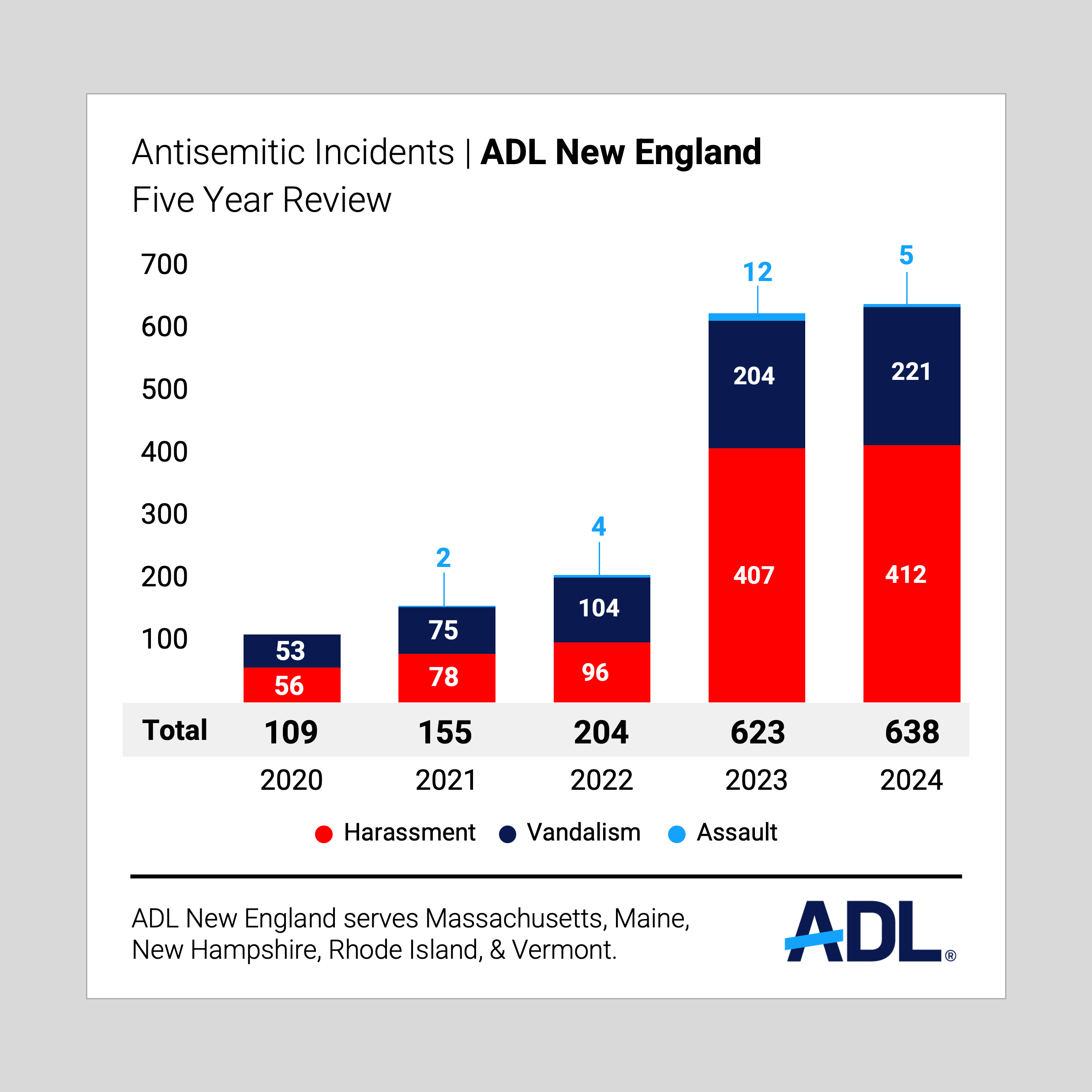
ADL’s Annual Audit of Antisemitic Incidents recorded a total of 638 incidents of assault, harassment, and vandalism in 2024 within the New England Region (covering Maine, Massachusetts, New Hampshire, Rhode Island, and Vermont). This is the fifth year in a row that antisemitic incidents increased and broke the previous all-time high in 2023. 2024 saw a 213 percent increase in incidents in New England from 2022 and a 485 percent increase since 2020.

“The persistent increase in antisemitic incidents over the past five years is a stark reminder that antisemitism continues to impact our communities,” said Samantha Joseph, ADL New England’s Regional Director. “Particularly concerning is the continued proliferation of extremist incidents and the rise of attacks against Orthodox Jews. The alarming manifestations of antisemitism in 2024 instill fear and are reminders that much work remains to be done.”

Sunday, January 26, 2025

Mass deportations don’t keep out ‘bad genes’

We've seen fake science used to justify exclusion, slavery and mass extermination


Threats of
mass deportations loom on the post-2024 election horizon. Some supporters claim these will protect the country from immigrants who bring “bad genes” into America. But this is a misguided use of the language of science to give a sheen of legitimacy to unscientific claims.

Politicians invoke genetics to confirm false stereotypes that immigrants are more violent than native-born citizens as a result of biological differences. 

This is despite the fact that immigrants living in the country with or without legal authorization have significantly lower crime and violent crime rates than U.S. citizens. Moreover, there is no strong genetic evidence to support a biological predisposition for committing violent acts.

As a geneticist and a child of immigrants, I study the intersection of biology and bias. I am also author of the book “Where Biology Ends and Bias Begins: Lessons on Belonging from Our DNA.” What is clear from my professional work is that this line of thinking – attempting to use science to explain human difference in ways that reinforce social hierarchies – isn’t new. It takes the playbooks of genetic essentialism and scientific racism and applies them to public policy.

The fallacy of genetic essentialism

Genetic essentialism is the concept that genes alone are the reason why someone develops a specific trait or behaves a certain way. For instance, a genetic essentialist would say that a person’s athleticism, intelligence, personality and a range of other traits are encoded entirely in their DNA. They ignore the influence that sports training, material resources and learned behaviors have on these traits.

When used to explain differences between populations, genetic essentialism discounts the role that structural biases – inequities deeply ingrained in how systems operate – play in individual differences. Structural biases create a playing field that advantages one group over another from the start.

For instance, studies seeking to identify a gene for violent behavior may use measurements that are themselves biased. If arrest or incarceration rates were used as evidence of violence, study findings would be affected by discriminatory practices in the policing and criminal justice systems that more harshly penalize people of color.

Studies trying to disentangle the relative effects of genetic and structural factors on specific traits also face similar biases. For example, mental health outcomes are influenced by the identity-related stress that racial or sex and gender minorities experience. Similarly, socioeconomic outcomes are affected by the effects of redlining and segregation on generational wealth.

Thursday, July 4, 2024

Survey Trolls, Opt-In Polls, and the New Era of Survey Science

A major reason not to trust polls

By Teresa Carr

Last December, a joint survey by The Economist and the polling organization YouGov claimed to reveal a striking antisemitic streak among America’s youth. One in five young Americans thinks the Holocaust is a myth, according to the poll. And 28 percent think Jews in America have too much power.

“Our new poll makes alarming reading,” declared The Economist. The results inflamed discourse over the Israel-Hamas war on social media and made international news.

There was one problem: The survey was almost certainly wrong. The Economist/YouGov poll was a so-called opt-in poll, in which pollsters often pay people they've recruited online to take surveys. According to a recent analysis from the nonprofit Pew Research Center, such polls are plagued by “bogus respondents” who answer questions disingenuously for fun, or to get through the survey as quickly as possible to earn their reward.

In the case of the antisemitism poll, Pew’s analysis suggested that the Economist/YouGov team’s methods had yielded wildly inflated numbers. In a more rigorous poll posing some of the same questions, Pew found that only 3 percent of young Americans agreed with the statement “the Holocaust is myth.”

These are strange times for survey science. Traditional polling, which relies on responses from a randomly selected group that represents the entire population, remains the gold standard for gauging public opinion, said Stanford political scientist Jon Krosnick. 

But as it’s become harder to reach people on the phone, response rates have plummeted, and those surveys have grown exponentially more expensive to run. Meanwhile, cheaper, less-accurate online polls have proliferated.

Friday, June 7, 2024

A century ago, anti-immigrant backlash almost closed America’s doors

Many of us wouldn't be here if the US embraced anti-immigrant bigotry

Matthew SmithMiami University

Immigrant children at Ellis Island in New York, 1908.
 National Archives/Wikimedia Commons
One hundred years ago, the U.S. Congress enacted the most notorious immigration legislation in American history. Signed by President Calvin Coolidge, the Immigration Act of 1924 dramatically reduced immigration from eastern and southern Europe and practically barred it from Asia.

How the law did this, however, was somewhat subtle: a quota. 

Lawmakers calculated how many immigrants from each European country were residing in the United States in 1890 and then took 2% of that number. 

Only that many newcomers could be admitted from any particular country each year. Before the end of the 19th century, the number of immigrants from outside western and northern Europe was still relatively small – meaning their 2% quotas would be minuscule.

In short, the Immigration Act was unabashedly racist, seeking to roll back the demographic tide. One of its sponsors, U.S. Rep. Albert Johnson, warned the House Committee on Immigration that “a stream of alien blood” was poisoning the nation.

Torn between “the American dream” and fears of an ungovernable “melting pot,” Americans have always viewed immigrants ambivalently. In 1924, as is true today, many citizens thought in terms of “good” immigration versus “bad” immigration. In their minds, 1890 marked a dividing line between the two.

Looking back as a historian of immigration and religion, I’m struck by three changes in U.S. views of immigration over the course of the 19th century.

Monday, May 20, 2024

Explaining "Hate" to kids

Why do people hate people?

Kristine Hoover, Gonzaga University and Yolanda Gallardo, Gonzaga University

Why do people hate people? – Daisy, age 9, Lake Oswego, Oregon

Have you ever said “I hate you” to someone? What about using the “h-word” in casual conversation, like “I hate broccoli”? What are you really feeling when you say that you hate something or someone?

The Merriam-Webster dictionary describes the word “hate” as an “intense hostility and aversion usually deriving from fear, anger, or sense of injury.” All over the world, researchers like us are studying hate from disciplines like education, history, law, leadership, psychology, sociology and many others.

If you had a scary experience with thunderstorms, you might say that you hate thunderstorms. Maybe you have gotten very angry at something that happened at a particular place, so now you say you hate going there. Maybe someone said something hurtful to you, so you say you hate that person.

Understanding hate as an emotional response can help you recognize your feelings about something or someone and be curious about where those feelings are coming from. This awareness will give you time to gather more information and imagine the other person’s perspective.

So what is hate and why do people hate? There are many answers to these questions.

Saturday, May 4, 2024

College administrators are falling into a tried and true trap laid by the right

Deja vu all over again

Lauren Lassabe ShepherdUniversity of New Orleans

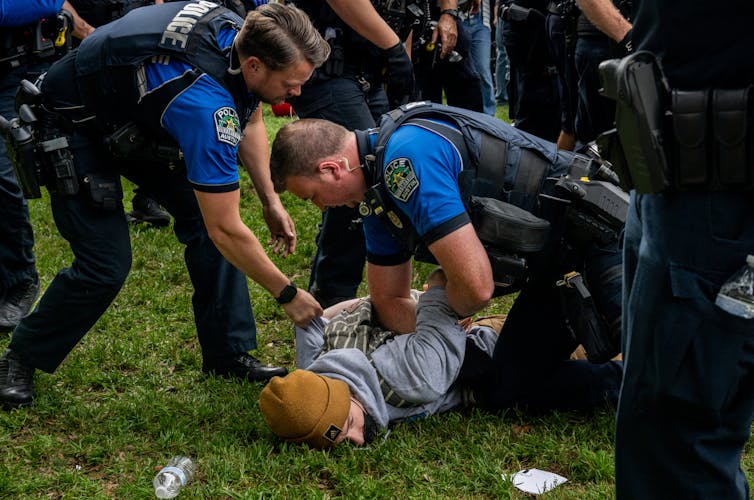
A student is arrested during a pro-Palestinian demonstration
at the University of Texas at Austin on April 24, 2024.
 Brandon Bell/Getty Images
Interrogations of university leaders spearheaded by conservative congressional representatives. Calls from right-wing senators for troops to intervene in campus demonstrations. Hundreds of student and faculty arrests, with nonviolent dissenters thrown to the ground, tear-gassed and tased.

We’ve been here before. In my book “Resistance from the Right: Conservatives and the Campus Wars in Modern America,” I detail how, throughout the 1960s and into the 1970s, conservative activists led a counterattack against campus antiwar and civil rights demonstrators by demanding action from college presidents and police.

They made a number of familiar claims about student protesters: They were at once coddled elitists, out-of-state agitators and violent communists who sowed discord to destroy America. Conservatives claimed that the protests interfered with the course of university activities and that administrators had a duty to guarantee daily operations paid for by tuition.

Back then, college presidents routinely caved to the demands of conservative legislators, angry taxpayers and other wellsprings of anticommunist outrage against students striking for peace and civil rights.

Today, university leaders are twisting themselves in knots to appease angry donors and legislators. But when Columbia University President Minouche Shafik called in the NYPD to quell protests, she was met with a firm rebuke from the American Association of University Professors.

If the past is any indication, the road ahead won’t be any easier for college presidents like Shafik.

Wednesday, May 1, 2024

Those who hoped for police to come in to crack heads will be disappointed to learn...

Brown has made a deal

After productive discussions between Brown University leaders and students who have held an encampment on the Brown campus since April 24, the parties reached an agreement that will end the encampment by 5 p.m. on Tuesday, April 30.

Brown President Christina H. Paxson shared details on the agreement in an April 30 campus message.

“The devastation and loss of life in the Middle East has prompted many to call for meaningful change, while also raising real issues about how best to accomplish this,” Paxson wrote. 

“Brown has always prided itself on resolving differences through dialog, debate and listening to each other. I cannot condone the encampment, which was in violation of University policies. Also, I have been concerned about the escalation in inflammatory rhetoric that we have seen recently, and the increase in tensions at campuses across the country. I appreciate the sincere efforts on the part of our students to take steps to prevent further escalation.”

Students agreed to end the encampment and refrain from further actions that would violate Brown’s conduct code through the end of the academic year, which includes Commencement and Reunion Weekend.

The University agreed that five students will be invited to meet with five members of the Corporation of Brown University in May to present their arguments  to divest Brown’s endowment from “companies enabling and profiting from the genocide in Gaza.” 

In addition, Paxson will ask the Advisory Committee on University Resources Management to provide a recommendation on the matter of divestment by Sept. 30, and this will be brought to the Corporation for a vote at its October 2024 meeting.

Another provision of the agreement relates to the application of Brown’s conduct code to students involved in the encampment. The establishment of tents and other related activities have violated a range of policies, and while Brown will continue to follow its conduct processes related to unauthorized activities, University leaders agreed that ending the encampment will be viewed favorably in disciplinary proceedings. 

The agreement also makes clear that reports of bias, harassment or discrimination received during the encampment will continue to be investigated. In addition, if the University receives new information about any conduct violations related to or following the encampment, students won’t be exempt from conduct proceedings for those violations.

The full letter from Paxson to the campus community is included below.

Saturday, February 17, 2024

Not his father's son

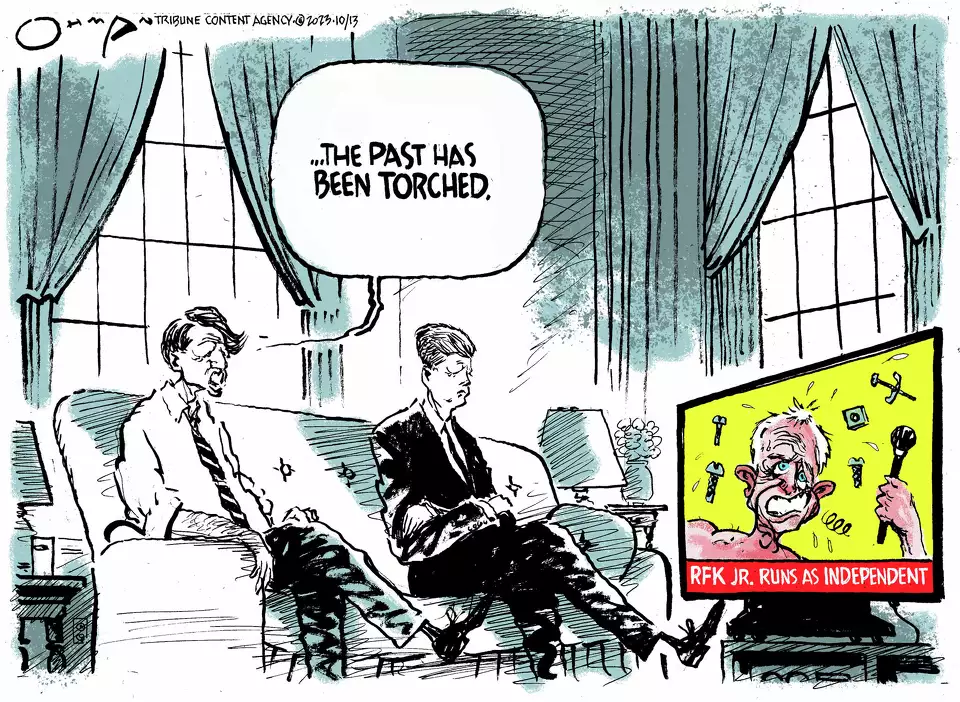
The growing disgrace and danger of Robert F. Kennedy Junior

Robert Reich

Jack Ohman/Tribune Content Agency
Robert F. Kennedy Junior has apologized to relatives after his Super Bowl ad last Sunday, which mirrored an ad broadcast by his uncle John F. Kennedy’s campaign in 1960.

The Super Bowl ad included images of RFK Jr. spliced into the original 1960 ad and a jaunty jingle that repeated the Kennedy surname 15 times in 30 seconds.

RFK Junior said the ad was the work of his SuperPAC and he had nothing to do with it.

Rubbish. Junior placed the ad at the top of his X feed, and it remained there Monday.

The ad cost $7 million. Timothy Mellon — grandson of Andrew Mellon and an heir to the Mellon banking fortune — gave RFK Junior’s SuperPAC $15 million.

Hmmm. Mellon is also a major donor to PACs supporting Trump. RFK Junior’s candidacy is backed by a PAC that also funds Marjorie Taylor Greene.

No one should doubt that Trump and Trump donors are behind RFK Junior’s campaign, with the goal of siphoning off enough votes from Biden to ensure a Trump victory.

Monday, January 8, 2024

Michael Flynn has a bad rep despite what Jim Mageau claims

Putting him on a pedestal tarnishes ours.

By Philip Eil, Rhode Island Current

Late December tends to be so sleepy for news, that at some point, the space between Christmas and New Years became known as “dead week.” But an uproar surged across Rhode Island screens and airwaves in recent days. And for those of you just returning to your desks, here’s a recap. 

The hubbub began on Dec. 20 when Boston Globe columnist Dan McGowan reported that the Rhode Island Heritage Hall of Fame had voted to include former National Security Advisor – and Middletown native – Michael Flynn in its 2024 class. Outrage ensued. 

Six members of the hall’s 25-member board resigned (a number which, per Providence Journal reporting, later grew to eight). And others around the state voiced their disapproval in tweets, columns, and letters to the editor

On Dec. 26, the story made the New York Times, which is always an event in the smallest state. Then, on Friday Dec. 29, honorary state Historian Laureate Patrick Conley weighed in with this statement

Speaking as the hall’s past president and “Volunteer General Counsel” Conley talked about a lot of subjects: the hall’s history, its funding, its “extensive website,” the nine other inductees in the 2024 class, the barrage of letters it received about Flynn’s induction, the hall’s long history of induction ceremonies undisturbed by protest, and, eventually, the board’s decision to “defer Flynn’s induction to a more peaceful and rational time and a more secure place.”

What he did not talk about was Flynn’s conduct or say that the induction wouldn’t happen at all. In a single sentence, Conley dismissed concerns about Flynn’s felony conviction for lying to the FBI

The board “accepted as true the grant of clemency from the president of the United States asserting that no crime was actually committed and the fact that charges against Flynn were dropped by a weaponized Department of Justice,” he wrote, without mentioning that other Trump pardonees include murderers and war criminals

Conley’s statement was disappointing. But given his record of commentary – his eagerness to defend awful men, his tendency to fire back at critics, his apparent impatience for left-leaning protests – it wasn’t surprising. 

And if you do look closely at what Flynn has done, it becomes clear how colossally inappropriate the hall’s choice was, and how further misguided Conley’s efforts are to defend, defer, or do anything short of rescind it. (In 2022, the University of Rhode Island’s board of trustees wisely revoked an honorary degree Flynn received in 2014.) And if Conley and the hall aren’t willing to explore why Flynn is so unworthy of induction, I will. 

Flynn’s outrageous behavior falls into roughly three categories.

Tuesday, January 2, 2024

Robert F. Kennedy Jr. earns Polifact's 2023 "Lie of the Year"

RFK Jr.’s Campaign of Conspiracy Theories Is PolitiFact’s 2023 Lie of the Year


Credit: Dick Wright, PoliticalCartoons.com / CTNewsJunkie via
Cagle Cartoons
/ ALL RIGHTS RESERVED
As pundits and politicos spar over whether Robert F. Kennedy Jr.’s presidential campaign will factor into the outcome of the 2024 election, one thing is clear: Kennedy’s political following is built on a movement that seeks to legitimize conspiracy theories.

His claims decrying vaccines have roiled scientists and medical experts and stoked anger over whether his work harms children. He has made suggestions about the cause of covid-19 that he acknowledges sound racist and antisemitic.

Bolstered by his famous name and family’s legacy, his campaign of conspiracy theories has gained an electoral and financial foothold. He is running as an independent — having abandoned his pursuit of the Democratic Party nomination — and raised more than $15 million. A political action committee pledged to spend between $10 million and $15 million to get his name on the ballot in 10 states.

Even though he spent the past two decades as a prominent leader of the anti-vaccine movement, Kennedy rejects a blanket “anti-vax” label that he told Fox News in July makes him “look crazy, like a conspiracy theorist.”

But Kennedy draws bogus conclusions from scientific work. He employs “circumstantial evidence” as if it is proof. In TV, podcast, and political appearances for his campaign in 2023, Kennedy steadfastly maintained:

  • Vaccines cause autism.
  • No childhood vaccines “have ever been tested in a safety study pre-licensing.”
  • There is “tremendous circumstantial evidence” that psychiatric drugs cause mass shootings, and the National Institutes of Health refuses to research the link out of deference to pharmaceutical companies.
  • Ivermectin and hydroxychloroquine were discredited as covid-19 treatments so covid vaccines could be granted emergency use authorization, a win for Big Pharma.
  • Exposure to the pesticide atrazine contributes to gender dysphoria in children.
  • Covid-19 is “targeted to attack Caucasians and Black people. The people who are most immune are Ashkenazi Jews and Chinese.”