Menu Bar

Home           Calendar           Topics          Just Charlestown          About Us
Showing posts with label North Korea. Show all posts

Saturday, August 29, 2026

Trump’s View of Everything in the World

Vassals, Mooches, and Thugs (oh my)

Robert Reich

Trump says he directed Defense Secretary Pete Hegseth to “substantially reduce” military drills with South Korea, citing his “very good relationship with North Korean leader Kim Jong Un” — whom he calls “unthreatening and respectful.”

Kim Jong Un is unthreatening and respectful? Hello?

Trump also says he’s miffed at South Korea for refusing to help the United States in its conflict against Iran — a conflict that was initiated entirely by Trump alone and is over 4,000 miles away from South Korea.

Wha?

Many are bewildered by how badly Trump treats America’s traditional allies and friends, like South Korea, and how nicely he treats traditional enemies and dictators, like North Korea’s Kim Jong Un.

But there’s no reason for bewilderment. All you need do is get into Trump’s transactional lizard brain to see that, for him, the world contains only three kinds of nations or people: vassals, mooches, and thugs.

Thursday, August 27, 2026

Why are we at war with Canada?

Trump shitposts fail to win support for Canadian trade war

Liz Dye

Yes, Trump actually posted this.

The Premier of Ontario has an answer
Donald Trump spent the past week cozying up to North Korea and attacking Canada. Whatever claim the US had to be a beacon of free trade — not to mention moral leadership — has been demolished like the East Wing of the White House.

And so it was probably inevitable the president would dig the prototypical failed economic policy of the 20th century out of history’s dumpster and operationalize it against our closest ally.

Smoot-Hawley tariffs are back, baby! Sure, aggressive levies cutting off trade as a means of stimulating domestic industry never worked for those people. In fact, it effectively crashed the global economy and turned a recession into the Great Depression. But it may work for us!

It will not work for us. But it may make us so roundly despised that it galvanizes other countries to reimagine the world order so as to cut out the one, heretofore indispensable nation.

USMCA? Never heard of it!

Upon returning to office, Trump immediately took a Sharpie to “the most modern, up-to-date, and balanced trade agreement in the history of our country, with the most advanced protections for workers ever developed” — also known as
 the USMCA, which he himself negotiated in 2018 as a replacement for NAFTA

"We don't need anything that Canada has, we don't need anything that Mexico has, but they need everything that we have,” he blustered in June. “We don't need their cars, we don't need their lumber, we don't need their energy, we don't need anything that they have."

This is self-evidently ridiculous.

Canada supplies roughly 80% of the potash American farmers use as fertilizer. Midwest refineries are built to run on heavy Canadian sour crude, and the pipeline infrastructure simply doesn't exist to swap in lighter, American-produced oil from places like Texas. 

Canadian hydropower fuels a significant share of the electricity supply in New York and New England. And the auto and auto parts trade between the two countries, already strained by Trump's steel and aluminum tariffs, is about as integrated as two countries' economies get.

And yet Trump negotiated as if Canadians could never say no, even as he demanded crippling concessions and lobbed humiliating insults at our stalwart ally. Trade talks were at an impasse after 18 months of threats and taunts about annexing our northern neighbor. But in July the prospect of an additional 50 percent levy on a sprawling list of Canadian goods forced Canadians back to the negotiating table. And last week, with the major principles agreed, Trump congratulated both sides for striking “a very fair deal.”

"Our farmers are going to be thrilled; our manufacturers are going to be thrilled," he gushed. "And basically, we have no tariffs going into Canada anymore."

Instead talks collapsed Friday night, when Prime Minister Mark Carney announced he was suspending negotiations and recalling Canada’s negotiators to Ottawa.

By Saturday morning, the Trump administration had levied tariffs on roughly $20 billion worth of Canadian goods — hockey sticks, building materials, beer, cheese. Carney promises dollar-for-dollar retaliation, hitting US steel, dairy, appliances, agricultural equipment, pulp, paper, and electronics starting September 8.

Art of no deal

The New York Times and Washington Post confirm that the deal fell apart because the Trump administration attempted to extract a fresh round of concessions at the last minute.

After domestic companies aggressively lobbied Commerce Secretary Howard Lutnick, the US backpedaled on reductions in steel and aluminum tariffs. Plus Lutnick insisted on excluding Ontario-built heavy trucks (the Ford F-350, F-450, and GM Silverado) in hopes of forcing carmakers to relocate production to the US.

And if you’ve got a problem, that crank Peter Navarro can make it worse.

“Navarro and Lutnick were both yelling at Greer saying: ‘What are you doing? This is stupid. You know, we’re not giving these things away,’” a source told the Post.

Trade Representative Jamieson Greer said the Canadians would never go for it, and he was right.

America’s last-minute demands included: dropping French language labeling and content requirements, an absolute non-starter for the country’s restive Québécois population; getting rid of “buy Canadian” government initiatives while leaving similar “buy American” measures in place; and restoring US-produced liquor to Canadian shelves. That last decision lies with each province, and Ontario Premier Doug Ford told Carney he wouldn’t go along with it.

Lots of “bluster” from Doug Ford, who is the Premier of the Canadian Province of Ontario, but who is better known as the less charismatic, intelligent, and overall unimpressive brother of the late, great, Rob Ford. America has been carrying Canada for decades, but no longer! The U.S.A. will always be far bigger, richer, and stronger than Canada. Without the United States, Canada couldn’t survive — It’s where they get all of their money and, because of their current bad leadership, primarily Governor Carney, and his Flunky, Ford, they will not be allowed to keep taking advantage of the United States — Their key to survival. Remember, much of the Electricity, Oil, and Gas that Canada gets is transported through the U.S.A. Someone should get these clowns to “fall in line” or, the consequences for Canada will be far WORSE! Canada’s Unemployment Rate is now at 10%, and rapidly rising. Their businesses are fleeing for the United States, and it’s all because of their failed policies, and inept leadership! The days of ripping off our Farmers, and other Businesses, are OVER! Thank you for your attention to this matter. President DONALD J. TRUMPTrump responded with a grotesque post comparing Ford to his dead brother, calling Carney “Governor,” and lying about Canada’s unemployment rate. (In reality, Canada has a higher labor force participation rate than the US.) 

The president is currently shitposting about changing the name of Lake Ontario, “in that we don’t expect to be doing much business with Ontario any longer.”

But what actually killed the deal was a demand that Canada subordinate its independent trade policy to the ever-changing whims of the United States — specifically, that Ottawa agree in advance to match tariffs imposed by Washington, even when it would override Canada’s existing trade agreements.

Per the New York Times:

The United States wanted Canada to apply US tariffs to other countries, particularly when it came to steel, now and in the future: If the United States changed policy and place higher tariffs on certain goods from a third country, Canada would need to do the same, even if it already had a trade agreement in place, a Canadian official said.

American negotiators characterize this as a measure to prevent Canada becoming a passthrough conduit for goods excluded by US tariffs. But no sovereign country could voluntarily surrender its trade policy, much less yoke itself to an erratic neighbor whose maniac leader imposes a new tariff scheme every week.

“Last spring, I warned that America is trying to break us so that they can own us. And I promised: ‘That will never, ever happen,’” Carney said Saturday. “We are keeping that promise. Canada is becoming stronger and less dependent on America. We are already giving ourselves more than they can take away.”

This echoes a major speech Carney gave in January at the World Economic Forum in Davos, in which he exhorted middle powers to band together rather than rely on the United States to ensure their national and financial security.

“You cannot live within the lie of mutual benefit through integration, when integration becomes the source of your subordination,” he warned, adding that “hegemons cannot continually monetize their relationships. Allies will diversify to hedge against uncertainty.”

And Canada is putting its money where its mouth is. Only two nations imposed retaliatory tariffs in response to Trump’s two prior rounds of levies: Canada and China. In fact, that response is now being cited as justification for the latest tariffs.

As America reverts to naked suzerainty, Canada hopes to lead the international resistance movement — yet another reason the Trump administration was so insistent on blocking the country’s power to enter into its own international trade deals.

But a funny thing happens when a world leader actually puts in the effort to explain his policy choices. Carney’s approval rating is at 60 percent, and polls show that 76 percent of Canadians support his decision to walk away from trade talks with the US.

The fallout from these tariffs will absolutely hit Canadians harder than Americans, with potential job losses in the tens of thousands. But Canadians are gearing up for the fight, and a movement to boycott US-made goods is picking up steam. In contrast, Americans feel no patriotic support for Trump’s capricious levies. And as Politico points out, swing state voters really don’t like these tariffs. That may have an impact in November, with the midterms serving as a referendum on Trump’s handling of the economy.

Naturally Susan Collins is concerned. And with Trump’s tariffs about to increase costs for farmers, builders, and autoworkers, she’s got a reason to be — as do her fellow Republicans in Minnesota, Michigan, Wisconsin, Ohio, and Iowa. Because Canada’s leaders have done the work to ensure that their citizens are prepared to absorb the pain from this trade war.

Carney spent the past nine months making the case that Canada must fight back against the United States to ensure its survival. Trump spent that time posting AI slop and pretending that the US has nothing to lose. One of these men has a 30 percent approval rating 70 days before an election.

Looks like it’s time for Tariff Man to test his theories … again.

Thanks for reading Public Notice. This post is public so feel free to share it.

 🇨🇦 Subscribe to PN 🇺🇸

Wednesday, August 19, 2026

Senator Reed blasts Trump's switching loyalty from South Korea to North Korea as "delusional"

Trump's favoritism toward North Korean despot Kim Jong Un based on ego
By Will Collette


The United Nations went to war with North Korea in 1950 after the North invaded South Korea. Of the estimated three million people who died in that war, 36,574 were American military. We still have almost 30,000 troops stationed in South Korea as a deterrent to another invasion.

Trump posted this on his website
For reasons that are far from clear, Donald Trump began a "relationship" with Kim Jong Un culminating in Trump's 2019 visit and photo op with Kim that rocketed North Korea from being an isolated rogue state to becoming a world power. North Korea continues to expand its stockpile of nuclear weapons and long-range missiles.
It has provided Russia with troops and weapons to continue its invasion of Ukraine. North Korea has helped Iran develop its missile technology and has publicly backed Iran in the current war with the US and Israel.

Yet, despite all this, Trump has decided to punish South Korea, our ally for 70+ years, because South Korea chose not to participate in Trump's illegal war against Iran. As he so often does, Trump posted this extraordinary foreign policy shift on his Truth Social website, screenshot below. 
.

Sen. Jack Reed (D-R.I.) went after Trump during an interview with Peter Alexander on MSNOW (see video above).

Excerpts from Reed's remarks:
“The president, in that — this sense, is delusional. He has this egomania that says every powerful figure in the world is — must bow down to me. They do that. That’s exactly the approach he took to [Russian President Vladimir] Putin, when he took over. The Ukrainians, he dismissed, he said, ‘You don’t have the cards,’ et cetera.”

“There was this relationship with Putin, and we know how that is going on. And it’s the same situation with North Korea. Kim Jong Un is not, I think, terribly impressed with Donald Trump. And withdrawing forces from Korea, canceling exercises, plays into his game.
I'd love to hear from Trump's local MAGA supporters. I'd especially like to hear from Jim Mageau, Trump's most vocal Charlestown supporter. Mageau often references his Army service in South Korea in the years following the ceasefire with North Korea. 

Thursday, June 4, 2026

Remind Me. Why Cuba?

I’ve Lost the Rationale for Why We’re Doing What We’re Doing

By Tom Cantlon

Cuba? My first reaction when recent news brought this up was, “Um, okay, yes, communist government, oppressed people, past possible attacks on the U.S.” But to consider each of those: Communism? 

There isn’t much left of it in the world. Out of the three or four still claiming it there is China which is primarily a typical single-top-leader with a mix of some central planning and programs with a significant amount of free-market. 

There is North Korea which is a dictatorship. Even if you could describe Cuba as truly communist, so what? It’s not going to be leading a wave of other countries becoming communist. What do we care what form they take?

Oppressed people? That’s also true in countries all over the world that we don’t seem to care about. Even further, Viktor Orban in Hungary was transitioning the country to an oppressive authoritarian system and we supported him. Is it because Cuba is in our Western hemisphere? So is Peru where President Bukele is leading a harsh authoritarian rule, but we’re making deals with him to take the immigration rejects (to put it in terms that fit Trump’s attitude) that Trump wants to get rid of. 

And much of what the Cuban people suffer is simple poverty which the U.S. has played a big role in creating. We’ve had embargoes of varying degrees imposed on them since 1960, and of course much worse now since Trump has almost cut off their ability to import oil.

Monday, April 21, 2025

What if God tells Donald Trump to go nuclear?

Or - more likely - what if Trump decides he doesn't want the world to outlive him?

BRIAN C. JONES

Donald Trump is killing us.

That’s not in dispute. The only question is how many of us will die too early, when and how.

A doctor friend reminded me recently of the predicted death toll that could result from Trump’s early moves to stop funding health programs in foreign countries.

Many of us have  probably forgotten Trump’s attack on USAID and similar programs because there’s so much else going on now. I know I’d put that out of my mind.

But my friend pointed me to a Nicholas Kristof column in the New York Times last month that predicted 1,650,000 million people might die annually without continued U.S. funding for HIV prevention and treatment. He noted other outcomes – such as a half-million annual deaths from lack of vaccines.

We know that two children have died in Texas of measles, and both were unvaccinated. We can’t blame Trump for those deaths, but we know that he appointed Robert F. Kennedy Jr., a vaccine skeptic, to oversee public health.  Without vaccines, children will die.

We know that the Trump is trying to end programs meant to slow, stall and reverse climate change. Our tortured environment already is producing catastrophic firestorms, tornadoes, blizzards, hurricanes, heat spells and floods. Unchecked, a wounded climate could make the earth unlivable.

The nation’s attention currently is on Trump’s assault on the economy – our own and the world’s – by imposing high tariffs, resulting in stunning shifts in stock and bond markets.

For days, Trump vowed to stay the course until he sort of didn’t, "pausing" most big tariffs hikes, but leaving in place 10 percent tariffs on most countries and boosting China’s levies to 145 percent.

Markets rose joyfully at first.  Then they fell.  Who knows what they’ll do next Monday morning or on Thursday afternoon, as financial wizards undertake a fool's mission - trying to make sense of what Trump is thinking.

Which brings me to the most serious danger of all – Trump’s singular ability to activate the United States' nuclear arsenal.

Thursday, October 3, 2024

The shocking truth behind Trump's hate-fueled political strategy

Who does he like? He likes himself first and foremost. Then he likes dictators, with Vladimir Putin #1 than Kim Il Son, Victor Orban, and others who agree with his fascist beliefs

He likes people who give him money, flatter him, do him favors and act on his wishes like his MAGA-mob.

Robert Reich

The FBI is investigating the source of suspicious packages sent to election offices in 21 states. Some election offices have been evacuated; staff are frightened.

Suspicious packages, bomb threats, death threats, harassment, assassination attempts, and violence are consequences of the politics of hate, now emanating more ferociously than ever from Trump and his sycophants.

Many explanations have been offered for why two assassination attempts have been made on Trump over the last two months. Some blame easy access to assault weapons; I’m sure that’s part of it.

But the real incitement to violence in America is hatefulness — hate speech, fearsome lies, and dangerous, paranoid rumors — the epicenter of which is Trump.

Trump blames the intensifying climate of violence on Kamala Harris and the Democrats: “Their rhetoric is causing me to be shot at,” he said. “Because of this Communist Left Rhetoric, the bullets are flying, and it will only get worse!” he wrote in a social media post. Trump’s campaign has circulated a list of so-called “incendiary” remarks Democrats have made against Trump and posted video clips from top Democrats calling him a “threat.”

JD Vance says “we cannot tell the American people that one candidate is a fascist and if he’s elected it is going to be the end of American democracy.”

Hello? Calling Trump a fascist and a threat to democracy is not inciting violence; it’s telling the truth. American voters need to be made aware, if they aren’t already.

Saturday, January 20, 2024

Could it be the end of the world?

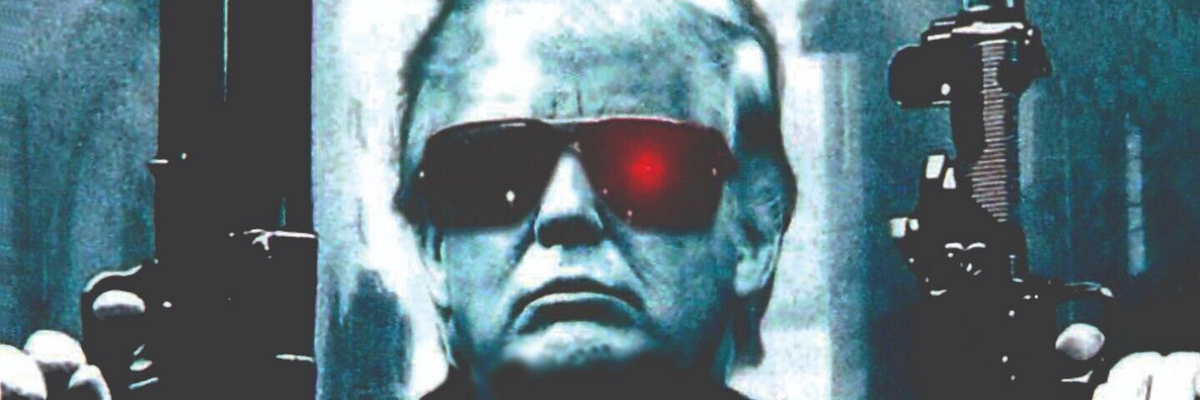
Trump as the Terminator of All Mankind

ALFRED W. MCCOY in the TomDispatch

(Image: ArtCard)

With recent polls giving Donald Trump a reasonable chance of defeating President Biden in the November elections, commentators have begun predicting what his second presidency might mean for domestic politics. 

In a dismally detailed Washington Post analysis, historian Robert Kagan argued that a second Trump term would feature his “deep thirst for vengeance” against what the ex-president has called the “radical Left thugs that live like vermin within the confines of our Country,” thereby launching what Kagan calls “a regime of political persecution” leading to “an irreversible descent into dictatorship.”

So far, however, Trump and the media that follow his every word have been largely silent about what his reelection would mean for U.S. foreign policy. Citing his recent promise of “a four-year plan to phase out all Chinese imports of essential goods,” the New York Times did recently conclude that a renewed trade war with China “would significantly disrupt the U.S. economy,” leading to a loss of 744,000 jobs and $1.6 trillion in gross domestic product. 

Economic relations with China are, however, but one piece of a far larger puzzle when it comes to future American global power, a subject on which media reporting and commentary have been surprisingly reticent.

So let me take the plunge by starting with a prediction I made in a December 2010 TomDispatch piece that “the demise of the United States as the global superpower could come far more quickly than anyone imagines.” I added then that a “realistic assessment of domestic and global trends suggests that in 2025, just 15 years from now, it could be all over except for the shouting.”

I also offered a scenario hinged on — yes! — next November’s elections. “Riding a political tide of disillusionment and despair,” I wrote then, “a far-right patriot captures the presidency with thundering rhetoric, demanding respect for American authority and threatening military retaliation or economic reprisal. The world pays next to no attention as the American Century ends in silence.”

Back then, of course, 2025 was so far off that any prediction should have been a safe bet. After all, 15 years ago, I was already in my mid-60s, which should have given me a “get-out-of-jail-free” card — that is, a reasonable chance of dying before I could be held accountable. But with 2025 now less than a year away, I’m still here (unlike all too many of my old friends) and still responsible for that prediction.

Wednesday, September 20, 2023

Seth takes on Tommy Tuberville

Magaziner condemns Sen. Tuberville for undermining US servicemembers and national security

For more cartoons by Nick Anderson, CLICK HERE
Representative Seth Magaziner (RI-02) spoke on the House Floor to condemn Alabama Senator Tommy Tuberville for his unprecedented action to block senior military promotions, undermining our military service members and national security. 

“Since February, the Alabama Senator has blocked more than 300 qualified officers in the military from receiving the promotions that they have earned, and from assuming the posts that our country needs them in. 

“No one is happier with the Senator from Alabama’s antics than Vladimir Putin, Kim Jong Un, and our nation’s other adversaries. By undermining our military, he is doing their dirty work for them. 

Tuesday, November 29, 2022

Who's the most dangerous person in the world?

Mike Pompeo Just Proved He Is the Stupidest Person in the World 

DIANE RAVITCH in the Diane Ravitch's Blog

Is it one of these guys? Nope, according to Mike Pompeo

Trump’s Secretary of State Mike Pompeo just proved that he is the stupidest person in the world. He said in an interview that Randi Weingarten, President of the American Federation of Teachers, is “the most dangerous person in the world.”

That's her on the right, assuming a very threatening posture
More dangerous than the President of China, Xi Jinping, who is threatening the survival of Taiwan and re-imposing a repressive regime across China.

More dangerous than President Kim, the dictator of North Korea, who is threatening South Korea and the rest of the world, with his intercontinental ballistic missiles and nuclear weapons.

More dangerous than Russian dictator Vladimir Putin, who is trying to destroy the people of Ukraine by destroying their access to heat, light, and water as winter begins, in addition to raining deadly missiles on them.

No, Pompeo says, Randi is “the most dangerous person in the world.”

Why? Because she leads a teachers’ unions, and unions are evil.

Teachers too are evil, Pompeo believes, because the children of America can’t read, write, or do math.

Monday, May 24, 2021

How much your personal information is worth to cybercriminals

What they do with your stolen data?


The black market for stolen personal information motivates most
data breaches. aleksey-martynyuk/iStock via Getty Images
Data breaches have become common, and billions of records are stolen worldwide every year

Most of the media coverage of data breaches tends to focus on how the breach happened, how many records were stolen and the financial and legal impact of the incident for organizations and individuals affected by the breach. 

But what happens to the data that is stolen during these incidents?

As a cybersecurity researcher, I track data breaches and the black market in stolen data. The destination of stolen data depends on who is behind a data breach and why they’ve stolen a certain type of data. For example, when data thieves are motivated to embarrass a person or organization, expose perceived wrongdoing or improve cybersecurity, they tend to release relevant data into the public domain.

In 2014, hackers backed by North Korea stole Sony Pictures Entertainment employee data such as Social Security numbers, financial records and salary information, as well as emails among top executives. The hackers then published the emails to embarrass the company, possibly in retribution for releasing a comedy about a plot to assassinate North Korea’s leader, Kim Jong Un.

Sometimes when data is stolen by national governments it is not disclosed or sold. Instead, it is used for espionage. For example, the hotel company Marriott was the victim of a data breach in 2018 in which personal information on 500 million guests was stolen. 

The key suspects in this incident were hackers backed by the Chinese government. One theory is that the Chinese government stole this data as part of an intelligence-gathering effort to collect information about U.S. government officials and corporate executives.

Saturday, May 8, 2021

Book Review: This Is How They Tell Me the World Ends: The Cyberweapons Arms Race

The Next Frontier of Warfare Is Online

By Mark Wolverton

Sometime in mid-2009 or early 2010 — no one really knows for sure — a brand new weapon of war burst into the world at the Natanz nuclear research facility in Iran. 

Unlike the debut of previous paradigm-shattering weapons such as the machine gun, airplane, or atomic bomb, however, this one wasn't accompanied by a lot of noise and destruction. 

No one was killed or even wounded. But the weapon achieved its objective to temporarily cripple the Iranian nuclear weapon program, by destroying gas centrifuges used for uranium enrichment. Unfortunately, like those previous weapons, this one soon caused unanticipated consequences.

The use of that weapon, a piece of software called Stuxnet widely concluded to have been jointly developed by the United States and Israel, was arguably the first publicly known instance of full-scale cyberwarfare. 

The attack deployed a software vulnerability or exploit, called a zero-day, buried so deeply in computer code that it remains undetected until someone — a team of hackers, a criminal, an intelligence or law enforcement agency — activates it. 

We've all heard of, and perhaps even been victimized by, criminal hacks that may have pilfered our credit card numbers and passwords, or been spammed by suspicious emails that invite us to claim supposed Nigerian fortunes. But zero-days operate on a different level entirely.

"Zero-days offer digital superpowers," New York Times cybersecurity reporter Nicole Perlroth writes in "This Is How They Tell Me the World Ends: The Cyberweapons Arms Race."

Tuesday, December 15, 2020

Better kind of cybersecurity strategy

New model shows why countries that retaliate too much against online attacks make things worse for themselves

Massachusetts Institute of Technology

During the opening ceremonies of the 2018 Winter Olympics, held in PyeongChang, South Korea, Russian hackers launched a cyberattack that disrupted television and internet systems at the games. 

The incident was resolved quickly, but because Russia used North Korean IP addresses for the attack, the source of the disruption was unclear in the event's immediate aftermath.

There is a lesson in that attack, and others like it, at a time when hostilities between countries increasingly occur online. In contrast to conventional national security thinking, such skirmishes call for a new strategic outlook, according to a new paper co-authored by an MIT professor.

The core of the matter involves deterrence and retaliation. In conventional warfare, deterrence usually consists of potential retaliatory military strikes against enemies. But in cybersecurity, this is more complicated. 

If identifying cyberattackers is difficult, then retaliating too quickly or too often, on the basis of limited information such as the location of certain IP addresses, can be counterproductive. Indeed, it can embolden other countries to launch their own attacks, by leading them to think they will not be blamed.

Saturday, July 25, 2020

How Russia's cyber-war works

Russian cyberthreat extends to coronavirus vaccine research
Dorothy Denning, Naval Postgraduate School


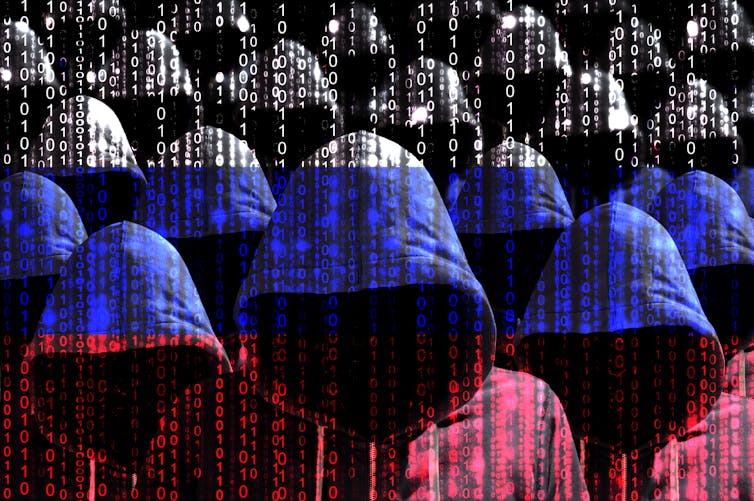
Who are in the hoodies? BeeBright/iStock/Getty Images Plus 
A Russian cyberespionage group that hacked into election networks before the 2016 U.S. presidential election is now attempting to steal coronavirus vaccine information from researchers in the U.S., U.K. and Canada. 

The governments of those three countries issued a warning on July 16 saying that the group known as APT29 or “Cozy Bear” is targeting vaccine development efforts. 

The group, which is connected with the FSB, Russia’s internal security service, had gotten inside the Democratic National Committee networks prior to the 2016 election.

This latest incident illustrates yet again how, beyond carrying all of our phone, text and internet communications, cyberspace is an active battleground, with cybercriminals, government agents and even military personnel probing weaknesses in corporate, national and even personal online defenses. 

Some of the most talented and dangerous cybercrooks and cyberwarriors come from Russia, which is a longtime meddler in other countries’ affairs.

Over decades, Russian operators have stolen terabytes of data, taken control of millions of computers and raked in billions of dollars. They’ve shut down electricity in Ukraine and meddled in elections in the U.S. and elsewhere. They’ve engaged in disinformation and disclosed pilfered information such as the emails stolen from Hillary Clinton’s campaign chairman, John Podesta, following successful spearphishing attacks.

Who are these operators, why are they so skilled, and what are they up to?

Back to the 1980s

The Russian cyberthreat dates back to at least 1986 when Cliff Stoll, then a system administrator at Lawrence Berkeley National Laboratory, linked a 75-cent accounting error to intrusions into the lab’s computers. 

The hacker was after military secrets, downloading documents with important keywords such as “nuclear.” A lengthy investigation, described in Stoll’s book “The Cuckoo’s Egg,” led to a German hacker who was selling the stolen data to what was then the Soviet Union.

By the late 1990s, Russian cyberespionage had grown to include the multi-year “Moonlight Maze” intrusions into U.S. military and other government computers, foretelling the massive espionage from Russia today.

The 1990s also saw the arrest of Vladimir Levin, a computer operator in St. Petersburg. Levin tried to steal more than US$10 million by hacking Citibank accounts, foreshadowing Russia’s prominence in cybercrime. And Russian hackers defaced U.S. websites during the Kosovo conflict, portending Russia’s extensive use of disruptive and damaging cyberattacks.