Menu Bar

Home           Calendar           Topics          Just Charlestown          About Us
Showing posts with label Jared Kushner. Show all posts

Wednesday, October 21, 2026

Russia, Russia, Russia…Trump now openly aligns the US with Putin

He really is a Russian asset

David R. Lurie

Donald Trump has never hidden his infatuation with Vladimir Putin and his brutal dictatorial regime, or his disdain for President Volodymyr Zelenskyy and Ukraine’s resilient democracy.

Before entering the White House for the second time in 2025, Trump agreed with Putin’s fictional grievances over the expansion of NATO — which provided the pretense for Putin’s assault on his neighbor, saying “I could understand their feeling.” Nonetheless, the Trump regime still purported to be supporting Ukraine’s defense.

But last week, Trump gave up any pretense of being a “mediator” in Russia’s War on Ukraine, and openly threw in his lot with Putin.

The dire significance of Trump’s actions can’t be minimized. Trump has declared his desire to make the United States an ally in Russia’s ever more brutal effort to annihilate Ukraine, including by bolstering Russia’s flagging economy with US funds, and using Ukraine’s dependence on US defense systems against it by hobbling the country’s successful offensive and defensive actions.

But there may be a silver lining in a very dark cloud: Ukraine’s true supporters are being forced to face facts many have long avoided.

Over the past two years, many have clung to the false proposition that pandering and supplication could induce Trump to change his mind and support Ukraine. 

That baseless theory allowed some Europeans to avoid the reality that they must take on the full burden — including the costs and risks — of supporting Ukraine, or face the inevitability that Russia will come after them next.

The false notion that Trump was not fully committed to Putin also allowed many Republican supporters of Ukraine to justify looking the other way while Trump uttered his endearments to the Russian dictator.

Now that the Trump/Putin alliance has been indelibly formalized, denial is no longer a remotely reasonable option.

The fake peace plan

Trump’s announcement of his full-blown alliance with Putin was preceded by an attempt by his incompetent and absurdly corrupt team of “envoys,” real estate investor Steve Witkoff and son-in-law Jared Kushner, to advance a predictably bogus Ukraine “peace plan.”

On October 9, Witkoff and Kushner made a show of inviting representatives of Ukraine, as well and European and NATO representatives whom they had previously frozen out of their “mediation” efforts, to a meeting at Witkoff’s Florida golf club.

The purpose, as columnist (and Kushner mouthpiece) David Ignatius explained in a recent column, was to announce a “peace” initiative.

As Ignatius touted, instead of going along with Putin’s demand for all of the eastern Donbas region of Ukraine, the Trumper plan offered Ukraine the “carrot” of a ceasefire based on the current lines — “guaranteed” by the US (whatever that is worth).

The only problem with the “plan” was that Putin has resolutely refused such terms in the past, and there’s no indication he’s changed his mind.

Ignatius asserted that the Trumper “envoys” had extended a generous offer of funding the rebuilding of Ukraine once Russia’s campaign of devastation ends. What Ignatius failed to mention, but later emerged from press reports, is that Kushner and Witkoff also demanded (as they have in the past) that Europe hand over to Trump as yet undisclosed portions of the billions of dollars in frozen Russian assets currently held in Belgium.

In sum, their “peace plan” was to use those monies — which rightfully belong to Ukraine — to fund the “rebuilding” effort, presumably after skimming a large amount off the top for Trump cronies.

The one-sided “ceasefire”

To cap off this great proposal, Witkoff and Kushner reportedly announced that the “peace plan” would involve an immediate halt on some of the most devastating attacks in the war … but solely by Ukraine.

For months, Ukraine has been striking key elements of Russia’s war economy, particularly its oil and gas industry, by attacking hydrocarbon industry plants and other infrastructure, including refineries and tankers. As a result, Russia’s ability to generate oil revenues on the black market is becoming impaired, as is Russia’s ability to produce the refined fuel that is crucial to the operation of its economy and prosecution of its war of conquest against Ukraine.

One would expect that Kushner and Witkoff, as supposed “mediators,” would want Ukraine to continue its strikes. After all — as demonstrated during Zelenskyy’s notorious February 2025 Oval Office encounter with Trump and JD Vance — Ukraine needs to have such “cards” of its own both to defend itself and obtain leverage over Russia in any actual negotiations.

But the very opposite was true. Over at least the past several months, it has come to light that US representatives from Vance on down have been demanding that Ukraine cease attacking Russian refineries. And during the Florida golf course meeting, Kushner and Witkoff formalized that demand for what Trump later called an “energy ceasefire.”

The problem, of course, is that such a one-sided “deal” would leave Russia free to continue hitting Ukraine’s heating and electrical infrastructure in advance of the winter, as Putin’s regime has been doing with ever greater ferocity — including immediately after Trump announced the “ceasefire.”

The peace “proposal,” therefore, was actually a proposal for Ukraine to hobble its own military and defense activities, while Russia assaults Ukrainian civilians and infrastructure.

Trump’s “diesel deal”

But Trump himself all but put the kibosh on his purported mediators’ “peace plan” by announcing his intention for the US to join Iran, North Korea, and China in becoming an open ally in — and profiteer from — Russia’s “Special Military Operation” against Ukraine.

The vehicle for that announcement was Trump’s declaration that he had reached a “diesel deal” with Russia, pursuant to which the US would purchase diesel fuel from Russia and facilitate the sale of the fuel by Russia to other countries.

Since Russia’s full-scale invasion of Ukraine, the United States has cut off purchases of Russian oil and gas and has strongly pressured allies, particularly Europeans, to do the same. Some countries, particularly Germany, have substantially reconfigured their economies to end dependence on Russian hydrocarbons.

Furthermore, just weeks ago, Trump signed into law the Lindsey O. Graham Sanctioning Russia Act of 2026, which was to impose massive secondary tariffs on countries that continued to purchase Russian oil and gas, including China and India. Trump’s announcement was, therefore, a complete about-face, rendering the US into a buyer and marketer of the very same Russian oil products the US has pressured others to shun.

It was hard to make sense of Trump’s actions in light of actual energy market realities.

Because of Ukraine’s successful refinery strikes, as Secretary Chris Wright acknowledged during two Sunday interviews, Russia has been experiencing a serious shortage of diesel.

Indeed, Putin has had to turn to other countries, including South Korea, for supplies of the fuel. Furthermore, the US produces more diesel that it consumes, so it’s unlikely that Russian diesel would be imported to the US even if it was available.

But Trump’s actual purpose was plainly not to increase US diesel supplies, or otherwise lower consumer prices, but rather to make clear his intention to definitively change sides and become Russia’s wartime ally — and to undermine the international sanctions regime against Russia that the US worked so hard to implement over the past nearly five years.

This became all the more clear when reports began leaking out that Trump’s “peace” envoys, Witkoff and Kushner, have been working on a plan with their close associate, Russian oligarch Oleg Deripaska, to pressure Germany to start buying Russian gas again — but this time in a commercial arrangement that will give Trump-associated American firms a cut. This jibes completely with another Kushner/Witkoff scheme that was recently leaked to sell the assets of a large Russian oil company, Lukoil, to an American investor named Todd Boehly who has donated millions to Trump.

If Russia is going to be an ally, why shouldn’t Trumpers get a piece of the resulting gusher of oil profits?

Trump capped off the week by announcing last Friday that he was “implementing” the Graham Act by suspending its provisions and preventing the sanctioning of purchasers of Russian goods, including the diesel fuel Trump has effectively been marketing for his ally Putin’s part.

The Graham Act requires the president to provide certification that any such waiver “is in the national interests of the United States” and to report to Congress on why that’s the case. But Trump made a mockery of these requirements by simply declaring that his about-face in US policy is in the national interest without any substantial explanation.

Secretary of State Marco Rubio, in typically disingenuous fashion, later said that Trump “wants to take the 60-day period of time to sort of analyze what imposing both sanctions and tariffs will mean to the global economy and even to the US economy,” despite the fact that the president signed a law calling for those sanctions and tariffs just days ago.

But, of course, by that time, everyone knew Trump’s actual purpose was to help Putin vanquish Ukraine and endanger the rest of Europe.

The scheme to hobble Ukrainian defenses

Trump’s decision to ally the US with Russia became clear last week, when the Defense Department — which uses its sophisticated aerial intelligence to warn Ukraine of incoming Russian ballistic missile attacks — repeatedly failed to provide such warnings in advance of massive Russian assaults on Kyiv. That came on the heels of reports that Kushner and Witkoff had threatened a complete cutoff of US intelligence sharing with Ukraine during the “peace” talks in Florida.

Then, on October 12 — entirely without warning — the Ukrainian armed forces began to incur sudden speed and connection interruptions in the SpaceX-owned Starlink systems used for navigation of many Ukrainian drones. As a result, Ukraine’s ability to both intercept incoming Russian drone attacks and conduct the midrange attacks the country has been pursuing with great success on Russian military logistics hubs were drastically impaired.

The unexplained cutoff was met with such anger and dismay by Ukraine and its allies that even Putin-friendly oligarch Elon Musk distanced himself from it, stating it was ordered by the US military. Defense Department sources then pointed the finger at, you guessed it, the White House.

Rubio later acknowledged that the US government has wholly cut off Ukraine from the “military” elements of Starlink. Rubio went on to say that it is “under discussion right now how [Ukraine] would want to use” the services Trump has cut off, more than implying that Trumpers are continuing to try to blackmail Ukraine into a one way “energy ceasefire.”

Just yesterday, reports emerged the United States has been holding off on giving necessary approvals to Ukraine of the transfer of Patriot missile interceptors — which provide virtually the only effective defense to increasing Russian ballistic missile attacks. This comes as the US itself has largely refused to provide these interceptors to Ukraine from its own stockpiles.

Also on Monday, Trump opined that Russia "hasn't been doing much" to Ukraine and that its brutal war of annihilation is “fine.”

Facing facts

During a Sunday morning interview Treasury Secretary Scott Bessent was repeatedly asked if Ukraine is an ally of the United States. He refused to give a straight answer, but effectively responded in the negative by berating Zelenskyy.

Trump himself is far less cagey than Bessent on the topic of who his allies are. He recently announced that he was going to invite Putin to attend the G20 meeting, to be held in December at his own Doral golf club. It is now clear that if Putin attends, it will be in his newly anointed role as US, or rather Trump, ally.

Trump’s open effort to join nations like Iran, North Korea, and China in aiding Putin’s murderous assault on Ukraine is nothing short of disastrous, and it will leave a lasting moral stain on the United States. But there may be something of a silver lining to this dark cloud.

Since Trump returned to the presidency, many of Ukraine’s supporters — including some allies in Europe and Republicans in the US — have clung to the theory that, despite Trump’s fondness for Putin, he was not ineluctably committed to a pro-Russian position. All that was needed, these “optimists” argued, was continued sweet-talking and submission from Ukraine’s leaders — including a lot of plaintive “thank yous” — and Trump would come around.

This never made much sense, particularly given the ample evidence that Russia helped Trump get elected, and continues to cultivate him through elaborate disinformation campaigns and by offering lucrative financial “deals” to the likes of Kushner, Witkoff and other Trump cronies.

But it was also, in certain respects, a reassuring fiction.

Many European countries have been notably hesitant to take all of the steps necessary to assist Ukraine in defending itself against Russia. Those include sharing weapons systems and stocks of anti-missile defense weapons (if the US allows it), and by providing Ukraine with access to frozen Russian assets, which are needed both to keep the Ukrainian economy afloat and fully fund the country’s defense.

That European hesitation has continued despite, and possibly in some respects because, Russia has been increasing its so-called hybrid war on other European countries, consisting of everything from cyber attacks to kinetic terror attacks on airports and infrastructure. The use of the term “hybrid warfare” itself reflects a form of self-denial by Europeans, many of whom are hesitant to acknowledge that they are now effectively at war with Russia.

Trump’s now open alliance with Russia may increase the impetus for European leaders to take more steps necessary to provide Ukraine — which after all is the frontline defender of the entire continent against Russian aggression — the resources it requires to prevail. But even if such full-throated resolve is forthcoming, it could also be too late given that (with the help of Russia) pro-Russian politicians may soon come to power in France and potentially Germany.

There also remains a chance, albeit a small one, that some of the vast majority of Republicans who have long claimed to support Ukraine against Russia’s murderous assault will finally stand up to Trump, even feebly. Lindsey Graham’s sister, who Trump plucked out of obscurity to become her late brother’s successor, took a first step in that direction last week by opposing Trump’s “diesel deal” with Putin. A drubbing in the midterms and Trump’s descent into the political basement could encourage that process.

Recent history makes it hard to say that optimism is warranted. But continued, and ever greater, efforts by Ukraine’s supporters are nonetheless essential. The stakes not only for Ukraine, but also the world, could not be higher.

Thanks for reading Public Notice. This post is public so feel free to share it.

🌍 Subscribe to PN 🌍

Saturday, August 29, 2026

Biden Family Grift vs. Trump Family Grift: Let’s Do the Numbers

It's not even close

Dean Baker in Beat the Press   

Most people recognize that Donald Trump and his kids are stealing from us with both hands every day. But they are not as outraged as they should be because most have the view that everyone does it. While I will never defend the Democrats as paragons of honesty (what the hell are those crypto contributions?), they are not in the same ballpark as Trump and his crew.

Part of the confusion stems from the media’s refusal to ever put big numbers in context. They all know that the vast majority of their audience is not clear on the distinction between millions, billions, and trillions, and have no idea how large the federal budget is, but they refuse to take the ten seconds and ten words that would be needed to give readers a clearer sense of what is at stake.

The other source of confusion is that the Republicans spent four years endlessly hyping the “Biden crime family.” They used Congressional hearings, as well as thousands of appearances on TV news, shows to yell (often literally) about Biden family corruption.

And it’s clear it was not zero. Hunter Biden, while struggling with drug addiction, openly traded on his family name to land a well-paying perch with a Ukrainian energy company. He also managed to sell his artwork, which is not obviously of great value, for $50K a painting.

Joe’s younger brother James also seems to have traded on the family name, but the sums involved appear to be in the hundreds of thousands of dollars, and mostly during the years 2017-2019, when Joe Biden was not even in public office.

It is a bad practice for family members to profit from their ties to a vice-president or president, but there is zero evidence that Joe Biden ever did anything to directly benefit his son or brothers in their business dealings. We can be pretty certain of this fact because Republicans in Congress and the White House, both in Trump’s first term and his current term, have left no stone unturned in trying to show Biden’s corruption. (Trump’s first impeachment was over his effort to extort Ukraine’s president to lie about Biden’s corruption.)

While it is difficult to get clear numbers on the extent of the corruption of Trump and his family in his current term, since they disclose as little as possible, and no one can accept what they do disclose at face value, we can try to put some numbers on it. At the very least, it should be totally clear that Trump’s corruption, by any measure, is in a totally different universe from even the worst imaginable story that can be told about Joe Biden and his family.

The list below is far from exhaustive. We will probably not know all the ways that Trump put money into his and his family’s pockets until long after his presidency, and maybe not even then. But this should be a good start.

Biden vs Trump Family Grift: A Comparison

Monday, June 29, 2026

Trump’s “Board of Peace” Has No Funds for Gaza Reconstruction

Where are the billions that have been collected? The ballroom? The arch?

By Shireen Akram-Boshar

This article was originally published by Truthout

Donald Trump’s “Board of Peace” fund has no money for the reconstruction of Gaza, despite raising billions of dollars since January. According to the Guardian, they are also planning to grant themselves sweeping immunity for any crimes or civil liability they may incur.

The Financial Times reported that “Zero dollars have been deposited” into the board’s financial fund — but that the body has received donations directly into its JP Morgan bank account, which allows it to override transparency regulations. 

At its inaugural meeting in February, member states pledged $7 billion for the Board of Peace’s relief and reconstruction package for Gaza, and Trump promised an additional $10 billion.

The Financial Times reported that earlier this year, Morocco contributed $3 million and the United Arab Emirates (UAE) $20 million to the board’s JP Morgan account, and that this funding has helped cover the position of Nickolay Mladenov, the “director-general” of the Board of Peace, as well as salaries for the Palestinian technocrats selected by the board to govern Gaza. The UAE also provided $100 million to train a new police force in Gaza — but the funds are frozen and the program has not started. 

In April, a U.S. official traveled to Saudi Arabia to ask its leaders to follow up on its $1 billion pledge to the board, as it had become concerned that funds were not materializing, according to Middle East Eye. Officials claimed that the U.S. has been relying on the Gulf region to fund the board. 

Friday, May 15, 2026

Chart Shows How Trump 2.0 Is ‘Most Brazenly Self-Enriching’ Administration in US History

Buying Trump’s meme coin is like investing in “a pet rock, except you don’t even get a rock” 

Brad Reed for Common Dreams

Since returning to office a little more than a year ago, Donald Trump has nearly tripled his net worth, driven in large part by investments in his family’s cryptocurrency ventures.

Appearing on MS NOW, economist Steve Rattner broke down how Trump’s net worth has exploded from $2.34 billion in 2024 to an estimated $6.5 billion in 2026.

“So where did the money come from? He had $4 billion, he and his family, of profits,” Rattner said. “$3 billion of it came from crypto, and I will tell you, there are so many transactions here, so many structures, that made my head hurt trying to understand it.”

In addition to the crypto ventures, Rattner pointed to Trump son-in-law Jared Kushner raising money from investors in the Middle East through his investment firm Affinity Partners; increased revenue that came from raising admission fees to his Mar-a-Lago resort; and money he’d obtained from lawsuits against assorted media companies.

Rattner then explained the finances of the Trump meme coin, which he described as investing in “a pet rock, except you don’t even get a rock” out of the deal.

Monday, March 2, 2026

Who profits from Trump's newest war?

Trump's son-in-law Jared Kushner for one

Judd Legum

In private calls over the last several weeks, Saudi Crown Prince Mohammed bin Salman (MBS) reportedly urged President Trump to attack Iran. Iran is a top regional rival of Saudi Arabia, and MBS had become concerned about Iran’s growing military capabilities.

The lobbying campaign achieved success on Saturday, when Trump announced he had begun “major combat operations in Iran.” Trump launched a war even though U.S. intelligence assessed that Iran posed no imminent threat to the United States. In June 2025, Trump publicly declared that more limited strikes “completely obliterated Iran’s nuclear capability.”

MBS’s influence with Trump has grown as the Saudi government has invested billions in projects that personally enrich Trump and his son-in-law, Jared Kushner.

Despite the glaring conflicts-of-interest, Trump installed Kushner as a top negotiator with Iranian officials. Kushner and Middle East envoy Steve Witkoff participated in a mediation session with their Iranian counterparts in Geneva on Thursday, billed as a last-ditch effort to avoid war.

The Saudi Arabian Public Investment Fund (PIF) is the largest investor in Jared Kushner’s private equity fund, Affinity Partners. PIF invested $2 billion in Affinity Partners in 2021, even though the PIF committee that screens investments recommended rejecting Kushner’s proposal, citing “inexperience” and “excessive” fees. The committee’s recommendation was overruled by MBS, who heads PIF’s Board of Directors.

PIF pays Kushner 1.25% of its investment, or $25 million, annually. The Senate Finance Committee estimates that Kushner will be paid $137 million in management fees from PIF by August 2026. Further, in September 2025, PIF, Affinity Partners, and others jointly acquired Electronic Arts, the publisher of iconic video games like The Sims and Madden NFL, for $55 billion. The deal, which is the largest leveraged buyout in history, will likely be very lucrative for Kushner.

After raising billions for the Saudis and other foreign governments, Kushner dismissed concerns about conflicts of interest, pledging he would not be involved in Trump’s second term. 

In February 2024, Axios’ Dan Primack asked Kushner whether his business relationship with foreign governments would make it “very difficult… to do any sort of foreign policy work” moving forward. “I’m an investor now,” Kushner replied. “I served in government, and I think my track record is pretty impeccable. Now I’m a private investor.”

Yet, after Trump took office, Kushner resumed his central role in shaping U.S. foreign policy. In an October 2025 interview on 60 Minutes, Kushner argued that financial conflicts made him and Witkoff more effective. 

“What people call conflicts of interests, Steve and I call experience and trusted relationships that we have throughout the world,” Kushner said.

CNN reported that both Saudi Arabia and the UAE lobbied Trump to strike Iran. Like Saudi Arabia, the UAE has significant financial ties to Kushner and Trump.

The UAE is another major backer of Affinity Partners, directly investing about $200 million with Kushner’s firm. Additional money came via Lunate, a supposedly private Abu Dhabi investment firm that is financed by government money and tied to the UAE’s sovereign wealth funds.

Witkoff is the co-founder of the crypto firm World Liberty Financial (WLF) and retains an 8-figure stake in the company. Trump and his family also own significant pieces of the company. 

Sheikh Tahnoon bin Zayed Al Nahyan, the UAE’s national security advisor and head of the country’s largest sovereign wealth fund, purchased 49% of WLF days before Trump’s inauguration. 

Of the $250 million paid up front by the UAE, $187 million was directed to Trump family entities and $31 million to the Witkoff family. In May 2025, MGX, a company controlled by Tahnoon, purchased $2 billion of crypto tokens from WLF.

Following the conclusion of the mediation on Thursday, Kushner and Witkoff “ominously issued no statement,” and the pair was reportedly “disappointed“ by the Iranian negotiating position. After presumably being debriefed by Kushner, Trump said, “we’re not thrilled with the way they’re negotiating.” According to Trump, it would be “wonderful” if the Iranians “negotiated in … good faith and conscience but they are not getting there so far.”

The new Iran War comes weeks after PIF financed a $7 billion development deal in Saudi Arabia with the Trump Organization. Under the agreement, Dar Global, a developer with close ties to the Saudi government, will build a “Trump-branded hotel and golf course,” along with “500 mansions, priced between $6.7 million and $24 million.” The project is part of Diriyah, a $63 billion development funded entirely by PIF.

When Trump visited Saudi Arabia in May 2025, MBS took him on a tour of Diriyah and showed him a model of the development. According to Jerry Inzerillo, who heads the Diriyah Company, a PIF subsidiary, Trump was “amazed“ with the quality and scale of the project.

Trump maintains full ownership of the Trump Organization and will profit from the deal. Typically, these deals involve the developer paying millions in fees simply to license the Trump name. About 80% of the money will flow directly to Trump, according to Forbes’ reporting on similar deals. (The Trump Organization has been nominally transferred to a trust controlled by his son, Donald Trump Jr. — an arrangement ethics experts have dismissed as meaningless.)

While Trump discussed a potential war with Iran in multiple calls with MBS, he has spent little time justifying the war to the American people. In lieu of a traditional live address from the Oval Office, Trump announced the war in a short, edited video, delivered in a baseball cap and posted on his social network, Truth Social. The video was recorded at his Florida home and private club, Mar-a-Lago. On Saturday night, Trump attended a $1 million-per-plate fundraiser there for the primary pro-Trump Super PAC, MAGA Inc.

After the beginning of hostilities on Saturday, Iran launched attacks on the Saudi capital of Riyadh and numerous targets in the UAE. In response, the Saudi Ministry of Foreign Affairs released a statement saying it would “mobilize all its capabilities“ against Iranian aggression, and the UAE warned Iran of “grave consequences.”

By Sunday, the war claimed the lives of three U.S. service members and hundreds of Iranians.

Subscribe to Popular Information by Judd Legum 

Tuesday, February 10, 2026

Trump's "Peace" Board is set to line his pockets

First get rid of the Palestinians, then let Jared Kusner build a giant Trump resort

Meanwhile, pay Trump a billion dollars!

Sabrina Haake

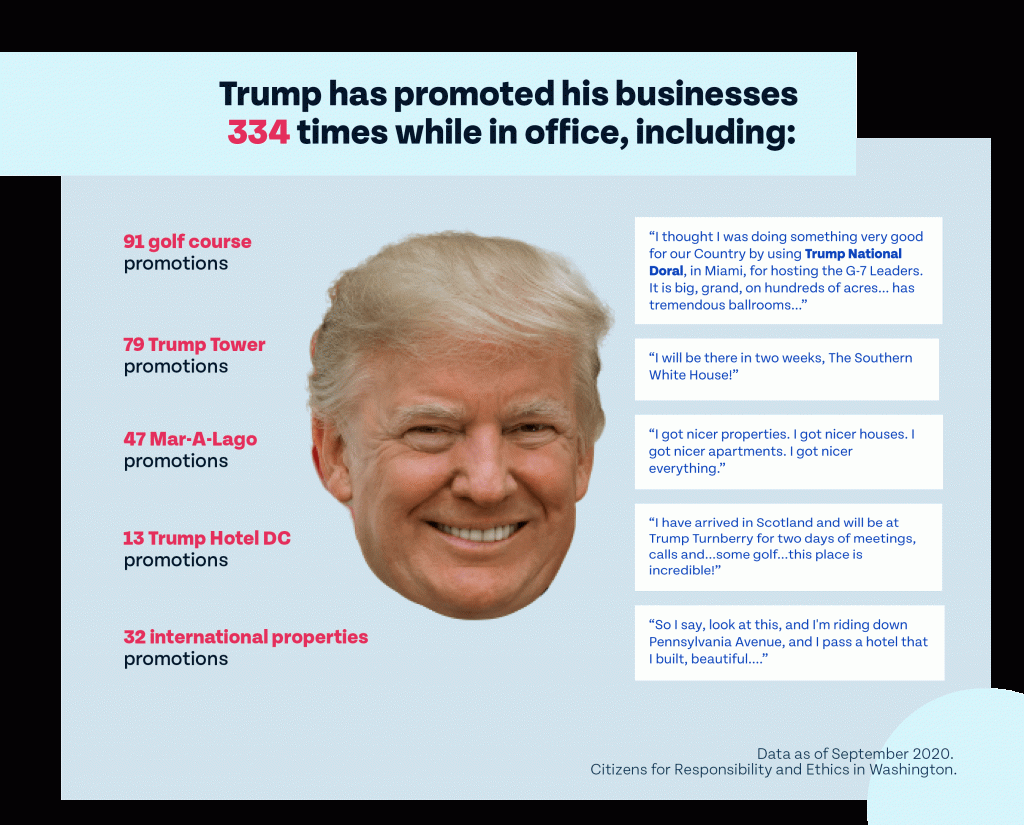
Trump Tower. Trump Steaks. Trump University. Trump Watches. Trump cologne, candles, coins, robes, ornaments, towels, pens, gerbils, and gold-tipped suppositories. It’s hard to think of anything Trump hasn’t tried to monetize.

And now, from his premier fantasy collection, there’s Trump UN.

Last September, while Trump was busy solving eight wars that leaders of those countries say never started, never ended, or had nothing to do with him, Trump hatched a plan to line his own pockets with the misery in Gaza. He came up with a Gaza Board of Peace vested with magical powers to maintain order while steering private investments to his friends and family.

Trump’s Billion-dollar racket

From a plan being circulated within the White House
For a mere billion dollar membership fee, you can join Trump’s Orwellian-themed Peace Board and dine with the world’s most brutal dictators.

Trump, who invested his dad’s money in Middle East real estate two decades ago, claimed last year that the U.S. would “run” Gaza, that he saw “long term ownership” possibilities there. His “Riviera of the Middle East” proposal with son in law Jared Kushner floated luxury tourism and an economic hub, describing Gaza as having a “phenomenal location, on the sea, the best weather” with “unbelievable” potential.

The only hitch? Someone would first need to relocate more than two million desperately poor Palestinians who have nowhere else to go.

Israeli Prime Minister Benjamin Netanyahu, no fan of international law or Palestinians, loved the concept. Arab leaders, not so much. Palestinians, leaders of surrounding Arab nations, and international organizations saw Trumps ‘Riviera’ as ethnic cleansing, ripe for war crimes under international law.

Wednesday, November 19, 2025

How Trump Has Exploited Pardons and Clemency to Reward Allies and Supporters

With Trump, everything is for sale (or barter)

The beneficiaries of Donald Trump’s mercy in his second term have mostly been people with access to the president or his inner circle. Those who have followed the rules set out by the Department of Justice, meanwhile, are still waiting.

Trump has granted clemency to allies, donors and culture-war figures — as well as felons who, like him, were convicted of financial wrongdoing. On Friday, he granted pardons to 77 people, including Rudy Giuliani and other allies tied to efforts to overturn the 2020 election, though they are mostly symbolic because federal pardons do not apply to ongoing or possible state prosecutions, which many of the grantees face. 

Those clemencies came on top of the commutation awarded last month to George Santos, the disgraced former New York congressman found guilty of defrauding donors and lying to the House of Representatives. Trump cut short Santos’ seven-year sentence after less than three months.

For those who followed the standard protocol set out by the Department of Justice, the sense is growing that the process no longer matters; they’ve watched the public database of applicants swell with thousands of pending cases, while Trump grants pardons to people who never entered the system at all.

In just over nine months back in office, roughly 10,000 people have filed petitions for pardons or commutations, about two-thirds the total of the 14,867 applications submitted during the entire Biden presidency.

Under Justice Department standards and requirements, people seeking pardons generally must wait five years after their release from incarceration, demonstrate good conduct and remorse, and file petitions through the Office of the Pardon Attorney. But Trump’s actions in his second term show he has largely abandoned that process.

Saturday, June 29, 2024

Donald Trump ia a Profound Threat to Social Security, Medicare, and Seniors

How do we know? He's already told us—over and over and over again.

NANCY J. ALTMAN in Common Dreams

Donald Trump was the worst president for seniors in the history of the nation. That is not hyperbole. Alarmingly, if elected again, he will be even worse—and, worryingly, more effective.

When Trump ran for president in 2016, he claimed he would be the one Republican not to cut our earned benefits but, when he actually became president, every single one of his budgets proposed deep cuts to Social Security and Medicare, as well as Medicaid.

When Trump couldn’t get the cuts enacted, he employed the old tactic of “starve the beast.” Figuring tax cuts are easier to enact than benefit cuts, he cut income taxes which help to fund Medicare and Medicaid, and sought to defund Social Security, which has its own dedicated revenue source.

To advance his goal of undermining Social Security, Donald Trump grabbed the questionable power to go after its dedicated revenue unilaterally—something without precedent. Because Trump was limited to executive action, he was able to only defer the revenue, but he made clear that he would not just defer the revenue, but eliminate it, if he were re-elected. Insufficient dedicated revenue leads to automatic cuts. Conveniently, automatic cuts means there is no one to clearly be held accountable.

Trump’s goals to undermine these programs, so vital to seniors, have not changed. Trump continues to claim he won’t cut benefits despite his record to the contrary, but tells the truth from time to time. Moreover, he is reportedly considering, once again, defunding Social Security, if he has the chance. Trump also plans to continue to give his billionaire friends massive tax giveaways.

Friday, March 22, 2024

DO NOT let him do it again

Trump nearly derailed democracy once 

Richard L. Abel, University of California, Los Angeles

Elections are the bedrock of democracy, essential for choosing representatives and holding them accountable.

The U.S. is a flawed democracy. The Electoral College and the Senate make voters in less populous states far more influential than those in the more populous: Wyoming residents have almost four times the voting power of Californians.

Ever since the Civil War, however, reforms have sought to remedy other flaws, ensuring that citizenship’s full benefits, including the right to vote, were provided to formerly enslaved people, women and Native Americans; establishing the constitutional standard of one person, one vote; and eliminating barriers to voting through the 1965 Voting Rights Act.

But the Supreme Court has, in recent years, narrowly construed the Voting Rights Act and limited courts’ ability to redress gerrymandering, the drawing of voting districts to ensure one party wins.

The 2020 election revealed even more disturbing threats to democracy. As I explain in my book, “How Autocrats Seek Power,” Donald Trump lost his reelection bid in 2020 but refused to accept the results. He tried every trick in the book – and then some – to alter the outcome of this bedrock exercise in democracy.

A recent New York Times story reports that when it comes to Trump’s time in office and his attempt to overturn the 2020 election, “voters often have a hazy recall of one of the most tumultuous periods in modern politics.” This, then, is a refresher about Trump’s handling of the election, both before and after Nov. 3, 2020.

Trump began with a classic autocrat’s strategy – casting doubt on elections in advance to lay the groundwork for challenging an unfavorable outcome.

Despite his efforts, Trump was unable to control or change the election results. And that was because of the work of others to stop him.

Here are four things Trump tried to do to flip the election in his favor – and examples of how he was stopped, both by individuals and democratic institutions.

Wednesday, June 14, 2023

A Criminal President -- with Accomplices

Trump is not our first criminal president

By Thom Hartmann for the Independent Media Institute

Donald Trump has been indicted on seven federal felonies.

Most Americans view Donald Trump as an aberration, a one-off, the exception. He’s our first “criminal president” they think, the first to have committed crimes to get into office, while in office, or both.

Most Americans, in this regard, are wrong, and it’s a tragic statement about both the way we teach American history in our schools and the way our corporate media deals with past presidential crimes.

If previous Republican presidents had been held to account for their crimes the way it appears Trump is about to be, Trump may well have not been as brazen in everything from his violations of the Hatch Act to the Espionage Act to his explicitly asking Vladimir Putin to intervene in the 2016 election.

Everybody knows that Richard Nixon got caught orchestrating and then covering up a break-in at the DNC headquarters in the Watergate complex, and that he avoided going to prison by resigning his office. Yet it’s no secret that Nixon committed a far more serious crime — naked treason — just to get into office in the first place.

When the LBJ White House tapes were released in 2013, the world learned that Johnson had negotiated a secret deal with the Vietnamese to end the war in the late fall of the election year of 1968.

Nixon got wind of it and, through a campaign aide during a meeting in his New York apartment, reached out to the South Vietnamese ambassador offering inducements to pull out of the peace talks and scuttle the deal, which they then abandoned just as it was about to be signed.

Sunday, April 23, 2023

Ethics Watchdog group issues new report comparing Trump and Biden Administrations’ compliance with the law

Biden administration financial disclosures show strong pattern of compliance

Citizens for Responsibility and Ethics (CREW)

Introduction (To read the full report, CLICK HERE).

Stark differences between Biden and Trump administration officials’ financial disclosures highlight a need for reforms of ethics rules. 

A review of senior Biden administration officials’ financial disclosures for 2022 shows a high degree of compliance with divestiture obligations, and even includes examples of cabinet members going beyond required divestitures. 

In contrast, several notable examples from both the Trump White House and Cabinet illustrate how officials were permitted to retain holdings that presented significant concerns about conflicts of interest and appeared to allow them to profit off of their public positions. 

To prevent future abuses, Congress should adopt legislation that bans the president, vice president, cabinet members and all senior White House staff from owning and trading individual stocks and from retaining personal interests in family businesses that could make them susceptible to influence-peddling. 

Wednesday, February 15, 2023

How Trump's Legacy Could Make a Bird Flu Pandemic More Deadly Than Covid

If you hate egg prices, wait till avian flu jumps to humans 

By Thom Hartmann for Economy for All, a project of the Independent Media Institute.

Trump’s no longer president, but he and his racism could still be responsible for millions more American deaths from a new pandemic disease. How and why? I’ll explain in just a moment, but first let’s look at the disease itself. 

One reason egg prices are so high right now is because a new strain of bird flu — H1N5 — has popped up among egg-laying chickens. The disease has a shocking mortality rate, leading to the death (both from disease and from euthanizing flocks to stop its spread) of almost 60 million domesticated birds in the US alone, so far.


The virus has mutated enough to infect wild birds, and dead or dying wild birds with H1N5 have now been found in 920 counties across all 50 states. It’s also spread to mink in Europe (whose respiratory systems are so similar to ours they’re used for research) and has caused seizures and death among bears in the United States.


The disease also infects and kills humans, although all of the cases so far have been people infected directly from sick animals. 


Nonetheless, the numbers are grim: according to the World Health Organization, there have been 863 people infected with H1N5 “bird flu” so far, most of them in Egypt, Indonesia, and Vietnam, and 456 of them — 52.8 percent — have died of the disease.


For comparison, Ebola kills about 40 percent of the people infected by it, according to the CDC.


For the H1N5 flu to move from bird-to-human transmission to human-to-human transmission will only require a small mutation in the virus. 


It would just have to pick up a gene that’s present in the other flu variants that currently infect people, presumably by infecting a person who’s also already infected with or recovering from a “normal” flu. Like a poultry worker who catches the seasonal flu but goes to work anyway because she doesn’t have paid sick leave.


Odds are that if it stays as deadly as it currently is it wouldn’t spread as rapidly or as widely as a less deadly variety, simply because it would kill its hosts so quickly. 


But even if its pathogenicity dropped from 52.8 percent all the way down to 2.5 percent, that would equal the Spanish Flu of the 1918-1920 pandemic that killed 50 million people around the world and an estimated 675,000 Americans when our population was only a third of what it is today.


For comparison, Covid kills 1.4 percent of unvaccinated people who acquire the disease.


To deal with this potential crisis, America should right now be developing H1N5 vaccines in large quantities and begin inoculating workers in factory farms, slaughter, and meat-packing operations. And informing the American people about the possible scope of an H1N5 pandemic. 


Friday, December 9, 2022

62 Things Trump Did That You Forgot About To Preserve Your Sanity

Donald Trump's running for president again, so you can look forward to more of his "fun" ideas — like the time he tried to buy Greenland.

By Ryan Grenoble, HuffPost

Donald Trump has returned to the news cycle amid a deluge of stories about a dinner meeting he hosted with a white supremacist and Ye, the rapper previously known as Kanye West.

It’s a reminder of the chaotic years of his presidency, as well as a foreboding ― though hopefully instructive ― warning about how he would wield power if elected again.

If past is prologue, let’s take a moment to remember just how unsettling things got during the Trump administration, with this not-even-remotely-exhaustive list of weird and bad stuff he attempted while in office:

Monday, November 28, 2022

Trump is already getting foreign governments to sponsor his 2024 bid

Just days after announcing another run, Trump signs $4 billion real estate deal with Saudis and Oman

Rebekah Sager, Daily Kos Staff

Saudi Arabia’s King Salman and Donald Trump take part in a
traditional sword dance, Riyadh, May 2017.
 
Photograph: Bandar Al-Jaloud/AFP/Getty Images
The word hubris comes from Ancient Greece, meaning “exaggerated pride or self-confidence.” And no word seems more fitting to describe former guy Donald Trump walking into Trump Tower in New York City with his son Eric Trump last week to sign a reported $4 billion deal with a Saudi Arabian real estate company to build a mammoth project in Oman.

The word hypocrite also comes from the Ancient Greek word hypokrites, which means “an actor,” another word most fitting to describe the Republican Party, which, after winning the House by a razor-thin margin, is promising to spend every minute of its time impeaching President Joe Biden and investigating his son, Hunter Biden, amid unabashedly bogus allegations of conflict of interest.

Trump is no stranger to selling his brand, but the Saudi deal is a bold move considering that he’s just thrown his name in the hat for a third run at the presidency.

This particular deal puts him directly into murky waters. According to The New York Times, the project isn’t just some random real estate deal—it’s a deal with the government of Oman itself. Conflict of interest much?