Menu Bar

Home           Calendar           Topics          Just Charlestown          About Us
Showing posts with label fake fire districts. Show all posts

Thursday, June 11, 2026

Great new local website breaks great news about a new Charlestown Town Council candidate

Eat your heart out, CCA

By Will Collette

This is Cynthia's Corgi, Maris, who WON'T
be on the campaign trail
Alex Nunes, former South County bureau chief for Rhode Island public radio, left the station after Donald Trump wiped out federal funding for public broadcasting. I was worried that meant an end to his outstanding coverage of local coastal issues such as the fake fire district ripoff and beach access.

Fortunately, Alex won the post of Executive Editor for the Westerly Sun and is working hard to revitalize that local institution. But having way more energy than me, he has also set up a side gig.

Working with Sun columnist Nancy Burns-Fusaro, there’s a new media source called the South County Star where Alex is continuing to work on the stories that made him a must-read/hear source on The Public’s Radio. Call the Star another must-read source.

He just broke the story that another fine local journalist, Cynthia Drummond, will be running as a Democrat for a seat on the Charlestown Town Council. She will not seek endorsement from either the CCA or Charlestown Residents United (CRU) but WILL seek the support of the Charlestown Democratic Town Committee.

In the 25 years since Cathy and I returned to Rhode Island to live in Charlestown, we’ve enjoyed Cynthia’s work. Charlestown was lucky to have her as its Westerly Sun specialist for many years. I loved her attention to detail, witty writing style and fairness. I was sorry to see her retire, though I still followed her freelance work for such publications as EcoRI.

Charlestown Town Council President Deb Carney told Alex Nunes she was “very excited” to run with Cynthia as both will be running as endorsed Democrats, elaborating further, “I know Cynthia going back to 2010. She’s very smart. She’s very scientific. She does her research.”

As does Deb.

Here's Cynthia's bio from her stint at the Rhode Island Current:

Cynthia Drummond began her journalism career as a television reporter in Canada. She holds a Master of Marine Affairs degree from the University of Rhode Island and worked for several years at The Westerly Sun, covering Hopkinton, Richmond, Charlestown and the Chariho Regional School District. In addition to writing for the Rhode Island Current, Cynthia covers the Town of Richmond for the Beaver River Valley Community Association.

Alex reported that she moved to the US in 1998 and became a US citizen.

One thing she won’t do as a candidate is use her beloved Corgi Maris as a political prop as so many others do. Maris is prominently featured in Cynthia’s Bluesky account and she seems like a natural campaigner.

Saturday, May 30, 2026

Senate approves Sen. Gu’s shoreline access education bill

Local fake fire districts who block beach access also need "educating" 

The Senate today approved legislation from Sen. Victoria Gu to educate tenants and short-term rental guests about public shoreline access rights.

“This bill expands upon the work we’ve done to codify shoreline access and educate buyers of shoreline property about the public’s right to access the shore,” said Senator Gu (D-Dist. 38, Westerly, Charlestown, South Kingstown). 

“While a lot of people in Rhode Island are aware of the public’s right to access the shoreline, people coming in from other states to rent or book a short-term rental aren’t necessarily aware of them. This is an important consumer protection and education measure to ensure that people renting ocean front real estate understand the public’s right to access the shoreline.”

Senator Gu sponsored a new law in 2024 that requires similar disclosure to buyers of shoreline property. This bill (2026-S 2734A) would extend this disclosure to tenants of shoreline properties, requiring landlords to provide renters with written shoreline access disclosure before the start of tenancy.

The disclosure would include the public’s rights and privileges to the shore up to 10 feet above the recognizable high tide line, requires the landlord to disclose any known rights of way to the tenant and advise the tenant to contact CRMC to find out if any public rights of way or permits are tied to the property.

Wednesday, December 3, 2025

CRMC settles one beach access dispute in Westerly

Weekapaug fake fire district road blocks still unresolved.

By Rob Smith / ecoRI News staff

After more than 40 years since it was first given to the state for consideration, coastal regulators have decided to designate a shoreline access point at the end of Everett Avenue in Westerly a state right of way.

The matter had technically been before the Coastal Resources Management Council, the state agency that oversees coastal access, since the late 1970s. According to a report and recommendation authored by CRMC counsel Anthony DeSisto, the agency’s right of way subcommittee held hearings in the fall and winter of 1978 and early 1979.

“The town has made representations that it’s a public street, it’s in the harbor management plan as a public right of way to the shore,” DeSisto said. “You have your dedication and acceptance as subcommittee members heard, the two elements indicating it’s a public right of way.”

During the hearings, the town and members of the public indicated the access point was used as a public right of way (ROW) by local residents, but the full council voted in 1980 to put its designation process on hold to allow abutters opposing the designation process to provide evidence to the contrary. That evidence never materialized, and the ROW issue lay dormant until brought to CRMC’s attention by a town solicitor in Westerly in February.

Friday, November 14, 2025

Battle Over Westerly Beach Access Rages On Before CRMC

Fake fire district fights to restrict public beach access

By Rob Smith / ecoRI News staff

Access to Weekapaug Beach in Westerly, R.I., is guarded by a security officer from 9 a.m. to 6 p.m. during the summer. The Weekapaug Fire District, at least according to a group of concerned residents, is also illegally blocking a shoreline right of way known as the Spring Avenue Extension. (Frank Carini/ecoRI News)

EDITOR'S NOTE: The Weekapaug Fire District is actually just a homeowners' association not an fire-fighting entity. Ironically, the Fire District lost what little capacity it had when its own firehouse burned down in November 2017. They have a security force, as shown above, but no firefighters. Weekapaug is similar to Charlestown's two fake fire districts, Shady Harbor and Central Quonnie, who likewise lack the ability to fight fires but plenty of determination to keep outsiders off the beach.  - Will Collette

Observers hoping for a quick resolution to the Spring Avenue Extension coastal access point are sure to be disappointed.

The Coastal Resources Management Council’s right of way (ROW) subcommittee opened its first evidentiary hearing Nov. 4. It’s the first chance both sides have had to produce evidence that proves or disproves if the ROW is truly open to the public.

For two and a half hours — with a single 15-minute break — the subcommittee heard testimony from witnesses, including title attorney Joseph Priestly, as attorneys representing the town of Westerly tried to prove to council members using decades-old plat maps the public status of the ROW.

“It’s a public highway open for access by the public and will remain so until abandoned by the town of Westerly,” Priestly testified. “Assuming that it has not been, it remains a public highway.”

Priestly added he had seen no evidence indicating the town had abandoned the ROW, either formally or informally, but noted he had not specifically looked for evidence of abandonment either. He also testified to subcommittee members that he saw no maintenance obligation by Westerly in the land evidence records.

A key point of evidence for supporters of the right of way is a 1939 plat map that has the ROW labeled. Westerly solicitor William Conley said for the ROW to be accepted under common law jurisprudence was a plat map depicting the ROW, and proof that it was open to the public historically, which would count as the town “accepting” the ROW without formally adopting it.

Tuesday, October 21, 2025

Reassessing Assessment

How property tax assessments become random

Tom Sgouros in SteveAhlquist.news

Charlestown property assessments are skewed by
out-of-state buyers paying far more than assessed value.
This house was bought for almost $4 million when
it was assessed at under $2 million
In a previous column, I wrote that property taxes in Rhode Island are limited to a 4% increase each year. This is oversimplified in two ways: first, because the 4% limit applies to the total amount a town collects (which is weird and worth an article itself), and second, each city and town suffers a state-mandated “revaluation” every three years, where the assessment of each home is adjusted up or down according to recent sales prices.

Property in Rhode Island is taxed according to its market value, and has been for at least a couple of centuries. This is widely perceived as a fair way to do things, but what is a home’s value? You don’t ever know until it sells, and even then, you might not *really* know. 

This is another way Charlestown's tax
assessments are artificially skewed
Pao Lun Cheng, a longtime business professor at the University of Massachusetts, wrote in 1970 that the value of a house is an essentially unknowable abstraction because any particular sale price is confounded by complicating factors: the acumen of the buyer, the patience of the seller, the competence of the agent, the rectitude of the appraiser, and so on. He wrote that if you could sell a house many times over, the average sales price could be a good estimate of a property’s value, but a single sale price is hardly enough data.

This doesn’t mean throwing up one’s hands, but trying to be clear about what sales data tells you: a little, but not that much.

Before 1997, property in Rhode Island was assessed every ten years, when all properties were to be examined and revalued. But those revaluation years were marked by a tremendous number of complaints as people saw huge jumps in their property tax bills. I had a retired neighbor in Fox Point in the 1980s who saw his home’s value triple after a revaluation. His tax bill didn’t increase as much, but it jumped a lot. A real estate agent I mentioned it to told me my neighbor should be happy that his property’s value had gone up so much—small comfort to a guy who did not want to move. In the 1990s, among Mayor Cianci’s many transgressions was putting off the mandated revaluations by three years to help one of his reelection bids, because he knew how much people hated the inexplicable and unpredictable jumps in their tax bills.

Monday, October 13, 2025

After Rhode Island’s shoreline access law, what’s next?

"Fire Districts" use guards, and one guy pulls a gun to keep people off the beach

Kristen Curry 

CLICK HERE for the details
URI coastal law expert assessing Rhode Island's shoreline access law in the face of rising seas and eroding coastlines

These recent sunny days bring the last chances to access the Rhode Island coastline before chillier weather sets in, though that won’t keep Jesse Reiblich away. When he’s not in or around the water — as an avid surfer, diver, and sailor — the University of Rhode Island assistant professor is working on a project to assess how effective Rhode Island’s shoreline access policies are, in a project funded by the National Sea Grant Law Center.

An attorney who teaches in URI’s Department of Marine Affairs, Professor Reiblich is writing and presenting on an important topic in the Ocean State: How can access to its shorelines be protected if the boundary is unclear?

Public access to the coast is threatened by a number of factors, including climate change, development, and conflicting coastal uses. Rhode Island’s Constitution guarantees certain coastal access privileges, but these rights have been undermined by judicial decisions that define the “shore” in limited ways.

In response to these discrepancies, Rhode Island’s legislature two years ago passed a new shoreline access law that enshrines the right of the public to access 10 feet above the mark of the last high tide. Professor Reiblich says this new law functions as a coastal resilience law. Now, he’s overseeing a research project aiming to evaluate the new law’s effectiveness, hoping to share research findings with the government agencies responsible for implementing the law.

Along with URI colleagues Melva Treviño Peña and Nathan Vinhateiro, the trio will assess whether the shoreline’s newly defined demarcation is sufficient for ensuring public coastal access and enhancing the public’s ability to access the shore. They hope to determine whether Rhode Island’s “shoreline” definition is legally sufficient or whether a new delineation would be legally preferable, for users, property owners, and regulators, as well as in the face of rising seas, eroding coastlines, and other effects of climate change.

Professor Reiblich believes that Rhode Island stands out within New England for protecting public ocean access: “Rhode Island’s effort to protect shoreline access in this new law and in its Constitution is among the strongest in the region,” he says.

Wednesday, September 24, 2025

Can CRMC Solve Mystery of Who Owns Westerly’s Spring Avenue Extension Right of Way?

Weekapaug fake fire district claims it can block beach access

By Rob Smith / ecoRI News staff

(Rob Smith/ecoRI News)
The public testimony presented in the Town Council chambers last week about a shoreline right of way sounded more like a science fiction novel than democracy in action.

For the first time coastal regulators were on hand to accept comment on the status, history, and local traditions surrounding what’s become the most contentious shoreline access point in recent memory: the Spring Avenue Extension right of way (ROW).

Supporters of shoreline access have identified the ROW as being once owned by the town as recently as the 1940s, with plenty of town residents recalling using the path to Quonachontaug Barrier Beach, also known as Weekapaug Beach, as recently as the 1970s. The town, these advocates allege, owns the right of way and never gave up its rights to the ROW.

On the other side of the issue is the Weekapaug Fire District, which restricts access and excludes the public from the beach during the busy summer session from mid-June to mid-September, as well as private property owners who claim the ROW was never used by the public, and who say the ROW is privately owned.

It’s a paradox, one that officials at the Coastal Resources Management Council aim to solve within the next year. The hearing last week, on a hot Monday evening, was the first in a series of public meetings aimed at soliciting the opinions and views of local residents and Rhode Islanders on how and when the right of way was used.

Monday, December 9, 2024

Congratulations to Charlestown’s new Town Council

You can do great things, Part 1

By Will Collette

This is the first of a two-part series. Part 2 will run tomorrow night.


For the second straight election, Charlestown voters rejected the Charlestown Citizens Alliance (CCA) and voted continued confidence in the leadership from Charlestown Residents United (CRU). This time voters picked an all-CRU slate led by newly sworn in Council President Deb Carney and Vice-President Rippy Serra. For the first time since 2008, there is no one from the CCA on the Town Council.

They held their first business meeting tonight (Dec. 9) of the new term.

The CCA’s traditional power base on the Planning Commission is no longer filled with commissioners who snap “jawohl” to every command from CCA leader and Planning Commissar Ruth Platner. In addition to newly elected CRU-endorsed Glenn Babcock, CCA stalwart Lisa St. Goddard who was just re-elected but now just resigned and will be replaced by the CRU-controlled Town Council.

CRU-endorsed Patricia Stamps is already on the Planning Commission. With the addition of Glenn Babcock and whoever is picked to replace Lisa St. Goddard, the cracks in Platner’s platform of obstructionism are becoming evident.

So Charlestown has a substantially changed power structure led by an all CRU Council. Can we hope to see some action on issues that have long been dismissed by the CCA?

Charlestown’s Town Council has a broad array of powers it can use to make change. It can pass ordinances. It can repeal ordinances. It can issue resolutions. It can direct town staff to make administrative changes. It can make recommendations to our General Assembly representatives for legislation that would help the town.

I’m particularly interested in fair taxation and believe tax reform in town is long-overdue to address these issues:

Property tax relief for volunteer firefighters.

We should not only show them our gratitude but provide incentives for recruitment and retention. This would require General Assembly approval. South Kingstown provides us with a recent example of what to do in legislation that Rep. Teresa Tanzi got passed last year.

Homestead (or Resident) Tax Credit.

First proposed by Charlestown Democrats in 2011 and crushed by the CCA on behalf of its non-resident political donors, a Homestead tax credit would give full-time residents tax relief to make up for the costs we bear to accommodate part-time residents and visitors.

Every summer, our population grows from 8,000 to 30,000. We have to maintain a year-round infrastructure to pay for that – police, roads, trash collection at public locations, strain on water, etc. We endure heavy traffic, poor drivers, increased litter

Most of Rhode Island’s coastal towns (e.g. Newport, North Kingstown, Narragansett) have had such a tax credit program for years. South Kingstown has one that is focused on seniors and is currently working on an expanded Homestead credit. It’s time for Charlestown to step up for those of us who make Charlestown our home.

In 2011, the CCA argued a homestead tax credit would piss off non-resident property owners so much that they either leave or stop using local businesses and services. They might even boycott local charities – as if they were big local givers anyway.

None of these arguments hold water. They're buying up big ticket properties in Charlestown often for DOUBLE the assessed value. A tax hike of a few thousand dollars isn’t going to phase some New York hedge fund manager who just paid $3 million for a beachfront house assessed at $1 million. 

Further, they're not going to mow their own grass, fix their own plumbing and bring their groceries with them from Manhattan. Besides, if these new Charlestown home buyers decide to actually live here, they'd get the Homestead Credit, too.

No more tax breaks for fake fire districts.

The Quonnie Central Beach Fire District's 28 acre rec center, was
assessed at $98,000. This is the photo the Charlestown Tax Assessor
posted in 2014, not the one being used today. 
Charlestown has two wealthy homeowner associations that operate as “fire districts” even though they have no trucks, equipment, fire houses or firefighters. Quonnie resident and CCA President Leo Mainelli’s fire extinguishers don’t count.

Shady Harbor Fire District pays ZERO property tax to Charlestown despite owning six prime pieces of coastal real estate. Their 19.26 acres total includes a private beach where public access is strictly forbidden, a dock, boat launch, three vacant lots on Meyerand Drive and a pumping station for private water, all worth millions. The Fire District pays nothing.

Central Quonnie FD is not tax-exempt, but its property tax assessments are insanely low. Central Quonnie owns 10 prime coastal properties totaling 38 acres with tennis courts, a sports field, private beach docks, boat launches and a beach club as well as a private water system plus five vacant lots on Surfside Ave. 

Doing a spot comparison between similar properties, it appears that non-Quonnie property is assessed at dollar values eight times higher than Central Quonnie property.

These two fake fire districts, better understood as homeowner associations, own almost 60 prime shore acres and pay almost nothing in property tax. Given the locations, these properties could be assessed at as much as $100 million or close to $600,000 in tax underpayments. 

That means all of us Charlestown taxpayers are subsidizing these posh gated neighborhoods. That’s just wrong.

I recommend a Council resolution or directive to our Tax Assessor to tax these properties as if they were owned by any other homeowners’ association.

Tina and Victoria regularly team up to help pass bills
I also suggest the Charlestown Town Council asks our state legislators, especially Rep. Tina Spears and Senator Victoria Gu – both of whom have shown outstanding work in their first terms – to craft legislation to require that any organization bearing the title and holding the privileges of fire district must use most of its resources to actually fight fires.

Ending the fake fire districts’ tax breaks would offset the cost of a firefighter tax credit and a homestead tax credit.

These proposed tax initiatives would be a big step toward much fairer taxation in Charlestown without increasing Charlestown’s overall tax burden.

Tomorrow night, I will run “You can do great things, Part 2” with more ideas how our new town government can improve the lives of Charlestown residents.

Wednesday, September 18, 2024

Charlestown finances and taxes – Your choice on November 5

Do not let the crowd that messed up, lied and then covered up get back into office

By Will Collette

The CCA's 2024 campaign slogan
There are many reasons why Charlestown voters should reject the effort by the Charlestown Citizens Alliance (CCA) to regain control of Charlestown. I hope to cover them all before election day.

But for starters, let’s talk about the biggie: Can you trust the CCA to manage your money?

In 2020, the CCA proved it can’t be trusted with taxpayer funds. The lead evidence was the “$3 million Oopsie.” This was a grave problem that the CCA called a “misallocation.” 

$3 million in town funds went walkabout, unnoticed by the CCA financial brain trust of ex-Town Administrator Mark Stankiewicz and ex-Budget Commission chair Richard Sartor for almost two years. The error was finally spotted by the town’s ex-auditor and duly reported.

This sparked panic within the CCA as they first tried to find a word other than “lost” to describe the screw-up. They settled on "misallocation." Their word, not mine.

Next, they searched for someone to blame since as we all know, the CCA is always right. They ended up scapegoating the auditors who found the problem. 

Then they tried to distract and minimize the problem using laughable analogies. Ruth Platner compared it to parking your car in the wrong place. Bonnie Van Slyke came up with some story about a ladder that I've never quite understood.

Finally they fell back on that old “Hey, how about that low tax rate?” tripe.

During all these machinations, they had their pet Town Administrator Stankiewicz use every trick in the book to avoid disclosing town financial records that would have brought some disinfecting sunshine to this issue. The CCA also blocked even a public discussion of the need for an outside financial review and instead let Sartor and Stanky review themselves.

Two years later, the CCA and especially their mouthpiece Council candidate Bonnita Van Slyke are now denying there was ever any problem, claiming their political opponents made it up. I wish I was that clever.

Van Slyke personally attacked me for even raising the issue, saying my reporting hurts the reputation of such a stellar personality as Stankiewicz.

The $3 million oopsie was and is a flashpoint in 10 years of CCA financial shenanigans. Before the “oopsie” went public, the worst abuses were questionable land deals promoted by Planning Commissar Ruth Platner who is now running for Council. Ruth never met a piece of undeveloped land she didn’t want to buy, regardless of price, using your money of course.

Time and again, she pushed deals where owners (often CCA affiliates like the Sachem Passage Association) would be paid far more than the land’s assessed values, often based on appraisals that relied on fictitious conditions. Stankiewicz helped by clamping down on the release of public records on these corrupt deals.

“But the tax rate!”

The CCA ran Charlestown from 2011 to 2023.
 Source: Charlestown Tax Assessor
To hear the CCA tell it, the only thing that matters to taxpayers is the property tax rate which they claimed was ultra-low, due to their genius. That, plus providing virtually no municipal services and relying on rising property values to buttress the tax base.

First, a few facts: under the CCA, the tax rate went up pretty consistently as the table to the right shows. 

After the voters gave the CCA the boot in 2020, the tax rate has plummeted to its lowest level in decades, going from $8.17 when the CCA was booted to the current $5.78.

But the tax rate is only half the equation. What you actually pay in taxes is the tax rate multiplied by your property assessment. 

Assessments have skyrocketed due to shorefront purchases by rich New York and Connecticut folks who discovered Charlestown is way cheaper than the Hamptons.

Their multi-million-dollar purchases drove up property assessments generally to the point where Charlestown has become even more unaffordable and we all pay taxes based on property values that we are unlikely to ever appreciate when we eventually sell our homes. 

The most recent reassessment increased the taxable value of our home by 65% to a level I can't imagine in my wildest dreams ever getting should we sell. Unless you’ve got a shoreline property, your assessment probably does not reflect market reality.

Even Van Slyke found that out when she tried to sell her waterfront Arnolda estate for $3 million but ended up having to settle for $2 million.

An economy out of balance

This East Beach Road property was assessed at
$1,967,700 and just sold for $3.65 million.
The CCA left the current Council majority from Charlestown Residents United (CRU) a large and complicated mess to clean up.

Actions have consequences. The CCA’s decade of reliance on rich people buying beach property and tourists flocking in during the summer has skewed our economy. 

While those beachfront owners pay a large portion of town taxes, they plus tourists triple the town’s population during the summer.

We have to provide – and pay for – a town infrastructure needed to accommodate them. Other seaside towns have the same problem and have chosen to resolve this tax inequity through homestead tax credits

These credits cut the property taxes of permanent residents to offset the cost imposed by visitors and temporary residents. While Homestead credits are working well in Narragansett, South Kingstown, Newport and North Kingstown, the CCA adamantly opposed a Democratic proposal for a Charlestown Homestead Tax Credit.

The CCA also turned a blind eye to tax rip-offs by Charlestown’s two “fake” fire districts – Shady Harbor and Central Quonnie. Between them, these homeowner associations (HOAs) in disguise own hundreds of millions of dollars in prime beach property and pay little or no property taxes.

We are long past the time to strip the fire district designation from these associations that do not provide actual fire protection. It’s insulting to real fire fighters and a tax rip-off. While state legislation may be needed to completely resolve this embarrassment, Charlestown should immediately begin taxing their properties at real value.

They’ll sue of course. As The Public’s Radio South County Bureau Chief Alex Nunes has chronicled, fake fire districts from Bonnet Shores to Watch Hill file lawsuits anytime anybody challenges them on any issue. I believe this is a battle worth fighting and one I believe we can win.

We could easily fund a Homestead Tax Credit by making the fake fire districts pay their fair share of taxes.

We could also fund a special tax credit for fire fighters who nol only deserve our praise and thanks, but might also help alleviate the shortage of volunteers. Rep. Teresa Tanzi (D) got the General Assembly to pass legislation authorizing a fire fighter tax credit in South Kingstown.

Some other problems in the Charlestown economy

The real tax question is tax fairness, not the tax rate. Affluent Charlestown property owners can use fake fire districts and loopholes in conservation law to cut their taxes while the CCA blocks tax credits for working families.

Charlestown needs to diversify its economy and not simply rely on minimum and sub-minimum wage jobs servicing tourists and part-time residents. The people needed to provide those services can’t afford to live in Charlestown. The CCA has made it even harder by making Charlestown the only mainland Rhode Island town without RIPTA service.

Contrary to CCA claims, Charlestown does not need an overly large budget surplus. Paying cash for capital investments, including the CCA’s shady land deals, just jacks up taxes.

For years, the CCA has known about mis-zoningproperties undeservedly designated for uses that lower taxes. Planning Commissar Ruth Platner promised to fix this problem in 2012. Twelve years later and she hasn’t done it. Yet she wants you to elect her to the Town Council.

Choose wisely in November. The CCA candidates are no longer simply listed as "independents" (as if they ever were). Most CCA candidates are co-mingled with the CRU slate as either Democrats or Republicans although none of them carry town party endorsements. 

Watch your mailboxes for campaign flyers. If you want to prevent a return financial mismanagement, DON'T vote for the CCA candidates and instead cast your votes for the CRU slate.

Wednesday, July 17, 2024

Charlestown vigilantes?

A new twist on the endless battle over shoreline access

By Will Collette

Signs warning of ticket penalties posted by Nope’s Island Conservation Association. 
Credit: Courtesy of Stephen Cersosimo
The Public’s Radio South County bureau chief Alex Nunes has probably done more in-depth coverage of the on-going battle between beachgoers and shoreline property owners than anyone. 

Even though the right of beach access is written into the RI Constitution and a new state law was passed last year to define those rights, the issue is far from resolved.

Along the way, Alex has written about fences, signage, walls, nose-to-nose conflicts, legislative fights and a conveyor belt of lawsuits filed for and against beach access. We’ve learned about “fake fire districts,” glorified homeowner associations that actually don’t fight fires but serve as a tax dodge and beach bulwark.

In a separate article, we’ll cover a brand-new problem – a federal judge’s rulingthat calls RI’s shoreline access right into question, but for now, let’s look at the issue of privacy and vigilantism.

Charlestown police accused of empowering ‘vigilantes’ to help patrol local beach

Under a new policy, the Charlestown Police Department is using video surveillance captured by private individuals to help enforce a town driving ordinance on a barrier beach.

BAlex Nunes July 12, 2024, The Public's Radio

Shoreline access and civil liberties advocates are crying foul over a new policy in Charlestown welcoming private individuals to collect surveillance evidence for police to use in enforcing a vehicle ordinance on a barrier beach at the center of multiple beach access legal fights.

Under the new policy rolled out by the Charlestown Police Department this summer season, people who believe they see someone violating a seasonal restriction on driving on the beach face at the Quonochontaug Barrier Beach can record video to send to the police department for officers to investigate and possibly act on, according to Charlestown Town Administrator Jeffrey Allen.

“The police department has been accepting time-stamped videos of potential violators, and they research it, and they obtain a written statement from the person who was responsible for taking the video, and they will look into it and potentially write summonses,” Allen said. “We’re basically getting the information from a private property owner.” 

In explaining the policy, he said the Rhode Island Department of Environmental Management also accepts evidence from individuals “in these types of situations where there’s not a lot of active enforcement for whatever reason – right, lack of manpower, or situations where this is hard to get to.”

EDITOR’S NOTE: For many years, law enforcement has not only accepted, but often solicited photos and video to help catch criminals. The Boston Marathon bombing is a famous example. Private cellphone video of the police murder of George Floyd was crucial in convicting the officers involved. Few would question the value or legitimacy of those uses. – Will Collette

Charlestown police have already issued two tickets using the new system, Allen said. While it’s not clear what fine the tickets levy, the municipal ordinance they are issued under provides for penalties up to a $500 fine or 30 days imprisonment.

Allen, who previously served as chief of the Charlestown Police Department during a 32-year law enforcement career, said the new policy was “a first for me.” 

“I never really heard of it,” Allen said. “But times are changing, right?”

Steven Brown, executive director of the Rhode Island affiliate of the American Civil Liberties Union, had a stronger reaction to the new policy. 

“It sounds very disturbing,” Brown said. “The idea of delegating private citizens to engage in this type of law enforcement activity seems quite inappropriate.”

“That’s something that we might very well look into once we get more information about what’s going on,” he added. “If the town is essentially deputizing private residents to enforce a local ordinance, it’s problematic.” 

Scott Keeley, a shoreline access advocate and Charlestown resident, said the policy has created “vigilantes” gathering information for law enforcement. 

“It doesn’t sound right to me at all,” Keeley said. “I didn’t even know that was possible.” 

EDITOR’S NOTE: Weaponizing video or photo taking as a tool for harassment is, in my opinion, way over the line. Charlestown Citizens Alliance leader Cliff Vanover used to use his camera to provoke opponents or bait them into a fight. He did that to me. He succeeded in provoking then Town Council President Jim Mageau to push away Vanover’s camera. That led to an assault charge by Vanover against Mageau that ended up in a circus trial. But the actual legality of Cliff’s actions has never been judged in court. – Will Collette

The new policy comes as the town continues to navigate a fraught situation on the Charlestown side of the Quonochontaug Barrier Beach, which begins in Westerly and stretches 1.7 miles east before ending at a state breachway. 

The Nope’s Island Conservation Association, which owns the majority of the land on the barrier beach in Charlestown, has been pressuring the town to more strictly enforce a town ordinance that prevents vehicles from traveling on the beach face in Charlestown during the summer months. Nope’s Island members say four-wheel-drive vehicles are damaging the dunes.

Allen said the evidence that led to the two tickets was submitted to the police department by the conservation group.

Shoreline access advocates and fishermen who use the area have accused the conservation association of overstating the threat of vehicles as part of a “ruse” aimed at making the area less accessible to visitors. The Nope’s Island Conservation Association is associated with the Weekapaug Fire District, which is fighting two costly legal battles to prevent public access to the barrier beach shores. The two organizations share the same address, the fire district headquarters, and belong to a membership group that sets policies on the barrier beach.

People pushing for increased police enforcement also contend the Sand Trail path that leads down  the barrier beach and onto the beach sand in Charlestown does not give the public the right to access the state property at the breachway. The path is currently before the Rhode Island Coastal Resources Management Council for consideration as a state designated right-of-way to the shore, and the Weekapaug Fire District has taken the case to court to prevent a public designation.

EDITOR’S NOTE: Weekapaug is one of those fake fire districts that lacks the ability to fight fires, instead serving as a homeowners’ association. = Will Collette

Earlier this year, Charlestown Town Council member Stephen Stokes held a private meeting with Nope’s Island and officials from Charlestown, Westerly, the CRMC, DEM, and Rhode Island Mobile Sportfishermen, which also owns property on the barrier beach in Charlestown, to discuss concerns the conservation group has about vehicles on the barrier beach.

The town council later considered an ordinance change to expand the dates of the beach driving restrictions, but the plan was abandoned following outcry from beach access advocates and skepticism from some town council members.

People interested in the issue had considered it settled for the time being. Then photos surfaced this week of signs posted on Nope’s Island Conservation Association land implying visitors could face enforcement action.

Two signs photographed read:

“Sand Trail Ends…Private Property

No Vehicle Trespassing……Violators Will Be Ticketed By Camera”

Allen, Charlestown’s administrator, said the signs do not belong to the town or state and Nope’s Island Conservation Association President Michael Sands has acknowledged that he placed them on Nope’s Island property.

Allen said the town does not plan to remove the signs. When it was pointed out to him that the signs could be read to suggest enforcement of trespass law, while Nope’s Island is assisting the town with enforcing an ordinance about driving on the beach face, Allen said, “Well, fine, then it’s not legally valid then. So what’s the problem?”

“What do you want me to say?” Allen said regarding the signs. “You want me to go down there and throw them away? I’m not throwing them away. It’s on private property. It’s on Nope’s Island property.”

Allen said he forwarded the information to CRMC in case the signs violate state regulations and CRMC is investigating the situation.

In a statement sent to The Public’s Radio, Sands, the Nope’s Island president, said his organization has “photographic resources and evidence of vehicles illegally trespassing on our property that we share with respective law enforcement officials. Those same photos may contain violations of Charlestown, CRMC and DEM laws at the same time. That is for the respective agencies to determine.”

EDITOR’S NOTE: It’s not illegal for a private group to take photos and videos and then forward them to law enforcement along with their allegations. Does it have a chilling effect on beachgoers? Sure it does.

The CRMC and DEM did not immediately respond when asked by email Friday morning if the agencies had received any video or other image evidence from Nope’s Island and acted on it.

Brown, of the ACLU, called the signs Nope’s Island put up on the barrier beach “completely inappropriate.”

“Private residents have no right to be putting up signs saying that people are going to be ticketed,” he said. 

EDITOR’S NOTE: Rhode Island General Laws 11-14-1 makes it a crime to impersonate a “public officer.” The law’s definition would apply to Charlestown Police, the Town of Charlestown, CRMC or DEM. The Nope’s Island signs that claim that “Violators will be ticketed by camera” looks to me like a fit. But hey, I’m not a lawyer. – Will Collette

Keeley, the shoreline access advocate, said the signs and video surveillance will have the effect of scaring away people who have a right to visit the shore, which he believes is the intent of Nope’s Island. 

“They’re getting a private beach for filming and turning people in,” Keeley said. “I’m surprised that the Charlestown police would support that. Maybe they just don’t understand its intent is to privatize the shore.”

Thursday, May 30, 2024

Irresponsible Motorists Tear Up Dunes, Bird Nests for Fun

No justification

By Frank Carini / ecoRI News columnist

Driving on the beach, or in areas where dunes should be, is illegal in Rhode Island. This photo was taken May 8. (Frank Carini/ecoRI News)

Doughnuts, retied yellow rope, and sawed-off signposts mark where dunes and piping plover nests should rest, in peace. But thoughtless motorists, empowered by commercials that glamorize Jeeps pulverizing non-pavement space, treat the Quonochontaug Sand Trail, and the dunes and beach that run parallel with it, as their private racetrack.

The Sand Trail, 15 feet wide at best in some spots, runs along much of Quonochontaug Beach, one of the few remaining undeveloped barrier beaches in Rhode Island. This fragile stretch of sand runs nearly 2 miles between Spray Rock Road to the Breachway in Charlestown. 

It encompasses some 150 acres, which are largely privately owned — the Rhode Island Department of Environmental Management owns some of the land at the tip that touches the Charlestown Breachway. It separates Quonochontaug Pond from the Atlantic Ocean, and is one of the Ocean State’s most beautiful coastal spots.

For those such as Westerly resident Michael Sands, “Quonnie Beach,” as the locals call it, is a tranquil coastal oasis whose ecological and social value easily exceeds its size.

This barrier beach is “a unique and special place for us all to enjoy,” according to the Nope’s Island Conservation Association (NICA). Sands is the nonprofit’s president. About 40% of the Quonochontaug coastal area is owned and protected by NICA. (Nope’s Island is a small island in Quonochontaug Pond that is home to a stand of trees.)

Wednesday, March 27, 2024

Weekapaug fake fire district drops SLAPP suit against beach access activist

Free speech wins

ACLU of Rhode Island

In a victory against retaliatory lawsuits, the Weekapaug Fire District filed a motion dismissing Westerly resident Caroline Contrata from a lawsuit regarding a highly contentious shore access dispute in the town.

The ACLU of Rhode Island had joined the case to represent Contrata, who was being sued for monetary damages by the District in what the ACLU argued was a SLAPP (“Strategic Lawsuits Against Public Participation”) suit intended to chill her from exercising her freedom of speech about this dispute. The ACLU had sought her dismissal from the case under the SLAPP statute.

In December, the Fire District filed this suit in Superior Court against more than 20 defendants, including the Attorney General and the Town of Westerly, for seeking a determination from the Coastal Resources Management Council that a strip of land along the beach at Weekapaug is not purely private. 

Contrata, who had moved to intervene in the proceedings before the CRMC, was the only private individual being sued in the case. In defending Contrata, ACLU of RI cooperating attorney Michael Rubin had argued in a court filing last month that the only reason she was named in the complaint was because she “had the temerity to ask the CRMC to designate a tract that is universally acknowledged as a roadway … as a public right-of-way.”

The ACLU called the dismissal of Contrata from the suit before it proceeded further a victory validating her right to petition the government without retaliation.

In response to the Fire District’s actions, Contrata said today: “With the help of the ACLU, we achieved success in the court case.  Now, I can get back to the merits of the Spring Avenue right-of-way case that is before the CRMC.”

Attorney Rubin added: “I am glad that this local governmental district relented in the case of this brave citizen, Caroline Contrata.”

ACLU of RI executive director Steven Brown said: “The ACLU is very pleased that the Fire District reconsidered its decision to sue Ms. Contrata and has dismissed her from this lawsuit. We commend Ms. Contrata for standing up to the District to vindicate her rights and the rights of others.”

A copy of the District’s motion dismissing Contrata from the case, alongside the ACLU’s memo to dismiss and the Fire District’s initial complaint, can be found here.

Wednesday, March 13, 2024

Charlestown should do this now

Rep. Tanzi’s legislation to grant SK firefighters tax exemptions heard in committee

Charlestown shares the same problems as South Kingstown in recruiting and retaining volunteer firefighters. Granting tax credits is one way to address this problem. In Charlestown, we could fund fire-fighter tax credits by revoking the property tax privileges enjoyed by its two FAKE fire districts (Central Quonnie and Shady Harbor) who have no capacity to fires, but own tens of millions of prime coastal land and pay little or no property tax. - W. Collette

South Kingstown’s all-volunteer firefighting force is looking to entice recruits with a break on their district fire taxes, with help from a bill introduced by Rep. Teresa A. Tanzi. 

“We are very fortunate in South Kingstown to have an all-volunteer force of firefighters who provide excellent service to our residents,” said Representative Tanzi (D-Dist. 34, South Kingstown, Narragansett). 

“However, in recent years it has become more difficult for them to recruit volunteers. Allowing the district to grant tax exemptions will give them another important recruitment tool and show our community’s appreciation for the work that they do protecting us.” 

Representative Tanzi’s bill (2024-H 7838) would allow the Union Fire District of South Kingstown to grant district fire tax exemptions or abatements to current and retired firefighters and their spouses. 

Supporters of the bill point to the rising cost of housing making it harder to recruit and retain firefighters in the South Kingstown. 

“As chief of the department, my goal is to retain enough people to protect the town of South Kingstown,” said Chief Steven Pinch of the Union Fire District. 

“We receive over 2,000 calls per year and we stay very busy, but it’s difficult to maintain the staff to respond to that level of call volume. We feel this bill will help us attract older fire fighters with homes in town and retain younger ones as they settle down and are able to stay with us for a longer period of time.” 

The bill was heard in the House Municipal Government and Housing Committee Thursday. It was held for further study to allow the committee to review the bill and the testimony submitted on its behalf.

Sunday, February 25, 2024

Lawmakers, advocates call for extra $16M to make the green bond greener

Has past funding been distributed fairly?

By Nancy Lavin, Rhode Island Current

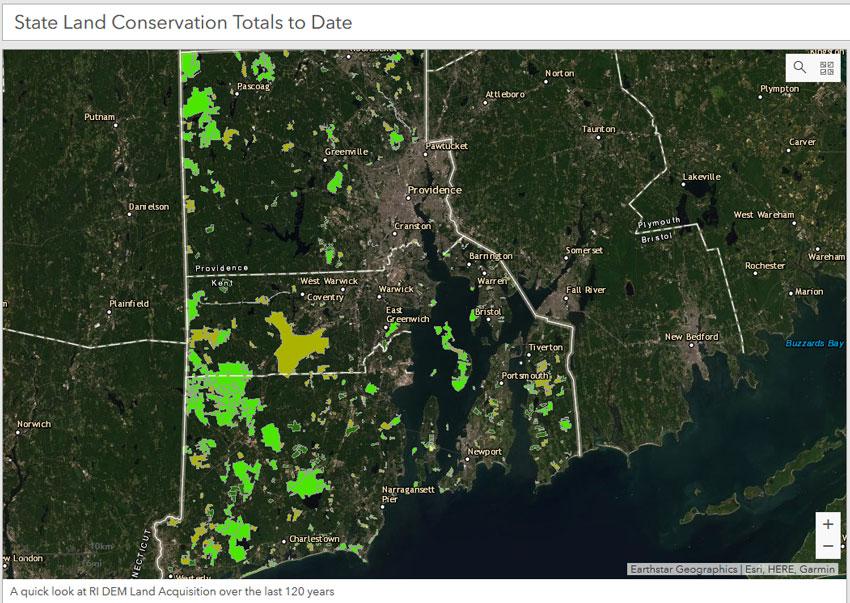
Rhode Island has conserved more than 92,000 acres of forest and farm land through state open space and conservation easement programs. (Rhode Island Department of Environmental Management). This map shows a disproportionate distribution of state open space funded properties. Heavy in the western end of South County, especially Charlestown, while light in the eastern end towns like Exeter, North and South Kingstown and Narragansett.

It doesn’t matter who hears the tree that falls in the forest if the forest has already been razed for development or ravaged by brush fires.

Which is why environmental advocates and lawmakers are rallying behind a proposal to borrow $16 million for state land preservation — before it’s too late.  

“Once farmland is gone, it’s gone,” said Sen. Lou DiPalma, a Middletown Democrat. “You can’t get that back.”

DiPalma and Rep. Megan Cotter, an Exeter Democrat, introduced legislation earlier this month to add $16 million for land protection programs to the existing, $50 million “green economy” bond included in Gov. Dan McKee’s fiscal 2025 budget proposal. 

The extra money would replenish depleted grant programs that preserve open space, forest and farmland, which might otherwise be sold for commercial development or cleared to make way for massive solar arrays. There is also money for forest management and habitat restoration.

3233.8766 acres in Charlestown alone: 

DEM Land Aquisition report. These figures DO NOT include open space where state funding was not a factor, such as lands owned by the federal government, the Narragansett Indian Tribe, private non-profits, the Town of Charlestown or its two "fake" fire districts (Central Quonnie and Shady Harbor).