
Showing posts with label Halloween. Show all posts
Showing posts with label Halloween. Show all posts
Friday, October 31, 2025
Thursday, October 30, 2025


Thursday, October 31, 2024

Sunday, October 27, 2024

Saturday, October 26, 2024

Friday, October 25, 2024

Halloween candy binges can overload your gut microbiome
A gut doctor explains how to minimize spooking your helpful bacteria
.webp)
But as the wrappers pile up and the sugar rush hits, there’s something far more sinister brewing beneath the surface: the negative effects of candy on your gut health.
Sugar and other ingredients in Halloween treats can cast a sickly spell on the trillions of microorganisms that reside in your gut, collectively known as the gut microbiome. As a gastroenterologist and gut microbiome researcher at the University of Washington School of Medicine, I have dedicated my career to decoding the cipher of how food affects this microbial community within your gut.
While no candy is truly healthy, some options are better for your gut than others. And there are ways you can help wake your gut from its sugar “spell” after holiday indulgence.


Monday, October 30, 2023

Sunday, October 29, 2023

Monday, October 31, 2022

How was Halloween invented?
Once a Celtic pagan tradition, the holiday has evolved to let kids and adults try on new identities
 |
| Kindergarten students in 1952 race out of school in Los Angeles, eager to celebrate Halloween. Los Angeles Examiner/USC Libraries/Corbis via Getty Images |
Much like Frankenstein’s monster, traditions are also alive, which means they can change over time or get reinvented. Built from a hodgepodge of diverse parts, Halloween is one such tradition that has been continually reinvented since its ancient origins as a Celtic pagan ceremony. Yet beneath the superhero costumes and bags of candy still beats the heart of the original.
The Celts lived in what’s now Ireland as far back as 500 B.C. They celebrated New Year’s Day on Nov. 1, which they called Samhain. They believed that leading up to the transition to the new year, the door between the worlds of the living and the dead swung open.
The souls of the recently dead, previously trapped on Earth, could now pass to the underworld. Since they thought spirits came out after dark, this supernatural activity reached its peak the night before, on Oct. 31.
The Celts invented rituals to protect themselves during this turbulent time. They put on costumes and disguises to fool the spirits. They lit bonfires and stuck candles inside carved turnips – the first jack-o’-lanterns – to scare away any spirits looking for mischief. If all else failed, they carried a pocketful of treats to pay off wayward spirits and send them back on their way to the underworld.
Sound familiar?
Although focused on the dead, Samhain was ultimately for the living, who needed plenty of help of their own when transitioning to the new year. Winter was cold and dark. Food was scarce. Everyone came together for one last bash to break bread, share stories and stand tall against the dead, strengthening community ties at the time they were needed most.
Sunday, October 30, 2022
Ewwww!
Why are so many people delighted by disgusting things?
Bradley J. Irish, Arizona State University
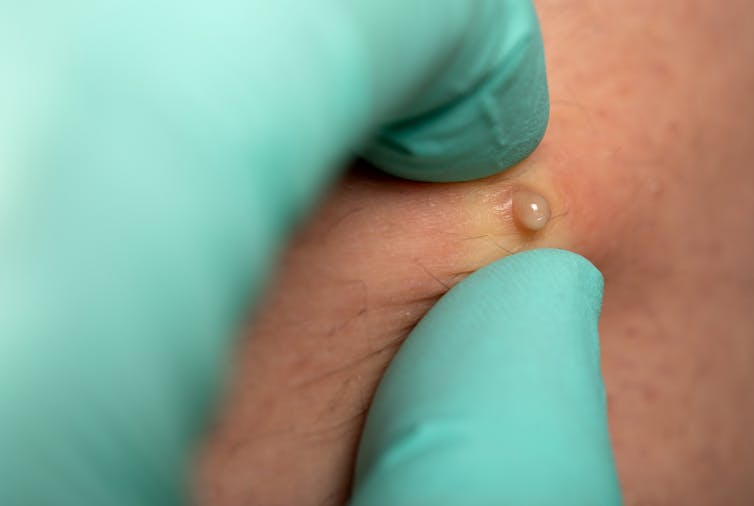 |
| In what’s called ‘benign masochism,’ some people find the feeling of disgust pleasurable. Ocskaymark/iStock via Getty Images. |
But the attraction to stuff that grosses us out goes beyond this annual holiday.
Flip through TV channels and you’ll come across “adventurous eating” programs, in which hosts and contestants are served all manner of stomach-clenching foods; reality shows that take a deep dive into the work of pimple-popping dermatologists; and gross-out comedies that deploy tasteless humor – think vomiting and urination – to make viewers laugh.
You can see this in other forms of media, as well. In romance novels, for example, you can find portrayals of consensual sibling incest that are designed to titillate the reader. And, most extreme of all, there are internet shock sites that host real footage of death and dismemberment for those who want to seek it out.
It isn’t just a recent media phenomenon, either. Early modern England has a similar culture of disgust, which I’ve written about in a forthcoming book.
Why are so many people drawn to things that should, by all rights, compel them to turn away in horror? Modern science has an answer, and it has everything to do with how the emotion of disgust fundamentally works.
Blame the Irish
Halloween’s celebration of mingling with the dead has roots in ancient Celtic celebrations of Samhain
Tok Thompson, USC Dornsife College of Letters, Arts and Sciences
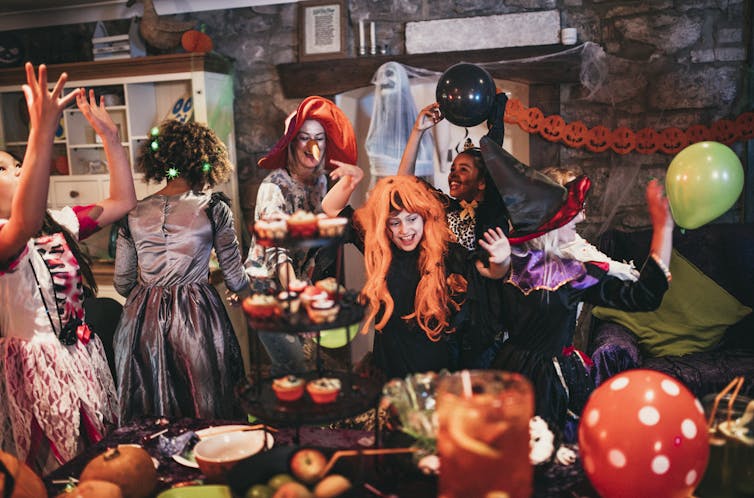 |
| How did Halloween get associated with the spooky? SolStock/Collection E+ via Getty Images |
Festivities center around the realm of the dead, and some believe that the dead might actually mingle with the living on the night of Halloween.
Scholars have often noted how these modern-day celebrations of Halloween have origins in Samhain, a festival celebrated by ancient Celtic cultures. In contemporary Irish Gaelic, Halloween is still known as Oíche Shamhna, or Eve of Samhain.
Friday, October 28, 2022

Tuesday, October 25, 2022

Monday, October 10, 2022
How to keep your jack-o’-lantern from turning into moldy, maggoty mush before Halloween
Your pumpkin is scary enough without going grotty
Matt Kasson, West Virginia University
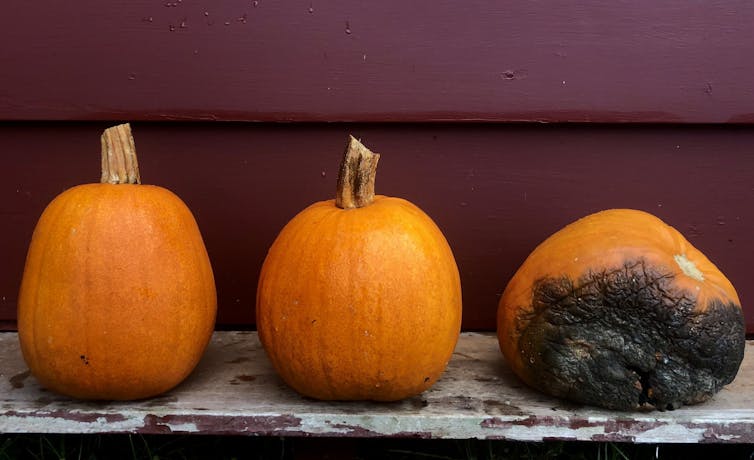 |
| The pumpkin on the right has a fungal disease known as black rot. Matt Kasson, CC BY-SA |
But these fruits – yes, botanically, pumpkins and squash are fruits – don’t last forever. And they may not even make it to Halloween if you buy and carve them too early.
As a plant pathologist, gardener and self-described pumpkin fanatic, I have both boldly succeeded and miserably failed at growing, properly carving and keeping these iconic winter squash in their prime through the end of October. Here are some tips that can help your epic carving outlast the Day of the Dead.
Monday, February 7, 2022
How much candy do Americans eat in a whole year?
Too much
Rahel Mathews, Mississippi State University
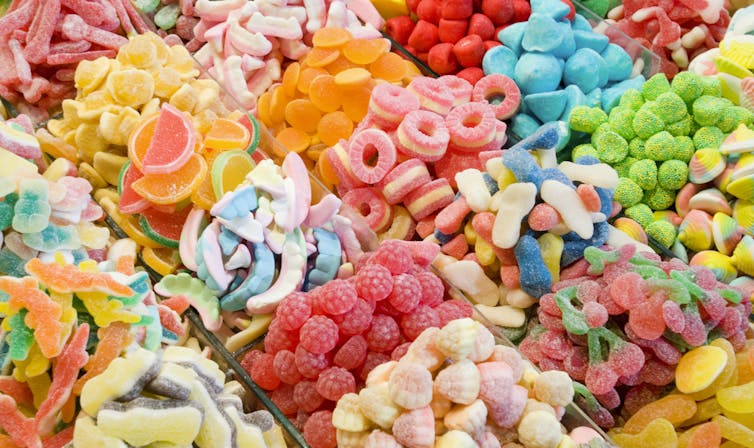 |
| Most candy is basically just a heap of sugar. Atlantide Phototravel/Corbis Documentary via Getty Images |
Sugar, whether it’s derived from sugar cane, sugar beets or corn, is a primary ingredient in all candies, partly because it can be masterfully crafted to all sorts of different sizes, shapes and textures.
Whether you are nibbling on rock candy, chewing on taffy, munching on jellybeans or licking a lollipop, you’re basically eating spoonfuls of sugar.
The average American consumes an estimated 8 pounds of candy (3.7 kilograms) annually, with children eating even more. On a typical day, 1 in 4 eat at least some candy and almost all of us do it once a year. As a dietitian, I advise moderation, even on special occasions.
That’s because growing kids, and adults too, need food to have enough energy, maintain strong bones and muscles and help their bodies fight infections.
Fruits, vegetables, grains, dairy products and nuts contain natural sugars for energy that are better for you. Those foods also provide nutrients, like iron and vitamin C, that your body needs for good health and survival.
While the sugars in candy do provide plenty of calories for energy, your body doesn’t benefit from those “empty calories.” In fact, your body does not need them at all. Sugars that do not provide health benefits are called added sugars.
Sunday, November 14, 2021
The Muddy Genesis of the CCSPAA
Decade-Old Charlestown Citizens/Sachem Passage Alliance Association Emerges From The Mud Hole
By Robert Yarnall

Part 2 Sedimental Journey
To read Part 1, CLICK HERE.
With a wink and nod to trick or treat season, the USPS recently delivered an official SPA 2021 Board of Directors’ Survey to every Sachem Passage property owner in order to explore the future of Oyster Drive 05-95-5. Click here for a very cool GIS plug & play of the venue under the microscope.
What you need to know: twenty-one years ago, a small group of Sachem Passage residents voted to accept an offer of “free land” from Randall Associates, thereby assuming ownership of not only the vacant lot, but also the financial responsibility attached to property ownership: taxes, liability insurance and maintenance costs.
In a nutshell, the dilemma SPAvillians now face is a tad squirrelly. The situation is best illustrated by the Board of Directors’ Survey itself, developed under the auspices of newly-elected SPA president Ronald Areglado.
To add context to the BOD Survey, it may be helpful to note that Mr. Aregaldo boasts a doctorate in education and is considered by some to be a masterful public speaker with a recognized penchant for nuance. Nonetheless, he was the unsuccessful Charlestown Citizens Alliance (CCA) 2020 candidate for Town Moderator, trounced by Charlie Beck, the straight-talking owner of the Charlestown MiniSuper.
Below
in italicized font are the introductory paragraphs that CCA adherent/SPA
president Ronald Areglado served up as a preamble trick to the SPA 2021 Board
of Directors’ Halloween treat survey.
“In September 2000, 4.2 acres
of property located on Foster Cove was deeded to the Sachem Passage
Association, Inc. This property, formerly owned by Randall Associates,
contained a right-of-way (Oyster Drive) that was for the exclusive use of all
Sachem Passage I & II property owners. To facilitate this transfer of
ownership and manage the property, Sachem Passage Association was formed and
incorporated (June 2000).”
“A membership survey was
performed in 2008 to explore the uses and options for the property. Since then,
we have many new members in our community. The current Board of Directors feels
that the input of all the property owners in Sachem Passage I & II is
essential, and we would value your participation at this time by completing the
enclosed survey. Please return this survey by November 8, 2021. To protect
individual responses, results will be summarized and shared with the
membership, and the Board of Directors will act in accordance with the
findings.”
For the benefit of readers who are not familiar with the modus operandi of the Charlestown Citizens Alliance (CCA), it reminds its elected, appointed, and endorsed politicos that “it’s not what you say, it’s what you don’t say.” Former one-year-only Charlestown Elementary School Principal Ronald Areglado (1998-99) embodies this CCA primal doctrine better than anyone. Just ask retired Chariho Superintendent of Schools John Pini.
Prior to September 2000, every property deed in Sachem Passage I & II contained a deeded right-of-way to Charlestown Pond. Our deeded right-of-way existed independent of any other parcel of land then owned by Randall Associates, it cost us nothing, there were no strings attached. The right-of-way was simply a humble, overgrown path that had been used for generations by the Narragansett Indian Tribe to access the salt pond for fishing, oystering, berry picking and related activities.
Sachem
Passage Association, Inc., a nonprofit business corporation- was created in June 2000
to facilitate the transfer of the Oyster Drive vacant lot from Randall
Associates to Sachem Passage Association, Inc. 
Screen shot from the TOWN's GIS map of the property
The property transfer provided
Randall Associates the opportunity to offload 26 years of property taxes and
liability insurance premiums on a lot likely to be deemed unbuildable, based on
the Town of Charlestown GIS mapping data available here (select Base Maps >
Planimetric Base Map ; select Map Layer, check Wetlands, check 2014 Soils)
The 2008 membership survey was initiated by the SPA Board of Directors as a response to the burgeoning reality that the overwhelming majority of Sachem Passage residents had little or no interest in utilizing the Oyster Drive property. A spate of disinterested property owners ignored requests for annual dues payments that were necessary to maintain the costs associated with the property. To most of us in Sachem Passage this was no surprise.
Before 2000, the Sachem Passage Association was nothing more than a collegial geographic descriptor for an area of town lucky enough to be within sleep walking distance of Watchaug Pond and the Burlingame Park Picnic Area. There was no formal structure, no meetings, no by-laws, no dues, no semblance of the dreaded self-serving embezzlement-prone “home owners association” movement that accompanied the American condominium boom beginning in the late 1970’s and exists to this day.
We were a young neighborhood then, composed primarily of nuclear families with toddlers and pre-adolescent school children. School busses made multiple stops. Dogs pretty much had free reign as they accompanied their human pets on their daily walks. There was a healthy sprinkling of “seasoned citizens” representing the best of “the greatest generation.” They graciously took it upon themselves to host the first couple of rounds of holiday parties, staying in the background, learning about “the new kids on the block.”
Then things started to change, as things always do. Sometime before the incorporation of the SPA in 2000, Randall Associates let it be known a vacant lot with Ninigret Pond frontage could be had for the asking. And it just so happened that our “deeded right-of-way” traversed this particular parcel.
The neighborhood began kicking around the idea of accepting the Randall offer. Sachem Passage resident John Kaptinski voiced unbridled enthusiasm for the acquisition, citing its value as both a real estate and a life style asset that could be developed for recreational opportunities.
Mr. Kaptinski’s neighbor, Rob Lyons, Ocean House Marina owner and current Coastal Pond Management Commission chairman, offered a different assessment based on his working knowledge of the salt pond. Mr. Lyons indicated that the muddy bottom of Foster Cove, typical for that part of the salt pond, might not be the best place to pursue activities generally associated with seasonal recreational options afforded by Ninigret Pond. I told John Kaptinski that I agreed with Rob Lyons’ assessment of Foster Cove.
 |
| Cinder Worm (from Wikipedia) |
Foster Cove is indeed muddy, the kind of mud that provides the ideal habitat for a nematode known locally as a cinder worm, an animal that is singularly responsible for one of the most anticipated fishing events on the East Coast for pursuers of the coveted Striped Bass. The event is called the cinder worm hatch, which is very much of a misnomer.
The
cinder worm hatch is
actually a spawning event. Every year toward the end of May, when the sun is
strong and warms the muddy bottom of the salt pond to just the right
temperature, cinder worms (nematodes) who live embedded in the mud for the rest
of the year rise up into the water and spew forth their reproductive fluids for
a few weeks. 
Here's a cinder worm hatch in progress
Think about that if someone tries to talk you into a cozy footbath in the warm mud of Foster Cove.
Quick foot notes aside, I told John Kaptinski 21 years ago that I was opting out of the oasis-in-the-rough idea. I and other families with kids in the neighborhood were more than happy with unfettered free access to the Burlingame Picnic Area with its dedicated boat launch area, clean sandy beach, roped off swimming areas, seasonal lifeguards, shaded grass sitting venues, picnic tables, fire places, bathrooms, and genuine log shelter with its fresh water spigot foot wash. Who wouldn’t be?
Well,
apparently a small contingent of newly-arrived neighbors, the first wave of
recently retired baby boomers, were not content with sharing the Burlingame amenities
with the hoi polloi. Perhaps they thought they deserved better. If that’s the
case, “...it is what it is,” as Head Coach Bill Belichik would say.
But a mud hole? Really? Ok, so at least now I understand the Millennial Generation’s trademark pejorative, “Ok, Boomer...”
So there it is. And here we are again – time for another pause as the cinder worms head down into Foster Cove’s insulating mud layer. Sunlight hours grow shorter. Water temperatures drop. Time to dig a little deeper in the mud. Sling time.
Subscribe to:
Posts (Atom)