Menu Bar

Home           Calendar           Topics          Just Charlestown          About Us

Thursday, November 7, 2024

Aquaculture Industry Declining Slightly in Ocean State

This should be a growth sector

By Rob Smith / ecoRI News staff

Oysters, scallops, and clams may still be growing by the bushel in state waters, but the aquaculture industry as a whole is declining in Rhode Island, according to a new report.

The latest numbers released by the Coastal Resources Management Council, the state agency that oversees Rhode Island’s burgeoning aquaculture sector, show that the dollar value for products grown in aquaculture farms declined 2.42% in 2023 compared to the previous year, earning slightly above $8 million. 

The industry saw a similar decline in employment, shedding 7.3% of part-time and full-time jobs in the industry in 2023 compared to the previous year. The figures come from a yearly questionnaire distributed to all aquaculture leaseholders by CRMC.

The declines are in spite of the fact the agency approved a new aquaculture lease last year, and approved more than 10 additional acres of state waters for aquaculture use. Benjamin Goetsch, the agency’s sole aquaculture staffer who wrote the CRMC report, found demand for farm-grown shellfish remains robust, noting that “demand and production remained very strong, with 2023 out-pacing all other years other than 2022.”

US government tries to rein in an out-of-control subscription economy

Very welcome and much needed

David Arditi, University of Texas at Arlington

A new rule set to go into effect in 2025 will make canceling subscriptions
much easier. violetkaipa/iStock via Getty Images Plus
Signing up for a subscription to a streaming service or newspaper has never been easier.

Canceling it, on the other hand, can be a cumbersome journey involving phone calls, letters or finding the option to cancel buried in a remote menu on an app.

And that’s if you remember to cancel in the first place.

Now, thanks to a new rule passed by the U.S. Federal Trade Commission, you may have an easier time getting rid of subscriptions you no longer want.

The rule aims to make canceling a subscription as easy as setting one up. The Federal Trade Commission refers to it as “click-to-cancel” under the logic that one click should be able to cancel a subscription.

It will go into effect on April 14, 2025.

The move updates a 1973 regulation called the “Negative Option Rule,” which governed subscription services for products like magazines or book-of-the-month clubs — physical items sent over and over. The phrase “negative option” refers to the fact that a subscriber, under the rules of the service, doesn’t need to do anything to remain subscribed; if a customer fails to cancel a subscription, a company can charge customers for another year. Silence is acceptance.

The 1973 rule only regulated “prenotification” subscriptions, in which a service would send subscribers a product and, if no action were taken, the customer was responsible for paying for it – a model that Columbia Records used for its Columbia House Record Club, which would periodically send music to subscribers and charge them for it if they didn’t return it.

The new rule requires companies that sign up customers online to allow customers to cancel online. Some companies have been forcing customers who had signed up online to cancel over the phone or in person. Under the click-to-cancel rule, companies will no longer be able to force customers to cancel in a different manner.

But I do wonder if this rule is merely a Band-Aid on a broken leg, particularly since more and more companies are starting to see value in making sure customers get locked into regular payments – and, in some cases, never fully own what they buy.

Wednesday, November 6, 2024

The people want bread and circuses. They will definitely get a circus

It's hard to accentuate the positive, but I will try

By Will Collette

The Charlestown Citizens Alliance (CCA) got whipped again by Charlestown Residents United (CRU). All five CCA Council candidates were rejected. All five CRU candidates were elected.

The CRU picked up another Planning Commission seat.

The CCA's consolation prize, for what it's worth, was getting voters to reject most of the Charter revision questions the CCA opposed.

I am unspeakably shaken by Trump's win and the apparent loss of Congress to the MAGA mob, but there's nothing I can do about that except urge you all to get vaccinated and make whatever energy-saving improvements you need in your house before Bobbie Kennedy Jr. abolished the national vaccine program and the MAGA's wipe out green energy programs.

Over the coming weeks, we'll have time to ponder what else we must do, but for now, let's review the state and local results where for the most part, the good guys won.

Charlestown Town Council

Rippy Serra (CRU) edged out Deb Carney to win the right to the Town Council President's chair. Unless he declines, Deb would move to the VP slot. Voters re-elected 3rd-place finisher Steve Stokes, elected new Councilor Craig Marr of Breachway fame and gave Peter Slom his first full term.

The best CCA finisher, is Sarah Fletcher who ran as a Democrat and had the good fortune to appear first on the ballot. She finishes in 6th place and out of the money.

Planning Commission

CCA leader Ruth Platner and her dog's body Bonnita Van Slyke were soundly rejected by Charlestown voters, with Platner finishing 9th and Van Slyke in last place. Platner seems likely to stay on in her role as Planning Commissar where she can continue to terrorize small businesses and homebuilders. Maybe she'll let Van Slyke take notes for her.

Platner tried to make dark skies the town's marquee issue, but it clearly bombed with the voters.
 
For Planning Commission, the top vote getter was CRU candidate Glenn Babcock. Here are the Planning Commission results:


Charlestown Charter Revision Proposals

Charlestown voters voted on 11 proposed amendments to the Town Charter. Charlestown ballot questions. The CCA opposed five of those questions and had reservations about Question 8 which would prevent Council majorities from blocking the Council minority from putting items on Council meeting agendas. 

The CCA got their wish on four of the five questions they opposed. 

Voters rejected Question 7 and Question 15. Together, those questions would have equalized the terms of office for the Town Council and Planning Commission at four years, staggered. Voters also rejected Question 10 which would have made the use of a Search Committee to fill Town Administrator vacancies optional. 

In a victory for the Westerly Sun, voters turned down Question 9 which would have made it optional for the town to post notices in a print newspaper. Yeah ok, the Sun needs the revenue.

Voters ignored CCA opposition to Question 14 by approving it by almost 20 points. This vote means that emergency rescue services will now be included in the Town Charter as a basic municipal service. Why the CCA opposed this question is beyond me.

Instead the CCA devoted so much of its energy to trying to make Charlestown's dark sky this year's imaginary political crisis. They tried to convince voters that only they, the CCA, can protect our wonderful dark skies by blocking all development and buying more open space, even though more than 60% of Charlestown's land area is already protected open space. 

They also put a lot of energy into pushing their point of view on the Charter revision questions, perhaps at the expense of actually getting their people elected. Maybe this will work out for them in the long-run, but short-term, the voters inflicted a crushing blow to CCA power.
State Results 

As expected, Rhode Island voters have re-elected Senator Sheldon Whitehouse, Rep. Seth Magaziner and Gabe Amo by comfortable margins which is very good news. Their work in the new MAGA Congress will be a key part of any strategy to defend democracy, our basic rights and the environment against the attacks to come.

Controversial state Question 1 to convene a state Constitutional Convention lost big, as hoped. The other four state ballot questions, all for good job-creating programs, were approved by comfortable margins.

In local General Assembly races, all of South Kingstown's Democratic women won either by default or by wide margins. 

In the rematch for Senate District 38 between incumbent Sen. Victoria Gu and MAGA dude Westin Price, Victoria won by a handy 15 points. This district includes the southern half of Charlestown.

Charlestown's state Rep. Tina Spears was unopposed and thus automatically re-elected.

In Senate District 34 which includes the northern half of Charlestown, MAGA state Senator Elaine Morgan (R) beat Democrat Steve Moffitt. Last night, her margin seemed insurmountable at over 20 points, but by morning, that lead was trimmed to 8 points. Still, that doesn't count so she wins and will continue to grace the State House with her toxic personality for another term.

In neighboring House District 39, there was another rematch. Hardworking state Rep. Megan Cotter (D) faced MAGA insurrectionist Justin Price. Pundits predicted this race would be very close since Megan only won by 22 votes in 2022 and the district is one of the most conservative in the state.

They were wrong. This time, Price was sent home to watch The Price Is Right by a margin of 8 points and 654 votes.
What's next?

On the national level, I really don't know except to know that it's going to be bad.

I just turned 75. After a lifetime as an activist, it's hard to face this kind of loss though I am happy at what's happened here at home. Almost 15 years ago, Tom Ferrio and I started Progressive Charlestown as a counterweight to the Charlestown Citizens Alliance.

We did a lot of other stuff - lots of national politics, environmental news, weather reports and public service announcements, cartoons, science and astronomy. Basically whatever interested us and might interest you. A total of almost 30,000 separate posts.

Over 15 million people clicked on our posts, 2 million in the past year alone and almost 42,000 just yesterday. We never considered "monetizing" the site and just did it as a combination public service and source of entertainment for us as well as for you.

We accomplished the main thing we wanted to do when we started this thing: to bust the CCA. Now that this has been done, I am trying to decide if I want to continue and, if so, how much I am willing to put into it. I'm talking to family and friends but would also like to hear from you. 

I would really like to see others step up to keep the site going. 

Please e-mail us at Progressive Charlestown with your thoughts about its future direction. On

If you are a public water user in Richmond or Hopkinton, there's a boil-water alert

Precautionary Boil Water Advisory Issued for Customers of the Town of Richmond and Town of Hopkinton Public Water Systems

The Rhode Island Department of Health (RIDOH) is alerting customers of the Town of Richmond Public Water System and the Town of Hopkinton Public Water System that they should boil their water before consuming from Thursday November 7th through approximately Tuesday, November 12th. This boil water advisory is a precaution while a water storage tank is being repaired.

When repairs are being made to a water storage tank that is not isolated from the system, bacteria may get into the water supply. RIDOH wants to assure customers that there is currently no confirmed bacterial contamination within the water system(s) or the water that supplies the systems. Once the repairs on the storage tank are complete, and before the boil water advisory is lifted, the water system will disinfect the system (within safe levels), flush the pipes, and test the water (at least two consecutive samples collected 24 hours apart). RIDOH will review and approve water sample test results to assure no bacteria entered the water system. Once the repairs on the storage tank are complete, RIDOH will announce when the advisory is lifted. Customers will also be directly notified by the water system when the advisory is lifted. A list of addresses impacted by this precautionary boil water advisory are listed below.

RIDOH advises: 

• All water used for drinking, preparing or cooking food, making ice, brushing teeth, or making infant formula should be boiled vigorously for at least one minute. Alternatively, customers can use bottled water. 

• Wash dishes in a dishwasher and use the sanitizer cycle. If you do not have a dishwasher, wash dishes in warm, soapy water and rinse the dishes with pre-boiled or bottled water. 

• Infants and young children should not be bathed in this water because they may swallow it accidentally. Anyone else using this water for bathing or showering should be careful to avoid swallowing the water.

Contaminated water can cause diarrhea, cramps, nausea, headaches or other symptoms. Infants, young children, or people with weakened immune systems may have more severe symptoms. Boiling the water kills bacteria and other organisms in the water. Additional guidance is available online. RIDOH is sharing specific guidance with restaurants and other food establishments in the area. (Guidance for food establishments is also available online.)

The monarch butterfly may not be endangered, but its migration is, researchers find

Breeding population of monarchs is stable, but they're dying off on their way to Mexico

University of Georgia

With vigorous debate surrounding the health of the monarch butterfly, new research from the University of Georgia may have answered the biggest question plaguing butterfly researchers. Why are the wintering populations declining while breeding populations are stable?

Published by the Proceedings of the National Academy of Sciences, the study suggests that monarchs are dying off during their fall migration south to Mexico.

Migrating monarchs don't fly at night, so they spend their evenings in bunches on trees or shrubs, known as roosts. The study relied on 17 years of data from more than 2,600 citizen scientist observations of monarch roosts along the butterfly's migration route.

The researchers found that roost sizes have declined by as much as 80%, with these losses increasing from north to south along the migration route.

"The monarchs are increasingly failing to reach their winter destinations," said Andy Davis, lead author of the study and an assistant research scientist in UGA's Odum School of Ecology. "Either they're losing their ability to migrate or they're losing their will to migrate."

And it's likely not because they've lost habitat or food supplies along the way. The study largely ruled out this possibility.

Are Charlestown wells compromised by PFAS pollution?

USGS Warns Millions of Americans May Be Drinking Contaminated Water

By U.S. Geological Survey

This map shows extensive PFAS presence in the groundwater where most Charlestown residents draw their drinking water

An estimated 71 to 95 million people in the contiguous United States—over 20% of the nation’s population—may depend on groundwater containing detectable levels of per- and polyfluoroalkyl substances (PFAS) for their drinking water. This data comes from a U.S. Geological Survey study published on October 24.

The predictive model results can help members of the public, water suppliers, and regulators understand the potential for PFAS contamination, guide future studies, and inform strategic planning for water resources.

USGS scientists are the first to report national estimates of PFAS occurrence in untreated groundwater that supplies water to public and private wells. This research also provides the first estimate of the number of people across the country who are potentially affected by PFAS-contaminated groundwater.

Along with a scientific report, the USGS published an interactive, online map so users can see probability estimates of PFAS occurrence. Note that predictive results are intended to be evaluated at state, regional, and national scales rather than at individual household levels. Probability estimates are for the presence of PFAS in groundwater and do not account for any subsequent actions taken by states, municipalities, or individuals to treat drinking water. The model does not include estimates of PFAS concentrations; testing is the only way to confirm the presence of contaminants.

Dealing with the winter time blues

Shorter, colder days can present mental health challenges.

 By Lauren Drapeau 

Tough on wildlife, too (Photo by Will Collette)
With Seasonal Affective Disorder, SAD, ‘the symptoms tend to be more severe, more present in younger people.’

As every geographic location experiences seasons differently, New England’s transition into the colder months poses a particular threat to the mental health of residents in the area. 

The Diagnostic and Statistical Manual of Mental Disorders, Fifth Edition, DSM-5, defines Seasonal Affective Disorder, more commonly referred to as seasonal depression, as a major depressive disorder with a seasonal pattern.

While the symptoms are similar to depression, they will occur most commonly in the fall and winter months, and begin to subside with the arrival of spring. Less sunlight, in other words, can allow individuals to struggle with daily functioning or become overwhelmed and distressed. 

SAD can occur during warmer months as well, but this is much less common. In these cases, individuals would experience the onset of symptoms during springtime. 

The disorder can affect individuals of any age range, but the symptoms typically begin to present themselves between the ages of 18-30, according to the DSM-5. 

Tuesday, November 5, 2024

"What is to be done?"

Repairs to Damaged Section of Charlestown Breachway Seawall Complete

Thanks to Rep. Tina Spears, we got a fix instead of a patch

By Bonnie Phillips / ecoRI News staff

The repaired section of the Charlestown Breachway. (Bonnie Phillips/ecoRI News)

When a 150-foot section of the Charlestown Breachway gave way last winter after being battered by storms in late 2023 and early 2024, the results were immediate: sand from the beach washed into the channel, making it shallower and dangerous for boaters to navigate, and affecting the health of Ninigret Pond.

The breachway channel connects the Atlantic Ocean and Ninigret Pond, a vital ecosystem that acts as a nursery for a variety of fish and shellfish and is home to commercial aquaculture farms. It’s surrounded by the Ninigret National Wildlife Refuge, the Ninigret Conservation Area, homes, and marinas. A variety of groups, including recreational boaters, recreational anglers, shellfishers, and birders use the pond and fish from the breachway’s jetties, considered one of the best saltwater fishing areas in the state.

The town had been worried about the state of the breachway since Superstorm Sandy came through in 2012. Recognizing what could happen if the most recent damage wasn’t repaired, the town began working with the Coastal Resources Management Council to discuss ways to fix the seawall.

From Bad to Worse

Bayer’s new Roundup products appear more toxic than prior formulations, new report asserts

Carey Gillam 

New types of Roundup weed killing products marketed to US consumers contain chemicals that pose greater health risks to people than prior formulations suspected of causing cancer, according to an analysis by an environmental health advocacy group. The report was disputed by Bayer, which called the analysis “deeply flawed.”

Friends of the Earth (FOE) reported Tuesday it found four chemicals have recently been added to Roundup products that have been scientifically shown to cause a variety of health problems, including reproductive defects, kidney and liver damage, cancer, and neurotoxicity.

The analysis comes after the agrochemical company Bayer pledged that it would remove glyphosate from its popular Roundup herbicide products sold for residential lawn and garden use starting in 2023.

Bayer, which bought Monsanto in 2018, made the change to try to curtail the filing of future litigation as it battles thousands of lawsuits filed against Monsanto by cancer patients who claim they developed non-Hodgkin lymphoma from using Monsanto’s Roundup and other glyphosate-based herbicides.

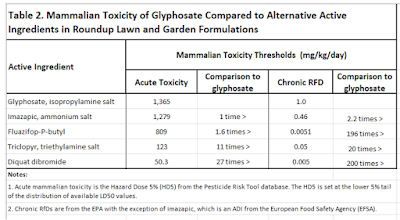
But FOE said it found the chemicals used in the new Roundup formulations are, on average, 45 times more toxic to humans experiencing chronic exposure than  glyphosate-based Roundup. The chemicals were roughly four times more acutely toxic, the group said.

Notably, all four of the added chemicals pose greater risk of long-term and/or reproductive health problems than does glyphosate, based on the Environmental Protection Agency’s (EPA) evaluation of safety studies, FOE said.

Of the four chemicals found in the products – diquat dibromide, fluazifop-P-butyl, triclopyr, and imazapic – the “worst offender”, according to FOE, is diquat dibromide. It is 200 times more toxic than glyphosate when exposure occurs over a long period of time, the group said, and is banned in the European Union. It is 27 times more toxic in acute exposures, the group said.

Couldn't resist giving you this last election comic...


Inside the Company Helping America’s Biggest Health Insurers Deny Coverage for Care

“Not Medically Necessary”: screwing people for profit

By T. Christian Miller, ProPublica; Patrick Rucker, The Capitol Forum; and David Armstrong, ProPublica

Reporting Highlights

  • Dialing for Dollars: America’s largest insurers hire EviCore to make decisions on whether to pay for care for more than 100 million people.
  • “The Dial”: EviCore uses an algorithm that allows it to adjust the chances that company doctors will screen prior authorization requests, increasing the possibility of denials.
  • Lucrative Deals: Some EviCore contracts are based on how deeply the company can reduce spending on medical procedures. It tells insurers that it can provide a 3-to-1 return on investment.

These highlights were written by the reporters and editors who worked on this story.

Every day, patients across America crack open envelopes with bad news. Yet another health insurer has decided not to pay for a treatment that their doctor has recommended. Sometimes it’s a no for an MRI for a high school wrestler with a strained back. Sometimes for a cancer procedure that will help a grandmother with a throat tumor. Sometimes for a heart scan for a truck driver feeling short of breath.

But the insurance companies don’t always make these decisions. Instead, they often outsource medical reviews to a largely hidden industry that makes money by turning down doctors’ requests for payments, known as prior authorizations. Call it the denials for dollars business.

The biggest player is a company called EviCore by Evernorth, which is hired by major American insurance companies and provides coverage to 100 million consumers — about 1 in 3 insured people. It is owned by the insurance giant Cigna.

Monday, November 4, 2024

Some closing thoughts on Election Day Eve

Lives on the line from the top to the bottom of the ticket

By Will Collette

Norman Rockwell's 1944 depiction of the
undecided voter
So much is on the line tomorrow and the days following. 

If democracy still works and sanity still prevails, Donald Trump will be defeated, and Democrats will control both the House and the Senate. 

If that’s the outcome, we have many years of healing to do, perhaps the biggest challenge since the end of the Civil War. 

If Trump and his fascist hordes win, well that’s another matter altogether. Then, it will be about survival strategies.

I don’t know whether there are many more “undecided” voters out there or people who haven’t yet voted, but if you’re one of those still trying to decide, let’s cover the bases.

I have already proudly cast my ballot for Kamala Harris and Tim Walz. I think she’ll be a great president and hopefully, she will have a successful term in office. Trump should be in prison, not the White House.

I am also proud of our Congressional delegation and have cast my votes for Senator Sheldon Whitehouse and District 2 US Rep. Seth Magaziner who work hard for us in the bruising arena of a bitterly divided Congress.

Statewide, we have several excellent state ballot questions that would fund important job-creating infrastructure to benefit education, environment and the arts.

We have a clunker in Question 1, whether to convene a state Constitutional Convention. 

Do we need it? No. Is it worth the money? No. Is it simply an opportunity for far-right wingnuts to cause chaos and mischief with our rights? Yes, and if you want proof of that, just look at the cast of characters supporting it.

Local General Assembly races offer some clear-cut choices except in House District 36 where Rep. Tina Spears (D) is unopposed as our state Representative making her the automatic winner. If she had had an opponent, I would have backed her unreservedly.

Sen. Victoria Gu (D-District 38), who represents the southern half of Charlestown faces a rematch in her reelection bid against MAGA dude Westin Place. 

Victoria has done an outstanding job in every aspect of the job while Place has littered Route One with big signs paid for by the Republican Party.

In Senate District 34 which includes the northern half of Charlestown, Sen. Elaine Morgan (R-MAGA) seeks re-election. Morgan is a gun nut, anti-immigrant racist and adjudicated thief who was caught stealing money from her campaign fund to pay for personal items.

Morgan has held herself out as a champion of morality and children’s welfare, but somehow couldn’t instill those beliefs at home. On September 25, her 22-year-old son Ian took a plea deal to plead no contest to third-degree sexual assault of a child. According to WJAR, “Prosecutors said he had a sexual relationship with a 14-year-old girl he had met online. Morgan was 18 at the time.”

Elaine Morgan has been an embarrassment since first elected in 2014. It’s time for her to go and for voters to send Hopkinton Democrat Steve Moffitt to the State House.

In neighboring House District 39, there’s a rematch between hard-working incumbent Rep. Megan Cotter (D) and January 6 insurrectionist Justin Price (R-MAGA). Price doesn’t belong on the ballot under the anti-insurrection clause in the 14th Amendment of the Constitution, but Sec. of State Greg Amore has chosen not to pursue that sanction.

Megan narrowly beat Price in 2022 and has since done an exemplary job on behalf of her district. In two years, she’s far more to help her district and the state than Price did in the 8 years he held the office.

She promises more of the same, while it’s still an open question whether Price will face charges for breeching security lines at the US Capitol on January 6. Pretty clear choice.

Our town election is a complex matter that confronts the Election Day voter with some complicated choices.

In Charlestown, Democratic or Republican party labels don’t really tell you much about what kind of town government you will get. As a devoted life-long Democrat it pains me to suggest you ignore party labels when marking your ballots.

Actual power in Charlestown comes down to a contest between two political action committees (PACs) who present you with an almost equal number of candidates more or less split roughly the same between labelled Democrats and Republicans, mixed together on the ballot.

Half of them are endorsed by Charlestown Residents United (CRU) that won the majority in the 2022 election on a platform of honest, sound financial management and reform.

The other half represents the discredited Charlestown Citizens Alliance (CCA) that seized control of Charlestown politics in 2008 and held power until beaten in 2022.

I have already voted for the CRU slate and have posted a series of articles here on Progressive Charlestown to make the case that the CRU has done a great job compared to the dark decade of total CCA dominion.

Even when the CCA promotes good things like conservation, dark skies and tourism, they do so in such twisted, radical ways that they usually turn consensus into controversy.

If you need to see the arguments and supporting evidence for the reasons to support the CRU and reject the CCA, please read:

CCA tries to distract Charlestown voters with shiny things

The politics of Charlestown open space

Should Charlestown voters amend the town’s “constitution?”

Early voting, mail-in ballots start this week amid confusing ballots for Charlestown voters

Fear and loathing in Charlestown politics

RI Auditor General finds new CRU leadership in Charlestown improved town finances

The last article on the RI Auditor General’s report establishes how the CRU majority has largely cleaned up the financial mess the CCA left behind when they slunk off in defeat in 2022.

CCA President Leo Mainelli wrote the CCA closer in a piece he entitled "Indisputable Truths. No spin." Unfortunately, Leo then proceeds to offer no facts and lotsa spin about how this race has been about Dark Skies and Open Space but should really be about whether the town government listens to the CCA. 

He glosses over the issues that have been raised about the CCA's decade of financial mismanagement:

Today, we live in a world where any position can be validated as “the truth” by simply turning to the source of information that agrees with an individual’s relative “truth”. Polar opposite opinions can each be substantiated, depending on which source of information is deemed a trustworthy authority.

I agree: when it comes to the management of Charlestown's finances, there is the state Auditor General whose data show the marked improvement in Charlestown's finances under the CRU, while the CCA has Bonnie Van Slyke who claims the CCA handled Charlestown finances flawlessly.

Even before the Auditor General's report, we knew Charlestown was being mismanaged by the CCA when the Rhode Island Public Expenditure Council found that Charlestown had the worst record in the state for excessive administrative costs, at $566 per capita, the highest in the state. By contrast, the CCA has Bonnie Van Slyke who says there are no problems.

Bonnie, who is trying to return to the Town Council after two years off, claims a BA in economics from Wellesley College, but there's no sign in her employment history she actually used that degree. Hey, if Leo wants to believe Bonnie over the RI Auditor General or the RI Public Expenditures Council, then so be it. As Harry S Truman famously said:

“Give me a one-handed economist. All my economists say 'on ONE hand...', then 'but on the other...”

Elections are a regular reminder that despite how divided we can get, we all have to live with each other. Hopefully, we’ll make it through this one with our fundamental principles and institutions intact.

The Good Things Hitler did

Let's really end it tomorrow