Menu Bar

Home           Calendar           Topics          Just Charlestown          About Us
Showing posts with label review. Show all posts

Thursday, October 16, 2025

A Call to Arms About the Threat of Anti-Science

Anti-science kills

By Dan Falk

BOOK REVIEW — “Science Under Siege: How to Fight
the Five Most Powerful Forces that Threaten Our World,’’
by Michael E. Mann and Peter J. Hotez
(PublicAffairs, 368 pages).

In the 1995 book "The Demon Haunted World," the astronomer Carl Sagan warned that the United States was turning its back on science, and that the consequences would be dire. 

Near the start of their new book, “Science Under Siege: How To Fight The Five Most Powerful Forces That Threaten Our World,” Michael E. Mann and Peter J. Hotez cite Sagan’s vision of science as a “candle in the dark,” and argue that what the astronomer feared is now coming to pass. In fact, readers may get the impression that the situation is already much worse than what Sagan envisioned.

While Sagan was primarily concerned with the rise of pseudoscience, Mann and Hotez fear that we’re now in the midst of an anti-science boom, led by people, corporations, and governments who intentionally spread false or misleading information. 

“Anti-science has already caused serious illness and mass casualties in the near term,” they write. “Unmitigated, it will in the long term take millions more lives, produce misguided national policies, and have long-lasting catastrophic consequences, including potentially, the destabilization of our civilization.”

Mann and Hotez are not merely observers, but scientists who have found themselves on the front lines of the ongoing attacks on science. Mann is a climate scientist at the University of Pennsylvania, and director of the Penn Center for Science, Sustainability, and the Media. Hotez is a pediatrician and vaccine scientist at Baylor College of Medicine, where he is also the co-director of the Texas Children’s Center for Vaccine Development. In 2022, he was nominated for the Nobel Peace Prize for his work on a patent-free Covid-19 vaccine.

While attacks on science have taken many forms, the authors highlight the current pushback against vaccines and skepticism over climate science as two of the most urgent issues. Mann and Hotez describe the resistance to climate science and vaccines as a one-two punch, but add that there is a third punch as well, in the form of mis- and disinformation. 

The authors point to the devastating consequences of resistance to public health measures, especially vaccines, which came to the fore during the Covid-19 pandemic, the death toll from which currently stands at 1.2 million Americans, according to the World Health Organization.

Many of those deaths, they suggest, could have been prevented had people been vaccinated and followed social distancing and mask guidelines. And they’re not shy about saying who’s to blame: “The deaths occurred mostly along a political partisan divide,” they write, “with those living in Republican-majority (‘red’) states disproportionately suffering most of the deaths and disabilities as a consequence of being targeted by propaganda and misinformation from elected leaders, extremist media, and the modern political Right.”

Thursday, September 11, 2025

Tom Sgouros on getting organized in the Time of Trump

History's call to action

Tom Sgouros

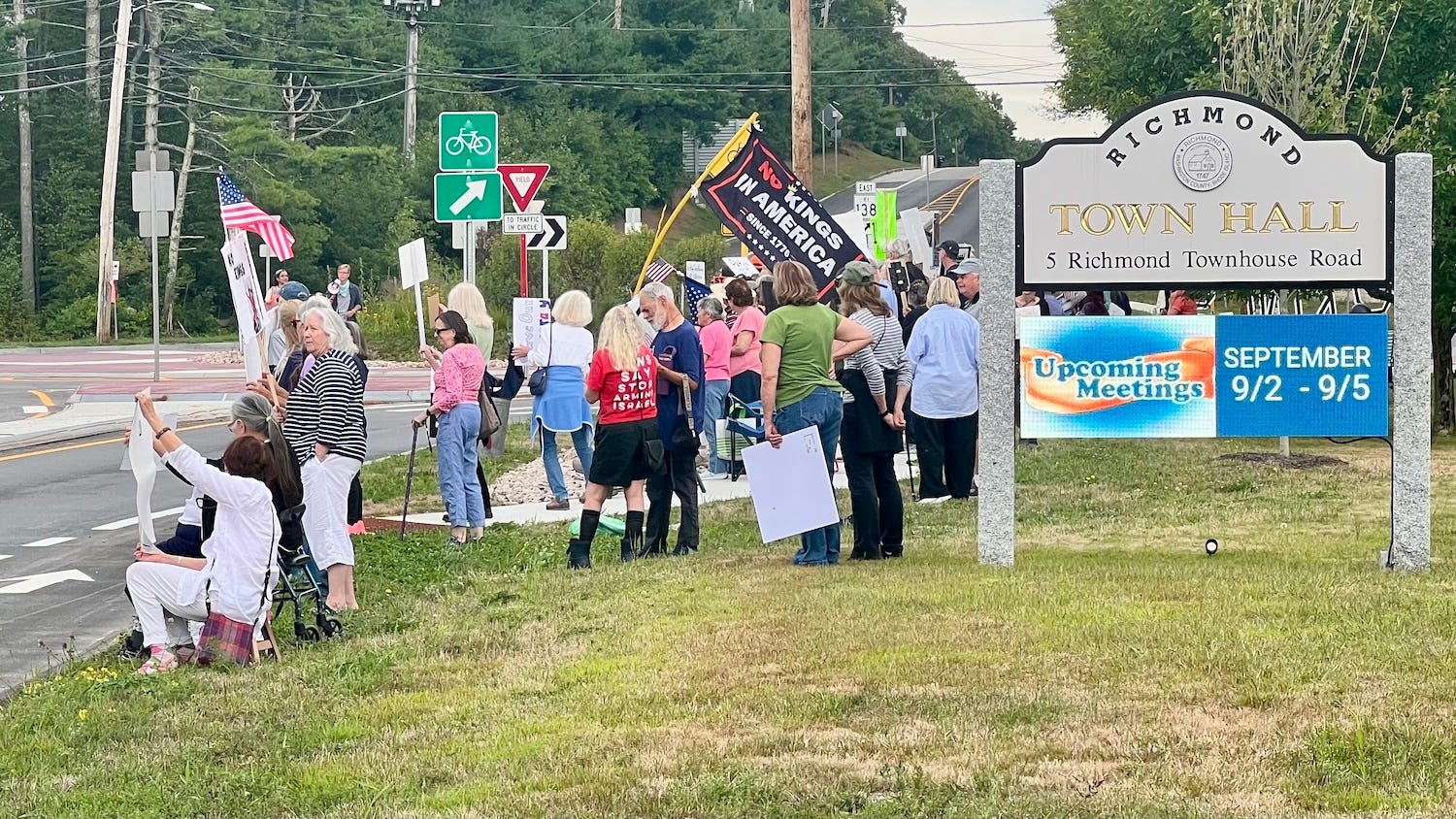
A group of people holding signs

AI-generated content may be incorrect.

I don’t know about you, but I find it hard to concentrate these days, while what seems to be the ashes of my nation’s ideals settle around my ankles as I read the news. From the words in the U.S. Constitution to the words on the Statue of Liberty, so much of the text of our nation seems to be rejected by people who have the effrontery to call me and my friends unpatriotic. It’s infuriating but also enervating, in no small part because it’s so hard to see what might be the most constructive way to push back.

But it turns out that lots of people have felt the same way in the past, and lots of them found ways to act nonetheless. This is why I so enjoyed Erik Loomis’s new book, “Organizing America: Stories of Americans Who Fought for Justice.” It’s easy to remember the famous Americans who led successful fights for justice: Martin Luther King, Jr., Rosa Parks, Cesar Chavez, and Mother Jones. But what lessons do such heroic figures have for me, now?

The answer is more than I thought. The evidence is in Loomis’s book, where he tells the stories of other Americans who found themselves in the fight for human rights: against slavery, against lynching, for labor unions, for women’s suffrage, for gay rights, and more. Some of these are names you might have heard -- Ida B. Wells, Eugene Debs, Daniel Berrigan -- but many are not. 

Maggie Walker was an entrepreneur in the Black community in Virginia, Frank Little was a union organizer in Montana mines, Robert Williams was a not-terribly-peaceful civil rights activist in both North and South, and Richard Oakes participated in the American Indian struggles of the 1960s and 1970s in New York and California.

Erik Loomis is a historian at the University of Rhode Island. In addition to his duties there, he participates in writing the excellent Lawyers, Guns, and Money blog, where he writes a series he calls “Erik Visits an American Grave,” which is more or less exactly what it sounds like. He visits graves of the famous, infamous, and almost famous, and writes short biographies of the people he finds there, with almost 2,000 visits under his belt, and still going. 

Tom in 2012
His writing is straight-ahead, nothing fancy, but pleasurably propelled by both the subject matter and his exhilaratingly frank evaluations of the people he writes about. He is willing to call a hack a hack (Supreme Court Justice William Rehnquist), a fascist a fascist (U.S. Senator David Reed), and a legend a legend (Bluesman Willie Dixon). My favorite is when he writes about a grave in Arlington where Jack Miller is “buried on the confiscated grounds of the traitor Lee,” a formulation that strikes me as undisputably factual and admirably so.

EDITOR'S NOTE: Since we first published a column by Tom in February 2012, we've carried just under 60 of his always interesting essays on Rhode Island's politics and economy. 


Wednesday, October 30, 2024

Adam Kinzinger and Jim Langevin join for provocative discussion with students at URI

Democracy at stake

Kristen Curry 

Self-described renegade Congressman Adam Kinzinger made his first visit to Rhode Island this week. Despite the state’s notable blue streak, its appreciation for the occasional Republican politician (see Chafee Hall) and noted independent streak made it a welcoming spot to hear Kinzinger’s message, shared most recently in his book, Renegade: Defending Democracy and Liberty in Our Divided Country, published last year, and on his substack.

On Tuesday, the former U.S. representative visited the University of Rhode Island, where students and community members have been mulling and debating the meaning of democracy this fall.

Kinzinger’s visit was a warm one—at times humorous—with little talk of blue or red and more discussion of the impact of the political on the personal and what recent and current events mean for young people today. 

The candid conversation was hosted by his former colleague and friend James Langevin, a member of the U.S. House of Representatives from 2001-23 known for reaching across the aisle in both his political work and post-legislative life.

Wednesday, September 4, 2024

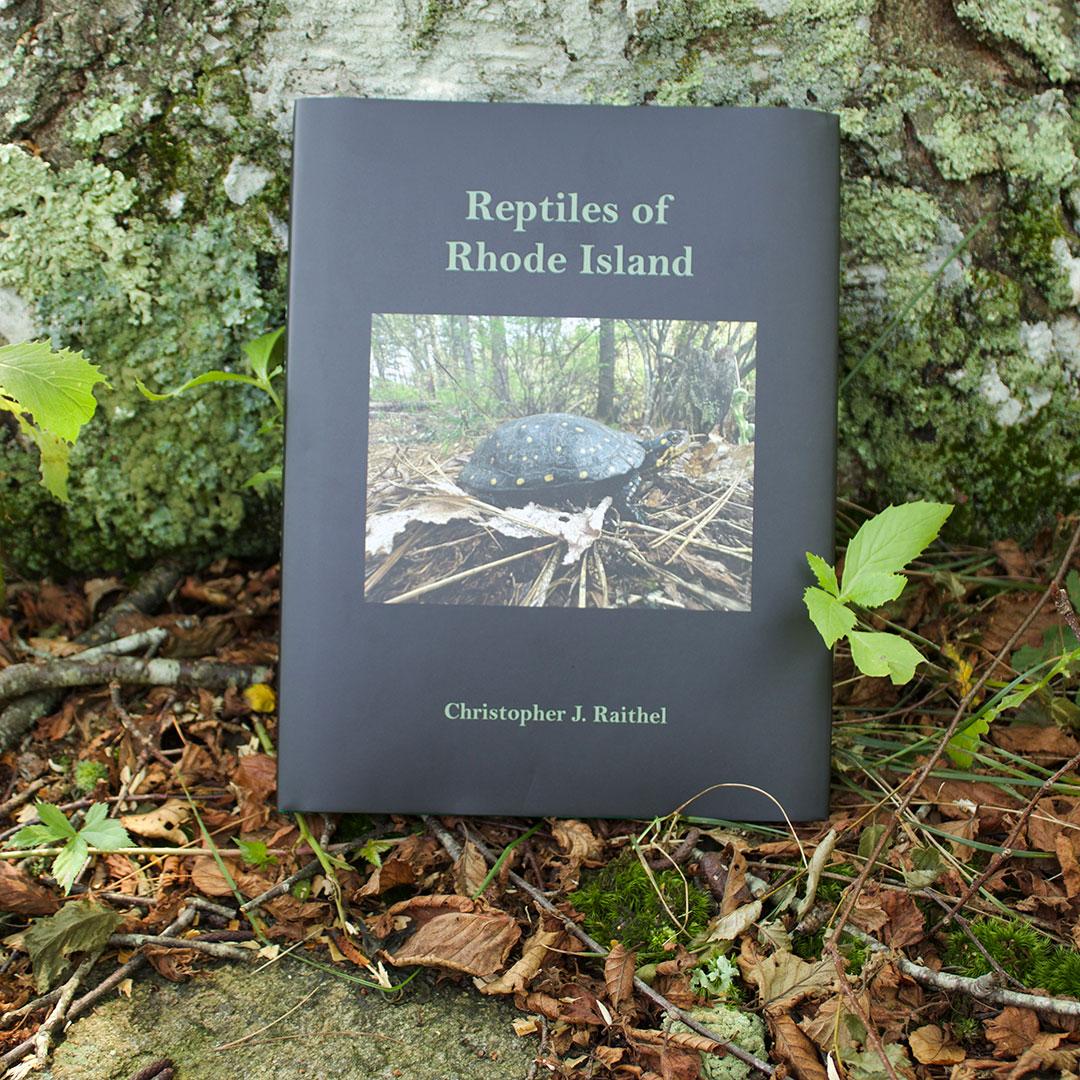
New Book Details R.I.’s Native Reptiles and How to Protect Them

Know your beasties

By Rob Smith / ecoRI News staff

Rhode Island’s snakes, turtles, and frogs can rest a little easier at night knowing they have at least one learned hand in their pocket.

Last week the Rhode Island Department of Environmental Management announced it was publishing a new book, “Reptiles of Rhode Island.” The book, the lovechild and brainchild of now-retired DEM environmental scientist Christopher Raithel, lists the state’s 13 native snake species and seven native turtle species, as well their habitats. 

Research and observations of the species stem from Raithel’s nearly 30-year career with the department as a naturalist.

It’s not the first book Raithel has put together for DEM to publish, either. In 2018 the department announced it was publishing a similar volume on the state’s amphibian species. Both books were paid for with federal grants from the U.S. Fish & Wildlife Service, and proceeds from book sales go toward DEM’s wildlife conservation efforts.

Raithel said he had a goal of using his decades-long experience as a naturalist, and his observations of local species, to establish a local baseline, making it easier for people to be able to monitor change in species or their habitats. Both books feature a wide swath of animals, ranging from species of greatest concern to least.

Friday, March 22, 2024

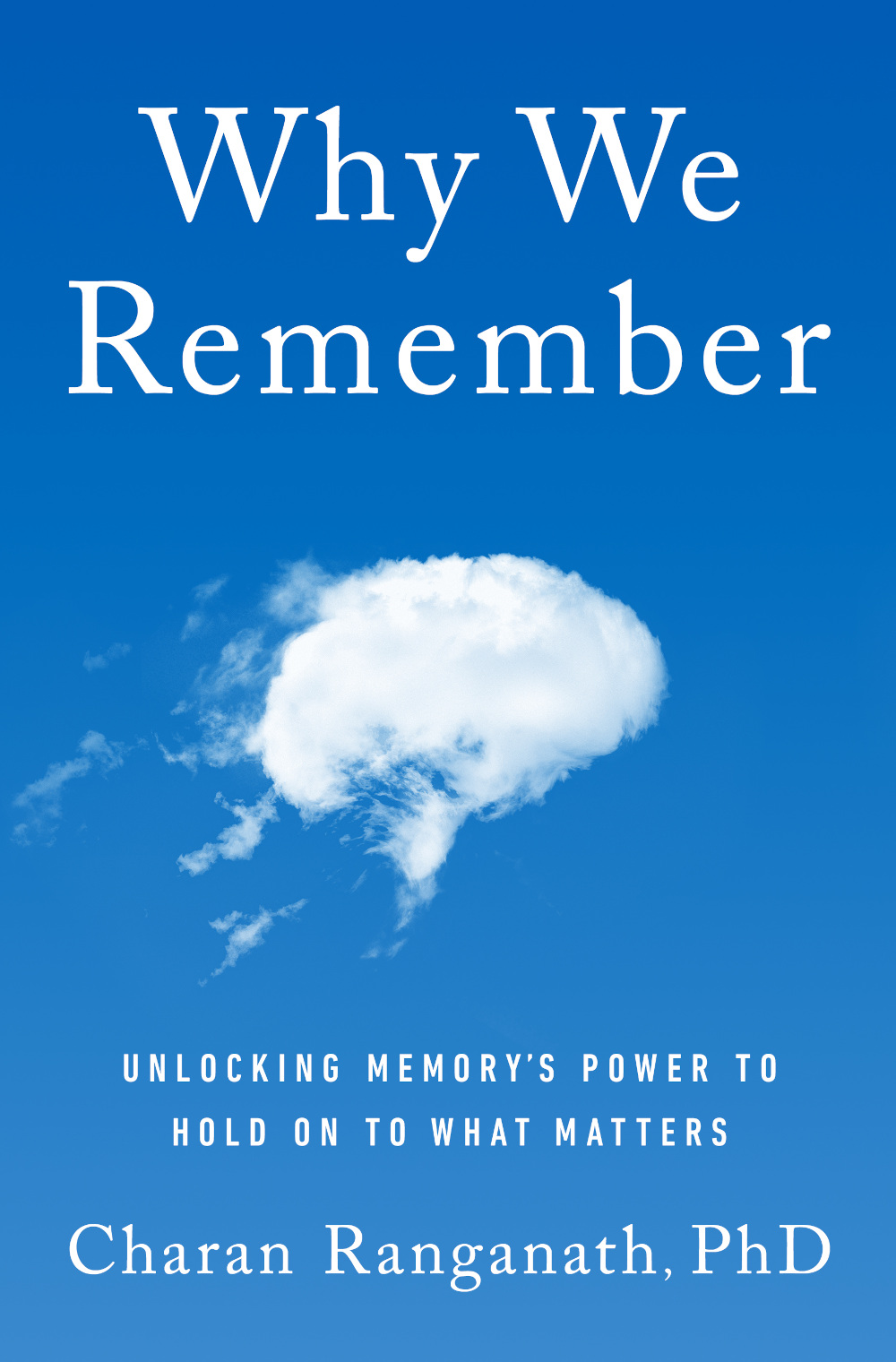
Why we remember

Book Review: The Mysteries and Quirks of Human Memory

By Erica Goode

BOOK REVIEW — “Why We Remember: Unlocking
Memory’s Power to Hold on to What Matters,”
by Charan Ranganath (Doubleday, 304 pages).
Authors don’t get to choose what’s going on in the world when their books are published. More than a few luckless writers ended up with a publication date of Sept. 11, 2001, or perhaps Nov. 8, 2016, the day Donald Trump was elected.

But Charan Ranganath, the author of “Why We Remember: Unlocking Memory’s Power to Hold on to What Matters,”was more fortunate. 

His book went on sale last month, not long after the Department of Justice released a report describing President Joe Biden as an “elderly man with a poor memory” who, in interviews, was “struggling to remember events,” including the year that his son Beau died.

The special counsel’s report immediately became a topic of intense discussion — disputed by the White House, seized on by many Republicans, analyzed by media commentators, and satirized by late-night television hosts.

But for Ranganath, a psychologist and neuroscientist at the University of California, Davis, who for decades has been studying the workings of memory, the report’s release was a stroke of luck. His book, which dispels many widespread but wrongheaded assumptions about memory — including some to which that special counsel Robert K. Hur appears to subscribe — could easily have been written as a corrective response.

If Ranganath has a central message, it is that we are far too concerned about forgetting.

Friday, June 30, 2023

A look at hand gestures

Book Review: How Our Hands Reveal Our Thoughts

By Dan Falk

It’s no secret that humans use their hands, as well as their voices, to communicate. But while countless volumes have been written about the world’s spoken and written languages, gestures appear to have been given short shrift. And so Susan Goldin-Meadow’s new book, “Thinking with Your Hands: The Surprising Science Behind How Gestures Shape Our Thoughts,” comes as a welcome attempt to close the gap.

For Goldin-Meadow, a psychologist at the University of Chicago who has been studying how we convey information with our hands for 50 years, gestures represent “an undercurrent of conversation” that happens in parallel to speech, even if their significance is “often unacknowledged.”

We gesture — with our bodies but especially with our hands — to communicate to those around us; to focus our thoughts; to remember. And these signals are everywhere. At the start of the book, Goldin-Meadow points to a scene in Season 4 of the TV series “The Crown,” where the young Diana Spencer (soon to be married to then-Prince Charles) is given instruction on what to do, and what not to do, with her hands. 

Her teacher says: “Gestures reveal us, whether we are anxious, or agitated, or cross. It’s best not to give that away.” (Though the author doesn’t mention it, fans of “Star Trek: The Next Generation” may recall Captain Picard responding to an annoying character named Q by putting his left hand over his face in what would become a ubiquitous internet meme — the Picard facepalm.)

Tuesday, May 30, 2023

The kitty that roared

Book Review: Learning to Love Your Cat’s Inner Lion

By Hope Reese

If you think your pet cat has a wild side, you’re not wrong. 

According to evolutionary biologist Jonathan B. Losos, “housecats aren’t that different from mountain lions.” 

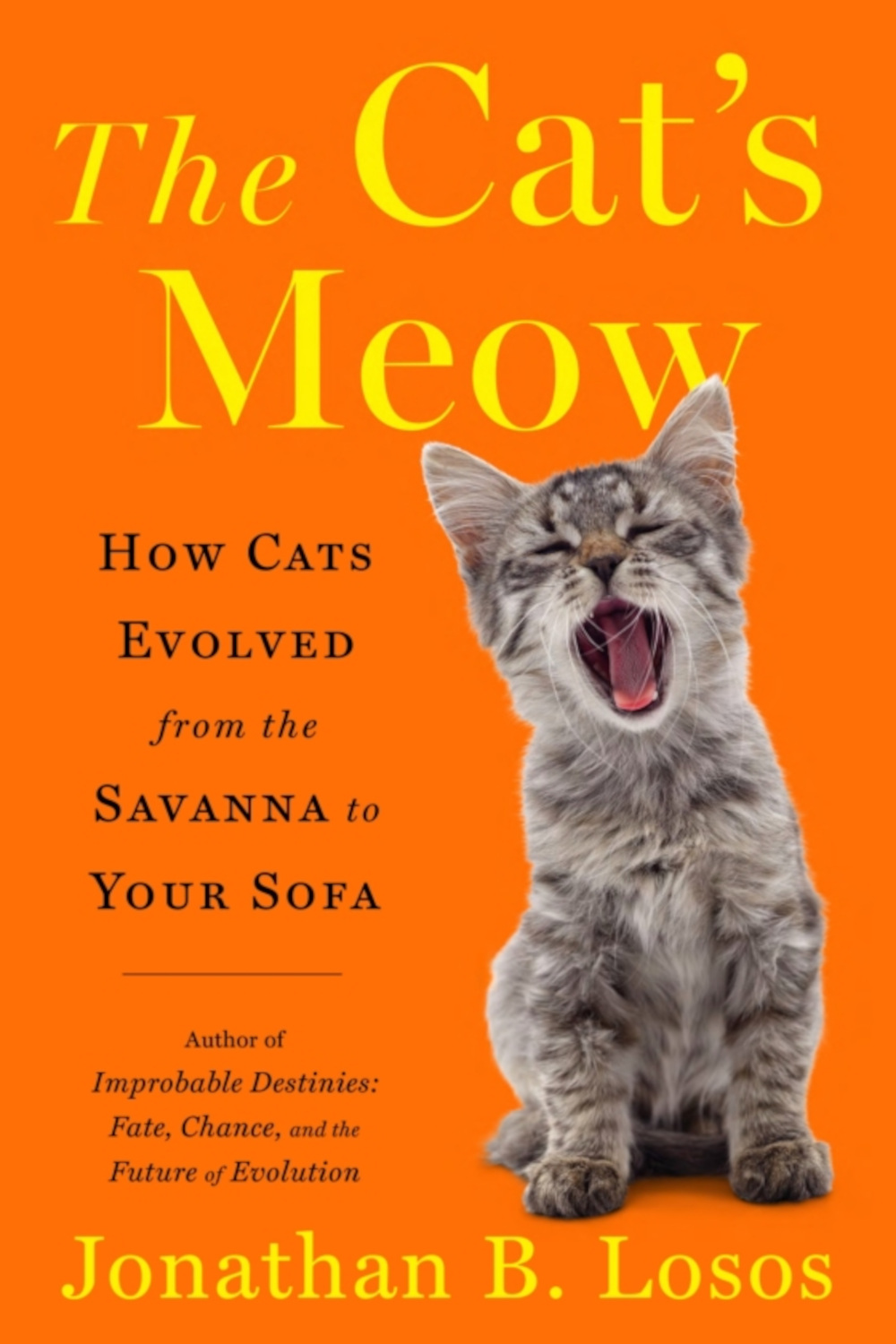
In his latest book, “The Cat’s Meow: How Cats Evolved from the Savanna to Your Sofa,” Losos guides readers through the evolutionary history of felines, uncovering the ancestral roots of the modern housecat. 

Not to worry: This isn’t another cute cat book. Instead, Losos, a professor at Washington University in St. Louis whose specialty is studying a large family of tree-living lizards known as anoles, taps deeply into a wide range of feline research, from digital tracking of nighttime activity to DNA testing, to show how much we’ve learned so far about cats — and how much is still left to discover.

The earliest cats lived about 30 million years ago — the species we now call Proailurus lemanensis — but about 10 million years later, evolution “kicked into gear,” Losos writes, when felines diverged into two groups: the saber-toothed cats, which eventually became extinct, and the conical-toothed group, which evolved into today’s Felis catus. 

Genetically linked to the North African wildcat Felis silvestris lybica, the first domestic cats appeared about 10,000 years ago. Most researchers believe that living near humans in early agrarian communities, where cats presumably shared food and helped control rodents — a mutually beneficial arrangement — probably led to the domestication of today’s housecats.

While there is a substantial fossil record for the saber-tooth line, the conical-toothed group is much harder to trace back. Today, there are up to 42 species of wild felines derived from the conical branch – including ocelots, bobcats, lions, and cheetahs. 

Friday, April 14, 2023

How Misinformation Acts Like a Virus

The on-going struggle against lies and fake news

By Christie Aschwanden

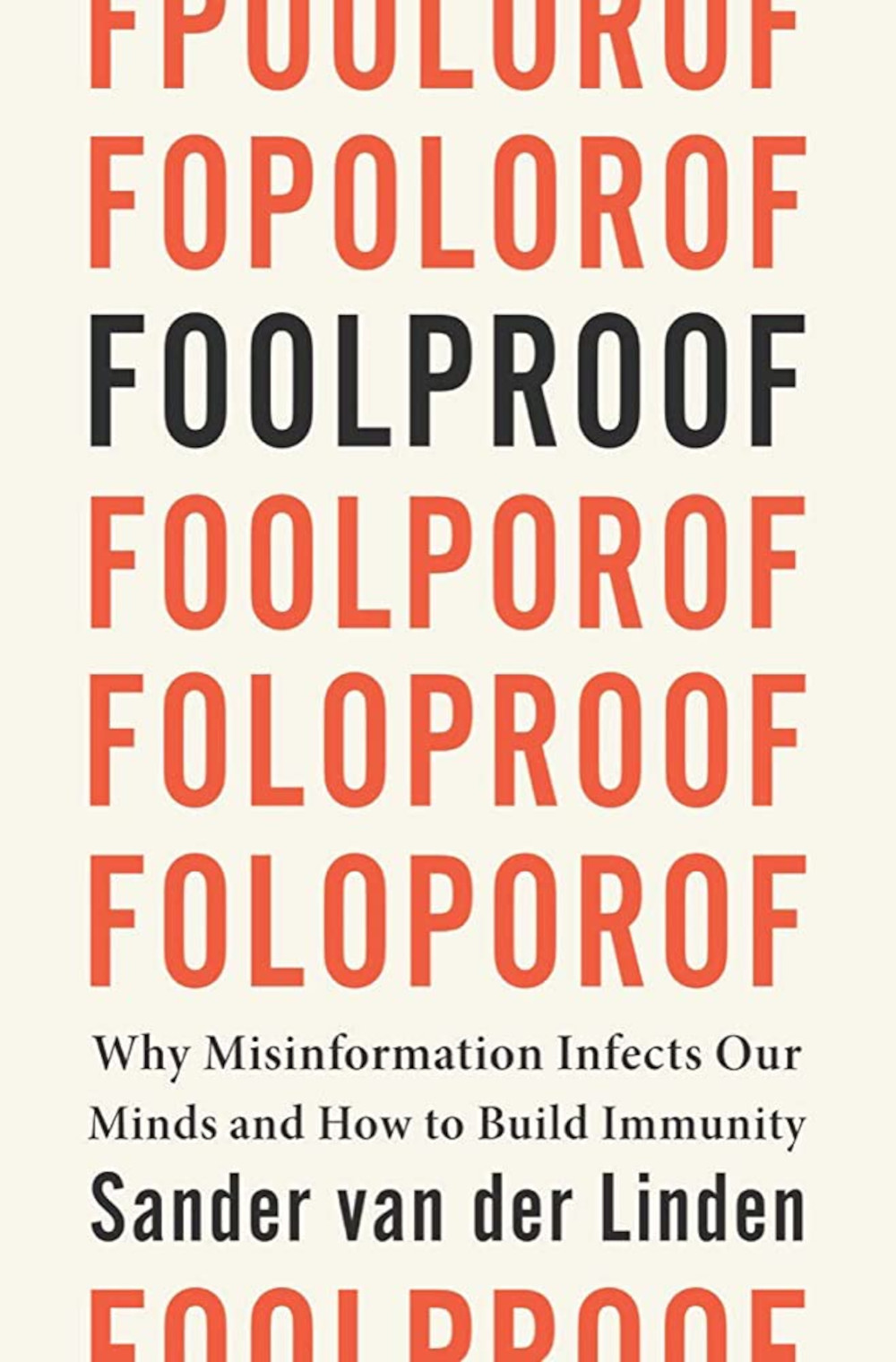
“Foolproof: Why Misinformation Infects Our
Minds and How to Build Immunity,” by
Sander van der Linden
(W. W. Norton & Company, 368 pages).
In the early months of 2022, U.S. intelligence officials announced that Russian propagandists were preparing to release a fake video and images that purported to show Ukrainian aggression as a pretext for Russia’s planned invasion. 

“The goal of these campaigns was not to convince foreign audiences that Russia’s military invasion was somehow justified, but to make it harder for people to discern fact from fiction,” writes Sander van der Linden in his new book, “Foolproof: Why Misinformation Infects Our Minds and How to Build Immunity.”

The misinformation, he says, was meant to distract political analysts and fact-checkers by forcing them to track down and debunk information that was obviously false. 

One of the obstacles facing the effort to dismantle disinformation, van der Linden suggests, is that while “lies and fake news tend to be simple and sticky, science is often presented as nuanced and complex.” In other words, where factual scientific information is full of caveats, misinformation and conspiracy theories operate in certainties.

Another hallmark of conspiracy theorists: rage. “By analysing the language used in hundreds of thousands of tweets from the most popular conspiracy theorists on Twitter, we found that they express much more negative emotions — particularly anger — compared to their popular science counterparts,” writes van der Linden, a psychologist at the University of Cambridge.

Sunday, February 19, 2023

“A New War On Cancer,” out this May, tackles cancer-causing chemicals in our everyday lives.

EHS reporter reveals a revolution in cancer prevention in new book

Environmental Health News Staff


Fifty years into the “war on cancer,” we’re better than ever at treating cancer, but one in six people in the U.S. and around the world still die from the disease.

The astonishing news is that up to two-thirds of all cancer cases are linked to preventable environmental causes. If we can stop cancer before it begins, why don’t we?

That was the question that motivated Environmental Health Sciences reporter Kristina Marusic’s revelatory inquiry into cancer prevention.

In searching for answers, she met remarkable doctors, scientists, and advocates who are upending our understanding of cancer and how to fight it by working to rid our lives of the deadly chemicals that trigger the disease.

Marusic’s book, "A New War On Cancer: The Unlikely Heroes Revolutionizing Prevention," is available for pre-order now and will be published by Island Press on May 11, 2023.

Friday, May 13, 2022

The back story of Love Canal

Book Review: Anatomy of an Environmental Tragedy

By Peter Andrey Smith

EDITOR'S DISCLOSURE: Immediately after this story ends, Love Canal leader Lois Gibbs moved to DC with a plan to launch a national grassroots movement against toxic waste. She hired me as her national organizing director and we worked together to build that movement over the next nine years. This review is, to the best of my knowledge of the people and the story, accurate.   - Will Collette

By the late 1970s, the odor seemed just about everywhere on the east side of Niagara Falls, New York, in a neighborhood with thousands of residents and two area public schools. Noxious fumes seeped into basements. The stench filled backyards. It clung to one engineer’s sweater for days after his visit. A chemical stain appeared on the bed sheets of one factory worker. The odor was spreading from drums the Hooker Chemical Company had unceremoniously dumped decades prior in an unfinished canal.

That canal was built by a shady developer who — in journalist Keith O’Brien’s telling — had skipped town by 1896. His name was William Love. The neighborhood built atop the toxic landfill would become a household name, cultural shorthand for catastrophe: Love Canal. 

O’Brien’s book “Paradise Falls: The True Story of an Environmental Catastrophe” begins in the 1970s, as children unearthed rocks that made their eyes burn. “Secrets,” O’Brien writes, “long kept in Niagara Falls, began bubbling to the surface on the east side of town, seeping into people’s homes, newspaper stories, national headlines, and finally the American consciousness at large.”

O’Brien, a longtime contributor to National Public Radio, focuses on the women who put Love Canal on the map — and on the national news. Chief among them: Lois Gibbs and Luella Kenny, two mothers whose efforts to leave their neighborhood were galvanized by fears, ultimately well-founded, that toxins were seeping into their children’s bodies and doing harm. 

Gibbs started by knocking on doors, organizing a homeowners’ association, as “a loose, somewhat disorganized, and increasingly contentious group of people who really had only one thing in common: they had made the unfortunate decision to buy an affordable home on the cusp of the old Hooker landfill.” The two crossed paths after Kenny’s son unexpectedly became sick and died. O’Brien has a penchant for unlikely duos: Gibbs is described as a 20-something smoker who “barely graduated from high school” and didn’t attend church; Kenny, in her 40s, worked as a scientist, had her kids attend Catholic school, and “never touched cigarettes.”

Thursday, February 10, 2022

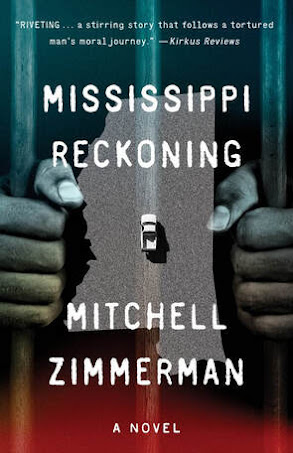
BOOK REVIEW: Mississippi Reckoning by Mitchell Zimmerman

Page-turning crime thriller for the times we live in

By Will Collette

Here we are in the middle of Black History Month, but millions of white Americans don’t want their children to be taught anything about black history. 

The John Lewis Voting Rights Act has just been obstructed by every Senate Republican, aided by two DINOs, Joe Manchin of West Virginia and Kyrsten Sinema of Arizona.

Mississippi Reckoning is a fine book to read, even without these current news events, but more so because of them.

As a fan of crime fiction, I can distinguish between good versions of the genre and the bad. Mitchell’s book is not only well-written, but he adds interest by setting up a challenging set of twists and turns in geography and in time.

I can usually guess the ending of many crime thrillers, but not this one.

Without giving you any spoilers, there are two main plot lines that intertwine throughout the book, linked by the theme of justice and by the main character, attorney Gideon Roth.

The book opens on Gideon Roth’s client, Kareem Jackson, preparing to be executed for a brutal murder. Jackson was heavy drug user and stone killer who understood he was guilty. Gideon’s best case outcome was to get Jackson’s death sentence commuted to life without parole. He failed and watched Jackson die at the hands of the state.

The other main plot line begins during Freedom Summer, 1964, when hundreds of white students and activists travelled south to help black activists in the big push for voting rights.

Young Gideon Roth was among them and found himself on duty at the Mississippi office of the Congress for Racial Equality (CORE) the night that James Chaney, Andrew Goodman, and Michael Schwerner were kidnapped and murdered by the Klan near Philadelphia, MS.

Gideon’s role that night was to use a WATS line to the Justice Department to bring in agents to rescue the kidnapped civil rights campaigners. He did not succeed and carried guilt for that failure for years to come. That guilt was heightened when the murdering Klansmen were caught and only received light sentences for the brutal slaying.

After watching Kareem Jackson’s execution, Gideon’s life fell apart. As he was trying to cope with this, his mind went back to those days in Mississippi and how differently the Klansmen were treated compared to Kareem – three year sentences for three brutal murders compared to the gas chamber for one heinous killing.

These thoughts led Gideon on a cross-country quest to seek, if you’ll pardon the cliché, truth and justice.

He wanted to know why Kareem Jackson became an irredeemable criminal and why the Klansmen in Mississippi literally got away with murder. And Gideon also wanted to figure what he could and should do about it.

I loved this part of the book as Mitchell set each new scene bringing alive a different period of history or vividly describing a different part of the country, while relentlessly moving toward the book’s climax.

I had a feeling this was going to be a good book. I have enjoyed reading Mitchell Zimmerman’s political writing for quite a while and have re-printed twenty of his essays in Progressive Charlestown.

In his own life, there are unmistaken resemblances between Mitchell’s life and that of his lead character, Gideon Roth. Mitchell also defended death row defendants. Unlike Gideon, Mitchell succeeded in getting one client off of San Quentin’s death row after a 22 year court battle. Mitchell was also a civil rights worker in Arkansas, Georgia and Mississippi during the 1960s.

His experiences give this book its authenticity. His use of history makes this book illuminating. And Mitchell’s writing style makes it a joy to read.

Friday, October 1, 2021

Book Review: An Emergency Room Doctor’s View of the Covid Crisis

Welcome to hell

By Jaime Herndon

In late winter 2020, when the full gravity of Covid-19 was only starting to come to light in New York City, journalist Dan Koeppel sent a text to his cousin, Robert Meyer, an emergency room doctor at the Montefiore Medical Center in the Bronx.

"How are you doing? I’m worried for you."

"Hanging by a thread," Rob replied.

"Are you seeing a lot of cases?"

"Yes."

"On a scale of 1 to 10, where do you think you are?"

The answer arrived 10 minutes later: “100.” After that, Koeppel encouraged Meyer to text, email, and call him about what was going on, as a coping mechanism. 

It eventually became a diary of sorts, and that, combined with interviews with Meyer's colleagues, became "Every Minute Is a Day: A Doctor, an Emergency Room, and a City Under Siege."

Montefiore is affiliated with the neighboring Albert Einstein College of Medicine and is home to the second-largest medical residency program in the United States, after the Mayo Clinic. 

It is part of a sprawling system with many buildings, labs, classrooms, and even housing for residents. Montefiore is the largest employer in the Bronx, “one of the poorest, least healthy urban counties in the U.S.,” as the book points out. The area is also filled with nursing homes. All of these factors came together during the pandemic to flood the hospital’s ER.

Meyer’s nearly 25 years at Montefiore had given him a wealth of experience, and he and his colleagues were prepared for everything. Everything except Covid-19. But in fairness, no hospital was ready.

As early as January, doctors at Montefiore had started to hear about patients with symptoms similar to the U.S.’s first confirmed patient, who had returned from Wuhan to his home in Washington state on Jan. 15 and tested positive for Covid-19 a few days later. 

Around the same time, Meyer reports hearing stories of New Yorkers coming to the hospital complaining of symptoms like fever, cough, and fatigue and being treated for the flu and released. 

One doctor told him that they had sent information about a suspected case to the Centers for Disease Control and Prevention, but there was no response. Later on, Meyer muses: "Were they Covid? Later studies would say probably, but at the time Covid-19 wasn’t even on our radar."

By early March, positive Covid-19 cases were detected in New York and the number of patients admitted to the hospital with Covid-19 started building slowly — and then exponentially. Because of its location near many nursing homes, the Montefiore ER saw many of the city’s sickest patients. 

Meyer and Koeppel are not shy about pointing out the systemic factors that made everything about the pandemic worse for this hospital. "Life in the Bronx is hard and resources are scarce," they write. "All those comorbidities that have led to all those Covid fatalities in poor communities around the world were preventable in a way that Covid itself wasn’t.”

Through Meyer’s eyes, the authors paint a gruesome scene of the early days of the pandemic: ERs packed with stretchers, not enough ventilators, and soon, not enough personal protective equipment. The speed with which the virus took hold was unexpected, even for medical professionals, which led to overcrowding and the turning away of patients. 

Saturday, December 30, 2017

Critics say Trump wine is like Welch’s grape jelly with alcohol

One of America’s top wine experts brutally reviews Trump Wines 
Image result for trump wine reviewAfter the Charlottesville protests turned deadly, Trump held a series of press conferences where he infamously made statements equating the neo-Nazis and white supremacists with the peaceful protesters, stoking even more anger.

During one press briefing in particular, Trump took the occasion to promote one of his company’s products, Trump Wines, which he said were made in a nearby winery in Virginia, that he said was the largest in the state. 

Trump had said that he owned the winery – and he did buy it in a deal that was a huge bargain – but it is now actually owned and overseen by his son, Eric.

That set a journalist from Vanity Fair off on a quest to learn more about Trump Wines and the winery – which he learned wasn’t the largest in Virginia – making about 45,000 cases a year, compared to at least two other area wineries that produce 60,000 cases a year or more.

On its website, the Vanity Fair journalist read, Trump’s winery said it had “the most acres planted in Vitis Vinifera, the classic species of wine grapes, of any East Coast vineyard,” which he learned was also “way off.”

Trump, he reports, has 210 acres while Pindar, on Long Island, New York, has 500 acres and produces almost twice as many cases of wine per year.

EDITOR'S NOTE: Trump's winery is in line to get a substantial tax cut under the GOP tax bill Trump recently signed, plus a tax CREDIT of between fifty cents and a dollar per gallon. This amazing subsidy was one of the many goodies lobbyists managed to get tucked into the bill. It's also another one of the many ways the tax bill personally benefited Trump and his family. - W. Collette

Then came the big question: how good is the wine produced by Trump Wineries?


Thursday, June 5, 2014

Doesn't this just make you sick?

By Marc Abrahams in Improbable Research

sick animated GIFEDITOR’S NOTE: as a regular Progressive Charlestown feature, we run Health Department inspections on local food establishments. We caution that there are lots of ways to make your own decisions about where to spend your food dollar, including reviews such as those you might find on Yelp for Charlestown.

Restaurant reviews, some of them — especially the reviews written by non-professionals — have taken on new importance. They can be a means of identifying illnesses that otherwise go unreported to health officials. Mary McKenna (who is sometimes known professionally as “Scary Disease Girl”), writing on The Plate blog, explains:
Yelp Helps NYC Health Department Track Foodborne Illnesses

Saturday, August 4, 2012

Summer's almost over; have you been to the Hitching Post yet?

K&S Pizza features produce from local farms.
How did it get to be August already? Where does the summer go? If you haven't made it to your favorite summer eating spot yet, hurry on down before they close up for the winter.

By Linda Felaco

Friday, May 4, 2012

The lobster rolls of Charlestown: 2012 edition

Hitching Post proprietor Jerry Duhamel Sr. adds
the personal touch by chatting up the clientele.
Today's reopening of the Hitching Post seemed like an opportune time to update my ratings of the lobster rolls of Charlestown. It's a tough job, but someone's got to do it! 

By Linda Felaco 


Sunday, April 29, 2012

Signs of summer: The Hitching Post reopens

You know summer can't be far off when the sign in front of The Hitching Post changes from "Closed to May" to "Opening May __." This year, the happy day falls on Friday, May 4.

By Linda Felaco

Sunday, February 19, 2012

Politics, Perpetrators and the Plight of Women

Angelina Jolie's "In the Land of Blood and Honey" is an important reminder that the international community can't forgo its responsibility to respond to genocide.

Angelina Jolie's writing and directorial debut "In the Land of Blood and Honey," snubbed by the Oscars and screened in very few U.S. theaters, isn't generating the blockbuster actress's usual buzz. It deserves better.
"Blood and Honey" hinges on a personal relationship between a man and woman from opposing sides of the Bosnia war in the 1990s. Even before filming began, Bosnian women's groups expressed outrage about the possible portrayal of a romance between a perpetrator and victim. They accused Jolie, a well-established global humanitarian advocate, of exploiting the war.


Wednesday, January 4, 2012

New on Progressive Charlestown

Hungry Haven
Today is the first day that feels like winter to us. But Progressive Charlestown is preparing for the summer 2012 season.

Read on for information about our plans to provide more information about local restaurants and other businesses.

Saturday, December 31, 2011

Hungry Haven, Where Everybody Knows Your Name

Restaurant Review by Linda Felaco
UPDATE: December 31. I finally got to try the sea scallops, and I have a new favorite dish: Pan-seared sea scallops alla vodka. Don't try saying it, just point to it on the menu. Nine or 10 nice, meaty sea scallops on a bed of fettucine in a "pink" sauce of tomato and cream with caramelized onions. It was too much to finish, so I will enjoy the remainder tomorrow for lunch. Yum.
__________

My husband and I had some errands in the vicinity of Route 1 and Route 2 one day shortly after we moved to Charlestown. We were getting hungry for lunch, and seeing as how we’d barely gotten our kitchenware unpacked, we looked for a place to eat and discovered the Hungry Haven.