Yet another monumental screwup

But not so much the Trump White House. In what appears to be
a sloppy but serious error, the administration released a document to Congress
that MSNOW’s Carol Leonnig and Jacqueline Alemany reported on yesterday.
They write,
“In a January 2023 'progress memo' reviewed by MS NOW, Smith’s office discussed
the possible motive after the FBI discovered that Trump held on to many
documents related to his businesses.” Although the document isn’t publicly
available, it sounds like the sort of reports agents and/or prosecutors might
prepare for supervisors. This one contains some fascinating details.
The document was released as part of a regular
document production DOJ has been making to Congress in support of the
Republican inquiry into Smith. House Judiciary Democrats put it like this:
“This particular production contained a memorandum detailing non-public
information about the classified documents Trump stole when leaving office. The
newly produced materials offer a startling view of evidence gathered by Special
Counsel Jack Smith during his investigations into the criminal activity of
President Trump, even as DOJ continues to suppress Volume II of his final
report.”
First, is the hint at motive. Why did Trump do something so obviously criminal, and not do it particularly well? Why did he lie to DOJ officials when asked to return classified material they had learned was still in his possession? What was so important to the former president?
Motive is not an element of the crimes Trump was ultimately
charged with (indictment ironically
still available on the DOJ website). There were 32 counts of Willful Retention
of National Defense Information, along with some related counts and a
conspiracy to obstruct justice. The lead charge, 18 U.S.C. § 793(e),
provides as follows:
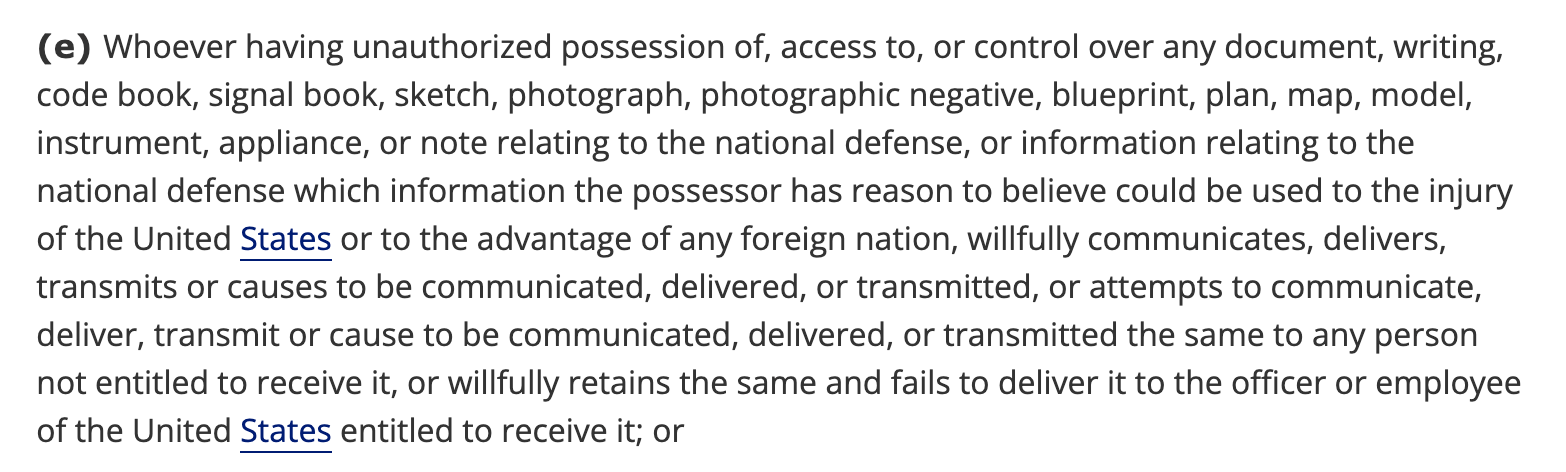
Prosecutors have to prove the conduct the statute sets forth and the defendant’s state of mind. Here, that means convincing a jury that Trump unlawfully possessed classified information and willfully refused to return it to the National Archives when asked to do so. But prosecutors don’t have to establish why the defendant did that.
Of course, juries are made up of human beings and we are
curious by nature. Prosecutors want to satisfy that curiosity by helping juries
understand why the defendant did what he did. This newly released memo suggests
at a possible motive: “‘Trump possessed classified documents pertinent to his
business interests — establishing a motive for retaining them,’ according to
the memo, which tracked progress in the documents and election-interference
investigations. ‘We must have those documents.’”
“We must have those documents” is likely a reference to
getting the intelligence community (IC) to provide a sanitized, unclassified
version of the documents that could be admitted at trial as evidence. This is
the dance prosecutors have to engage in when classified material is part of the
evidence they want to use to prove their case—persuading classification
authorities that either a declassification of a document or at least a version
of it that, while protecting sensitive information, is sufficient to help them
prove their case—should be made available.
The memo was written in January 2023. We don’t know if
prosecutors received the IC’s blessing and moved forward with this theory or if
other information came to light that led them to subsequently abandon it. But
they sound serious about pursuing it. “We must have those documents,” they
wrote in the memo. The implication is that Trump was using classified
information for personal profit, putting national security at risk along the
way.
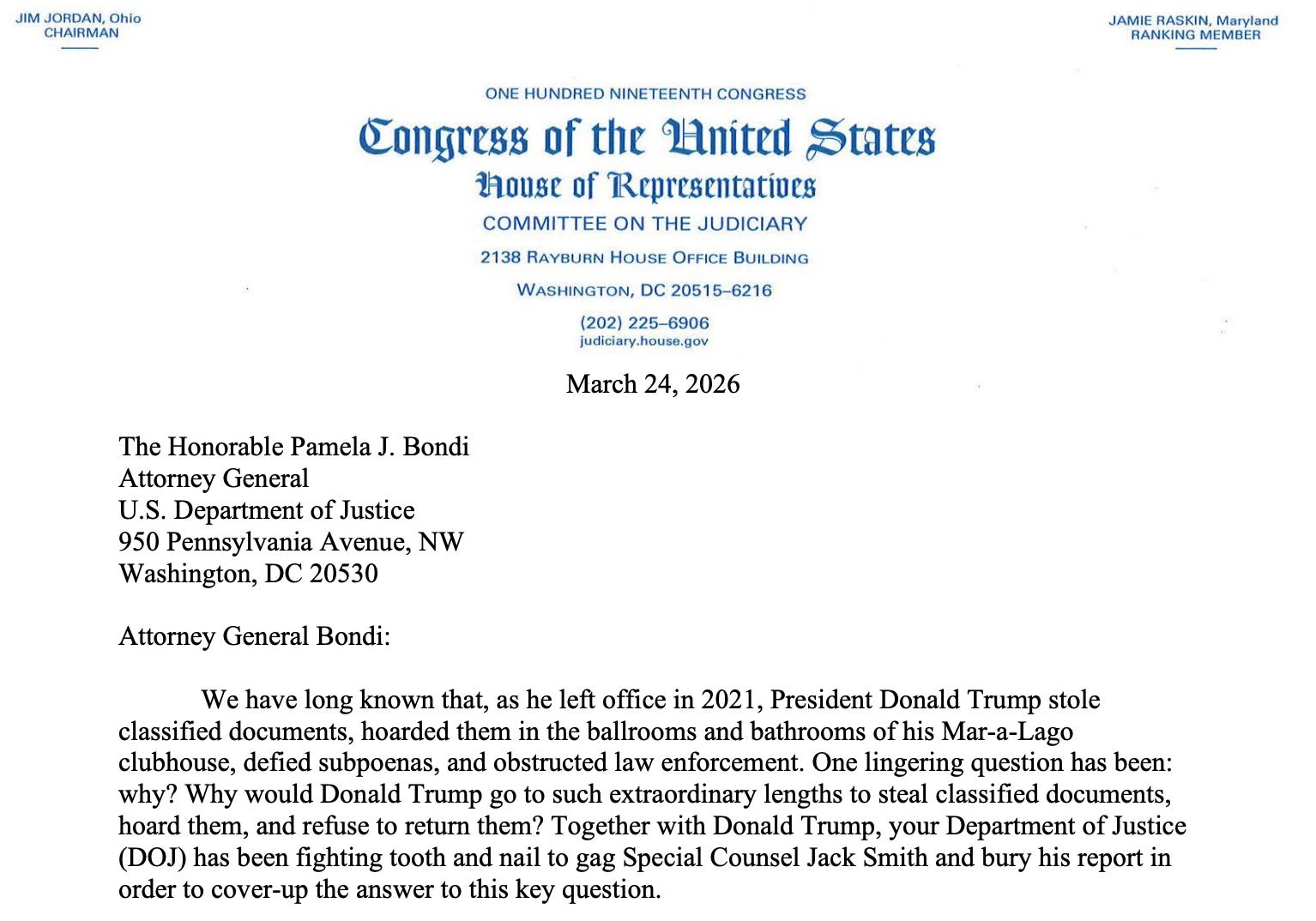
Representative Jamie Raskin, the ranking Democratic member
of the House Judiciary Committee, slipped another interesting detail into a
letter he wrote to AG Pam Bondi. “These new disclosures suggest that
Donald Trump stole documents so sensitive that only six people in the entire
U.S. government had access to them.” That suggests a document of extraordinary
sensitivity.
Asked for comment, the White House had only word salad to
offer: “It’s pathetic that Democrats with zero credibility like Jamie
Raskin are still clinging to deranged Jack Smith and his lies in 2026.
President Trump did nothing wrong, which is why he easily defeated the Biden
DOJ’s unprecedented lawfare campaign against him and then won nearly 80 million
votes in a landslide election victory.” The insult to Raskin and the electoral
victory do little to support the assertion that Trump “did nothing wrong,” when
his conduct is plain.
How did the memo come to light? Raskin explained it like
this in the letter to Bondi: “Apparently blinded by the frenzied search to find
any scrap of evidence that could be twisted and distorted to level an attack
against Special Counsel Smith (despite constantly coming up empty-handed), you
have, quite amazingly, missed the fact that some of the documents you provided
include damning evidence about your boss’s conduct and may well violate the gag
order your DOJ and Donald Trump demanded from Judge Aileen Cannon.”
The reporting so far doesn’t reveal precisely which Trump
business interests are involved, but Raskin engages in some educated
speculation in the letter, which involves a classified map Trump had. “Without
access to Volume II of the Special Counsel’s final report or the investigative
files, we do not know what that classified map contained, nor can we determine
from this memo the relationship between the classified documents President
Trump stole and their pertinence to his ‘business interests,’” Raskin acknowledged.
He continued, however, “We do know that around the time of this flight to
Bedminster, President Trump was entering into partnerships with Saudi-backed
LIV Golf and state-linked real estate firm Dar al Arkan.”
The flight is one where Trump allegedly showed others the
map in question, and Raskin notes, “A month after this flight, in July 2022,
President Trump played golf at Bedminster with Yasir al-Rumayyan, head of the
sovereign wealth fund of Saudi Arabia—the same official who plied the Trump
family with tens of millions of dollars as the family began to run out of money
between terms. During this trip, President Trump defended his business partners
from criticism levied by the families of 9/11 victims protesting the Saudi
government’s role in the attack.” Raskin say that in this time period Trump
boasted about having maps and said “that it was only the hawks who wanted to
attack Iran, not him, and that he had Pentagon war plans ‘done by the military
and given to me’ about such a potential attack.”
Raskin’s conclusion is stark because of what is going on
today, years later. “If this map is related to our military posture in the
Middle East,” he writes to Bondi, “and it was in fact shown to any foreign
official, Saudi or otherwise, that would amount to an unforgiveable betrayal of
our men and women in uniform who are currently valiantly fighting in President
Trump’s disastrous war against Iran.” Raskin includes a list of questions for
DOJ to respond to and demands that DOJ “cease cherry-picking investigative
materials and produce all remaining investigative files, including memoranda,
emails, and analyses prepared by the Special Counsel’s Office by 5:00 p.m. on
April 14, 2026.” I suspect he’ll have even less luck with that than Congress
has had obtaining the full Epstein files. But as with those files, public
awareness and outcry is essential.
DOJ mistaked its way into providing information it has been
desperate to withhold and has been able to keep from public view so far, with
Judge Cannon’s help. But her decision is on appeal and a panel at the 11th
Circuit will hear oral argument in June. That court could order the release of
Volume II of the Special Counsel’s report and complete our understanding of the
picture that is only hinted at here.
This one letter that has come to light reminds us that Jack
Smith had a serious prosecution that was derailed, and not because it lacked
merit. Recent reporting suggests that the Saudi’s continue to push the
war in Iran. We have the implications of Raskin’s letter at hand. American
lives are at stake in the Middle East, fighting a war that appears poorly
thought out at best and likely to seriously impact the economy. The classified
documents case, which Trump tried to dismiss and then delay, ultimately
succeeding, reemerges as an extraordinarily serious matter.
If you value clear, experience-based analysis that
connects the dots between court decisions, political power, and the rule of
law, consider becoming a paid subscriber to Civil Discourse. Your subscription
gives you deeper access to the reporting and helps sustain a community of
readers who care about understanding what’s really happening—and why it
matters.
We’re in this together,
Joyce

