He doesn't want you to see this one, either.


“It Sounds Bad, and It Is Bad”
By WASHINGTON UNIVERSITY SCHOOL OF
MEDICINE

The good news is that quitting smoking prevents further loss of brain tissue — but still, stopping smoking doesn’t restore the brain to its original size. Since people’s brains naturally lose volume with age, smoking effectively causes the brain to age prematurely, the researchers said.
The findings, published in Biological Psychiatry: Global Open Science, help
explain why smokers are at high risk of age-related cognitive decline and Alzheimer’s disease.
Surprising study results show limits of using recommended steps to debunk false content
New York University

The findings,
which appear in the journal Nature, offer insights into the impact
of search engines' output on their users -- a relatively under-studied area.
Van Slyke spins the facts about Charlestown
By Deborah Carney, Charlestown Town Council President

Be honest Bonnie, the CCA made mistakes. Stop trying to
convince everyone that things in Charlestown were perfect under the CCA
leadership. They were not. As issues come to light, this current Town
Council is not sweeping them under the rug. We are addressing them, in
public, as we should.
The buck stops with the Town Council, not the
staff. The issue is not that there was a mistake, the issue is how you
handle the mistake. The CCA handled mistakes by trying to convince people
that everything was fine when it was not. Candidates endorsed by Charlestown
Residents United face these issues in a transparent manner.
As to the assertions in her letter:
I never said the staff violated the Impact Fee
Ordinance. I said the town violated the ordinance. That falls on
past councils. CCA supporters can claim the impact fees have been handled
properly, but no one can seem to find the required documentation for
expenditures of this money.
The issue of the legality of an elected Planning
Commission has been raised in the past but never decided by the
courts. A recent change in Rhode Island state law provides for
applicants to appeal decisions of the Planning Commission directly to the
Superior Court. It is highly likely that this issue will once again be
raised by an applicant aggrieved by a Planning Commission decision.
The Charlestown Affordable Housing Commission raised the
issue of applications for Accessory Dwelling Units not being accepted by the
town and requested the Town Council act upon this matter. The Town Council will
hold a public hearing on the ADU ordinance amendments in January.
There was in fact a problem with the payroll, which was
evidenced by the fact the council had to transfer a large sum of money to cover
the shortfall. The problem was addressed and corrected, not swept under
the rug.
This Town Council is not afraid to discuss town issues in
public. Nor will we sweep problems under the rug. If something is
not being done correctly, we will fix it.
As mistakes come to light, the CCA desperately tries to
convince the taxpayers that under their leadership everything was perfect, and
they did everything correctly. They did not. Stop making statements
that aren’t true as you try to divert attention away from what really happened.
To my fellow Charlestown residents, stay tuned, because we have also seen the CCA tall-tale machine spinning with regards to the Ninigret Master Plan Update. The truth will come out on that matter, despite their best efforts to the contrary.
Rational Riddles: Unpacking the Puzzle of Political Polarization
By PETER DIZIKES, MASSACHUSETTS
INSTITUTE OF TECHNOLOGY

This is often regarded as a product of irrationality: People can be tribal, are influenced by their peers, and often get information from very different, sometimes inaccurate sources.
Tribalism and misinformation are real enough. But what if people are often acting rationally as well, even in the process of arriving at very different views?
What if they are not being misled or too
emotional, but are thinking logically?
He's rich but claims to be broke - and you're not
ROBERT REICH in Robertreich.Substack.Com
Within days of a nearly $150 million judgment against
former New York Mayor Rudy Giuliani for defaming Ruby Freeman and Shaye Moss,
the election workers Giuliani falsely claimed stole the 2020 election in
Georgia for President Joe Biden, Giuliani filed for bankruptcy.
Getty Images
He thereby shielded himself from having to surrender his
assets to fulfill the judgment, at least in the near term.
The long term may be quite long. Freeman and Moss may not
see a penny of that judgment for many years, and when they do, it’s likely to
be far less than $150 million.
One of the most basic of all questions in a market
economy is what to do when someone can’t pay what they owe. The U.S.
Constitution (Article I, Section 8, Clause 4) authorizes Congress to enact
“uniform Laws on the subject of Bankruptcies throughout the United States.”
Congress has done so repeatedly. In the last few decades,
Congress’ changes have reflected the demands of the wealthy, giant
corporations, and Wall Street banks, which have made it harder for average
people to declare bankruptcy but easier for themselves to do it.
Many people are too broke to go bankrupt. Filing for
bankruptcy costs money, as does hiring an attorney (which is the best way to
make sure you actually get debt relief). Because attorney fees, like other
debts, are wiped out in a bankruptcy, most bankruptcy lawyers require clients
to pay in full before filing.
Swamps and wetlands sustain fish, birds, and mammals
By Rob Smith / ecoRI News staff
The state’s swamps aren’t only for ogres, at least at one
popular South County hot spot.Don't overlook the history of the Great Swamp, site
of the December 19, 1675, massacre of hundreds of
Narragansett women, children and elders by European
colonizers. Read more HERE.
Despite their pop-culture reputation as slimy, smelly
habitats for all kinds of gross creatures, swamplands are the unsung heroes of
the environment, and more plainly, they’re just cool as hell.
Wetlands produce enormous amounts of food to attract an
equally enormous amount of species, making them essentially superhighway
habitats for a stunning amount of wildlife. Swamps and wetlands sustain
everything from fish to plants to birds to insects to mammals. These areas
sustain wildlife so well that the Environmental Protection Agency has compared
them to rainforests and coral reefs.
And where wildlife goes, so do nature lovers. Longtime
residents of the state might be surprised to find out that one of the biggest
swamplands in the region is in South Kingstown, nestled between Route 138 to
the north and Worden Pond to the south. Aptly named the Great Swamp, it’s been
owned and maintained by the Rhode Island Department of Environmental Management
since 1950 as a state management area.
As a management area, the swamp is left mostly
undeveloped, and there’s tighter restrictions over what members of the public
can do. (DEM has long struggled to eliminate off-road vehicles from its management areas, which are banned.)
As a result, there’s some 2,200 acres of untouched,
forested swampland — one of the largest contiguous areas of its kind in the
state — primarily cedar and red maple swamp. It makes for beautiful hiking, and
there are 6 miles of flat trails between the management area and nearby Worden
Pond. Hikers are likely to see a plethora of wildlife, including dozens of
possible bird species at any given time of the year, and other mammals such as
beavers.
US Adults’ Daily Snacks Equal a Full Meal’s Calories
By OHIO STATE UNIVERSITY

Researchers analyzing data from surveys of over 20,000
people found that Americans averaged about 400 to 500 calories in snacks a day
– often more than what they consumed at breakfast – that offered little
nutritional value.
Though dietitians are very aware of Americans’ propensity
to snack, “the magnitude of the impact isn’t realized until you actually look
at it,” said senior study author Christopher Taylor, professor of medical
dietetics in the School of Health and Rehabilitation Sciences at The Ohio State
University.
“Snacks are contributing a meal’s worth of intake to what we eat without it actually being a meal,” Taylor said.
New York appeals court rules there is "ample evidence of malfeasance"
A New York state court will move forward
with a case brought by the state against the National Rifle Association,
following an appeals court ruling on Thursday that rejected the powerful
pro-gun group's claim that the probe violated its First Amendment rights.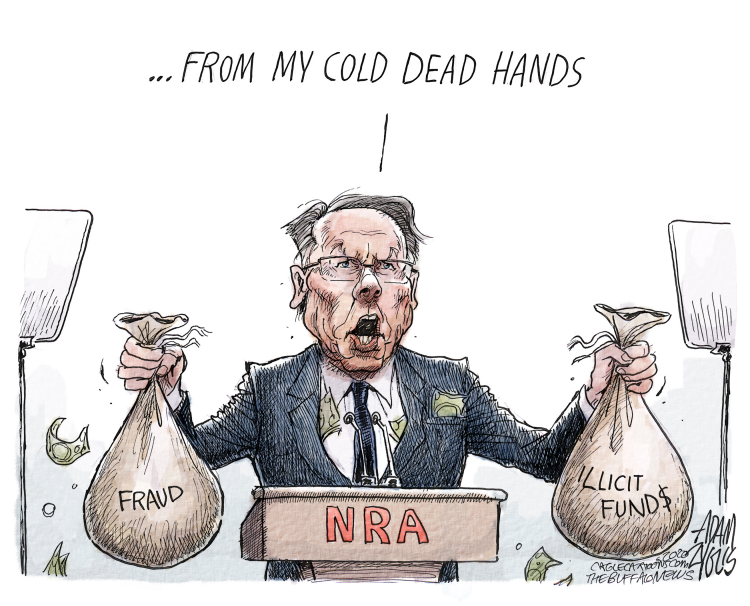
Adam Zyglis
A panel of five judges in the Appellate
Division in Manhattan unanimously ruled that
state Attorney General Letitia James has probable cause to investigate the NRA
over allegations that it diverted millions of dollars to fund the lavish
lifestyles of executives including Wayne LaPierre, its chief executive officer.
James sued the NRA in August 2020, saying
executives also failed to obtain board approval for conflicts of interest and
retaliated against whistleblowers who spoke out against allegations of
financial misconduct. She is seeking an overhaul of the NRA's leadership,
including the removal of LaPierre.
The appeals court said James has provided
"ample evidence of malfeasance" at the organization, and has
authority to enforce state laws governing nonprofits.
How do you comply with the law when your boss, CCA founder Ruth Platner, hates affordable housing?
Since last summer, Warwick Planning Director Tom Kravitz has been racing against the clock. That’s why on a recent day he locked himself in an empty office with his laptop and numerous plat maps.
Charlestown Planner Jane Weidman says complying with
the state affordable housing law is "a real pain." Maybe if
she put more time into it, and less time trying to
cover up shady deals by the Charlestown Citizens
Alliance, she could get it done.
“I spent four of five days, six hours in a row, really plowing through it,” he said.
“It” is the work required to overhaul the city’s municipal code, something Kravitz and his staff of seven have had to do on top of their normal workload in order to comply with state-mandated changes to the city’s zoning, planning, and permitting statutes.
The changes are required by the 13 bills passed by the General Assembly back in June to stimulate the production of more affordable housing across Rhode Island. Among the changes are provisions allowing commercial buildings to be converted to residential use, shortening the review process for plans, and shifting approval power away from local boards to their municipal planners.
The legislation was hailed as an important step in helping remove bureaucratic hurdles that slow down development in cities and towns in order to address the state’s housing crisis. But it has placed pressure on Rhode Island’s municipal planners, who have to prepare their communities to adopt these changes by Jan. 1.
Kravitz has most of his city’s new zoning rules set. But he said the city will likely need an extra month or two to update ordinances for subdivisions and land development projects.
These are changes many planners didn’t ask for and don’t want — especially the power shift from locally-appointed planning boards to these full-time planners who prefer to work in more of an advisory role.
“This was all thrown at the towns,” said Jane Weidman, the town planner of Charlestown who only has one assistant to help address the planning needs of a 36.5 square mile town of about 8,000 people. “It’s a real pain.”