 |
| Ellis Rosen |
Sunday, November 19, 2023

Another reason why recycling is not the answer to plastic trash
Scientists found hundreds of toxic chemicals in recycled plastics
University of Gothenburg

Because of this, the scientists judge recycled
plastics unfit for most purposes and a hinder in the attempts to create a
circular economy.
The results are published in a study led by scientists at
the University of Gothenburg.
Delegates, scientists and health and environmental
advocates from around the world are traveling to Nairobi, Kenya for the third session of the Plastics Treaty Intergovernmental
Negotiating Committee (INC-3).
There scientists will urge delegates to heed the latest
science showing that because toxic chemicals are used to make all plastics, and
plastics will adsorb other chemicals during use, there are no plastics that can
be deemed safe or circular.


Getting to know your cranberries
Cranberries can bounce, float and pollinate themselves
Serina DeSalvio, Texas A&M University
 |
| Cranberries grow on vines in sandy bogs and marshes. Lance Cheung, USDA/Flickr |
Compared to many valuable plant species that were domesticated over thousands of years, cultivated cranberry (Vaccinium macrocarpon) is a young agricultural crop, just as the U.S. is a young country and Thanksgiving is a relatively new holiday. But as a plant scientist, I’ve learned much about cranberries’ ancestry from their botany and genomics.
New look for I-95?
House Commission to Study Feasibility of Solar Arrays on Highway Medians
By Rob Smith / ecoRI News staff

A new study commission is meeting this fall to investigate the idea of building ground-mounted solar arrays on the median strips found along interstate highways and Route 146.
As
part of its authority, the commission, chaired by Rep. Robert Phillips,
D-Woonsocket, who also sponsored the bill creating the panel in 2022, will also
study and provide recommendations for solar carports in state parking lots and
in other public locations.
In some ways median strips are the perfect sites for
solar. Many are already relatively flat and ready for building thanks to
interstate construction, and barring trees or wetlands, there isn’t much else
that’s allowed to be placed on median strips. It is illegal for the public to
tread on them.
A preliminary list compiled by the Rhode Island Department of Transportation
identified 15 potential sites for solar placement along interstates, totaling
about 330 acres. Building solar on all identified sites could provide more than
100 megawatts of renewable energy, using the latest solar density estimates
from the Lawrence Berkeley National Laboratory.
Saturday, November 18, 2023
The Public Purse Should Fund the Public Good, Not Private Profits
Why should taxpayers subsidize stock buy-backs?
SARAH ANDERSON, Inequality.Org

The reasoning? These CHIPS program subsidies, explained Commerce
Secretary Gina Raimondo, “should be used to expand in America, to out-innovate
the rest of the world. Invest in R&D and your workforce, not in buybacks.”
Wielding the power of the public purse against buybacks
makes total sense.
Taxpayers want every dollar of their public investments
to produce maximum benefits. But every dollar spent on stock buybacks is a
dollar not spent on worker wages, R&D, and other productive investments to
stimulate long-term growth and make U.S. companies more competitive. Analysts
have documented how buybacks are associated with reduced capital investment and
innovation and wage stagnation.
And yet in the past two years, S&P 500 corporations
spent record annual sums repurchasing
their own stock—$922.7 billion in 2022 and $881.7 billion in 2021. In the first
half of 2023, share repurchases were down a bit but still an eye-popping $390.5 billion.
What’s the goal of all these buybacks? This financial
maneuver artificially inflates the value of a company’s share price by reducing
the supply on the open market. That keeps shareholders happy. It also
creates huge windfalls for CEOs,
since most of their compensation is in some form of stock-based pay, and their
bonuses are often tied to financial targets that can be influenced by stock
buybacks.


Who owns your car's data?
The battle over right to repair is a fight over your car’s data
Leah Chan Grinvald, University of Nevada, Las Vegas and Ofer Tur-Sinai, Ono Academic College
 |
| Independent repair shops are fighting for access to vehicles’ increasingly sophisticated data. Matthew P/Flickr |
However, as cars grow “smarter,” the right to repair them is under siege.
As legal scholars, we find that the question of whether you and your local mechanic can tap into your car’s data to diagnose and repair spans issues of property rights, trade secrets, cybersecurity, data privacy and consumer rights. Policymakers are forced to navigate this complex legal landscape and ideally are aiming for a balanced approach that upholds the right to repair, while also ensuring the safety and privacy of consumers.
Happy healthier Thanksgiving
Thanksgiving sides are delicious and can be nutritious
Julie Pollock, University of Richmond
 |
| Side dishes made with colorful vegetables are a holiday staple for many. VeselovaElena/iStock via Getty Images |
Colorful vegetables like green beans, collard greens, roasted carrots and mashed sweet potatoes are loaded with important micronutrients.
But how you prepare them will help determine whether you get the most nutritional value out of each bite this holiday season.
As a biochemist, I know that food is made up of many chemical substances that are crucial for human growth and function. These chemical substances are called nutrients and can be divided into macronutrients, such as carbohydrates, fats and proteins, and micronutrients, such as vitamins and minerals.
Vegetables are full of micronutrients that human bodies need for metabolism – or converting food into energy – as well as to form and maintain cells and tissues. These micronutrients can be classified into three types: minerals, water-soluble vitamins and fat-soluble vitamins.
You Have a Right to Know Why a Health Insurer Denied Your Claim.
Some Insurers Still Won’t Tell You.
By Maya Miller, with additional reporting by Ash Ngu for ProPublica

Just outside public view, the American health insurance industry’s algorithms, employees and executives process tens of millions of claims for people seeking medical care.
Sometimes, as ProPublica has reported, insurers base decisions on what’s good for the company’s bottom line rather than what’s good for the patient’s health. Sometimes, insurers make mistakes.
In one case we learned about, a company denied a child’s treatment because it based its judgment on adult guidelines instead of pediatric ones. In another, an internal reviewer misread what type of surgery the patient sought and denied coverage based on that error.
At first, these patients had no idea why they were denied treatment. But in each instance, insurance employees left a paper trail — in notes, emails or recordings of phone calls — explaining what happened. Patients and advocates used what they found in those records to craft appeals and ultimately receive the care they needed.
Federal law and regulations require insurers to hand over exactly this sort of information in response to a written request. And they have to do it fast: Most people who get insurance through an employer should get the records, called claim files, within 30 days.
There’s just one catch: Some insurers aren’t turning files over like they’re supposed to. We followed ProPublica readers through the process with five different insurers. Several companies only shared documents with patients after we reached out.
Friday, November 17, 2023
Will Trump's Supreme Court majority make family murders easier?
Supreme Court considers whether to uphold law that keeps guns out of the hands of domestic abusers
Morgan Marietta, University of Texas at Arlington
 |
| Will the federal law prohibiting the possession of firearms by someone subject to a domestic violence restraining order survive? iStock / Getty Images Plus |
That’s the question posed in one of the biggest cases of the current Supreme Court term, focused on the limits of individual gun rights, which will be argued before the justices today.
The case, U.S. v. Rahimi, comes in the wake of revolutionary changes in doctrine over the past two court terms. Now, justices must grapple with how far the new principles will reach.
Two years ago, the court began what many consider to be a constitutional revolution.

When the court announces a new principle – for example, a limit on the powers of a specific part of government – citizens and lawyers are not sure of the full ramifications of the new rule. How far will it go? What other areas of law will come under the same umbrella?
In a revolutionary period, aggressive litigants will push the boundaries of the new doctrine, attempting to stretch it to their advantage. After a period of uncertainty, a case that defines the limits on the new rule is likely to emerge.


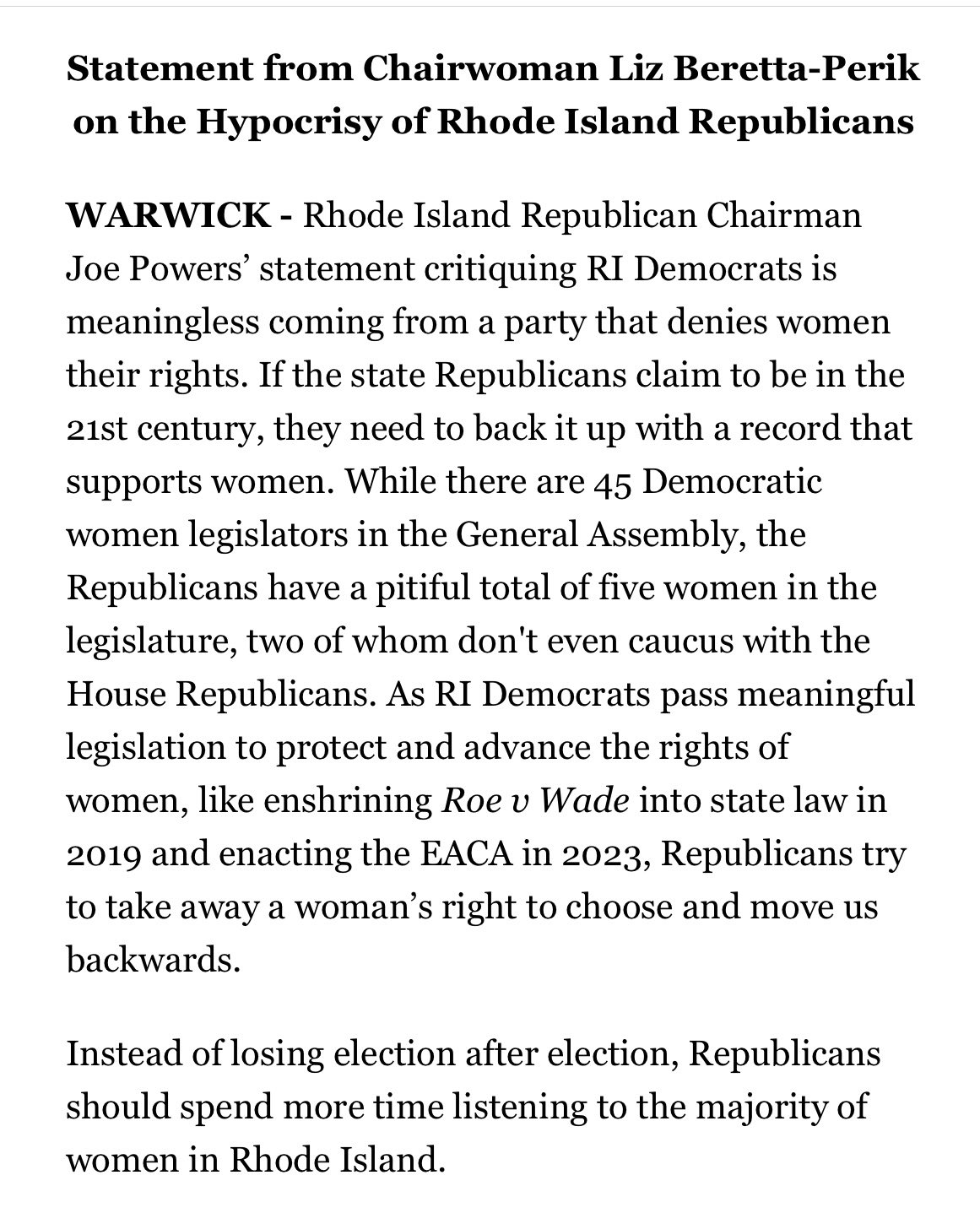
New Democratic Party chair responds to RIGOP snark

Subscribe to:
Posts (Atom)