It’s Always Been About Race

This is the question posed by possible Supreme Court review
of the finding by an Alabama judicial panel that Alabama could not use a
congressional district map that deliberately discriminated against Black
voters.
Two of the three judges on the panel which found race-based
discrimination had been appointed to the bench by President Trump; one, by
President Reagan. The issue now is whether the conservative justices of the
Supreme Court will upend the panel’s racial discrimination finding,
notwithstanding that the Alabama judges had followed legal standards set in the
Supreme Court’s recent decision in Louisiana v.
Callais.
If they allow the Alabama decision stand, it will be a rare
exception to the flood of Supreme-Court-encouraged gerrymandering prompted by
the Callais decision. Those Republican gerrymanders are likely
to purge
one-third of African -Americans representatives from Congress by
destroying the Black majority districts that elected them.
Nonetheless, the six justices of the Supreme Court who
caused this political bloodbath along racial lines claim that Republican
gerrymandering does not violate the voting rights of African-Americans. The
purge is lawful under the Voting Rights Act, say the justices, because the
G.O.P. has partisan reasons to eliminate the Black districts
that cannot be “disentangled” from racial motives.
Through a convoluted logic we explore below, and in the supposed interests of a “color-blind” Constitution, the right-wing justices have emasculated the Voting Rights Act. The majority insists we ignore the reality of race relations in America and ignore the link between Republican partisanship and Republican racial politics. But judicial ignorance cannot yield justice.
Partisanship and race have always been inextricably linked
in Southern politics. Since party identification for white people in the South
has, first and foremost, been driven by race, any “disentanglement” requirement
makes it impossible for the Voting Rights Act to protect the voting rights of
Black and other minority citizens.
The Fifteenth Amendment to the Constitution, adopted in
1870, recognized that the right to vote serves as the great protector of civil
and human rights. The Amendment prohibits states from denying or abridging the
right to vote on account of race. But for nearly a century, the former
Confederate states in effect suspended the Fifteenth Amendment. Decade after
decade, they prevented Black people from voting through legal chicanery,
violence and economic intimidation.
The long civil rights struggle of the 1950s and 1960s against Jim Crow and for racial equality reached their culmination in the Civil Rights Act of 1964 and the Voting Rights Act of 1965. The Voting Rights Act recalled the Fifteenth Amendment to life by giving federal courts broad and flexible authority to protect African-American voting rights. Overwhelming majorities of both parties supported the Act, with 80% of Senators and 80% of Congresspeople voting for it.
Among other protections, Section 2 of the Voting Rights Act
prohibits states from imposing any electoral “practice or procedure . . . in a
manner which results in a denial or abridgement” of the right to vote “on
account of race or color.” Notably, it does not require proving the racial
intentions behind supposedly neutral voting requirements or election practices.
The Voting Rights Act was passed precisely to protect the Black franchise even
when those who oppose Black voting rights don’t say so out loud. Consequently
Section 2 bars a practice if it “results in . . . abridgement” of
voting rights.
In an effort to avoid any ambiguity, the Act was amended in
1982 to specifically confirm that Section 2 is violated if a political
processes gives racial minorities “less opportunity than other members of the
electorate . . . to elect representatives of their choice.”
For decades federal courts applied this provision to
protect African-American voters from racial gerrymandering. But in
last month’s Louisiana v. Callais decision, the Supreme Court
deleted those protections and turned the Voting Rights Act upside down. What
was the supposed logic behind the decision?
Callais expanded on the court’s 2019
decision in Rucho
v. Common Cause, which unleashed states to engage in unlimited
gerrymandering. “Partisan” gerrymandering represents a majority
party power grab. With gerrymandered districts, a slight majority of voters
could elect a super-majority in a state legislature. Or, as President Trump
hopes this year, multi-state gerrymandering might give the G.O.P. enough
purloined congressional seats to retain their hold on Congress even if most
voters, nation-wide, vote against Republicans.
Gerrymandering defies the fundamental principles of America
constitutional democracy; nonetheless the Rucho majority held
that courts could not restrain the practice.
Bad enough. But in this anti-democracy decision, the conservative justices also found an excuse for gutting the Voting Rights Act.
Disempowering Democratic voters and disempowering
African-American voters commonly go together, and the court’s
right-wingers saw a danger: Disadvantaged voters might try to “evade” Rucho’s
greenlighting of gerrymandering by “repackaging a partisan-gerrymandering claim
as a racial-gerrymandering claim.”
This stands reality on its head. The real danger is
packaging (and therefore excusing) a racial gerrymander as
a partisan one. Of the two “risks,” why did the right-wingers
choose to privilege the one that de facto enhances white voting power, not the
voting rights of citizens of color?
The “danger” in thwarting partisan gerrymandering is that a
white majority won’t be allowed to unfairly magnify its power beyond its actual
level of voter support. The danger in racial gerrymandering is that voters of
color will, once again, be denied a meaningful voice in the political process
because of race. In a multiracial democracy with a history of white racial
oppression, it is obvious which concern should matter more. Except to white
nationalists and their allies.
In order to put a state’s supposed “right” to gerrymander
first, the conservative justices held that African-American voters who attack
gerrymandering as racially discriminatory have a “‘special’ burden to
overcome.”
“Courts must treat partisan advantage like any other
race-neutral aim,” so an African-American plaintiff must “disentangle race from
politics” and prove racial considerations drove a decision to eliminate Black
majority districts.
“If either politics or race could explain a district’s
contours, the plaintiff has not cleared its bar,” the Callais majority
held, and the state is free to gerrymander away African-American congressional
districts.
The unexamined premise of disentanglement is that partisan
advantage is a “race-neutral aim.” But how can partisan advantage be deemed
“race-neutral” when the very identity of the political party seeking advantage
rests on racial ideology?
Supreme Court Justice Oliver Wendell Holmes once wrote, “a
page of history is worth a volume of logic.” So it is here.
Following the Civil War, white Southerners became the “Solid
South” of the Democratic Party. The politics of the Democratic Party were
grounded, before all else, on white supremacy. But in the 1960s, as the
national Democratic Party became the party of civil rights, Southern support of
Democrats eroded, then washed away.
White segregationist voters fled to the G.O.P., pushed by
President Kennedy’s and President Johnson’s support for civil rights and pulled
by Republican support for resistance to integration. The G.O.P.’s Southern
Strategy was employed by Richard Nixon in 1968 and Ronald Reagan in the 1980s.
Reagan’s presidential campaign launch in Philadelphia, Mississippi, notorious
as the site of the murder of three civil rights workers, made unmistakable that
Reagan was making a racial appeal to anti-integration white Southerners.
The racially
motivated movement of white voters transformed the South from
Democratic stronghold to Republican bastion. The G.O.P.’s stance on race also
found a sympathetic audience among whites outside the South, who often fought
to preserve de facto segregation and white advantages.
In short, the Republican Party of the last 56 years
was constructed on white resistance to integration and
opposition to African-American rights. When, consequently, Republican
politicians attack African-American political participation, the attacks
advance G.O.P. partisan interests by invoking voter-perceived
racial concerns.
There can be no disentangling of race and politics when
the means of attaining partisan advantage is racial politics – any
more than you can “disentangle” cream from coffee after you’d poured it in. The
mixture of race and politics is the Republican flavor.
By imposing a “disentanglement burden” on those seeking the protection of the Voting Rights Act, conservative justices made it nearly impossible for the Act to ever provide a remedy for the denial or abridgement of minority voting rights. What is true of redistricting applies to any other electoral practice that impairs minority voting effectiveness: its discriminatory impact must always confer partisan advantage on a political party whose underlying ideological appeal is white resentment and white supremacy.
Consider what this means for people of color in our
multinational, multiracial society.
Discrimination, past and present, in housing, zoning,
employment, education, policing and community resources, along with
inequalities in wealth and income, have contributed to concentrating
African-Americans and of other people of color in America’s inner cities.
Although racial minorities are inevitably vulnerable in a
larger society that disdains them, the existence of population centers in which
minorities are the majority should at least mean that those nonwhite majorities
can elect representatives to the tables of power. In the language of the Voting
Rights Act itself, they are entitled to equal “opportunity . . . to elect
representatives of their choice.” Redistricting that is simultaneously racial
and partisan denies that right.
Tennessee’s post-Callais redistricting divided
Memphis, a city with a 63% African-American majority, into three pieces, which
were then distributed to three majority white districts. What could be more
obvious then that this is precisely the kind of political practice Congress
intended to outlaw in passing the Voting Rights Act? But the court’s
“disentanglement burden” likely makes this legal atrocity untouchable.
For the Supreme Court to say there is no remedy because
the racial wrong is politically advantageous to a party whose politics rest on
racial ideology is a travesty of reason and justice. The Republican
Party’s entanglement of politics with race is no reason for the Supreme Court
to deprive minorities of the opportunity to elect representatives of their
choice.
The right-wing justices have not interpreted the Voting
Rights Act. They have interred it. Since their timely promotion of Republican
political advantage cannot be disentangled from the G.O.P.’s racial politics,
we can fairly conclude that Supreme Court Justices Roberts, Thomas, Alito,
Gorsuch, Kavanaugh and Barrett are intentionally advancing white supremacy.
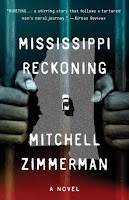
Mitchell Zimmerman is an attorney, longtime social activist, and author of the anti-racism thriller Mississippi Reckoning. He's also a longtime contributor to Progressive Charlestown. His writing can also be found on his Substack, Reasoning Together with Mitchell Zimmerman.
Subscriptions to Reasoning Together with Mitchell Zimmerman are free at this time. If you find my writing of value, please like, subscribe and recommend Reasoning Together to your friends. Thank you.
You may also be interested in my road-trip novel / social thriller Mississippi Reckoning. Read an excerpt. Read the Progressive Charlestown review HERE.

