State Senate District 38 Candidate Forum. sponsored by the League of Women Voters of Rhode Island
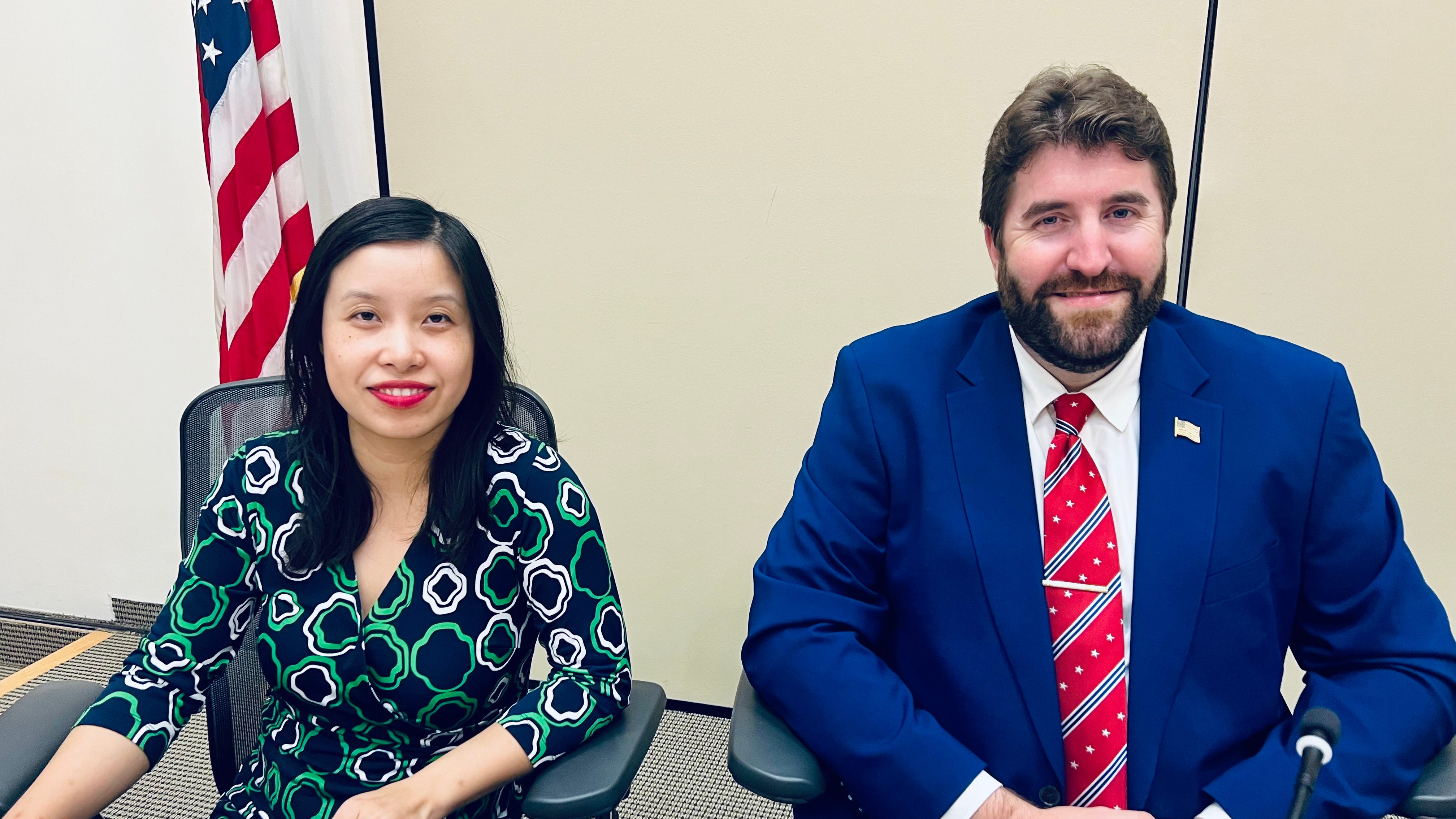
State Senator Victoria Gu (left) and Westin Place (right)
The League of
Women Voters of Rhode Island sponsored the 2026 State Senate
District 38 Candidate Forum featuring incumbent Senator Victoria Gu (Democrat)
and challenger Westin Place (Republican) at the Westerly Town
Hall on October 8, 2026. District 38 covers Westerly, Charlestown, and
South Kingstown.
Matthew Ulricksen, an associate professor of
political science at the Community College of Rhode Island, moderated
the forum. He contributes to the Rhode Island
Current.
Here’s the video:
Here’s the transcript, edited for clarity:
Matthew Ulricksen: Opening statements
Victoria Gu: It’s been an honor to represent the most
beautiful part of the state. I grew up here, going to the beach and fishing
with my dad. In 2023, I pledged to pass the shoreline access bill and, in my
first year, negotiated it, built on it with the Shoreline Access Disclosure
Law, and passed a bill to protect against reductions in parking near CRMC
(Coastal Resources Management Council) rights-of-way to the shore. Because
we’re a coastal area, we’re vulnerable to storms and sea-level rise, so I also
passed the Act on Coasts and secured $5 million in additional green bond
funding, which will run in November and provide resources for states and towns
to harden their infrastructure against storms and flooding.
My community is tight-knit, with many generations growing up
in South County, and it’s harder right now for young people and seniors to get
priced out, so I’ve also been working on housing through accessory dwelling
units, also called in-law units. Those permits have roughly doubled annually
since we passed my bill in 2024. I’m also working to reform for-profit
utilities like Rhode Island Energy, push back against rate increases, and seek
greater oversight of the spending they pass on to ratepayers. So there’s a lot
to do, and I look forward to discussing these issues.
Westin Place: A lot of people know me since this is my third time running. I’ve been here since 1988. I was born in Virginia and moved here with my family to my grandparents’ house in North Kingstown. I then moved to Narragansett, and I moved to Westerly in 2010, right before the Great Flood. I have a family: my wife, my daughter, and my son, Jack, Astrid, and Tony. They’re basically the reason I’m doing this, because I want my kids to stay in Rhode Island.
People ask why I’m here. Is it because we have great roads?
Is it because we have great schools and we have really high test scores? We
have low taxes? We get a lot for what we put into the state? No. The only
reason anybody’s here right now is family. That’s it. If your family can’t live
here because there’s no opportunity and they move away, there’s no reason to
stay here. We’ve got great weather, but we need more than families to keep
Rhode Island running, where the entire state is going to be on welfare. I’m a
medical office manager now, not a truck driver, so I’m full-frontal in the
primary care crisis, and I see the issues can be fixed. I see the issues that
arise. I know that not being able to afford to live here is one reason doctors
decided not to come. So hopefully we’ll learn what differentiates me from my
opponent, and everybody will make the right choice in November.
Rhode Island will spend more than $14,300 per person to
run the state, one of the highest in the country and among its New England
peers. Yet it lags behind in infrastructure and education. If elected, what
legislation would you propose to deal with these two issues?
Victoria Gu: One step we took in last year’s budget
was establishing an Inspector General, who will take a closer look at all state
departments, identify inefficiencies, and streamline the budget. With booming
budget deficits, I think we will have to streamline each agency. Another area I
have looked at extensively is Medicaid, which takes up a large portion of the
budget and is growing at 6% a year, while our general revenues are only growing
3% a year. We will have a growing budget deficit unless we can manage Medicaid
spending.
One of my approaches has been to adopt successful models
from other states, like a food-as-medicine program that uses food interventions
to address the root causes of chronic disease. It will help people become
healthier and reduce overall healthcare expenditures. The legislation I passed
establishes a task force to create a pilot program to measure how much it
improves people’s health and how much it improves our Medicaid expenditures. I
plan to use the task force’s results to inform future, expanded programs that
will help us manage our spending.
Westin Place: Two things I would do: first, $14,300
per person. You look at my family of four; that’s almost $60,000 a year. I’m at
the poverty level with my new job at $60,000 a year. I see it as every dollar I
make going to the state. There’s no money for me or retirement: it’s feeding my
children and paying my electric bill. So number one, as John Laughlin said in a
recent podcast, 47% of your electric and gas bills could be lowered if they got
rid of the mandates from the 2021 Act on Climate. It’s obviously not going to
happen; everybody’s going to drive electric cars by 2030? You might as well put
that off for now and make it so people can actually afford to heat their homes
this week.
Number two: the budget itself basically gets a free pass. I
know the governor proposed a budget that was less than what the House Speaker
proposed. Now, you may want to say we’re going to have a budget deficit, but
you can still cut spending. It won’t be the end of the world. We’re not all
going to be on the street with pitchforks and torches. Right now, what’s
important is making sure people don’t freeze to death in the winter or cook to
death in the summer, which is a huge deal for my family, at least. On top of
that, the state budgeted $344 million for “other” expenses. That is not
acceptable. I’d love to do my taxes and see $15,000 in “other” donations. It’s
not acceptable.
According to CNBC’s 2026 Top States for Business list,
Rhode Island ranks 48th in terms of business friendliness and dead last in the
infrastructure category. What are your specific plans to improve this?
Note: For more on state rankings, see here
Westin Place: My specific plans for business are
fewer regulations. I’m a general operations manager in a medical office. So
that means I’m in charge of payroll, taxes, sales tax, licensing,
credentialing, and billing. I do it all. I have to go to seven different sites
to get my state credentials just to run payroll in the clinic, which is
ridiculous. There could be one. But at the same time, the state will say, “You
have to go and basically hire someone and pay them before we can give you an
employee number to pay the state.”You see why they get all their fees, because
it’s extremely difficult to do that. So really, the only people that’ll make a
lot of money are going to be those finance officers that are doing payroll for
you.
On top of that, we have a $1,800,000 death tax. Basically,
if you own a house that’s paid off, a 401k and a couple cars, your kids are
going to not get what you worked hard for. So why are these rich people here?
Was that $1,800,000 made back in 1980? Have they adjusted for inflation? We
have to raise those numbers so they’re competitive with other states and people
actually want to move here.
Victoria Gu: I found a number of constituents,
including some who are trying to open their business, and helped them get their
permits. And I’m seeing delays in the permitting process when someone at the
department is away on vacation or something like that. We can streamline the
process, get their permits done, and make sure that’s not a barrier to starting
a new business. On attracting businesses in general, when Hasbro moved, they
said they were attracted to Boston not because of lower taxes, but because of
the talent pool that was available in Boston. We can’t necessarily compete with
someplace the size of Boston, but we should lean into our strengths, notably in
maritime technology and the defense sector. We should invest in what
differentiates us from other states, so when someone wants to do research or
develop undersea technology, they’ll come to Rhode Island because itt’s the
best place to do it. It’s a way to attract good-paying jobs, and we should lean
into career technology and funnel our higher education into internships at
these sorts of companies.
As a state legislator, you will have many legislative
options to improve access and cost of health care in the round. What specific
legislation will you support to immediately improve access to health care and
reduce costs in Rhode Island?
Victoria Gu: In recent years, we responded to the
federal administration’s Medicaid cuts and the loss of Affordable Care Act tax
credits. People going to HealthSource RI to get insurance on the marketplace
saw their premiums skyrocket because of federal government cuts. The Senate put
$19 million of the state’s money behind those credits. I had friends doing
part-time contracting trying to decide whether to pay for health insurance, but
we took decisive action during the last budget to make sure they had health
insurance and could stay insured. The second piece is access, because I’ve also
been championing global integrated health when working with Charlestown Rescue
Service and Westerly Ambulance Corps to expand the pilot program so they can
manage chronic disease and follow up on whatever their primary care physician
recommends. This helps overcome some of our transportation barriers and
improves access to care.
Westin Place: The biggest issue I have at my clinic
is that people call me daily and ask, “How long until I can see a primary care
doctor?” And I’ll tell them two weeks, and they’ll say that’s unheard of. We do
something different because we’re a small independent clinic. The only clinics
that really take patients right now, especially with UnitedHealth, will be the
giant mega clinics owned by Brown, Yale, or South County Health. We need to
address the cost for people who pay. On top of that, if you go to HealthSource
RI for your health care, you’ll find it cheaper if you go directly to the
insurer. HealthSource RI is a broker. UnitedHealth pays them a lot of money to
point them to UnitedHealth. The same goes for a Medicare broker. They’ll say,
“Blue Cross Blue Shield is going out of business.” Even though they’re going to
be cheaper than UnitedHealth, you’ll get $100 from UnitedHealth every year to
spend on food, for example. So they give you perks to get into that insurance.
We need to make it so not every doctor wants to be
concierge. Concierge is a great model. For $2,500 a year, you see your doctor
as much as you want, and they don’t have to worry about insurance. The problem
is not everybody has $2,500 a year to pay when they are forced to buy health
care in Rhode Island. I don’t think we should be paying into a system that’s
trying to support itself because it’s already dying. It’s going down real fast.
My opponent claimed there’s a 6% increase in Medicaid every year. Is there a 6%
increase, or is it 6% of people who pay into the health insurance leaving the
state? That’s the question. You want it cheaper? Go to Massachusetts; they have
a better option. The doctors make 30% more a year just by moving across state
lines. The reimbursement rates are horrible. There’s not enough competition: if
you have three big companies running the whole thing, they can choose exactly
how much they’re going to charge for everything.
Victoria Gu: We’ve taken primary care very seriously
in the Senate. In the last budget, we improved reimbursement rates by putting
in $40 million to improve Medicaid reimbursement rates, so they’re on par with
Connecticut and Massachusetts. Medicare and private insurance reimbursement
rates are lagging, so I would prioritize raising those rates to attract
physicians to common practice here. In addition, we’ve also worked on the URI
medical school.
The state legislature appointed a commission on education
funding in the 2026 session to recommend changes to the state education
formula. What would you recommend to aid schools in South County?
Westin Place: To aid schools in South County, I would
probably recommend cutting off the yoke of Providence. All the school
committees and town councils should get together and say, “We don’t want to
follow your rules.” The problem is, Providence makes all these unfunded
regulations, shoves them down our throats, and we have to pay for them. [Note:
Providence does not produce rules that other municipalities must follow.] Our
kids, obviously, aren’t getting a good education. Alabama, as much as many of
you want to make cousin jokes, now has better test scores than Rhode Island.
Eventually, we’re going to be the butt of the joke. We’ll be the new Alabama.
It’s not acceptable. These kids deserve a better education. They deserve to
have opportunities.
It’s an easy fix: Look at the administration costs. You
don’t need six different assistant principals for a school. You don’t have to
basically make one school the one school in town. Students at smaller schools
have been proven to do better on tests. Yes, we can redo the funding formula to
save some money, but at the same time, we’re sending money to Providence. We’re
not getting the same amount back. We should be worrying about that globally.
That’s one of my big things. I’d love to have my kids go to public school, but
when somebody says, “That restaurant’s good, but maybe only the appetizers.”
That’s what I heard when walking around my districts. The elementary school’s
“Okay.”You’re not going to go to a restaurant where somebody says the
appetizer’s the only thing that’s good. You’re going to look for a better
opportunity.
Victoria Gu: I’m a proud public school student from
K-12, and I’m proud of the education I received. I do think we can do more and
listen to our South County school leaders. In particular, they have raised the
high cost of special education for the small number of students who require
much more funding to educate, as well as out-of-district transportation (for
example, DCYF). We need to build these costs into the education formula so
schools aren’t seeing wide variances in how much they have to spend on these
high-cost students. I also think we need regional bonuses not only for
regionalizing schools, but for having career technical education at a more
regional level. So if they’re building special facilities for health or for
construction, they don’t have to have the same facility as the one in
Charlestown; they can share some of that physical infrastructure and resources.
And I’d definitely lean more into career tech as a way to go. It not only gives
people more hands-on learning, but also a pathway to an internship and a job
right out of high school.
Many residents are concerned about the effects of climate
change on their homes, infrastructure, beach erosion, and tourism income. A
proposed $100 million bond referendum for coastal resiliency projects was held
for further study in the 2026 legislative session. What ideas do you have for
dealing with this challenge?
Victoria Gu: I passed the Act on Coasts to create a
statewide plan for climate resiliency and prioritize assets like the salt ponds
in South County and the Westerly Wastewater Treatment Facility. Those were
priorities. The blue bond you referenced was proposed and was ambitious at the
time. Many of those proposed bonds were rolled into the green bond, which we’ll
vote on in November to invest in climate resiliency. To invest at the level we
need to, the state report said Massachusetts dedicates 1% of its budget to climate
resiliency; if we did that in Rhode Island, that would be $140 million a year.
We’re not necessarily investing at the level that we need to, in part because
the state budget had a lot of different priorities. But it’s a priority of mine
to ensure we get the funding we need for erosion, and that we got funding for
the Charlestown Breachway emergency fix and permanent fix.
Westin Place: Dealing with the challenge of ocean
levels rising, which have been rising basically since the start of the last Ice
Age, there are certain things you’re gonna save, and certain things you’re not
gonna save. Would I like to save everything? Absolutely. But at the same time,
the cost would be astronomical. I don’t think everybody wants to live behind a
levee. We found out what happened to that during Katrina. Rhode Island’s got
the beaches. It’s basically our one tourist attraction. There’s really nothing
else for us to do around here for the most part, especially with kids. We’re
going to need funding for that, but at the same time, they probably don’t refer
to the study because there were no specific things to spend it on. It was just
another $100 million. You’re going to spend an extra 5% per year on it for the
next 20 years. And they said, “What are we going to use it for? I don’t know,
let’s take the money, though.”
If we have actual plans, so people like Caswell Cook can
come down and say, “Hey, we have ideas for the beach.” Or we have people in
town who work for the sewage treatment plant. We’re never going to increase its
capacity. But at the same time, we get shut down with, “We need 10% affordable
housing.” Well, that’s great. Where are we going to put all the flush toilets,
and where are we going to get our water? This was the first year Westerly had a
water ban, even for a short amount of time. In South Kingstown, I was on a
water ban for the past, god, since I grew up in Narragansett, 20 years or
something like that. What do you do with that? Obviously, you need to pay...
Rhode Island still ranks 50th in the country in housing
stock. Last year, Rhode Island added fewer than 1,000 new housing units. Where
do you stand on state mandates about affordable housing?
Westin Place: There’s a difference between affordable
housing and making housing affordable. Obviously, everybody saw the RIPEC
report, and if you haven’t, I recommend you read it. It costs the state twice
as much to build a unit as the private market does.. So, if the state’s
competing with a private builder, and the private builder says, “That guy gets
paid twice as much as me; why should I even put up a building?” The other thing
with affordable housing is: I own my house. I got lucky and bought it at the
bottom of the market and quickly refinanced, so I have a heck of a mortgage,
but between when I bought my house and now, costs went up. If I wanted to
rebuild my house, it would cost more than it’s worth because of Providence
mandates telling us we need insulation. If somebody wants to do that in their
house, absolutely spend the extra money. But when every single house costs more
to build, you’re not going to build as many. That’s a big thing.
Talk to any builder in town. Go call their number and ask,
“Does it cost more to build a house now just because of material costs?” They
will say, “No, it’s because of the mandates passed down by the state.” There’s
a lot of things we don’t have to do to cut costs on housing, making housing
cheaper to build, which means if it’s cheaper to build, you can build more of
it. And homeownership is what we should be striving for, not subsidizing a
family of four making $150,000. A $450,000 house is part of an affordable
housing package, and the state’s paying for that. I’m sorry, those are not
houses that should be affordable housing. Those are houses that people on the
open market should be able to buy.
Follow-up question: Do you think state mandates about
affordable housing undermine local control? If so, what ideas do you have for
increasing affordable housing, both rental and owned?
Westin Place: Again, we’re talking about affordable
housing. I am 100% about keeping Providence out of Westerly, Charlestown, and
South Kingstown. Our towns know what’s best. You can’t mandate the way you want
to change it when they only come down here to visit the beach. They say, “Well,
look, it’s open land. Let’s just build houses.” I dare anybody to drive through
Cranston and Providence. If you want Westerly to look like that, by all means,
vote for my opponent. But if you want open land and farms, and people who actually
enjoy coming down here for the beaches instead of going to Florida where the
entire thing is privatized... That’s how they make money down there. They
privatize the beaches. We don’t want to end up like that.
Victoria Gu: No community in Rhode Island lets a
family making $100,000 afford to buy a house. Accessory dwelling units provide
long-term rental units and a way for homeowners to generate rental income; they
don’t cost the state anything, and they’re smaller, more affordable units on
the land we already have. They don’t encroach on open space. They don’t require
any additional land.
Housing is unaffordable because land is limited. Land is a
high cost in housing. Trades are costing more because of the shortage of
tradespeople. Habitat for Humanity and volunteers have also partnered with our
Jericho Project construction team. We need to keep funneling people through
that program. My opponent is also incorrect about my support for several
Providence bills. I’ve supported a balanced approach. We need to support every
town’s comprehensive plan. Every town should also work towards affordable
housing. When a place is designated as open space, I support keeping it as open
space; every town should be able to designate where it wants additional housing
to go and where it does not.
Follow-up: Do you think state mandates about affordable
housing undermine local control? If so, what ideas do you have for increasing
affordable housing, both rental and owned?
Victoria Gu: I support housing that fits within the
town’s comprehensive plan. I think each town should be making strides toward
its affordable housing plan. To that end, I also passed a Housing Champions
bill that supports towns making those strides and making changes to encourage
affordable housing; in return, they get preferential access to state grant
resources and whatnot.
Rhode Island has some of the highest energy costs in the
nation. What legislation is needed to rein in these costs?
Victoria Gu: I have several approaches. One is that
utility rates are rising much faster than inflation. Compared with our locally
owned utilities across the country, those rise at less than the rate of
inflation, so profit-seeking is a growing portion, and it’s baked into the
delivery cost of your bill, but they won’t tell you how much because they would
rather distract you by talking about renewable energy. I support bills that
reform that profit mechanism and change the profit margins and how they’re
calculated. I also support bills that help expert witnesses intervene on behalf
of the public. Often, they have been able to win concessions from utilities in
the rate cases and secure customer bill credits. Finally, I support strong
oversight of utilities’ capital spending, especially on telephone poles. If
they spend $100 million on a project, they get a 90% profit. If they balloon
that cost to $ 200 million, they double their profits. They have no incentive
to control costs, so we need to build in more incentives or oversight to
control costs that get passed on to ratepayers.
Westin Place: Number one would be to remove the 2021
Act on Climate mandates that increase delivery costs. As I said, we can reduce
47% of our bills overnight if we got together and said, “We’re going to pause
these for five years.” It’s a simple fix that would save me $150 a month in the
summer. That would go great toward more organic food for my family. But my
opponent said “control "a lot. If you control all these businesses, it is a
business; it has to run. If you want skilled labor, you have to pay for skilled
labor. If you want the company to make enough money, you can say, “Okay, in the
next 10 years, you’re going to have to upgrade X percentage of the grid.”
Right now, the northern part of the state is maxed out with
the solar panels. They can’t put any more solar panels out there because it’ll
melt the lines off the poles. So it’s the same thing. We’re basically
subsidizing the wind turbines out in the ocean. The problem is we’ve been
paying for that, and we haven’t seen a single return on investment in making
energy cheaper. We get our natural gas shipped from overseas up into
Providence, and that’s what runs our energy. A couple of nuclear reactors, on the
smaller side in the bay, which, if you already have one or two in there
already, would probably cut down the cost of electricity a lot. Then, instead
of using natural gas to generate electricity, it would generate heat, which is
much cheaper than running coal furnaces and buying it from out of state.
Does the state need to regulate AI? If so, what do you
propose?
Westin Place: You can regulate a new business as much
as you want. Regulations only make smart people find a way around the rules.
That’s what you see with those regulations. You see this with the tax code. My
opponent chairs the [Rhode Island Senate Committee on Artificial Intelligence
and Emerging Technologies]. One thing she’s done is make it so that every
single patient who comes into my office has to sign a piece of paper because I
use AI to scribe what is said in the doctor’s office. If I had to pay someone
to sit there and scribe for the doctor, I’d have to pay $60,000 a year. With
AI, I spend $100 a month doing that. Does it take away a job? Possibly. But it
means less work for my doctor, so my doctor can see more patients. Right now,
you don’t want to see a doctor for five minutes every time you go and hear,
“Yeah, come back in six months.” They look at your chart. They don’t look at
you, which is why we have so many chronic issues.
I’m not a big fan of AI data centers because we have enough
water issues in the southern part of the state. We can’t support them. If they
want to build them out in the ocean, as long as they don’t destroy the
environment, have at it. As for AI and Rhode Island, we should keep it out of
school so kids can actually learn how to read a book and write. I used to be
able to write a six-page paper reading the book the night before going to
Narragansett High School. But now teachers are just checking with AI or checking
to see if it’s not AI.
Victoria Gu: The bill we’re describing doesn’t say
you can’t use AI as a scribe; it just says you should notify patients because
using AI carries risks, like data leakage or privacy concerns. Patients
obviously talk about private issues; the AI is listening and scribing. So the
law mandates notifying the patient. We did some chatbot regulations because
there are unfortunately a number of teenagers and people who have expressed
suicidal ideation or harm to others and are unfortunately pushed into that even
more through the chatbots that are very human-like. So I’m mandating chatbot
notifications again, so people know they are talking to chatbots, not humans,
and that they follow protocols for handling a user expressing harm to
themselves or others. These are light-touch but important safeguards for users
in crisis.
Other goals I’ve been working on include data privacy and
surveillance. As you know, with the talk about phone cameras, AI can use video
footage to track people on a larger scale than any humans can, and so I look
forward to delving into that more in our AI committee, which I chair next year.
Where do you stand on data centers?
Victoria Gu: We already have high energy costs, and
we don’t need additional data centers in Rhode Island. I know there’s a
proposal out of Smithfield; I don’t know if that will actually go through. If
they are even considering it, the data center would need to pay for its own
power. We’re considering bills that would require them to pay for any
additional power and pay at higher rates than regular customers and households.
To the point about regulating utilities, they are a
monopoly. The Public Utilities Commission exists to ensure that when the
utility spends money, it does so responsibly, because we can’t opt out and get
our energy from someone else. The Public Utilities Commission’s job is to
ensure the utility’s spending is appropriate and that the rates it sets,
whether for data centers or other users, are appropriate. Finally, Revolution
Wind and solar are very cost-competitive. I favor an all-of-the-above energy approach
to keep our energy costs reasonable.
Westin Place: As I said in the previous question,
data centers use a lot of water. They make a lot of noise. I don’t know if
anyone wants to sit at the beach and hear that humming sound. It’s not
feasible. Now, if a town wanted to have one, it’s a local issue. That town can
have one. You go to your town council and ask how much they’ll pay in property
tax. They’ll pay an increased electricity rate, which they obviously won’t.
They’ll discount it because they use so much. The problem is that if the town
doesn’t want one, the business can go to the state to bypass local control.
They have a way to do it, which is unacceptable.
AI data centers are not needed around here. Our electricity
costs are high enough. It’s like we’re paying for all these green energy
things, but we’re not seeing a return on investment. You might say he energy’s
cheaper. That’s great. My cable is cheap, or my Netflix subscription is cheap,
but I still have to spend a lot of money for a good TV to see it well. I can
get a really cheap TV, but I still have to pay that rate. Now, in Rhode Island,
you can find discounts on your electric rate. If you’re getting it from Rhode
Island Electric, you are paying the highest rate. The problem is the delivery
fees don’t change. The mandate fees don’t change. We could have a 47% discount
on our electric bills.
Victoria Gu: 47% is a gross exaggeration of what the
renewables or the fees cost. I’ve looked at my utility bill and done my own
calculations of what the fees actually are. The utility loves to harp on
renewable energy because it wants to distract from its profiteering. Revolution
Wind just came online at 9.8 cents per kilowatt-hour, and that is much lower
than our winter energy rates, which range from $0.14 to $0.17 per
kilowatt-hour.
Westin Place: So 47% is a gross overstatement. You’re
probably going to laugh, but I would probably listen to the experts the
Lieutenant Governor listened to. They do a lot of research, and the 47%,
especially if you have a commercial property, you’ll know that Rhode Island
Electric has already had a 15% increase in electric rates approved, and then
another 7% increase already. And they send in a little tiny thing. You have to
actually run a business and hire people to figure that out.
Yes, no, or pass.
Do you support passage of the Rhode Island Voting Rights
Act in 2027?
- Victoria
Gu: Pass
- Westin
Place: Yes
Do you oppose moving the Rhode Island primary for state
and local officials to early summer?
- Victoria
Gu: No
- Westin
Place: Yes
Do you support term limits for state legislators?
- Victoria
Gu: Yes
- Westin
Place: Yes
Will you support establishing a dedicated fund for
teacher training and civic education materials, beginning with a $1 million
commitment to better implement the 2021 Civic Education Literacy legislation?
- Victoria
Gu: Yes
- Westin
Place: Yes
Do you support wind farms as a way to decrease energy
costs and air pollution?
- Victoria
Gu: Yes
- Westin
Place: No
This year, a green bond referendum that included $25
million for water infrastructure improvements did not pass. Do you support such
a referendum?
- Victoria
Gu: Yes
- Westin
Place: Yes
Do you oppose new parking restrictions near rights-of-way
to the shore?
- Victoria
Gu: Yes
- Westin
Place: Yes
Would you oppose legislation to repeal the mandate in
S-2710, which requires the sale or transfer of certain semi-automatic weapons
by December 31, 2026?
- Victoria
Gu: Pass
- Westin
Place: Pass
The legislature and Governor McKee declined to
participate in the new federal scholarship program, which would take Rhode
Island taxpayer money and give it to non-profits for educational programs
instead of giving the money to the federal treasury. Do you support this
program?
- Victoria
Gu: Pass
- Westin
Place: Yes
Will you push RIPTA to increase bus service in South
County?
- Victoria
Gu: Yes
- Westin
Place: No
Closing statements:
Westin Place: I want to thank everybody for those
extremely confusing questions at the end of the lightning round, and for any
confusion on that. Do I oppose repealing something that hasn’t passed? No idea.
This is a simple choice right now. Basically, you have control versus freedom.
You have democratic socialism versus independence. One of the big things I tell
people when I walk around and knock on doors. They say, “Well, I’m a Democrat.
I’m going to vote Democrat.”. I ask, “Are you an old-school Democrat like Reagan
with the low taxes?” [Note: President Ronald Reagan was a Republican.]
They answer, “I love Reagan. I love JFK.” I say, “Well, me too. The problem is
that the party has been taken over by Democratic socialists.”
Certain people are endorsed by the Rhode Island Working
Families Party in Providence. They backed the Democratic-socialist who ran,
basically unopposed, in Providence. [Note: David Morales ran against
incumbent Democratic Mayor Brett Smiley, not unopposed.] They want to
turn Providence into a municipal socialist experiment. We shouldn’t be
experimenting with people. We should be doing what works for other states. We
should be doing what works for our town. Which is why I can tell, you know,
with confidence, if I go up there, I’m going to go up there as a voice to say
Providence can suck eggs. I’m going to be working for Westerly, South
Kingsstown, and Charlestown, and that’s it. Nobody else. I’m not beholden to
anybody else up. I don’t have to do favors to get on to a committee. I can walk
onto every single one and represent this town a heck of a lot better than we
have gotten recently.
Victoria Gu: It’s not fair to associate me with the
Democratic Socialists just because of different organizational affiliations. By
that logic, I could say that your organization, the Republican Party, contains
insurrectionists, and therefore you’re an insurrectionist.
I’ve taken many ideas from the community and made them a
reality. For example, Westerly High School students who wanted to bring a Blue
Envelope Program from Connecticut to Rhode Island worked very hard just to
testify and make that a reality. I made it easy for them to share their ideas
with me and stay engaged. Democracy is stronger when we’re more informed, so I
put a lot of effort into my monthly newsletters, town halls, answering hundreds
of emails from constituents, and personal calls, so people know what to expect
from me, how to reach me, and how to share their ideas. I’m happy to support
them, and I’m happy to continue representing and fighting for Westerly.

