Workers charge McKee gives with one hand, takes with the other
 |
| Noris Fernandez, Liliana McPherson, and Ercilia De Leon |
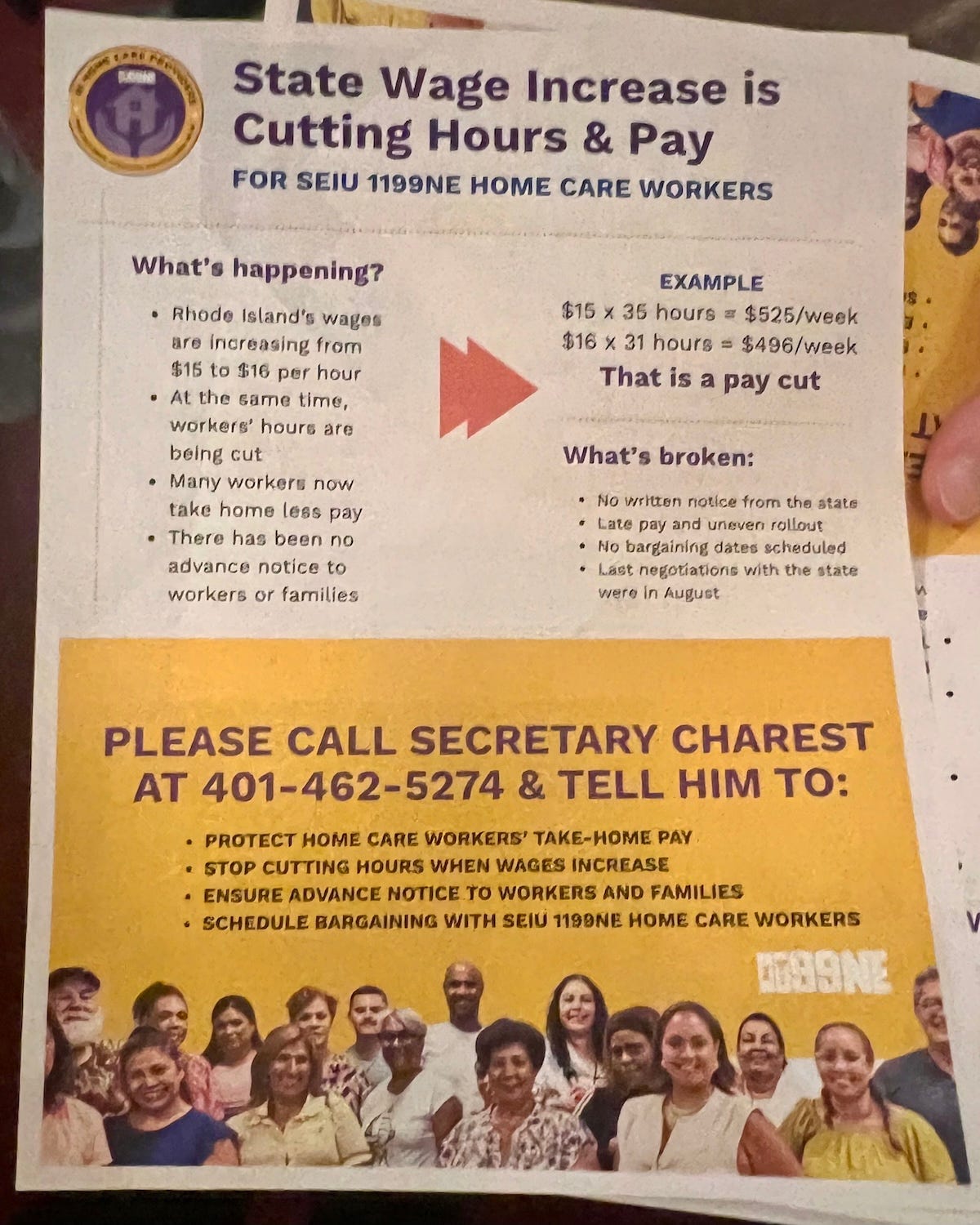
On January 1, 2026, Rhode Island increased its state minimum wage to $16 per hour, up from $15 in 2025. But for hundreds of consumer-directed home healthcare providers across the state, this wage increase comes at the expense of fewer care hours for the vulnerable individuals they serve. With little to no notice, home care workers are seeing the number of approved care hours slashed alongside the wage increase, resulting in less overall income.
On Tuesday, before Rhode Island Governor Daniel McKee began his 2026 State of the State Address, home care workers gathered at the State House to call on his Administration to fulfill its promise to raise incomes and improve healthcare outcomes for every Rhode Islander by not balancing the budget on their backs. At the same time, they are demanding EOHHS (Executive Office of Health and Human Services) resume bargaining a new contract after a five-month hiatus with home care providers who recently joined SEIU 1199NE.
Amid the chaos of the People’s
State of the State, I spoke to some home healthcare providers. I edited the
discussion for clarity.
Liliana McPherson: We care for the elderly and
are here looking for support because, as caregivers, we notice that when our
elderly are sick, they are rushed to the hospital without any kind of analysis
or asking, “What do they need?” It may not require them to go to the hospital.
Perhaps it’s simple, but the patient isn’t confident enough to disclose it to
anyone. They’d rather have a relative care for them, or that relative can take
them to urgent care or call the doctor instead of going to the hospital. By
doing so, we save the state significant money. Instead of rushing to the
hospital and incurring high costs, we care for them and stay on top of their
needs. If they believe it is serious, we can schedule an appointment with the
doctor.
We give our lives to care for these people, but we also
expect benefits. We don’t have insurance. We work 40 hours with one person or
alternate with others, but we still don’t receive paid holidays or any
benefits. We would appreciate your support.
Steve Ahlquist: So you’re saying that by being
there and caring for people, you’re saving the state a lot of money, and the
savings you bring could be used to pay you a little bit more money and
benefits, and treat you properly as workers, right?
Liliana McPherson: They increased the minimum
wage from $15 to $16 this year, but the McKee Administration decreased our
hours.
Steve Ahlquist: So, you’re making less money?
Liliana McPherson: Yes.
Steve Ahlquist: That is terrible.
Ercilia De Leon: And you know how much tax they
take.
Steve Ahlquist: That makes it very hard. I
really want you guys to win this, so thank you.
Ercilia De Leon: I think we deserve it.
Steve Ahlquist: I think you deserve it, too—100%. You’ll never have to convince me. Thank you so much for the work to do. I’ll do what I can with this, I promise.
SEIU 1199NE is asking that you call EOHHS Secretary
Richard Charest at 401-462-5274 and tell him to:
- Protect
home care workers’ take-home pay;
- Stop
cutting hours when wages increase;
- Ensure
advance notice to workers and families; and
- Schedule bargaining with SEIU 1199NE home care workers.
In March 2025, 1,700 workers voted overwhelmingly to form
their union with SEIU 1199NE to improve working conditions and stability for
their consumers, marking the largest election of state workers since the 1980s.
Since then, workers have been negotiating a new contract with EOHHS, but have
not held any bargaining sessions with the state since August 2025, despite
repeated requests.
SEIE 1199NE provided the following statements from workers:
“I was told my hourly wage would increase from $15 to $16,
but at the same time, the state cut my mother’s care by five hours a week. My
mother has congestive heart failure and ovarian cancer and needs almost
constant care. This is not a raise - it leaves us with less income overall
while reducing care for someone who needs more, not less,” said Ronjena
Henderson, who provides ongoing care for her mother.
“My 17-year-old great granddaughter makes more working
at Dunkin Donuts than I do caring for my 95-year-old mother
for the last 11 years,” said Roseanna Pacific, home care provider.
“Governor McKee has repeatedly pledged to support the economic and healthcare
needs of all Rhode Islanders. We formed our union to finally make real
improvements for both ourselves and our consumers, but the state refuses to
bargain a contract with us. How is this fair to caregivers or to the thousands
of vulnerable people who depend on us every day?”
District 1199 SEIU New England represents 29,000 health care and service workers in Connecticut, Rhode Island, and Southeastern Massachusetts. In Rhode Island, 1199 SEIU NE represents 5,000 members. 1199 SEIU NE is affiliated with the Service Employees International Union (SEIU) - a union of over 2 million members across the United States, Puerto Rico, and Canada. SEIU has been a national leader in pushing the growing Fight for $15 and a Union movement.
SteveAhlquist.news is a reader-supported publication. To
receive new posts and support my work, consider becoming a free or paid
subscriber.

