Why they are important

First, from Indivisible:
Indivisible Rhode Island: Why we will gather by candlelight
on January 6 at the State House
Lev Poplow; Lead Organizer, Indivisible Rhode Island
MK Getler; Indivisible Rhode Island Steering Committee Member
Michaela Keegan; Indivisible Rhode Island Steering Committee Member
"Democracies do not fail all at once. They erode slowly
in pivotal moments when truth becomes negotiable, and participation becomes
optional..."
On January 6, 2026, as the Rhode Island General
Assembly gavels in its first day of a fresh new legislative session, the
members of Indivisible Rhode Island and our Chapters will gather
quietly by candlelight.
We do so not to celebrate the occasion, but to honor the
truth.
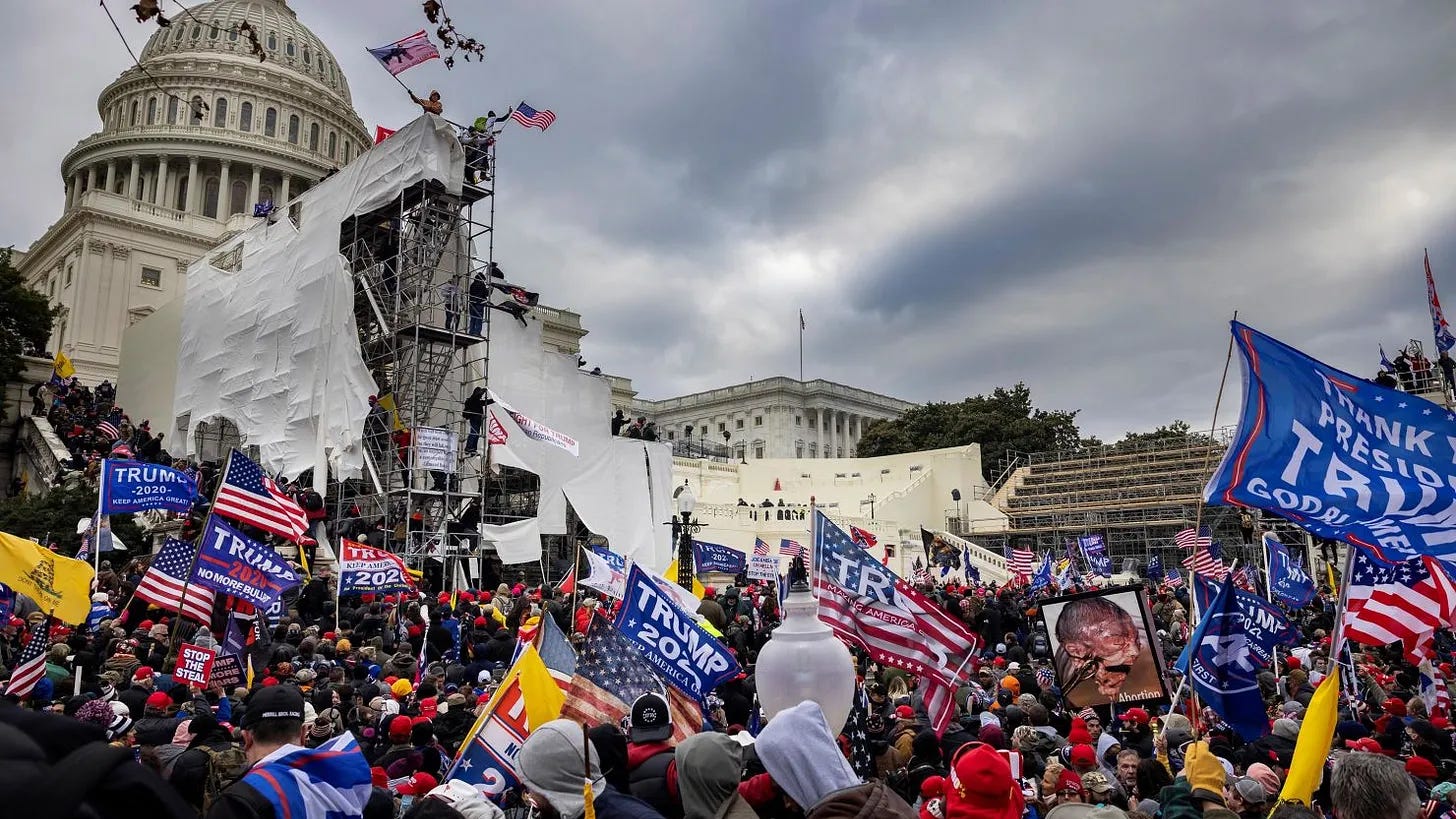
Five years ago, on January 6, 2021, our nation watched as a
violent mob stormed the United States Capitol in an attempt to overturn a free
and fair election. People were injured. Lives were lost. Democratic norms, the
likes of which many of us had taken for granted, were shaken to their core. For
some, the images feel like a distant memory. For others, especially those who
work in public service, journalism, advocacy, and policy, that day
fundamentally altered how safe and stable our democracy felt.
The candlelight vigil we are holding is first and foremost
about those impacted by that day: Capitol staff, law enforcement officers,
elected officials, their families, and everyday Americans who realized, perhaps
for the first time, how fragile our democratic system can be when hateful
rhetoric is allowed to metastasize into violence.
But this vigil is also about Rhode Island.
January 6, 2026, is not just an anniversary. It is the first
day of legislation at the Rhode Island State House. The irony of that
convergence is not lost on us.
However, kismet the dates may be, we choose to let them
serve as a reminder that democracy is not an abstract ideal housed in
Washington, D.C. It lives here in our tiny state. It dwells in our state house,
city halls, school committees, and town councils. It lingers in the daily work
of governance and in citizens’ responsibility to remain engaged, informed, and
vigilant.
Indivisible Rhode Island believes that remembrance is not
passive, and as such, this candlelight vigil is an action: a form of
accountability and responsibility. When we forget, or worse, when we normalize
political violence, we weaken the guardrails that protect a pluralistic
democracy. A candlelight vigil is deliberate: quiet instead of chaos,
reflection instead of rage, community instead of fear.
Some may ask why we are “looking back” when there is so much
work ahead. Our answer is simple: We cannot move forward responsibly without
reflecting on what has led us to this moment. Democracies do not fail all at
once. They erode slowly in pivotal moments when truth becomes negotiable, and
participation becomes optional.
As lawmakers return to the State House to debate policies
that will shape the lives and wellbeing of Rhode Islanders, from housing and
healthcare to education and climate resilience, we want to ground that work in
a shared commitment to democratic principles: Respect for humanity. Civic
disagreement without dehumanization. And equal rights for all.
Rhode Island has a long history of civic engagement and
dissent rooted in a commitment to the common good. Gathering by candlelight on
January 6 is our way of reaffirming that legacy. It is an invitation to
lawmakers and neighbors alike to begin this legislative session with humility,
inclusivity, and resolve.
Democracy is not self-sustaining. It asks something of each
of us. It calls us to action and challenges us to pursue a more perfect
society.
On January 6, we will show up not with slogans or speeches,
but with light. A beacon of our state motto: Hope.
Source: SteveAhlquist.news is a reader-supported
publication. To receive new posts and support my work, consider becoming a free
or paid subscriber.
The most shameful day in American history
We will never forget, and we will not let the nation or the
world forget.
Jan 05, 2026
Friends,
Five years ago tomorrow was the most shameful day in
American history.
We must not allow Trump to persuade America that it did not
happen or that he was innocent, or let him deflect the nation’s attention from
the fifth anniversary of what occurred that day.
Less than three weeks ago, Jack Smith, the former special
counsel to the Justice Department, appeared before the House Judiciary
Committee and testified
under oath:
“Our investigation developed proof beyond a reasonable doubt
that President Trump engaged in a criminal scheme to overturn the results of
the 2020 election and to prevent the lawful transfer of power.”
The sole reason Donald Trump is not now behind bars is that
Smith dropped the case after Trump was elected to a second term, because the
Supreme Court’s ruling in Trump v.
United States — written by Chief Justice John Roberts and joined
by five other justices, three of whom were nominated by Trump — prevented the
prosecution of a sitting president.
Let us ponder this for a moment.
Although the peaceful transfer of power lies at the heart of
American democracy, Trump sought to overturn the result of the 2020 election.
He is now president once again.
Five years ago tomorrow, on January 6, 2021, when Vice
President Mike Pence walked into the Capitol, he faced a withering pressure
campaign by Trump.
Trump and his henchmen had already twisted the arms of
governors and election officials around the country to change the result of the
election in his favor. They had coaxed loyalists in five swing states to submit
signed certificates falsely claiming they were “duly elected and qualified”
members of the Electoral College.
Pence was about to throw out the slates of false electors.
As he began the electoral vote count, thousands of Trump supporters — many of
them armed — stormed the Capitol. Some chanted they wanted to “hang Mike Pence”
for refusing to block the certification.
They came directly from a rally Trump held on the Ellipse,
in which Trump repeated his false claim that the election had been stolen and
told the crowd, “If you don’t fight like hell, you’re not going to have a
country anymore.”
According to the criminal indictment,
“After it became public on the afternoon of January 6 that the Vice President would not fraudulently alter the election results, a large and angry crowd — including many individuals whom the Defendant had deceived into believing the Vice President could and might change the election results — violently attacked the Capitol and halted the proceeding.”
The FBI estimated that between 2,000 and 2,500 people
entered the Capitol Building in the attack, some of whom
participated in vandalism and looting, including of the offices
of members of Congress. Rioters also assaulted Capitol Police officers. They
occupied the empty Senate chamber while federal law enforcement officers
defended the evacuated House floor.
Within 36 hours, five people died. One was shot by Capitol
Police; another died of a drug overdose; three died of heart attacks or
strokes, including a police officer who died the day after being assaulted by
rioters. Many were injured, including 174 police officers. Four other officers
who responded to the attack died by suicide within seven months.
“President Trump was wrong,” Pence said subsequently. “I had
no right to overturn the election. And his reckless words endangered my family
and everyone at the Capitol that day, and I know history will hold Donald Trump
accountable.”
A week after the attack, the House of Representatives
impeached Trump for incitement of insurrection. In February 2021, after he left
office, the Senate voted 57–43 in favor of conviction but fell short of the
required two-thirds majority, resulting in his acquittal.
Senate Republicans then blocked a bill to create a
bipartisan independent commission to investigate the attack, leaving the House
to organize its own select committee.
After an 18-month investigation including more than 1,000
witnesses and nine televised public hearings, the House’s select committee
identified Trump as the “central cause” of the Capitol attack by the pro-Trump
mob.
The panel, made up of seven Democrats and two Republicans,
voted unanimously to recommend charges to the Justice Department to prosecute
Trump for seeking to overturn the results of the 2020 election.
Following a special counsel investigation by the Justice
Department, Trump was indicted on four charges in August 2023.
As I’ve noted, all charges against Trump were dismissed
after his reelection to the presidency.
Of the 1,424 people charged with federal crimes relating to
the riot, 1,010 pled guilty and 1,060 were sentenced and served
time in prison. Enrique Tarrio, then the chairman of the Proud Boys, received
the longest sentence, a 22-year prison term.
Upon retaking the presidency, Trump pardoned them all.
***
Trump and his lackeys in the Republican Party have since
promoted a revisionist history of the event — downplaying the severity of the
violence, spreading conspiracy theories, and portraying those charged with
crimes as hostages and martyrs.
Trump has tried to recast the violent events as a “day
of love.”
On December 8, 2024, in his first broadcast news interview
since the 2024 election, Trump said members
of the House committee that investigated the riot “should go to jail.”
***
We must never forget. We must teach our children and our
children’s children and all future generations of Americans what happened on
January 6, 2021— so that, as Mike Pence hoped, “history will hold Donald Trump
accountable.”
January 6, 2021 was the most shameful day in American
history. It should live in infamy, as should the traitor who refused to accept
the election results and incited the attack on the U.S. Capitol — Donald J.
Trump.

