America’s Most Popular Cooking Oil May Be Harming Your Intestines
 |
| A diet high in soybean oil is found to encourage the growth of harmful bacteria such as adherent invasive E. coli in the gut. Credit: Sladek lab, UC Riverside |
Soybean oil or “vegetable oil” is everywhere in the American
diet. It is used in salad dressings, sauces, fried foods, packaged snacks,
frozen meals, and many restaurant meals. Most people may consume it regularly
without realizing how much they are getting.
New research from the University of California,
Riverside suggests that high soybean oil intake may affect more than
body weight. In mouse studies, it has been linked to changes in gut bacteria, a
weaker intestinal barrier, greater susceptibility to ulcerative colitis, and
metabolic problems.
The findings do not prove that soybean oil causes these diseases in people. But they do raise concerns about how often this inexpensive, widely used oil appears in processed and restaurant foods.
Soybean Oil and Colitis
A study published in Gut Microbes, examined mice
fed a diet high in soybean oil for up to 24 weeks. Researchers found that the
diet disrupted the gut microbiome. Beneficial bacteria declined, while harmful
bacteria increased, including adherent invasive Escherichia coli, a
type of E. coli linked to inflammatory bowel disease (IBD) in
humans.
The researchers focused on linoleic acid, the main
fatty acid in soybean oil. Linoleic acid is essential, meaning the body needs
some of it. But the team found that too much may create problems in the gut.
“While our bodies need 1-2% of linoleic acid daily, based on
the paleodiet, Americans today are getting 8-10% of their energy from linoleic
acid daily, most of it from soybean oil,” said Poonamjot Deol, an assistant
professional researcher at UC Riverside. “Excessive linoleic acid negatively
affects the gut microbiome.”
In the study, harmful E. coli used linoleic
acid as a food source, while some helpful bacteria could not tolerate high
levels and died off. The researchers also found that linoleic acid made the
intestinal barrier more porous, which can allow toxins and microbes to leak
into the bloodstream and fuel inflammation.
“It’s the combination of good bacteria dying off and harmful
bacteria growing out that makes the gut more susceptible to inflammation and
its downstream effects,” Deol said. “Further, linoleic acid causes the
intestinal epithelial barrier to become porous.”
Not All Plant Oils Act the Same
Soybean oil is an unsaturated plant oil, a category often
viewed as healthier than saturated fats from animal products. But the
researchers say the issue is more complicated.
“Our work challenges the decades-old thinking that many
chronic diseases stem from the consumption of excess saturated fats from animal
products, and that, conversely, unsaturated fats from plants are necessarily
more healthful,” Deol said.
Frances M. Sladek, a toxicologist and professor of cell
biology at UC Riverside, said the assumption that all unsaturated fats are
healthy became widespread without enough direct comparison among different
oils.
“Since studies showed that saturated fats can be unhealthy,
it was assumed that all unsaturated fats are healthy,” she said. “But there are
different types of unsaturated fats, some of which are healthful. For example,
the unsaturated fat fish oil is well known to have many beneficial health
effects. People, therefore, assumed that soybean oil is perfectly safe and
healthier to consume than other types of oils, without actually doing a direct
comparison as we have done.”
Linoleic acid is not inherently bad. It is essential,
meaning the body needs it and cannot make it on its own. It helps maintain cell
membranes, including in the brain. The concern is whether modern diets deliver
far more than the body needs.
“Every animal has to get linoleic acid from the diet,”
Sladek said. “No animal can make it. A small amount of it is needed by the
body. But just because something is needed does not mean a lot of it is good
for you. Several membranes in the body, in the brain, for example, require
linoleic acid for the cells to function properly. If all we ate was saturated
fats, our cell membranes would become too rigid and not function properly.
Future studies are needed to determine the tipping point for how much daily linoleic
acid consumption is safe.”
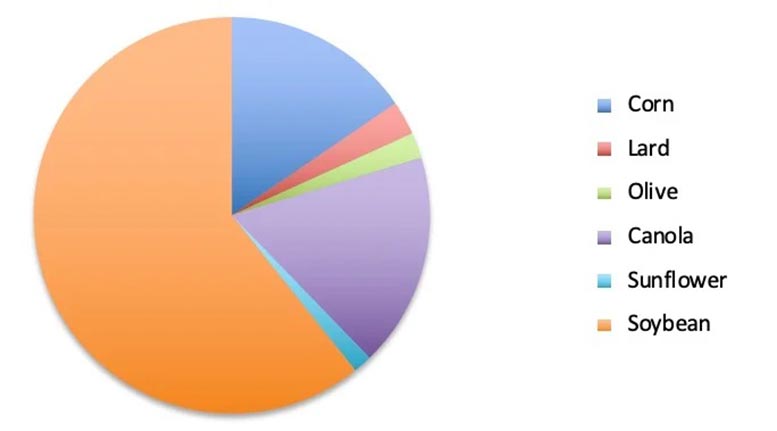
Chart
depicts consumption of edible oils in the U.S. for 2017/18. Credit: USDA
Olive Oil Did Not Show the Same Effect
According to Deol and Sladek, olive oil may be a better
choice because it contains much less linoleic acid than soybean oil. Olive oil
is also a key part of the Mediterranean diet, which has been linked to many
health benefits.
“Olive oil, the basis of the Mediterranean diet, is
considered to be very healthy; it produces less obesity and we have now found
that, unlike soybean oil, it does not increase the susceptibility of mice to
colitis,” Sladek said.
The researchers also pointed to avocado oil and coconut oil
as other cooking options. They cautioned that corn oil contains a similar
amount of linoleic acid as soybean oil.
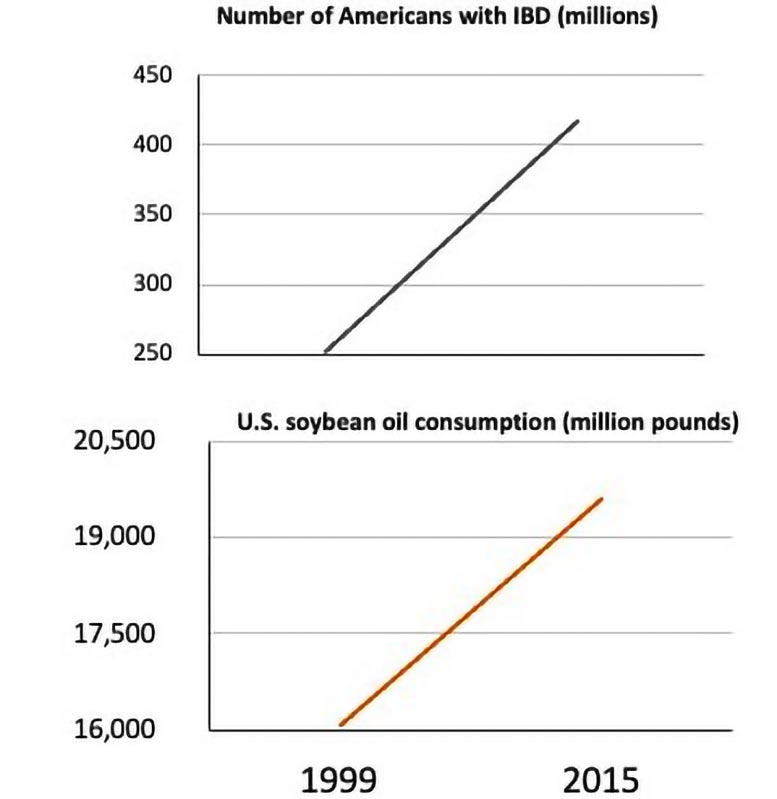
The
increase in IBD parallels the increase in soybean oil consumption in the U.S.
Credit: Sladek lab, UC Riverside. Data from Dahlhamer et al, 2016; USDA
Follow-Up Research
A related study in Scientific Reports looked
at how different high-fat diets affected gene activity throughout the mouse
intestine.
The researchers compared diets based on coconut oil,
conventional soybean oil, and a modified soybean oil lower in linoleic acid and
higher in oleic acid, making it more similar to olive oil.
The conventional soybean oil diet caused more disruption in
genes tied to metabolism, immune function, gut barrier health, inflammation,
and microbiome interactions, supporting the idea that excess linoleic acid may
be an important factor.
A different study published in the Journal of Lipid
Research looked at soybean oil and obesity. It focused on oxylipins,
compounds the body makes when it processes fats such as linoleic acid. The
study suggested that soybean oil’s effects may depend partly on what the body
turns linoleic acid into after digestion. Mice that were protected from soybean
oil-linked obesity had lower levels of certain oxylipins, gained less weight,
and were less likely to develop glucose intolerance or fatty liver.
The Practical Takeaway
Soybean oil is common because it is cheap, neutral-tasting,
and useful in large-scale food production. That also makes it easy to consume
in large amounts without noticing.
“Try to stay away from processed foods,” Sladek advised.
“When you buy oil, make sure you read the nutrition facts label. Air fryers are
a good option because they use very little oil.”
References:
“Diet high in linoleic acid dysregulates the intestinal
endocannabinoid system and increases susceptibility to colitis in Mice” by
Poonamjot Deol, Paul Ruegger, Geoffrey D. Logan, Ali Shawki, Jiang Li, Jonathan
D. Mitchell, Jacqueline Yu, Varadh Piamthai, Sarah H. Radi, Sana Hasnain, Kamil
Borkowski, John W. Newman, Declan F. McCole, Meera G. Nair, Ansel Hsiao, James
Borneman and Frances M. Sladek, 3 July 2023, Gut Microbes.
DOI:
10.1080/19490976.2023.2229945
“Impact of various high fat diets on gene expression and the
microbiome across the mouse intestines” by Jose Martinez-Lomeli, Poonamjot
Deol, Jonathan R. Deans, Tao Jiang, Paul Ruegger, James Borneman and Frances M.
Sladek, 27 December 2023, Scientific Reports.
DOI:
10.1038/s41598-023-49555-7
“P2-HNF4α alters linoleic acid metabolism and mitigates
soybean oil-induced obesity: role for oxylipins” by Poonamjot Deol, Johannes
Fahrmann, Dmitry Grapov, Jun Yang, Jane R. Evans, Oliver Fiehn, Brett Phinney,
Bruce D. Hammock and Frances M. Sladek, 28 October 2025, Journal of
Lipid Research.
DOI:
10.1016/j.jlr.2025.100932

