Hegseth lied: Trump's Iran War costs almost triple

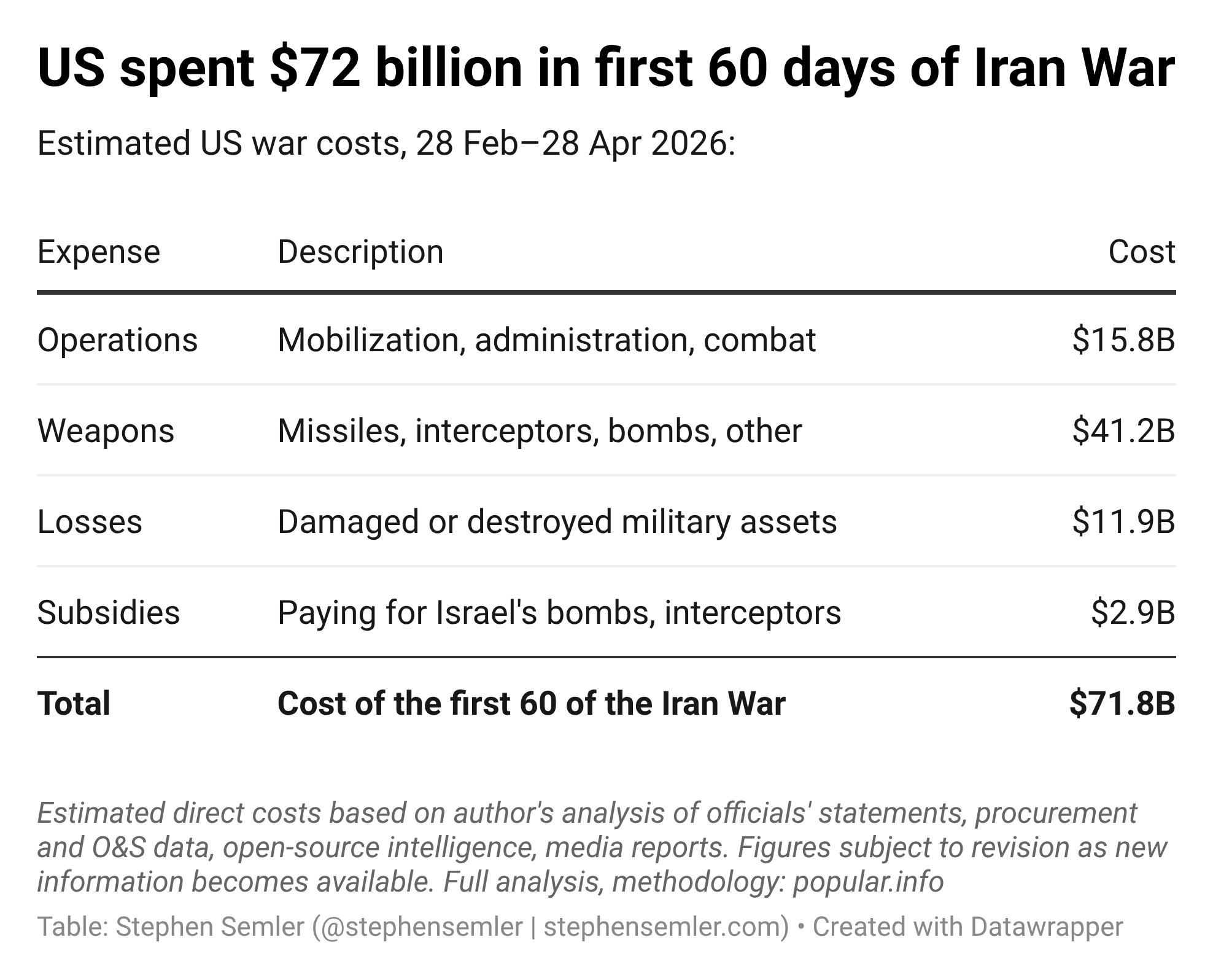
Popular Information conducted a cost estimate of the Iran
War based on officials’ statements, military procurement and operations data,
and reporting on deployments and armament use. Through 60 days, the US spent an
estimated $71.8 billion on the Iran War, or $1.2 billion per day on average.
This includes the cost of operations, munitions, combat losses, and arming
co-belligerents. Like the estimates from Pentagon leadership and unnamed
officials, this figure refers only to direct war costs — near-term expenses for
military operations, munitions, and the like — and not indirect costs, which
include broader economic impacts, interest on the national debt and longer-term
expenses like veterans’ care.
Why this figure is higher than the Pentagon’s internal estimate
Why is Popular Information’s estimate so much largest than
even the Pentagon’s internal figure? Factors include incomplete accounting of
damaged or destroyed military assets, the exclusion of costs outside the
department (including billions of dollars in State Department-funded military
aid to Israel), and a flawed method for tracking munition expenditures. The
last is likely the biggest factor.
The Pentagon tracks munition “burn rate” costs by merging
operational logistics (what munitions are fired, and in what quantities) with
financial values (how much each one costs). The issue lies in how the Pentagon
determines unit cost. The war costs that show up on the Pentagon’s ledger — and
that media outlets report — are much lower than the costs the US public will
ultimately be forced to pay.
For example, the largest categorical munition cost is for
interceptors, which are missiles designed to shoot down other missiles. The
cost to fire one SM-2 interceptor
is $1.2 million. If 50 are withdrawn from the stockpile and fired, the
Pentagon’s ledger would show $60 million in expenses from consuming those
munitions. The $50 billion cost estimate unnamed officials gave lawmakers
likely reflects this accounting method, as it’s the department’s standard.
This accounting can lead to undercounts when a rapidly consumed munition
like the SM-2 isn’t planned to be purchased in the future. The Pentagon no
longer buys SM-2s; the interceptor is being replaced by the more advanced and
expensive SM-6. So each time an SM-2 is fired in the ongoing war, the
Pentagon’s accounting system registers a cost closer to the SM-2’s $1.2
million unit cost from 2010 than the $6.3
million unit cost budgeted in 2027 for the SM-6 that will replace it.
For US taxpayers, the cost of firing 50 SM-2s isn’t $60 million; it’s $315
million.
There are many more examples of expended munitions (or
destroyed equipment) that are budgeted to be replaced by much more expensive
variants.
Foreseen consequences
The $25 billion war cost given by Pentagon Secretary Hegseth
and acting Comptroller Hurst before Congress was a lie. It was a denial of the
Iran War’s spiraling costs, one of several foreseen consequences of the Trump
administration’s decision to go to war. The closing of the Strait of Hormuz is
another predictable consequence. As nonproliferation expert Joe Cirincione
told Popular
Information last June:
There’s a whole list of things [Iran] could do, including
closing the Straits of Hormuz. By closing the Straits of Hormuz, you cut off
one-fifth of the world’s oil supply overnight. That will send stock markets
crashing. That could tip the world into a global recession, even a depression.
This is why no previous president has attacked Iran. There’s
a reason for it. It’s not because they weren’t courageous enough. It wasn’t
because they didn’t have the capabilities. It’s because they understood that
the enemy gets a vote. You could have stunning initial tactical success, and
you could still end up in a quagmire with global consequences that will sink
you.
Now, in May 2026, the US is in the quagmire phase of its war
with Iran. The Trump administration’s plan, based on its 2027 budget request with
its record $1.5
trillion in military spending, is to throw money at the problem. It
will be up to Congress and its power of the purse to decide whether to enable
Trump’s doubling down on another endless war.
A detailed methodology for the $72 billion estimate is
available HERE.

