Charlestown is NOT suing, at least for now
Over the last three years or so, under the leadership of
former Speaker of the House K. Joseph Shekarchi, the Rhode
Island General Assembly passed legislation designed to make it easier
for developers to build housing. 
Charlestown Town Council gave its OK to converting
this derelict motel on Route 1 into affordable housing.
The ONLY dissenting vote was Charlestown Citizens Alliance
(CCA) rep Bonnita Van Slyke
Given the massive shortage of available housing, rapidly escalating rents that harm low- and middle-income families, and a more than 400% increase in homelessness across the state, these measures, though not sufficient, are a necessary stab at mitigating Rhode Island’s housing apocalypse.
The legislation, among other things, reformed the
comprehensive permitting process to better enable affordable housing
development and streamlined zoning and land-use regulations. These aren’t
exactly the sexiest bills; we’re talking about things like density bonuses for
building near transit, adding homes in commercial lots, or infilling
non-conforming lots (think weird-shaped lots that require some creative
designs).
The goal of these reforms is to reduce costs and accelerate
the construction of new homes. Given that Rhode Island has long been last in
the nation for building homes (on a per capita basis, not because of our size),
and it is estimated that the state needs to build between 15,000 and 24,000 new
units to get the situation under control, it is right to ask if the state is
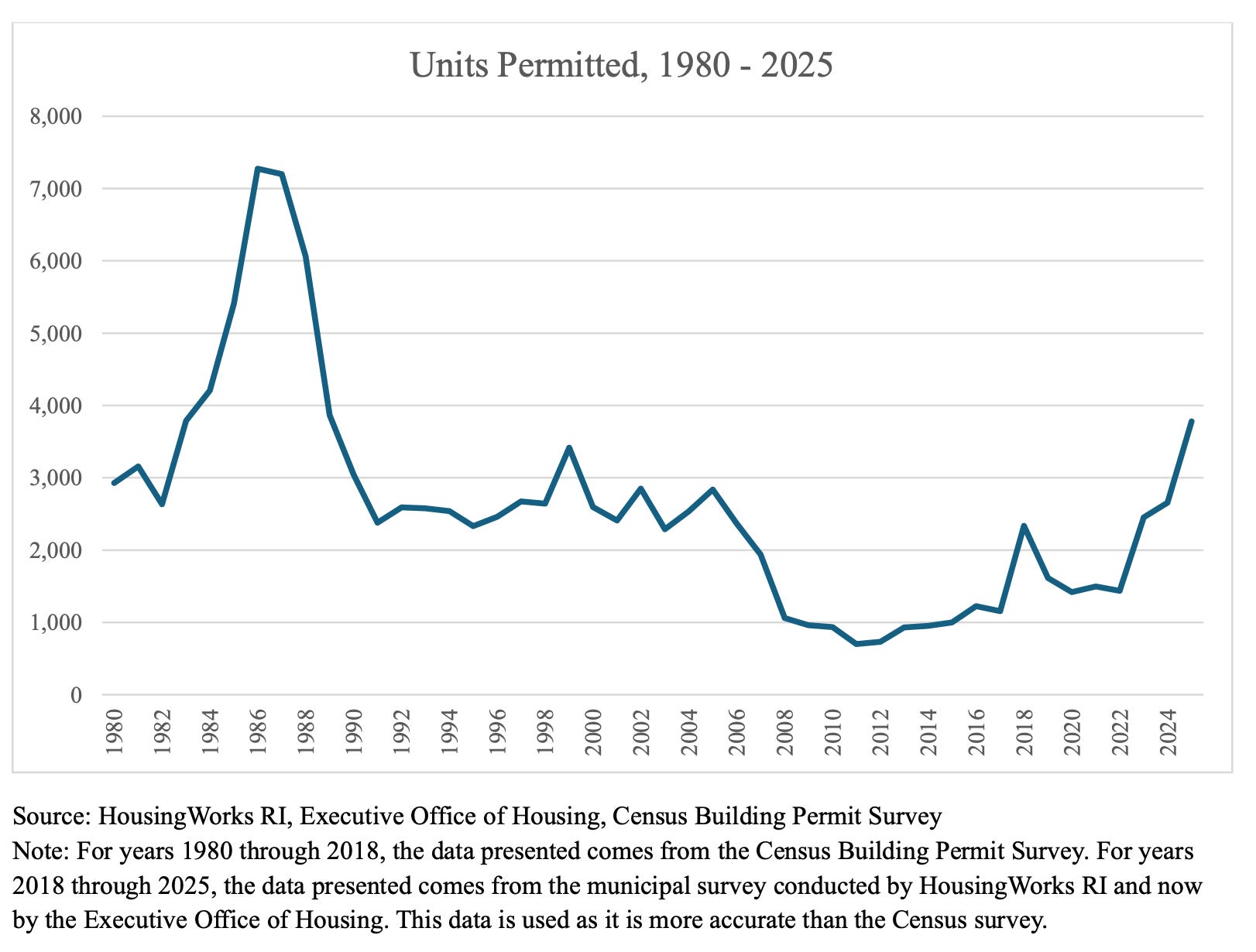
doing enough. That said, permitting for new housing is trending up, as shown in
the 2025
Integrated Housing Report from the Rhode Island Executive
Office of Housing, but at our current rate of development, we are over a
decade from seeing the housing market stabilize.
As Rhode Island families suffer, you’d think that local
municipalities would be all in on these reforms, but of course, that’s not the
case. Instead, around 14 municipalities, including Portsmouth, Tiverton,
Hopkinton, Burrillville, Bristol, Smithfield, West Greenwich, East Greenwich,
Lincoln, Middletown, Charlestown, and Westerly, have signed onto a Joint
Municipal Statement1 opposing the state’s efforts. The
statement appears to be the brainchild of Larry Fitzmorris,
President of the conservative Portsmouth Concerned Citizens,
and Mark Brady, former Narragansett Planning Board Chair.
EDITOR'S NOTE: When I saw that Steve listed Charlestown among the towns planning to sue, I asked Charlestown Council President if this was true. It's not. This is what Deb said:
"My concern is the one size fits all approach to solve the housing problem. Charlestown relies on private wells and septic systems which makes our situation different from those cities and town with public water and sewer. Charlestown did not vote to join the lawsuit at this time. Based on the information presented at the May Town Council meeting, it does not seem as though this lawsuit has a likely chance of success. The Town Council will revisit the matter once new information is available."
- Will Collette
According to Fitzmorris, in a May 2026 op-ed printed
by EastBayRI.com,
“...almost half of the towns in our state, the councils — on a bipartisan basis
— have voted to enter Superior Court to obtain a temporary injunction on the
housing laws passed in the recent Assembly sessions.”
What Fitzmorris is objecting to here is “preemption,” state
law enacted to block a local ordinance from taking effect or to dismantle an
existing ordinance. Usually, conservatives favor preemption. In 2014,
conservative Rhode Island Democrats passed a law preventing cities and towns
from raising the minimum wage. In 2017, when the state passed a law requiring
paid leave for some workers (low-wage workers were exempted), language was
included to prevent a municipality like Providence from expanding the law to
cover more workers. [See: Rhode Island is the only New
England state relying on anti-labor, ALEC-inspired preemption clauses]
When the General Assembly pre-empted efforts to expand the
minimum wage and paid leave, municipal governments largely remained silent. (Providence
City Council President Luis Aponte being an
exception.) Legislation passed to increase the affordability and availability
of housing, on the other hand, draws legal action.
The lawsuit is being done, writes Fitzmorris2, “to both evaluate the actual impact [of the
state’s legislation] on the infrastructure of their towns and its cost. They
also intend to ask the court to rule on the constitutionality of the 35 or so
laws passed, and specifically how Article
XIII, the home rule section of the Rhode Island Constitution, applies
to that legislation.”
Through their state legislators, 13 bills [H7123, H7124, H7125, H7292, H7294, H7295, H7297, H7372, H7492, H8034, H8041, H8279,
and H8281]
have been introduced at the state level seeking relief from zoning laws,
specifically amendments that were made to the Low
and Moderate Income Housing Act to enable more affordable housing
development. These bills, according to testimony presented to the House
Committee on Municipal Government & Housing, “propose changes… that
will undermine the progress that has been made and leave many Rhode Island
households without any affordable housing options.”
According to a recent
poll,
- 80% of
voters agree there are not enough affordable homes for ordinary people to
buy or rent.
- 79%
reported that housing costs have had a negative impact on their lives or
on those of their family, friends, and neighbors.
- 88%
agree that the state legislature should take action to address the housing
shortage and housing costs.
- 70%
support creating more housing options in their neighborhood, even if their
neighborhood would look different.
Fitzmorris, for his part, is framing
this as a property rights issue, ironic since in many cases, the laws
passed by the General Assembly allow property owners to more fully exercise
their property rights, such as turning a garage into an accessory
dwelling unit (ADU), or building homes on irregular lots, both
of which might have previously required onerous local permitting.
Where this battle goes next depends on the courts, of
course, and on the new Speaker of the House, Christopher Blazejewski.
Will Speaker Blazejewski center housing as prominently as his predecessor?
Highlighting his work on housing affordability is a good sign. In the official
House press release announcing his election as Speaker, it was noted, “As a
representative, Speaker Blazejewski has championed housing
affordability, environmental protection, public education, civil rights,
senior services, health care, and economic opportunity for working families.”
SteveAhlquist.news is a reader-supported publication. To
receive new posts and support my work, consider becoming a free or paid
subscriber.

