Menu Bar

Home           Calendar           Topics          Just Charlestown          About Us
Showing posts with label polling. Show all posts

Wednesday, August 5, 2026

Do personal green lifestyle choices distract from commitment to address bigger issues?

Scientists put the “recycling is a distraction” claim to the test

University of New South Wales

Recycling, greener diets, and other personal climate choices do not seem to distract people from supporting major environmental reforms. A four-year study of nearly 2,800 Australians found that these habits neither increased nor reduced later political engagement. 

Behavioral scientists from UNSW Sydney and Griffith University have found no evidence that personal climate-friendly choices reduce people's interest in broader action on climate change.

The research, published on July 23, followed nearly 2,800 Australians over four years as part of the National Climate Action Survey. Participants who recycled, used reusable cups and containers, took public transportation, ate greener diets, or cycled to work were no less likely to support wider climate policies and collective action.

The findings challenge a common argument that governments and businesses promote small lifestyle changes to shift attention away from more difficult reforms, such as transforming energy systems and regulating industry.

"Individual climate actions neither facilitate nor undermine broader climate engagement," says lead author Dr. Omid Ghasemi from the UNSW Institute for Climate Risk & Response.

"We found no evidence for the idea that personal action might reduce collective action or policy support because people feel they've done enough, overestimate the impact of individual actions, or feel less worried about climate change," he says.

Rather than changing people's political behavior, everyday environmental choices may mainly reflect values they already hold. The researchers found that these actions were neither a trigger nor a barrier to greater public engagement.

Monday, August 3, 2026

Trump posts more crazy stuff on his social media site

At some point, even MAGA Republicans should admit enough is enough


Trump was such a pain in the ass that his parents sent him to military school where he developed a reputation as a bully. He avoided by draft by claiming bone spurs that somehow never impeded his golf game:


But, in Trump's mind, none of America's problems actually exist, as his also non-existent poll numbers show.

Friday, July 31, 2026

Voters Are Realizing that Trump Doesn’t Care About Them

He has his own priorities

Mark Schauer for Common Dreams

This month, the bipartisan 21st Century ROAD to Housing Act became law—without Donald Trump’s signature, exactly as he’d threatened. It’s a small, recent example of a much bigger habit: Trump keeps showing voters exactly how little he thinks of them. 

The bill wasn’t controversial at all. It was negotiated by both parties’ top committee members and aimed squarely at lowering housing costs. 

But Trump let it sit for weeks rather than sign it, hoping to extract an unrelated voter-suppression bill in return.

At this point, childish behavior from the president shouldn’t be surprising.

In his first inaugural address, Trump claimed to be the champion of America’s “forgotten men and women.” But it was a lie from the start. He never cared about the poor and marginalized. 

He cared about cutting taxes for his friends; scapegoating immigrants for the struggles of the working class; and restoring a mythical era of American “greatness” characterized by the supremacy of straight, white, Christian males.

Although his lie was obvious, it was also effective. In 2016, Trump won around one-eighth of voters who’d supported Sen. Bernie Sanders (I-Vt.) in the Democratic primaries. In 2024, he significantly increased his share of the Black and Hispanic vote. 

Sunday, July 26, 2026

MAGA declaring war on seniors — and it could be their downfall

Is Trump testing to see how much he can take away from seniors before they rebel?

Alex Henderson

According to data from the Roper Center at Cornell University, 50 percent of U.S. seniors — those who are 65 or older — voted for Donald Trump in 2024 compared to 49 percent for Democratic presidential nominee Kamala Harris

The senior vote was close in 2024, and seniors, Roper says, played an important role in getting Trump past the finish line. But according to Salon's Heather Digby Parton, seniors could be the ones who doom Republicans in the 2026 midterms.

Parton notes that because so many seniors vote GOP, "it's always been a mystery" to her "why Republicans have always been so bent on destroying the safety net that brought the elderly out of poverty and assured them a baseline level of subsistence and medical care." And she points that crucial safety-net programs used by seniors — Social Security and Medicare — came from liberal Democratic presidents.

"From the moment Franklin D. Roosevelt signed the Social Security Act in 1935 to the day Lyndon B. Johnson signed the Medicare and Medicaid Act 30 years later," Parton explains, "the right has been trying to destroy them. In the early days, it sprang from their obsession with anti-communism, arguments that the country couldn't afford it, and that individuals and their families are rightfully responsible for their own care in old age.

“In a 1961 radio address — 20 years before he became president — Ronald Reagan said, 'One of the traditional methods of imposing statism or socialism on a people has been by way of medicine' ... Before Medicare was created, only 54 percent of elderly people had health insurance, and that could be cancelled without cause when they got sick — which, as you know, tends to happen when you get old."

Parton continues, "Three years after it was enacted, 96 percent of people over 65 had hospital insurance. It was literally a life saver. Over the years, Medicaid, created at the same time to assist people living below the poverty line, came to cover many of the health expenses that Medicare didn't for elderly people, most importantly for nursing homes and caregivers. The GOP has been hacking away at these vital programs ever since, and yet, senior citizens have been voting for them in greater numbers than any other age cohort."

Monday, July 20, 2026

Trump's renewed Greenland threats are why we have no allies

And our former friends won't trust us again anytime soon.

Noah Berlatsky

An image Trump posted on Truth Social depicts
America taking over Canada, Greenland, Cuba,
and Venezuela. (TS screencap)
Depending on when you read this, Trump may be bombing Iran, claiming a peace deal is imminent, threatening to commit more war crimes against the civilian population, teasing a ground invasion, or some combination thereof.

Nothing, though, has really changed.

Nearly five months out from Trump’s unprovoked and disastrous attack, the bottom line is that he’s lost the war but still can’t bring himself to admit it. So we’re trapped in a seemingly endless cycle of vacillating between belligerence and fake peace deals while gas prices spike, bombs fall, and people die.

Off to the side of that debacle, Trump last week reiterated that he wants to seize Greenland in his sweaty short-fingered appendages.

Greenland, he blustered, “should be controlled by the United States, not Denmark.” He added, “that’s what hurt my relationship with NATO, because Greenland doesn’t help Denmark”— which is both nonsensical and a lie, inasmuch as Trump’s been attacking NATO for at least a decade.

Trump’s gaseous blather about invading Greenland seems like a minor monstrosity compared to his actual murderous bombing of, and ongoing humiliation by, Iran. But they’re part of the same phenomenon — a foreign policy driven by ego, ignorance, and inflamed colonial malice, in which the US sees no allies and really no other sentient human beings, just territory to be won and glorious carnage to commit.

The renewed threats against Greenland are serious because they signal once again how untrustworthy, erratic, selfish, and cruel US foreign policy has become. Neither allies, rivals, nor enemies can trust us. Which means everyone, definitely including us, is poorer, less secure, and less safe.

Hapless McKee catches a small break

McKee’s lucky day at ballot placement lottery

By Nolan Page, Rhode Island Current

Gov. Dan McKee won the top spot on the Sept. 9 Democratic primary ballot in a lottery conducted at the Rhode Island Department of State’s Elections Division in Providence Friday, a welcome stroke of luck for a reelection campaign that has weathered some setbacks.

The first place on the ballot is usually reserved for the party-endorsed candidate. But ballot placement was at the mercy of a retired Rhode Island Lottery ball machine now owned by the Department of State. That’s because the state’s Democratic Party declined to endorse either McKee or his main rival, Helena Bounanno Foulkes, at its convention on June 20.

McKee became the first sitting governor in recent history to not win his party’s endorsement. He also missed out on an influential endorsement from the Rhode Island AFL-CIO, which declined to back a Democratic governor candidate on Wednesday. 

Party endorsements reward candidates with the top ballot spot and an asterisk next to their name. While McKee will go without that asterisk, research suggests being the first name on a ballot advantages a candidate, said Matt Ulricksen, an associate professor of political science at the Community College of Rhode Island. 

That advantage is greatest in races where voters know less about the candidates and default to whichever name is at the top, Ulricksen said. While McKee could get a “modest bump” from coming first, Ulricksen said it won’t matter as much in the Democratic governor race, where most voters are familiar with the candidates.

“Any bump that McKee gets from first placement on the ballot likely will not be sufficient to overcome the gap,” Ulricksen said.

Thursday, July 16, 2026

Public opinion on abortion has shifted 4 years after Dobbs decision overturned Roe v. Wade

We're more polarized than ever

Laurel Elder, Hartwick College; Mary-Kate Lizotte, Augusta University, and Steven Greene, North Carolina State University

It’s been four years since the Supreme Court’s decision in Dobbs v. Jackson Women’s Health Organization overturned Roe v. Wade, ending the federal constitutional right to abortion.

In the immediate aftermath of the decision, national attention centered on implementation of state bans and a rapidly shifting legal landscape.

But four years later, one of the most impactful developments has been less visible: a significant, sustained and politically consequential shift in public opinion. In the wake of Dobbs, the debate over abortion rights did not simply return to the states. It fundamentally altered how many Americans think about the issue and how they vote.

Friday, June 26, 2026

Americans' ability to afford health care falls to 5-year low

Losing ground

By West Health Institute

Edited by Sadie Harley, reviewed by Robert Egan

Share of U.S. adults who are "Cost Secure"
dips below half. Credit: West Health-Gallup
Center on Healthcare in America

New research released from the West Health-Gallup Center on Healthcare in America finds that fewer than half of Americans (49%) are considered "Cost Secure," meaning they can consistently afford health care and prescription medications when and where they need them, the lowest level recorded since West Health and Gallup launched its Healthcare Affordability Index in 2021.

In the past year alone, 2.8 million Americans dropped out of the Cost Secure category, unable to keep up with rising health care costs. The new data largely extend last year's downward trends, with continued declines in affordability evident among traditionally vulnerable populations, including Black and Hispanic adults and lower-income households.

"The fact that fewer than half of Americans can reliably afford health care should alarm every person, policymaker and health care leader in the country," said Tim Lash, president of the West Health Policy Center.

"Millions of Americans are being priced out of health care because costs are rising faster than their ability to pay. Without meaningful reforms that better address health care delivery, high prescription drug prices and rising insurance premiums, Americans will continue to struggle and affordability will only continue to deteriorate."

Health care spending is on the rise in the U.S., reaching $5.3 trillion in 2024, a 7.2% increase from the prior year and growing more than twice the rate of overall inflation (2.9%). Hospital prices climbed 3.4% in 2024, the fastest increase since 2007, while prescription drug spending rose 7.9%.

Thursday, June 11, 2026

New Pell Center national survey finds Americans with the strongest authoritarian attitudes are the most likely to support violations of democratic norms

By the numbers, Republicans like fascism more than Dems

Salve Regina University’s Pell Center

Americans with the strongest authoritarian attitudes are more likely to support political actions that violate democratic norms, according to a new survey from Salve Regina University’s Pell Center. 

While support for democratic norm violations is generally low across the population, high authoritarians—a characteristic identified through a series of questions designed to surface those sentiments—are more likely to support government actions like ignoring court decisions, censoring media sources, and changing election rules to disadvantage the political opposition.

Download the full report here.

The survey was directed by Pell Center Associate Director and Fellow Katie Sonder and fielded by Embold Research between May 4-12, 2026. 

It gathered responses from 2,034 likely voters in the United States, with a modeled margin of error of 2.2 percent. It examined how Americans perceive the health of U.S. democracy, democratic norm violations, and partisan identity, as well as the relationship between authoritarian attitudes and those views.

While support for democratic norm violations remains relatively low, substantial differences exist across partisan and ideological groups. Most Americans do not support election interference, but high authoritarians are more likely than any other demographic subgroup (gender, race, age, etc.) to support changing election rules to make victory harder for the opposition.

Additionally, higher levels of authoritarianism were strongly associated with conservative political identification. 

Of those scoring highest on the authoritarian scale, 80% were Republican or Republican-leaning. Of those scoring lowest on the scale three-quarters were Democrat or Democrat-leaning.  

Finally, Americans remain deeply divided on the basic state of American democracy 

itself. While 95% of Democrats say the United States is facing a constitutional crisis, a majority of Republicans believe the country has a strong system of checks and balances and a thriving economy.

Sunday, June 7, 2026

Fourteen Rhode Island municipalities are planning to sue the state over laws designed to make it easier to build housing

Charlestown is NOT suing, at least for now

Steve Ahlquist

Charlestown Town Council gave its OK to converting
this derelict motel on Route 1 into affordable housing.
The ONLY dissenting vote was Charlestown Citizens Alliance
(CCA) rep Bonnita Van Slyke
Over the last three years or so, under the leadership of former Speaker of the House K. Joseph Shekarchi, the Rhode Island General Assembly passed legislation designed to make it easier for developers to build housing. 

Given the massive shortage of available housing, rapidly escalating rents that harm low- and middle-income families, and a more than 400% increase in homelessness across the state, these measures, though not sufficient, are a necessary stab at mitigating Rhode Island’s housing apocalypse.

The legislation, among other things, reformed the comprehensive permitting process to better enable affordable housing development and streamlined zoning and land-use regulations. These aren’t exactly the sexiest bills; we’re talking about things like density bonuses for building near transit, adding homes in commercial lots, or infilling non-conforming lots (think weird-shaped lots that require some creative designs).

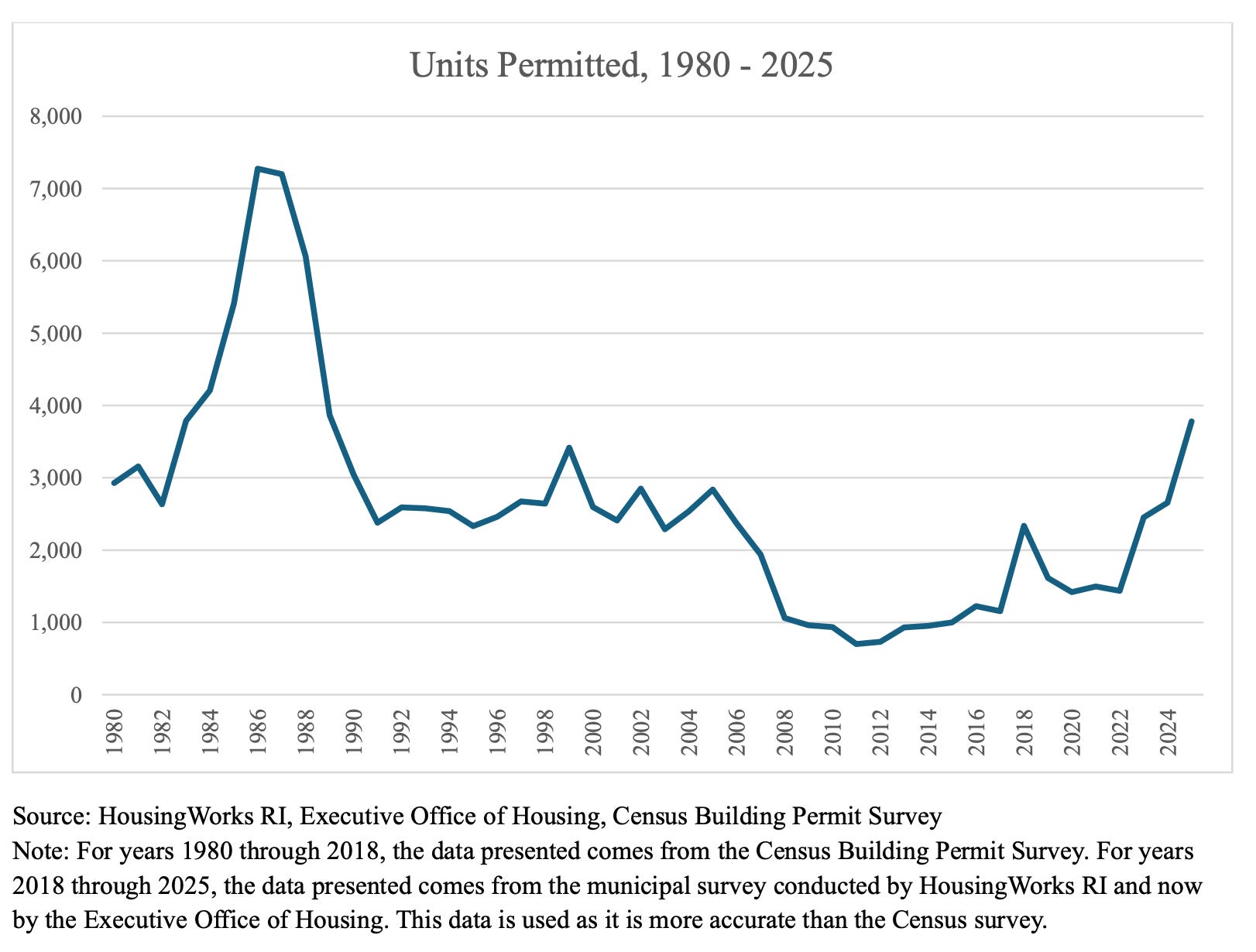
The goal of these reforms is to reduce costs and accelerate the construction of new homes. Given that Rhode Island has long been last in the nation for building homes (on a per capita basis, not because of our size), and it is estimated that the state needs to build between 15,000 and 24,000 new units to get the situation under control, it is right to ask if the state is doing enough. That said, permitting for new housing is trending up, as shown in the 2025 Integrated Housing Report from the Rhode Island Executive Office of Housing, but at our current rate of development, we are over a decade from seeing the housing market stabilize.

As Rhode Island families suffer, you’d think that local municipalities would be all in on these reforms, but of course, that’s not the case. Instead, around 14 municipalities, including Portsmouth, Tiverton, Hopkinton, Burrillville, Bristol, Smithfield, West Greenwich, East Greenwich, Lincoln, Middletown, Charlestown, and Westerly, have signed onto a Joint Municipal Statement1 opposing the state’s efforts. The statement appears to be the brainchild of Larry Fitzmorris, President of the conservative Portsmouth Concerned Citizens, and Mark Brady, former Narragansett Planning Board Chair.

EDITOR'S NOTE: When I saw that Steve listed Charlestown among the towns planning to sue, I asked Charlestown Council President if this was true. It's not. This is what Deb said:

"My concern is the one size fits all approach to solve the housing problem.  Charlestown relies on private wells and septic systems which makes our situation different from those cities and town with public water and sewer.  Charlestown did not vote to join the lawsuit at this time. Based on the information presented at the May Town Council meeting,  it does not seem as though this lawsuit has a likely chance of success.  The Town Council will revisit the matter once new information is available."

- Will Collette

Tuesday, June 2, 2026

Trump Aide Claims Americans ‘Spending More Money on Everything’ Shows They’re ‘Optimistic’ About Economy

Multiple consumer surveys have shown that Americans have never been more pessimistic

Brad Reed for Common Dreams

For the second time in a month, National Economic Council Director Kevin Hassett on Tuesday claimed that Americans spending more money on gasoline and other goods is a sign of strength for the US economy—rather than evidence of the Trump administration’s inflationary policy decisions.

During an interview with Fox Business, Hassett tried to counter recent data showing US consumer sentiment hitting all-time lows during Donald Trump’s second term.

“The thing that I’ve seen when I look at credit card data,” Hassett said, “is that while people have been spending more money at gas stations, they’ve been spending more money on everything else, which means that they’re still very, very optimistic about the state of the economy, and they should be.”

In fact, multiple consumer surveys have shown that Americans have never been more pessimistic about the state of the economy.

Last week, the University of Michigan’s latest Surveys of Consumers showed consumer sentiment hitting the lowest level ever, driven primarily by concerns about the cost of living.

Gallup last week published new data showing that Americans’ economic confidence has fallen to its lowest level since October 2022, with just 16% of Americans rating the economy as excellent or good, and nearly half describing it as poor.

Monday, May 18, 2026

Earth-Destroying Trump and the Threat of World War III

The nightmare that is Donald Trump

Tom Engelhardt in the TomDispatch

Unlike every other column of mine, this one won’t be broken up with section titles for a simple reason. It’s all about Donald J. Trump and when it comes to him, in this strange world of ours, no one ever really gets a break.

In that context, here’s my advice to you: Don’t get old. For years, I managed not to do so, but unfortunately that’s all over now and I’m increasingly an old man. In fact, I’m not quite two years older than Donald J. Trump. 

I was born on July 20, 1944, while World War II was still ongoing, and he was born on June 14, 1946, in the peacetime that followed but would all too soon become the Cold War with the Soviet Union.

And let me tell you something else: these days it’s hard enough to keep the website I still run, TomDispatch, in some kind of reasonable shape, while also keeping track of our ever-stranger, more confusing, all-too-Trumpian world. 

But keeping track of things nationally and globally as an 80-year-old president of the United States (with another two-and-a-half years to go) in a world that seems to be coming apart at the — whoops, sorry, I can’t help it! — seams? I simply can’t imagine that. Of course, I couldn’t imagine it for Joe Biden either, and yet he left the presidency when he was a staggering 82 years and 61 days old and will still have been younger than Trump if he truly makes it to January 20, 2029. (And both of them will have beaten the oldest Roman Emperor, Gordian I, who at 81 only lasted a few weeks in power.)

It’s hardly news that Donald Trump is now the oldest president ever to take the oath of office (twice!) and, in that sense, he’s been both record-setting and, in his own strange way, remarkable. 

But in case you hadn’t noticed, while he’s always had his odd moments, they are indeed getting ever odder and more frequent. After all, how many times has this country had a president who mistook himself for (or do I mean confused himself with) Jesus Christ? Oh, wait, how could be so confused? That image wasn’t of Jesus but (as “our” president insisted) of a lookalike medical doctor. (“I thought it was me as a doctor,” Trump said. “Only the fake news could come up with that.”)

And meanwhile, of course, in his own ever stranger fashion, “our” president took out after Leo, the American pope, himself a veritable youth at 70 years old, calling him of all things, “WEAK on crime” and, of course, “catering to the Radical Left.” Oh, and while he was at it, Trump also posted an image of himself being hugged by (yes, of course!) Jesus. And Leo responded to the president’s abuse by all too accurately deploring a world being “ravaged by a handful of tyrants” (including, of course, You Know Exactly Whom).

Just in case you hadn’t noticed, as an imperial power (even, historically speaking, the imperial power, the only one at its height to control quite so much of the planet in one fashion or another), this country, too, is growing ever older and (again) in its own strange fashion going down (as, of course, all great imperial powers do sooner or later). Phew! That was a long sentence for this old guy, but you can’t get too long and complicated (or do I mean confused?) when it comes to the world of Donald J. Trump. In electing him a second time in 2024, 49.8% of American voters clearly opted to go down in style by giving imperial oldness a startling new meaning.

Wednesday, May 13, 2026

Who do you think would win in a physical fight between you and Donald Trump?

A pollster asked Americans that question after Trump asked an 8-year-old if he could take him in a fight.

Terri Rupar, Editorial Director

This story was originally reported by Terri Rupar of The 19th. Meet Terri and read more of their reporting on gender, politics and policy.

Who do you think would win in a physical fight between you and Donald Trump?

The question, asked by YouGov, was sparked by a Tuesday event in the Oval Office, when the president revived the Presidential Physical Fitness Award. “Are you a strong person?” Trump, 79, asked a child in attendance. “You think you could take me in a fight?”

Overall, 55 percent of Americans said they could take Trump in a fight; 19 percent said Trump would win. 

Tuesday, May 12, 2026

Medical experts declare Trump is too unstable to remain in office

Can't be trusted with unchecked authority to launch nuclear weapons

Bandy X. Lee

The following press release has just been issued:

Washington, DC—On April 30, 2026, a group of 36 leading physicians and other doctors with expertise in mental health issued a statement calling for President Donald J. Trump’s immediate, lawful removal from office for medical reasons. His mental instability, coupled with his sole, unchecked authority to launch nuclear weapons, makes him a clear and present danger to the safety of all Americans, they declared. 

The U.S. Senate offices of Sheldon Whitehouse (D-RI) and Jack Reed (D-RI) entered their statement into the Congressional Record, Vol. 172, No. 76.

While they did not offer diagnoses, the experts were informed by voluminous evidence from the historical record of the president’s bizarre and impulsive behavior, rambling digressions, factual confusions, unexplained sudden changes of course in strategic matters, both national and international, and his deeply impaired judgment. 

Since we circulated our concerns among medical colleagues, Mr. Trump has exhibited more signs of grandiosity, e.g., posting images of himself on social media shaking hands with God, acting like Jesus, and dressing as a Pope. And he has continued nocturnal bingeing on social media posts that are filled with accusations of multiple conspiracies against him, as often as 150 times a night. 

Most worrisome are his outbursts of extreme, seemingly uncontrollable rage, such as his threat to destroy Iran, saying, “A whole civilization will die tonight, never to be brought back again.”

Current nuclear policy permits a president, and the president alone, to choose the time and target of a nuclear launch, without his orders being subject to review. The U.S. has a policy that permits a first use of nuclear weapons. These policies, combined with an emotionally unstable leader is a formula for unspeakable tragedy waiting to happen. For this reason above all others, the group of medical experts urged that lawful steps be taken to remove the president from office.

Wednesday, April 22, 2026

Trump's polling is terrible and getting worse

Looking behind Trump's cratering polls

Tom Schaller

The irony is profound: Donald Trump, a man who craves adulation and perhaps deification, is the least-liked American president ever.

Trump’s approval ratings have reached historic lows. He’s polling lower than he did at the same point in his first term, and he suffers net-negative approval ratings in all but nine states. Americans overwhelmingly reject him, his policies, and his job performance as president. 

In fact, if the third of Americans who comprise his bedrock base of red-hatted MAGAs are held aside, the rest of the nation is now nearly unified in deeming Trump’s second term a failure, if not a disaster.

No matter the pollster or topic, no matter how questions are phrased nor the subgroup of Americans tracked, Trump and his policies are disfavored, even despised. His numbers were bad before he started his reckless Iran war and they have fallen further since. And most recent approval ratings came before Trump began circulating images that likened him to Jesus. (More on that at the end.)

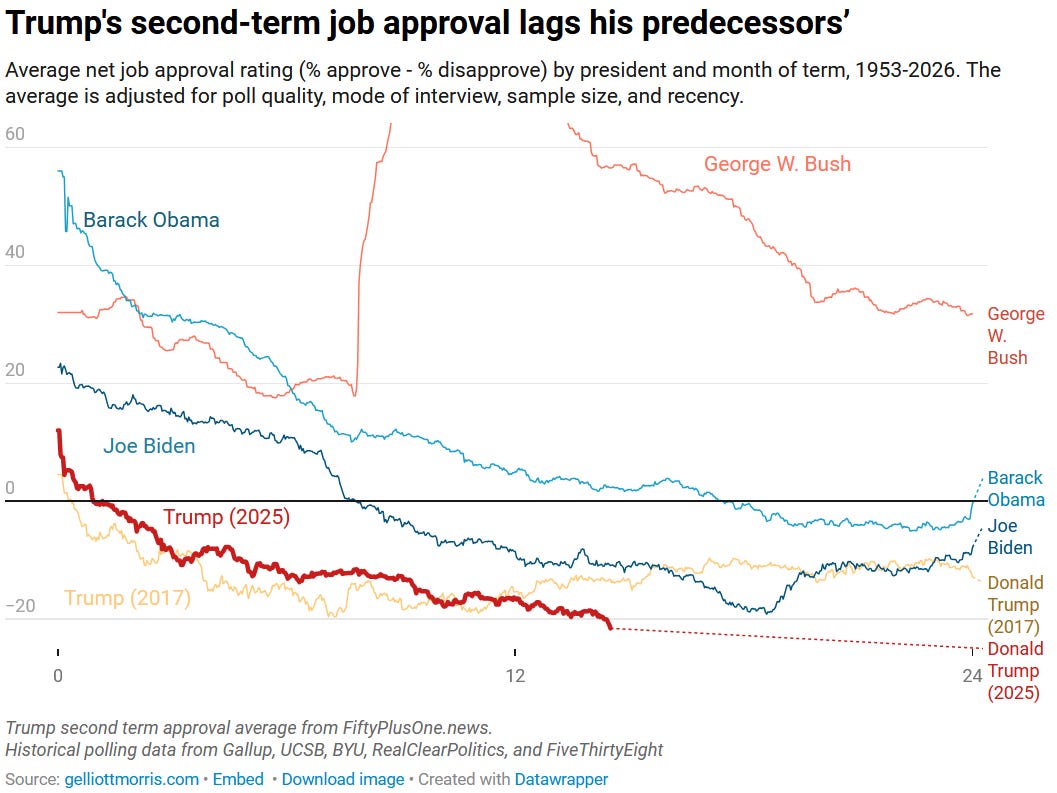
Per pollster G. Elliott Morris, comparing Trump to other recent presidents 15 months into their terms confirms how badly the public rates him. At -21.6 net negative approval, Trump lags behind Joe Biden (-10.8), Barack Obama (+2.3), and a post-9/11 George W. Bush (+57.0) at comparable points of their terms. In fact, Trump already lags more than 8 points behind the 15-month mark of his own first term (-13.3).

Graph showing how Trump's second term job approval lags behind his predecessors

Even if his current term is treated as a second term — when presidents tend to experience declining approval — the comparisons are still grim.

At the end of the first year of their second terms, only the Watergate-addled Nixon had a lower net approval number, -29.6, than the -16.2 net disapproval Trump had at the end of his fifth combined year in office. And that low rating came three months ago, before the ICE/CBP shootings in Minneapolis and the Iran war eroded Trump’s support by another five points and counting.

Wednesday, April 1, 2026

Bobby Jr. has become a political threat to Republicans

Republicans Fret Over RFK Jr.’s Anti-Vaccine Policies While MAHA Moms Stew

Health and Human Services Secretary Robert F. Kennedy Jr. is fielding pressure from the White House to relax his controversial approach to vaccine policies as the midterms near, but his most steadfast supporters are pressing for more aggressive action — like restricting covid-19 vaccines and pesticide use — to carry out the Make America Healthy Again agenda.

The tensions risk fraying Kennedy’s dynamic MAHA coalition, potentially driving away critical supporters who helped fuel President Donald Trump’s 2024 election win.

The movement’s grassroots membership includes suburbanites, women, and independents who are generally newer entrants to the GOP and laser-focused on achieving certain results around the nation’s food supply and vaccines.

Promoting healthy foods tops their list and will be at the center of the White House’s pitch to voters during the midterm election cycle.

“President Trump’s mass appeal partly lies in his willingness to question our country’s broken status quo,” White House spokesperson Kush Desai said in a statement. “That includes food standards and nutrition guidelines that have helped fuel America’s chronic disease epidemic. Overhauling our food supply and nutrition standards to deliver on the MAHA agenda remains a key priority for both the President and his administration.”

At the same time, with most Americans opposing efforts to undermine vaccines, the White House has cooled on Kennedy’s aggressive policies to curb vaccines and MAHA’s interest in tamping down environmental chemicals that are linked to disease.

The result: Republicans are realizing just how demanding the MAHA vote can be. Moms Across America leader Zen Honeycutt warned that Republicans are facing their biggest setback yet with the MAHA movement, after Trump signed an executive order to support production of glyphosate, a herbicide the World Health Organization has linked to cancer.

“It has caused the biggest uproar in MAHA,” Honeycutt said during a CNN interview in late February.

Saturday, March 28, 2026

Why do Americans hate each other while Canadians love each other?

Could it have something to do with our politics? With the sociopath in the Oval?

Robert Reich

survey released on March 5 by the Pew Research Center finds that 53 percent of American adults describe the morality and ethics of our fellow citizens as “bad” (ranging from “somewhat bad” to “very bad”).

This puts Americans way out front of other nations on the we-hate-our-compatriots scale. In the 24 other countries polled by Pew, most people called their fellow citizens somewhat good or very good.

At the opposite end of the spectrum from the United States is Canada, where 92 percent say their fellow Canadians are good, while just 7 percent say they’re bad.

Why are we so down on our fellow citizens? It may have something to do with our politics.

Some 30 years ago, my dear friend the late Republican Senator Alan Simpson told me Democrats viewed Republicans as stupid and Republicans viewed Democrats as evil. “I’d rather be in the stupid party,” he chuckled.

I asked him why Republicans saw Democrats as evil.

He took a deep breath. “Religion.”

I said I didn’t understand.

“It’s the Christian right,” he said, as if talking to a five-year-old. “Since Reagan, my party has been a magnet for religious conservatives and Christian fundamentalists, where it’s all about good and evil. Too bad, pal. You’re on the evil side.”

That was 30 years ago. Since then, the divide has only sharpened.

In 2012, Mitt Romney told supporters that “47 percent” of Americans would vote for Obama no matter what because they’re “dependent upon government ... believe that they are victims ... believe the government has a responsibility to care for them ... [and] pay no income tax.”

Insulting 47 percent of Americans was no way to win an election. It was also no way to unite the country.

Then in 2016, Hillary Clinton described half of Trump’s supporters as a “basket of deplorables.” Also no way to win or to foster mutual trust.

Once Trump took office, dislike of our fellow citizens soared.

Before he entered the White House, 47 percent of Republicans and 35 percent of Democrats said people in the opposing party were “immoral.”

By 2022, after years of Trump’s venom: 72 percent of Republicans and 63 percent of Democrats called people in the opposing party “immoral.”

Since he’s been back in the Oval, it’s gotten even worse. 

Thursday, March 26, 2026

People trust the pediatricians more than Bobby Jr.'s CDC on vaccines

Trust in federal government drops when it comes to childhood vaccines, poll suggests

Stephanie Soucheray, MA

A new Axios/Ipsos American Health Index poll shows Americans are losing confidence in the federal government to make recommendations about childhood vaccines. 

From June 2025 to March 2026, public trust in federal childhood vaccine recommendations dropped 11 points, from 71% to 60%, with only 8% of those polled saying they trust the Centers for Disease Control and Prevention (CDC) more than the American Academy of Pediatrics (AAP). 

The poll was conducted in early March, before a federal judge in Boston temporarily blocked changes to the childhood vaccine schedule. 

One in three respondents (35%) have more confidence in guidelines from the AAP than in those from the CDC. About one-quarter (23%) express equal confidence in both sources, while 16% are not confident in either source.

Sunday, March 15, 2026

Americans increasingly trust career scientists, not leaders, at CDC, NIH, and FDA

Most Americans don't trust Bobby Jr. or Dr. Oz

Stephanie Soucheray, MA

A new Annenberg poll conducted in the first half of February shows Americans are placing their trust in career scientists and professional medical organizations over the heads of federal health agencies such as the Centers for Disease Control and Prevention (CDC), National Institutes of Health (NIH), and Food and Drug Administration (FDA). 

Two-thirds of respondents (67%) said they were confident in career scientists at the CDC, NIH, and FDA. But just 43% of Americans are confident in the agency leaders. 

The poll shows a significant lack of confidence in Health and Human Services Secretary Robert F. Kennedy Jr. Less than four in 10 adults polled (38%) said they are confident Kennedy is providing trustworthy information on public health.  Only 42% said they trust information from Mehmet Oz, MD, administrator of the Centers for Medicare and Medicaid Services.

Those percentages are lower than the 54% who said they had confidence in Anthony Fauci, MD, the former head of the National Institute of Allergy and Infectious Diseases, when he was in office.