Menu Bar

Home           Calendar           Topics          Just Charlestown          About Us
Showing posts with label tariffs. Show all posts

Tuesday, October 20, 2026

“At this point, Trump’s economic policy is starting to look less like governing and more like Publishers Clearing House with a campaign logo.”

Trump promises yet another check, this time a $90 Medicare check

Stephen Prager for Common Dreams

With the midterm elections just weeks away, Donald Trump announced that more than 20 million Medicare Part B beneficiaries will receive a one-time $90 payment this month.

Trump, who declared on Truth Social that his administration would send out “checks,” said the money will come from the $2 billion Medicare Improvement Fund and is expected to appear in seniors’ bank accounts around October 8.

The $90 payment is not even enough to cover half of the standard monthly Medicare Part B premium payment, which is about $202. But Trump described the comparatively small payment as proof that Americans could trust his promise of a much heftier windfall if Republicans prevail in next month’s elections.

“Because I delivered on this very important issue for the American people, they can also rest assured the highly popular $5,000 Trump Dividend will be distributed to every U.S. Citizen if, and when, the Republicans win the Midterm Elections!” Trump said.

Americans have reason to be skeptical that they will ever see such a payout. Although roughly 1 million unsubsidized Affordable Care Act enrollees are currently receiving $500 payments, Trump has on several other occasions floated or promised Americans larger sums of free money that never materialized.

In February 2025, he proposed $5,000 “DOGE dividend” checks for Americans, purportedly funded by savings generated by Elon Musk’s Department of Government Efficiency, but the payments were never authorized by the GOP-controlled Congress.

That November, he promised that most Americans would receive tariff payments of “at least $2,000 a person,” but Congress has still not authorized them nearly a year later.

Saturday, October 3, 2026

The real reason Americans are paying more under Trump Republicans

The Rot at the Top

Robert Reich

Democratic candidates should be talking about ONLY two things in these last five weeks before the midterms, and show how they’re connected: higher prices and Trump-Republican corruption.

Consider:

1. The Trump-Republican war on Iran has been a huge windfall for Big Tech supplying the military — such as Palantir, a core artificial intelligence and data-integration partner for the U.S. Department of Defense, founded by Trump and JD Vance buddy Peter Thiel. But it’s costing Americans dearly.

At the same time, investment companies backed by Donald Trump Jr. and Eric Trump have accumulated at least $3.2 billion to $6.3 billion in direct Pentagon contracts, current funding, and future contract options since January 2025.

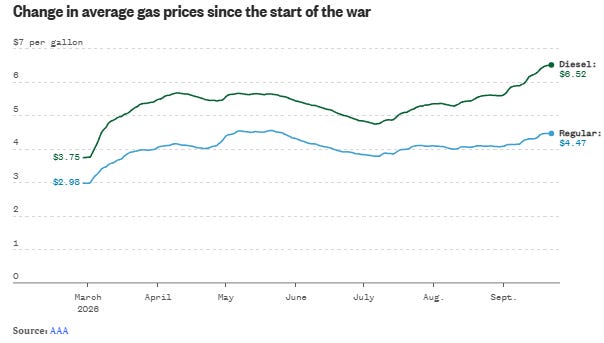
But Trump’s Iran war is causing Americans to spend some $1.50 a gallon more on gas (gas was $2.98 per gallon before the war; it’s now $4.42 to $4.47 per gallon). Since the war began, Americans have spent $65 billion more on gas.

The price of diesel fuel has soared to an average of $7.00 a gallon — and because trucks that transport everything to retail stores now pay so much more to get it there, this price increase is also being passed on to consumers.

2. Trump has given out tariff waivers and carve-outs to industries and companies making kickbacks to him, while the tariffs have jacked up prices overall.

For example, when polyethylene terephthalate, the thermoplastic used to make plastic bottles, got a tariff exemption, it was a win for Reyes Holdings, a Coca-Cola bottler that ranks among the largest privately held companies in the U.S. and is owned by a pair of brothers who have donated millions of dollars to Republican causes.

Just after Tim Cook, Apple’s CEO, dumped $1 million into Trump’s inauguration, Apple got tariff exemptions for its products.

After Elon Musk sank a quarter of a billion dollars into Trump’s 2024 campaign, Tesla got a tariff exemption for electronics.

And so on.

But the worldwide tariffs that made these corrupt exemptions possible have increased annual household costs by an estimated $1,100, according to The Budget Lab at Yale.

Thursday, September 24, 2026

Former Canadian Prime Minister Justin Trudeau shares insights into Trump policies with Brown University audience

Says Trump’s ‘win-lose’ approach is hurting U.S.-Canada relations

By Christopher Shea, Rhode Island Current

The last time former Canadian Prime Minister Justin Trudeau was in Rhode Island, he spoke to a gathering of U.S. governors to advocate for free trade amid tensions between the two North American neighbors.

Nearly a decade later, Trudeau returned to Providence where he said the relationship has moved beyond ordinary trade disputes to what he described as a threat to Canada’s sovereignty under the Trump administration

“Canadians are feeling rightly, deeply destabilized by this,” Trudeau told a crowd of more than 2,000 people inside Brown University’s Pizzitola Sports Center Tuesday. “And it seems to have no logical point.”

The former Canadian prime minister’s remarks came as part of Brown’s 106th Stephen A. Ogden Jr. ’60 Memorial Lecture on International Affairs. Much of the hour-long discussion with University President Christina Paxson focused on differences between the two countries’ healthcare systems, the value of diversity and the increasingly strained relationship between the U.S. and its northern neighbor.

Trudeau, 54, served more than nine years as Canada’s 23rd prime minister after leading the Liberal Party to a historic majority government in 2015. Amid declining support and poor polling, he announced in January 2025 that he would resign as prime minister once a successor was chosen. He was succeeded by fellow Liberal Mark Carney that March.

His time in office was marked by the COVID-19 pandemic and the global economic disruptions it caused, along with a domestic agenda that included a gender-balanced cabinet, a national $10-a-day childcare program, efforts toward reconciliation with Indigenous peoples and climate policies aimed at encouraging clean energy investment.

Tuesday, September 22, 2026

Desperate to appear strong, Trump shows pathetic weakness

Surprisingly, providing more evidence that he is crazy doesn't help Trump to regain public support

Paul Waldman

Remember “Sharpiegate,” a relatively inconsequential but uncommonly stupid episode from Trump’s first term?

The Sharpie is back.

In the surrealist performance hall that is the Oval Office, Trump grabbed his pen, took out a map of the Great Lakes, crossed out “Lake Ontario” and wrote in “Lake America,” part of a pointless new trade war he has started with Canada.

“Lake Ontario, that’s gone. Lake America,” he said. “So now we have a lake and now we have a Gulf because we have the Gulf of America and now we have Lake America.”

Stirring words.

Like so much of what Trump does, this was meant to be a show of strength. Yet it actually demonstrated just the opposite: Trump is weak and getting weaker.

He can instruct the federal government to change its maps, as he did with an executive order late last week, and will even find that many people will submit to his desires.

As of this writing, Google Maps has changed Lake Ontario to Lake America for those searching in the US, while Apple Maps has yet to do so — though since Apple Maps did change the Gulf of Mexico to the Gulf of America on Trump’s instruction, it may fall in line soon. (MapQuest loudly refused to make the change, in what may be a bid to inform people that it still exists.)

But if there are any voters in America who are impressed by Trump’s lacustrine nomenclature revisionism, they will surely be hard to find.

Instead, the “Lake America” inanity will be slotted alongside Trump’s ballroom, his quest to keep his name on the Kennedy Center, his helipad, and his Reflecting Pool faceplant. These are the things a failing, frustrated president does in a desperate bid to look strong, because he hasn’t been able to accomplish much of anything that might improve Americans’ lives.

Monday, September 21, 2026

Trumpflation is here

He broke it, he bought it.

Tom Schaller

“Bidenflation.”

Throughout the 2024 campaign, Donald Trump, his supporters, and the national punditry invoked that term to indict President Biden’s economic policies. Although Biden actually reduced covid-induced inflation in the United States from 7.2 percent in 2022 to 2.4 percent by 2024, Trump won a second presidential term by capitalizing on consumer angst about high prices.

Put me, a genius businessman, back into office and I will solve America’s inflation woes, he promised.

Trump’s problem now is all three of his major second-term policies are raising prices across a range of commodities, but especially housing, food, and gas. Reducing the immigrant labor pool, imposing tariffs on imports, and the Iran War are costing consumers billions in higher out-of-pocket costs.

Americans are finally starting to realize the great business “genius” is an economic imbecile.

Clueless

Let’s start with Trump’s signature policy: xenophobic, ICE-led attacks on immigrants.

Nobody believes the United States should have open borders and zero restrictions for immigrants seeking either full citizenship or temporary work visas. But the ineluctable fact is that immigrant workers are good for the economy because their labor lowers domestic production costs and keeps inflation down.

That fact is especially true for the construction and food industries. Almost no commercial or residential work site operates without immigrant labor, and few agriculture products are harvested, picked, shipped, processed, cooked, or served without immigrant labor.

Immigrants comprise roughly 30 percent of the construction trade workers who build America’s commercial and residential properties. The construction industry confirms that 92 percent of member firms report production delays as a result of labor shortages caused by the “chilling effect” of Trump’s brutal ICE policies. An untold number of workers not already removed from the country by the government are no-showing for work. Trump has worsened America’s housing affordability crisis.

As for groceries — a term Trump, who has probably never food-shopped in his life, infamously marveled at — almost every calorie of food Americans consume that is not harvested from private gardens is cooked at home from fresh or processed foods purchased at markets, or are restaurant meals prepared from similar food sources.

Friday, September 4, 2026

Where is Trump's tariff-free beef coming from?

Cattle farmers are latest Trump allies to get shafted

By kos

The agricultural sector has been struggling ever since it helped Donald Trump win a second term.

His tariffs have constrained key overseas markets, with China shifting major soybean and other commodity purchases toward countries like Argentina and Brazil. 

Immigration raids have created labor shortages and driven up the cost of harvesting crops, some of which have been left rotting in the fields.

But there was one corner of agriculture that was thriving: cattle farmers.

A shortage of cattle combined with strong domestic demand meant high prices. Cattle producers also argue that near-monopoly conditions in the processing industry have pushed prices even higher. Since the 1990s, Tyson Foods, Cargill, JBS, and National Beef have controlled upward of 80% of purchases of cattle, squeezing cattle farmers on one end while consumers pay more on the other.

Still, despite challenges like the New World screwworm outbreak, likely boosted by the so-called Department of Government Efficiency, cattle farmers were riding high, their faith in Trump apparently rewarded.

That is, until Friday, when Trump announced that he would temporarily allow a massive influx of tariff-free foreign beef into the United States, explicitly intended to undercut domestic beef prices by 25%.

“Today, I concluded a deal to substantially lower the price of ground beef for working American families,” Trump posted on Truth Social. “[F]or the next 90 days, the United States will allow up to 300,000 metric tons of product for ground beef to be imported with no out of quota tariff. We have a commitment that this beef will be sold at 25 percent below current market prices.”

Weirdly, Trump is refusing to say which countries will supply all this mystery meat—an omission that becomes particularly notable amid concerns about the spread of New World screwworm.

On its face, Trump’s announcement is an extraordinary admission that even he knows his economic policies aren’t working.

First, he’s temporarily lifting tariffs to lower consumer prices. That’s a pretty remarkable concession from a president who has spent years insisting that foreign countries pay his tariffs rather than American importers and, ultimately, American consumers.

Trump’s ‘forever’ tariffs are kicking in for the long haul – and US consumers are footing the bill

Trump uses tariffs to wield personal power

Kent Jones, Babson College

Donald Trump’s tariff announcements no longer cause the market gyrations that they did in 2025. But their sticker shock for American consumers is becoming increasingly clear – just as economic sentiment is souring ahead of the November 2026 midterm elections.

Many business groups had hoped that the tariff wars would end in February, when the Supreme Court overturned Trump’s emergency tariffs. They got a rude awakening five months later, however, when Trump announced a raft of new import taxes to replace the levies that were struck down.

Covering nearly all U.S. imports, the advantage of these tariffs in the Trump administration’s view is that they’re more firmly based on existing U.S. trade law, beyond the reach of the Supreme Court’s review. And Trump has said he envisions enacting many more of these so-called trade law tariffs.

As a trade economist who has been following the tariff wars, I believe that the longer these import taxes are in place, the more the consumers will bear their burden. The 2025 “Liberation Day” tariffs that the Supreme Court struck down, as well as other levies Trump announced after the February ruling, turned out to be temporary. But the bulk of the new levies are designed to be permanent.

That means that for consumers, the total cost burden is likely to increase even if the tariff rates don’t change – because the new tariffs will be stacked on older ones.

The cost squeeze

On one level, Trump’s tariff fixation is a mystery. Tariffs continue to be unpopular, and it’s unclear why Trump would double down on them before midterm elections when his approval ratings, including on the economy, are so low.

But on another level, Trump’s embrace of tariffs can be understood as an instrument of personal power. He has long viewed them as tools for negotiating leverage, and he recently declared that U.S. tariffs “aren’t high enough.” The president also has deflected criticism of their impact on consumer prices by claiming erroneously that foreigners pay for them.

Friday, August 28, 2026

Thursday, August 27, 2026

Why are we at war with Canada?

Trump shitposts fail to win support for Canadian trade war

Liz Dye

Yes, Trump actually posted this.

The Premier of Ontario has an answer
Donald Trump spent the past week cozying up to North Korea and attacking Canada. Whatever claim the US had to be a beacon of free trade — not to mention moral leadership — has been demolished like the East Wing of the White House.

And so it was probably inevitable the president would dig the prototypical failed economic policy of the 20th century out of history’s dumpster and operationalize it against our closest ally.

Smoot-Hawley tariffs are back, baby! Sure, aggressive levies cutting off trade as a means of stimulating domestic industry never worked for those people. In fact, it effectively crashed the global economy and turned a recession into the Great Depression. But it may work for us!

It will not work for us. But it may make us so roundly despised that it galvanizes other countries to reimagine the world order so as to cut out the one, heretofore indispensable nation.

USMCA? Never heard of it!

Upon returning to office, Trump immediately took a Sharpie to “the most modern, up-to-date, and balanced trade agreement in the history of our country, with the most advanced protections for workers ever developed” — also known as
 the USMCA, which he himself negotiated in 2018 as a replacement for NAFTA

"We don't need anything that Canada has, we don't need anything that Mexico has, but they need everything that we have,” he blustered in June. “We don't need their cars, we don't need their lumber, we don't need their energy, we don't need anything that they have."

This is self-evidently ridiculous.

Canada supplies roughly 80% of the potash American farmers use as fertilizer. Midwest refineries are built to run on heavy Canadian sour crude, and the pipeline infrastructure simply doesn't exist to swap in lighter, American-produced oil from places like Texas. 

Canadian hydropower fuels a significant share of the electricity supply in New York and New England. And the auto and auto parts trade between the two countries, already strained by Trump's steel and aluminum tariffs, is about as integrated as two countries' economies get.

And yet Trump negotiated as if Canadians could never say no, even as he demanded crippling concessions and lobbed humiliating insults at our stalwart ally. Trade talks were at an impasse after 18 months of threats and taunts about annexing our northern neighbor. But in July the prospect of an additional 50 percent levy on a sprawling list of Canadian goods forced Canadians back to the negotiating table. And last week, with the major principles agreed, Trump congratulated both sides for striking “a very fair deal.”

"Our farmers are going to be thrilled; our manufacturers are going to be thrilled," he gushed. "And basically, we have no tariffs going into Canada anymore."

Instead talks collapsed Friday night, when Prime Minister Mark Carney announced he was suspending negotiations and recalling Canada’s negotiators to Ottawa.

By Saturday morning, the Trump administration had levied tariffs on roughly $20 billion worth of Canadian goods — hockey sticks, building materials, beer, cheese. Carney promises dollar-for-dollar retaliation, hitting US steel, dairy, appliances, agricultural equipment, pulp, paper, and electronics starting September 8.

Art of no deal

The New York Times and Washington Post confirm that the deal fell apart because the Trump administration attempted to extract a fresh round of concessions at the last minute.

After domestic companies aggressively lobbied Commerce Secretary Howard Lutnick, the US backpedaled on reductions in steel and aluminum tariffs. Plus Lutnick insisted on excluding Ontario-built heavy trucks (the Ford F-350, F-450, and GM Silverado) in hopes of forcing carmakers to relocate production to the US.

And if you’ve got a problem, that crank Peter Navarro can make it worse.

“Navarro and Lutnick were both yelling at Greer saying: ‘What are you doing? This is stupid. You know, we’re not giving these things away,’” a source told the Post.

Trade Representative Jamieson Greer said the Canadians would never go for it, and he was right.

America’s last-minute demands included: dropping French language labeling and content requirements, an absolute non-starter for the country’s restive Québécois population; getting rid of “buy Canadian” government initiatives while leaving similar “buy American” measures in place; and restoring US-produced liquor to Canadian shelves. That last decision lies with each province, and Ontario Premier Doug Ford told Carney he wouldn’t go along with it.

Lots of “bluster” from Doug Ford, who is the Premier of the Canadian Province of Ontario, but who is better known as the less charismatic, intelligent, and overall unimpressive brother of the late, great, Rob Ford. America has been carrying Canada for decades, but no longer! The U.S.A. will always be far bigger, richer, and stronger than Canada. Without the United States, Canada couldn’t survive — It’s where they get all of their money and, because of their current bad leadership, primarily Governor Carney, and his Flunky, Ford, they will not be allowed to keep taking advantage of the United States — Their key to survival. Remember, much of the Electricity, Oil, and Gas that Canada gets is transported through the U.S.A. Someone should get these clowns to “fall in line” or, the consequences for Canada will be far WORSE! Canada’s Unemployment Rate is now at 10%, and rapidly rising. Their businesses are fleeing for the United States, and it’s all because of their failed policies, and inept leadership! The days of ripping off our Farmers, and other Businesses, are OVER! Thank you for your attention to this matter. President DONALD J. TRUMPTrump responded with a grotesque post comparing Ford to his dead brother, calling Carney “Governor,” and lying about Canada’s unemployment rate. (In reality, Canada has a higher labor force participation rate than the US.) 

The president is currently shitposting about changing the name of Lake Ontario, “in that we don’t expect to be doing much business with Ontario any longer.”

But what actually killed the deal was a demand that Canada subordinate its independent trade policy to the ever-changing whims of the United States — specifically, that Ottawa agree in advance to match tariffs imposed by Washington, even when it would override Canada’s existing trade agreements.

Per the New York Times:

The United States wanted Canada to apply US tariffs to other countries, particularly when it came to steel, now and in the future: If the United States changed policy and place higher tariffs on certain goods from a third country, Canada would need to do the same, even if it already had a trade agreement in place, a Canadian official said.

American negotiators characterize this as a measure to prevent Canada becoming a passthrough conduit for goods excluded by US tariffs. But no sovereign country could voluntarily surrender its trade policy, much less yoke itself to an erratic neighbor whose maniac leader imposes a new tariff scheme every week.

“Last spring, I warned that America is trying to break us so that they can own us. And I promised: ‘That will never, ever happen,’” Carney said Saturday. “We are keeping that promise. Canada is becoming stronger and less dependent on America. We are already giving ourselves more than they can take away.”

This echoes a major speech Carney gave in January at the World Economic Forum in Davos, in which he exhorted middle powers to band together rather than rely on the United States to ensure their national and financial security.

“You cannot live within the lie of mutual benefit through integration, when integration becomes the source of your subordination,” he warned, adding that “hegemons cannot continually monetize their relationships. Allies will diversify to hedge against uncertainty.”

And Canada is putting its money where its mouth is. Only two nations imposed retaliatory tariffs in response to Trump’s two prior rounds of levies: Canada and China. In fact, that response is now being cited as justification for the latest tariffs.

As America reverts to naked suzerainty, Canada hopes to lead the international resistance movement — yet another reason the Trump administration was so insistent on blocking the country’s power to enter into its own international trade deals.

But a funny thing happens when a world leader actually puts in the effort to explain his policy choices. Carney’s approval rating is at 60 percent, and polls show that 76 percent of Canadians support his decision to walk away from trade talks with the US.

The fallout from these tariffs will absolutely hit Canadians harder than Americans, with potential job losses in the tens of thousands. But Canadians are gearing up for the fight, and a movement to boycott US-made goods is picking up steam. In contrast, Americans feel no patriotic support for Trump’s capricious levies. And as Politico points out, swing state voters really don’t like these tariffs. That may have an impact in November, with the midterms serving as a referendum on Trump’s handling of the economy.

Naturally Susan Collins is concerned. And with Trump’s tariffs about to increase costs for farmers, builders, and autoworkers, she’s got a reason to be — as do her fellow Republicans in Minnesota, Michigan, Wisconsin, Ohio, and Iowa. Because Canada’s leaders have done the work to ensure that their citizens are prepared to absorb the pain from this trade war.

Carney spent the past nine months making the case that Canada must fight back against the United States to ensure its survival. Trump spent that time posting AI slop and pretending that the US has nothing to lose. One of these men has a 30 percent approval rating 70 days before an election.

Looks like it’s time for Tariff Man to test his theories … again.

Thanks for reading Public Notice. This post is public so feel free to share it.

 🇨🇦 Subscribe to PN 🇺🇸

Sunday, August 23, 2026

Trump’s 50% Tariffs Take Hold After US-Canada Trade Talks Collapse

We’re back to war with Canada, our oldest and closest ally, jacking up tariff taxes on US consumers

Jon Queally for Common Dreams

While courting North Korea and Russia, Trump
destroys ties with our historic allies and
says this make US stronger and safer.
“It’s war.”

That’s how one Canadian journalist described developments between the governments of the US and Canada after trade talks between the two were suspended on Friday night without a deal in place to avoid the imposition of 50% tariffs threatened by Donald Trump on a wide swath of Canadian goods.

Both nations accused the other of scuttling the deal, with Canadian Prime Minister Mark Carney citing “last-minute changes” by the Trump administration and US Trade Representative Jamieson Greer pointing to “new demands and walk backs” by the Canadians.

Asked earlier on Friday if a deal was within reach, Trump responded, “I think so, yeah, we’ll see.” But by late Friday night, it was clear the talks had collapsed entirely as Carney summoned Canada’s representatives back to Ottawa.

In his statement on Friday night, Carney said, “We have recognized from the beginning that America has changed, and that we will not return to our old relationship. Our government understood, before many, that America is altering all its trade relationships. Putting tariffs on its closest allies and charging for access to its vast market.”

Here are Trump's demands on Canada: 

"French language rules in Quebec?" WTF!

Tuesday, August 4, 2026

Trump Unveils Sweeping New Tariffs Expected to Cost Americans $100 Billion a Year

Trump uses bogus claims to continue to impose a national sales tax on Americans

Jake Johnson

On July 23, Donald Trump  unveiled a new package of tariffs targeting 60 countries that account for over 99% of US imports, a move that—if upheld in court—would cost Americans an estimated $100 billion per year in the form of higher costs.

The duties, ranging from 10% to 12.5%, were announced as part of Trump's effort to maneuver around repeated court rulings against his sweeping tariffs, including by the conservative-dominated US Supreme Court. Jamieson Greer, the Trump administration’s top trade official, pointed to Section 301 of the Trade Act of 1974 to justify the new tariffs, introduced with the purported goal of penalizing countries “for their failure to impose and effectively enforce a prohibition on the importation of goods produced with forced labor.”

Observers questioned the administration’s pretext. “Magically, the US tariff probe on forced labor practices is done perfectly in time to replace the generalized but expiring Section 122 tariffs,” noted Bloomberg’s Josh Wingrove, referring to the legal authority Trump cited for earlier tariffs.

Rep. Mike Levin (D-Calif.) acknowledged that “Section 301 is a law Congress passed,” but added, “What was passed in 1974 was authority to respond to specific unfair trade practices after investigation.”

“What is being done with it now is a tariff on 99% of American trade, set by Trump, with no expiration, no vote, and no ceiling,” said Levin. “If a delegation that broad is lawful, then the tariff power in Article I means very little. The Supreme Court struck down the last version of this policy in February. The response was to avoid Congress and find a different statute and rebuild substantially the same tariffs, effective the same minute the old ones lapsed.”

The list of countries targeted by the Section 301 tariffs includes Canada, Australia, Brazil, China, Mexico, Russia, Norway, the United Kingdom, and Vietnam.

Between the start of his second administration and January 2026, Trump’s tariffs cost American families $1,700 each on average as importers passed burdens onto consumers in the form of higher prices. The tariffs have also hammered small businesses, increased hardship for farmers, and failed to arrest the decline of American manufacturing jobs.

Saturday, August 1, 2026

You’re not imagining it: Your kid’s school supplies cost more this year

From lunchboxes to No. 2 pencils, the prices are skyrocketing. Here's how much.

Chabeli Carrazana, Economy and Child Care Reporter

This story was originally reported by Chabeli Carrazana of The 19th. Meet Chabeli and read more of their reporting on gender, politics and policy.

Pencils are more expensive. So are notebooks, scissors, glue sticks — just about every back-to-school item that families will load into their literal or virtual carts this summer has gone up in price at a time when American families already feel crushed by rising costs.

According to one analysis of the 21 most common school supply items by the Groundwork Collaborative and The Century Foundation, two progressive think tanks, prices are up about 7.7 percent with parents paying an average of $173.45 for their school supply haul. That’s an even bigger jump than last year. Add to that an 11 percent hike in prices for school lunch essentials — from the literal tons of blueberries needed to feed young children to apple juice — and costs balloon to nearly $4,000 a year to cover supplies and meals. 

That data was first shared exclusively with The 19th. The analysis is based on weekly retail transaction data on millions of products collected by NielsenIQ from about 50,000 retailers.

With school supply costs outpacing inflation, many families — and especially the women who do the majority of purchases in American households — are going to feel the sticker shock, said Lindsay Owens, the president and CEO of the Groundwork Collaborative.

“Women in this country are rip-roaring mad about the price hikes that they're absorbing. They're trying to manage household finances and budgeting. They're trying to feed their kids healthy food,” Owens said. “The work is getting harder of providing for your family.”

Here are the school supplies with the biggest spikes in price: 

  • Lunch boxes are up 27 percent
  • Notebooks, notebook paper, tissues and index cards are all up about 20 percent
  • Scissor costs rose 14 percent
  • Dry erase markers and glue sticks are up 8 percent
  • Headphones, binders, crayons, colored pencils and No. 2 pencils increased between 5 and 7 percent

On the lunch side: 

  • 12 ounces of blueberries are up a whopping 48 percent
  • A loaf of sandwich bread is up 22 percent
  • Apple juice prices have risen 20 percent
  • A pound of oranges has risen 17 percent
  • A box of packaged animal crackers will run you nearly 16 percent more 
  • A package of chocolate chip cookies is up 14 percent

Driving up some of these costs are tariffs and the war on Iran. 

Thursday, July 30, 2026

O Canada

Trump renews war on Canada because?

Robert Reich

Trump on Monday signed orders to impose a 50 percent tariff on a wide range of Canadian imports.

The White House claims the tariffs are a “punishment” for Canadian discrimination against American cars, dairy, and alcohol.

But the tariffs will also punish us. Remember, tariffs are import taxes — paid for by you and me and everyone else in America. So, we’re about to pay more for everything we import from Canada — plywood, paper, furniture, hockey sticks, cement, et al. Canada is our second-largest trading partner, for chrissake.

Even if the Supreme Court finds that Trump lacks authority to invoke these tariffs and the government must refund American importers for the extra cost — as the high court did with his first round of tariffs — you and I won’t be reimbursed for the extra costs we’ve paid.

Corporations aren’t giving their customers any of the $80 billion in refunds they’ve received from the Treasury Department for the first round of tariffs, so don’t expect any reimbursement on this second round. Which means we’re doubly screwed.

Worse yet, the Treasury isn’t really bearing the cost of the $80 billion in refunds. 

Friday, July 10, 2026

Why Is He Using the Communist Trump Card?

He's run out of other cards.

Robert Reich for Inequality.org

The cover of “Is This Tomorrow,” an anti-communist comic
book published in 1947, suggests the chaos and ruin
that would follow a communist takeover of the United
States. The publications reflected a fevered politics that
prevailed after World War II and through the 1950s.
(Image via Wikimedia Commons)
Trump has run out of cards to play in the midterm elections, which is why he’s now talking about the “communist menace.”

He can’t talk about the economy, because prices continue to rise faster than wages, which means most Americans are getting poorer. He can’t talk about foreign policy, because his war in Iran has been a debacle, his tariffs are an utter failure, and he obviously hasn’t settled the war in Ukraine on “Day 1.” He can’t talk about immigration, because his raids and mass deportations have become so unpopular.

So, facing the midterm elections, what’s left?

He’s resorting to the oldest of right-wing tropes — accusing Democrats (especially a rising generation of new, young, vigorous Democratic politicians) of being commies.

He kicked off America’s 250th anniversary celebrations on Friday with a speech at Mount Rushmore extolling American culture and warning of a resurgence of the “communist menace.” With the granite faces of four of his predecessors behind him, Trump took aim at what he called “radicals” and “extremists.”

“There is now a resurgence of the communist menace in our land, including from newcomers to our country who embrace ideas totally opposed to our way of life and our great success. You can be a communist, or you can be a patriot. You cannot be both.”

Oh, please.

For years, Trump has been trying to scare Americans about progressive Dems who advocate Medicare for All, universal childcare, free public higher education, and higher taxes on the super-wealthy to pay for them (all of which the rising young Democrats are advocating).

But he hasn’t gotten anywhere because these initiatives are supported by most Americans.

So now he’s throwing the commie label at the wall and seeing if it sticks.

Communism was the scare word used by right-wingers after World Wars I and II to crack the whip on the left. It provoked witch hunts and ruined careers.

It made former Wisconsin Senator Joe McCarthy a one-man bomb squad in the early 1950s, when he rid
iculed the “pitiful squealing” of “those egg-sucking phony liberals” who “would hold sacrosanct those Communists and queers,” and forced American citizens to “name names.”

McCarthyism was a by-product of the Republican Party’s postwar effort to eradicate the New Deal. The GOP had portrayed the midterm election of 1946 as a “battle between Republicanism and communism,” and the Republican National Committee chairman claimed that the federal bureaucracy was filled with “pink puppets.”

Southern segregationist Democrats joined in the red-baiting. Mississippi senator Theodore Bilbo, a Klansman who filibustered to block anti-lynching legislation, described multiracial labor unions’ advocacy for civil rights as the work of “northern communists.” 

Tuesday, June 9, 2026

The triple toll of Trump’s terrible tariffs

Ultimately, American workers and consumers suffer three different ways.

Tom Schaller

Following the Supreme Court’s February ruling that Donald Trump’s tariff policy violated Congress’s tax authority, the administration must now refund the $159 billion it collected from its unconstitutional tariffs.

But unfortunately for American workers and consumers, winding down this fiscal fiasco results in a lose-lose-lose situation:

  • First, most Americans will never be reimbursed for what were effectively temporary sales taxes they paid for various imports, nor will they receive the public benefit of having those sums spent on government programs or projects.
  • Second, because it is logistically easier to reimburse the American companies that directly paid the tariffs, some corporations may enjoy windfall refund profits — presuming, that is, those companies did not go bankrupt.
  • Finally, the surviving businesses and the employees who still work for them — hundreds of thousands of workers were laid off because of the tariffs — will for the foreseeable future continue to suffer because foreign countries, companies, and citizens quite rationally retaliated against Trump’s policies.

Let’s work through the three-fold ruin wrought by Trump’s catastrophic policy.

Wednesday, May 27, 2026

Corruptonomics

A memo to Democratic candidates on connecting Trump’s lousy economy to his corrupt regime.

Robert Reich

Friends,

Here’s a memo to Democrats as they begin campaigning in earnest for control of the House and Senate in the midterm elections. (Please send to any candidates you care about.)

***

TO: Democratic candidates in the 2026 midterm elections

RE: Connect Trump’s lousy economy to his corrupt regime.

The purpose of this memo is to help you shape your midterm message around the crisis of affordability and Trump Republican corruption. I urge you to present these two issues as aspects of the same underlying problem: The economy is lousy for most Americans because Trump Republicans are enabling super-rich oligarchs to siphon off most of its gains while exerting increasing control over it. Their — and Trump’s — self-dealing is undermining trust and confidence in the U.S. economic system.

1. Republicans in the House and Senate have put oligarchs in charge of America.

House and Senate Republicans have allowed Trump’s war and his tariffs to drive up prices and Trump’s corruption to undermine faith in the economy. They’ve allowed Trump to gild his White House in gold leaf, plan a giant Arc de Trump, throw lavish parties, and build a Billionaire’s Ballroom — at a time when most Americans can’t afford gas or groceries.

They raided Medicaid to pay for Trump’s giant tax cut, whose benefits are going mostly to the rich. Legislative efforts advanced by House Republicans and signed into law have targeted up to $2 trillion in federal health care cuts, forcing millions of Americans off Medicaid rolls to pay for these tax reductions.

They refused to extend Affordable Care Act subsidies. This is causing average premiums to more than double and has already pushed 1.2 million people off coverage because they can’t afford it. Coverage losses are mounting as many who initially selected a plan or who were automatically reenrolled have to drop coverage.

Big Tech oligarchs — centi-billionaires Bezos, Musk, Zuckerberg, Ellison, and other robber barons — paid for Trump’s 2024 election, his inauguration, and his ballroom and are major donors to Senate and House Republicans. They’ve shown up at Trump’s inauguration, White House dinners, and official visits to China.

In return, these oligarchs have been allowed to monopolize and drive up the prices we pay and silence Trump critics. Bezos’s Amazon, for example, won’t allow any seller on the site to post lower prices on any other site, and Bezos won’t allow his Washington Post editorial page to criticize Trump. Larry and David Ellison have bought CBS and sanitized “60 Minutes” of Trump criticism and effectively canceled Stephen Colbert. After buying X (formerly Twitter), Musk turned it into a pro-Trump voice box.

The AI oligarchs have bribed Trump and congressional Republicans to allow unfettered and unregulated growth of AI and its data centers, threatening millions of jobs and posing potential dangers to human life itself.

The crypto oligarchs have bribed Trump and congressional Republicans to allow them to create the world’s largest Ponzi scheme — which is enriching Trump and his family while providing a means for criminals to hide insider trades, child trafficking, and drug deals.

The Big Oil and aerospace oligarchs have bribed congressional Republicans to allow Trump to go to war in Iran, resulting in massive profits for Big Oil — while the rest of us pay $1.50 more per gallon of gas — and giant profits for giant military contractors.

This war spending has also contributed to higher inflation, which the rest of us pay for in higher mortgage rates and higher rates on car loans and education loans. The average 30-year fixed mortgage rate has surged to over 6.6 percent, reaching its highest level in nearly nine months, driven by rising Treasury yields, higher oil prices, and broader economic inflation concerns stemming from the war in Iran. The major beneficiaries of these higher rates — who pocket the higher payments we have to make — are the biggest banks and super-rich who make the loans.

Oligarchs have also bribed Trump and congressional Republicans to (1) get no-bid contracts, (2) deregulate Wall Street, (3) roll back environmental safeguards and worker safety, and (4) get massive subsidies for their corporations — all of which have made them even richer while making life for the rest of us more dangerous and more costly.