Menu Bar

Home           Calendar           Topics          Just Charlestown          About Us
Showing posts with label Jobs. Show all posts

Wednesday, October 14, 2026

Vote “No” on Question 3

Blue is not Green: ...What, exactly, is the money for? 

Steve Ahlquist

These signs can be found across North Kingstown
(Frank Carini/ecoRI News)
Rhode Island will soon be voting on five ballot measures to borrow money for education, housing, economic development, cultural improvements, and the green economy. 

I want to focus on Question 3: a $100 million investment in the so-called Blue Economy. The question reads:

  • Economic Development $100 million: Approval of this question will allow the State to issue general obligation bonds, refunding bonds, and/or temporary notes in an amount not to exceed one hundred million dollars to fund industrial facilities infrastructure improvements for economic development purposes, to fund site development and growth industry infrastructure, to be allocated as follows:
    • Site Development: Provides $55 million for land acquisition or assembly, environmental remediation, infrastructure and utility installation, site preparation or development, and project investments. Eligible uses include, but are not limited to, large-scale industrial site development to create pad-ready locations and/or facilities, infrastructure improvements and investments within the Quonset Business Park, and land acquisition, preparation, and project investments within the I-195 District.
    • Growth Industry Infrastructure: Provides $45 million for infrastructure, facilities, projects, and investments that support Rhode Island’s ocean, defense, life sciences, data analytics, and related industries. Eligible uses include, but are not limited to, water-based test ranges and onshore ocean- or defense-related innovation/production facilities, as well as facilities, projects, and investments that advance businesses and job growth in the life sciences.

Question 3 will almost certainly pass. As far as I can tell, every bond question sent to Rhode Island voters for approval over the last two decades has passed. [Note: A $100 million bond, paid back over 20 years at 5% interest, will ultimately cost Rhode Island taxpayers over $160 million.] But what, exactly, is the money for? 

The phrase “[e]ligible uses include, but are not limited to” is extremely broad. A literal reading of the phrase could include any imaginable expenditure. Similarly broad is the phrase, “investments that support Rhode Island’s ocean, defense, life sciences, data analytics, and related industries.” Does “data analytics” include data centers? Such an investment is certainly covered by the phrases “related industries” and “not limited to.”

The Blue Economy is bullshit

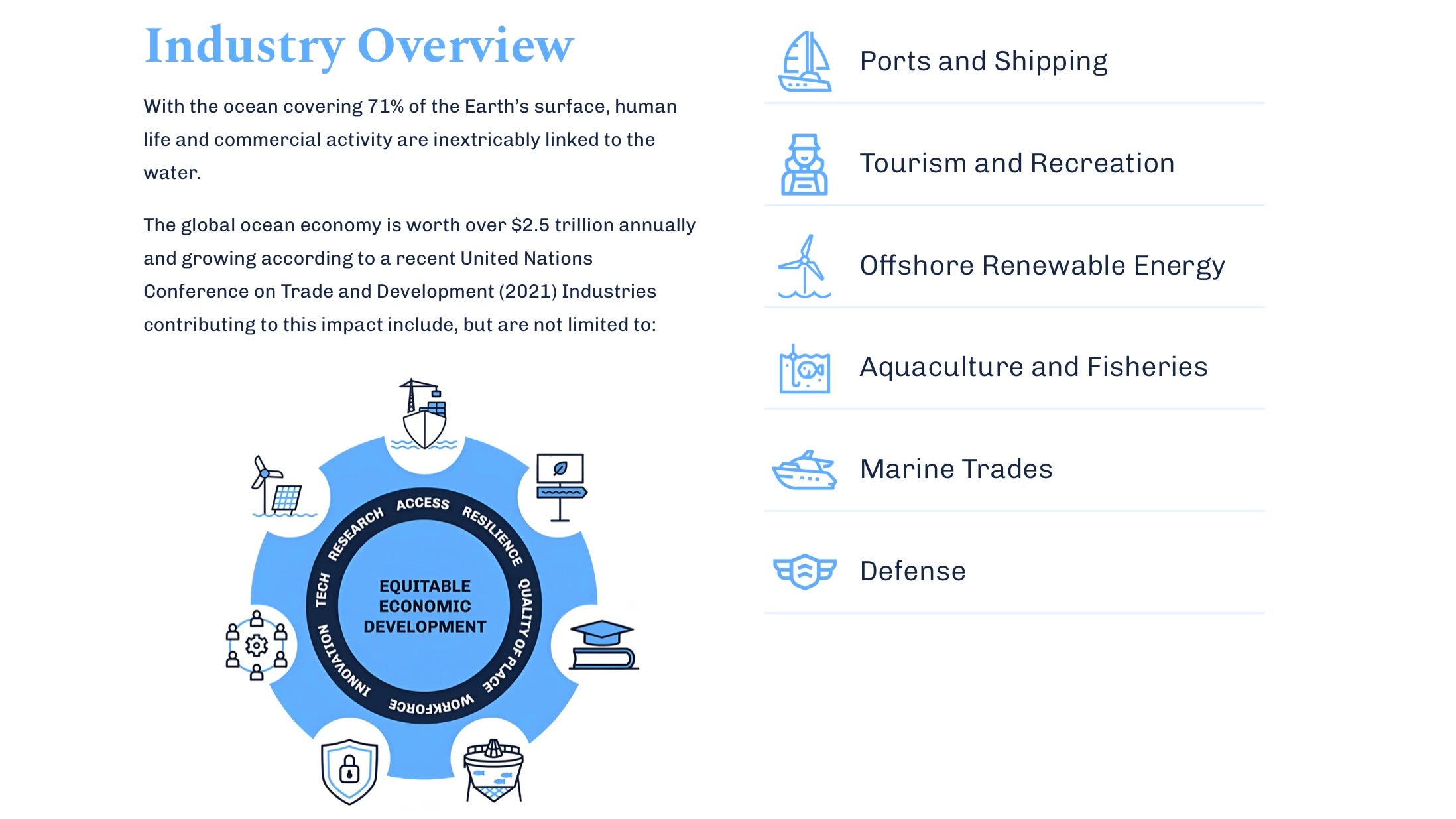
You may have heard the phrase “Blue Economy” bandied about by our federal delegation and local state and corporate leaders. The Grow Blue Partnership, a Rhode Island-based coalition of industry groups, environmental organizations, government agencies, and academic institutions, including the University of Rhode Island (URI), defines the Blue Economy as “the sustainable use of the ocean to create a resilient economy and good-paying jobs.” Which sounds great, until you realize that defense contractors make up a substantial chunk of the Blue Economy.
 

Monday, August 3, 2026

RI Jobless Claims Nearly Double in a Single Month

New claims jump - Why This Matters

Eddie Exxe, Labor & Workers

26,700 Rhode Islanders were counted as unemployed in July, and the state's jobless rate has climbed nearly two percentage points in a year while running above New England's for ten straight quarters — meaning a harder job hunt and thinner leverage for workers here than in neighboring states.

Here's the thing about a 400-job loss in a state with 510,300 payroll jobs: on its own, it's noise. It's eight hundredths of one percent. If that were the only number in the July employment bulletin, nobody would write about it.

But it isn't the only number.

The Department of Labor and Training's July figures show jobs at Rhode Island businesses fell by 400 from June, and the state's unemployment rate rose to 4.5 percent. Total nonfarm jobs came in at 510,300, down from a revised June figure of 510,700. Over the year, jobs are still up 6,200, or 1.2 percent. So far, so mixed.

Then look at the unemployment insurance claims.

Initial UI claims averaged 1,559 per week in July. In June, that average was 825. That is close to a doubling in a single month, and it's up 109 claims per week from July 2023. New claims are the closest thing the state has to a real-time signal — people don't file for unemployment because a statistical model told them to. They file because they just lost a job.

And the year-over-year comparison on the jobless rate is the number that should stop you. In July 2023, Rhode Island's unemployment rate was 2.7 percent. It is now 4.5 percent. That's a jump of one and eight-tenths percentage points in twelve months. There were 26,700 Rhode Islanders counted as unemployed in July, up 1,200 over the month.

Charlestown unemployment is comparatively low: 


Friday, July 3, 2026

USA! USA!

Americans are not as well off as people in peer nations

Stephen Bagwell, University of Missouri-St. Louis and Susan Randolph, University of Connecticut

As the United States celebrates the 250th anniversary of its Declaration of Independence, the global data we collect and analyze shows that the country is failing to “promote the general Welfare,” as the Constitution’s framers promised a little more than a decade later.

We are scholars of human rights. Alongside the Human Rights Measurement Initiative, a nonprofit that tracks how well more than 200 countries and territories are meeting the human rights commitments their governments have made, we annually update scores measuring whether people can actually get the basics of a decent life, such as healthcare, adequate food and a quality education.

The latest data our team has amassed shows that the U.S. is falling short compared with what it could achieve, given its US$32 trillion economy. This is not a one-year blip – the U.S. has been underperforming for the past 25 years.


Monday, June 22, 2026

Rhode Island beats Trump in court in suit over offshore wind farms

Stop the war on Green Energy

Attorney General Peter F. Neronha and a coalition of 18 attorneys general announced the United States Court of Appeals for the First Circuit’s dismissal of the Trump Administration’s appeal of the states’ victory in their lawsuit challenging the federal government’s unlawful order to freeze all federal permitting for wind energy projects.  

“Wind energy creates jobs and helps stabilize energy prices, neither of which this Administration seems to know how to do,” said Attorney General Neronha. 

“Today’s win once again demonstrates that this federal government is not immune from consequences, and our coalition is proving that with each legal victory we achieve. Rhode Islanders and Americans everywhere continue to pay the price, quite literally, for a collective hesitancy in embracing clean energy infrastructure. Wind energy is crucial to bringing energy costs down and keeping them down, and we will continue fighting to ensure a clean energy future for generations to come.”

On January 20, 2025, Trump issued a Presidential Memorandum which indefinitely froze all federal approvals needed for the development of wind energy projects pending federal review. Pursuant to this directive, federal agencies stopped all permitting and approval activities. In May 2025, the coalition filed a lawsuit challenging the freeze and in December, a federal judge in the United States District Court for the District of Massachusetts them to be arbitrary and capricious and contrary to law. The federal government appealed that ruling but subsequently decided to drop their appeal. Today, the Court entered a judgement dismissing the appeal and cementing the states’ victory.

Thursday, June 18, 2026

‘AI gravity’ is pulling you toward dependency.

Here’s how to push back

By Beth Stackpole, MIT Sloan School of Management


As businesses pull out all the stops to integrate artificial intelligence tools into mainstream workflows and business practices, they may be overlooking the longer-term implications of widespread AI use on institutional knowledge and critical thinking.

Top of Form

Eric So, a professor of global economics and behavioral science at the MIT Sloan School of Management, believes that AI is changing the way people’s brains operate, creating a trap where users become overly dependent on the technology, with potentially serious ramifications for business.

“We are increasingly deferring tasks that our brains are meant to handle to AI systems that think for us, write for us, and create on our behalf,” said So, presenting recently as part of the MIT Sloan speaker series, “AI + X: How AI Is Changing Management Practice.”

“Each time we engage in this sort of cognitive outsourcing, we’re participating in dramatic societal change” — one that shouldn’t be taken lightly, said So, who addresses those changes in depth in his forthcoming book, “The Collision: What AI Does to Us.” 

“We need to do as much as we can to preserve our capabilities, to recognize when these tools are wrong, to understand when they are missing something, and to be able to take action when these systems fail,” he said.

Tuesday, June 16, 2026

It's Easy To Create Lots of Shitty Jobs

So don't break out the champagne about Friday's jobs report

Robert Reich

Friday’s jobs report — showing that America added 172,000 jobs in May — stimulated a lot of celebratory bullsh*t.

Trump said, “It’s raining jobs!” White House National Economic Council Director Kevin Hassett claimed the job market is "hitting on all cylinders.” The mainstream media called it a “blowout jobs report,” “stronger-than-expected jobs data,” the labor market’s “best three-month stretch in more than two years.”

What all this acclaim left out was that wages are falling relative to prices.

Average hourly earnings for private-sector production and non-supervisory workers — that is, for most employees — rose by only 8 cents (or 0.2 percent) in May. That’s the weakest pace of wage growth since 2021.

Meanwhile, prices are rising quickly — by around 3.8 percent annually. Hence, real wages — that is, their actual purchasing power — are dropping. The paychecks of most American workers aren’t covering rising costs. They’re getting poorer.

Tuesday, June 9, 2026

The triple toll of Trump’s terrible tariffs

Ultimately, American workers and consumers suffer three different ways.

Tom Schaller

Following the Supreme Court’s February ruling that Donald Trump’s tariff policy violated Congress’s tax authority, the administration must now refund the $159 billion it collected from its unconstitutional tariffs.

But unfortunately for American workers and consumers, winding down this fiscal fiasco results in a lose-lose-lose situation:

  • First, most Americans will never be reimbursed for what were effectively temporary sales taxes they paid for various imports, nor will they receive the public benefit of having those sums spent on government programs or projects.
  • Second, because it is logistically easier to reimburse the American companies that directly paid the tariffs, some corporations may enjoy windfall refund profits — presuming, that is, those companies did not go bankrupt.
  • Finally, the surviving businesses and the employees who still work for them — hundreds of thousands of workers were laid off because of the tariffs — will for the foreseeable future continue to suffer because foreign countries, companies, and citizens quite rationally retaliated against Trump’s policies.

Let’s work through the three-fold ruin wrought by Trump’s catastrophic policy.

Saturday, June 6, 2026

When ICE ramped up enforcement, US‑born workers didn’t see any economic gains

US workers don't want or get jobs done by deported workers

Chloe N. East, University of Colorado Boulder and Elizabeth Cox, University of Colorado Boulder

Donald Trump campaigned on a promise to strengthen the labor market. His immigration platform – including a pledge to conduct the largest deportation campaign in U.S. history – was central to that promise.

“For too long, Washington ignored how mass illegal immigration artificially suppressed wages, hurting working-class Americans – especially young men,” wrote Treasury Secretary Scott Bessent on X in July 2025. “But under President Trump, we now have a secure border, a blue-collar wage boom, and major investments from trade deals.”

The labor market tells a different story. In the first year of Trump’s second term, unemployment rose, hiring slowed and wage growth stagnated. The construction sector was hit particularly hard.

We’re scholars of labor markets, immigration and public environmental policy who have examined how these economic trends can be traced to the mass deportation campaign of Trump’s second term. Notably, while areas with heavier ICE enforcement saw a drop in employment among immigrants, there was no increase in either employment or wages among U.S. citizens.

Friday, June 5, 2026

Foulkes Unveils Third Component of “Believe in Rhode Island” Economic Plan: Creating & Growing Good-Paying Jobs

Proposes $150 Million Ocean Economy Investment Fund 

Helena Buonanno Foulkes shared the final part of her Believe in Rhode Island economic plan: creating good-paying jobs in Rhode Island. This plan lays out Helena’s vision to leverage Rhode Island’s unique assets that no other states can replicate: our talent and our location. 

“For too long, Rhode Island has been solving the wrong problem when it comes to our economic development strategy, and it’s driven away large employers and left our people behind. I’m excited to share the final part of my economic plan, centered around my belief in Rhode Island,” said Helena. 

“It’s time to lean into what sets Rhode Island apart from other states: our people, our colleges and universities, our world-class food and arts scene, and our 400 miles of coastline and access to the ocean. As governor, I’m going to bet on our people and lean into our strengths, and I’m excited to grow our economy together.” 

Part Three of Helena’s Believe in Rhode Island Plan includes:

Tuesday, May 19, 2026

Foulkes rolls out first part of her economic plan with a $100 Million "Classroom-to-Career" proposal

Practical approach for jobs and the economy

Steve Ahlquist

Gubernatorial candidate Helena Buonanno Foulkes (Democrat) announced the first component of “Believe in Rhode Island,” her comprehensive economic plan to give “every Rhode Islander a real shot at a good-paying job, a career, and a better future.”

“Over the next few weeks, I’m going to be rolling out parts of Believe in Rhode Island, my comprehensive economic plan that I will implement as governor,” said Foulkes. 

“My plan is grounded in the belief in our people, our talent, and the incredible assets that Rhode Island has to offer. For too long, our elected leaders have been trying to tax incentive or special deal their way into economic success. Instead, we should invest in Rhode Islanders and lean into what our incredible state has to offer. I’m proud... to announce my Classroom-to-Career Initiative, the largest investment in career and technical education in the history of Rhode Island.

“Every parent I meet wants the same thing for their kid: a good, stable job and a future where they don’t have to leave Rhode Island to find a job. For too long, we’ve told young people that the only path to a successful career runs through a four-year college, but talking to the men and women in our trades, the operating engineers, the electricians, the plumbers, the iron workers, and the carpenters, they’ll tell you they have stable careers, good pay, and pride in the work they do. 

"It’s the same for our healthcare workers, our advanced manufacturers, and our marine technicians. All Rhode Island needs is more people in all of these careers, and that’s why, as governor, I’ll propose a $100 million bond to fund capital construction for career and technical education facilities at or near high schools throughout the state, so our young people can learn career track skills and start careers with Rhode Island companies straight after graduation.”

“My classroom to career plan has four key points,” said Foulkes.

Friday, May 15, 2026

Why Trump’s $2 billion buyoff to cancel offshore wind farms is a bad deal for American taxpayers and the US energy supply

Who, other than the fossil fuel industry, benefits from Trump's jihad on offshore wind?

Christopher Niezrecki, UMass Lowell; Ben Link, Johns Hopkins University, and Zoe Getman-Pickering, UMass Amherst

The U.S. is in a bizarre situation in 2026: It’s facing a looming energy shortage, yet the Trump administration is making deals to pay offshore wind developers nearly US$2 billion in taxpayer money to walk away from energy projects.

These politically motivated moves are costing Americans far more than just the buyouts.

Communities have been laying the groundwork for offshore energy projects for years. Offshore wind development brings jobs and economic development that reshape regional economies, with the scale of public and private investment reaching into the hundreds of billions of dollars over years. 

East Coast communities have built up ports to support the industry and launched job-training programs to prepare workers. Construction, maintenance and shipping businesses have sprung up, along with secondary businesses that support the industry.

Losing the projects, and the threat of losing other planned wind farms, will also likely mean higher energy prices. And while some offshore wind farms are moving ahead, developers must account for both lost momentum and increased uncertainty from the Trump administration.

As a result, Americans will bear the economic brunt of these decisions for decades ahead.

Wednesday, May 13, 2026

Energy experts agree: The governor's plan to reduce energy costs is a short-term fix and long-term mistake

McKee, wrong again

Steve Ahlquist

Rhode Island State Senator Samuel Zurier’s Commission to Study the Successful Implementation of the Act on Climate met on Monday and heard from two experts on energy policy who were critical of FY2027 Budget proposals that Governor Daniel McKee claims will save ratepayers money on energy costs. Nick Nybo of Revity Energy, a Rhode Island-based utility-scale solar developer, expressed skepticism about the governor’s projected savings from the proposal, estimating the savings were closer to $70 million over five years, not the claimed $259 million, and that the governor’s plan would make it harder, if not impossible, for the state to reach its 2021 Act on Climate goals.

Samuel Ross, a Director at Dunsky Energy and Climate Advisors, a consulting firm that works across the U.S. and Canada on topics across the clean energy industry, was similarly skeptical, noting that the governor’s proposal to weaken the state’s Renewable Energy Standard threatens compliance with the 2030 goals of the Act on Climate and will likely increase long-term energy costs, even if it manages some near term savings.

Tuesday, May 12, 2026

Trump Tariffs Ruled Illegal—Again—as Data Shows Promised Manufacturing Boom Is Nonexistent

Trump treats court opinions as "advisory"

Jake Johnson for Common Dreams

A panel of federal judges ruled Thursday that US President Donald Trump’s sweeping 10% tariffs on most imports are unlawful, another major legal blow to the centerpiece of the Republican president’s economic agenda—which has failed to produce the manufacturing boom he repeatedly promised on the campaign trail.

The Court of International Trade (CIT) found in a 2-to-1 ruling that Trump violated the law when he unilaterally enacted the 10% import taxes following a February decision by the US Supreme Court, which struck down tariffs the president imposed using emergency powers. 

But the CIT’s ruling, which the Trump administration is expected to appeal, only barred collection of the tariffs from some of the plaintiffs in the case—including a pair of businesses and Washington state—limiting the ruling’s immediate impact.

Rep. John Larson (D-Conn.), a member of the House Trade Subcommittee, applauded the new ruling in a statement, saying that “Trump must comply with the law by ending his illegal tax on the American people and getting families and small businesses the refunds they are owed.”

Friday, May 8, 2026

May 12 presentation on wind power development

Results of wind development discussions at New London presentation

Dawn Bergantino

URI Photo / D. Bidwell

David Bidwell, professor of marine affairs at the University of Rhode Island, will share research results on offshore wind community discussions at a free public presentation on Tuesday, May 12, at 6 p.m., at the New London Community Recreation Center, 1 Recreation Way, New London.

Bidwell will lead a presentation hosted by the New London NAACP to provide area residents with information related to prior research and community discussions in the area, as well as discuss community priorities and concerns over offshore wind energy development activities. 

At URI, Bidwell’s work focuses on how people interact with renewable energy technologies, including offshore wind in southern New England. He began conducting research in New London in 2024. 

Thursday, May 7, 2026

Sen. Victoria Gu sponsors bill to regulate the use of AI to make workplace decisions

Who's the boss? 

Legislation from Sen. Victoria Gu and Rep. Thomas E. Noret aims to ensure artificial technology is used responsibly in the workplace by installing common-sense guardrails governing its use.

“Businesses in Rhode Island are already using AI and electronic monitoring tools to surveil and discipline workers in a way no human supervisor could. If you’re making these consequential decisions overs workers’ lives, there needs to be disclosure, meaningful human oversight and an opportunity to make corrections, because we have seen real examples where workers are disciplined because of an algorithm error,” said Senator Gu (D-Dist. 38, Westerly, Charlestown, South Kingstown), who chairs the Senate Committee on Artificial Intelligence and Emerging Technologies.

The bill (2026-S 2499, 2026-H 7767) would create a regulatory framework to ensure fair and transparent use of AI tools that affect workers, including disclosure to employees about what electronic monitoring is happening and how it might be used to measure worker performance; meaningful human oversight on algorithmic decisions like employee hiring, discipline, pay and termination; requiring companies to use the least invasive means of electronic monitoring possible; and prohibiting electronic monitoring in break rooms, bathrooms and during off-duty hours.

Monday, May 4, 2026

Rep. Tina Spears named 2026 Environmental Legislative Champion by Clean Water Action

Congratulations, Tina!

From a Clean Water Action press release:

Clean Water Action announced their 2026 awardees to be honored at the organization’s 24th Annual Breakfast of Champions, happening on Friday, May 22nd at 9:30 am at the Edgewood Yacht Club in Cranston.

“When life gives you lemons, make lemonade. When Trump gave us anti-environment headwinds, Rhode Island built wind power,” said Emily Howe, Clean Water Action’s RI Director. “Now more than ever, it’s important to celebrate our victories and honor the advocates who make those wins happen!”

Thursday, April 2, 2026

Leave Ninigret, Trustom Pond et al. alone, dammit!

Wildlife Refuges on Trump’s Hit List 

By Gina-Marie Cheeseman

Trustom Pond. Photo by Will Collette
The Trump administration has wildlife refuges in its sights. U.S. Fish and Wildlife Service head Brian Nesvik launched a review of the National Wildlife Refuge System and the National Fish Hatchery System. The review will look for “refuges or hatcheries established for a purpose that no longer aligns with the mission. It will also look for operational funding and the workforce.

The NWRS has 573 refuges on more than 96 million acres of land and five Marine National Monuments on 760 million acres of submerged lands and waters. Half of FWS employees work for the NWRS. The NFSH stocks over 122 million fish per year. President Theodore Roosevelt created the Pelican Island National Wildlife Refuge off Florida’s coast as the first unit of the NWRS.” Congress created the NFHS in 1872 to help the production of fish for food. 

Wildlife refuges are places set aside to protect wildlife and their habitats. The NWRS and the NFHS protect 700 species of birds, 220 species of mammals, 250 species of reptiles and amphibians, and more than 1,000 species of fish. Wildlife refuges welcome more than 67 million visitors per year, generate over $3 billion in economic activity, and support more than 41,000 jobs.

Tuesday, March 31, 2026

Demoralized CDC Workforce Reels From Year of Firings, Funding Cuts, and a Shooting

Once the world's greatest public health agency, gutted by Trump, Musk and Bobby Jr.


On the coffee table at her home in Atlanta, Sarah Boim has a pile of documents from her old job at the Centers for Disease Control and Prevention. They are printouts of her employment records.

Boim lost her job in the first big wave of CDC firings — more than 1,000 people were suddenly let go last February.

“This is the termination letter. I also printed off my performance review from 2024,” she said. “I knew I wouldn’t have access to it, and everything was so chaotic that I needed proof of what was happening.”

Boim worked in the National Center for Environmental Health/Agency for Toxic Substances and Disease Registry, handling communications about radon, substances known as forever chemicals, lead poisoning, and other health threats.

Rereading her termination letter, she still can’t believe what it says.

“The agency finds you are not fit for continued employment because your ability, knowledge, and skills do not fit the agency’s current needs, and your performance has not been adequate to justify further employment at the agency,” the emailed letter reads.

“And that floored me,” Boim said, “because my performance was rated outstanding, and I even got a raise. It was just deeply insulting. So I was more upset than I think I was prepared to be.”

The Trump administration later brought back some of the workers who were fired in the first round, but it has also cut more staff and funding.

The CDC has been without a permanent director for more than six months. Recently the Trump administration made Jay Bhattacharya the CDC’s interim director, while he also runs the National Institutes of Health.

The leadership uncertainty comes amid a year of disruption and dismissals at the Atlanta-based institution, from which more than 3,000 public health workers are now gone. That includes staffers the Trump administration terminated and workers who accepted early retirement.

Ripple effects of the turmoil are still hitting the Atlanta region.

By the end of 2025, the CDC had lost roughly a quarter of its workforce.

Sunday, March 29, 2026

What Trump's "reorganization" has done to the Interior Department

Chaos

This article originally appeared on Inside Climate News, a nonprofit, non-partisan news organization that covers climate, energy and the environment. Sign up for their newsletter here.

One year into Donald Trump’s second term, the Department of the Interior is in turmoil, hobbling many of the agencies overseeing the country’s public lands and waters. 

Not only has Interior lost some 11,000 employees, or more than 17 percent of its workforce, it is also reeling from a drastic centralization of personnel: Last May, almost 5,500 staff from the department’s component agencies were moved into the office of the Interior secretary, Doug Burgum. 

That shift has created a hostile work culture, made staff less efficient and broken important lines of communication, former Interior employees say. According to an Inside Climate News analysis of federal workforce data released by the Office of Personnel Management, almost 1,800 workers have left Burgum’s office since the reorganization—the vast majority opting to retire or quit.

As a whole, the federal workforce shrank by about 12 percent in the first year of the second Trump administration. Some parts of the government, such as the Environmental Protection Agency, which shed 24 percent of its employees, have suffered bigger losses. But Burgum’s reorganization is unique, with wide ripple effects. 

Under an order signed on April 17, Burgum confirmed plans to absorb administrative staff from Interior’s component agencies, including workers responsible for human resources, training, information technology, contracting and communications. The Inside Climate News analysis shows sudden staff losses in the next month at agencies including the Bureau of Reclamation; the U.S. Geological Survey; the Bureau of Land Management; the Office of Surface Mining Reclamation and Enforcement; and the Fish and Wildlife Service that correspond to the swelling of Burgum’s own staff.

The stated goal was efficiency. “This unification effort will accelerate technology advancements and enhance the Department’s ability to deliver on our core mission,” Burgum’s order said. 

But Interior staff reorganized into Burgum’s office who later left say they encountered a hostile, inefficient work culture designed to push people out. Russell Vought, the powerful director of the federal Office of Management and Budget, said in a private speech between Trump’s two terms that “we want the bureaucrats to be traumatically affected” by going to work, ProPublica reported in 2024.