 |
| A session discussing the role of AI in creating and spreading misinformation, and strategies to stay vigilant against its effects. |
Showing posts with label Education. Show all posts
Showing posts with label Education. Show all posts
Monday, November 2, 2026
Thursday: a session on the issues of artificial intelligence.


Sen. DiMario honored for her work supporting families and children with special needs
Honored for her effective advocacy
 |
| From left, Sen. Alan M. DiMario and RIPIN Executive Director Samuel Salganik. |
Sen. Alana M. DiMario was honored today for her work on behalf of families and children with special needs with a Legislative Partner award at the RIPIN Annual Breakfast.
“I am honored to receive this award and celebrate the 35th anniversary of RIPIN, a group founded by parents of children with special needs who recognized that through community and mutual support they could build a more inclusive and supportive Rhode Island,” said Senator DiMario (D-Dist. 36, Narragansett, North Kingstown, New Shoreham).
“I’ve been proud to do my part in
the General Assembly to move our laws in the same direction. Every child
deserves to thrive, and every family deserves the support they need to provide
the best learning environment possible for their children.”
Senator DiMario has sponsored a number of laws supporting
special education and children with special needs, including to improve
individualized education plans (IEP) for children and their parents, to
ensure that parents of children with special educational needs have
access to local advisory committees for support and advice, to allow
students to help with IEP physical education classes, and to codify federal
504 education plans into state law.
She also successfully advocated for the state budget to fund
behavioral
health training for staff in out-of-school programs and personally
supported workforce training for child mental health professionals by covering
membership fees for infant and child care professionals.
EDITOR'S NOTE: Senator DiMario was one of several Democratic women legislators in South County who were targeted for defeat by the far-right League of Rhode Island Businesses. She beat her LORIB challenger Mark Mesrobian by 72% to 28%. She also has no opponent in the General Election tomorrow so she automatically will retain her seat. - Will Collette
Wednesday, October 28, 2026
Déjà vu all over again in House District 39 as Democratic incumbent faces MAGA Republican
District 39 continues to be a culture war battleground
By Nancy Lavin, Rhode Island Current
 |
| It's work like this that serve as reasons to re-elect Cotter |
They are both moms in their 40s who want to lower energy bills and preserve western Rhode Island’s rural beauty.
The similarities between Democratic Rep. Megan Cotter and her Republican challenger Jasmin Roy end there.
Cotter, the two-term incumbent for House District 39, has a record of legislative accomplishments she can point to while canvassing the 100-square mile district, spanning Exeter, Richmond, and Hopkinton: adding more money to the green bond for forest and farmland preservation, spurring — and leading — a newly begun legislative panel to study how housing developments affect water supply in rural communities; and limiting self-checkouts at grocery stores to preserve jobs.

“I don’t coparent with the government,” Roy proclaimed in a June 1 episode of local conservative podcast Cumberland Unfiltered.
A vocal Trump supporter who touts Second Amendment protections and parental rights in education, Roy’s views, as shared on her campaign website and social media, are likely to resonate with many of the voters in the district, which backed Trump in the last three presidential elections. Cotter’s predecessor, Republican Justin Price, attended the Jan. 6 rally outside the U.S. Capitol, though Price said he did not participate in the riots.
Sunday, October 25, 2026
Sen. DiMario honored for her work on behalf of early childhood education
DiMario has sponsored a number of laws improving early childhood education
 |
| Sen. Alana M. DiMario attends a July 15, 2026 RIght from the Start event at Child Inc. |
Sen. Alana M. DiMario was honored for her work supporting early childhood education by the Rhode Island Association for the Education of Young Children.
“Early educators build the foundation for everything Rhode
Island will become. Investing in them is investing in our future,” said Senator
DiMario (D-Dist. 36, Narragansett, North Kingstown, New Shoreham). “This award
means so much coming from an organization like RIAEYC, which is made up of so
many of the educators providing for the well-being of our young children. I am
honored and energized to keep working with my colleagues in the General
Assembly to support our early child educators and give our children the present
and future they deserve.”
Senator DiMario received the Sue Connor Special Friend of
Rhode Island’s Children - Early Childhood Advocate award, which recognizes
“significant contributions to early childhood education in Rhode Island” at
RIAEYC’s annual Early Childhood Conference Saturday, Oct. 10
EDITOR'S NOTE: Sen. DiMario was one of the several South County Democratic women targets by far-right coffee baron Dave Levesque who financed nine primary challengers on Sept. 9 through his collection of 40 political action committees. These PACs all bear the name "League of Rhode Island Businesses (LORIB)" DiMario and her colleagues beat all of these straw candidates.
However, there are still LORIB-backed candidates running in the November 3 general election running against Charlestown's state Senator Victoria Gu, and South Kingstown Reps. Carol McEntee and Kathy Fogarty. Sen. DiMario will return to the Senate since she is unopposed in the General Election. - Will Collette
Saturday, October 24, 2026
Hopkinton considers its cost share for construction of new unified elementary school in Charlestown
Hopkinton Council Hears School Bond Share Could Top 4% Tax Cap
Adriana
Vossari, RI & Local Government, is NOT an actual person but rather is an AI-bot used by UpriseRI to review and summarize public records. Click here for their explanation for how this is done:

If the November 3 bond passes with 65% state reimbursement, a median Hopkinton home at $515,500 would pay about $335.39 more a year, the town manager said. A speaker said the town's share of the debt payments could top the 4% levy cap, which the town can exceed only by asking the state.
A speaker told the Hopkinton Town Council at its Monday night
meeting that if the town's increase comes to about $1 million, its share of
debt payments on the proposed $116 million regional school bond would be over
the town's 4% cap on tax levy growth, according to the Hopkinton Town Council's
published meeting
recording.
The tax levy is the total amount a town raises through
property taxes. A speaker said the town can only increase its levy by 4%
"or else we have to go to the state" and ask for permission to exceed
the cap. A speaker added, "I believe our 4% cap is around 700,000."
The bond goes before voters in the November 3 election. The
council did not vote on the bond; the agenda item was a discussion of the
school bond financial breakdown.
The tax math
The town manager presented a one-page breakdown, also posted
on the town website, that the regional school district requested from its three
member towns for an impact statement on the bond. The manager said the managers
and finance directors of Hopkinton, Charlestown and Richmond coordinated so the
data would be consistent. The manager said they spoke with Jeff Allen of
Charlestown and the Richmond town manager, among those involved.
The manager said the figures assume the state reimburses 65%
of the $116 million bond. Under that assumption, the manager said, the total
cost to the district after reimbursement would be $80,626,214. The district's
financial advisor supplied the annual debt service figures, according to the
manager.
Costs are split among the three towns by enrollment, and
Hopkinton's share is 39.17%, the manager said. For a median Hopkinton home,
valued at $515,500, the manager said the annual tax bill would rise $335.39 for
the bond alone. Homes with higher assessed values would pay more, and
lower-valued homes would pay less.
Thursday, October 22, 2026

Wednesday, October 14, 2026
Richmond calculates the cost of their share of proposed Chariho elementary school project
Richmond has published its fiscal breakdown for the $116 million Chariho elementary school bond on the November ballot
Kelly
Lockhart,

Charlestown would need to increase its tax rate by thirteen cents. Source: The Pipeline, Charlestown town government.
Richmond property owners face an estimated 5.03% tax
increase under the proposed school bond, though the town's published figures
carry slight accounting discrepancies.
When Richmond voters open their ballots on November 3, they will
confront a regional school proposal that has been reworked, downsized, and sent
back to the ballot box. But for local property owners, the decision ultimately
narrows to two practical questions: what will the project cost, and how much of
that burden lands on their tax bills?
Richmond officials released the town's official
fiscal impact breakdown for Question 6—a regional ballot referendum authorizing
the Chariho Regional School District to borrow up to $116 million for
elementary school construction. The figures give the town its first detailed
projection of its expected debt payments and property tax adjustments before
next month's vote.
Friday, October 9, 2026
Voters in Charlestown, Hopkinton, and Richmond will decide a $116 million Chariho school bond on November 3 to fund a consolidated elementary campus.
Chariho's $116M School Bond: What Voters Need to Know
Kelly
Lockhart,
Residents in Charlestown, Hopkinton, and Richmond will vote
November 3 on up to $116 million in school bonds, affecting local school
facilities and property tax debt.
Plan for the proposed unified Chariho elementary
school complex in Charlestown
Across Charlestown, Hopkinton, and Richmond, the lawn signs
and municipal notices are multiplying ahead of the general election. But for
voters in the three rural towns that make up the Chariho Regional School
District, the ballot brings a familiar and high-stakes choice.
Two years after rejecting a three-school overhaul, voters
will decide on November 3 whether to authorize up to $116 million in borrowing
for a consolidated elementary campus. The measure — framed as Local Question 1
on the ballot — will determine the direction of the district's aging school
infrastructure for decades.
Yet for regular homeowners watching local tax rates, the
question calls to mind a straightforward concern: what will the borrowing
actually fund, and what will it cost?
One Campus or Three?
The central proposal on the ballot authorizes the district
to issue not more than $116 million in bonds or notes to finance an elementary
school on a single campus. Under the legislative act, the facility would serve
students across all three member communities and could consist of "one or
more buildings."
The financing authorization also covers capital improvements
at the district's Switch Road Campus in Richmond, which houses Chariho's middle
and high schools. State law permits bond proceeds to fund land acquisition,
demolition, architectural design, health-and-safety improvements, playgrounds,
and site paving.
The plan marks a distinct shift from the district's previous
attempt. In May 2024, Chariho voters narrowly rejected a larger, $150 million
bond proposal by a margin of 2,445 to 2,369. That earlier referendum would have
constructed three separate elementary schools — one in each member municipality
— alongside the Switch Road renovations.
Consolidation brings different logistical considerations.
During a public hearing in July on a proposed site at the former Charlestown
Elementary School, residents raised questions about added bus traffic, local
drinking-water protection, and the total cost, according to the South County
Star. Charlestown held a separate referendum on August 4 regarding ground-lease
arrangements for that site.
According to the bond legislation, the single-campus project
is intended to meet Northeast Collaborative for High Performance Schools
standards, with the district aiming to cut long-term operating and energy
overhead.
Wednesday, October 7, 2026
RI Ballot Question 1 would support healthcare, workforce training in Rhode Island’s high-demand fields
Higher education bond would fund programs at URI, RIC and CCRI

The University of Rhode Island, Rhode Island College and the Community College of Rhode Island are partnering on efforts related to Question 1, a higher education bond measure on the November ballot. The measure would provide funding for training and workforce development in healthcare, the skilled trades, and other high-demand fields.
A new Integrated Health Building at URI will expand modern
health education and clinical training, strengthening the pipeline of
professionals who care for Rhode Islanders and their families. Healthcare
careers are among the fastest-growing occupations, as well as the state’s
largest employment sectors.
A recent
poll showed that 49% of respondents believe that Rhode Island isn’t
spending enough money on improving and protecting healthcare in the state, with
62% indicating that healthcare should be a top priority for elected leaders.
Sunday, October 4, 2026
URI Metcalf Institute’s Fall Lecture takes participants outside to experience the North Woods Field Guide with DWELL Lab
Immersive two-part walk and zine-making event on Oct. 14
By Abbie Lahmers
 |
| The URI Metcalf Institute’s fall lecture takes participants outside to experience the North Woods this October. (URI Photo / Abbie Lahmers) |
The University of Rhode Island’s Metcalf Institute concludes its 2026 Annual Public Lecture Series on Wednesday, Oct. 14 with their Fall Lecture, straying from the lectern this year to bring participants on a walk through the North Woods, followed by a conversation and hands-on zine-making activity with DWELL Lab.
URI’s North Woods serves as a teaching forest and site for
field research on the Kingston Campus as well as an important communal space.
Ellie Lin, an illustration student at RISD who worked with DWELL Lab this
summer through the Rhode Island NSF EPSCoR’s Summer Undergraduate Research
Fellow (SURF) program, will lead participants through the Narragansett
Story Walk, exploring the rich ecology and human history of the North
Woods.
 |
| RISD artist Ellie Lin has created a field guide to the North Woods and will present it as part of an immersive walk and zine-making event at URI on Oct. 14. |
Lin sees the event as an opportunity to “bring people together through storytelling, community, and local ecology.” Sketching, journaling, and reflecting is encouraged during the immersive walk and materials will be provided.
The event will continue at Toray Commons with a
conversation, reception, and zine-making workshop.
In a conversation moderated by Metcalf Institute Executive Director Fara Warner, Lin will be joined by URI’s Madison Jones and Stephanie West-Puckett, with Bonnie Phillips ’88 of ecoRI News, to discuss the creation of the first edition of the “North Woods Field Guide.”
The guide, which is part of the bigger North Woods Project, is funded by a Rita Allen Civic Science Media Grant. Expected to be released in print and digital forms this fall, it will contain a collection of scientific, creative, and journalistic writing and imagery that covers animals, vegetation, flowers, minerals, and other elements of the woods.
“I’m excited to walk with folx in the North Woods and discuss how queer genres, specifically zines and community-authored field guides, can make civic science communication more accessible and inclusive,” said West-Puckett, associate professor of professional and public writing, who’s leading the creation of the first North Woods Field Guide. Jones, associate professor of science communication and director of the DWELL Lab, shared that he looks forward to talking about outdoor education. “Field notes are an exciting way to connect as writers with our local environments and communities,” he said.
Thursday, October 1, 2026
Screen Time at Ages 1 and 6 Linked to Lasting Learning and Memory Effects
Study challenges commonly held beliefs
By Zhejiang University

Screens are now a routine part of life for many young
children, but their possible effects on later learning remain uncertain. A
study that tracked children from age 1 through age 8 found that greater viewing
time, especially during infancy and near the start of school, was associated
with lower academic performance at age 9 and weaker working memory at age 10.5.
The results indicate that when children use screens may matter as much as how
long they spend using them.
The World Health Organization (WHO) and the American Academy
of Pediatrics advise avoiding screens before 18 to 24 months and limiting
viewing to less than one hour per day between ages 2 and 5. Many children
exceed those recommendations, yet previous research on screens and cognitive
development has produced inconsistent results.
Much of that work has examined children at only one point in
time, concentrated on those already in school, or lacked repeated measurements
across the early years. Following children through several developmental stages
can help researchers identify periods of greater sensitivity while accounting
more carefully for family and environmental factors.
Sunday, September 27, 2026
Just leave those kids alone!
 |
| Jocelyn Foye, Executive Director of The Womxn Project |
“I want to bring to the Commission’s attention that Rhode Island is consistently on the radar of the Moms for Liberty hate group organizing that’s going on across the country,” said Jocelyn Foye, Executive Director of The Womxn Project, speaking before Thursday’s meeting of the Rhode Island Commission on Prejudice and Bias.
“While every nonprofit has the opportunity to do whatever they want with their messaging and the way they behave, I’d like to draw attention to some extremely prejudicial behavior that’s now being specifically targeted at trans students in North Kingstown and South Kingstown.”
Specifically, Executive Director Foye was there in response
to a complaint
filed by America
First Legal Foundation with the U.S. Department of Justice and
the U.S. Department of Education, “calling for a federal investigation
into Rhode Island’s South Kingstown School District, alleging that its
policies directing staff to facilitate students’ ‘gender transitions’ without
parental notification are unlawful.” The America First Legal Foundation
is a 501(c)(3) nonprofit far-right public interest organization founded in 2021
by white nationalist Stephen
Miller, President Donald Trump’s Deputy Chief of Staff for
Policy.
This complaint follows a similar
complaint the group made against the North Kingstown School District
on July 22. Both complaints allege that the current school district policies
regarding transgender and gender-expansive students violate the law, when in
fact the policies comply with local, state, and federal law, as
determined by the Rhode Island Department of Education and the Rhode
Island District Attorney’s Office.
EDITOR'S NOTE: Moms for Liberty leader Jasmine Roy (R) is running against local state Representative Megan Cotter for House District 39 covering Richmond, Hopkinton and Exeter. Roy is supported by the ultra-rightwing League of RI Businesses that also supported Rep. Tina Spears' opponent, sex crimes defense lawyer Leah Boisclair. - Will Collette
Monday, September 21, 2026
Geology underfoot: Public invited to join field trips focused on Rhode Island landscape
URI hosting 117th annual New England Intercollegiate Geological Conference, Oct. 2-4
 |
| The sole purpose of the yearly New England Intercollegiate Geological Conference is to present field trips in interesting geologic areas; this year it’s Rhode Island’s turn—the public is invited to join in. Shown: Beavertail State Park. (URI Photo / Brian Savage) |
University of Rhode Island geosciences students get to welcome an event that hasn’t happened at URI since before they were born—and the larger public is also welcome to join and be a student of geology for a day (or two).
Hosted by URI this year, the annual New England Intercollegiate Geological
Conference attracts students and faculty from the geologic disciplines
across New England, but anyone is welcome to attend. Conference “field trips”
are all free and open to the public.
This year’s conference will kick off with emeritus faculty Dan Murray co-hosting a virtual field trip on Thursday, Oct. 1 at noon to share updates on the ancient bedrock geology of Rhode Island. (Murray was also the organizer for URI’s last conference in 1998.)
According to URI geoscientist Dawn Cardace, one of
this year’s organizers, “This is a community-led initiative, loosely managed,
but much loved: Every year, the host organization shapes the event to fit the
host college, the site, and the local flavors.”
Tuesday, September 15, 2026
Unless blocked by Trump as an "enemy alien," Former Canadian Prime Minister Justin Trudeau to speak at Brown on Sept. 22
Maybe he can help us understand Trump's war on Canada
Brown University

In an open-to-the-public talk titled “Leadership, Democracy and the Evolving Global Landscape,” Trudeau will reflect on his time in office and discuss the forces shaping democracies, international alliances and public life.
Drawing on his experience leading Canada through a period of global
change, he will share insights on Canada-U.S. relations, the evolving world
order, institutional trust and civic engagement. Trudeau will also speak about
the challenges and opportunities facing democratic societies in an increasingly
interconnected world.
 Trudeau served for a decade as Canada’s 23rd prime minister
after leading the Liberal Party of Canada to a historic majority government in
2015. During his time in office, he set about delivering an ambitious
agenda that included appointing Canada’s first gender-balanced cabinet,
launching a national $10-a-day childcare program, lifting over 2 million
Canadians out of poverty, advancing Indigenous reconciliation, and taking
action to fight climate change, including through policies that attracted investment
in clean economic growth and jobs.
Thursday, September 10, 2026
When plastic companies write the lesson plans
Keep plastic industry propaganda out of schools
Joseph Winters "This story was originally published by Grist. Sign up for Grist's weekly newsletter here."
Joseph Winters

This fall, 54 million K-12 students are headed back to the classroom for another year of lessons in all the classic subjects: math, English, history, biology. But there’s another subject that’s been sneaking into school curricula: plastics.
A new report from the nonprofit Plastic Pollution Coalition documents the many ways the plastics industry has been inserting its agenda into classrooms across the U.S. — including through lesson plans and worksheets, hands-on science experiments, and a program called “PlastiVan” that travels from city to city teaching students about “the contribution plastics make to modern life.”
Industry interests offer these resources to teachers for free or for cheap, according to the report. The materials tend to highlight the necessity of plastics while downplaying their significant downsides to human health and the environment.
“When that information is provided to kids, it obfuscates the true impacts of plastic pollution,” said Madison Dennis, senior policy and advocacy manager for Plastic Pollution Coalition and one of the report’s main authors. Besides harming marine life, plastics can expose people to hazardous chemicals, clog storm drains and contribute to flooding, and release planet-warming greenhouse gases. Dennis’ organization is calling for stricter school policies against the use of industry-sponsored learning materials.
Wednesday, September 9, 2026
Survey data reveal demographic divides in Americans’ COVID vaccine hesitancy
Too stupid to live

“Some research has estimated nearly a quarter of a million
preventable deaths due to non-vaccination in the US, during the period May
2021-Sept 2022,” they write. Average life expectancy in the United States
decreased by almost two years because of COVID.
To better understand what drives Americans’ vaccine
hesitancy, the researchers analyzed surveys from nearly 14,000 people. Their
findings suggest that vaccination rates differed significantly by education
level and age, and reasons for remaining unvaccinated differed by race and
education level.
Saturday, August 22, 2026
Who are the winners in this culture war?
The defense of transgender student rights shifts, once again, to the Westerly School Committee
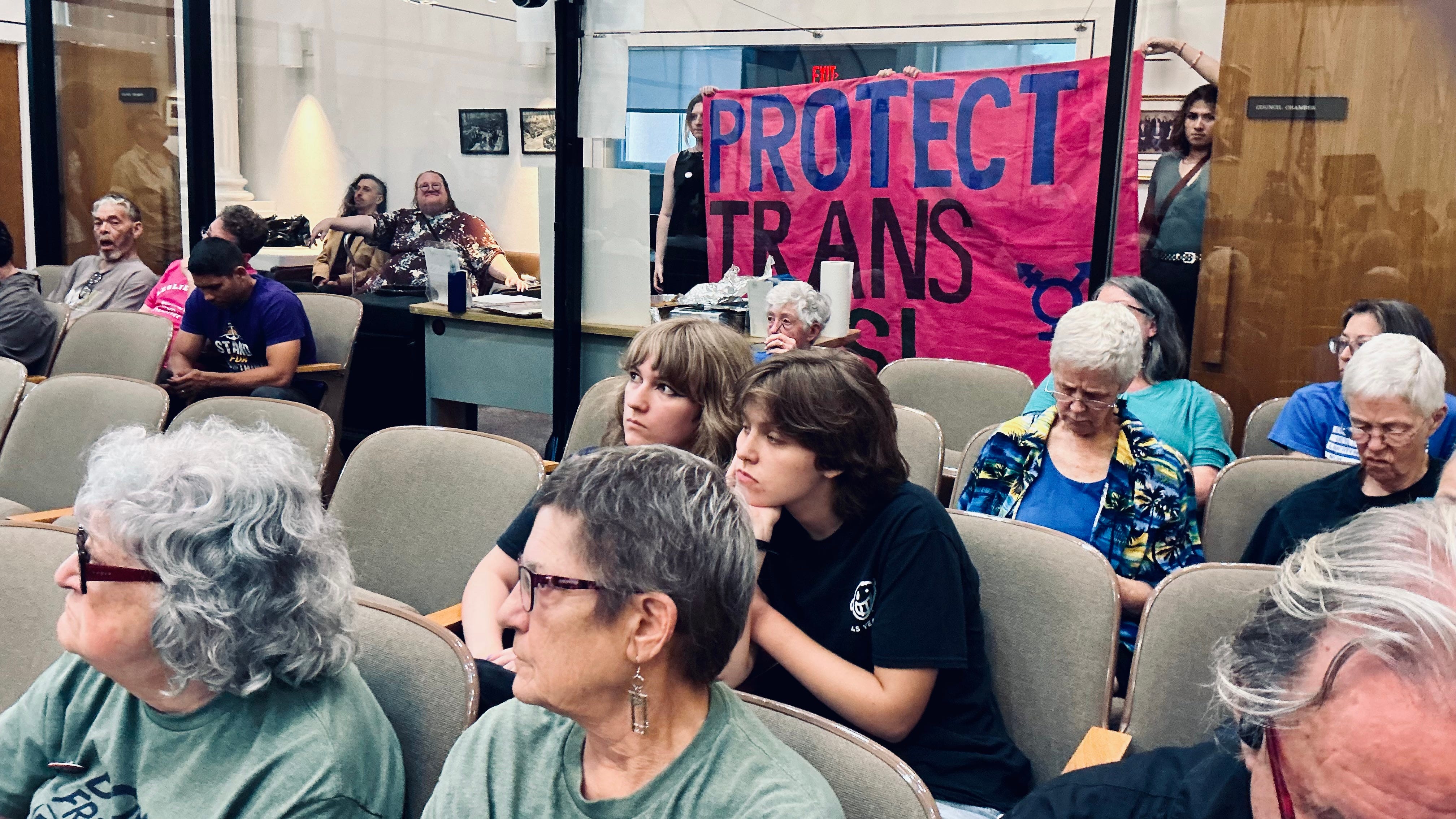
Dozens of people attended the August 19 meeting of the Westerly School Committee to advocate against agenda item 12d, “Request of Counsel to seek written opinion from Rhode Island Attorney General’s Office regarding SCOTUS Decision as to transgender athletes.” The decision is West Virginia v. B.P.J., in which the United States Supreme Court upheld state laws, such as West Virginia’s “Save Women’s Sports Act,” that banned or restricted transgender women athletes from participating in women’s school sports teams on a 6-3 vote.
You can watch the relevant parts of the School Committee
meeting here: https://www.youtube.com/watch?v=ltJLTv1o0g8
“You folks who came to the mic tonight wondering who put this item on the agenda,” said Westerly School Committee member Peter Nero. “It was me. The reason I put it on the agenda is that I want final clarity on where Rhode Island law stands, and I want the Attorney General to put that in writing, because I don’t want to have any more of these long nights… Bottom line: I wanted clarity on this so we don’t have more meetings like this, and we put an end to this now. That’s why it’s on the agenda.”
The long nights Committee member Nero is referring to are
likely the meetings where the school committee takes up potential changes to
their Transgender,
Gender Nonconforming & Transitioning Students Protocol and a
large number of people fill the room to advocate for transgender student
rights.
Committee member Timothy Killam seemed
exasperated. He wanted to talk about what he considered the positive things
happening in Westerly, like the opening of a new school in a couple of weeks.
“Why are we going around in circles about this instead of talking about some
forward progress? In my opinion, we have a protocol in place. We don’t have a
problem right now. Why are we taking the time about this?”
Committee member Killam sought to assure the people in the
room that they had misunderstood the agenda and that nothing would be decided
during the meeting. “I want you all to understand: if you read the agenda,
we’re not voting on anything today,” said Committee member Killam. “That was
never on the agenda. And if you interpreted it that way, you are incorrect. No
vote is being taken tonight. Period. There is not. It was simply a statement to
ask for something in writing.”
Seventeen minutes later, the School Committee voted 4 to 3
against seeking an opinion from the Attorney General. Later in the meeting,
Committee member Angela Goethels apologized for her yes vote,
saying that upon further reflection she was against it.
Ahead of the vote, when asked about seeking a written
opinion from the R.I. Attorney General’s Office about the status of the State
Law regarding transgender students, Attorney William Nardone said,
“I’m not sure what you want me to ask the Attorney General. If you want me to
ask him for ‘his opinion on a decision,’ frankly, I would be embarrassed to
send that letter to the Attorney General…”
The “clarity” desired by Committee member Nero doesn’t
exist, opined Attorney Jennifer Wood, who has decades of legal
expertise in the education space.
“I wasn’t going to comment tonight because I saw that you
didn’t have an agenda item that you were voting on this evening - although it
ended up being voted on - and I didn’t want to attenuate further what has been
a painful and difficult conversation for your committee over several evenings,”
said Attorney Wood. “And I definitely never wanted to discourage anyone from
seeking an opinion from the Attorney General. I would never be so arrogant as
to suggest that that should not be done.
“I appreciate the desire for clarity and finality on this
issue that this committee and that a lot of others in the community are
yearning for. I am here to share the bad news that it is not yet available. [In
the] West Virginia v. BPJ case, the Supreme Court ruled
narrowly on one aspect of the issue that relates to transgender athletes’
participation in sports. But on page three of the decision, in footnote number
one, it’s quite straightforward: Brett Kavanaugh, writing the
majority opinion says, [paraphrasing] ‘We’re not deciding most of this issue in
this decision. All we’re saying is that the 27 states who have state law that
permits the exclusion of transgender women in women’s sports, they can do that.
And the 23 states that do not have state law, and among them, Rhode Island,
states that permit the participation of students in sports teams that are
aligned to their gender identity can also do that. We’re not opining on that
today. We weren’t asked to; it’s not in the case, and we’re not doing that.’
Then they, in the footnote, the court further excludes: We’re not talking about
trans men participating in men’s sports.
“So the clarity and finality that I think everyone wants
isn’t there.”
Public Testimony
Public testimony lasted over an hour. Every person who spoke
was there in defense of transgender students. Here are some excerpts, edited
for clarity:
The threat of more, expanded measles outbreaks looms with start of school
With measles on the rise, school gets riskier
 |
| Map showing where the most measles cases have been reported in the United States in 2026. Credit: CDC |
School starts
soon in north-central Colorado and pediatrician Shen Nagel, MD, is bracing for
the possibility of a measles outbreak.
In some ways this
is par for the course. After major holidays and summer breaks, kids bring
viruses back to their classrooms, and Nagel sees spikes of flu, respiratory
syncytial virus and other respiratory illnesses, among his patients at
Pediatrics West, a practice in suburban Denver.
Measles might soon be added to that list, though it wasn't a disease that pediatricians worried about much when Nagel started practicing 25 years ago. But post-COVID-19, dropping vaccination rates and conflicting federal messaging have created an opening for measles, widely considered the most contagious infectious disease known to humans.
The good news is
that most parents do get their kids the measles, mumps, and rubella (MMR)
vaccine, which is 97% effective after two doses. Experts who spoke to CIDRAP
News for this story say that if a fully vaccinated child has a normal immune
system, parents shouldn't worry about their child catching measles at
school—especially if that school has a relatively high vaccination rate.
Outbreaks are extremely unlikely in communities where overall MMR coverage is
95%.
Wednesday, August 19, 2026
Head Start could soon be overhauled.
Here’s exactly what would change.
Chabeli Carrazana, Economy and Child Care Reporter This story was originally reported by Chabeli Carrazana of The 19th. Meet Chabeli and read more of their reporting on gender, politics and policy.
Chabeli Carrazana, Economy and Child Care Reporter

The Trump administration is pushing a total overhaul of Head Start that could fundamentally reshape the 60-year-old program that has provided childcare and key support for America’s lowest-income families.
A new proposed rule released last week put more than 1,400 regulatory provisions that govern how Head Start is implemented on the chopping block. Across the country, 1,600 Head Start grant recipients provide quality care for disadvantaged children, as well as support for families by connecting them to health insurance, job training, developmental screenings, specialist referrals and postpartum support.
This latest proposal is aimed at cutting red tape and allowing more flexibility in the programs, the administration said.
“There's 1,600 providers across the country facing different conditions, and our proposed rule will reduce their paperwork. It will streamline duplicative statutory requirements and give them flexibility for things like personnel and workforce decisions, as well as licensing relief,” said Alex Adams, the assistant secretary at the Administration for Children and Families (ACF), on a call with reporters.
But Head Start providers and experts say the proposal may actually make it harder for programs to operate and transform Head Start to look more like commercial childcare than an anti-poverty program.
“Families lose the assurance that Head Start means the same thing everywhere, and taxpayers lose a clear measure of impact that Head Start funding should have,” said Celena Roldan Sarillo, the president of Start Early, a nonprofit that advocates for quality early learning.
Secretary of Health and Human Services Robert F. Kennedy Jr. said on a call with reporters to announce the changes that “it is important to protect” Head Start, which is administered by HHS and was created in part by Kennedy’s uncle Sargent Shriver during the Lyndon B. Johnson administration. Kennedy wants to see more nutrition and physical activity requirements added to Head Start, and agrees the new rules could streamline it and open seats for more children.
That messaging, however, is misleading, said Yvette Sanchez Fuentes, the senior vice president at Start Early.
“At first glance, these proposed changes might not seem so terrible, but as you dig deeper into it, what we will find is that there really are a lot of changes that will impact what is the heart of Head Start,” Sanchez Fuentes said, adding that the performance standards are not just red tape, “they really are the foundation for how we ensure that programs across the country are supporting children, families and communities in the way that they want best.”
Here is a breakdown of what the administration is proposing to change for Head Start.
Wednesday, August 5, 2026
In a close vote, Charlestown voters approve Chariho land deal
Almost 900 voted; 50 votes made the difference
By Will Collette

The vote was 454
YES votes versus 404 NO votes.
If voters in all three towns approve the $116 million bond
proposal that will appear on the November 3 General Election ballot, the
project will move on to construction that will involve a choreographed
construction plan to avoid disrupting the kids’ education.
Charlestown produced a special edition of The Pipeline to
provide details about the proposed school project. CLICK
HERE.
For those of you wondering about the cost, it’s not out of
line. In Rhode Island, average elementary school
construction runs at around $580 per square foot. The cost rises to $650
per square foot for high schools. A
year ago, it cost nearly $100 million to build an elementary school, but
construction costs have soared in 2026 due to inflation driven by tariffs and
labor shortages.
Roughly
65% of the construction costs will be covered by the state.
The plan for a unified elementary school arose as the
alternative to building new schools in each town, a
proposal that voters rejected in 2024.
Subscribe to:
Posts (Atom)