
Showing posts with label trash. Show all posts
Showing posts with label trash. Show all posts
Tuesday, November 3, 2026
Tuesday, September 15, 2026
Charlestown Beach Cleanup Hits Shoreline Saturday
Time to clean up after the summer people
Jaxon
Veridian, Entertainment & Culture

Listen, there is a very particular late-September energy
along the Rhode Island coast — the crowds have cleared out, parking gates flip
open, and South County beaches settle into that crisp, quiet post-season
groove. But if you think the shoreline simply takes care of itself once the
lifeguards pack up their umbrellas, I have some numbers for you.
On Saturday, Save
The Bay and the Town of Charlestown are summoning volunteers down to
Charlestown Town Beach for a two-hour sweep from 9 to 11 a.m. The meetup point
is 557 Charlestown Beach Road, and according to the town's notice, the clean-up
corridor heads from the beach down toward the Breachway. It is quick, it is
outdoors, and frankly, it is an easy entry point into a massive global
undertaking.


Thursday, September 10, 2026
When plastic companies write the lesson plans
Keep plastic industry propaganda out of schools
Joseph Winters "This story was originally published by Grist. Sign up for Grist's weekly newsletter here."
Joseph Winters

This fall, 54 million K-12 students are headed back to the classroom for another year of lessons in all the classic subjects: math, English, history, biology. But there’s another subject that’s been sneaking into school curricula: plastics.
A new report from the nonprofit Plastic Pollution Coalition documents the many ways the plastics industry has been inserting its agenda into classrooms across the U.S. — including through lesson plans and worksheets, hands-on science experiments, and a program called “PlastiVan” that travels from city to city teaching students about “the contribution plastics make to modern life.”
Industry interests offer these resources to teachers for free or for cheap, according to the report. The materials tend to highlight the necessity of plastics while downplaying their significant downsides to human health and the environment.
“When that information is provided to kids, it obfuscates the true impacts of plastic pollution,” said Madison Dennis, senior policy and advocacy manager for Plastic Pollution Coalition and one of the report’s main authors. Besides harming marine life, plastics can expose people to hazardous chemicals, clog storm drains and contribute to flooding, and release planet-warming greenhouse gases. Dennis’ organization is calling for stricter school policies against the use of industry-sponsored learning materials.
Wednesday, September 2, 2026
Green Report Card Gives Rhode Island’s Climate Change Actions Bad Grade
Rep. Tina Spears and Sen. Victoria Gu score "A" grades, Sen. Elaine Morgan gets an "F"
By Rob Smith / ecoRI News staff
Rhode Island has slowed its actions against
climate change in the past two years, and environmental groups have found
themselves playing defense.
Tina and Victoria fought hard for the environment
That’s the takeaway from a new report by the Environment Council of
Rhode Island (ECRI), a coalition of some 60 organizations dedicated to
environmental advocacy. The group released its biennial Green Report Card on Aug. 27, less than two weeks
before the state primary elections.
It’s a big difference from just four years ago, when the
report card for the legislative sessions of 2021-2022 called them “the best two
years of environmental policymaking” in state history.
“We need to act quickly and decisively to slash emissions
from buildings and transportation and get on track to meet our climate
commitments,” said Jordan Miller, ECRI’s executive director. “We must ensure
that all our communities benefit from a just transition to a net-zero future.
The next steps we take are vital if we want to secure a healthy and sustainable
future for all Rhode Islanders.”
Elaine Morgan didn't
Environmental organizations have had a tough few years in
the General Assembly. Of the 68 priority bills ECRI identified in 2025, only
21% passed the Legislature. The group fared a little better this year, with a
third of its 78 endorsed bills securing passage out of legislative chambers.
None of the group’s eight top priority bills from the past
two years passed into law. Those priorities included a package to fund the
Rhode Island Public Transit Agency, new offshore wind procurement, a bottle
bill and extended producer responsibility omnibus bill, and building
benchmarking legislation.
That doesn’t mean the General Assembly has been completely
hostile to the group’s priorities; ECRI noted in its Green Report Card that the
past two years saw some significant wins in standards for labor and workforce
development, new protections against PFAs and rodenticides, and a stronger
Green Bond for voters in November.
Monday, August 10, 2026
Why so many of us can’t let go of our old electronics, and what we can do about it
Lost in your junk drawer

From our survey of 4,000 American consumers, we found the single most common thing people did with a device they were finished with was nothing at all: 39% simply stored it. Recycling and reselling, outcomes better for the environment, each accounted for only about 1 in 10 devices. Throwing devices in the trash claimed another 9%.
Funded by the National Science Foundation, our multidisciplinary team blended our expertise in causal inference, sustainability and cybersecurity, to work on the tangled question of what people do with their consumer electronics when they’re done using them. We used statistical models to connect what people say – that is, their stated knowledge and attitudes – to what they actually did.
Why the drawer wins
Two main forces keep devices in the drawer. The first is anxiety about data. People who worried that recycling or reselling a device would compromise their data were 14% and 9% more likely to store it instead.
The second force is simply not knowing how to. People who did not know where to recycle were 10% more likely to hold onto a device, and many also kept old gadgets as a perceived data backup.
Recycling and reselling electronics are a lot easier than a lot of people think. In the U.S., the national chain Best Buy accepts devices for recycling; reselling online is convenient with vendors such as Back Market and Gazelle.
Thursday, July 16, 2026
Misquamicut Pilot Composting Program Off to Strong Start
It's a start
By Dan D'Ambrosio / ecoRI News contributor

“It’s been very exciting,” Saunders said. “We’ve already had 13 people sign up to participate in the program. It’s easy to recruit people who are aware of the benefits and are educated about some of the negative components of throwing your food scraps into the landfill — the methane that’s produced in landfills that are close to capacity.”
The pilot
program is starting small, with a collection bin provided by Black
Earth Compost, based in Massachusetts. The bin — labeled “Food Scraps” — is in
Saunders’ yard, because the foundation was unable to secure a public location.
“We did explore several options to see if we could come up with a more public space, either on town or municipal property or some other private property, but this was the best solution in the end for this year,” Saunders said.
The pilot program, which will run for the summer, can handle
up to 30 families.
“I do believe we’ll easily get there,” Saunders said.
The foundation provided $2,000 to cover the purchase of the
bin, some small canisters for people participating in the program, and a
service contract for Black Earth Compost.
David McLaughlin, sustainability coordinator for the Rhode
Island Department of Environmental Management, said the state’s Central
Landfill, in Johnston, is projected to reach capacity by 2046.
Wednesday, July 15, 2026
Be the first in Charlestown to apply
Course applications now open for fall Food Recovery for Rhode Island program at URI
 |
| URI’s Food Recovery Course lets participants get hands-on experiences with Rhode Island food systems; applications are open now. (URI Photo / Vanessa Venturini) |
The program celebrated five years of food action this spring. To date, 250 Rhode Islanders have enhanced their food literacy through the Food Recovery for Rhode Island program, all the while tackling a large problem. Thirty-four percent of Rhode Island residents experienced food insecurity last year, and demand for food assistance has also increased. With the rising cost of food, more people than ever are interested in maximizing their groceries at home. Food also remains the largest component of Rhode Island’s single landfill, with harmful greenhouse gases released as it breaks down.
Vanessa Venturini, the program’s co-founder at URI Cooperative Extension, says Food Recovery for Rhode Island addresses residential food waste through grassroots change.
Saturday, June 20, 2026
RI General Assembly session produced mixed results on the environment
McKee's effort to slash green energy funding rebuffed
By Rob Smith / ecoRI News staff

It was a roller-coaster ride for environmental advocates, who spent most of the session playing defense. Gov. Dan McKee had proposed rolling back the renewable energy standard and slashing solar financing programs and energy efficiency initiatives as part of an affordability agenda to reduce electric and gas bills by any means necessary.
McKee wasn’t the only politician in New England proposing
cuts to such programs. Lawmakers in the Massachusetts House passed a bill in
February cutting $1 billion from their energy efficiency
programs, more commonly known as Mass Save.
But ultimately, in the version of the Rhode Island budget
signed into law by McKee on June 12, most of Rhode Island’s climate programs
will remain intact. The only changes will be to virtual net metering, which
will introduce a voluntary opt-in rate, and reduce the total cap of future
solar projects eligible for the program to just 175 megawatts.
Environmental advocates also notched another set of small
wins in the budget: the director of the state Department of Transportation was
removed as chair of the board of directors for the Rhode Island Public Transit
Authority, and lawmakers allocated the embattled transit agency with enough
funds to close its deficit.
Here’s some of what else lived, died or stalled:
First the big news: building decarbonization lives,
from a certain point of view.
Previous sessions saw lawmakers attempt to pass a single
bill that would require buildings in Rhode Island to track, benchmark, and
reduce their greenhouse gas emissions. That single bill always died in
committee, so this year advocates tried a more traditional tack, the
tried-and-true General Assembly two-step.
They spun off the more unpopular elements of building
benchmarking — the emission mandates — from the main bill that pushes large
buildings owners to start tracking emissions. Advocates acknowledged just
starting a benchmarking program for all buildings in the state would require
years of lead time to draw up regulations and spur adoption.
The two-step worked, and lawmakers passed H7813/S2260 in concurrence Thursday night. Starting in 2028,
property owners with buildings larger than 50,000 square feet will have to
track and report their emissions for the previous year. Buildings larger than
25,000 square feet start tracking in 2030.
Thursday, June 18, 2026
Sen. Victoria Gu gives her review on the recently ended General Assembly session
Highlights from a productive session
By Victoria Gu
|
||||||||||||||
|
||||||||||||||
|
||||||||||||||
|
||||||||||||||
|
||||||||||||||
|
||||||||||||||
|
||||||||||||||
|
||||||||||||||
|
||||||||||||||
|
||||||||||||||
|
||||||||||||||
|
||||||||||||||
|


Friday, June 5, 2026
Bottle Bill, Producer Responsibility Again Topics of Legislative Debate, with No Resolution in Sight
Looks like we're going to kick the can (and nips and water bottles) down the road again
By Rob Smith / ecoRI News staff

One year, for Christmas, he gave his 5-year-old grandson a toy truck. His grandson asked him for help opening the packaging on the truck, which had hard plastic, wire ties, buttons, and cardboard. It was difficult for his grandson to open, and, as Bennett tells the story, just as difficult for him as an adult to open.
“It took me penny cutters, write cutters, scissors, and
pliers just to open the packaging on the truck,” Bennett said during a
committee hearing May 27. “About 15 minutes later I’m done, and I turn around
and he’s got three more trucks.”
For years now, Bennett has told that story when introducing
his legislation (H7910) for extended producer responsibility (EPR) program
for packaging and paper. The program puts the onus on producers of plastic and
paper packaging to come up with a recycling program for the materials.
There’s no easy way to recycle the hard plastic that encases
toys, electronics, and other high-value products. The traditional catechism
from some producers of some packaging is it makes it harder to shoplift and
cuts down on theft — but it also all but guarantees packaging fills up Rhode
Island’s already limited landfill.
“It’s a theft, we’re throwing all that stuff in our
landfill,” Bennett said. “We have to pay for that.”
Stronger EPR legislation has struggled to make it out of the
General Assembly in recent years, due in part to local business opposition to
its close cousin, the bottle bill (H7911).
Bottle bills, or beverage container redemption systems,
attach a fixed fee — 10 cents per container, according to this year’s
legislation — that can be redeemed once returned to a recycling collection
center.
The redemption fee is aimed at incentivizing consumers to
recycle empty water bottles, soda bottles, and other plastic waste associated
with drinks. Similar programs exist in Rhode Island already for two categories
of products: mattresses and paint.
Bottle redemption programs, like EPR programs, are run by
producer responsibility organizations, entities made up of the producers of the
waste being recycled.
Thursday, April 16, 2026

Friday, March 27, 2026
Researchers develop biodegradable, plant‑based packaging from natural fibers – new research
The on-going search for a safe and practical plastic substitute
J. Carson Meredith, Georgia Institute of Technology

Jie and I had been hoping to identify naturally occurring whitening pigments that could be used in paper and paints. The beetle’s white exoskeleton is made from a compound called chitin, which is a type of carbohydrate – one that is also commonly found in crab and lobster shells.
First, Jie extracted chitin nanofibers from crab shells obtained from food waste that are chemically the same as those found in the white beetles. But instead of creating a white material as intended, Jie produced dense, transparent films. The nanofibers more readily assembled in tightly packed films than in the porous structures Jie desired.
 |
| An attempt to mimic the striking white color of Cyphochilus beetles led researchers to a unique discovery. Olimpia1lli/Wikimedia Commons, CC BY-NC-ND |

On a whim, Jie measured the rate at which oxygen passed through the film. The result was astonishing: The barrier allowed less oxygen through than many existing packaging plastics.
That serendipitous finding in 2014 shifted my team of engineering students’ focus from color to packaging. We asked whether natural materials could rival the performance of common plastics. In the years since, our team has used this discovery to create biodegradable films that offer a more sustainable and effective alternative to plastic packaging.
Challenges of plastic packaging
Plastic packaging is commonly used to protect food, pharmaceuticals and personal care products. These plastics keep out moisture and oxygen from the air, so products stay fresh and safe.
Most packaging has several layers that work together to keep air out, but these layers hinder reuse and recycling efforts. As a result, most of this plastic barrier packaging is discarded to landfills as single-use materials.
Many researchers have sought alternatives that are renewable, biodegradable or recyclable, yet just as effective. At Georgia Tech, my team of students and post-docs has spent more than a decade tackling this problem. This journey began with that beetle.
Wednesday, January 21, 2026
‘The Cigarette Surfboard’ documentary draws attention to dangers of beach litter
The film will make its Rhode Island premiere at URI on Jan. 28
 |
| One of the cigarette surfboards that was designed and made by Taylor Lane. (Photos courtesy of Ben Judkins) |
During the International Coastal Cleanup in Rhode Island from September to November 2025, cigarette butts made up 17.8% of all trash collected.
In all, 20,908 cigarette butts were picked up from Rhode Island’s beaches—making up the largest single category of trash items collected.
The documentary “The Cigarette Surfboard,”
which will make its Rhode Island premiere at URI’s Graduate School of Oceanography on Wednesday,
Jan. 28 at 6:30 p.m. in Corless Auditorium on the Narragansett Bay
Campus, draws attention to this environmental hazard.
The film screening is free and open to the public, but reservations are required.
Sunday, January 11, 2026
R.I. has a rising tide of tiny trash on its beaches.
But it still doesn’t have a bottle bill.
By Nancy Lavin, Rhode Island Current

But the button-sized plastic and foam pieces less visible to the casual observer might be a more serious problem. More than 14,000 of these 2.5-or-smaller centimeter pieces were collected from state shorelines as part of 2025 volunteer-led efforts through the International Coastal Cleanup, according to a new report from Save the Bay.
Tiny trash came in second to cigarette butts, which claimed the dubious honor of no. 1 trash item among the 15,561 pounds of trash collected from September to November 2025. “Other plastic waste” was the third most prevalent, followed by food waste, bottle caps and plastic beverage bottles and cans.
Saturday, December 13, 2025
Everyday Plastics Could Be Fueling Obesity, Infertility, and Asthma
Rising Concerns About Plastic Exposure in Early Life
By NYU Langone Health / NYU Grossman School of
Medicine

This conclusion comes from an extensive review of hundreds
of recent studies published in The Lancet Child & Adolescent
Health.
Evidence Linking Plastic Chemicals to Disease
In the new analysis, researchers summarize decades of work
showing that additives commonly incorporated into industrial and household
plastics may raise the likelihood of disease and disability, especially when
exposure occurs early in life. The review highlights three major groups of
chemicals — phthalates, which increase flexibility, bisphenols, which give
plastics their rigidity, and perfluoroalkyl substances (PFAS), which make
products heat resistant and water repellent.
Together, the evaluated studies followed thousands of
pregnant people, fetuses, and children. The findings connect these chemicals to
long-term health problems that include heart disease, obesity, infertility, and
asthma.
“Our findings point to plastic’s role in the early origins
of many chronic diseases that reverberate into adolescence and adulthood,” said
study lead author and pediatrician Leonardo Trasande, MD, MPP. “If we want kids
to stay healthy and live longer, then we need to get serious about limiting the
use of these materials,” added Trasande, the Jim G. Hendrick, MD, Professor of
Pediatrics at NYU Grossman School of Medicine.
Thursday, September 11, 2025
Here's a great new issue for the CCA
An environmental guide on how to shit in the woods
 |
| A pilot program to distribute waste bags to hikers on Mount Elbert in Colorado successfully cut down the amount of human waste on the massive mountain. Shari Edelson, CC BY-ND |
Aside from personal inconvenience, why is this such a big deal?
Human fecal contamination is a public health concern in natural areas.
Pathogens in human poop can remain active for a long time – over a year in outdoor environments – meaning that waste left behind today can cause severe gastrointestinal disease and other sicknesses for future visitors. Fecal waste can enter waterways after storms or snowmelt, harming water quality.
Finally, it can be upsetting – or at the least, unpleasant – to encounter someone else’s poop and used toilet paper in nature.
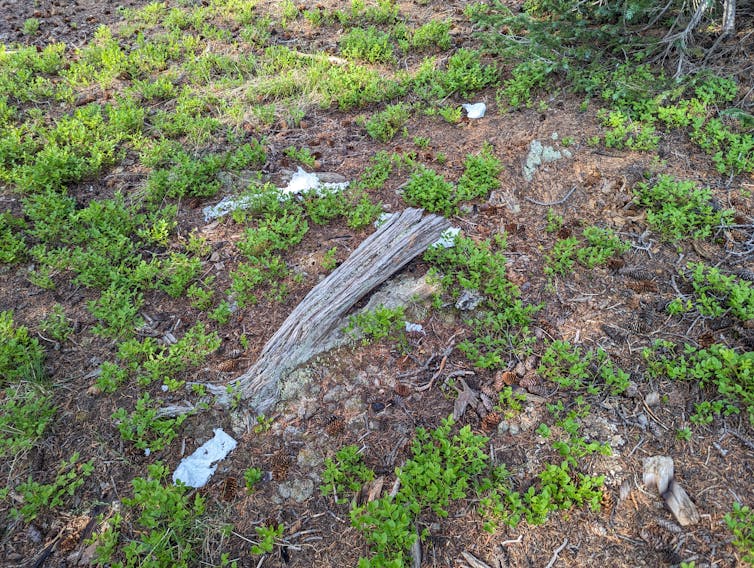 |
| Toilet paper waste on Mount Elbert in the San Isabel National Forest in Colorado. Shari Edelson, CC BY-ND |
As a researcher and a Ph.D. candidate who study human impacts on parks and protected areas, we have been thinking quite a lot about poop and ways people can tread more lightly on the landscape.
Our focus is on Leave No Trace, an environmental education framework – created by an organization with the same name – that helps people implement minimal-impact practices in the outdoors.
Saturday, July 19, 2025
Study reveals for the first time the extent to which nanoplastic pollutes the North Atlantic
Underestimated sources of marine pollution
Helmholtz Centre for Environmental Research

The
findings show that nanosized plastic particles are present at all depths
between the temperate and subtropical zone of the ocean. By mass, the amount of
nanoplastic is comparable to that of microplastic. An article published
in Nature concludes that nanoplastic plays a far greater role
in marine plastic pollution than previously assumed.
Plastic waste pollutes oceans across all regions of the world. Marine animals may become entangled in larger plastic debris such as nets and bags or mistake smaller pieces for food. Ingested plastic can block or injure the gastrointestinal tract. The smallest plastic particles in the micro and nano range are mostly excreted, but a small proportion can pass through the intestinal wall and enter the bloodstream.
Friday, June 20, 2025
URI Cooperative Extension program aims to rescue and recycle food by changing the way Rhode Islanders interact with it
Course applications now open for six-week Food Recovery for Rhode Island

Attendees learn how to make the most of their grocery
purchases, preserving and storing them properly. Through hands-on experiences
exploring the local food system on farms, community gardens, and in kitchens,
participants will:
- Gain
skills in canning, pickling, dehydrating and freezing the harvest
- Improve
their home composting
- Get
involved with community composting
- Rescue
surplus food
- Network
with inspiring organizations making changes at the grassroots level
- Learn
about employment helping schools establish share tables and compost
sorting stations in the cafeteria
The reasons for making changes are clear. Wasted food is the
most common item in Rhode Island’s Central Landfill with 100,000 tons entering
the landfill each year. Yet 38% of state residents experience food insecurity
and the demand for food assistance has increased 9% in the past year. Each
month, approximately 84,400 Rhode Islanders seek assistance at food pantries
across the state.
All Rhode Islanders benefit from reduction of greenhouse
gasses by diverting material from the state landfill. In the meantime,
community members also benefit when food can be diverted to hunger relief
agencies, helping to bolster the state’s emergency food system.
One participant, Laurel Spears, is using what she learned in
her work at the Tomaquag Museum, teaching the indigenous community about modern
composting methods, exploring traditional food preservation techniques, and
promoting the importance of foraging, growing, and utilizing produce in its
entirety.
Thursday, June 19, 2025
Bad bottle bill news
Bottle bill shelved in favor of another study while CRMC reform effort is set adrift
By Nancy Lavin, Rhode Island Current

“I am not happy,” the South Kingstown Democrat said.
That’s because 24 hours earlier, House Speaker K. Joseph Shekarchi and Senate President Valarie Lawson unveiled amended legislation gutting McEntee’s 57-page bill. Gone is the proposed 10-cent fee on recyclable bottles redeemed upon return to designated redemption sites.
In its place, another study, this time, by a third-party consultant hired by the Rhode Island Department of Environmental Management (DEM). The compromise aims to find middle ground for environmental advocates and beverage makers and retailers, who failed to reach consensus on a deposit-refund program.
Meanwhile, a separate environmental priority to overhaul the troubled Rhode Island Coastal Resources Management Council (CRMC) also appears dead in the water amid hesitation at the corresponding price tag, with a less extreme alternative in its place.
Tuesday, May 13, 2025
R.I.’s bottle bill faces fierce industry opposition despite commission’s two-year effort
Spending big bucks to block needed legislation
By Christopher Shea, Rhode Island Current

But at least two of the commission’s 20 members, both of whom work in the industry, remained firmly opposed to two of the “three bottle bills” receiving an initial vetting before the Senate Committee on Environment and Agriculture Wednesday.
Their displeasure was targeted toward a bill sponsored by Sen. Bridget Valverde, a North Kingstown Democrat, and another bill by Sen. Mark McKenney, a Warwick Democrat, calling for a 10-cent fee on individual beverage containers. Consumers could get their money back upon returning the containers to designated redemption sites run by a nonprofit contractor hired by beverage producers.
The point of a redemption program is twofold: to discourage littering and to reduce the waste accumulating in the state’s Central Landfill in Johnston. A report published last month by the commission notes roughly 1,000 tons of microplastic was detected by University of Rhode Island researchers within the sediment of Narragansett Bay — which ultimately end up being consumed by marine species that humans then eat.
Of the six New England states, only Rhode Island and New Hampshire do not have a bottle refund program.
But reaching a compromise with industry leaders was always going to be an uphill battle. Even before the final report was issued in April, five beverage industry members who sat on the commission issued a letter stating they supported none of the recommendations for a proposed bottle deposit program, citing concerns over cost, implementation, and balance issues in the region.
“The intention of this bill is definitely honorable,” Rhode Island Food Dealers Executive Director Scott Bromberg, who served on the commission, told lawmakers Wednesday. “But we beg the question: Is this the right time to propose additional fees to everyday, regular Rhode Islanders?”
He added that businesses would ultimately pass on the 10-cent fee to consumers — at a time when tariffs threaten to drive prices even higher.
“While 10 cents may not seem like a lot on one bottle, $2.40 for a case of $5 bottles of water is significant,” Bromberg said. “This can be recouped, but return is often unpredictable.”
Nicholas Fede Jr., executive director for the Rhode Island Liquor Operators Collaborative, also served on the commission, said the state should instead focus on updating existing curbside infrastructure to better sort out recyclable materials that may end up crushed in the landfill.
“People want to do the easiest thing possible, and that is curbside,” Fede told the committee. “The fact that we’re going to make people take their recyclables to a redemption center is a massive inconvenience.”
McKenney, commission co-chair, sees a bottle bill as an obligation to a cleaner future.
“We can kick the can down the road — it can be our children’s problem, it could be our grandchildren’s problem,” said McKenney, a Warwick Democrat. “But we do have to ask what kind of state we are leaving for them.”
Lack of consensus
Bottle bill supporters and opponents have tried to show the public is on their side. But the results of surveys on the subject favor whoever commissioned the poll.
A survey released Tuesday by a group calling itself Stop the Rhode Island Bottle Tax found that 60% of 600 respondents were opposed to the legislation. The group is backed by the American Beverage Association. EDITOR'S NOTE: I was one of those called for this poll. I said I supported the deposit bill. It was a "push" poll where the questions were designed to give them the answers they wanted, but not with me. - Will Collette
Subscribe to:
Posts (Atom)