Menu Bar

Home           Calendar           Topics          Just Charlestown          About Us
Showing posts with label Valerie Lawson. Show all posts

Saturday, September 5, 2026

South County Democrats: Beware of DINOs on the Sept. 9 Primary ballot

The League of RI Businesses is a wolf in sheep’s clothing

An oped from Bill Ibelle


There’s a new, big-money player on the Rhode Island political stage that’s targeting many of our finest environmental legislators because they also support gun control.

The League of RI Businesses is a wolf in sheep’s clothing, posing as a moderate, bipartisan, pro-business organization, when in fact, it was created last year specifically to knock off legislators who voted for a ban on assault weapons.

So if you feel safer knowing the guy down the street has an assault rifle hanging in his living room gun rack, then by all means, vote for a League-endorsed candidate. (listed below).

The League’s founder, David Levesque, knows that most Rhode Islanders don’t believe a deer hunter needs to pump out 60 rounds a minute to bag a doe. 

So Levesque and his cohorts rarely mention assault weapons when explaining why the League has targeted so many fine legislators. Instead, in an interview with Ocean State Media, he said that the League is merely targeting legislators who “fail to support the Constitution.” Only when pressed repeatedly by an interviewer does he concede that he’s referring exclusively to the Second Amendment—the right to bear arms.

Apparently, the League believes that James Madison had assault weapons in mind when he introduced the amendment to Congress in 1789. Never mind that an assault rifle, at that time, was a musket, a ramrod, a powder pouch, and a lead ball that took nearly a minute to load and, because it had no rifling, had the accuracy of a pea shooter.

He’s also against renewable energy because it’s unprofitable, doesn’t work, and has driven up electric rates by 27 percent — all untrue. What is true is that he revealed his true colors when he claimed that if we eliminated all state wind and solar programs, “we could literally put almost $30 million a month back in the hands of Rhode Island businesses.” Translation: The heck with our children’s future, we want bigger profits now.

Levesque insists that his group wants “middle-of-the-road, common-sense people” in office. This seems just a wee bit hard to believe, given that Levesque is a vocal Trump supporter who, when asked by the Providence Journal about our president’s second term, said, “I think it’s going awesome.”

So if ICE raids make you feel safer; if you think the war with Iran is the best use of $37 billion in taxpayer money; if you believe the skyrocketing price of oil is the path to affordability; and if you thrill at the grade-school insults our leader routinely hurls at our foreign allies—then by all means, take the League’s advice on who to vote for.

If you’re still not convinced that this organization is poison, consider the League’s subversion of the state’s campaign finance laws. To get around the state’s $2,000 limit on individual donations, they formed 40 separate Political Action Committees (PACs). In an interview with Channel 12, Levesque boasted that “What we did is extraordinary. It’s never been done before. We opened more PACs than anybody’s ever done [in Rhode Island]. This will allow us to give $80,000 to an individual candidate. There’s no other organization in the state of Rhode Island that can put that kind of money into a candidate’s hands.”

Just to be clear, the state donation limit is $2,000 and the League says its armada of 40 PACs makes it legal to give $80,000.

If you would like to reduce the influence of money in state politics, you might want to vote against the candidates the League is financing.

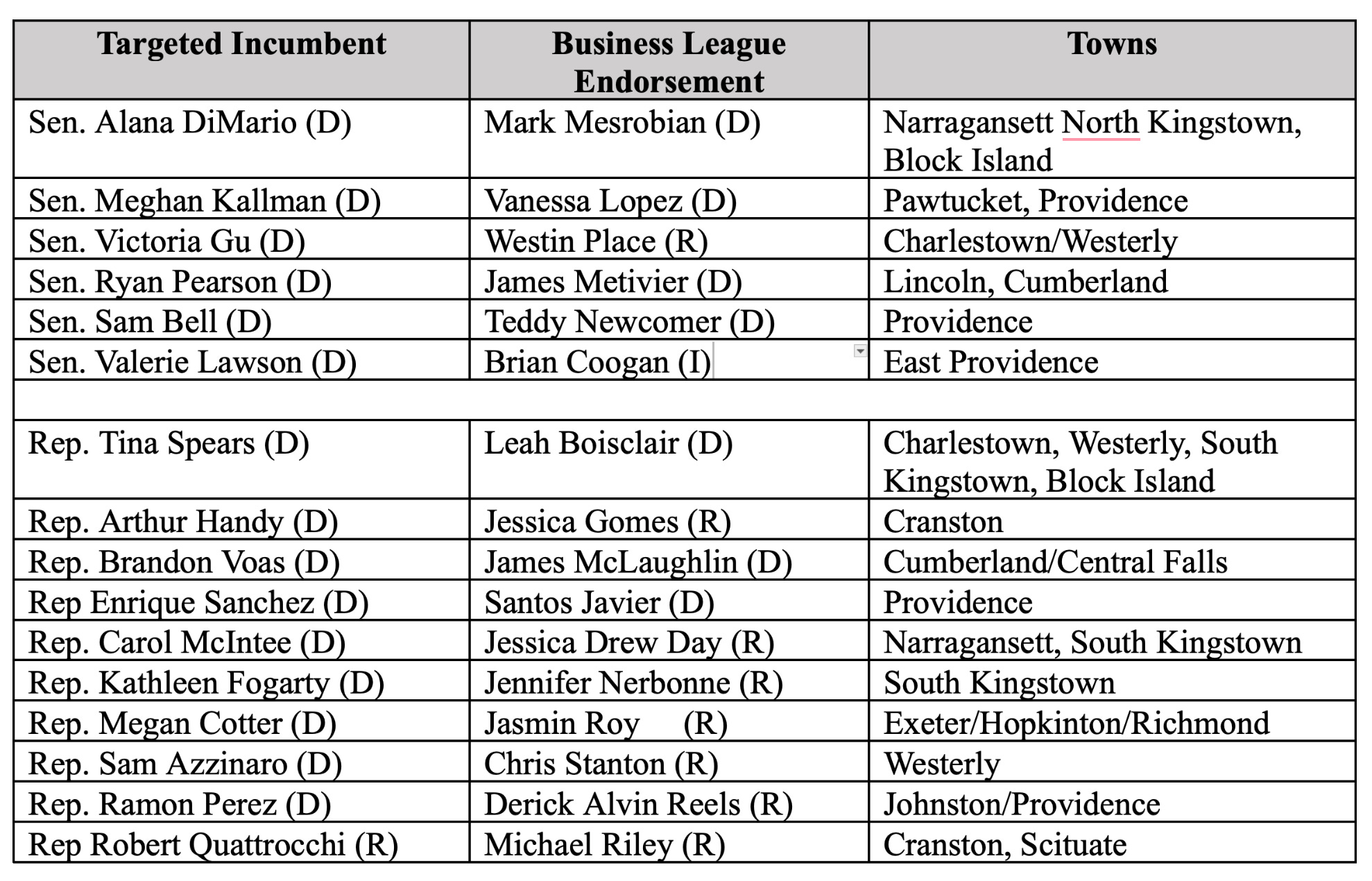
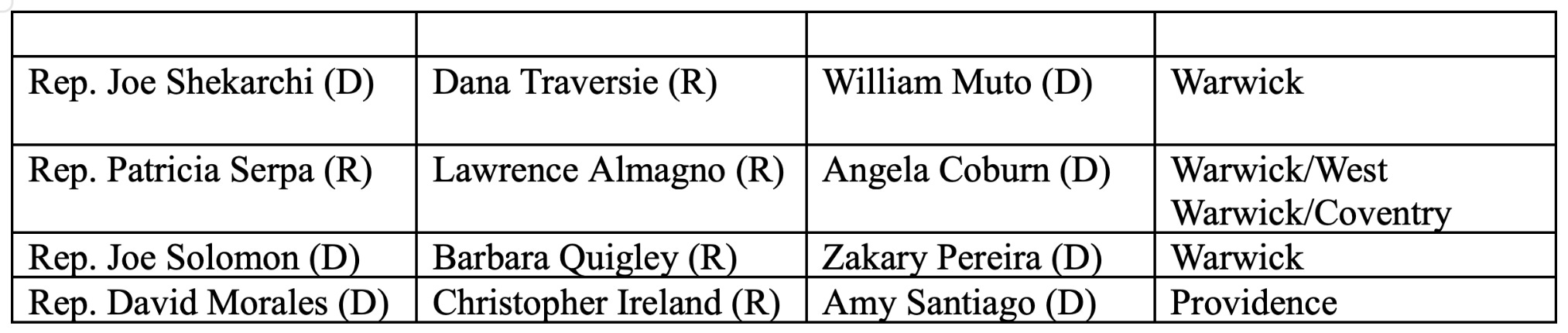
Here is a list of incumbents the League has targeted and the candidates it is backing to unseat them:

The League also endorsed nine incumbents: John Brien, Elaine Morgan, Leonidas Raptiakis, Patrick Maloney, Gregory Constantino, Marie Hopkins, Paul Santucci, Stephano Famiglietti, and six candidates running for open seats:


Wednesday, July 1, 2026

President Lawson, Rep. Cotter bill to establish limits on grocery self-checkouts signed

Thank you, Megan!

Bill sponsors Senate President Valarie J. Lawson and Rep. Megan L. Cotter were joined by Governor Dan McKee for a ceremonial signing establishing limits on the use of self-checkout lanes at grocery stores in Rhode Island.

The legislation (2026-S 2342B, 2026-H 7290A) requires grocery stores with self-checkouts to have a minimum of one staffed checkout for every three self-checkouts operating, with at least one of the self-checkout stations meeting the accessibility standards of the Americans with Disabilities Act.

It also requires that grocery store employees be relieved of all other duties, including operating a manual checkout station, while monitoring self-checkout stations.

President Lawson and Representative Cotter said they introduced the bill out of concern for those who work as cashiers, and for customers who struggle with frustrating self-checkout experiences, particularly elderly customers.

Sunday, June 14, 2026

General Assembly passes protection for Rhode Islanders to get vaccines

Elaine Morgan was the only NO vote in the Senate

Steve Ahlquist

Charlestown's Sen. Elaine Morgan.
Whatever it is, she's against it
The Rhode Island General Assembly approved legislation on Tuesday, introduced by Senator Linda Ujifusa and Representative Susan Donovan, to protect coverage for routine childhood and adult vaccines under Rhode Island law.

This bill (S2379A, H7625A), which now goes to the governor, gives Rhode Island a clear statutory framework to ensure vaccines remain accessible, affordable, and grounded in public health science. It requires state-regulated health insurers in Rhode Island to cover vaccines recommended by the Rhode Island Department of Health (RIDOH) without cost-sharing barriers.

“We don’t have to speculate about the risks of not protecting access to vaccinations,” said Senator Ujifusa (Democrat, District 11, Portsmouth, Bristol). “We can already see the consequences, with measles outbreaks emerging across the country as anti-vaccine messages have gained traction. Rhode Island is acting now to make sure cost and uncertainty never stand in the way of basic public health.”

“Vaccination has been one of the great success stories of public health, protecting not only the vaccinated but also entire communities,” said Representative Donovan (Democrat, District 69, Bristol, Portsmouth). “This bill ensures that here in Rhode Island, coverage for vaccines is protected and that our vaccine guidelines continue to be based on sound medical science.”

The bill comes in response to the Trump Administration’s war on vaccine science. Last year, the U.S. Health Secretary Robert Kennedy Jr replaced all 17 members of the Advisory Committee on Immunization Practices (ACIP), the independent panel that advises the Centers for Disease Control and Prevention on vaccine recommendations. The committee was subsequently reconstituted with new appointees, including individuals who have previously been skeptical of the efficacy of vaccines and the federal pandemic response.

The legislation ensures Rhode Island retains the authority to act promptly and responsibly to protect public health. It follows the lead of other states, including Massachusetts, and ensures that any vaccine recommended by the Rhode Island Department of Health is covered without cost-sharing for every Rhode Islander, whether they have private insurance, Medicaid, or state employee coverage.

The bill passed in the House, but 14 Representatives, Democrats, Republicans, and the one Independent, voted against it. 

Over in the Senate, the bill passed with only one vote against.  

EDITOR'S NOTE: That was Sen. Elaine Morgan who "represents" the northern half of Charlestown. She's a corrupt MAGA-nut who has achieved virtually nothing for her constituents. She faces a strong challenger, Samantha "Sam" Wilcox, Democrat, who currently serves as Richmond Town Council president. To stop Morgan from further embarrassing us, I urge you to support Sam Wilcox for RI Senate District 34. I do. - Will Collette 

Here’s the video of the discussion on the House floor: RI State Representative Charlene Lima vs Vaccines

The discussion on the floor is presented here, edited for clarity, where clarity was possible:

Thursday, March 19, 2026

What’s inside the Rhode Island Senate’s 2026 health care bill package

Rhode Island is on its own in fight to improve health care

By Alexander Castro, Rhode Island Current

The Rhode Island Senate on March 12 released its third annual bundle of health care bills for this year’s legislative session, with proposals from ensuring the 988 hotline stays live to guardrails on AI usage in psychotherapy to initial funding for a proposed medical school at the University of Rhode Island (URI).

The 17-bill package is nearly double the size of last year’s collection, which sported nine pieces of legislation.

“These are complex issues we’re facing,” Senate President Valarie Lawson said at a State House event Thursday introducing the package. “And this is a long, long process.”

Lawson said the chamber’s priorities reflect listening to consumers and primary care providers over the last couple of years as well as the work of a special Senate-led commission which determined in January that a medical school at URI would help alleviate the state’s primary care workforce shortage.

Senate Committee Health and Human Services Chair Melissa Murray joined Lawson and bill sponsors in the Senate Lounge to present their lawmaking to-do list, which Murray described as orbiting three major themes:

  • One suite of bills aim to support people in crisis by improving access to behavioral health resources.
  • Another tranche would boost the Ocean State’s health care workforce.
  • The last set seeks to protect patients and providers via initiatives like further regulation of pharmacy benefit managers (PBMs) and updated vaccination schedules for children.

“While we know that solving the crisis cannot be accomplished through any single piece of legislation, or any one collection of bills, those being highlighted today build on our past progress and help address the most pressing needs of this moment,” Murray said in a statement. “Achieving our goals will be a long-haul effort, and our chamber remains truly committed to seeing it through.”

Before Thursday, six of the package bills had already been introduced and await hearings in their respective committees. The remaining 11 bills were introduced Thursday and await hearings.

Wednesday, October 1, 2025

McKee faces backlash for keeping Washington Bridge forensic audit secret for over a year

McKee fails Watergate test - that the cover-up is worse than the crime

By Christopher Shea, Rhode Island Current

Corrosion and section loss are visible in this inspection photo of exterior tie-down rod for cantilever beam F at Pier 6 on the Washington Bridge, taken July 21, 2023. (Photo from Wiss, Janney, Elstner Associates Inc. report)

Legislative leaders on Monday called for yet another oversight hearing on the handling of the 2023 closure of the westbound Washington Bridge, three days after the release of a long-awaited forensic audit of what led to its failure was made public.

The audit report commissioned by Gov. Dan McKee had been kept under wraps by the state for more than a year after he first promised to make it public during a March 2024 press conference when he announced the bridge would need to be rebuilt.

Then on Friday evening, the 64-page report by Illinois-based engineering firm Wiss, Janney, Elstner Associates Inc. (WJE) was posted online by Rhode Island Attorney General Peter Neronha’s office, which is actively suing 13 of the vendors contracted to conduct maintenance. Contents of the analysis were first reported by WPRI-12. 

House Speaker K. Joseph Shekarchi and Senate President Valarie Lawson said late Monday afternoon they were “deeply troubled by the findings” of the audit, which identified decades worth of failures by the state and its contractors responsible for maintaining the westbound span of Interstate 195.

Friday, July 4, 2025

Rhode Island Democratic Leaders blast Trump’s Big, Beautiful Boondoggle

Trump and His Mean-Spirited Republican Congress Destroy Sixty Years of Progress

Statement from U.S. Senator Jack Reed

“Republicans knew this bill is a bad deal for their constituents and passed it anyway.  This bill goes against the self-interest of average Americans in favor of the ultra-wealthy and corporations.  It slashes the safety net out from under hardworking families – taking away health care from millions -- in order to give special interests bigger tax benefits.  Republicans structured the bill so the ultra-wealthy can cash out right away while the little guy and average taxpayers will get stuck paying the bill for years to come.

“During this unprecedented time of chaos and dysfunction, it’s easy to get overwhelmed and miss the latest developments. But the negative impacts of this bill must cut through the noise. Americans must be informed about the consequences of this legislation and they deserve to hear plainly from their elected representatives about how this bill is going to impact their families.

“Republicans are shifting a heavier financial burden onto families, communities, hospitals, and states.  Taking away people’s health coverage doesn’t mean they stop getting sick or can’t see a doctor.  Health costs for everyone will rise.  And it takes away over one trillion dollars in federal funding that states and localities rely on to provide vital services like schools, transit, nutrition assistance and aid to families in crisis.

“This fiscally irresponsible giveaway to the wealthy and well-connected is a debt-busting disaster.  It will cost U.S. taxpayers trillions of dollars in interest payments and Republicans unilaterally approved a record-breaking $5 trillion dollar debt limit increase.  But that’s just debt already incurred – this bill will add trillions of dollars in future debt when it’s all said and done, with little to no long-term benefit for middle- and working-class families. 

“Whatever short-term economic benefits this bill may offer, it will do lasting destructive damage to U.S. finances and young Americans will be forced to pay for it long after Donald Trump is gone.”

Statement from U.S. Senator Sheldon Whitehouse

“Trump’s Big, Beautiful-for-Billionaires Bill is one massively destructive piece of legislation.  Cooked in back rooms, dropped at midnight, and fraudulently scored, it increases costs for everyone by walloping the health care system, making families go hungry, and sending utility bills through the roof.  It saddles our children and grandchildren with trillions and trillions of dollars in debt – all to serve giant corporations, fossil fuel polluters, and billionaire Republican megadonors who are already among the richest people on the planet.”

Statement from Congressman Seth Magaziner

“Republicans in Congress have jammed through a bill that guts programs working people rely on to hand out tax breaks to the wealthiest people on the planet.

“The final version will cause millions of people to lose their health insurance, and will increase costs for millions more by slashing Medicaid, Medicare, and the Affordable Care Act. It also cuts over $100 billion from SNAP, which helps 40 million Americans put food on the table, and will eliminate good-paying clean energy jobs in Rhode Island and across the country.

“This bill represents the largest transfer of wealth from working people to the ultra-wealthy in U.S. history, and is a shameful betrayal of the basic promise that the government should work for everyone, not just those at the top.

“Today, I voted ‘no’ and I will keep fighting back against cruel attacks on working Rhode Islanders. Despite today’s setback, our fight to lower costs and improve quality of life for working people will continue.”

Sunday, June 29, 2025

Five losses from Rhode Island’s 2025 legislative session

RIPTA, climate change, open records reform, school lunch and McKee's agenda lose out

By Nancy Lavin, Christopher Shea and Alexander Castro, Rhode Island Current

More than 2,500 bills and resolutions were introduced across both sides of the State House rotunda this year. But far fewer — about 300 when discounting resolutions extending congratulations and condolences, and granting officiants’ wedding rights — survived the six-month session.

Some were killed outright, while others were left to languish in political purgatory known as legislative committee, or without the necessary budget funding to survive. 

Earlier, we brought you five wins from the legislative session. Now, here are five losses.

1. Gas tax hike not enough to avoid layoffs and service reductions at RIPTA

Cuts are coming soon to the state’s public bus service. That’s even after the General Assembly propped up the Rhode Island Public Transit Authority (RIPTA) with nearly $15 million in the fiscal year 2026 budget, including with revenue from a 2-cent increase in the state’s gas tax.

It wasn’t enough to fill what was a $32.6 million shortfall when Gov. Dan McKee released his version of the budget in January. After state lawmakers reduced the deficit to $18 million, RIPTA CEO Christopher Durand said 90 layoffs and a 20% reduction in service may be necessary.

Durand told reporters Thursday afternoon that the deficit was down to $10 million after the agency identified another $8 million in savings from a “favorable price lock” in diesel fuel, along with a positive market performance for the agency’s pension plan.

When cuts would take effect is still to be determined. The agency plans to hold a series of public hearings on potential service changes starting July 28. But RIPTA already has a guide available — an efficiency study of its operations and financial situation mandated in the state’s fiscal 2025 budget. The governor and legislative leaders wanted the agency to finish the study by March 1, but the board of directors was focused on finding a permanent CEO and didn’t commission Canadian engineering consulting firm WSP to conduct the study until March 27.

Saturday, June 28, 2025

Cats among five major wins from Rhode Island’s 2025 legislative session

Rhode Island cats celebrate new ban on de-clawing

By Nancy Lavin and Christopher Shea, Rhode Island Current

Photo by Will Collette
The race to the legislative finish line this year was every bit as drama-filled and frenzied as expected. Restrictions on assault weapons got top billing, including on the eight-and-a-half hour marathon that marked the final day of the session, but there was plenty more to crow about and criticize during the jam-packed final weeks.

Here are five wins you might have missed from the 2025 Rhode Island General Assembly. Stay tuned for the losses, coming Friday.

1. Shekarchi zones in on housing

House Speaker K. Joseph Shekarchi succeeded in his push to boost housing production in Rhode Island for a third consecutive year, with 10 of the 12 bills of his legislative package clearing the Senate in the final days of the session. (All 12 had already secured approval in the lower chamber.)

That includes two bills sponsored by Shekarchi: one to expand electronic permitting and another to amend the state’s building code by centralizing the responsibilities of various officials, commissions, and boards involved in building and fire code permitting.

Other bills passed include measures to allow townhouses wherever duplexes are permitted, require mixed-use zoning in every community, and promote the conversion of vacant or underused commercial buildings into housing.

“Rhode Island’s housing crisis was decades in the making and is taking a sustained effort, over the course of years, to address,” Shekarchi said in a statement Monday.  “I am so appreciative of all of the partners who work with me to address our housing shortage, and this progress is the result of our collaborative efforts.”

Legislation that would have allowed development of vacant state-owned land did not make it across the finish line. Shekarchi described the bill as in need of some “fine-tuning,” pledging to work with the Senate on it again next year.  

Also left hanging by the Senate was legislation that would have eased local restrictions on subdividing large parcels of land, despite having passed in the House on May 15. However, Shekarchi noted that elements of the stalled bill were addressed in one of the successful 10 bills, which sought to eliminate unnecessary red tape and delays in local land subdivision more broadly.

Senate President Valarie Lawson said while there were concerns with the bill, she intends to continue to work with Shekarchi and other lawmakers to encourage further housing development.

2. All rise for AG Neronha

Rhode Island Attorney General Peter Neronha’s skilled litigation style persuaded lawmakers to his side on a host of policy changes and added funding for his office for new hires.

Neronha initially sought 13 more staffers for his office, asking for $1.7 million to fund the hires in his fiscal 2026 budget request to Gov. Dan McKee. McKee’s proposed spending plan did not offer any of the money, or additional employees.

Neronha subsequently revised his request, asking lawmakers in the House Committee on Finance for four, rather than 13, hires, funded by settlements his office had won for the states. Lawmakers included an $848,000 allocation of state settlement money for the extra AG staffers in the final fiscal 2026 budget.

Neronha thanked lawmakers for funding the hires in a statement Tuesday.

“The people of my Office show up to work every day with one goal: improve the lives of Rhode Islanders,” Neronha said. “These four additional attorneys will share in that goal, and deliver for the residents of our state.”

Neronha scored wins on several policy changes, too, including a change to state procurement to ban “bid-rigging” by public officials. The Neronha-backed legislation taking aim at McKee’s involvement in “steering” a state education contract to the ILO Group in 2021, passed unanimously in the Senate on the final night of the session, having already secured approval by a strong majority of the House. 

Lawmakers also signed on to versions of some of Neronha’s proposed remedies for the health care crisis, such as using Medicare reimbursement rates as the standard by which to hike corresponding Medicaid payments to primary care providers, and doing away with cumbersome and time-consuming pre-authorization requirements for primary care providers.

Finally, the AG’s office staved off an eleventh hour challenge by House Republicans to his authority over state settlements. GOP lawmakers unsuccessfully attempted during the House budget vote on June 17 to siphon $11 million from the AG’s fiscal 2026 funding as a quid pro quo for what they argued was an unconstitutional overstep of his authority. Neronha had already set in motion a plan to spend the $11 million state settlement from the Route 6/10 contamination lawsuit on pediatric dental care in Providence. 

Speaking to reporters after the June 17 House budget vote, Shekarchi affirmed Neronha’s authority over the state settlement funds.

“If this particular settlement was unfair, the solution is to appeal that,” Shekarchi said. “What we’re doing with the money is helping underprivileged children with health care and dental care is a good thing and I will never be against that.”

3. Republicans at the ready for 2026

RI Republicans outraged at infringement
of this guy's 2nd Amendment rights
The most high-profile victory of the session belongs to those who supported a state ban on assault-style weapons — even if the final legislation did not go as far as some had hoped. 

But state Republicans wasted little time turning “L” on what they say is a matter of Constitutional rights into a potential win for the party and its candidates in the 2026 election cycle.

GOP Chairman Joe Powers initiated the call to action Friday night, declaring it was actively recruiting candidates to challenge the “anti-Constitution, anti-liberty legislators” who voted to limit assault-style weapons in the state.

“We now have a clear, targeted list of every legislator who voted to betray their oath — and their time is running out,” Powers said in a statement. “To every Rhode Islander who still believes in the Constitution — we’re not going to fix this by posting memes or yelling at the TV. We fix it by running for office, knocking doors, and taking back this state seat by seat.”

His call to action has already been met with a flurry of responses — a few dozen potential candidates have reached out to the Republican Party in just the last four days, Powers said Tuesday night.

Meanwhile, Senate Minority Leader Jessica de la Cruz of North Smithfield debuted a new “Keeping the Spirit of 1776 Alive” fundraising campaign Tuesday morning, seeking support and donations to retain and boost the Republican’s 14-person presence on Smith Hill.

It’s no secret that state and local Republican party committees have struggled to recruit candidates for state and local office, diminishing their voice in a solidly blue state. Could the contested ban on assault weapons sales change the tides in their favor?

Sunday, June 22, 2025

Compromises on assault weapons, casino smoking and CRMC reform mark end of 2025 session

You can't always get what you want, but if you try some time, you might not even get what you need

On some key issues, General Assembly opts for baby steps

By Nancy Lavin, Christopher Shea and Alexander Castro, Rhode Island Current

Rep. Teresa Tanzi, a South Kingstown Democrat, speaks in
the House chamber on Friday, June 20, 2025.
(Photo by Nancy Lavin/Rhode Island Current)
Explosive debate over assault-style weapons — what types of guns and owners to restrict, if any — carried through the final day of the 2025 legislative session Friday.

After a series of failed attempts to weaken and strengthen a proposed limit on assault-style weapons, a ban on sales and manufacturing — but not possession —  ultimately prevailed.

True to form, lawmakers found plenty more to debate and discuss over the marathon day that stretched late into the evening. 

As the sun went down, the temperature inside the airless second-floor chambers seemed to rise. On what was the first full day of summer, lawmakers quenched their thirst with Del’s frozen lemonade and an endless carousel of caffeinated beverages.

Senate Majority Leader Frank Ciccone donned shorts in an unusually casual fashion choice, displaying a rarely seen calf tattoo of his late dog, Gunther.

Senate softens state’s aim on assault weapons 

You can still own an assault-style weapon in Rhode Island, but can’t buy or sell it. That’s the gist of the legislation approved by both chambers in an eleventh-hour rework aimed at appeasing at least some of its critics.

The rewrite was led by the Senate, which kicked off its marathon session with an hour-long debate, culminating in a 25-11 vote, to approve the bill banning the manufacture and sale of semi-automatic rifles, shotguns, and handguns with military-style features beginning July 1, 2026. It does not address inheritance of these weapons.

“The expectation over time is the proliferation of assault-style weapons, as specified in the bill, will go down,” Sen. Lou DiPalma, a Middletown Democrat and bill sponsor, said. “We need to get this done today.”

The Senate’s checkmate forced the House, which had already approved a more restrictive version that also banned possession, to reconsider. The lower chamber eventually caved to the Senate’s less stringent counterpart by a 43-28 vote just before 9:30 p.m.

The House’s vote came after a nearly two-hour break likely marked by behind-the-scenes negotiations, and an additional, five-minute recess for representatives to familiarize themselves with the Senate’s changes.

“This bill cuts off the supply of weapons of war for the long haul at the point of sale,” Rep. Jennifer Boylan, a Barrington Democrat and gun safety advocate, said. 

Rep. Jason Knight, a Barrington Democrat, also backed the Senate version, despite its significant changes from the more sweeping ban he had successfully advanced through the House chamber already.

“The two bills in their effect on the ground are closer to each other than you think,” Knight said, noting that the difficulty in procuring a new assault-style weapon even in other states prevents expansion of the “universe” of such weapons in Rhode Island.

Yet, the compromise was met with some dissatisfaction from both sides. The Rhode Island Coalition Against Gun Violence had denounced the “watering down” of what had been a much more sweeping ban on assault-style weapons. 

Sen. Pamela Lauria, a Barrington Democrat, sought to amend DiPalma’s bill to mirror the House version, despite the Senate Committee on Judiciary opting to hold the stronger option for further study on Wednesday. 

“As we look to pass critical legislation regarding assault weapons, we should have taken the opportunity to pass the best version of this bill,” Lauria said.

But after Senate Republicans, along with Ciccone, raised objections, Senate President Valarie Lawson ruled that Lauria was out of order.

Republicans, along with some conservative Democrats, and gun rights groups maintained that no ban at all was the answer. All four Senate Republicans, plus some conservative Democrats, voted against the ban on the manufacture and sale of assault-style weapons.

Across the rotunda, Cranston Rep. Charlene Lima, a conservative Democrat, also denounced the compromise bill for going too far. Her critiques were met with raucous applause from yellow T-shirt-wearing Second Amendment supporters seated in the gallery. House Speaker K. Joseph Shekarchi issued a stern rebuke, noting the seriousness of the topic before them.

“We will not have interruptions,” Shekarchi told onlookers. “If there is another uproar, I will close the gallery and you can watch on TV.”

Despite the warning, gun rights advocates booed after the House passed the amended bill.

The final version drew support from Everytown for Gun Safety, which maintained the language still covers the majority of the assault-style weapons frequently used in mass shootings. The Rhode Island AFL-CIO, a strong supporter of Lawson, also backed the proposal in a statement Thursday pointing to the union’s February poll that found 64% of residents support “banning the sale and manufacture of military-style assault weapons” in the state. 

Gov. Dan McKee, who had posed the weapons ban as a budget issue earlier in the year, confirmed via social media he will sign the measure into law.

“I’m proud that Rhode Island took an important step forward in protecting our communities from gun violence,” he posted to X at 9:50 p.m.

Clearing the air in R.I.’s two casinos

Bally’s two Rhode Island casinos will be slightly less smoky starting in 2027 — 18 months later than its advocates wanted.

The delayed start combined with a second, late-in-the-session clawback prompted longtime advocate and sponsor Rep. Teresa Tanzi to withdraw her name from her own bill after the opposite chamber added a carveout for smoking bars within casinos. Tanzi was one of four Democratic representatives to vote against the bill she introduced, though it prevailed with 67 supporters in the House Friday.

Tanzi, a South Kingstown Democrat, railed against the revised proposal, declaring it was “nothing like” her original, which had called for the smoking ban to start July 1, 2025, with no exceptions.

Rather than banning smoking in Bally’s Corp.’s Lincoln and Tiverton casinos altogether, the amended legislation adds an exemption for smoking lounges with a new, hazy definition, Tanzi argued.

“This does not prevent Bally’s from expanding cigarette smoking or cigar smoking or vaping or, I don’t know, cannabis,” Tanzi said. “It’s really not clear to me what this new definition is because there’s all of a sudden a brand-new definition about smoking lounges.”

Existing state law defines “smoking bars” as businesses where tobacco sales are greater than 50% of its total revenue. The amended version offers new meaning for a – “pari mutual facility smoking lounge,” defined as any kind of smoking bar with a “proper ventilation system” that will “prevent the migration of smoke to nonsmoking areas.”

In Tanzi’s interpretation, that means any walled-off section of the casino floors could remain a smokers’ paradise.

The Senate already approved the modified smoking ban under a unanimous vote Wednesday. Though Sen. V. Susan Sosnowski sponsored her chamber’s version, Senate Majority Leader Frank Ciccone brokered the compromised legislation after initially seeking to reach an agreement between Bally’s and union leaders to expand existing nonsmoking areas at the Lincoln facility. 

Bally’s Corp. officials had opposed the proposed smoking ban, citing a potential annual revenue loss of $30 million to $60 million. Company spokesperson Patti Doyle thanked legislators for the compromise.

“Confining smoking to an existing smoking lounge at our Lincoln venue and allowing for a delayed transition away from smoking on the gaming floor will hopefully mitigate a portion of that anticipated revenue loss to the state,” Doyle said in a statement late Friday.

Union workers who for years have decried the health consequences of smoke-filled working conditions reluctantly agreed to the compromise version as “the best we could get,” Tanzi said Friday. However, the union wants to revisit the topic when lawmakers reconvene, either in a possible fall session in October or when it starts its next regular session in January, Tanzi said.

“I had a lot more faith in our legislators,” Vanessa Baker, an iGaming manager at Bally’s Twin River Casino in Lincoln, said in a phone interview Friday. “I thought they thought we were people.”

15th time’s a charm on payday lending reform

Cracking down on predatory payday lending practices drew strong support in the Rhode Island Senate Friday. The 27-6 vote came swiftly and with little debate — a stark contrast to the 15-year battle to move the legislation out of committee to the chamber for a vote.

Having already passed in the House with unanimous support Monday, the Senate’s endorsement sets the stage for the long-awaited end to triple digit interest rates on short-term, small-dollar loans — though not as soon as some advocates had hoped. A last-minute revision delayed the start date till January 2027 in an effort to give time to the “deferred deposit providers” like Advance America to wind down operations, and for their employees to find new jobs.

Under existing law, these storefront lenders had been able to take advantage of a loophole in state law to charge an annual percentage rate up to 360%. The legislation caps the annual interest and fees at no more than 36%, mirroring policies already adopted by 22 states and the federal government.

Kicking the can on a bottle bill

Rather than start prescribing specifics of a deposit-refund program for recyclable bottles, glasses and cans, both chambers approved a modified bottle bill Friday that advances only a small component of the original calling for yet another study of the policy. 

The 53-11 and 36-0 votes in the House and Senate, respectively, came with reluctant support from Democratic backers who blamed opposing retailers and beverage manufacturers for mounting a misinformation-laden opposition campaign.

“There is still a great deal of conflicting data as to the implementation of best practices to address the problems of improving and disposing of our recyclable products, as well as enhancing our anti-littering efforts,” Shekarchi said in a statement earlier this week.

Rep. Carol McEntee, a South Kingstown Democrat and bill sponsor, also expressed disappointment, stating outright that the watered-down version is not a bottle bill at all, calling just for a series of studies.

Instead, the legislation calls for a “statewide implementation analysis” to be conducted by a third-party consultant hired by the Rhode Island Department of Environmental Management. The study would now be due no later than Dec. 1, 2026, with an interim status report due April 1, 2026. The state-hired consultant would consider the conclusions drawn by an 18-month legislative study commission, and the original bottle bills.

McEntee, who co-chaired the prior study commission, has already indicated she’s planning to introduce a full-fledged bottle bill again next session, even though the state analysis will not be finished yet.

CRMC membership changes on the horizon

Change is coming to the Rhode Island Coastal Resources Management Council, though not the sweeping reform advocates wanted. Rather than abolishing the politically appointed council and reshaping the agency as an administrative authority, lawmakers in both chambers narrowly agreed to a more modest update.

The bills, approved by 49-19 and 25-10 votes in the House and Senate, respectively, Friday, reduce the size of the council from 10 to seven members, simultaneously shrinking the quorum requirement in a nod to the vacancy issues that have plagued the existing panel. And it adds new professional qualifications for the powerful coastal regulatory body, specifically requiring an engineer, a coastal biologist and an environmental organization representative to sit on the new council. 

The existing council does not have any expertise requirements, though members must represent a variety of municipalities based on size and coastal proximity.

How fast the refresh occurs depends largely on how fast new candidates can be found; the legislation calls for Gov. Dan McKee to name six appointees (the seventh is designated as a DEM representative) no later than March 1, 2026. But the bill also says existing members can continue to serve until their replacements are named.

Progressive Democrats and Republicans joined in opposition, with the former insisting the membership changes fell too far short of more comprehensive reforms needed.

Legislators reprimand McKee with anti-bid rigging bill

McKee just can’t seem to escape the stain left by a 2021 state education contract scandal, with an anti bid-rigging bill included on the legislature’s final calendar of the session.

The Rhode Island Senate’s unanimous approval Friday, following passage in the House two days prior, aims to close a loophole in state procurement law by expressly forbidding public officials and administrators from intentionally interfering with the process by which the state awards competitive contracts to outside vendors. 

The need for specificity was laid bare by an investigation by Attorney General Peter Neronha’s office and Rhode Island State Police into a state education contract awarded to the ILO Group. State investigators ultimately found insufficient evidence to charge McKee for steering the $5.2 million school reopening contract to one of his former adviser’s friends — in part because there was nothing in state law saying that he could not.

The newly approved legislation, however, imposes strict penalties on state officials and vendors who participate in future collusion or bid-rigging activities: a felony charge punishable by up to three years in prison and a $1 million fine (or three times the value of the contract, whichever is greater). Vendors found to have participated in bid-rigging or steering activities are also no longer able to perform work for the state for up to five years.

McKee still needs to sign the legislation for it to become law — uncertain given documented attempts by his aides to dismantle the bill earlier in the session. McKee’s office did not immediately respond to inquiries for comment later Friday.

Opposition couldn’t break levy bill

The General Assembly OK’d Providence Mayor Brett Smiley’s request to exceed the state’s annual 4% tax levy cap, clearing the way for a 7.5% increase in the amount of property taxes the city can collect in fiscal year 2026.

Providence Democrats Rep. Rebecca Kislak and Sen. Sam Zurier introduced the bound-to-be unpopular bill in their respective chambers. 

The House was the first to grant the city’s wish, passing Kislak’s bill in a 56-17 vote on May 27. The Senate passed Zurier’s version 30-7 on Wednesday. On Friday night, each chamber voted to concur with the other’s version of the bill, finalizing its passage out of the State House and toward McKee’s desk.

In the House, Zurier’s bill passed 57-14, with opposition from all 10 Republicans plus four Democrats, including Providence Reps. Enrique Sanchez and David Morales. In the Senate, Kislak’s bill passed 27-7, with Providence Democratic Sens. Sam Bell, Tiara Mack and Ana Quezada expressing disapproval similar to their House colleagues.

The extra revenue from the tweaked levy cap is meant to help resolve a budget shortfall introduced last November by a $15 million settlement between the city and the state’s education department over Providence’s public schools. The mayor, with the Providence City Council’s somewhat reluctant approval, has been counting on the levy measure as the critical piece in the city’s fiscal 2026 budget. While the mayor’s budget technically lowers property tax rates, new property valuations mean many homeowners will still see higher tax bills.   

WPRI-12 reported Wednesday that Smiley has asked McKee to sign the legislation as soon as it arrives on his desk. But even with the General Assembly’s blessing, it’s not clear if the added tax revenue will arrive in time to shore up the city’s fiscal 2026 budget, Smiley told the news station. 

Kratom clears Senate

For the second year in a row, a bill to regulate the psychoactive drug known as kratom arrived at the final night of the legislative session. Unlike last year, when the bill provoked a fierce debate in the Senate, it sailed through the chamber with a 22-9 vote.

The House version encountered more vigorous resistance when it went up for a floor vote on May 29. It passed 40-24, with a mix of Republicans, Democrats and one independent lawmaker decrying easier access to the plant-derived drug, which can be used as an opioid substitute or a stimulant.  

The bill was sponsored by Rep. Brian Patrick Kennedy, a Westerly Democrat, and Sen. Hanna Gallo, a Cranston Democrat, with the intent of bringing kratom — a product already available in gray markets like gas stations or head shops — into the sphere of regulation and taxation. This year’s bill is 25 pages, compared to last year’s six, and it would mandate strict labeling, testing, and age restrictions around kratom commerce, as well as limitations on what products could be sold mixed with kratom.

Last year, McKee vetoed the legislation — an outcome sponsors tried to avoid this year by working with the governor and the state health department to craft a more agreeable bill.

GET THE MORNING HEADLINES.

SUBSCRIBE

Rhode Island Current is part of States Newsroom, a nonprofit news network supported by grants and a coalition of donors as a 501c(3) public charity. Rhode Island Current maintains editorial independence. Contact Editor Janine L. Weisman for questions: info@rhodeislandcurrent.com.

Thursday, June 19, 2025

Bad bottle bill news

Bottle bill shelved in favor of another study while CRMC reform effort is set adrift

By Nancy Lavin, Rhode Island Current

Upon first mention of the phrase “bottle bill” at the State House Tuesday night, Rep. Carol McEntee’s face dropped.

“I am not happy,” the South Kingstown Democrat said.

That’s because 24 hours earlier, House Speaker K. Joseph Shekarchi and Senate President Valarie Lawson unveiled amended legislation gutting McEntee’s 57-page bill. Gone is the proposed 10-cent fee on recyclable bottles redeemed upon return to designated redemption sites. 

In its place, another study, this time, by a third-party consultant hired by the Rhode Island Department of Environmental Management (DEM). The compromise aims to find middle ground for environmental advocates and beverage makers and retailers, who failed to reach consensus on a deposit-refund program.

Meanwhile, a separate environmental priority to overhaul the troubled Rhode Island Coastal Resources Management Council (CRMC) also appears dead in the water amid hesitation at the corresponding price tag, with a less extreme alternative in its place.

Saturday, June 7, 2025

Rep. McEntee, Sen. Sosnowski introduce bill to help Matunuck Oyster Bar ‘Take It Outside’

Sounds like a great idea!

After the devastating fire that ripped through Matunuck Oyster Bar in South Kingstown, Rep. Carol Hagan McEntee and Sen. V. Susan Sosnowski have introduced legislation that would enable the restaurant to reopen on a limited basis.

The legislation would allow the restaurant to serve customers across the street in a parking lot that is owned by Perry Raso, who owns Matunuck Oyster Bar, and keep 50 employees of the restaurant working during the busy summer months.

The House bill (2025-H 6392) is expected to be heard by the House Committee on Small Business on Tuesday.  Representative McEntee chairs the committee. The Senate bill (2025-S 1139) is also expected to be heard by the Senate Committee on Housing and Municipal Government on Tuesday.

“The award-winning Matunuck Oyster Bar is a beloved part of the South Kingstown and Rhode Island community and everyone was devastated when the fire broke out a few weeks ago.  Its success elevates the town and both locals and tourists alike have made this restaurant a true destination in Rhode Island.  This legislation is the least we could do to help weather the difficulties resulting from the fire, including keeping some of the restaurant’s workers employed during the busy summer season.  Perry has been a tremendous partner with the town and state and I am proud to help him and his employees out during this trying time,” said Representative McEntee (D-Dist. 33, South Kingstown, Narragansett).

“Our community was heartbroken by the fire at Matunuck Oyster Bar, and so many people have rallied behind Perry Raso and his employees during this difficult time. The fact that this happened on the cusp of the busy summer season is particularly devastating for Perry, the restaurant’s workers, and our entire community. As this cherished establishment works to rebuild, it’s important we do everything we can to support that process and the many people who rely on the restaurant for their livelihood. Utilizing the successful approach of the ‘Take It Outside’ law is a common-sense step that will help immediately. I am grateful to Perry for his commitment to our community, and to the many people who have stepped forward to lend a hand following the fire,” said Sen. Sosnowski (D-Dist. 37, South Kingstown). 

The General Assembly’s leadership has expressed its strong support for this legislation, and for Matunuck Oyster Bar as it plans to rebuild.

“I met with Perry Raso yesterday and he is deeply committed to keeping his thriving restaurant open and retaining at least some of his dedicated workers during his busiest time of the year.  He is understandably devastated by the fire and I give him tremendous credit from developing this creative approach.  I pledged my strongest support to expedite this process with the House members and I will be working with our partners in the Senate and with the Town of South Kingstown to make this happen quickly,” Speaker K. Joseph Shekarchi (D-Dist. 23, Warwick), who is the second co-sponsor of the legislation.

“Matunuck Oyster Bar is nationally recognized for its culinary excellence, and Perry Raso is an outstanding member of Rhode Island’s business community. While the news of the fire was truly devastating, the way Rhode Islanders have responded to support Perry and his employees has been extraordinary. I want to thank Sen. Sosnowski and Rep. McEntee for introducing this important legislation. Along with our partners at the State House and in South Kingstown, we will continue working to support everyone impacted as the restaurant rebuilds,” said Senate President Valarie J. Lawson (D-Dist. 14, East Providence).

The legislation amends the “Take It Outside” law by allowing a food service establishment to provide temporary outdoor dining services any time a building or other structure used as a food service establishment is rendered uninhabitable by virtue of a casualty including, but not limited, to fire or flood for 18 months or the building is fit for occupancy. The act would sunset and expire on June 30, 2027.

The bill requires municipal approval and the South Kingstown Town Council is scheduled to consider a resolution of support at a meeting to be held on Monday. 

The legislation, if approved by the General Assembly, would allow the restaurant to establish a mobile kitchen on the site and serve patrons at outdoor tables.  Other aspects of the business remain open, such as catering and oyster farm tours.

For more information about business operations, please visit https://rhodyoysters.com/.

Friday, May 23, 2025

McKee still opposes desperately needed reforms to Rhode Island's public records law

When the Charlestown Citizens Alliance ran the town, we were a case study for abusive use of open records loopholes

By Nancy Lavin, Rhode Island Current

When the CCA's guy Mark Stankiewicz
responded to open records, the town demanded
payment up front for the maximum charged
allowable by law. After you paid, you got
documents that looked like the above
Attempts to compromise haven’t appeared to reduce the state administration’s objections to reforming Rhode Island’s public records law.  

This year, advocates didn’t bother consulting with Gov. Dan McKee’s office for feedback prior to unveiling proposed changes to the Access to Public Records Act. 

Instead, they made the case directly to lawmakers, and the public, at a State House press conference Wednesday, one day before an initial Senate panel hearing on the legislation.

“Last year, we made a number of changes after dozens of meetings with the administration, and we still got opposition,” said John Marion, executive director of Common Cause Rhode Island. “We didn’t want to compromise against ourselves this year.”

Indeed, the companion bills introduced by Sen. Lou DiPalma, a Middletown Democrat, and Rep. Pat Serpa, a West Warwick Democrat, are nearly identical to the sweeping set of reforms pitched during the 2024 session. The bills failed to advance out of committee in either chamber last year, buried in a mountain of objections by state agencies.

Scott Pickering, publisher of East Bay Media Group and president of ACCESS/RI, called the administration’s past concerns “exaggerated” and “intended to create fear.”

“I don’t buy it,” Pickering said of arguments that the proposed reforms burdened state agencies and  jeopardized sensitive information. “Look at the groups supporting it. These are not radical groups hoping to undermine the government. These are groups devoted to the best interests of our democracy with noble intentions rooted in the public interest.”

Supporters also include the American Civil Liberties Union of Rhode Island, the New England First Amendment Coalition, the League of Women Voters of Rhode Island and the Rhode Island Press Association, of which Rhode Island Current is a member.

McKee’s office did not respond to inquiries for comment Wednesday.

Tuesday, May 13, 2025

R.I.’s bottle bill faces fierce industry opposition despite commission’s two-year effort

Spending big bucks to block needed legislation

By Christopher Shea, Rhode Island Current

It was supposed to be a compromise between environmental and business interests. Rhode Island’s beverage sale industry representatives agreed to help work on a solution two years ago when a legislative study commission formed to study the best way to craft a deposit-refund program for recyclable bottles and cans.

But at least two of the commission’s 20 members, both of whom work in the industry, remained firmly opposed to two of the “three bottle bills” receiving an initial vetting before the Senate Committee on Environment and Agriculture Wednesday.

Their displeasure was targeted toward a bill sponsored by Sen. Bridget Valverde, a North Kingstown Democrat, and another bill by Sen. Mark McKenney, a Warwick Democrat, calling for a 10-cent fee on individual beverage containers. Consumers could get their money back upon returning the containers to designated redemption sites run by a nonprofit contractor hired by beverage producers.

The point of a redemption program is twofold: to discourage littering and to reduce the waste accumulating in the state’s Central Landfill in Johnston. A report published last month by the commission notes roughly 1,000 tons of microplastic was detected by University of Rhode Island researchers within the sediment of Narragansett Bay — which ultimately end up being consumed by marine species that humans then eat.

Of the six New England states, only Rhode Island and New Hampshire do not have a bottle refund program.

But reaching a compromise with industry leaders was always going to be an uphill battle. Even before the final report was issued in April, five beverage industry members who sat on the commission issued a letter stating they supported none of the recommendations for a proposed bottle deposit program, citing concerns over cost, implementation, and balance issues in the region.

“The intention of this bill is definitely honorable,” Rhode Island Food Dealers Executive Director Scott Bromberg, who served on the commission, told lawmakers Wednesday. “But we beg the question: Is this the right time to propose additional fees to everyday, regular Rhode Islanders?”

He added that businesses would ultimately pass on the 10-cent fee to consumers — at a time when tariffs threaten to drive prices even higher.

“While 10 cents may not seem like a lot on one bottle, $2.40 for a case of $5 bottles of water is significant,” Bromberg said. “This can be recouped, but return is often unpredictable.”

Nicholas Fede Jr., executive director for the Rhode Island Liquor Operators Collaborative, also served on the commission, said the state should instead focus on updating existing curbside infrastructure to better sort out recyclable materials that may end up crushed in the landfill.

“People want to do the easiest thing possible, and that is curbside,” Fede told the committee. “The fact that we’re going to make people take their recyclables to a redemption center is a massive inconvenience.”

McKenney, commission co-chair, sees a bottle bill as an obligation to a cleaner future.

“We can kick the can down the road — it can be our children’s problem, it could be our grandchildren’s problem,” said McKenney, a Warwick Democrat. “But we do have to ask what kind of state we are leaving for them.”

Lack of consensus

Bottle bill supporters and opponents have tried to show the public is on their side. But the results of surveys on the subject favor whoever commissioned the poll.

A survey released Tuesday by a group calling itself Stop the Rhode Island Bottle Tax found that 60% of 600 respondents were opposed to the legislation. The group is backed by the American Beverage Association. EDITOR'S NOTE: I was one of those called for this poll. I said I supported the deposit bill. It was a "push" poll where the questions were designed to give them the answers they wanted, but not with me. - Will Collette