Menu Bar

Home           Calendar           Topics          Just Charlestown          About Us
Showing posts with label Climate change. Show all posts

Thursday, October 29, 2026

‘Voting is medicine’: These health professionals want you to vote in the midterms

Your vote matters

When wildfire smoke drifts over a city or a heat wave blankets a community, doctors and nurses see the results firsthand. Asthma attacks, heart attacks, strokes, and heat-related illnesses surge.

Dr. Cynthia Mahoney, a retired California internist and nephrologist, helps lead Climate Health • Civic Health, an all-volunteer alliance of health professionals and organizations, alongside colleagues Margie Chen and Karina Maher.

Yale Climate Connections spoke with Mahoney about how climate change affects our health, why data centers have galvanized action, and what readers can do leading into Election Day.

The interview has been edited for length and clarity.

Yale Climate Connections: How does climate change affect people's health?

Dr. Cynthia Mahoney: Climate disruption and fossil fuel pollution impact our health from cradle to grave, and it's going to get much worse unless we change course now.

Think of a worker who collapses in 105-degree heat and ends up in the hospital. That's going to get worse. That's climate change.

What's so unique about climate change is that it's going to impact all of us. It puts us all in this together.

YCC: You practiced in intensive care units. Does that shape how you see this problem?

Mahoney: I was trained as a nephrologist and practiced a lot in ICUs. What I prided myself on was not just treating what I saw in front of me, but asking, "Where is this patient going? How do I intervene now to keep them from deteriorating?"

This is an ICU moment. The health of the people on Earth needs ICU-level care. We see where this is heading, and we need to intervene.

YCC: Why do you want people to vote?

Mahoney: Democracy is the way we change direction.

A lot of young people think, "Look what I've lived through. Voting hasn't helped me. Why should I bother?" Some people are cynical: The politicians are just in it for the money. There may be some truth to part of that. But that is furthering the goals of the people who are trying to corruptly extract our health from us. If voting wasn't important, they wouldn't be trying that hard to suppress it.

Trump’s FEMA Head Tells States to Prepare to Handle Disasters on Their Own

We have a federal government to handle problems too big to be managed locally

Trump tells campaign crowd no FEMA support unless they elect Republicans.

Stephen Prager for Common Dreams

As the climate crisis intensifies extreme weather events, Donald Trump’s head of federal disaster relief sent a stark message to states: You’re on your own.

Politico reported that Cameron Hamilton, the administrator of the US Federal Emergency Management Agency (FEMA), told state officials at the National Emergency Management Association’s annual meeting in Little Rock, Arkansas, that they would need to allocate resources to respond to most disasters without help from the federal government.

“Every state must have the appropriate financial reserves” and other abilities “to ensure that recovery efforts can start immediately and not necessarily be held up simply because of the federal [disaster] declaration process,” Hamilton said, according to a recording of his remarks obtained by the outlet.

“A future that I hope we would shoot for is one where we wouldn’t require as many disasters because the capability of states is so high and so substantial,” Hamilton added, referring to presidential authorizations of federal disaster aid.

Trump has instituted dramatic cuts to FEMA that have hampered its response to disasters. When Texas faced floods last year that killed at least 138 people, for example, the administration’s spending restrictions delayed FEMA’s deployment of search-and-rescue teams for more than 72 hours, while lapsed call-center contracts left thousands of survivors’ calls for assistance unanswered.

Saturday, October 24, 2026

How Trump’s disaster aid delays and FEMA cuts could galvanize the ‘movable middle’ in the 2026 elections

Dealing with disasters should not be politicized

Dana R. Fisher, American University

Rhode Island was one of the states Trump
 turned down
When Hurricane Isaias hit the Florida Panhandle on Oct. 9, 2026, it was just the latest weather disaster for Americans in a year that continues to break records.

The hottest U.S. summer on record left millions of Americans facing life-threatening heat waves. Extreme heat and drought set the stage for wildfires. Flooding from powerful storms and days of heavy rainfall inundated communities in several states. And now a “Super El Niño,” on top of already rising temperatures and sea levels, is expected to make extreme events worse, at least into spring 2027.

In the past, states relied heavily on federal aid and expertise to respond quickly to disasters. But in communities across the U.S., people recovering from floods, storms and wildfires in 2025 and 2026 have been left waiting much longer for federal aid – if it arrives at all.

Will there be political consequences in the midterm elections for the slow aid and lack of government assistance?

The answer to that question runs through the ways the Trump administration has changed disaster response and federal disaster aid. As a professor who has written for years about civic engagement and climate policy, I have reason to believe that voters’ frustration with slow disaster aid may show up at the polls.

Cuts to FEMA hobbled federal disaster help

Even though the United States is experiencing more disasters as the climate changes, the federal programs meant to help Americans recover are being diminished.

The Federal Emergency Management Agency has faced significant cuts to funding and staff since the Trump administration took office in January 2025. The administration initially talked about abolishing the agency, arguing that states and communities could deal with disasters on their own. It created a plan to cut FEMA’s staffing by 50%, but in September 2026, a judge found that plan to be unlawful.

FEMA lost over 17% of its trained staff members in 2025 alone, including hundreds of people who were on call to respond to disasters. Homeland Security Secretary Markwayne Mullin continues to defend the administration’s goal of a leaner workforce at the agency.

Wednesday, October 21, 2026

A new report just busted another myth about heat pumps

There is there plenty of room on the grid for these electrical wonders — and they'll save ratepayers tons of cash.

Matt Simon, Senior Staff Writer

"This story was originally published by Grist. Sign up for Grist's weekly newsletter here."

You may have heard by now that heat pumps — which transfer warmth from outdoor air to an indoor space, instead of generating it like a furnace — don’t work when it gets really cold out. That’s incorrect, as models designed for frigid climes can keep you toasty even in the dead of winter. Don’t believe me? Look no further than the Nordic countries, which have fully committed to them despite the region’s not-exactly-balmy winters.

OK, so heat pumps are more efficient than ever, which is why Americans seem to be warming up to the appliances. But surely, since they’re electric, switching to them en masse will push the grid to collapse? That’s also false. 

A new report from the energy think tank RMI finds that thanks to “headroom” in the grid during the winter months, three-quarters of U.S. homes — some 109 million — could adopt the technology, no problem. That would significantly reduce greenhouse gas emissions and slash electric bills by over 20 percent in some states. 

Tuesday, October 20, 2026

‘Nature-Based’ Solutions Could Save Insurers and Policyholders Billions

Wetlands restoration and wildfire prevention can drive down insurers’ costs and skyrocketing premiums

Photo by Will Collette
This article originally appeared on Inside Climate News, a nonprofit, non-partisan news organization that covers climate, energy and the environment. Sign up for their newsletter here.

After years trudging through marshes around San Francisco Bay studying conservation practices, coastal ecologist Megan Kelso realized that one of the largest determinants of wetland health may not be an invasive species lurking with her among the sea grasses, but decisions made miles away in the executive suites of insurance companies. 

Wetlands absorb massive volumes of carbon and are vital to combating climate change, Kelso said, and she saw her early field work as the most effective way to keep them healthy.

It wasn’t until she started working alongside Mike Beck, director of University of California Santa Cruz’s coastal resilience program, and was offered a grant to research how insurance can promote similar habitat restoration projects, that she had her “aha” moment. 

“I was thinking, maybe there’s a way to align this huge sector of insurance with nature and conservation in a way that could have a bigger impact than what I was doing before,” Kelso said.

Now her research is the basis of a new study published in the science journal Nature by Kelso and five co-authors that outlines what these “nature-based” insurance policies would look like and how they could benefit both insurance companies and policyholders in the long run.

“It could be tens of billions of dollars going towards nature-based projects that reduce your risk,” Kelso told Inside Climate News. “It’s this big lever that hasn’t really been fully utilized yet.”

Monday, October 12, 2026

Can America Recover From Trump-World?

If we actually survive it, recovery will be long and hard

Stephen Eric Bronner in Common Dreams

Much can be said about Donald Trump, but it is impossible to say that he has “done nothing.” This boorish, megalomaniacal, unpredictable, and frighteningly ignorant real-estate salesman has transformed his country by unleashing an avalanche of executive orders, edicts, institutional transformations, legislative shifts, and policy changes. 

Whether the nation can recover its democratic roots should not be taken for granted despite its institutional resilience and civic culture.

Trump-World is about more than Trump the president and demagogic ruler of the Republican Party. MAGA stands on tradition. Its base is rooted in the same backward classes, with a similar authoritarian and fascist ideological outlook as its right-wing extremist forerunners such as the “know-nothings,” the KKK, “America First!,” McCarthyism, and the White Segregationist Councils. 

Whatever the president’s decline in poll numbers, his mass base isn’t going anywhere and its racist, xenophobic, chauvinistic, and anti-working class beliefs are firmly entrenched. A reactionary sword of Damocles still hangs over a Democratic Party torn between a sclerotic mainstream and an exuberant faction of democratic socialists. 

Republicans collapse the former into the latter and then attack this essentially “center-left” political organization as “liberal,” “socialist,” communist, “Marxist,” and “anarchist,” even as Trump followers haven’t a clue what these words actually mean.

For a forest to recover from a fire takes more than planting a few new trees. Rolling back what amounts to a domestic counterrevolution is a daunting task, and it is easy to be misled. It is not a matter of the next election or putting together a grab bag of issues that will leave the public as confused as it was before, but a readiness to change institutions, reorient economic policy, and refashion foreign policy by highlighting three or four crucial points in each domain.

Trump has issued over 500 executive orders in 2025-2026 alone. These now touch upon virtually every aspect of everyday life. Every progressive social movement with a marginalized constituency has come under attack through legislative and often coercive means. 

Public lands have been privatized, coal has been promoted while wind and solar energy projects have been shut down. Agencies such as the Internal Revenue Service, the Department of Justice, and the Department of Homeland Security have been “weaponized;” indeed, between the beginning of June and the end of August 2026, more than 150,000 arrests were made by Immigration and Customs Enforcement.

Meanwhile the “leftist” departments of education, environmental protection, and health and human serves have been gutted. Other regulatory agencies have been purged, including the Joint Chiefs of Staff. Legal gambits have insulated the presidency from criminal indictment, legal harassment of critics and “enemies” has become an everyday occurrence. 

The press has been intimidated, television shows have been canceled, and academic freedom is on the ropes. The threat to democracy is real and the nation’s fabric is fraying. Drastic changes to the tax codes favoring elites and the top 0.1% have contributed to the greatest upward shift in wealth in American history. 

Unions have been banned from 40 federal agencies, collective bargaining agreements are imperiled, and worker health programs have been eviscerated. The new imbalance of class power is fixed, if not set in stone. Everything associated with the “New Deal” of the 1930s, and the “Great Society” programs of the 1960s is hanging by a thread. 

With the Trumpist counterrevolution, the whole has become more than the sum of its parts, and everyday people find it difficult to process this avalanche of reactionary measures or the dangers that they pose. A mixture of political frustration and disorientation that provides fertile ground for nostalgia associated with the 1950s, when America was seemingly admired by the whole world.

US foreign policy has changed for the worse as multilateralism has surrendered to “America First!” Indeed, reference to the isolationist and quasi-fascist movement of the 1930s with the same name is not coincidental. Trump has identified the American national interest with his own. 

His personal enrichment by $2.6 billion in 2025-2026 occurred in concert with constantly fluctuating positions on the Russia-Ukraine War, the Iran War, NATO, the European Union, and Canada. The rule of thumb: Where cash is not to be made, support is not to be given. 

The United States has reneged on all major climate treaties. Aid to the United Nations, UNICEF, the World Health Organization, and the world’s most vulnerable nations has been cut to the bone. Trump has signed a sweeping bill imposing sanctions on Russia while simultaneously negotiating new “business deals” before the conflict ends, thus contradicting his previous warnings. 

His on-again, off-again imperialist threats to turn Canada into America’s 51st state, “protect” Greenland and Denmark, “run” Venezuela’s oil industry, create a “Gazan Riviera” (presumably based on Trump company investments), exploit Ukrainian minerals, sign a bill with sweeping sanctions and set up hotel deals in Russia, constitute the mix of personal and institutional goals that provide the president’s zigzag approach with a certain logic.

Trump’s foreign policy has no need for a state department, which has essentially been hollowed out along with the experts necessary to create prudent policies. Our president values the personal touch, and he is not above blackmail, threats, intimidation, bluster, and childish tantrums to get his way. None of this has worked. 

Trump has alienated NATO and the EU to Russia’s delight. Relations with Canada are at their lowest point amid a bitter tariff war. America’s squandering of military sources and diplomatic setbacks have left Taiwan and South Korea feeling increasingly uneasy as Chinese military actions linger in the background.

Trump’s record of failure is astonishing. After all the grandiose claims, mediation efforts to end the Russian-Ukraine War are stalled, policy toward Israel is an embarrassment, Venezuela has the same authoritarian regime, Iran’s geopolitical importance has actually increased, and there are rumblings about charging the United States with war crimes. 

Trump’s attempts to intimidate China have failed, the tariff offensive is tottering, and the president’s charismatic charm apparently hasn’t prevented North Korea’s “supreme leader” Kim Jong Un from further nuclear testing. Never has the moral and symbolic standing of the United States been lower, and never has it shown itself so incapable of distinguishing between democratic friends and authoritarian enemies.

“America First!” has turned into America last. Reversal of discrete policies is possible, restoring checks and balances is more difficult, and reigning in the charismatic presidency is likely. But this ignores the forest for the trees. Trump-World is more than the sum of its parts, and the avalanche of policies and edicts makes the counterrevolution difficult to process and threatens to overwhelm the ability of critics to prioritize their responses. 

MAGA will offer ongoing opposition to progressive forces and, in response, they must forward a rational and radical agenda of their own. This calls for shifting away from Trump, the insufferable person, and focusing on Trump-World’s devastating attack on the welfare state, neofascist battle against civil liberties, cultural parochialism, and xenophobic-imperialist foreign policy. That is what it will take for the United States to recover from its decade-long trauma—and even then...

Stephen Eric Bronner is Board of Governors distinguished professor emeritus of political science at Rutgers University and executive director of the “Independent Experts’ Peace Initiatives.”

Sunday, October 11, 2026

Green Bond Would Add $25 Million to Resilient Rhody Infrastructure Fund

Green Bond important to protect Rhode Island from effects of climate change

By Rob Smith / ecoRI News staff 

It’s not every day that lingering rain and wind from a rare, offseason nor’easter is an auspicious event.

Last week, just as the last of the weekend storm began to fade, state and local officials gathered inside the Looff Carousel in Crescent Park to launch the campaign for one of November’s ballot questions: the semiannual Green Bond.

The bond, a regular feature on election day in Rhode Island, is the ballot question that asks voters to approve funding for a number of environmental and climate resilience projects. The Sept. 28 event was aimed at encouraging people to vote yes on Question 5 this year.

Local state Rep. Megan Cotter worked hard to get
more funding for the Green Bond
The $55 million bond includes funding for state beaches, parks, and campgrounds; watershed restoration around Narragansett Bay; brownfield remediation; and farmland and open space preservation.

The Green Bond is one of five bond questions on the ballot this year, as voters are being asked to approve $600 million in new borrowing. Other bond questions include funding for capital improvements at the state’s three public higher education institutions; an affordable housing fund; economic development for Quonset Business Park and the I-195 District; and a new State History Center.

The clear winner this year for the Green Bond is climate resilience; $25 million from the bond would go toward the Resilient Rhody Infrastructure Fund administered by the Rhode Island Infrastructure Bank (RIIB).

Climate Action endorsing Sen. Victoria Gu, Senate candidate Sam Wilcox, and state reps. Megan Cotter, Carol McEntee and Kathy Fogarty

Thursday, October 8, 2026

Why Worry About Climate Change When AI Will Get Us First?

Or maybe Trump will settle the question by pushing the nuclear button 

By Thomas Schueneman 

This short essay on climate change and AI is from my Thinking Out Loud column in our September newsletter. Subscribe for more!

When I was a wee lad growing up in the sixties, nuclear war, mutually assured destruction, or MAD, was the apocalypse du jour.

Splitting the atom ended the war and allowed a new world order to emerge. By the 1960s, that new world included schoolchildren huddled under their desks, covering their heads with their hands, practicing for the end of the world.

Some sixty years on, we live in a post-modern world nothing like that turbulent, transformative, often violent decade. But only in form. Despite the obvious technological and cultural differences between then and now, it feels vaguely the same, hiding under our virtual desks, our heads buried in distraction and division.

Climate Change and Artificial Intelligence: What, Me Worry?

You have likely heard the AI Cassandras marching up and down the digital sidewalk with their virtual placards warning that the end is near (very near), and that we are the seeds of our own destruction. We are Frankenstein; AI is the monster.

These stark warnings have spilled out as one news story after another about rogue AI agents breaking free and potentially creating havoc in the real world where humans live. It is unsettling.

Or is it?

Wednesday, October 7, 2026

Harsh Reality Awaits Ocean State’s Human-Built Coastline

Six decades of beach surveys reveal extent of shoreline erosion

By Frank Carini / ecoRI News columnist


Southern New England’s beaches are under attack from misdirected human behavior. While they may be eroding and retreating, they will survive. The same can’t be said for the human-made infrastructure sitting on and behind these popular stretches of sand.

The region’s coastline is a transitory environment in which change is both natural and unforgiving. But a century-plus of sustained coastal development, buoyed by shortsighted federal flood insurance, has significantly changed the dynamic.

Bottom of Form

With nowhere to retreat because of oceanfront cottages, private bathhouses, massive vacation homes, assorted businesses, roads, parking lots, and various shoreline amenities, these coastal areas of loose sand, pebble, and shell particles will eventually just take what we think is ours.

“A beach is a transition zone between land and sea. There’s always going to be a beach, where the geology allows,” J.P. Walsh, a University of Rhode Island professor of oceanography, marine geology, and geophysics, said. “It’s just what is it going to look like? Is it going to be a nice sandy beach? Unless you’re eroding into bedrock, you will form a beach from what you’re eroding into.”

In that case, most of Rhode Island’s coastal beaches, in the not-too-distant future, will be comprised of worn-down pieces of aluminum siding, cedar panels, roofing shingles, steel beams, cement, asphalt, and tons more plastic.

A rapidly increasing number of human beings, our relentless burning of fossil fuels, and our unabated consumption of natural resources is taking a toll on the natural world. It’s upending the climate by changing natural systems, such as slowing down the Gulf Stream and melting mountain glaciers and ice sheets. Sea level is rising.

While the climate crisis shouldn’t be blamed for all of this coastal change, it has accelerated natural processes. Beach nourishment is for us. Mother Nature has her own way of dealing with a changing shoreline. Humans just get in the way.

An ongoing University of Rhode Island project has been documenting changes along the Ocean State’s coastal landscape for six decades.

Tuesday, October 6, 2026

Wood Pawcatuck Watershed Association gets $350,000 state grant

DEM Awards Over $2M in Climate Resilience Grants

The Rhode Island Department of Environmental Management (DEM) has awarded $2,022,146 in matching Climate Resilience Fund (CRF) grants to five municipalities and three community organizations for statewide climate resilience projects. 

The grants will fund eight projects to restore and improve the climate resilience of local communities, infrastructure, and coastal habitats. The CRF is funded through 2024 Green Bond.

“Rhode Island continues to face increasing challenges from more frequent and intense weather events from climate change.  In 2026, we experienced record snowfall in February, drought conditions throughout the Spring, and then higher than average rainfalls in July.  Additionally, NOAA declared this July as the hottest July on record in our country. Our state’s communities face significant stresses and diverse risks from rising seas to severe storm events, flooding, and erosion,” said DEM Director Terry Gray. 

“These grants provide vital support for projects that strengthen the resilience of our communities, underscoring the importance of the voter-approved Green Bonds that make them possible. We urge Rhode Island voters to approve the 2026 Green Bond in November.” 

Thursday, October 1, 2026

Why haven’t we had an Atlantic hurricane yet?

Thank El Niño.

Matt Simon, Senior Staff Writer

"This story was originally published by Grist. Sign up for Grist's weekly newsletter here."

You are about to time travel. Off the Pacific coast of South America, the band of warm water known as El Niño is mutating into a freak of nature. At more than 3 degrees Celsius above normal, it’s the warmest El Niño recorded since satellites started measuring sea surface temperatures half a century ago, and it won’t peak for several more months, potentially hitting somewhere around 4 degrees by November or December. 

“This event is already in record territory,” said Zeke Hausfather, a climate scientist at the research group Berkeley Earth. “And every model expects it to keep growing.”

At the same time, this year’s Atlantic hurricane season, which began in June, is shattering records in the opposite direction. On average, by this time of year we should have seen four hurricanes, two of them major. But so far, the Atlantic hasn’t produced even one. The previous record for the latest first hurricane in a season was September 11.

The two events on opposite sides of the Americas are individually extreme and bizarre. But while they’re both record-breaking, they’re not unexplained. In fact, they’re intertwined in a fascinating way.

To understand the link, we need to talk about the ingredients of a hurricane, which you can think of as an engine. The fuel is warm ocean water, which sends energy skyward. This is why hurricanes have grown so much more powerful and destructive in recent years: The more the planet warms, the more high-octane fuel that can go into cyclones. Additionally, hurricanes like high humidity, as masses of dry air tend to break them up. Lastly, they prefer that the wind move in a consistent direction.

The Atlantic is full of warm water right now, so the hurricanes should have fuel. But it’s the wind that’s getting in the way: El Niño increases wind shear over the Atlantic, meaning air moving in different directions and different speeds at different altitudes. 

Saturday, September 26, 2026

New website developed by URI researchers illustrates impact of nor’easters and hurricanes over decades

More than 60 years of beach survey data reveal extent of shoreline erosion

Neil Nachbar

URI GSO students Emily Hall (left) and Dasan McElroy
get ready for another beach survey in December 2022. Hall and
McElroy earned their master’s degrees in oceanography in 2023
and 2024 respectively. Hall is now a coastal geologist for
the Rhode Island Coastal Resources Management Council.

The University of Rhode Island has made one of the world’s oldest and continuous beach survey efforts available online via Rhode Island Beach Dynamics Over Decades, a new public website.

Since 1962, about four dozen students and several scientists from the URI Graduate School of Oceanography (GSO), the URI Environmental Data Center, the URI Department of Geosciences, and Eastern Connecticut State University have monitored the shorelines of eight Rhode Island beaches, collecting measurements and images that reveal short- and long-term changes and the impact of severe storms.

This website took a year and a half to develop. The project was funded through a grant from the Rhode Island Executive Climate Change Coordinating Council (EC4).

“I’m thrilled to have this website published, not only because we put in a lot of hard work to make it—but also because students and staff have been braving the elements and other challenges for decades,” said J.P. Walsh, URI professor of oceanography, marine geology, and geophysics. “It’s great to have this information compiled for all to see and use.”

Walsh spearheaded the website with Mary Klimasewiski, a marine research associate in GSO.

“We’re excited to bring decades of beach survey data together in a publicly accessible resource, making it easier for managers, researchers, and the public to visualize and understand how our coastline is changing over time,” said Klimasewiski.

Sunday, September 13, 2026

The greenest building is the one still standing after a disaster

Build green for lower costs and survival

Fernanda Cruz Rios, Drexel University

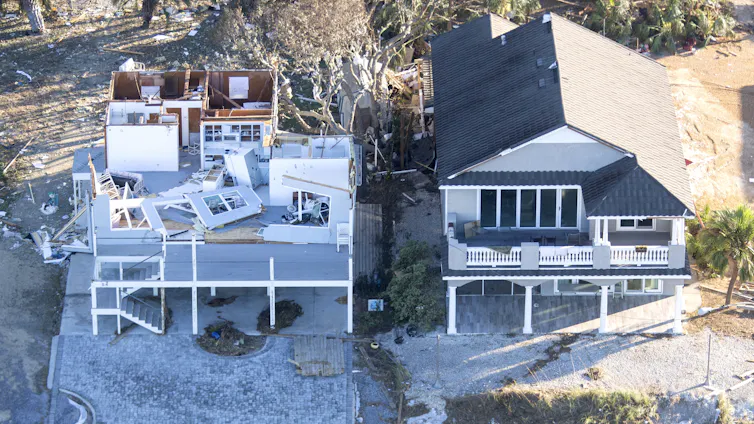
Two homes side by side, one mostly untouched, the other largely destroyed, with walls torn out and the roof gone.
Construction choices are often the difference between a house surviving a hurricane or being torn apart. Mark Wallheiser/Getty Images

When Hurricane Michael tore through the Florida Panhandle in 2018, a beach house called the Sand Palace was left standing, while more than half the buildings around it were destroyed.

Its owners had built it to withstand roughly double the wind speed that Florida’s code required, with reinforced concrete walls on 40-foot (12-meter) pilings. The cost was about 15% to 20% more than standard construction, but the owners wanted a house that could survive storms.

The owners of the Sand Palace talk with WJXT4 about why they built the home to survive hurricanes.

Designers usually measure how “green” a building is by its carbon footprint – the greenhouse gases released making, transporting and running everything that goes into it. The Sand Palace’s extra concrete expanded its carbon footprint, making the house appear less environmentally friendly on paper.

But a green building has to last for its intentionally small carbon footprint to make a positive difference. Damage from a flood, a wildfire or a hurricane can require significantly more building materials to repair it, ballooning its carbon footprint over time.

As storms happen more often and with more intensity, considering the full life cycle of a building and its costs over time becomes increasingly important to get an accurate picture of how sustainable that building really is.

Saturday, September 12, 2026

‘Starwashing’: The new space race has an environmental problem

What Tech billionaires aren't saying about their space ambitions
Kate Yoder, Senior Staff Writer

"This story was originally published by Grist. Sign up for Grist's weekly newsletter here."

As artificial intelligence devours more land and electricity, a new breed of tech companies promises that outer space holds the solutions to our problems on Earth. If data centers are so hard to find a place for down here, why not put them hundreds of miles above the planet instead? Since power demand surges in the evening, why not send tens of thousands of mirrors into orbit to shine sunlight down on demand, powering solar farms after sunset? 

These ideas might sound far-fetched, but they are real proposals from Elon Musk, Jeff Bezos, and start-ups in the space industry. As private industry drives the new “space race,” now launching more rockets than countries do, even the cosmos is starting to feel a bit crowded. A growing amount of so-called “space junk” has led to concerns that all the metal could collide, creating a destructive layer of debris that anything launching into orbit would have to contend with. Earlier this month, part of a discarded SpaceX rocket unintentionally slammed into the moon at 5,400 miles per hour, blasting a new crater.

As Musk’s SpaceX, Bezos’ Blue Origin, and other companies expand into space, they risk causing more problems for Earth in the process: air pollution, climate effects, and light pollution. The practice of downplaying these negative consequences while trumpeting the message that space operations can make life better on Earth has a new name: “starwashing,” a term the space researcher Melissa E. Yingling helped popularize in an article published in The Conversation earlier this month. 

Sunday, September 6, 2026

Dan McKee’s climate sabotage

The opposite of leadership

By Christian Roselund

Rhode Island Governor Daniel McKee has an exceedingly bad record on climate issues, spanning many years, multiple sectors, and countless destructive actions. In fact, it’s hard to think of a Democratic governor in this country in recent memory who has been worse - though New York’s Kathy Hochul seems to have ambitions in this regard as well.

The McKee Administration’s attempt to delay the targets in Rhode Island’s Renewable Energy Standard (RES) by decades in the most recent budget process was perhaps the clearest and most public demonstration of McKee’s willingness to sabotage climate action in the Ocean State. 

But this cynical delay of decarbonization in the electricity sector comes as the culmination of years of weakening, delaying, and otherwise undermining climate action. This includes actions that were never fully connected to climate, such as defunding public transit.

As an activist and organizer who has worked in multiple sectors that intersect with the climate crisis in this state, I have had a front-row seat to just how bad Dan McKee has consistently been on this issue. 

The following is a list of the four major areas and actions that are particularly damning for McKee’s climate record. Please note that this is not a comprehensive list, but rather the biggest-ticket items and areas that I personally participated in.

September 10: kick-off meeting of Charlestown Climate Resilience Commission

Wednesday, September 2, 2026

Green Report Card Gives Rhode Island’s Climate Change Actions Bad Grade

Rep. Tina Spears and Sen. Victoria Gu score "A" grades, Sen. Elaine Morgan gets an "F"

By Rob Smith / ecoRI News staff

Tina and Victoria fought hard for the environment
Rhode Island has slowed its actions against climate change in the past two years, and environmental groups have found themselves playing defense.

That’s the takeaway from a new report by the Environment Council of Rhode Island (ECRI), a coalition of some 60 organizations dedicated to environmental advocacy. The group released its biennial Green Report Card on Aug. 27, less than two weeks before the state primary elections.

It’s a big difference from just four years ago, when the report card for the legislative sessions of 2021-2022 called them “the best two years of environmental policymaking” in state history.

Elaine Morgan didn't
“We need to act quickly and decisively to slash emissions from buildings and transportation and get on track to meet our climate commitments,” said Jordan Miller, ECRI’s executive director. “We must ensure that all our communities benefit from a just transition to a net-zero future. The next steps we take are vital if we want to secure a healthy and sustainable future for all Rhode Islanders.”

Environmental organizations have had a tough few years in the General Assembly. Of the 68 priority bills ECRI identified in 2025, only 21% passed the Legislature. The group fared a little better this year, with a third of its 78 endorsed bills securing passage out of legislative chambers.

None of the group’s eight top priority bills from the past two years passed into law. Those priorities included a package to fund the Rhode Island Public Transit Agency, new offshore wind procurement, a bottle bill and extended producer responsibility omnibus bill, and building benchmarking legislation.

That doesn’t mean the General Assembly has been completely hostile to the group’s priorities; ECRI noted in its Green Report Card that the past two years saw some significant wins in standards for labor and workforce development, new protections against PFAs and rodenticides, and a stronger Green Bond for voters in November.

Friday, August 28, 2026

FEMA Downsizing Exacerbates Longstanding Problems, Imperils Disaster Response, Federal Watchdog Says

Hope we get lucky and no major storm makes landfall

By Amy Green, Kate Waxman

This article originally appeared on Inside Climate News, a nonprofit, non-partisan news organization that covers climate, energy and the environment. Sign up for their newsletter here.

A widespread downsizing of the Federal Emergency Management Agency during the second Trump administration has exacerbated longstanding workforce challenges there and imperiled its response to disasters, a congressional watchdog warns. 

More than 4,300 employees resigned or were let go from the agency last fiscal year, representing some 17 percent of its workforce, according to a report released Tuesday by the U.S. Government Accountability Office (GAO), an independent nonpartisan federal agency. A hiring freeze also began in January 2025 and was in effect until this past May.

The reductions have resulted in a loss of institutional knowledge and experienced personnel and were not conducted based on any analysis of the workforce or forecasted needs, the report said. Meanwhile FEMA also rescinded its strategic plan, leaving the federal agency with no direction when it comes to workforce planning. 

FEMA and its parent agency, the Department of Homeland Security, did not immediately respond to requests for comment. 

The GAO raised concerns about the changes at a time when disasters are intensifying and growing more frequent as the global climate warms. For instance, the double-blow of hurricanes Helene and Milton in 2024, which affected the Southeast within two weeks of one another, prompted the deployment of some 13,500 FEMA employees, the largest in the agency’s history. The effort included workers from outside the affected region and those who were not fully trained for the situation.