Menu Bar

Home           Calendar           Topics          Just Charlestown          About Us
Showing posts with label green energy. Show all posts

Saturday, September 5, 2026

South County Democrats: Beware of DINOs on the Sept. 9 Primary ballot

The League of RI Businesses is a wolf in sheep’s clothing

An oped from Bill Ibelle


There’s a new, big-money player on the Rhode Island political stage that’s targeting many of our finest environmental legislators because they also support gun control.

The League of RI Businesses is a wolf in sheep’s clothing, posing as a moderate, bipartisan, pro-business organization, when in fact, it was created last year specifically to knock off legislators who voted for a ban on assault weapons.

So if you feel safer knowing the guy down the street has an assault rifle hanging in his living room gun rack, then by all means, vote for a League-endorsed candidate. (listed below).

The League’s founder, David Levesque, knows that most Rhode Islanders don’t believe a deer hunter needs to pump out 60 rounds a minute to bag a doe. 

So Levesque and his cohorts rarely mention assault weapons when explaining why the League has targeted so many fine legislators. Instead, in an interview with Ocean State Media, he said that the League is merely targeting legislators who “fail to support the Constitution.” Only when pressed repeatedly by an interviewer does he concede that he’s referring exclusively to the Second Amendment—the right to bear arms.

Apparently, the League believes that James Madison had assault weapons in mind when he introduced the amendment to Congress in 1789. Never mind that an assault rifle, at that time, was a musket, a ramrod, a powder pouch, and a lead ball that took nearly a minute to load and, because it had no rifling, had the accuracy of a pea shooter.

He’s also against renewable energy because it’s unprofitable, doesn’t work, and has driven up electric rates by 27 percent — all untrue. What is true is that he revealed his true colors when he claimed that if we eliminated all state wind and solar programs, “we could literally put almost $30 million a month back in the hands of Rhode Island businesses.” Translation: The heck with our children’s future, we want bigger profits now.

Levesque insists that his group wants “middle-of-the-road, common-sense people” in office. This seems just a wee bit hard to believe, given that Levesque is a vocal Trump supporter who, when asked by the Providence Journal about our president’s second term, said, “I think it’s going awesome.

So if ICE raids make you feel safer; if you think the war with Iran is the best use of $37 billion in taxpayer money; if you believe the skyrocketing price of oil is the path to affordability; and if you thrill at the grade-school insults our leader routinely hurls at our foreign allies—then by all means, take the League’s advice on who to vote for.

If you’re still not convinced that this organization is poison, consider the League’s subversion of the state’s campaign finance laws. To get around the state’s $2,000 limit on individual donations, they formed 40 separate Political Action Committees (PACs). In an interview with Channel 12, Levesque boasted that “What we did is extraordinary. It’s never been done before. We opened more PACs than anybody’s ever done [in Rhode Island]. This will allow us to give $80,000 to an individual candidate. There’s no other organization in the state of Rhode Island that can put that kind of money into a candidate’s hands.”

Just to be clear, the state donation limit is $2,000 and the League says its armada of 40 PACs makes it legal to give $80,000.

If you would like to reduce the influence of money in state politics, you might want to vote against the candidates the League is financing.

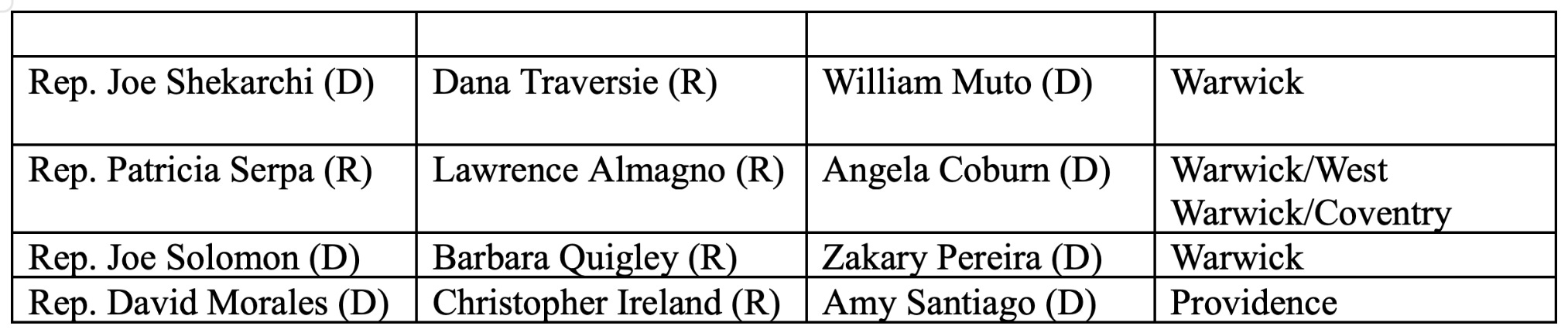
Here is a list of incumbents the League has targeted and the candidates it is backing to unseat them:
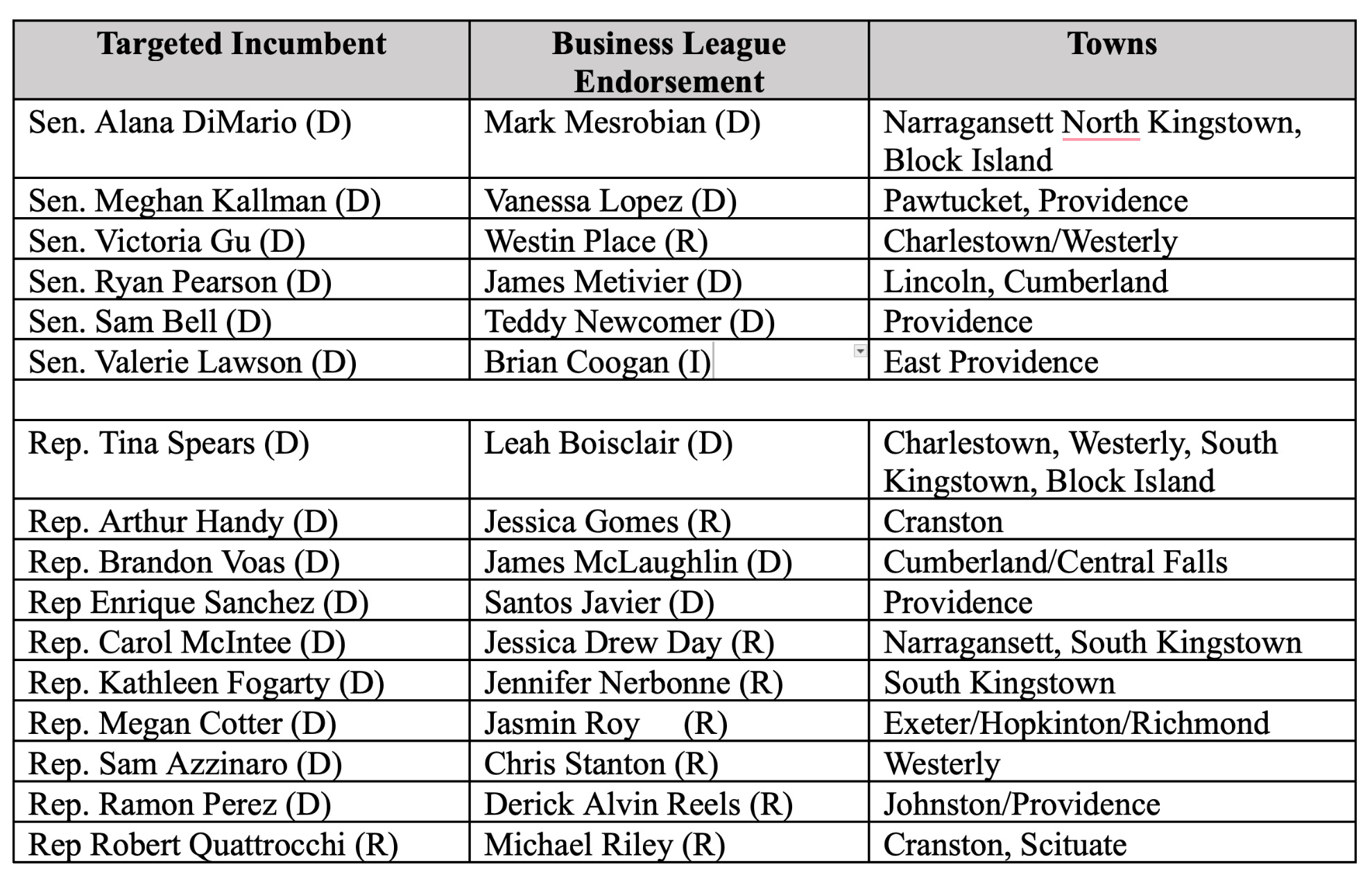
The League also endorsed nine incumbents: John BrienElaine MorganLeonidas RaptiakisPatrick MaloneyGregory ConstantinoMarie HopkinsPaul SantucciStephano Famiglietti, and six candidates running for open seats:

 

Thursday, August 13, 2026

Trump’s Anti-Clean Energy Policies Set to Cost US Consumers $650 Billion by 2040

You pay for Trump's love of coal

Brett Wilkins for Common Dreams

The Trump administration’s rollback of clean energy policies will cost American consumers $650 billion in additional energy bills by 2040, according to an analysis published Wednesday by a nonpartisan think tank.

Energy Innovation, a San Francisco-based energy and climate policy think tank, said in its report that “federal policy changes since January 2025 will increase energy prices, slow economic growth and job creation, increase air pollution and healthcare costs, and worsen grid reliability.”

The analysis examines seven major policy shifts during the second term of President Donald Trump, who—for the third time—ran on an aggressively pro-fossil fuel and anti-clean energy platform:

  • Passage of the so-called One Big Beautiful Bill Act (OBBBA);
  • The Environmental Protection Agency’s (EPA) reconsideration and repeal of Clean Air Act Greenhouse Gas Standards, Mercury and Air Toxics Standards, and Clean Water Act Effluent Limitations Guidelines for electric power plants;
  • EPA’s repeal of the endangerment finding and federal tailpipe emissions standards;
  • Passage of Congressional Review Act resolutions overturning approvals for state-level tailpipe emissions standards;
  • Actions to limit renewable energy development—especially onshore and offshore wind plants—including limitations on issuance of new permits;
  • Department of Energy cancellations of hydrogen hub funding and easing of 45V tax credit qualification for natural gas-based hydrogen; and
  • EPA’s cancellation of the $7 billion Solar for All grant program.

According to the analysis, “Households will pay an additional $650 billion for energy—an average of $460 per household in 2035 and $490 in 2040.”

Tuesday, July 28, 2026

Why Trump screws Rhode Island any time he has the chance

Trump Admin Targeted Democrats by Canceling Clean Energy Grants

Brad Reed for Common Dreams

Donald Trump’s administration has admitted in court that it chose to cancel certain grants for clean energy projects because they were set to benefit Democratic-voting states.

The New York Times reported that attorneys representing the US Department of Energy (DOE) acknowledged in court documents filed earlier this month that decisions about canceling grants were based “solely on the political identity of the grant recipient’s state, i.e., whether the recipient’s location and/or place of performance was in a Blue State or a non-Blue State.”

The Times described this as a “stunning admission” that “offered an unvarnished glimpse into the way President Trump has weaponized the provision of federal education, energy, health, housing, and infrastructure aid in his second term.”

According to the Times, the DOE last year recommended canceling more than 600 grants awarded for energy projects under former President Joe Biden’s administration.

However, the White House Office of Management and Budget only made 284 of the recommended cuts while leaving the rest of the grants in place.

Tuesday, July 7, 2026

Trump's war on green energy is about as successful as his war on Iran

How US renewable-energy growth persists despite federal policy uncertainty 

This guest post is by:

Dhruv Modi, research analyst, Center for Global Sustainability, University of Maryland

Alicia Zhao, research manager, Center for Global Sustainability, University of Maryland

Tyler Stotland, research analyst, Center for Global Sustainability, University of Maryland

Prof Nate Hultman, director of the Center for Global Sustainability, University of Maryland, and professor in the School of Public Policy, University of Maryland

Despite recent shifts in federal energy policies, our analysis shows that the US transition to renewable energy is continuing. 

The current administration has enacted a range of changes to prioritize fossil-fuel energy and environmental deregulation in the US, while withdrawing support for renewables. 

Yet solar, wind and battery storage accounted for over 90% of new energy capacity in 2025.

This is thanks to the falling cost of renewable energy technologies, investments spurred by the Inflation Reduction Act and Bipartisan Infrastructure Law and local and state policies, according to our research at the Center for Global Sustainability, University of Maryland.  

Our analysis examines recent trends in the US energy landscape, focusing on rising electricity demand, new electricity capacity additions and generation, as well as fossil-fuel production and state-level case studies. 

Saturday, June 27, 2026

Trump is fighting the green energy revolution. He'll lose.

Market forces are stronger than MAGA.

Paul Waldman

Something historic happened in May: For the first time in American history, more electricity was generated in the United States with solar power than with coal.

While natural gas remains our largest electricity source, the crossing of the lines between solar and coal — one representing the future and one the past — is something we may look back on as one of the key moments in the planet’s transition to green energy.

We don’t know whether someone told Donald Trump about this milestone, but if they did, he wouldn’t have been happy. Since taking office, he has waged an all-out war against renewable energy, not just making it more difficult to create and use clean power, but pouring taxpayer money into fossil fuels.

That’s the bad news. The good news is that though Trump has done significant damage to America’s green energy industry — and given us more pollution, higher costs, and more insecurity in the bargain — that industry continues to grow.

There is a global energy revolution underway, and Trump’s efforts to slow it down are destined to fall short.

Monday, June 22, 2026

Rhode Island beats Trump in court in suit over offshore wind farms

Stop the war on Green Energy

Attorney General Peter F. Neronha and a coalition of 18 attorneys general announced the United States Court of Appeals for the First Circuit’s dismissal of the Trump Administration’s appeal of the states’ victory in their lawsuit challenging the federal government’s unlawful order to freeze all federal permitting for wind energy projects.  

“Wind energy creates jobs and helps stabilize energy prices, neither of which this Administration seems to know how to do,” said Attorney General Neronha. 

“Today’s win once again demonstrates that this federal government is not immune from consequences, and our coalition is proving that with each legal victory we achieve. Rhode Islanders and Americans everywhere continue to pay the price, quite literally, for a collective hesitancy in embracing clean energy infrastructure. Wind energy is crucial to bringing energy costs down and keeping them down, and we will continue fighting to ensure a clean energy future for generations to come.”

On January 20, 2025, Trump issued a Presidential Memorandum which indefinitely froze all federal approvals needed for the development of wind energy projects pending federal review. Pursuant to this directive, federal agencies stopped all permitting and approval activities. In May 2025, the coalition filed a lawsuit challenging the freeze and in December, a federal judge in the United States District Court for the District of Massachusetts them to be arbitrary and capricious and contrary to law. The federal government appealed that ruling but subsequently decided to drop their appeal. Today, the Court entered a judgement dismissing the appeal and cementing the states’ victory.

Saturday, June 20, 2026

RI General Assembly session produced mixed results on the environment

McKee's effort to slash green energy funding rebuffed

By Rob Smith / ecoRI News staff

No more pencils, no more books, no more speaker’s dirty looks: lawmakers last week bid farewell to Smith Hill for the year Thursday night, when this year’s legislative session concluded.

It was a roller-coaster ride for environmental advocates, who spent most of the session playing defense. Gov. Dan McKee had proposed rolling back the renewable energy standard and slashing solar financing programs and energy efficiency initiatives as part of an affordability agenda to reduce electric and gas bills by any means necessary.

Bottom of Form

McKee wasn’t the only politician in New England proposing cuts to such programs. Lawmakers in the Massachusetts House passed a bill in February cutting $1 billion from their energy efficiency programs, more commonly known as Mass Save.

But ultimately, in the version of the Rhode Island budget signed into law by McKee on June 12, most of Rhode Island’s climate programs will remain intact. The only changes will be to virtual net metering, which will introduce a voluntary opt-in rate, and reduce the total cap of future solar projects eligible for the program to just 175 megawatts.

Environmental advocates also notched another set of small wins in the budget: the director of the state Department of Transportation was removed as chair of the board of directors for the Rhode Island Public Transit Authority, and lawmakers allocated the embattled transit agency with enough funds to close its deficit.

Here’s some of what else lived, died or stalled:

First the big news: building decarbonization lives, from a certain point of view.

Previous sessions saw lawmakers attempt to pass a single bill that would require buildings in Rhode Island to track, benchmark, and reduce their greenhouse gas emissions. That single bill always died in committee, so this year advocates tried a more traditional tack, the tried-and-true General Assembly two-step.

They spun off the more unpopular elements of building benchmarking — the emission mandates — from the main bill that pushes large buildings owners to start tracking emissions. Advocates acknowledged just starting a benchmarking program for all buildings in the state would require years of lead time to draw up regulations and spur adoption.

The two-step worked, and lawmakers passed H7813/S2260 in concurrence Thursday night. Starting in 2028, property owners with buildings larger than 50,000 square feet will have to track and report their emissions for the previous year. Buildings larger than 25,000 square feet start tracking in 2030.

Friday, June 19, 2026

Coal pollution is cutting solar power output, study finds

Will Trump look for ways to use coal to kill wind turbines?

University of Oxford

Trump's 2-for-1 obsession: promote coal, kill green energy
New research led by the University of Oxford and University College London (UCL) has revealed that pollution from coal-fired power plants is significantly reducing the energy output of solar photovoltaic (solar PV) installations, particularly where these are expanding side by side. The findings have been published today in Nature Sustainability.

The new study mapped and assessed more than 140,000 solar PV installations worldwide using satellite data.

By combining this with atmospheric data on air pollution, the researchers calculated how much sunlight is lost and how this reduces electricity generation. They found that aerosols - tiny particles suspended in the air - reduced global solar electricity output by 5.8% in 2023. This is equivalent to 111 terawatt-hours (TWh) of lost energy – the amount generated by 18 medium-sized coal-fired power plants. 

Crucially, these losses represent a significant and often overlooked constraint on the clean energy transition. 

Wednesday, June 17, 2026

For first time, Americans are getting more of their electricity from solar than coal

This is despite Trump's push for more coal use and his war on green energy

Tik Root, Senior Staff Writer

"This story was originally published by Grist. Sign up for Grist's weekly newsletter here."

Solar energy just provided more electricity in the United States than coal for the first time on record — marking a milestone for the rise of renewables in America. 

While gas and nuclear plants still lead the country’s energy mix, solar contributed 12.8 percent of the nation’s electrons in May, according to an analysis of government data by Ember, an energy think tank. Coal, meanwhile, provided just 12.2 percent. Just five years ago, solar was less than half of its current levels and coal was at 20 percent. 

Tuesday, June 16, 2026

Feds restore home energy rebates, but with a catch

Among other things, heat pumps take a hit

Major new limits on eligibility
This article originally appeared on Inside Climate News, a nonprofit, non-partisan news organization that covers climate, energy and the environment. Sign up for their newsletter here.

Federal energy efficiency rebate programs will no longer cover a switch from fossil fuels to electricity for heating, according to long-awaited guidance from the Department of Energy.

The department published an update on how it will implement consumer programs with $8.8 billion in funding. The new provisions include eliminating use of diversity, equity and inclusion considerations, among other changes.

This follows legal challenges after Donald Trump issued an executive order last year, upon returning to office, canceling the release of funds from President Joe Biden’s Inflation Reduction Act, including rebates for home energy efficiency. A coalition of states successfully sued to restore the funding, obtaining an injunction in March 2025.

States have been waiting for the Department of Energy to reopen funding, a process that begins with this latest publication.

Clean energy and environmental advocates said the guidance was overdue and severely flawed.

Monday, May 25, 2026

What ever happening to the Green New Deal (besides Donald Trump)?

The Green New Deal has evolved. Now it’s all about ‘affordability.’

Kate Yoder, Senior Staff Writer

This story was originally published by Grist. Sign up for Grist's weekly newsletter here.

Eight years ago, three little words took hold of the environmental movement: Green New Deal. Part popular slogan, part political philosophy, the phrase described a sweeping agenda to create jobs, advance social justice, and combat climate change through major public investment inspired by the New Deal of the 1930s. 

The term made its way from hats and protest signs to the halls of power, where it shaped local and national policy. Progressives even pressured future president Joe Biden to adopt plans to address the crisis in the lead-up to the 2020 election.

Congress eventually whittled his ambitions down to the Inflation Reduction Act, a package of green tax credits and incentives that became the nation’s first comprehensive climate policy. That is, until Republicans dismantled the law last year. 

Under Donald Trump, the national policy wins Democrats had scored by leveraging the Green New Deal’s momentum all but vanished. The party was left soul-searching, wondering how it should talk about climate change, or if those calling for solutions should even talk about it at all.

Progressives seem to have settled on an answer: Make everything about affordability. A new climate agenda released by the Climate and Community Institute, a left-leaning think tank, aims to lower costs for everyday people through home insurance rate caps, bans on utility shutoffs, and other measures. 

It promotes “green economic populism,” a framework to provide relief for the working class through policies that also happen to cut carbon emissions (such as free transit or a moratorium on data centers), while regulating the corporations contributing to climate change and the cost-of-living crisis. 

The architects of the so-called “working-class climate agenda” say they’ve learned lessons from the Green New Deal and the Inflation Reduction Act: One lacked political will, while the other failed to deliver tangible results to working-class voters quickly enough. 

Thursday, May 21, 2026

The long-term consequences of McKee’s short-sighted energy savings plan

Get ready for another Dan McKee mess

By Bill Ibelle, Rhode Island Current

If you think the Washington Bridge fiasco was a bummer, wait until you see the sequel.

That horror movie is in production right now and will be coming to a theater near you if the governor’s cuts to clean energy programs are approved by the legislature. It will be another example of kicking the can down the road until disaster strikes. But more importantly, it will be another example of how saving a few dollars today can lead to astronomical costs in the very near future.

What should we learn from the Washington Bridge? We knew for years that our highway bridges were aging and that hundreds of them, both large and small, were in dangerously poor repair. We know that the Rhode Island Department of Transportation and a succession of governors chose to look the other way because it’s always smart politics to save voters a few dollars immediately, even if it’s going to cost them a fortune for years to come. 

Our government opted to save some money. And then the Washington Bridge had to be demolished because it was on the brink of collapse. This created a massive traffic jam that will choke our economy for at least four years and cost taxpayers a half a billion dollars to demolish the bridge and build a new one.  

Now let’s look at our present situation. The governor is promising to save you $15 a month on your electric bill by ignoring the climate crisis, but experts say those numbers are wildly inflated and the governor has yet to provide documentation to specifically back up its claim. Still, the governor’s offer is nothing to sneeze at. It could buy you a few cups of coffee

All you have to do to get that free coffee is to agree to kick the climate crisis down the road by cutting programs designed to speed our transition to clean energy. You may wonder why saving $15 a month is a bad idea. To answer that question, let’s watch the movie trailer “Return of the Short-Sighted Leaders.”

Friday, May 15, 2026

Why Trump’s $2 billion buyoff to cancel offshore wind farms is a bad deal for American taxpayers and the US energy supply

Who, other than the fossil fuel industry, benefits from Trump's jihad on offshore wind?

Christopher Niezrecki, UMass Lowell; Ben Link, Johns Hopkins University, and Zoe Getman-Pickering, UMass Amherst

The U.S. is in a bizarre situation in 2026: It’s facing a looming energy shortage, yet the Trump administration is making deals to pay offshore wind developers nearly US$2 billion in taxpayer money to walk away from energy projects.

These politically motivated moves are costing Americans far more than just the buyouts.

Communities have been laying the groundwork for offshore energy projects for years. Offshore wind development brings jobs and economic development that reshape regional economies, with the scale of public and private investment reaching into the hundreds of billions of dollars over years. 

East Coast communities have built up ports to support the industry and launched job-training programs to prepare workers. Construction, maintenance and shipping businesses have sprung up, along with secondary businesses that support the industry.

Losing the projects, and the threat of losing other planned wind farms, will also likely mean higher energy prices. And while some offshore wind farms are moving ahead, developers must account for both lost momentum and increased uncertainty from the Trump administration.

As a result, Americans will bear the economic brunt of these decisions for decades ahead.

Thursday, May 14, 2026

What to Know Before You Get Balcony Solar

Balcony solar is poised to take the US by storm

By Alison F. Takemura / Canary Media

Bottom of Form

The DIY systems, which you can hang on a balcony and plug into a normal 120-volt outlet, help lower energy bills and carbon emissions. Already huge in Germany, solar that’s as easy to install as an appliance would be a game changer for the four out of 10 U.S. households that can’t get rooftop systems for financial or logistical reasons.

In 2025, deep-red Utah became the first state to pass a bill making it easier to adopt plug-in solar systems. So far this year, four more states have all advanced similar measures — and nearly two dozen others are weighing bills of their own.

Considering a balcony power plant yourself? Check our tracker to see the status of plug-in solar legislation in your state, and keep reading for some FAQs on the tech.

What is balcony (or plug-in) solar?

Balcony solar systems are modest in size, ranging from just one to a few solar panels. Most states, including California and New York, are considering capping systems at 1,200 watts — a sixth of the average home-solar installation.

A table labeled Do it yourself vs. Traditional installer

The panels connect to an inverter that converts their direct current into alternating current, the kind our homes use. A plug from the inverter fits into a typical 120-volt outlet (15 or 20 amps), pumping the power of the sun directly into a home’s existing wiring.

The systems can cover a small but meaningful fraction of a home’s electricity use: An 800-watt unit can power the equivalent of a fridge or a few small appliances when the sun’s shining.

Wednesday, May 13, 2026

Energy experts agree: The governor's plan to reduce energy costs is a short-term fix and long-term mistake

McKee, wrong again

Steve Ahlquist

Rhode Island State Senator Samuel Zurier’s Commission to Study the Successful Implementation of the Act on Climate met on Monday and heard from two experts on energy policy who were critical of FY2027 Budget proposals that Governor Daniel McKee claims will save ratepayers money on energy costs. Nick Nybo of Revity Energy, a Rhode Island-based utility-scale solar developer, expressed skepticism about the governor’s projected savings from the proposal, estimating the savings were closer to $70 million over five years, not the claimed $259 million, and that the governor’s plan would make it harder, if not impossible, for the state to reach its 2021 Act on Climate goals.

Samuel Ross, a Director at Dunsky Energy and Climate Advisors, a consulting firm that works across the U.S. and Canada on topics across the clean energy industry, was similarly skeptical, noting that the governor’s proposal to weaken the state’s Renewable Energy Standard threatens compliance with the 2030 goals of the Act on Climate and will likely increase long-term energy costs, even if it manages some near term savings.

Friday, May 8, 2026

Unfounded Health Concerns Are Powering a Solar Backlash

Does Trump think they cause cancer too?
by Anna Clark for ProPublica

Kevin Heath had hoped there would be solar panels by now on his family farm in southeastern Michigan, roughly 50 miles outside Detroit.

About six years ago, he agreed to lease part of his land for a solar project. It would help him pay off debt and keep the farm in the family, he said. But the opportunity was thwarted when, in 2023, following pushback from some local residents, his township passed an ordinance that banned large solar projects from land zoned for agriculture.

In the fight over solar development, Heath said he was bombarded by just about every argument from critics — including claims that solar fields are a health hazard. “I’ve heard them say that, but I’ve never heard anybody prove that,” Heath said.

“The health and safety issue,” he added, “that is just a joke.”

Michigan has big prospects in solar farming — measured by the expected growth in the capacity of its farms to add electricity directly to the grid. According to the U.S. Energy Information Administration, most of the nation’s new capacity from this type of solar farm is planned this year for four states, including Michigan. The others, with their hot deserts and big-sky plains, seem more obvious: Texas, Arizona and California.

To some, in Michigan and beyond, this growth feels dangerous. They pressure public officials to stop, stall or otherwise complicate new solar projects with an array of arguments that now go beyond just land use to include public health.

There is little reputable evidence to back their claims. But health concerns have helped power a solar backlash that undercuts efforts to broaden energy sources even as customer costs are rising.

Restrictions on solar development are proliferating nationwide, “often rooted in misinformation or unfounded fears,” including ones that involve “potential environmental and human safety risks,” according to an article published late last year in the Brigham Young University Law Review.

To generate electricity, solar projects harvest energy from the sun. “And that’s really not that different from what a field of corn or alfalfa does,” said Troy Rule, the Arizona State University law professor who authored the article. “In fact, arguably, it’s even more environmentally friendly.”

Tuesday, April 21, 2026

Trump’s Budget Proposes Massive Cuts for Climate and Environmental Programs

The budgets of the EPA, NOAA and FEMA would all be slashed, as would incentives for renewable energy.

This article originally appeared on Inside Climate News, a nonprofit, non-partisan news organization that covers climate, energy and the environment. Sign up for their newsletter here.

Donald Trump’s annual budget request to Congress continues his administration’s defunding of climate change programs, environmental protection and renewable energy, slashing the budgets of the Environmental Protection Agency, the National Oceanic and Atmospheric Administration and the Federal Emergency Management Agency. 

The spending plan for fiscal 2027 “builds on the President’s vision by continuing to constrain non-defense spending,” wrote Russell Vought, director of the Office of Management and Budget, in a foreword to the 92-page document, which includes an historic, $1.5 trillion defense budget, an increase of 44 percent.

EPA spending would be cut in half under Trump’s proposal, released Friday, and grants from the agency would be slashed by $1 billion. Congress rejected a similar budget request from the president last year. 

An Inside Climate News analysis of federal workforce data released by the Office of Personnel Management shows that EPA lost more than 4,000 employees in the first year of Trump’s second term, reducing its workforce to 12,849, its lowest level since the 1980s. The 24 percent reduction was more than double the rate of losses across the entire federal government.

Friday, April 17, 2026

Environmental Council of RI seeks to protect Rhode Island's climate goals, expand conservation funding, decarbonize buildings, and save RIPTA

ECRI pushes green agenda

Steve Ahlquist 


The Environment Council of Rhode Island (ECRI), a coalition of more than 60 organizations “advocating for policies to protect and enhance the environment for all Rhode Islanders,” introduced its 2026 legislative priorities at a State House event on Tuesday. “These priorities were chosen by the membership of ECRI through a month-long democratic process and represent the diversity of the environmental community in Rhode Island,” said ECRI Executive Director Jordan Miller at the opening of the event.

Here’s the video: The Environment Council of RI 2026 Lobby Day; April 14, 2026

This year, ECRI announced four legislative priorities for the 2026 legislative session. As described by ECRI Vice President Tina Munter, “[T]hese priorities, in no particular order, include urging our legislators to oppose the rollback of state clean energy and energy efficiency programs that have been proposed in the governor’s FY2027 budget, the Green Bond plus crucial additional funding for conservation and open space measures, the Save RIPTA legislative package as put together by the Save RIPTA Coalition, and building decarbonization legislation, both building benchmarking and reporting and building performance standards.”

Thursday, April 9, 2026

Gov. McKee, Statehouse MAGAs At War With Renewable Energy

Rightwing attacks on our best solution to our energy crisis

By Frank Carini / ecoRI News columnist

An illegal war started by a Monster caused the price of gasoline and other fossil fuels to explode. The human-caused climate crisis, fueled by the burning of said fossil fuels, is both frying and flooding great swaths of the planet and changing the ocean’s chemical composition.

But have no fear, Gov. Dan McKee and MAGA asshats are here.

To address this dual-threat emergency — war and the climate crisis, not gasoline prices — the underwater governor and the MAGA faction within the General Assembly believe blowing up Rhode Island’s support for renewable energy and retreating on the state’s climate initiatives are solutions.

Elections certainly do have consequences. We’ll be paying for them for generations.

House Minority Leader Rep. Michael Chippendale, MAGA-Foster, recently introduced a package of legislation designed to eliminate many of the state-mandated charges on utility bills that fund renewable energy and climate programs. He denied the legislation was meant to end renewable energy programs in Rhode Island, but it would essentially do just that.

His five irresponsible bills would: require all changes to the Renewable Energy Growth Program be approved by the General Assembly, instead of the Public Utilities Commission (the corporate-friendly PUC apparently isn’t corporate enough) or just eliminate the program altogether; terminate the energy efficiency charge, which funds the program that allows Rhode Island Energy to offer rebates, free weatherization services, and other initiatives that help ratepayers use less energy; end the net metering program used to finance solar arrays and prohibit any state subsidies for consumer heat pump purchases; and place a five-year moratorium on the Renewable Energy Growth and energy efficiency program charges.