Menu Bar

Home           Calendar           Topics          Just Charlestown          About Us
Showing posts with label Mexico. Show all posts

Tuesday, August 4, 2026

Trump Unveils Sweeping New Tariffs Expected to Cost Americans $100 Billion a Year

Trump uses bogus claims to continue to impose a national sales tax on Americans

Jake Johnson

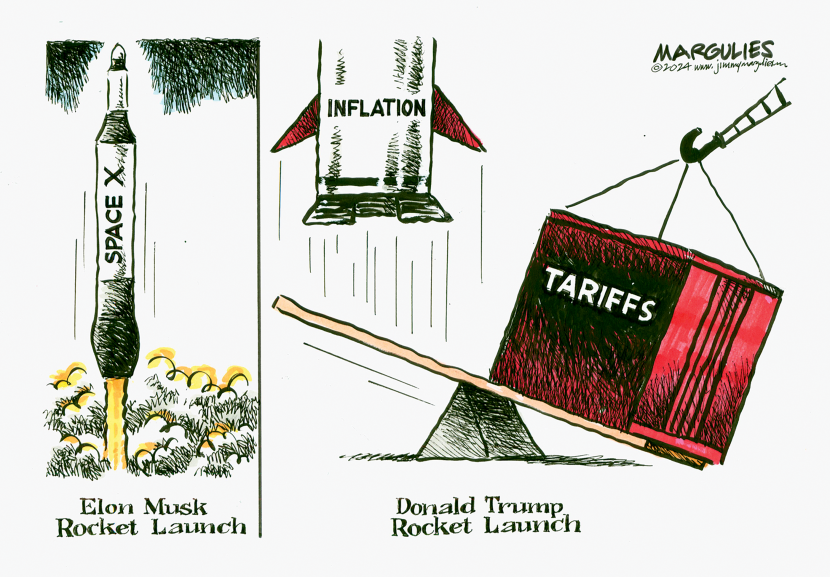
On July 23, Donald Trump  unveiled a new package of tariffs targeting 60 countries that account for over 99% of US imports, a move that—if upheld in court—would cost Americans an estimated $100 billion per year in the form of higher costs.

The duties, ranging from 10% to 12.5%, were announced as part of Trump's effort to maneuver around repeated court rulings against his sweeping tariffs, including by the conservative-dominated US Supreme Court. Jamieson Greer, the Trump administration’s top trade official, pointed to Section 301 of the Trade Act of 1974 to justify the new tariffs, introduced with the purported goal of penalizing countries “for their failure to impose and effectively enforce a prohibition on the importation of goods produced with forced labor.”

Observers questioned the administration’s pretext. “Magically, the US tariff probe on forced labor practices is done perfectly in time to replace the generalized but expiring Section 122 tariffs,” noted Bloomberg’s Josh Wingrove, referring to the legal authority Trump cited for earlier tariffs.

Rep. Mike Levin (D-Calif.) acknowledged that “Section 301 is a law Congress passed,” but added, “What was passed in 1974 was authority to respond to specific unfair trade practices after investigation.”

“What is being done with it now is a tariff on 99% of American trade, set by Trump, with no expiration, no vote, and no ceiling,” said Levin. “If a delegation that broad is lawful, then the tariff power in Article I means very little. The Supreme Court struck down the last version of this policy in February. The response was to avoid Congress and find a different statute and rebuild substantially the same tariffs, effective the same minute the old ones lapsed.”

The list of countries targeted by the Section 301 tariffs includes Canada, Australia, Brazil, China, Mexico, Russia, Norway, the United Kingdom, and Vietnam.

Between the start of his second administration and January 2026, Trump’s tariffs cost American families $1,700 each on average as importers passed burdens onto consumers in the form of higher prices. The tariffs have also hammered small businessesincreased hardship for farmers, and failed to arrest the decline of American manufacturing jobs.

Thursday, June 25, 2026

Soaring US beef prices likely to rise further thanks to trade tensions and disease outbreaks

Trump blunders lead to more expensive burgers

Andrew Muhammad, University of Tennessee and Charles Martinez

It’s summer grilling season, but for many Americans, surging prices mean beef is no longer what’s for dinner.

The cost of beef, having spiked since early 2025, is coming under even more pressure. The most recent is the screwworm outbreak that hit cattle in Mexico and has now spread to the United States, where the cattle herd has already fallen to levels not seen since the 1950s, due in part to drought.

Meanwhile, potential trade disruptions loom. Just before U.S. and Mexican trade negotiators began meeting on June 16-17, 2026, to discuss the long-standing deal binding North America, Donald Trump warned that Washington may not renew the agreement, which was negotiated during his first term, and instead potentially withdraw from it altogether.

As international trade and livestock economists, we have studied how North American trade has deeply integrated cattle and beef markets, influencing production, prices and the movement of animals and meat products across Canada, Mexico and the United States. 

And because beef is both a top agricultural import and export for the U.S., the industry is especially vulnerable to any disruptions to the existing trade deal. As one example, the cost of ground beef is up by more than 20% just since January 2025.

Current trade uncertainty, reflecting Trump’s more fragmented, bilateral approach to negotiations, couldn’t come at a worse moment for inflation-weary consumers. The growing turmoil in the North American beef market risks further tightening supplies and raising prices.

Monday, June 22, 2026

Trump and Musk’s DOGE “saved” $15 million by cutting a program to prevent the spread of screwworm that will now take $1 billion to fix

Make Musk pay

Stephen Prager for Common Dreams

When Elon Musk’s “Department of Government Efficiency” took its chainsaw to the federal bureaucracy last year, it created bottlenecks that may have hampered the fight against the screwworm infestation currently menacing the southwest while making it much more expensive.

The annual US Department of Agriculture (USDA) spending to combat the flesh-eating insects only amounted to about $15 million per year. But along with about $382 million aimed at combating animal-borne illnesses around the globe, it was terminated in March 2025 as part of DOGE’s effort to root out what it described as government “waste.”

But now, with the pests bearing down on Texas and New Mexico, and at least 12 infections already identified in the US as of Tuesday, the Trump administration is spending at least $1 billion to fight the outbreak.

Last week, during a Senate hearing, Secretary of Agriculture Brooke Rollins attempted to shift blame for the screwworm outbreak onto the Biden administration, while portraying herself and President Donald Trump as proactive in response to reports last spring that the insects were rapidly climbing through Central America.

Rollins said she asked Trump for “$1 billion to build a significant facility” in Texas that would breed hundreds of millions of sterilized male screwworm flies, a method that had been used to keep them contained in South America for decades. “Without hesitation, a couple questions, he said, ‘go.’”

That facility is expected to release around 300 million sterile flies per week. But it is not expected to be fully operational until the end of 2027.

In addition to the $15 million cut to monitoring the spread of the bugs from Panama, the Houston Chronicle reported that DOGE paused plans for a facility in Mexico that the Biden administration had authorized in 2024 as part of a $165 million emergency package to fight screwworm.

Wednesday, April 8, 2026

TACO Don loses again

It's consistent with how other countries, organizations, and people have defeated him

Robert Reich

Last night, 90 minutes before Trump said he’d cause the death of a “whole civilization” if Iran didn’t open the Strait of Hormuz, an Iranian official said the shipping channel would be reopened for two weeks if the United States stopped bombing Iran. The U.S. has now stopped bombing Iran.

So we’re back to the status quo before Trump began his war. Only now, Iran can credibly threaten to close the strait if it doesn’t get what it wants from Trump — thereby causing havoc to the U.S. (and world) economies. Trump’s only remaining bargaining leverage is the threat of committing war crimes.

In other words, last night’s showdown was a clear victory for Iran and a clear defeat for Trump (although he’ll frame it as a victory).

The Iran fiasco is only the latest in a host of examples revealing how to defeat Trump.

In addition to Iran, similar strategies have been used by China, Russia, Canada, Mexico, and Greenland. Inside the United States, the people of Minneapolis have used them, as have Harvard University, comedian Jimmy Kimmel, writer E. Jean Carroll, and the law firms Perkins Coie, Jenner & Block, Susman Godfrey, and WilmerHale.

What’s the strategy that connects them all?

All refused to cave to Trump, despite his superior military or economic power. Instead, they’ve engaged in a kind of jujitsu in which they use Trump’s power against him, while allowing Trump to save face by claiming he’s won. Consider:

Iran knew it was no match for the superior might of the U.S. (and Israel). So it used cheap drones and missiles to close the Strait of Hormuz and incapacitate other Gulf oil installations, thereby driving up the prices of oil and gas at the pump in the U.S., which has put growing political pressure on Trump, months before a midterm election. Hence, Trump has been forced stop his war.

China knew what to do when Trump imposed a giant tariff on Chinese exports to the U.S.: It put restrictions on seven types of heavy rare earth metals and magnets, crucial to U.S. defense and tech industries. Beijing continues to use these rare earth restrictions as tactical levers in ongoing negotiations over trade, rather than demand complete surrender by Trump on his trade policies.

Russia has leveraged its vast deposits of oil and natural gas with U.S. allies. It has also demonstrated its power to intrude into U.S. elections (the Mueller Report detailed a “sweeping and systematic” campaign by Russia to interfere in the 2016 U.S. presidential election, primarily favoring Trump).

Canada and Mexico have won every tariff showdown with Trump by leveraging America’s substantial economic dependence on them for components and raw materials, but without crowing about their victories.

Greenland has leveraged public opinion globally and in the United States — overwhelmingly against an American invasion or occupation — to curb Trump’s ambitions there.

The citizens of Minneapolis and St. Paul have leveraged their asymmetric power against Trump’s ICE and Border Patrol agents by carefully organizing themselves into a force of nonviolent resistance to protect immigrants there. Their strategy showed itself to be especially effective, tragically, after Trump’s agents murdered Renee Good and Alex Pretti, and the public outcry forced the agents to leave the Twin Cities.

Monday, January 5, 2026

After Venezuela Assault, Trump and Rubio Warn Cuba, Mexico, and Colombia Could Be Next

We were warned that this is what a malignant narcissist would do

Jake Johnson

Donald Trump and top administration officials, including Secretary of State Marco Rubio, characterized Saturday’s assault on Venezuela and abduction of the country’s president as a warning shot in the direction of Cuba, Mexico, Colombia, and other Latin American nations.

During a Saturday press conference, Trump openly invoked the Monroe Doctrine—an assertion of US dominance of the Western Hemisphere—and said his campaign of aggression against Venezuela represented the “Donroe Doctrine” in action.

In his unwieldy remarks, Trump called out Colombian President Gustavo Petro by name, accusing him without evidence of “making cocaine and sending it to the United States.”

“So he does have to watch his ass,” the US president said of Petro, who condemned the Trump administration’s Saturday attack on Venezuela as “aggression against the sovereignty of Venezuela and Latin America.”

Petro responded defiantly to the possibility of the US targeting him, writing on social media that he is “not worried at all.”

In a Fox News appearance earlier Saturday, Trump also took aim at the United States’ southern neighbor, declaring ominously that “something’s going to have to be done with Mexico,” which also denounced the attack on Venezuela and abduction of President Nicolás Maduro.

“She is very frightened of the cartels,” Trump said of Mexican President Claudia Sheinbaum. “So we have to do something.”

Rubio, for his part, focused on Cuba—a country whose government he has long sought to topple.

“If I lived in Havana and I was in the government, I’d be concerned, at least a little bit,” Rubio, who was born in Miami to Cuban immigrant parents, said during Saturday’s press conference.

That the Trump administration wasted no time threatening other nations as it pledged to control Venezuela indefinitely sparked grave warnings, with the leadership of Progressive International cautioning that “this armed attack on Venezuela is not an isolated event.”

“It is the next step in the United States’ campaign of regime change that stretches from Caracas to Havana—and an attack on the very principle of sovereign equality and the prospects for the Zone of Peace once established by the Community of Latin American and Caribbean States,” the coalition said in a statement. “This renewed declaration of impunity from Washington is a threat to all nations around the world.”

“Trump has clearly articulated the imperial logic of this intervention—to seize control over Venezuela’s natural resources and reassert US domination over the hemisphere,” said Progressive International. “The ‘Trump corollary’ to the Monroe Doctrine—applied in recent hours with violent force over the skies of Caracas—is the single greatest threat to peace and prosperity that the Americas confront today.”

Sunday, January 4, 2026

Run Venezuela? The Trump Regime Can’t Even Run the United States

Yet another distraction from our economic woes. Or is it about Epstein?

Richard Eskow in Common Dreams

Read it in the news:

“Economic Confidence Drops to 17-Month Low”
Gallup, December 4, 2025

“Satisfaction with U.S. healthcare costs is the lowest Gallup has recorded … since 2001.”
Gallup, December 15, 2025

“ACA credits expire, leading to sharp rise in health insurance premiums.”
—WANF TV Atlanta, January 1, 2026

“We’re going to run (Venezuela) until such time as we can do a safe, proper, and judicious transition.”
—Donald Trump, January 3, 2026

The commentary pretty much writes itself. As surely as night follow day, the Trump Administration was bound to do something to distract Americans from their well-founded economic fears—especially from a health cost crisis Trump’s party just made vastly worse. And all that Venezuelan oil looks mighty attractive from an oligarch’s perspective.

But “run Venezuela”? Shouldn’t they do a better job running this country first? Let’s start with healthcare. The Affordable Care Act is what programmers used to call a “kludge”; it’s a Rube Goldberg contraption whose goal is to mitigate the pain caused by America’s so-called healthcare “system.” America’s healthcare crisis can’t truly be fixed until the profit motive is removed.

Nevertheless, the ACA has provided at least some healthcare coverage to millions of people. That’s better than nothing—much better. The premium tax credits are a wealth transfer from the public to the private sector. But without them—and with no other system in place—millions of people will soon face disastrous monthly premium hikes. If they don’t pay them—and many won’t be able to afford it—they’ll face financial ruin if they become sick or injured.

We can recognize the flawed nature of the ACA and still see that these Republican cuts are inhumane and indefensible.

“We can’t afford it,” the Republicans argue. But that raises the obvious question: If not, then how can we afford to “run Venezuela”? Besides, they’ve got work to do right here.

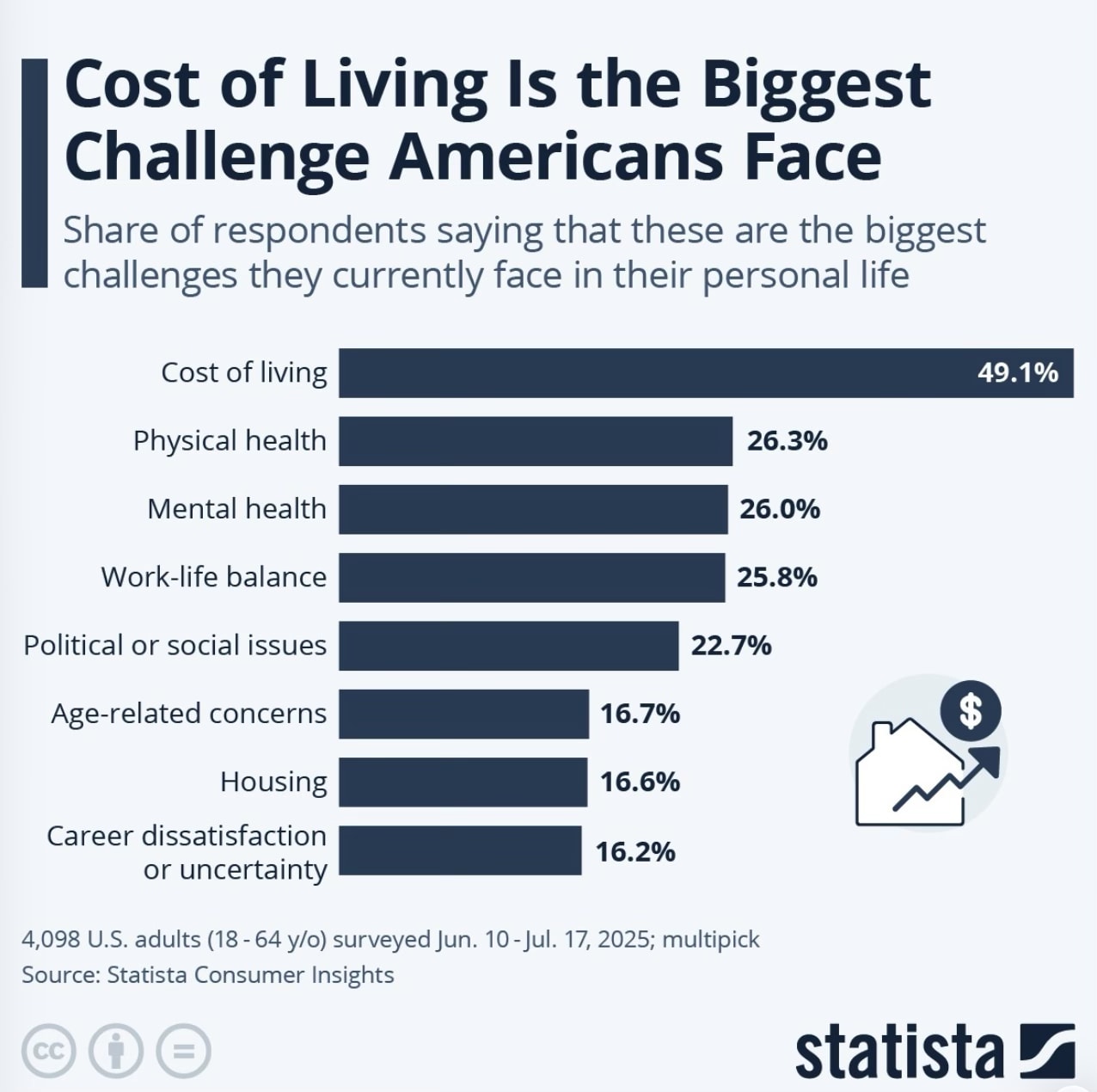
Sure, the economy is doing pretty well—for the investor class. But even that limited success is hanging by a thread. It’s driven by an AI bubble that will almost certainly burst, wreaking economic havoc when it does. Meanwhile, millions of households are struggling with the cost of living (click on images to expand):

Visual Capitalist/Statista

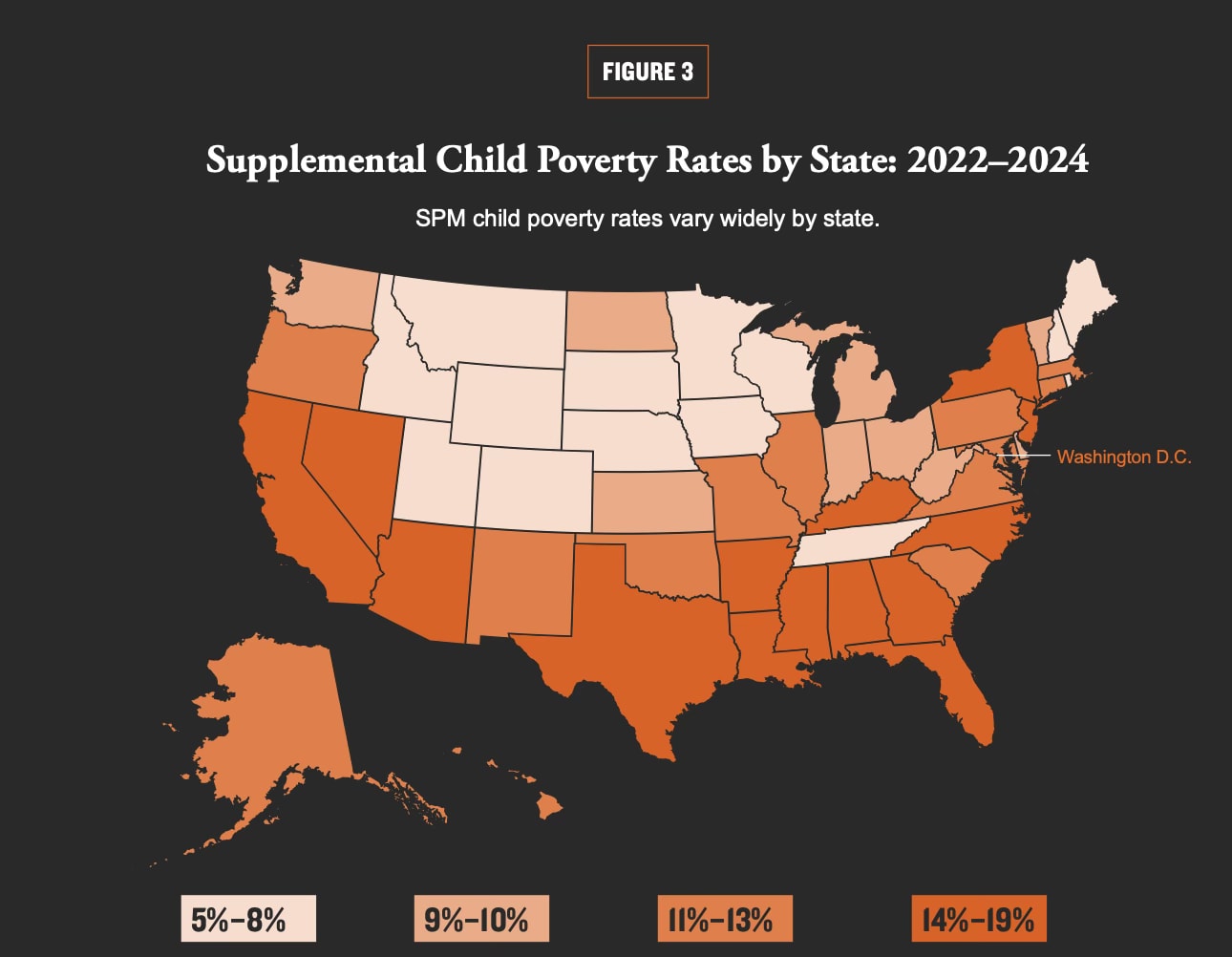
More than 43 million Americans live in poverty, including one child in seven:

Source: Annie E. Casey Foundation

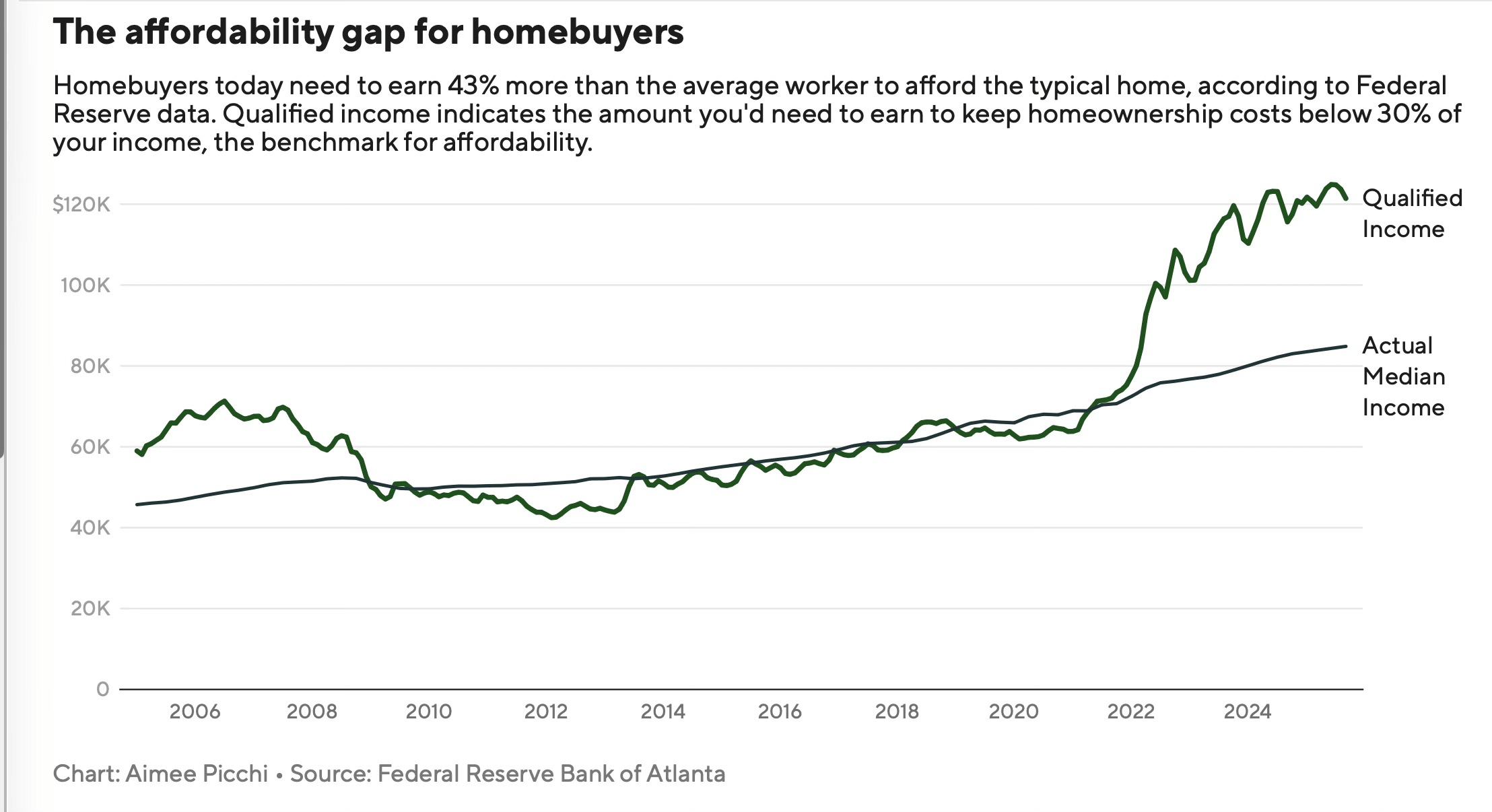
The housing shortage is causing widespread pain as homes become increasingly unaffordable for most workers:

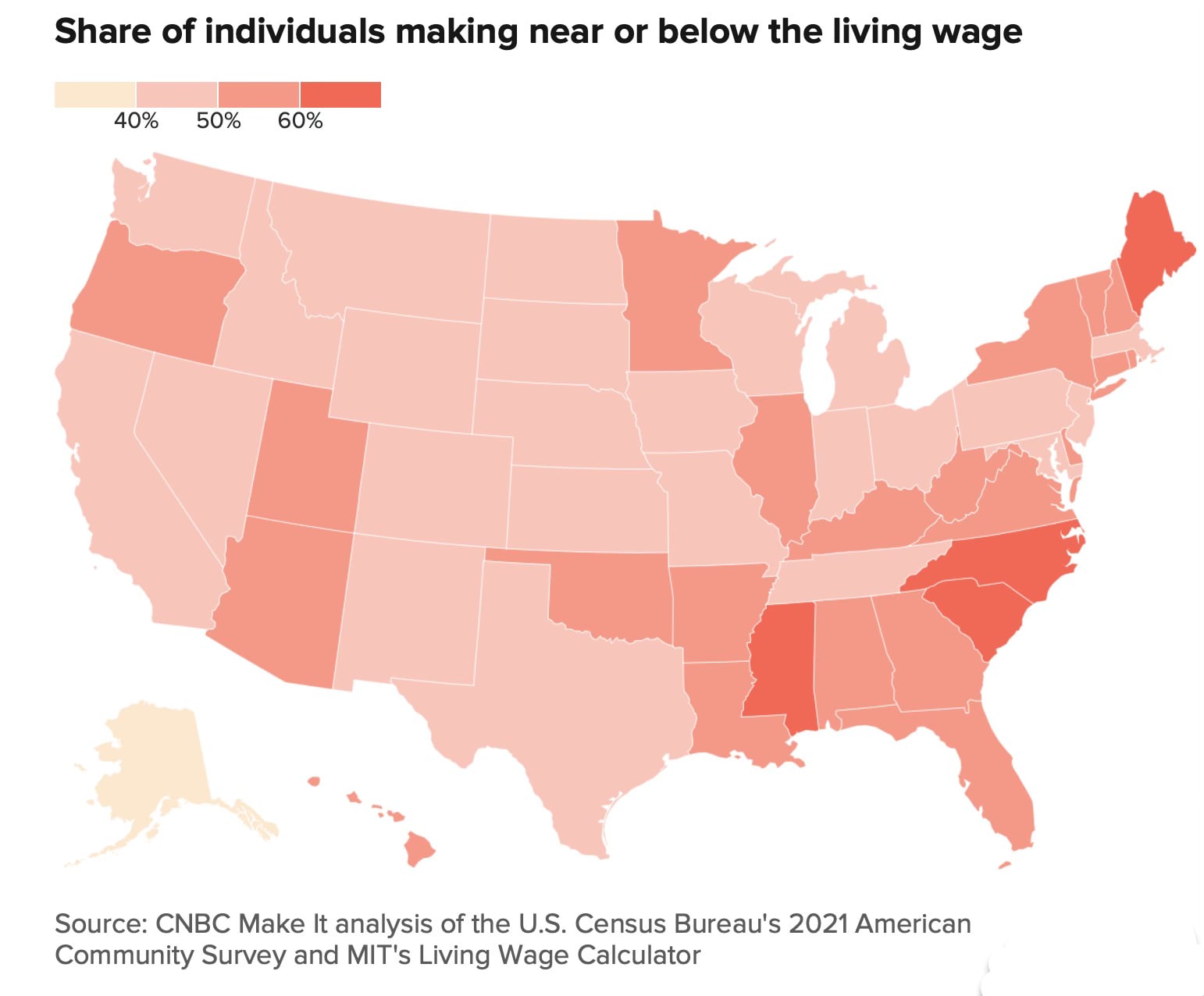
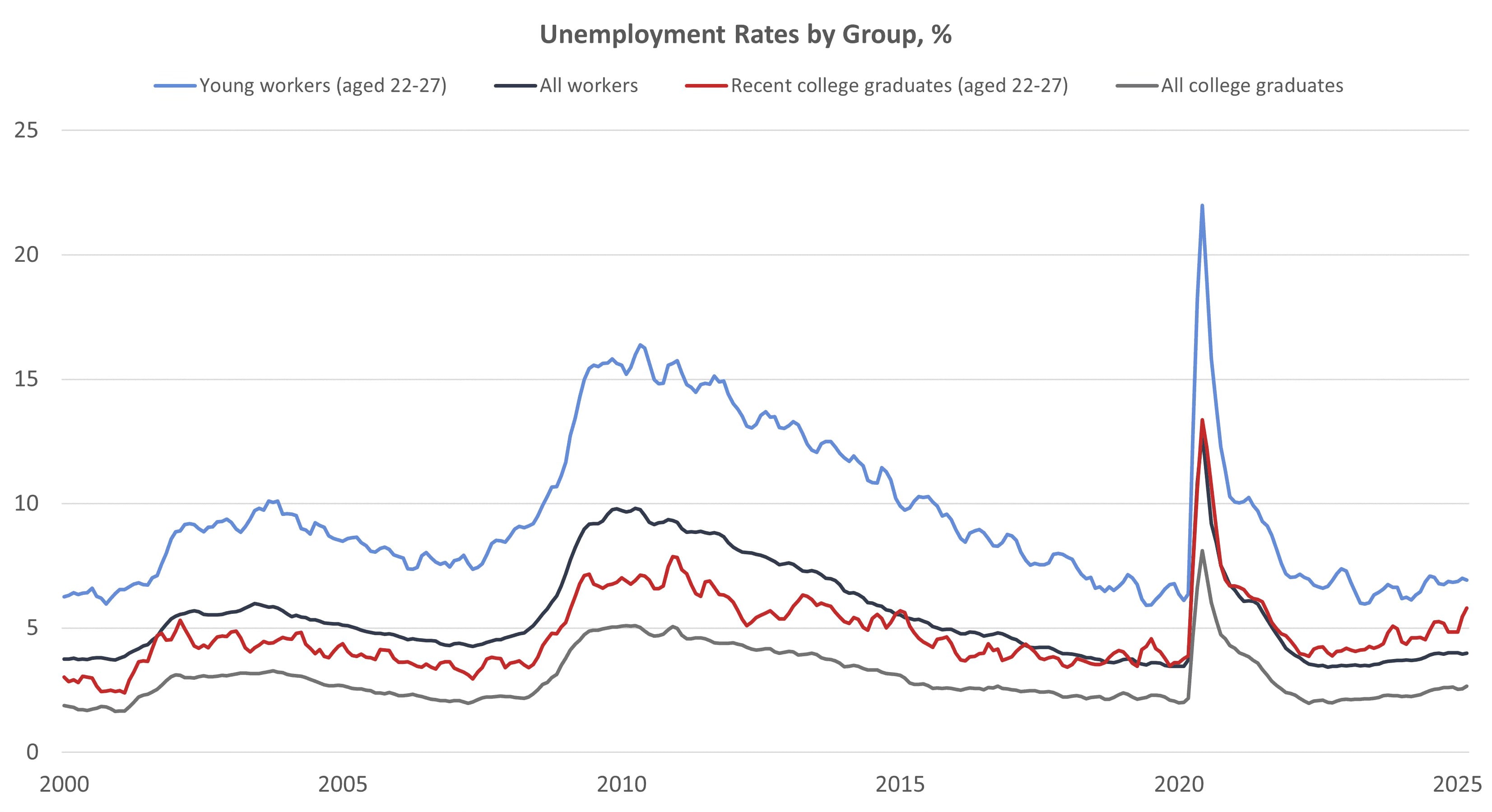
The labor outlook is “cooling,” as the economists say. But even that doesn’t count the most critical element of the job market, which is the ability to find jobs that actually pay a living wage:

Young people are especially hard-hit:

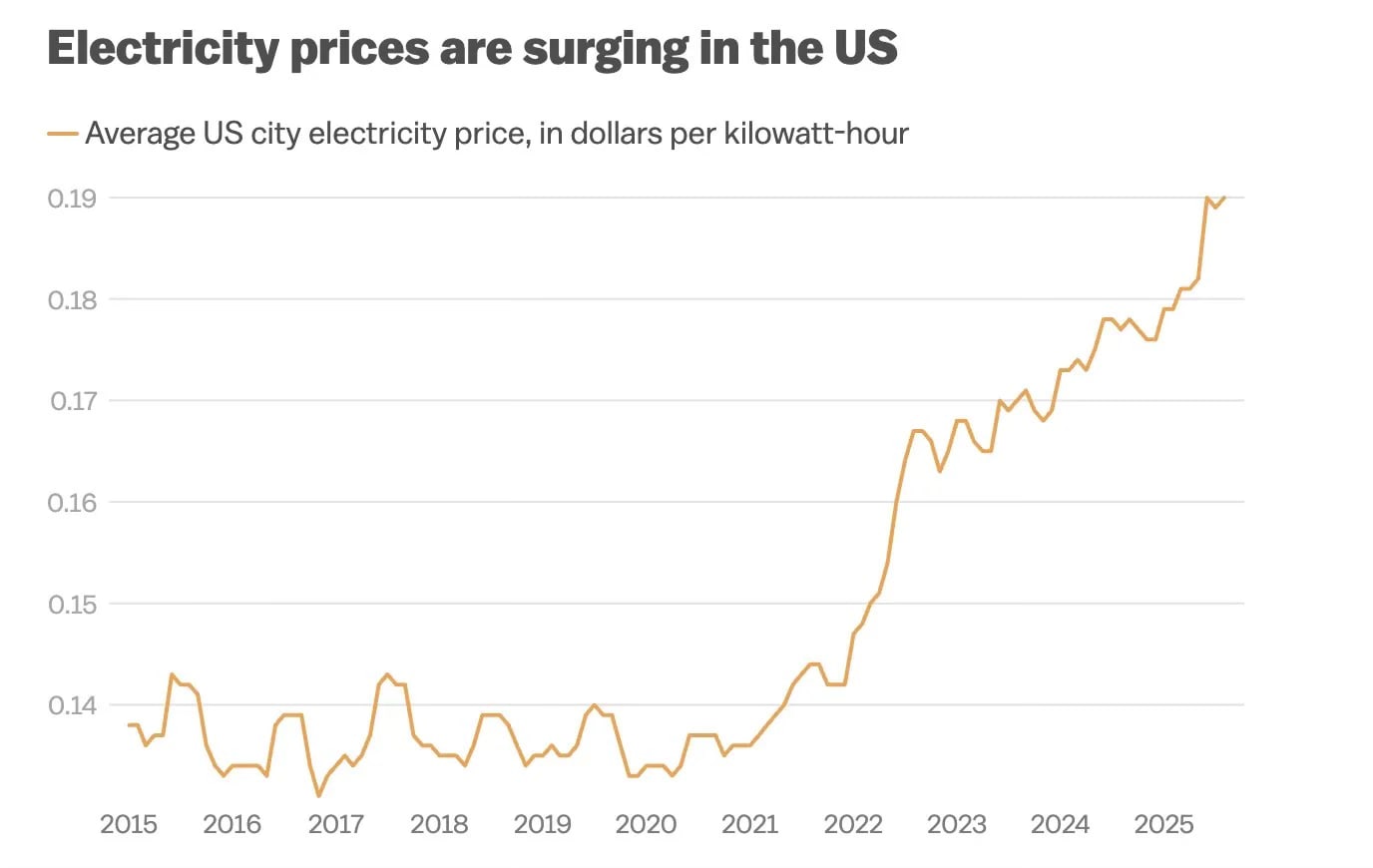
“Energy affordability” is a growing crisis, too. The average American household paid $124 per month more on its utility bill in the first nine months of 2025 and rates are still rising, with no end in sight:

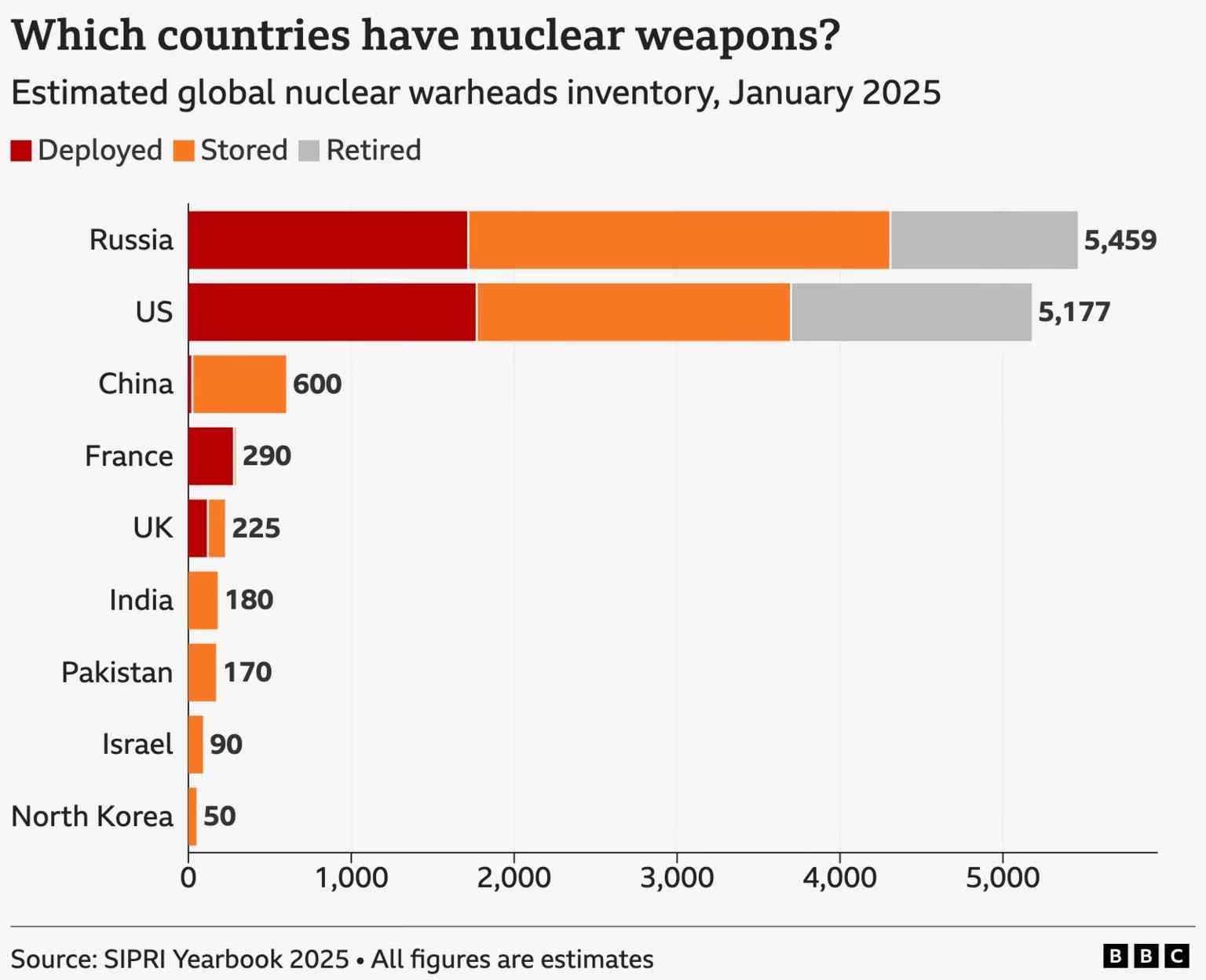
Oh, and the New START treaty will expire in a few weeks, leaving the world with no meaningful limits on the possibility of a new nuclear arms race:

Nuclear catastrophe? It’s not impossible. Doesn’t that warrant some attention from this country’s leaders?

You get the idea. With all these problems to solve, our leaders have decided the right thing to do is—invade Venezuela. That won’t be an easy ride. It’s a country of 28 million people and its terrain that includes jungles, deserts, and mountains.

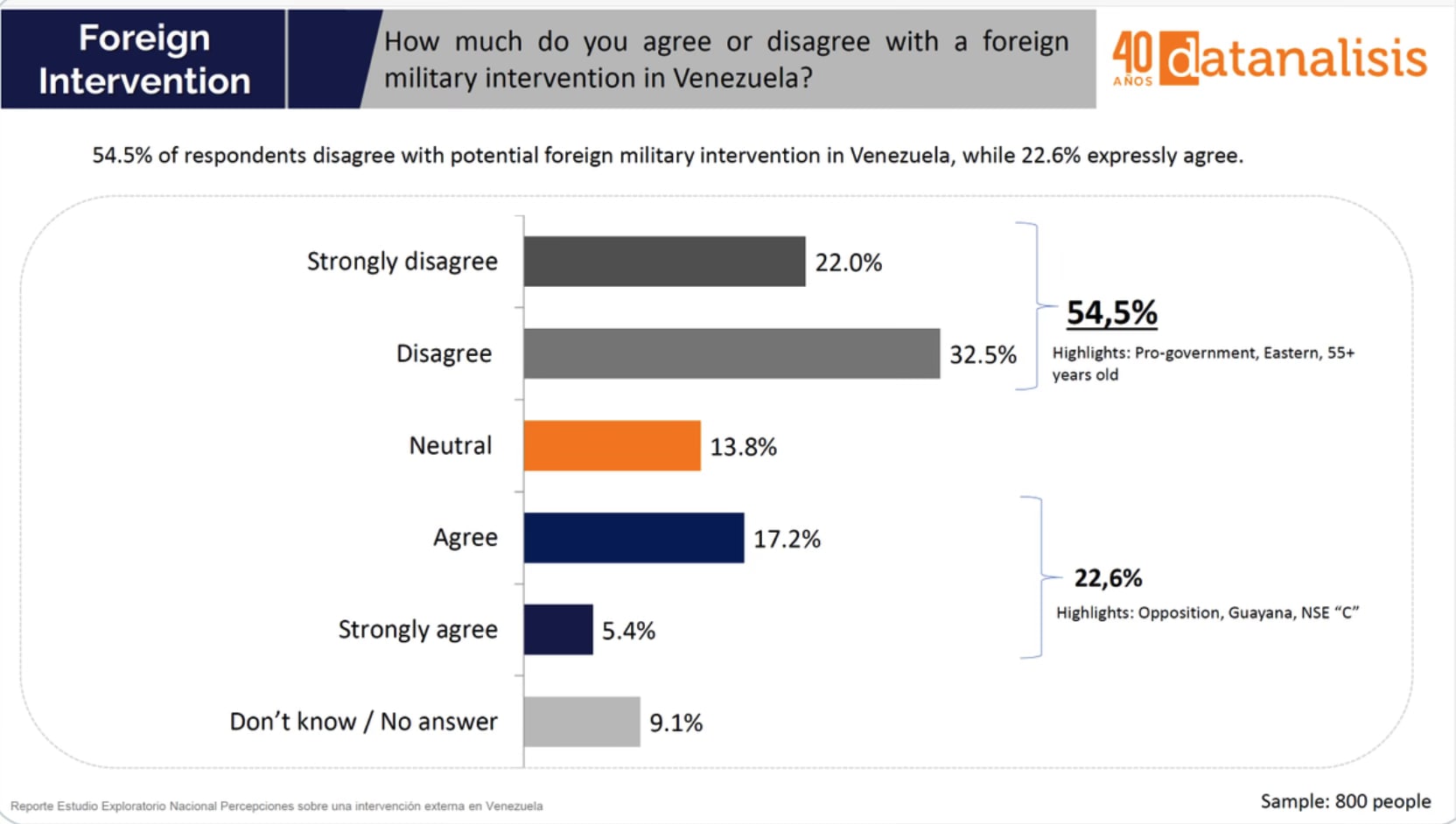
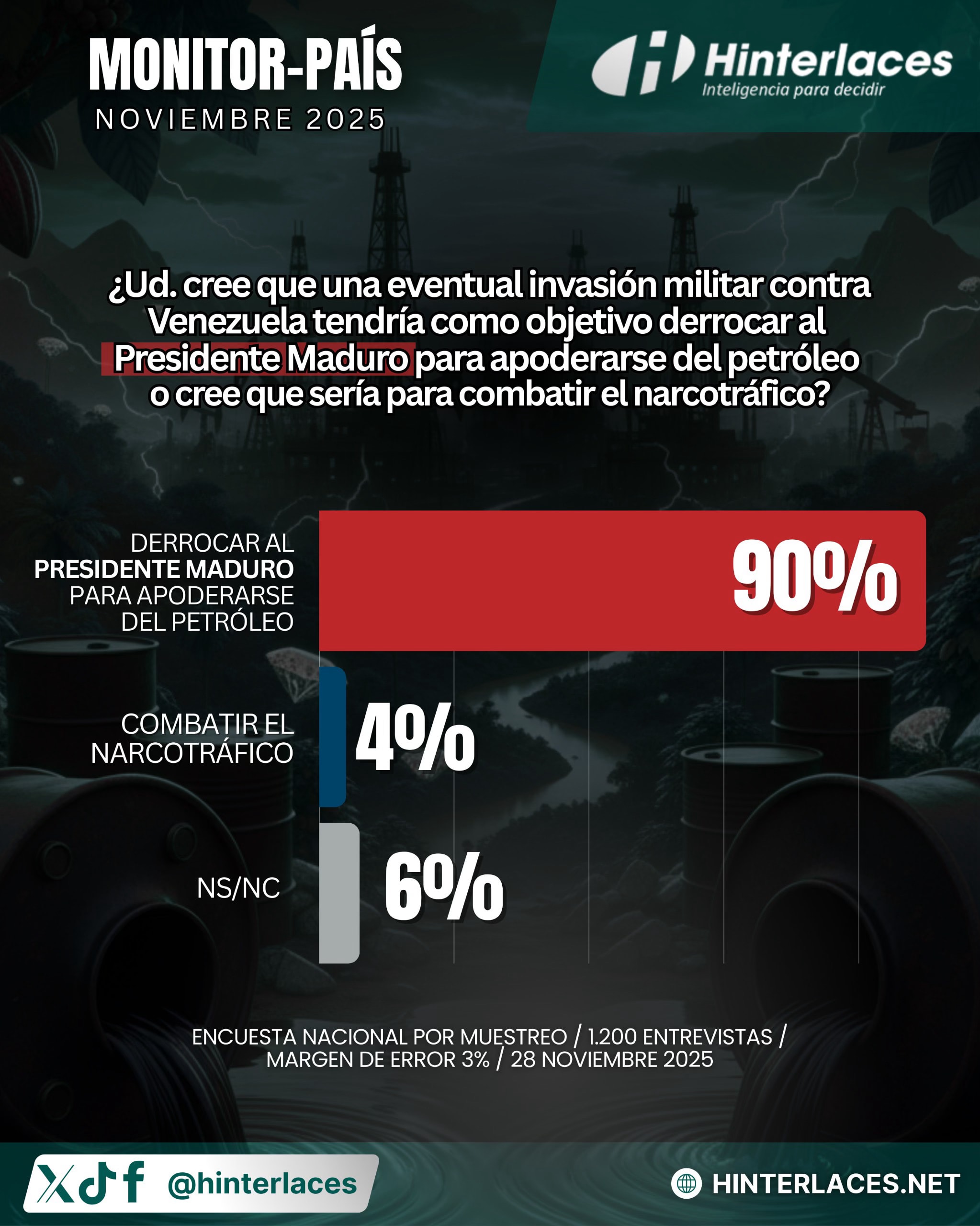
With all these disasters at home, it’s a safe bet we’re not wanted in Venezuela for our management expertise. In fact, most Venezuelans don’t want us there at all:

Most Venezuelans think the US is only doing it “because of the oil”:

The question, translated: “Do you believe that a potential military invasion against Venezuela would aim to overthrow the president in order to seize the oil, or do you think it would be to combat drug trafficking?” The headline: “90% believe that an invasion would aim to overthrow Maduro because of the oil.”

To be fair, we are only doing it because of the oil. Mostly, anyway.

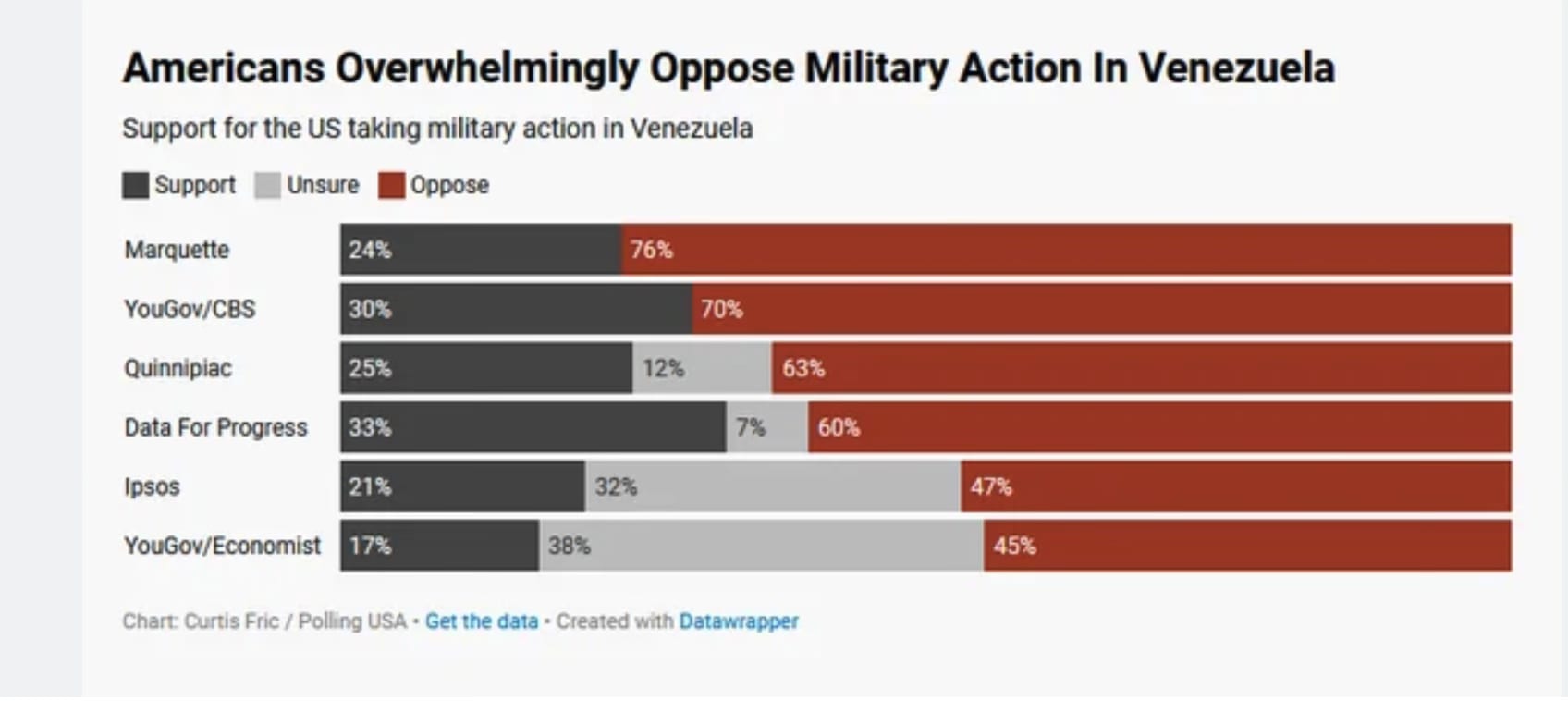
Most Americans don’t want us in Venezuela, either:

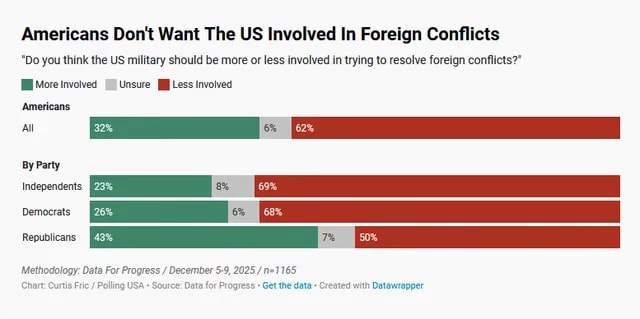
In fact, most Americans are sick of our government’s seemingly endless addiction to foreign military adventurism:

And yet, here we are.

This is a desperate resource grab by Trump and the other overseers of this dying economic system. It’s also an obvious and deliberate distraction from the many problems here in the United States. And we all know they’re doing it for their benefit, not ours.

Like the saying goes: it’s all about the grift. But at what price for the rest of us?

Our work is licensed under Creative Commons (CC BY-NC-ND 3.0). Feel free to republish and share widely.

Richard Eskow is a journalist who has written for a number of major publications. His weekly program, The Zero Hour, can be found on cable television, radio, Spotify, and podcast media.

Tuesday, December 16, 2025

Trump’s Draconian Border Policies Are Menacing the 2026 World Cup

Trump is banning travel from more than 30 countries 

Maybe this is why FIFA gave Trump his phony "peace prize"

By Nora Loreto

This article was originally published by Truthout

On Saturday, December 6, soccer fans around the world found out where their favorite teams will be playing in the 2026 FIFA World Cup. Players and staff from 48 countries and territories will play 104 games across North America — and for the first time in history, Canada is hosting some of the games. Together, Toronto and Vancouver will host 13 matches.

In addition to the matches, 84 training sites and 178 practice fields will be spread across Canada, the U.S., and Mexico. Plus, tens of thousands of broadcasters from around the world will cover the games for their home countries.

Holding the games in three countries means that ease of crossing borders is a fundamental part of the World Cup going smoothly. Hundreds of thousands of players, staff, and fans will need to move across the U.S.-Mexico border and the Canada-U.S. border multiple times in order to attend the matches over the course of six weeks in June and July 2026. But already, months before the games begin, concerns are mounting over whether attendees will be able to enter the host countries at all.

Wednesday, July 30, 2025

Tariff tax you will pay on Friday

Clothes, cars, food tariffs supposedly going into effect on Friday when King Donald's national sales tax takes effect

Friday, July 25, 2025

If the measure of success is losing billions of dollars, than chalk one up for King Donald

Trump deals another blow to American automakers 

by Emily Singer, Daily Kos Staff

Donald Trump announced late on Tuesday that he and Japan reached a trade agreement, which will slap a 15% tariff on Japanese imports in exchange for Japan investing $550 billion in the U.S.

The so-called deal is another shit sandwich for Americans, especially U.S. car manufacturers. 

That's because Japanese cars imported into the U.S. will face a 15% tariff rate—lower than the 25% tariff American car companies currently face for imported auto parts. 

American automakers have already said Trump's tariffs have dealt a massive blow to their companies.

General Motors reported Tuesday that it lost $1 billion from April to June, attributing the losses to Trump's tariffs. And Stellantis, which manufactures American brands like Chrysler, Jeep, and Dodge, said it lost a whopping $2.7 billion in the first half of 2025 because of Trump's tariffs.

That 15% rate is less than the shocking 25% tariff Trump had threatened against Japan if a deal wasn’t struck.

That’s why Japanese car stocks rose on Wednesday, with Toyota up about 13%.

“Toyota is up +8% on the news of a 15% tariff. Why? It's simple,” Spencer Hakimian, founder of the hedge fund Tolou Capital Management, wrote in a post on X. 

“Ford, GM, Tesla, and all the other American manufacturers are going to be paying 50% more for their steel, 50% more for their copper, 25% more for their Canadian production, 25% more for their Mexican production, and 55% on their Chinese production. Toyota only has to pay 15% more and they're done with all the shenanigans. Ford has to pay much more than that. A lot more in fact."

“We've given a Japanese car company an advantage over American car companies. All in hope of bringing auto jobs back to America,” he added.

The American Automotive Policy Council—which represents General Motors, Ford, and Stellantis—said on Wednesday that the Japanese trade agreement is a "bad deal for U.S. industry and U.S. auto workers."

But Trump’s trade policy is not hurting just automakers.

Goldman Sachs on Tuesday said that U.S. economic growth will slow in 2025 because of Trump’s tariffs. The bank’s chief economist, Jan Hatzius, wrote in a memo to clients that the tariffs “will eat into real income, at a time when consumer spending trends already look shaky.” 

Thursday, May 29, 2025

Nine of ten Americans reject RFK Jr.'s long-held stance on measles vaccine

One true thing RFK Jr. has said recently is don't take vaccine advice from him

Stephanie Soucheray, MA 

A new Annenberg Poll shows that 87% of Americans say the benefit of childhood measles, mumps, and rubella (MMR) vaccination outweighs the risk, and 67% say they know that MMR vaccines don't cause autism.

2025 may see the highest measles case count in the United States since the disease was officially eliminated in 2000. With more than 1,000 cases identified, and many more likely unreported, the virus is taking hold in unvaccinated and under-vaccinated communities. The Annenberg Poll surveyed 1,653 US adults from April 15 to 28, 2025, on measles knowledge and attitudes toward vaccines.

Despite the number of current outbreaks (14) and illnesses (1,024 confirmed), only 6 in 10 of adults polled (58%) said there are more measles cases in the United States in 2025 than in the comparable period in 2024.

The poll picked up increased support for mandating MMR vaccine for public school entrance. Eighty percent of those polled said they supported requiring MMR vaccines for school entry, up from 73% in 2023. Only 18% of those polled said vaccines should be a matter of parental choice.

Wednesday, May 28, 2025

Tomato trade dispute between the US and Mexico is boiling over again – with 21% tariffs due in July

Trump launches new trade war over tomatoes

Andrew Muhammad, University of Tennessee and Luis Ribera, Texas A&M University

Although technically they’re a fruit, tomatoes are one of the most-consumed vegetables, according to the U.S. Department of Agriculture. Among the fresh produce the nation buys from foreign countries, tomatoes often rank first or second, behind avocados.

This trade is now jeopardized because the Trump administration has revived a three-decade-old effort to limit imports.

As economists who study global trade issues affecting agricultural commodities and processed food products, we have assessed the benefits of imported tomatoes and other products on consumers and businesses. Fresh tomato imports ensure year-round availability for consumers, contribute significantly to the U.S. economy by generating billions in sales and supporting thousands of jobs, and promote competitive pricing that benefits both consumers and businesses.

New import restrictions could put all that at risk because domestic production cannot satisfy national demand. For tomatoes, like steel and other products, efforts to reverse trade imbalances can decrease consumer satisfaction and potentially destroy more jobs and economic activity than they create.

Sunday, May 25, 2025

Economic Anxiety of Americans Surges Under Trump

The worst part is Trump's bizarre claims that everything is great, all evidence to the contrary

Julia Conley for Common Dreams

Posted by Trump on May 12
The Trump administration has made its desire for Americans to expand their families well known, but a new survey out Monday details how a growing number of people are postponing such major life decisions—including having children, buying a home, or expanding their education—due to the economic anxiety created by Donald Trump's policies.

The Harris poll was conducted on behalf of The Guardian between April 24-26, in the wake of the news that the White House was considering multiple ways to encourage people to have more children. 

The proposals being floated by "pronatalist" advisers include a $5,000 "baby bonus" that the administration would offer to people when they have a new baby—which would cover less than half of the average annual cost of childcare in the United States.

Monday, March 31, 2025

Tariffs won’t just hit your wallet. They could also increase food waste.

Wednesday, on April 2, Trump plans to announce major new tariffs

Frida Garza, Staff Writer

Spring has sprung, and you can tell by looking at Dig’s online menu. The fast-casual chain known for its bountiful salads and bowls is promoting a new sandwich for the spring — the “avo smash,” wherein a hearty piece of chicken or tofu is embraced by a brioche bun, pesto aioli, and plenty of bright-green avocado. 

The lunch spot’s seasonal menus are planned at least three months in advance, said Andrew Torrens, Dig’s director of supply, meaning the avo smash has been in the works for a while. However, if the United States decides to escalate a global trade war next month, Dig will have to come up with a backup plan fast.

“If avocado prices explode, what’s our backup? How do we pivot?” said Torrens on a recent phone call. 

Since his inauguration in January, Donald Trump has repeatedly threatened tariffs on imports from Mexico and Canada — creating confusion for restaurant owners, food distributors, grocers, and consumers who rely on the United States’ neighbor to the south for fruits and vegetables year-round. 

On February 1, Trump signed an executive order levying a 25 percent tariff on goods from Canada and Mexico. However, he has twice pushed back the start date; earlier this month, he paused tariffs on most goods coming in from Mexico and Canada until April 2. What will actually happen on that date — which Trump has dubbed “Liberation Day” — is still largely unclear.

A tariff on goods from Mexico, the single largest supplier of horticultural imports to the U.S., would almost certainly mean higher prices at the grocery store. It could also, according to experts, increase food waste along the supply chain.

Dig sources most of its avocados from Mexico, where the warm climate is ideal for growing these fruits. This is common — in fact, about 90 percent of avocados consumed in the U.S. come from Mexico, according to the U.S. Department of Agriculture. 

Wednesday, March 19, 2025

How Trump’s tariffs could mean rising costs for families, strain for states

A potential $110B economic hit 

Bedassa Tadesse, University of Minnesota Duluth

Get ready to pay more for avocados, maple syrup and – well – almost everything.

The U.S. officially imposed new 25% tariffs on Canada and Mexico on March 4, 2025, following through on a long-delayed pledge from President Donald Trump. American consumers and businesses are now bracing for higher costs and potential supply disruptions.

Although tariffs, or taxes on imports, are a pillar of Trump’s economic policy, the move still surprised many observers, since Mexico and Canada are among the U.S.’s traditional allies and top trading partners. The administration further rattled global supply chains by doubling existing tariffs on Chinese goods to 20%.

As an economist who studies global trade, I wanted to know how the 25% import duties on Canada and Mexico would affect different parts of the country. So I conducted a state-by-state impact analysis.

What I found is alarming: The U.S. economy could face an annual loss of US$109.23 billion. This shortfall would mean rising costs of everyday goods for American families and would disproportionately affect certain states. My analysis focused exclusively on the effects of U.S. tariffs, so it didn’t take retaliation from Canada or Mexico into account. If it did, the losses would be even greater.

Unequal burdens for states, higher prices for families

Imagine your grocery bill surging by 17.5% to 25%, car parts costing hundreds of dollars more, and your favorite local restaurant raising prices as imported ingredients become unaffordable. Because tariffs drive up consumer prices, these scenarios, or others like them, will soon become reality across the U.S.

But not all Americans will be affected equally, I found. States that are deeply connected to North American supply chains will suffer the biggest economic blows. Texas, with its strong trade ties to Mexico and key role in energy, would lose $15.3 billion. California’s diverse economy would take a $10.2 billion hit. Michigan, heavily reliant on auto manufacturing, would face a $6.2 billion blow – over 1% of its gross domestic product.

Saturday, March 15, 2025

King Donald Demands Journalists Use Language He Wants or Face Punishment

Ominous Move to Strip Americans of First Amendment Rights

By David Cay Johnston

Donald Trump’s oft-stated hostility to journalism, and his dictatorial efforts to force journalists to heel, took a disturbing turn in a Washington courtroom on Monday, February 24. A turn detrimental to the health of our First Amendment rights.

A federal judge appointed by Donald Trump indicated that he would allow the Trump administration to bar from the White House press room the nonprofit Associate Press, one of the country’s largest news organizations.

The AP was blocked because it does not use language that Donald Trump demands that all Americans use or risk government punishment, calling the Gulf of Mexico the Gulf of America.

This could be seen as a petty dispute, but I see it as a window into Trump’s continuing efforts to consolidate power as our de facto dictator, which in large part requires bringing the press to heel so Americans learn only the official Trump version of events, not some pesky independent reporting.

Telling journalists what language to use contradicts the free speech and free press rights all Americans enjoy under our Constitution’s First Amendment.  But Trump knows that this will have a visceral impact only on the minority of Americans who understand, care about, and will fight for our Constitutional rights.

Most Go Along

The social experiments by Stanley Milgram and Philip Zimbardo on inflicting pain and running a faux prison showed that only one in six people will resist or reject orders to harm others. Zimbardo, a Stanford University professor whose experiment I wrote about at the time, insisted to his dying day that he had no interest in those who wouldn’t go along, only those who complied.

Donald has a long history of showing his utter lack of regard for our Constitution when he finds it inconvenient. In this his obsequiously loyal ally is Vice President JD Vance, a Yale-educated lawyer who knows better, but favors demonstrating his fealty to Trump above his oath of office to protect and defend our constitution against all enemies foreign and domestic.

Now Trump appears to have another ally in U.S. District Judge Trevor McFadden, a 2017 Trump appointee.

In that Monday’s hearing, judge McFadden declined to direct the Trump administration to let Associated Press reporters into the White House press room.

“I can’t say the AP has shown a likelihood of success here,” Judge McFadden said.

McFadden called the AP ban “problematic” and advised the government that “case law in this circuit is uniformly unhelpful to the White House.” He then ordered a hearing in March. without any relief for AP until then.

The judge also critiqued AP for waiting five days to file its case, saying it showed that AP didn’t consider this an emergency.

It’s hard to imagine a clearer First Amendment violation. Trump is punishing the Associated Press for exercising a Constitutional right, namely, to choose the words it thinks are proper and appropriate in news articles. That Judge McFadden is trying to weasel out of his duty to uphold Constitutional rights is another sign of obeisance to our dictator’s demands.

Trump made clear last week that unless AP writes the news as he demands, using his fictional Gulf of America in relevant articles, it will not be reinstated.

“We’re going to keep them out until such time that they agree it’s the Gulf of America,” Trump said.

Thursday, March 6, 2025

10 Reasons for Modest Optimism in the Fight Against the Trump-Vance-Musk Regime

Don't lose hope

Robert Reich for Inequality Media


If you are experiencing rage and despair about what is happening in America and the world right now because of the Trump-Vance-Musk regime, you are hardly alone. A groundswell of opposition is growing—not as loud and boisterous as the resistance to Tump 1.0, but just as, if not more, committed to ending the scourge.

Here’s a partial summary—10 reasons for modest optimism.

1. Boycotts Are Taking Hold

Americans are changing shopping habits in a backlash against corporations that have shifted their public policies to align with Trump.

Millions are pledging to halt discretionary spending for 24 hours on February 28 in protest against major retailers—chiefly Amazon, Walmart, and Best Buy—for scaling back diversity, equity, and inclusion initiatives in response to President Donald Trump.

Four out of 10 Americans have already shifted their spending over the last few months to be more consistent with their moral views, according to the Harris poll. (Far more Democrats—50%—are changing their spending habits compared with Republicans—41%.)

Calls to boycott Tesla apparently are having an effect. After a disappointing 2024, Tesla sales declined further in January. In California, a key market for Tesla, nearly 12% fewer Teslas were registered in January 2025 than in January 2024. An analysis by Electrek points to even more trouble for Tesla in Europe, where Tesla sales have dropped in every market.

X users are shifting over to Bluesky at a rapid rate, even as Musk adds more advertisers to his ongoing lawsuit against those that have justifiably boycotted X after he turned it into a cesspool of lies and hate (this week, he added Lego, Nestle, Tyson Foods, and Shell).

2. International Resistance Is Rising

Canada has helped lead the way: A grassroots boycott of American products and tourism is underway there. Prime Minister Justin Trudeau has in effect become a “wartime prime minister” as he stands up to Trump’s bullying.

Jean Chrétien, who served as prime minister of Canada from 1993 to 2003, is urging Canada to join with leaders in Denmark, Panama, and Mexico, as well as with European Commission President Ursula von der Leyen, to fight back against Trump’s threats.

Mexico’s President Claudia Sheinbaum is standing up to Trump. She has defended not just Mexico but also the sovereignty of Latin American countries Trump has threatened and insulted.

In the wake of JD Vance’s offensive speech at the Munich security conference last week, European democracies are standing together—condemning his speech and making it clear they will support Ukraine and never capitulate to Russian President Vladimir Putin, as Trump has done.

Saturday, February 22, 2025

Inflation is heating up again, putting pressure on Trump to cool it on tariffs

Predictably, terrible policies yield terrible results

Jason Reed, University of Notre Dame

Inflation figures released on Feb. 12, 2025, will come as a disappointment to Americans who hoped President Donald Trump would be true to his word on bringing down prices “on Day One.” It will also put pressure on the new administration to be wary of policies that may heat up inflation – and that includes tariffs.

The consumer price index, which measures the change in prices paid by consumers for a representative basket of goods and services, rose unexpectedly from December to January by 0.5%. It means consumers are paying around 3% more on item prices than they were a year ago.

Economists had been expecting the pace of inflation to slow in January.

The news isn’t good for anyone concerned. It means inflation remains above the Federal Reserve’s long-run target of 2% – making it harder for the central bank to cut rates at its next meeting on March 19. At its last meeting, the rate-setting Federal Open Market Committee kept its benchmark federal funds rate unchanged at a range of 4.25-4.50%.

Following the release of the latest inflation data, markets have a stronger conviction that the Fed will again hold rates steady when it meets in March.

It also means more pain for consumers. Higher interest rates set by the Fed play a large role in determining rates for mortgages, credit cards and auto loans. If January’s rate of inflation were to continue throughout 2025, consumers would see a painful 6.2% annualized inflation rate.

And although it would be churlish to link the latest jump in inflation to an administration just weeks old, it does put into focus the current slate of Trump economic policies. Economists have long warned that imposing tariffs on imports and cutting taxes does little to curb inflation – rather, they may contribute to faster price increases.

Monday, February 17, 2025

Trump's Old-School Brand of Imperialism

MAGA-Fest Destiny

William Astore for the TomDispatch

A few years ago, I came across an old book at an estate sale. Its title caught my eye: “Our New Possessions.” Its cover featured the Statue of Liberty against stylized stars and stripes. 

What were those “new possessions”? The cover made it quite clear: Cuba, Hawaii, the Philippines, and Puerto Rico. The subtitle made it even clearer: “A graphic account, descriptive and historical, of the tropic islands of the sea which have fallen under our sway, their cities, peoples, and commerce, natural resources and the opportunities they offer to Americans.” 

What a mouthful! I’m still impressed with the notion that “tropical” peoples falling “under our sway” offered real Americans amazing opportunities, as did our (whoops — I meant their) lands. Consider that Manifest Destiny at its boldest, imperialism unapologetically being celebrated as a new basis for burgeoning American greatness.

The year that imperial celebration was published — 1898 — won’t surprise students of U.S. history. America had just won its splendid little imperial war with Spain, an old empire very much in the “decline and fall” stage of a rich, long, and rapacious history. And just then red-blooded Americans like “Rough Rider” Teddy Roosevelt were emerging as the inheritors of the conquistador tradition of an often murderously swashbuckling Spanish Empire.

Of course, freedom-loving Americans were supposed to know better than to follow in the tradition of “old world” imperial exploitation. Nevertheless, cheerleaders and mentors like storyteller Rudyard Kipling were then urging Americans to embrace Europe’s civilizing mission, to take up “the white man’s burden,” to spread enlightenment and civilization to the benighted darker-skinned peoples of the tropics. 

Yet to cite just one example, U.S. troops dispatched to the Philippines on their “civilizing” mission quickly resorted to widespread murder and torture, methods of “pacification” that might even have made Spanish inquisitors blush. That grim reality wasn’t lost on Mark Twain and other critics who spoke out against imperialism, American-style, with its murderous suppression of Filipino “guerrillas” and bottomless hypocrisy about its “civilizing” motives.

After his exposure to “enlightened” all-American empire-building, retired Major General Smedley Butler, twice awarded the Medal of Honor, would bluntly write in the 1930s of war as a “racket” and insist his long career as a Marine had been spent largely in the service of “gangster” capitalism. Now there was a plain-speaking American hero.

And speaking of plain-speaking, or perhaps plain-boasting, I suggest that we think of Donald Trump as America’s retro president from 1898. Isn’t it time, America, to reach for our destiny once again? Isn’t it time for more tropical (and Arctic) peoples to be put “under our sway”? Greenland! Canada! The Panama Canal! 

These and other regions of the globe offer Donald Trump’s America so many “opportunities.” And if we can’t occupy an area like the Gulf of Mexico, the least we can do is rebrand it the Gulf of America! A lexigraphic “mission accomplished” moment bought with no casualties, which sure beats the calamitous wars of George W. Bush and Barack Obama in this century!

Now, here’s what I appreciate about Trump: the transparent nature of his greed. He doesn’t shroud American imperialism in happy talk. He says it just like they did in 1898. It’s about resources and profits. 

As the dedication page to that old book from 1898 put it: “To all Americans who go a-pioneering in our new possessions and to the people who are there before them.” Oh, and pay no attention to that “before” caveat. 

We Americans clearly came first then and, at least to Donald Trump, come first now, and — yes! — we come to rule. The world is our possession and our beneficence will certainly serve the peoples who were there before us in Greenland or anywhere else (the “hellhole” of Gaza included), even if we have to torture or kill them in the process of winning their hearts and minds.