Menu Bar

Home           Calendar           Topics          Just Charlestown          About Us
Showing posts sorted by date for query van slyke and arnolda. Sort by relevance Show all posts

Wednesday, September 18, 2024

Charlestown finances and taxes – Your choice on November 5

Do not let the crowd that messed up, lied and then covered up get back into office

By Will Collette

The CCA's 2024 campaign slogan
There are many reasons why Charlestown voters should reject the effort by the Charlestown Citizens Alliance (CCA) to regain control of Charlestown. I hope to cover them all before election day.

But for starters, let’s talk about the biggie: Can you trust the CCA to manage your money?

In 2020, the CCA proved it can’t be trusted with taxpayer funds. The lead evidence was the “$3 million Oopsie.” This was a grave problem that the CCA called a “misallocation.” 

$3 million in town funds went walkabout, unnoticed by the CCA financial brain trust of ex-Town Administrator Mark Stankiewicz and ex-Budget Commission chair Richard Sartor for almost two years. The error was finally spotted by the town’s ex-auditor and duly reported.

This sparked panic within the CCA as they first tried to find a word other than “lost” to describe the screw-up. They settled on "misallocation." Their word, not mine.

Next, they searched for someone to blame since as we all know, the CCA is always right. They ended up scapegoating the auditors who found the problem. 

Then they tried to distract and minimize the problem using laughable analogies. Ruth Platner compared it to parking your car in the wrong place. Bonnie Van Slyke came up with some story about a ladder that I've never quite understood.

Finally they fell back on that old “Hey, how about that low tax rate?” tripe.

During all these machinations, they had their pet Town Administrator Stankiewicz use every trick in the book to avoid disclosing town financial records that would have brought some disinfecting sunshine to this issue. The CCA also blocked even a public discussion of the need for an outside financial review and instead let Sartor and Stanky review themselves.

Two years later, the CCA and especially their mouthpiece Council candidate Bonnita Van Slyke are now denying there was ever any problem, claiming their political opponents made it up. I wish I was that clever.

Van Slyke personally attacked me for even raising the issue, saying my reporting hurts the reputation of such a stellar personality as Stankiewicz.

The $3 million oopsie was and is a flashpoint in 10 years of CCA financial shenanigans. Before the “oopsie” went public, the worst abuses were questionable land deals promoted by Planning Commissar Ruth Platner who is now running for Council. Ruth never met a piece of undeveloped land she didn’t want to buy, regardless of price, using your money of course.

Time and again, she pushed deals where owners (often CCA affiliates like the Sachem Passage Association) would be paid far more than the land’s assessed values, often based on appraisals that relied on fictitious conditions. Stankiewicz helped by clamping down on the release of public records on these corrupt deals.

“But the tax rate!”

The CCA ran Charlestown from 2011 to 2023.
 Source: Charlestown Tax Assessor
To hear the CCA tell it, the only thing that matters to taxpayers is the property tax rate which they claimed was ultra-low, due to their genius. That, plus providing virtually no municipal services and relying on rising property values to buttress the tax base.

First, a few facts: under the CCA, the tax rate went up pretty consistently as the table to the right shows. 

After the voters gave the CCA the boot in 2020, the tax rate has plummeted to its lowest level in decades, going from $8.17 when the CCA was booted to the current $5.78.

But the tax rate is only half the equation. What you actually pay in taxes is the tax rate multiplied by your property assessment. 

Assessments have skyrocketed due to shorefront purchases by rich New York and Connecticut folks who discovered Charlestown is way cheaper than the Hamptons.

Their multi-million-dollar purchases drove up property assessments generally to the point where Charlestown has become even more unaffordable and we all pay taxes based on property values that we are unlikely to ever appreciate when we eventually sell our homes. 

The most recent reassessment increased the taxable value of our home by 65% to a level I can't imagine in my wildest dreams ever getting should we sell. Unless you’ve got a shoreline property, your assessment probably does not reflect market reality.

Even Van Slyke found that out when she tried to sell her waterfront Arnolda estate for $3 million but ended up having to settle for $2 million.

An economy out of balance

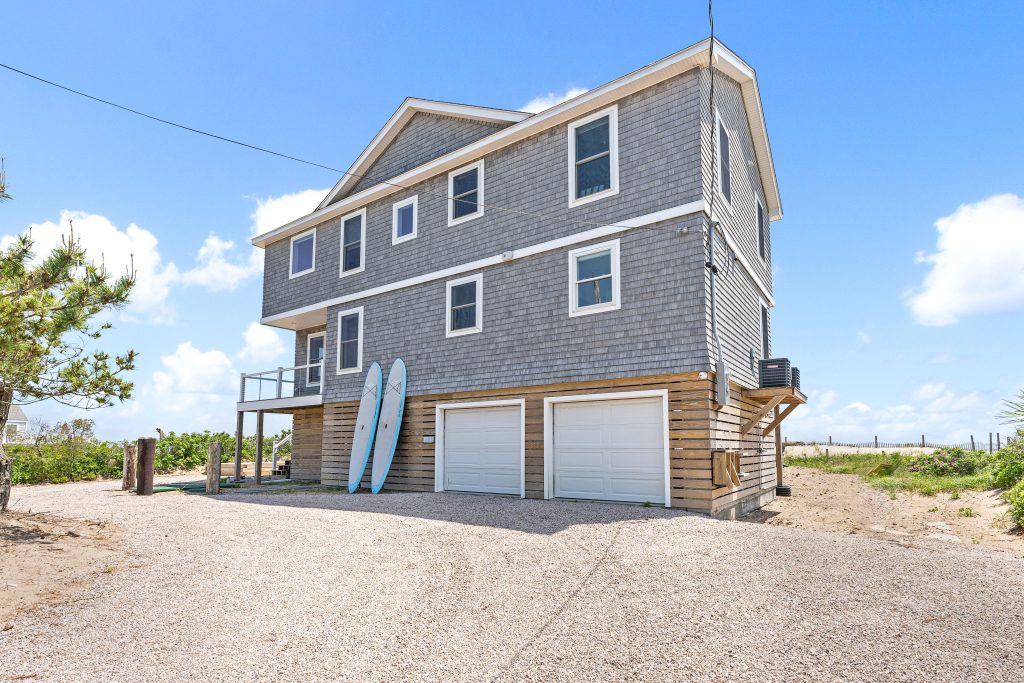
This East Beach Road property was assessed at
$1,967,700 and just sold for $3.65 million.
The CCA left the current Council majority from Charlestown Residents United (CRU) a large and complicated mess to clean up.

Actions have consequences. The CCA’s decade of reliance on rich people buying beach property and tourists flocking in during the summer has skewed our economy. 

While those beachfront owners pay a large portion of town taxes, they plus tourists triple the town’s population during the summer.

We have to provide – and pay for – a town infrastructure needed to accommodate them. Other seaside towns have the same problem and have chosen to resolve this tax inequity through homestead tax credits. 

These credits cut the property taxes of permanent residents to offset the cost imposed by visitors and temporary residents. While Homestead credits are working well in Narragansett, South Kingstown, Newport and North Kingstown, the CCA adamantly opposed a Democratic proposal for a Charlestown Homestead Tax Credit.

The CCA also turned a blind eye to tax rip-offs by Charlestown’s two “fake” fire districts – Shady Harbor and Central Quonnie. Between them, these homeowner associations (HOAs) in disguise own hundreds of millions of dollars in prime beach property and pay little or no property taxes.

We are long past the time to strip the fire district designation from these associations that do not provide actual fire protection. It’s insulting to real fire fighters and a tax rip-off. While state legislation may be needed to completely resolve this embarrassment, Charlestown should immediately begin taxing their properties at real value.

They’ll sue of course. As The Public’s Radio South County Bureau Chief Alex Nunes has chronicled, fake fire districts from Bonnet Shores to Watch Hill file lawsuits anytime anybody challenges them on any issue. I believe this is a battle worth fighting and one I believe we can win.

We could easily fund a Homestead Tax Credit by making the fake fire districts pay their fair share of taxes.

We could also fund a special tax credit for fire fighters who nol only deserve our praise and thanks, but might also help alleviate the shortage of volunteers. Rep. Teresa Tanzi (D) got the General Assembly to pass legislation authorizing a fire fighter tax credit in South Kingstown.

Some other problems in the Charlestown economy

The real tax question is tax fairness, not the tax rate. Affluent Charlestown property owners can use fake fire districts and loopholes in conservation law to cut their taxes while the CCA blocks tax credits for working families.

Charlestown needs to diversify its economy and not simply rely on minimum and sub-minimum wage jobs servicing tourists and part-time residents. The people needed to provide those services can’t afford to live in Charlestown. The CCA has made it even harder by making Charlestown the only mainland Rhode Island town without RIPTA service.

Contrary to CCA claims, Charlestown does not need an overly large budget surplus. Paying cash for capital investments, including the CCA’s shady land deals, just jacks up taxes.

For years, the CCA has known about mis-zoning – properties undeservedly designated for uses that lower taxes. Planning Commissar Ruth Platner promised to fix this problem in 2012. Twelve years later and she hasn’t done it. Yet she wants you to elect her to the Town Council.

Choose wisely in November. The CCA candidates are no longer simply listed as "independents" (as if they ever were). Most CCA candidates are co-mingled with the CRU slate as either Democrats or Republicans although none of them carry town party endorsements. 

Watch your mailboxes for campaign flyers. If you want to prevent a return financial mismanagement, DON'T vote for the CCA candidates and instead cast your votes for the CRU slate.

Thursday, March 23, 2023

Sticker shock from new Charlestown tax assessments

Charlestown’s tax base rockets up by 47%: how this will affect your taxes

By Will Collette


Charlestown property owners received letters this week from town Tax Assessor Ken Swain showing the results of the town’s full reassessment of property values.

Before the reassessment, Charlestown’s “Grand List,” the total value of taxable property, was $2.88 billion. The new number is $4.22 billion, a rise of $1.34 billion or 47%. This will mean higher taxes for some, lower taxes for others and for some, almost no change at all.

Big bucks being paid mostly by wealthy out-of-staters for shore property propelled this increase in the total tax base. However, on a personal level, this has meant an assessment hike for nearly all of the rest of us, averaging around 50%.

For example, Cathy and I received Swain’s notice that the assessment on our home and adjacent vacant lot, five acres total, rose by 65% to just under $1 million ($998,000).

In past articles about fake fire districts, two of which are in Charlestown, I compare our 2.5-acre north of One vacant lot to a 2.5-acre vacant lot owned by the Central Quonochontaug (Fake) Fire District. Both are zoned R3A. Our 2.5-acre lot is now assessed at $262,300 while its southern counterpart is assessed at only $33,700.

We’ll get back to that issue: how the Central Quonnie and Shady Harbor (also fake) Fire District evade Charlestown property taxes when neither Fire District actually fights fires. In reality, they are both jumped up homeowner associations who gamed the system. Anyway, more on that later.

Incidentally, Ken Swain’s office maintains a free, open database you can access for data on every property in Charlestown. CLICK HERE. All information disclosed in this article is public.

For years, the Charlestown Citizens Alliance (CCA) focused only on the tax rate, noting how low it is compared to most other municipalities, including those that provide far more services for the money. 

But in the real world, what you actually pay in taxes is the product of multiplying the tax rate (projected to drop to $5.71 per $1000 in value from the current $8.17) times the assessment.

My friend and Progressive Charlestown co-founder Tom Ferrio did this analysis for Charlestown Residents United:

New Valuations and Taxes

Use our tax calculator below to estimate you taxes with the new assessment value.

The new Charlestown property valuation letters arriving in the mail have caused a lot of discussion and concern, with many property values increasing by 40% to 50%.

It is very important to understand that a new tax rate is computed every year based on the budget for the town and the total value of the properties in the town. The assessed value of your property going up does not mean that your taxes will necessarily go up - with the inflation in property values over the last several years, the effect on your taxes depends on whether your property value went up more or less than the average increase in our town.

The town website has posted an estimate of the tax rate for 2023-24 tax year based on the new property valuations and the current draft budget. That estimate shows the tax rate dropping dramatically: from $8.17 per $1,000 valuation in the current year to $5.71 for the 2022-2023 fiscal year.

Incredibly easy to use. Plug in the old and new
assessments that are in Swain's letter.
We have provided this online calculator to see your current and projected taxes.

You can get your assessment valuations from your recent letter ( Old Assessment and New Assessment) or the tax database here (2021 Total Valuation and 2022 Total Valuation).

Or you can compute the taxes manually:

Multiply your 2021 Total Valuation divided by 1000 by $8.17 to get a tax bill estimate for next year.

Multiply your 2022 Total Valuation divided by 1000 by $5.71 to get a tax bill estimate for next year.

Thanks, Tom. I used Tom’s calculator to project our new tax bill. It looks like Cathy and I will be paying an additional $250.

When Cathy and I bought our house in 2000 and the adjacent lot in 2001 for a total of $396,000, we never expected to be property millionaires. Thanks to the buying binge by non-residents, lots of us full-time Charlestown residents saw the theoretical (and taxable) value of our homes skyrocket.

Can we actually sell our property for a million bucks? We can ask, but we might not get. Ex-CCA Town Councilor Bonnita Van Slyke put her Arnolda waterfront estate on the market for $3 million. After a year of no takers, she ended up settling for $2 million.

Mortgage rates are at a 15-year high and there is a limit to what the market for homes for working families will bear. While rich New Yorkers may slap down the cash here in Charlestown because our prices beat the Hamptons, it’s a different market north of Route One.

The Providence Journal notes there is an overall shortage of houses, especially acute under $500,000. Even though CCA leader Ruth Platner does not believe in the law of supply and demand, the market does. Shortages really do drive up prices, despite what Ruthie thinks. 

Right now, you need to be rich to get what you want in the housing market. The only proactive step we can take to bring prices down to some semblance of affordability is to increase the supply.

I think there are three take-aways from the new tax assessment numbers.

First, fake fire districts need to be abolished.

Unless a fire district actually devotes most of its resources to fighting fires, it is not worthy of the name. Indeed, these phony fire districts are an insult to real firefighters.

We have two fake fire districts: Central Quonnie and Shady Harbor. There are more than a dozen others dotting the coast. You can read more about them in Alex Nunes excellent series on fake fire districts on The Publics Radio. CLICK HERE.

Shady Harbor FD pays ZERO property tax to Charlestown despite owning six prime pieces of coastal real estate. Their 19.26 acres total includes a private beach where public access is strictly forbidden, a dock, boat launch, three vacant lots on Meyerand Drive and a pumping station for private water, assessed at $247,900 though actually worth millions. The Fire District pays nothing.

Central Quonnie is not tax-exempt, but its property tax assessments are insanely low, as the example I used comparing my 2.5-acre vacant lot with a similar lot owned by Central Quonnie where my assessment is eight times higher than Central Quonnie’s.

Part of Central Quonnie's portfolio, this 4.1-acre tennis 
complex is assessed at only $130,100 
(Charlestown Tax Assessor) 
They own 10 prime coastal properties totaling 38 acres with tennis courts, a sports field, private beach docks, boat launches and a beach club as well as a private water system plus five vacant lots on Surfside Ave. 

Their total assessed, taxable value for all that prime property is $738,323. If they weren't masquerading as a fire district, their assessment would be in the tens of millions. 

Almost 60 prime shore acres owned by the two fake fire districts are not being taxed fairly or at all. We are subsidizing two homeowners’ association to the tune of millions of dollars. That’s just wrong.

Second takeaway: full-time residents deserve a tax break.

The CCA, which counts on non-residents for political donations, has been adamantly opposed to the whole idea of the “Homestead Tax Credit.”

Homestead tax breaks are available in just about every state and are a common practice among coastal communities like Charlestown to compensate those of us who call Charlestown home for the added costs we pay for our summer people.

Narragansett has had this popular program for several years. North Kingstown added it a couple of years ago. Newport is adding it this year.

Homestead tax breaks can be designed in several different ways to reduce full-time homeowners’ taxes. A simple option would be to simply assign a dollar figure, maybe $1000 as town Democrats suggested in 2011, or $5000 or whatever is fair and affordable, to be credited against your tax bill. Or it could be a percentage of your assessment. I like the dollar amount for its simplicity.

Whatever the reduction in taxes for full-time resident homeowners costs the town, it's added back through the tax rate paid by all taxpayers. 

The CCA screamed about the “unfairness” of town Democrats’ proposal in 2011 calling the idea “discriminatory.” It's not, especially since part-time residents probably get a homestead exemption where they live.

Summer visitors can triple Charlestown’s population. Taxpayers support a year-round infrastructure to accommodate that surge in visitors from Memorial Day to Labor Day. We pay for their services. We pick up their trash when they leave it by the roadside. We are also paying for them through our higher tax assessments as their properties drive up housing costs.

Third takeaway: we need to make sure our tax credit system serves those who need it.

Charlestown has an array of tax breaks available to veterans, the blind, handicapped, disabled and low-income elderly. I have long advocated for a new tax credit for volunteer firefighters both as a reward for standing ready put their lives on the line for us and to aid in recruitment and retention.

Do all individuals and households who are eligible even know these tax breaks exist? Qualified property owners need to apply – no one gets the tax break automatically. Links to the tax breaks for most categories plus the FFOS (Forest, Farm and Open Space) tax break are now on the Tax Assessor’s Office web page (left-hand column). 

I would like to see the town do a special issue of the Pipeline mailed to all households.

Whether you see the huge rise in property assessments as good news or bad news, it’s all the more reason why Charlestown needs to take a cool, critical look at tax policy fairness. 

Taxes are the price we pay for a civilized society. While we may never develop a perfect system, we should nonetheless continue to make improvements whenever and wherever we can.

Sunday, December 11, 2022

Following the Charlestown money trail

And cleaning up the CCA’s mess

By Will Collette

The CCA's approach: deny, deny, deny
Our new Town Council has been duly sworn in and faces the major challenge of cleaning up Charlestown’s money messes. 

A lot has changed since the $3 million “oopsie” was revealed (the misplacement of $3 million and subsequent budget problems that created) and a newly revealed mess regarding the way town management has been calculating the payroll.

We have a new Council majority and only one surviving CCA Council member – retired attorney Susan Cooper who by interesting coincidence was the Council “liaison” to the Budget Commission where she was supposed to perform oversight for the Council.

Unfortunately, the Budget Commission is still headed by Dick Sartor, a former Charlestown Town Administrator, whose main talent appears to be keeping a lid on embarrassing problems. We still have Town Administrator Mark Stankiewicz who has also played a central role in both the “Oopsie” and the new staff payroll controversy.

The Charlestown Citizens Alliance (CCA) and their faithful manservant Stankiewicz hate it when anyone challenges the way they handled Charlestown taxpayers’ money.  

They address such challenges in two ways. First, they talk about Charlestown’s low tax rate while skimming over the fact that actual Charlestown tax collections have increased every year they held power largely due to the town’s Über-gentrification that has driven up tax assessments. 

Second, they attack the challenger, particularly Steve Hoff whose critiques have frequently been published in Progressive Charlestown. For some prime examples of Steve’s detailed professional analytical work, click HERE and HERE and HERE. 

One such attack was a ghost-written November 27 letter to the Westerly Sun that ran over the name of ex-CCA Town Council member Bonnita Van Slyke. She was listed as a Charlestown resident even though she closed on the sale of her waterfront Arnolda estate for $2 million on November 16.  

Steve Hoff had testified at the Town Council meeting on November 14 before Van Slyke left for parts unknown. He had found an error in the way Charlestown management had been paying its salaried employees caused by using the wrong number of days in a fiscal year to calculate their pay checks.  This resulted in overpayments to employees over a multi-year period. 

The Town uses 260 days as its standard number of workdays per year. However, that number is true in only 30% of the years while in 70% of the years, the number of workdays is 261 or 262 days. 

Charlestown pays staff every two weeks using an incorrect pay rate. Because they use the wrong number of days in most years, salaried employees get paid for one or two days more than allowed under their Collective Bargaining Agreements (CBA) or contracts. 

This cost is not included in the voter approved budgets. As the Van Slyke letter adamantly insists, “staff get paid for the hours they work” as they should, I might add, but in Charlestown, they get a little extra. 

When you pay more than what is budgeted, it not only affects wages, but all costs related to wages such as longevity, and the employer contributions to Social Security FICA, Medicare, the town pension, unemployment insurance and temporary disability insurance. 

That adds thousands more in taxpayers’ costs from this latest uncovered “oopsie” which is estimated to be at least $200,000 in overpayments to employees.  

This mismatch in days budgeted becomes a budget liability that accumulates and eventually must be addressed by an “adjustment” to correct the error, as was done earlier this year. It’s a sloppy practice. I will admit doing this when I discover my checkbook balance is out of whack and I can’t find the error. I do an “adjustment” and it’s all better. Or at least I can pretend it is. 

When I do it, it’s just a harmless entry on Quicken. When the town does it, it’s actual money out of the taxpayers’ pockets.   

The solution to this problem is ridiculously easy. The easiest, not to mention most logical, would be to simply count the actual number of workdays before the start of each fiscal year and divide the employee’s salary by the actual number of workdays.

The other simple solution would be to switch from paying every two weeks to paying twice a month, like the 1st and the 15th and divide the employee’s salary by the 24 payroll checks issued annually. 

It’s not rocket science, nor does it require some onerous effort. To do a payroll properly, you must constantly adjust for changes in salary, tax rates, insurance co-pays, dependents, etc. Why not simply annually adjust the number of workdays to reflect reality and stop overpaying Town employees with our tax dollars? 

Either method would make it easy to ensure each salaried worker gets exactly what their contract or collective bargaining agreement requires.

As a trade unionist, I staunchly support workers’ right to fair pay. I oppose making town staff pay back roughly $200,000 in overpayments caused by sloppy town financial management at the highest level. They did not contribute to causing this error and, in most cases, probably never noticed it. 

But going forward, I hope the new Council majority will insist on better management. 

The CCA runs on the principle that it never makes mistakes. Stankiewicz, good servant that he is, is also covered by the “never admit, never apologize, always attack” policy. Thus, they never take responsibility, nor do they ever promise to do better. 

Stankiewicz publicly attacked Steve Hoff after his testimony, not on the merits of his comments, but by claiming that (a) Steve is not a CPA and (b) none of Steve’s complaints, either about financial management or town open records policy, had any merit.  

Untrue on all counts. In fact, if Stankiewicz had spent ten minutes on-line, he would have found one of Steve’s CPA credentials at Connecticut’s licensing database. 

His other CPA credential is with the State of New Hampshire Certificate #1918 issued on November 19, 1990.  He also has a Master’s Degree in Business Administration with a major in Finance awarded by the University of Washington in Seattle on March 18, 1977.  

Here's the Connecticut license:

You can also click HERE to see Steve’s MBA diploma and HERE to see his New Hampshire credentials.

Steve retired and moved to Charlestown in 2008. Neither his retirement nor move to town changes the fact that he is a CPA.  

As for Stankiewicz’s charge that all of Steve’s complaints to the state have fallen on deaf ears, check out this letter from the state’s Auditor General Dennis Hoyle (CLICK HERE). 

Auditor General Hoyle leads off by acknowledging that Charlestown “misclassified” $3 million and said he had already reached out to the town telling them to correct it. He also agreed to several additional concerns Steve raised.  

In every appeal to the state Attorney General over Stankiewicz’s draconian records access policy, the AG’s Open Government officer has chastised Charlestown for looking for loopholes to prevent public access rather than following a more open policy. On several specific issues, the AG’s office ruled in Steve’s favor. 

To get additional information, Steve has paid the town $330.99 to get such key public records as the town’s General Ledgers. That paid off when he found the payroll irregularity that has gotten so deeply under the CCA’s and Stankiewicz's skin. Click HERE to see the General Ledger for fiscal year 2021.

I understand the appeal in attacking the messenger when you don’t like the message. After all, I pointed out at the start of this article that Bonnie’s CCA rebuttal letter was printed 11 days after Van Slyke sold her Charlestown house.

But it’s more important to focus on the substance and back up your arguments with evidence. 

Monday, November 21, 2022

Interesting end to another CCA land deal

Another large parcel changes hands

By Will Collette

Starting some months back, the Charlestown Citizens Alliance and its de facto leader Planning Commissar Ruth Platner, made another big push using taxpayer money to buy another large parcel of land as open space. 

When first introduced, the plan called for the town to write a proposal to DEM for state funding but without disclosing the location of the land, the owner’s name or the asking price.  

The then CCA Council majority saw nothing wrong with this and on a 3-2 vote directed Platner’s minion, Town Planner Jane Weidman, to write the proposal. 

When DEM ok’d the proposal for $400,000, we finally learned the parcel is 100 acres adjacent to Narragansett Tribal lands and owned by the Richard family for a price to be determined. 

We also learned that the land is already designated open space and that the Richard family had been getting a handsome property tax break under the Farm, Forest, and Open Space program. 

The Richards family had been getting that tax break for over a decade and did not seem to have any plans for the land other than leaving it untouched.  

Nonetheless, Platner and the CCA Councilors insisted the land was a necessary acquisition because unless the town locked up all remaining undeveloped land, anywhere from 4,000 to 6,000 units of housing might be built, according to now ex-Councilor Bonnita Van Slyke. 

Side note: I’ve written before that Van Slyke has been trying to sell off her pondside estate in Arnolda. Her starting price was $2,995,000 and then dropped to $2,750,000 and almost sold at $2,395,000 last July. She finally managed to unload the property at $2,050,000, two-thirds of her original asking price. Previous sales promotions for the house suggested the buyer might want to tear down the house to develop the land. 

But to move the deal forward, the town first had to pay for an appraisal. Non-CCA Councilors Deb Carney and Grace Klinger objected to the appraisal on the grounds the town already had tons of open space that it could not afford to manage. 

Because of a surprise recusal by ex-CCA Councilor Cody Clarkin, the vote to pay for an appraisal failed on a 2 to 2 vote. 

Ruth Platner almost had a stroke but recovered and turned this vote into “proof” that Carney and Klinger and the rest of Charlestown Residents United (CRU) were anti-open space, indeed anti-conservation. This was a recurring theme throughout the CCA’s unsuccessful effort to maintain its control over the Council. 

One of the last acts of the lame duck Council was to approve a novel resolution to the Richard property issue. The Charlestown Land Trust had worked a private deal with DEM to set up a transfer of the DEM grant from the Town to the Land Trust. The Land Trust would use private money to match DEM’s to complete the purchase.  

With the stipulation that the Land Trust would be solely responsible for the maintenance and security of the property, The Council signed over the DEM grant to the Land Trust. You can read the relevant documents HERE and HERE and HERE. 

Add another 100 acres to the brown bits. Map source: Charlestown
GIS specialist Steve McCandless
Acquiring this land will still involve up to $400,000 in taxpayer money from the state and will remove the property from Charlestown’s tax rolls. The tax loss to the town will only be between $2500 and $4000 because the land was already designated open space. 

Since the property was already open space, this deal doesn’t change the overall amount of land – almost 60% - in Charlestown devoted to open space. It does however shift the land from taxed to untaxed. 

The Town is relieved of all maintenance costs and liability but the question of how Charlestown will manage the land it already owns is unanswered. And Ruth Platner’s insatiable appetite for expanding open space means more such deals in the future.  

Except, at least for the next two years, the CCA no longer controls the Town Council meaning no more open line of credit for Ruthie.

Wednesday, November 2, 2022

UPDATED: Follow the money, Charlestown campaign 2022

As usual, the CCA counts on money from out of state as well as its old supporters

By Will Collette

UPDATE: I added an excerpt of the financial disclosure for Trumplican candidate Westin Place who is running for state Senate District 38. He admits he is in debt to the IRS for unpaid federal taxes. See below. - W. Collette

In case you were wondering where Uncle Fluffy Tom Gentz ended up, the Charlestown Citizens Alliance campaign finance reports tell us. Our former Town Council Boss sent the CCA $500 from his retirement home in Sunset City, Arizona. 

Another CCA regular, Peter Hernstein is now in Fountain Hills, AZ and he sent in his check for $100. Former CCA leader and co-founder Kate Waterman sent in her $500 from Connecticut. Nothing from Deputy Dan Slattery wherever he may be (maybe he’s on undercover assignment for the CIA).

As I read through the CCA’s report for the quarter going from July 1 to October, aside from the out-of-state money, I was amazed at how much the CCA took in from its candidates, past and present, various ward-heelers as well as prominent players in many of the CCA’s controversial land deals. Very little money came from newcomers.

People who stood to gain from the aborted Y-Gate Scandal are still giving, including Joanne D’Alcomo of Boston ($300) and Russ Ricci ($250). 

So are Sachem Passage Association folks who benefited from the town’s $2.1 million bailout of their botched resistance to the Whalerock wind turbine project (we bought the land where the turbines were to be built). 

Later on, the SPA tried it again, attempting to get Charlestown to take a bug-infested parcel off their hands for many times its assessed value – we dubbed that one “SPA-Gate.”   

In addition to Peter Hernstein, listed above, the CCA received $100 donations from SPA members Donna Chambers (seeking another term on the Chariho School Committee), Town Councilor Susan Cooper (SPA Trustee for the duration of Spa-Gate), and first-time donor John Kaptinski (SPA founding father), presumably holding out hope that Attorney Cooper can somehow engineer one last CCA bailout for the SPA should she be re-elected.         

Conspicuously absent is SPA El Presidente Ron Areglado, who “managed” the campaign against Whalerock and the bait-and-switch SPA-Gate scam, although his moneyman in both scams, Joseph Quadrato, coughed up $150 to reserve a slot in future CCA cash & carry do-overs.

Arnolda is well represented with donors but oddly, Councilor Bonnita Van Slyke donated nothing. She is not running for re-election, as she is trying to sell her Arnolda estate on the pond for $2.4 million to someone who will develop the land into “your own palatial coastal retreat.” 

Not only did Van Slyke stiff the CCA party, but she actually took $535.72 reimbursement for mailing expenses rather than make it an in-kind donation. 

In past years, the CCA attempted to hide the high level of out-of-state donations by reporting their absentee donors not at their actual addresses, but at their Charlestown vacation homes. 

They only did that once in this election cycle (so far), listing $1000 donor Robert Thavenius at 10 Dudley Lane when his mailing address is listed on the Charlestown Tax Assessor database as Avon, Connecticut. His family owns two properties in Charlestown assessed at $5,071,700.

In sum, the CCA began the campaign season with $7,911.24 and raised another $8,750 for a total campaign war chest of $16,701. Of that, they have spent $9,790 so far, most of it to produce and mail those laughable 6-page, trifold, fine-print graphic novels they’ve mailed to everyone – twice.

Though the CCA seems to be incapable of competently managing Charlestown’s money, they seem to have a good handle on their own cash. 

You can look up campaign finance reports for any candidate on the Board of Elections website HERE. If you enter “Charlestown,” you can see the files for anyone who has run for office from Charlestown going back to when the BOE set up the database. You can also enter a person’s name. 

I think campaign finance reports tell you more about a candidate than any other piece of information. For example, Trumplican Westin Place of Westerly is running for Senate 38 against Charlestown’s Victoria Gu (D) and former Republican Caswell Cooke of Westerly. 

Westin Place started out as a joke candidate, but his prospects came alive when the state GOP did some fund-raisers for him. In last quarter’s financial report, Place says he took in $2,100 from people he can’t identify. He also took major donations from big GOP donors statewide. In his last filing before the election, the only named donor is Gunowners PAC who gave him $200. 

One reason I didn't take Place seriously is that he was late in filing his organization report with the BOE and thus missed the cut-off to file a quarterly report. However, he did file his ethics disclosure statement with the Ethics Commission where he made this disclosure:

It's not a very good look for a candidate for state Senate to start campaigning while showing unpaid federal taxes.

A remarkable amount of money gets spent on political campaigns. It’s only loosely regulated and only occasionally do offenses get caught, like Charlestown’s Sen. Elaine Morgan who ripped off her campaign account to pay for personal expenses. Though she admitted the offenses, she threw her recently deceased husband under the bus by blaming him for her misdeeds. 

She got off with a fine, but I hope the voters will take this into account when they decide whether to re-elect her or replace her with her fine challenger, Charlestown’s Jennifer Douglas (D).

Sunday, October 30, 2022

PLEASE READ BEFORE YOU VOTE: What you need to know about Charlestown politics

What is the Charlestown Citizens Alliance?

By Will Collette

Over the past 12 years, I have written and updated versions of this review of Charlestown's ruling party, the CCA - the Charlestown Citizens Alliance. It's a very different version of events than what you will get from the graphic novel the CCA has been sending to your mailbox.
This edition was written last July but if ever there was a time to read (or re-read it), that time is now as they once again, ask voters to renew their rule over the town.  

Tom Ferrio and I launched Progressive Charlestown in December 2010, a month where we drew 106 readers. 

After 12 years and 5.64 million pageviews (an average of 35,000 a month), I sometimes forget that our local readers might not closely follow Charlestown’s political adventures or know the history. This article is the first of a series aimed at giving readers more context in this important election year.

Let’s start with the town's long-time rulers, the Charlestown Citizens Alliance (CCA) who seek to continue their reign by winning the November election.

In March 2008, the CCA officially formed as a political action committee (PAC) with Dan Slattery as President. Their purpose was Jim Mageau’s ouster from the Town Council (more on Jim, below), painting themselves as the epitome of civility, even though they started out by running a smear campaign against then Council President John Craig that actually drove him out of town.

The CCA achieved the goal of ousting Mageau with a powerful showing in the 2008 election. Mageau ended up as the lowest vote-getter with only 102 votes (4.3%).

However, the CCA became dissatisfied with its own elected Council members because they failed to follow orders from the CCA’s secret and mysterious Steering Committee. The Steering Committee list has not been updated in several years and includes at least one member who is dead. You cannot join the CCA nor are its meetings posted or public even though that’s where every important town decision is made.

So in 2010, the CCA purged their own Council members and replaced them with two of their most doctrinaire leaders, Tom Gentz and Dan Slattery.

With Ruth Platner commanding the Planning Commission (the only elected planning commission in the state, arguably illegal in composition), their conquest was complete. The CCA has controlled all the levers of power in Charlestown for the past 12 years.

Thank you, Jim, for launching the CCA

James Mageau (Jim) 👉has been a fixture in Charlestown politics since the world was young. Irascible, obnoxious, and litigious. Often called a bully, Jim has probably pissed off more people in Charlestown that I could ever dream of doing. At least, I think so.

Mageau made his reputation through filing tons of lawsuits, complaints and rumors about conspiracies and corruption by everyone else in town but himself. He also liked to get in people’s faces to scream and curse them out. Mageau, for no particular reason, cursed out my wife Cathy when they first met.

Years ago, Jim told me he was a “Scoop Jackson” Democrat, i.e. a DINO who is conservative on just about all issues.

By an odd sequence of events, he not only got himself elected in 2006 to the Town Council but through a string of resignations (including John Craig, noted above) landed in the Council President’s Chair. That was simply too much for most Charlestown residents (myself included). Local Democrats couldn’t stand him and resigned en masse rather than serve on the Democratic Town Committee with him.

Mageau lost his 2010 bid for re-election with the lowest vote total of any candidate and CCA-endorsed candidates won a majority on the Council.

Mageau tried for a comeback a couple of times after his defeat, but clearly had lost his voter appeal. After many years of absence from the ballot, Mageau filed a Declaration of Candidacy for Town Council this year and has qualified for this year’s General Election as an “independent.” 

Though Mageau was once nominally a Democrat, he became Donald Trump’s most vocal supporter in Charlestown. However, even though he's a Trumplican, local Republicans didn’t want him either.

Looking back at history

Though Jim Mageau was the Charlestown Citizens Alliance's causus belli, the CCA’s true roots are in the old founding families of Charlestown. They ran large plantations on land stolen from the Narragansett Indian Tribe using slave labor, mostly African but also some Narragansett who were captured after the Great Swamp Massacre in 1675.

Over time, especially after World War II, rich transplants seeking cheap land for big houses on the ocean joined Charlestown’s “high society.”

In nearby Shelter Harbor, a group of wealthy men formed the RI Shoreline Coalition (RISC) in 2003 to protect their fake fire district and guarantee the ability of non-residents to vote in fire district elections. They actually wanted voting rights to be based on property ownership, not residence.

For most of its life, the Coalition was headquartered in Charlestown. The Shoreline Coalition morphed into the Statewide Coalition and then into “Rhode Island Taxpayers.” But in 2016, it died, largely due to the 2014 death of its founder Harry Staley.

However, you can find lots of DNA traces showing the kinship between the CCA and the Shoreline Coalition.

Besides DNA, the CCA also carries on its parent’s values: favoritism toward rich absentee landowners, hatred of the Narragansetts and a general desire to block families and people of color from moving in.

Yes, the CCA will do anything to preserve Charlestown’s “rural character” though that term has never been defined. In practice, rural character is code for the CCA's effort to wall off Charlestown against “outsiders” most especially “People from Providence.”

Money, money, money

Photo by Steve Ahlquist
Charlestown is no different than the rest of America where money generally determines election results. Out-going state Rep. Blake “Flip” Filippi ðŸ‘‰beat much respected Rep. Donna Walsh (D) in 2014 because he is a wealthy man. His wealth scared off opponents for eight years.

Despite a complete lack of achievements, bizarre policy positions and questionable honesty, Flip was unopposed until this year and remained beloved by the CCA until he decided to quit.

This year, a credible candidate, Democrat Tina Spears, rose to challenge him so Flip pulled a Josh Hawley and flipped out of the race.

The CCA historically has always out-raised all competitors, holding on to power by using its paid propaganda to win over voters who normally don’t pay much attention to local politics. That's been going on again this year - WC.

Over the years, most of the CCA’s funding has come either from out of state or from neighborhoods that have become CCA territory. Ditto this year- WC.

Case in point: the Sachem Passage Association (SPA). Current CCA Town Council member Susan Cooper had claimed she was a “trustee” for the Sachem Passage Association on her filings with the RI Ethics Commission but has dropped that claim this year.

Other CCA donor bases include Quonnie and Arnolda.

In recent years, the CCA has used open space purchases to expand its political donor base. Buying land at the behest of a neighborhood filled with potential donors has paid off for the CCA, starting with the 2011 “Y-Gate scandal,” the first CCA land scam after they took control of the town.

The CCA locked in the devoted support of many Sachem Passage Association residents by spending $2.1 million in taxpayer money to block the Whalerock wind turbine proposal by buying the land out from under it.

The CCA rarely does fund-raising except in the last half of each election year. That’s when the money comes pouring in. I expect to see the first influx of big campaign bucks to show on the campaign finance report due to be filed on August 1.

Susan Cooper, a retired lawyer, is the only CCA Councilor seeking re-election. The rest of the CCA slate are primarily active or retired businesspeople with little experience in government but lots of experience making money.

What does the CCA really stand for?

You can read the CCA’s platform even though it’s largely a work of fiction due to glaring omissions but it’s a good place to start.

My quick take is the CCA stands for controlling the land, protecting the wealthy, fighting the Narragansett Indian Tribe, and turning Charlestown into a sparsely populated gated community for people like themselves.

You should also read the town’s recently adopted Comprehensive Plan that was largely written by CCA leader and Planning Commissar Ruth Platner 👉.

In it, you will see that the CCA opposes affordable housing, public transportation, Narragansett sovereign rights, business development except for tourism and services, and most green energy development while wanting everyone to ride a bike, plant shrubbery and support Platner’s goal of buying every acre she can to be set aside as open space. You can read this for yourselves in the CCA's 6-page mailers.

The CCA also has enacted numerous ordinances that attempt to micro-manage every business and residence in town. We have ordinances governing trees and shrubbery, light, the color of switch plates on electrical outlets, signs, mulch, etc. 

Most ordinances are “complaint-driven” meaning nothing happens without a complaint. That often feeds neighbor vs. neighbor feuds. Many town ordinances are unenforceable or enforced selectively, often ignoring some of the most obnoxious offenses.

Couple of examples: loud motorcycles and large illegal fireworks. Both are illegal and a public health and safety hazard, yet where is the enforcement?

Above all, the CCA stands for “rural character” as if all Charlestown residents have pick-ups with rifle racks, fly rebel flags and count on free care at Arrowhead Dental to save the last few teeth in their heads.

What you won’t find in their own self-description are these key parts of the CCA philosophy:

Larisa dismisses tribal sovereignty
Institutional racism. 

The CCA supports a perpetual war with the Narragansett Indian Tribe paying a $25,000 retainer to attorney Joe Larisa to monitor the Tribe and block any action the Tribe might take to better itself. It is the CCA’s position that the Tribe may do nothing on their own land without the town’s approval.

The CCA is also committed to “rural character” which, in practice, means no new housing that might attract “People from Providence,” working class families with children or any establishment that doesn’t meet the CCA’s undefined idea of “rural character,” although I think they might be using the antebellum South as their role model.

Reducing the town population. 

The CCA has an allergy to any housing that might increase the population.

To that end, the CCA seeks to buy up all the private land it can, regardless of the price. If you take the pattern the CCA has set over the past 10 years and extend it into the future, Charlestown north of one will consist primarily of government-owned open space and landowners with large tracts of land. South of One will be dominated by large and expensive waterfront homes occupied by wealthy retirees or owned by wealthy summer people.

Their latest ploy, their proposed “conservation development” ordinance, aims to give the Planning Commission more power to block new housing. How? By creating conditions that are so onerous and difficult that no one will seek to apply for a permit.

The CCA would be comfortable with a return to the 1700s version of “rural character” with large farms worked by compliant labor and large manor houses for the landed gentry.

Closed government, shady deals, rampant secrecy and rigged rules.

Charlestown has made it a struggle to gain access to public records. Our Town Administrator Mark Stankiewicz seemed more devoted to finding loopholes in the law to deny access to information under the Access to Public Records Act, drawing a rebuke from the Attorney’s General’s Office.

The CCA-Three, their Council majority, have bent and twisted the rules of procedure and common courtesy to the point where getting an item on the agenda is a struggle unless you are a CCA member. The three are: Bonnita Van Slyke, Cody Clarkin, and Susan Cooper. Only Cooper is running for re-election. Clarkin doesn’t even reside in Charlestown anymore, making him ineligible to serve.👇

Last July the CCA-3 voted down a resolution that affirmed the right of all Council members to be able to place items on the Council agenda, a key part of their responsibilities as Council members.

Here's what they voted down: 

The CCA-3 also ramrodded approval for filing a $400,000 open space grant application with the state without revealing where the land is, what it comprised, the asking price and who owned it. A normal piece of business for an out-of-control CCA.

Part of the CCA creed is to follow the dictates of Trump mentor Roy Cohn to “Never admit, never apologize, always attack.” Even when caught in a lie, such as Ruth Platner’s recent Charlestown Choo-Choo Hoax, they will profess their good intentions and innocence. Or say nothing at all.

The Prime Directive

Ever since the CCA’s 2010 internal purge of CCA-endorsed Council members who were not following orders, the CCA has made it clear that anyone running for office under their auspices MUST obey all the CCA decrees. 

It doesn’t matter if it’s their published platform, or the values expressed in their actions, spoken at secret Steering Committee meetings, or whispered in their ears by Ruth Platner

It doesn’t matter if it’s unconstitutional or illegal or simply doesn’t make sense. 

Conform or die as the 2008-10 CCA Council majority learned. The 2010 purge occurred when several CCA Councilors supported construction of the Whalerock wind farm. 

To them, it had merit and besides, CCA leader Tom Gentz had made a big presentation to the Council in support of wind energy, citing a CCA-conducted poll showing overwhelming public support for wind power. That poll was purged from the CCA website, but not before I reproduced the results HERE). Gentz was a big backer of a test turbine called “the Met Tower” in Ninigret Park, the precursor of a large municipal turbine in the Park that never happened.

Here's Dan Slattery delivering anonymous
anti-wind power leaflets in Sachem Passage
What these hapless CCA Councilors didn’t know was that Tom Gentz and Deputy Dan Slattery were canvassing the Sachem Passage neighborhood AGAINST the wind project. 

As my colleague Robert Yarnall documented, this effort by two CCA top leaders to subvert the CCA’s public support for wind power was done largely to win the support – financial and electoral - from the Sachem Passage neighborhood for the CCA.

It was like a page out of 1984 as the CCA did a 180 degree turn from loving wind power to absolutely hating it. Now, our current wind power ordinance makes it impossible for any Charlestown resident to install even the smallest residential wind energy device. Pure Doublespeak!

Those Councilors the CCA elected in 2008 were effectively excommunicated. This sent a message to all future CCA candidates: Obey or we will kill you.

The CCA also purged each town Board and Commission of people they deemed unfriendly to the CCA’s spoken and unspoken goals. 

They systematically placed their own loyalists onto these commissions, whether they were qualified or not, often passing over far more qualified volunteers whose only fault was a lack of professed homage to the CCA.

The CCA purged Charlestown’s Town Administrator Bill DiLibero over an astounding fake issue over who actually controls Ninigret Park. 

DiLibero and his Parks and Recreation director Jay Primiano (who was also purged) favored more active recreation in the Park, while the CCA won the undying support of the wealthy Arnolda neighborhood by fighting against anything other than passive (and quiet) use of the park.

One of them actually argued that children playing in the park kill birds. How? Citing an imaginary study, when children make noise, migratory birds fly away never to return, preferring to die at sea rather than tolerate the kids. I tried to find this so-called science and failed. If you have better luck, let me know.

The one exception to the CCA's aversion to active recreation was the construction of Faith’s Folly, an asphalt path in the Park for bikes and walking that no one uses.

CCA founding member Faith Labossiere really wanted this pathway and told the Council it would only cost $7,000 and would be very nice. Except the final cost was $266,927, a 4,000% overrun and used tons of asphalt, a material Planning Commission Ruth Platner has virtually banned for any other use.

But the land deals, the favoritism, the “pay-to-play” have been the CCA’s primary accomplishments since 2010. Personally, I believe the CCA may be just one more shady land deal away from a grand jury.