Menu Bar

Home           Calendar           Topics          Just Charlestown          About Us

Monday, June 29, 2020

Wall Street Journal reports Chinese Spies Penetrated The Trump White House

Bombshell investigation reveals spying in top Republican circles and naive US responses 
By David Cay Johnston, DCReport Editor-in-Chief
Communist Chinese government operatives got into the Trump White House and also sat at a confidential Republican election strategy meeting, Wednesday’s Wall Street Journal reports.

Some of the conduct the Journal described could form the basis for federal felony indictments.

Fronts for the People’s Liberation Army and the Chinese Communist Party donated at least $450,000 to Trump’s 2017 inaugural and his campaign, money the newspaper said was crucial to obtaining direct access to Trump and GOP strategy meetings. A furtive organization was created in California to boost Trump’s chances of getting a second term.

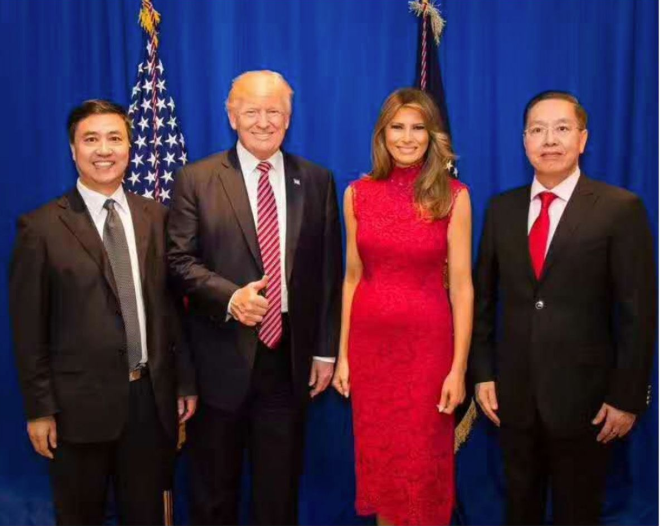
The Journal focused on four men, three of whom operate through fronts for the Chinese military or the Communist Party. One of the three, Tang Ben, is a naturalized American citizen. He and his wife gave $300,000 to Trump Victory, among the largest donations made to that organization. 

After assuming office, Trump and wife Melania posed for photos with Tang. PHOTO ABOVE.

Trump and his staff of unqualified family and equally unqualified sycophants are naïve and gullible, their rank incompetence unwittingly putting our national security in jeopardy.

The fourth man, a Chinese national whose green card allows him to work here, created Chinese Americans for Trump. The group boosted Trump’s political fortunes and ignored his many racist anti-Asian comments, which have continued to this week.

The Journal said David Tian Wang acted at the behest of the Chinese consulate in Los Angeles in creating the group. This  appears to be an example of astroturfing, the practice of masking the identities of sponsors to make them seem to be grassroots participants and to hide financial connections.

Wang gave $150,000 to the group, which passed the money on to the Trump campaign and the Republican National Committee.

Sunday, June 28, 2020

Russia Pays a Bounty For Dead U.S. Soldiers

Trump does less than nothing, denying he was told even though he is “Commander-In-Chief”
By Terry H. Schwadron, DCReport Opinion Editor

And Donald Trump has known about this intelligence since the beginning of March and has done nothing about it.

Actually, the more you roll this disclosure over in your mind, the worse it gets.

Protecting U.S. troops is Job One for any president, but particularly this one who insists on its primacy. And he isn’t doing his job to protect our sons and daughters in the field.

U.S. troops were attacked and we did nothing about it.

This alone should be an impeachable offense.


It's up to you now


For more cartoons by Keith Knight, CLICK HERE.

VIDEO: Never follow an empty wagon


To watch this video on YouTube: https://www.youtube.com/watch?v=quhVLpGm2uk

Tick surveillance and control lagging in US

"Show us your ticks!"
Entomological Society of America

TickEncounter Resource Center > Current Tick ActivityWhile the prevalence of Lyme disease and other illnesses spread by ticks has steadily increased in the United States over the past 20 years, a new study of the state of American tick surveillance and control reveals an inconsistent and often under-supported patchwork of programs across the country.

Annually reported cases of tickborne disease more than doubled between 2004 and 2018, according to the U.S. Centers for Disease Control and Prevention (CDC), while seven new tickborne germs were discovered in that same timeframe. But a clear gap exists in our public health infrastructure, say researchers who have conducted the first-ever survey of the nation's tick management programs.

The survey showed that less than half of public health and vector-control agencies engage in active tick surveillance, and only 12 percent directly conduct or otherwise support tick-control efforts. 

These and other findings from the survey, conducted by university researchers at the CDC's five Vector-Borne Disease Regional Centers of Excellence, are published today in the Journal of Medical Entomology.

"Ticks are responsible for the majority of our vector-borne illnesses in the U.S., and our programming does not adequately meet the need in its current form, for both surveillance and control," says Emily M. Mader, MPH MPP, lead author on the study and program manager at the Northeast Regional Center for Excellence in Vector-Borne Diseases, housed at Cornell University.

Mader and colleagues surveyed 140 vector-borne disease professionals working at state, county, and local agencies in the fall of 2018 to learn about their program objectives and capabilities for tick surveillance and control, testing ticks for disease-causing germs, and barriers to success. 

Reaching even that many respondents proved challenging, as no central database of tick-management programs or contacts was available.

Highlights from the survey of tick-management programs include:


COVID-19: Tradeoffs between economics and public health

MIT scientists look at risk and reward for opening certain types of businesses during the pandemic
Massachusetts Institute of Technology

jason dancing GIFBanks and bookstores. Gyms and juice bars. Dental offices and department stores. The Covid-19 crisis has shuttered some kinds of businesses, while others have stayed open. 

But which places represent the best and worst tradeoffs, in terms of the economic benefits and health risks?

A new study by MIT researchers uses a variety of data on consumer and business activity to tackle that question, measuring 26 types of businesses by both their usefulness and risk. 

Vital forms of commerce that are relatively uncrowded fare the best in the study; less significant types of businesses that generate crowds perform worse. The results can help inform the policy decisions of government officials during the ongoing pandemic.

As it happens, banks perform the best in the study, being economically significant and relatively uncrowded.

Image"Banks have an outsize economic impact and tend to be bigger spaces that people visit only once in a while," says Seth G. Benzell, a postdoc at the MIT Initiative on the Digital Economy (IDE) and co-author of a paper published Wednesday that outlines the study. Indeed, in the study, banks rank first in economic importance, out of the 26 business types, but just 14th in risk.

By contrast, other business types create much more crowding while having far less economic importance. These include liquor and tobacco stores; sporting goods stores; cafes, juice bars, and dessert parlors; and gyms. 


Saturday, June 27, 2020

The rabbit hole of COVID-19 conspiracy theories

Medical School Taught Me How to Talk to Conspiracy Theorists
By Yoo Jung Kim

How 5G's Rapid Growth Sparked a Conspiracy Theory – Adweek
Adweek
A few weeks ago, I took an uncomfortable trip down the rabbit hole of Covid-19 conspiracy theory videos. As a newly minted M.D. who will soon be taking care of patients at a safety-net hospital on the frontlines of an ongoing pandemic, I was especially pained by what I saw.

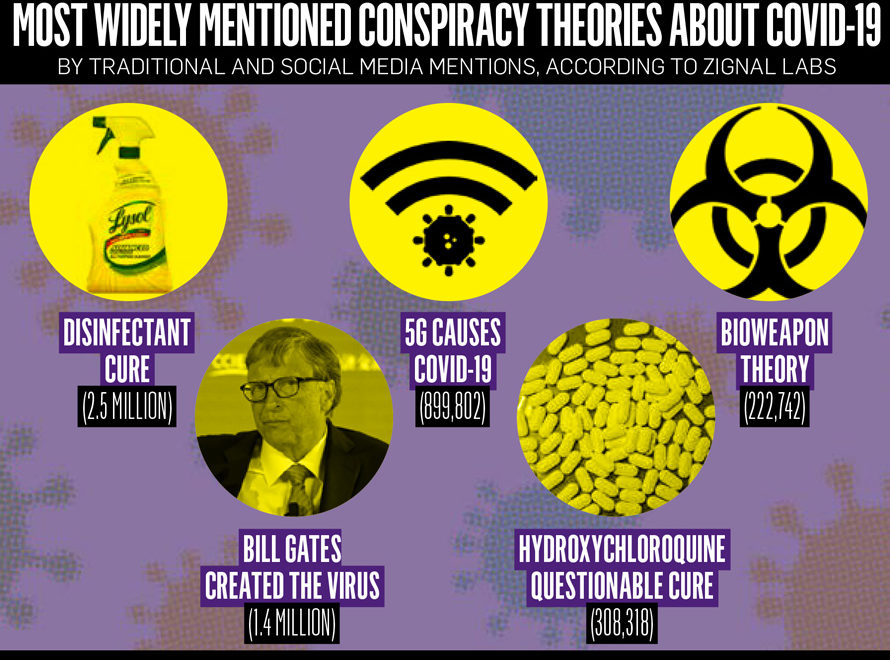
There was the infamous “Plandemic” video, which asserts that a cabal of elite individuals and organizations is using Covid-19 to cement power. There were also false claims that the new coronavirus was created with the backing of Bill Gates, for the purposes of diminishing our freedoms.

Watching the videos pushed me to think about why so many viewers gravitate toward them — and how best to counter their misinformation. On both of those fronts, my experiences working with patients have taught me valuable lessons.

I’ve learned that conspiracy theorists are often neither malevolent nor unintelligent. Rather, many are afraid of their own powerlessness, and these theories offer them a semblance of control.


It's beautiful! Perfect! Best ever!

Image may contain: one or more people, text that says 'WHITE HOUSE UNVEILS TRUMP'S OFFICIAL PORTRAIT'

VIDEO: Cosmic Reef


To watch this video on YouTube: 

COVID-19 is laying waste to many US recycling programs

We hope this isn't the "new normal"
Brian J. Love, University of Michigan and Julie Rieland, University of Michigan


A discarded medical glove in Jersey City, N.J., April 27, 2020.
Arturo Holmes/Getty Images
The COVID-19 pandemic has disrupted the U.S. recycling industry. 

Waste sources, quantities and destinations are all in flux, and shutdowns have devastated an industry that was already struggling.

Many items designated as reusable, communal or secondhand have been temporarily barred to minimize person-to-person exposure. This is producing higher volumes of waste.

Grocers, whether by state decree or on their own, have brought back single-use plastic bags. 

Even IKEA has suspended use of its signature yellow reusable in-store bags. Plastic industry lobbyists have also pushed to eliminate plastic bag bans altogether, claiming that reusable bags pose a public health risk.

As researchers interested in industrial ecology and new schemes for polymer recycling, we are concerned about challenges facing the recycling sector and growing distrust of communal and secondhand goods. 

The trends we see in the making and consuming of single-use goods, particularly plastic, could have lasting negative effects on the circular economy.


Antioxidant-rich diet reduces stress response during bird migration

Birds love berries
Wild Berries – Portuguese Food
A research team led by a University of Rhode Island ornithologist had birds fly in a wind tunnel to simulate migration and found that birds that consume dietary antioxidants before and during fall migration can reduce the endocrine stress response triggered by long-duration flights.

The results, published this week in the Proceedings of the Royal Society B, emphasize the importance of protecting habitat with an abundance of available berries containing antioxidants at migratory stopover sites.

“This reduction in the endocrine stress response may be a major benefit birds gain in fall by eating fruits at stopover sites during migration,” said Scott McWilliams, URI professor of natural resources science, noting that many species of birds select berries containing anthocyanins, a type of dietary antioxidant present in purple-colored berries. “We know birds prefer certain berries that have lots of antioxidants.”

During long-distance flights that push birds to their physiological limits, levels of metabolic hormones called glucocorticoids become elevated to provide ready-to-use fuel to satisfy high energy demands, according to McWilliams. 

But prolonged exposure to glucocorticoids is detrimental and can lead to chronic stress response. The research concluded that the consumption of anthocyanin-rich food attenuates the potential stress triggered by the secretion of high levels of glucocorticoids.


VIDEO: Brown scholar explores rising tide of anger over economic inequality

Authoritarian leaders can exploit this anger and make matters worse
Brown University


The economist John Maynard Keynes once said, “The difficulty lies not so much in developing new ideas as in escaping from old ones.” 

Brown University Professor of International Economics Mark Blyth agrees — and his new book, “Angrynomics,” details the outrage citizens feel when old, irrelevant economic ideas endure to the detriment of most of society.

“Angrynomics,” co-authored by Blyth and macro-hedge fund manager and economist Eric Lonergan, explores why measures of stress and anxiety are on the rise even as the vast majority of people are wealthier than ever. The authors propose radical new solutions for an increasingly polarized and confusing world. 

Blyth, who serves as director of the Rhodes Center for International Economics and Finance within Brown’s Watson Institute for International and Public Affairs, discussed the book in a Thursday, June 18, virtual talk with Ed Steinfeld, director of the Watson Institute.

“The world keeps getting richer and richer,” Blyth said. “Yet we see Americans getting more and more angry.”


Friday, June 26, 2020

Good news!

By Bill Bramhall, New York Daily News

VIDEO: Truth


 To watch this video on YouTube: https://www.youtube.com/watch?v=vEzfHfLaLG4

Ouch!

Clinging jellyfish found in nearby waters
RI Dept. of Environmental Management

Image may contain: plant and drinkPlease be advised — clinging jellyfish, a species that can have a powerful sting for those who are sensitive to it — have been found in Point Judith Pond, Potter Pond, and Narrow River this month.

These are the same waterbodies and approximately the same time we began seeing their presence last summer.

Adult clinging jellyfish are about the size of a dime and marked with an orange-brown cross on their transparent bodies. 

Their sting can be extremely painful and can result in hospitalization in some individuals.

DEM encourages the public to use common sense and caution.


Waders, quahoggers, and others using shallow, protected waterbodies, especially near aquatic vegetation like eelgrass, should take precautions against stings by wearing boots, waders, or wetsuits to protect themselves, or stick to sandy or surfy areas away from vegetation.

Some research has shown that the jellies will die off if the water gets too warm (~82F), but in many areas in RI the water will not typically reach this temperature.

Therefore, the jellies will likely be present until they live out their life cycle or are consumed by other predators.

Last year, Division of Marine Fisheries biologists observed the highest abundances in July, while numbers began to decrease in August and their presence was gone by early fall.