Menu Bar

Home           Calendar           Topics          Just Charlestown          About Us

Friday, June 3, 2022

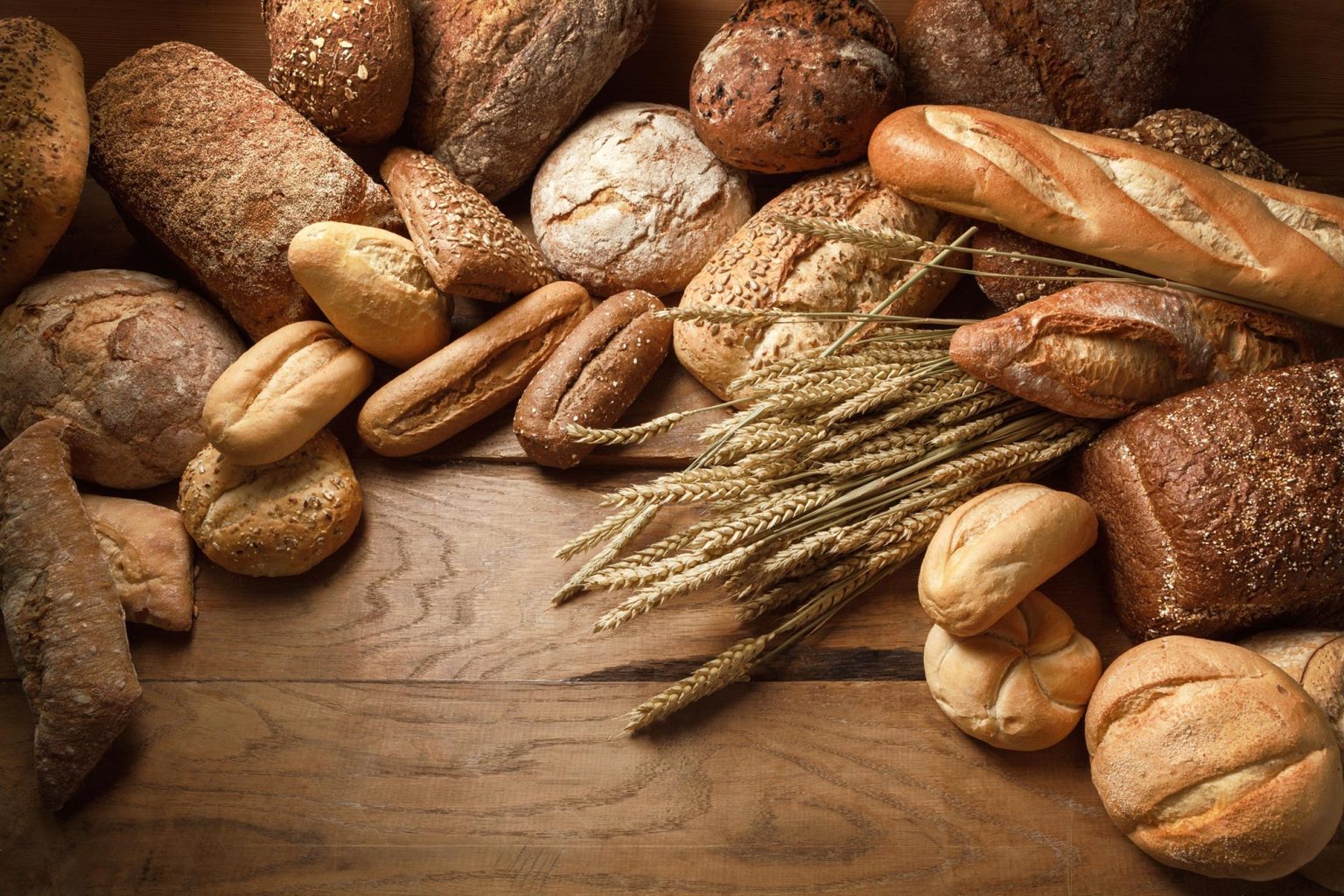
In Defense of Bread

The “Staff of Life” Throughout History
By SCITECHDAILY.COM 

Bread, that simple “staff of life,” has gotten a bad reputation in recent years, mainly from those who advocate low-carb or gluten-free diets. However, foregoing bread at meals can be a difficult prospect, as virtually every nation and every culture on the planet has incorporated some type of bread into their foods. 

You cannot travel through the world without finding various forms of bread that accompany or are an intrinsic part of your meal, and these should be savored as part of the cultural context and delicious part of your culinary experience. Here are some facts about bread that show how fundamental it is to our experience as human beings and to our culinary evolution.

Bread in History

Historians have traced the making of bread to about 14,000 years ago in early human history. What probably started out as a random experiment with naturally growing grain plants became an essential part of the development of human culture. Instead of constantly following migrating herds of animals for their meat, people could establish permanent communities that relied on a different type of food item for survival. 

Making bread did not depend on the presence and location of animals. It could be kept for longer periods of time to support survival when hunting was unsuccessful. Humans saw this value and began to plant seeds deliberately for later harvesting, which began the practice of agriculture. 

Conservatives more susceptible to believing falsehoods

Study finds news environment hurts ability to find truth

Jeff Grabmeier, Ohio State News

Getty Images, via Daily Kos
Conservatives are less able to distinguish political truths from falsehoods than liberals, mainly because of a glut of right-leaning misinformation, a new national study conducted over six months shows.

Researchers found that liberals and conservatives in the United States both tended to believe claims that promoted their political views, but that this more often led conservatives to accept falsehoods while rejecting truths.

One of the main drivers of the findings appeared to be the American media and information environment.

Thursday, June 2, 2022

What's it going to take? Do we need to SEE what guns do to their victims?

Decades ago, photos of Emmett Till’s murdered body galvanized action for civil rights. Today, disturbing images could do the same for gun control.

By Mitchell Zimmerman 

In the days since the Uvalde shooting, media outlets have shared heartbreaking images of the small victims as they were cherished in life. As Americans, we’re forced to look into their young, innocent eyes and accept our shame that we failed to protect them.

What we haven’t seen is what they looked like after their lives were ripped away by AR-15 bullets. Many of the children were reportedly so mutilated they could only be identified by DNA.

It is understandable that a newspaper would be loath to publish such photographs. Most human beings would be loath to look at them.

But in the past, such disturbing images have been used to galvanize action — by forcing us to examine painful realities. When I was a civil rights organizer in the South back in the 1960s, one episode still loomed large in the minds of those who took part in the freedom struggle.

Protect

By Mike Luckovich


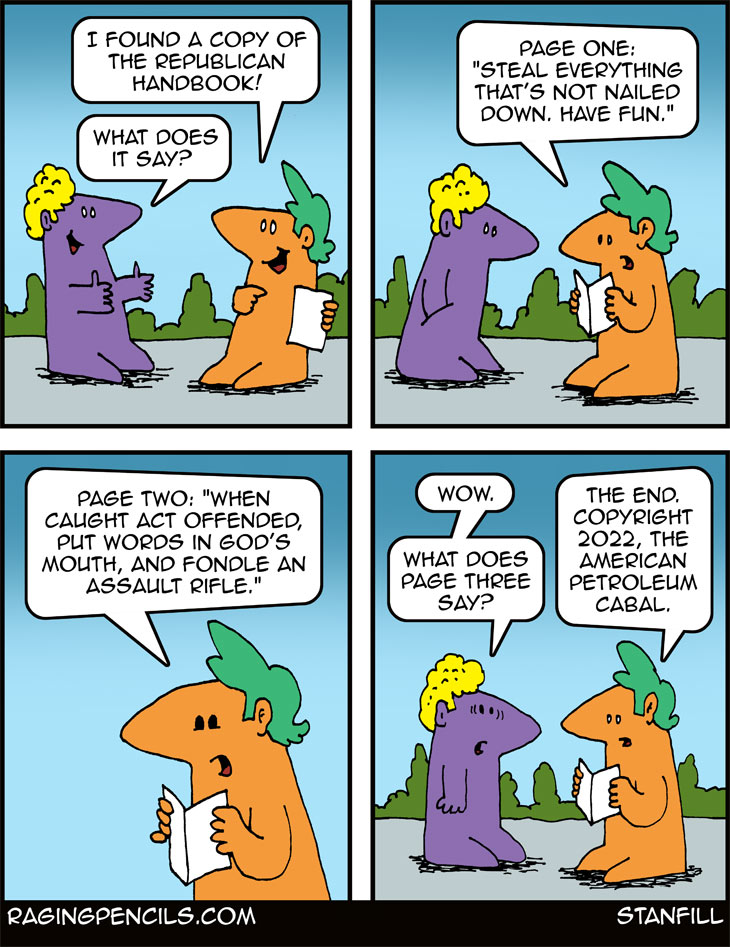
Republican instruction manual


Animal wisdom


Why Credit Cards Make It So Difficult to Budget

The Cashless Effect

By SCITECHDAILY.COM 

The end of the month is here again and, with it, the credit card bill. It’s higher than you thought it would be, and you can’t even remember making some of those purchases. It’s not like you’re made of money, so why do you keep spending like this?

What is the cashless effect?

The cashless effect describes our increased willingness to buy products and to pay more for them when no physical money changes hands.

The seminal study

The cashless effect was first studied in 1979 by Elizabeth Hirschman, a prominent theorist in marketing and economics who believed that people had a tendency to spend more when they paid with a credit card rather than cash. In order to verify her suspicions, she sent field interviewers out to survey customers shopping in different branches of a department store chain.[1] 

They asked the customers which products they had bought and what method of payment they had used. An analysis of the data showed that people who used either a store card or a credit card made larger purchases than people who paid in cash, and that people who had both store cards and credit cards were the biggest spenders. 

Hirschman concluded that people who used cashless forms of payment spent more than people who used physical money and that people who had several methods of payment available to them spent the most.

Further research has since shown that, compared to people who use cash, people who use credit cards are happy to spend more,[2] are less likely to recall their past expenditures,[3] are more likely to focus on and remember product benefits — like product quality, features, looks, the social prestige of owning the product — rather than costs,[4] and make more unplanned,[5] indulgent,[6] and unhealthy[7] purchases. The effect is similar for people who use bank cards rather than cash.[8]

Even mild COVID breakthrough cases in the vaccinated can lead to "Long COVID"

Vaccines Only Offer Modest Protection Against Long COVID

By  


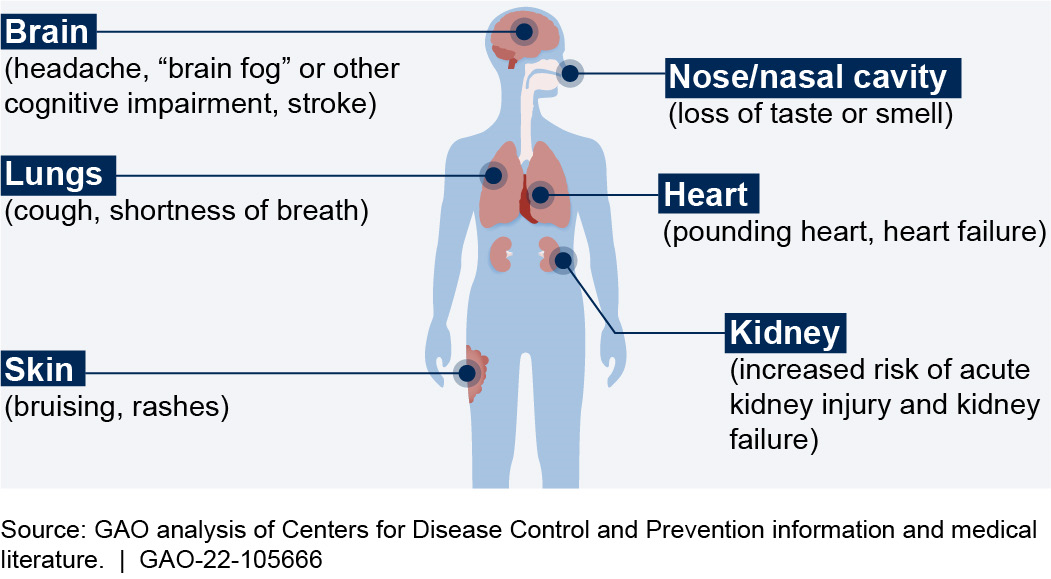
New research reveals that even vaccinated people with mild breakthrough COVID-19 infections can experience debilitating, lingering long COVID symptoms that affect the heart, brain, lungs, and other parts of the body.

While risks are higher for the unvaccinated, a new study points to the need for more tools against the virus.

According to researchers at Washington University School of Medicine in St. Louis and the Veterans Affairs St. Louis Health Care System, vaccinated people with mild breakthrough COVID-19 infections can experience debilitating, lingering symptoms affecting the heart, brain, lungs, and other parts of the body. 

A new study of more than 13 million veterans, however, discovered that immunization against the virus that causes COVID-19 lowered the chance of mortality by 34% and the likelihood of developing long COVID-19 by 15% when compared to unvaccinated individuals infected with the virus.

Even vaccinated people with mild breakthrough COVID-19 infections can experience persistent debilitating symptoms that affect the heart, brain, lungs, and other parts of the body, according to new research from Washington University School of Medicine in St. Louis and the Veterans Affairs St. Louis Health Care System.

“Vaccinations remain critically important in the fight against COVID-19.” — Ziyad Al-Aly, MD

ICE has probably spied on you

A new investigation reveals the immigration agency has collected data on most Americans. 

By Farrah Hassen 

Growing up in the Southern California suburbs, government surveillance never worried me. But my Syrian-American parents were more cautious. They would often warn me against talking about politics over the phone — in case Big Brother was snooping.

As a teenager, I dismissed their concerns. “Listen, we’re not in the Middle East,” I would counter.

My parents knew better though. I soon received a rude awakening in the aftermath of the September 11 attacks.

Almost 1,200 people, mostly Muslims, were rounded up and detained after the attacks, often for months without charges. Arabs and South Asians were racially profiled and deported for minor immigration violations. The FBI began surveilling mosques across America.

As part of the homeland security reforms following 9/11, Congress created the U.S. Immigration and Customs Enforcement (ICE) agency in 2003 to ostensibly fight terrorism and enforce immigration law. But the truth is, ICE went on to use its newly established authority to spy on nearly everyone in the United States.

An independent, two-year investigation has now revealed that ICE collected data on hundreds of millions of Americans under a legally — and ethically — questionable surveillance system largely outside of public oversight.

Georgetown Law’s Center on Privacy and Technology uncovered this dragnet after filing over 200 Freedom of Information Act requests and reviewing ICE’s contracting records from 2008 to 2021.

In its report, released May 10, the Center found that ICE has spied on most Americans without a warrant and circumvented many state privacy laws, such as those in California. The authors conclude: “ICE now operates as a domestic surveillance agency.”

Wednesday, June 1, 2022

Will the Texas massacre finally provoke the Republicans to do the right thing?

Will This Finally Be the Time Republicans Turn Against the NRA's Money?

By Thom Hartmann for the Independent Media Institute

President Biden is right. “For God’s Sake,” and our children’s sake, we must do something about gun violence in America. And we must do it now. 

Back in 1996, after a few years of mass shootings, Australia experienced a mass slaughter on a scale like we saw yesterday in Texas. Their Supreme Court hadn’t ruled that Australian politicians could be owned by industries, so they passed extensive gun control and a nationwide gun buyback program. It was a turning point, and the mass shootings have since largely stopped.

Over at Daily Kos, Walter Einenkel has summarized how many millions of dollars the top Republicans in Congress have taken from the weapons industry: it’s a grim toll, starting with Mitt Romney taking over $13 million and Richard Burr over $6 million.

We’ve been at this point over and over again in America: will this be the one that punches through the wall of money the NRA and the weapons industry it fronts for wraps around Republicans? 

Over on Fox News, one brilliant idea to deal with the slaughter of our children in our schools is to issue “Ballistic Blankets” to every school. This is how sick and twisted the Republicans taking money from the gun industry and their allies have become.

Twenty years ago, car accidents were the leading killer of children and youth: today it’s guns. 

At the turn of the 21st century, there were about 14 car-crash deaths among young people (aged 1-24) per 100,000 young Americans, and only a bit over 7 gun deaths per 100,000.  This year, almost 11 out of 100,000 children died from guns while only 8 per 100K died from car crashes.

And most all of those child gun deaths, mass shootings, and school shootings, which don’t happen in any other developed country in the world, are entirely preventable.

Oh so brief moments of clarity

For more cartoons by Jen Sorenson, CLICK HERE.


Strip the NRA of its tax-exempt status

Just print out this form, sign it and e-mail it to eoclass@irs.gov


How many bots are there on Twitter?

The question is difficult to answer and misses the point

Kai-Cheng YangIndiana University and Filippo MenczerIndiana University

Yes, worry about Twitter, but don’t worry whether there are hordes
of spambots running rampant there. gremlin/E+ via Getty Images
Twitter reports that fewer than 5% of accounts are fakes or spammers, commonly referred to as “bots.” Since his offer to buy Twitter was accepted, Elon Musk has repeatedly questioned these estimates, even dismissing Chief Executive Officer Parag Agrawal’s public response.

Later, Musk put the deal on hold and demanded more proof.

So why are people arguing about the percentage of bot accounts on Twitter?

As the creators of Botometer, a widely used bot detection tool, our group at the Indiana University Observatory on Social Media has been studying inauthentic accounts and manipulation on social media for over a decade. We brought the concept of the “social bot” to the foreground and first estimated their prevalence on Twitter in 2017.

Based on our knowledge and experience, we believe that estimating the percentage of bots on Twitter has become a very difficult task, and debating the accuracy of the estimate might be missing the point. Here is why.

New research may explain unexpected effects of common painkillers

New research looks at odd effects from some NSAID use

Yale University

Non-steroidal anti-inflammatory drugs (NSAIDs) such as ibuprofen and aspirin are widely used to treat pain and inflammation. 

But even at similar doses, different NSAIDs can have unexpected and unexplained effects on many diseases, including heart disease and cancer.

Now, a new Yale-led study has uncovered a previously unknown process by which some NSAIDs affect the body. The finding may explain why similar NSAIDs produce a range of clinical outcomes and could inform how the drugs are used in the future.

The study was published May 23 in the journal Immunity.

Until now, the anti-inflammatory effects of NSAIDs were believed to arise solely through the inhibition of certain enzymes. But this mechanism does not account for many clinical outcomes that vary across the family of drugs. For example, some NSAIDs prevent heart disease while others cause it, some NSAIDs have been linked to decreased incidence of colorectal cancer, and various NSAIDs can have a wide range of effects on asthma.

Now, using cell cultures and mice, Yale researchers have uncovered a distinct mechanism by which a subset of NSAIDs reduce inflammation. And that mechanism may help explain some of these curious effects.

The research showed that only some NSAIDs -- including indomethacin, which is used to treat arthritis and gout, and ibuprofen -- also activate a protein called nuclear factor erythroid 2-related factor 2, or NRF2, which, among its many actions, triggers anti-inflammatory processes in the body.

Brown adopts land acknowledgment to the Narrgansett Indian Tribe

Pledges additional commitments to Native and Indigenous communities

Brown University

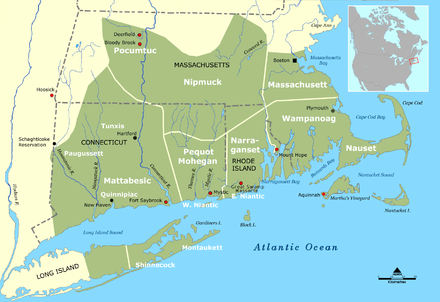
Tribal lands in c. 1600 (Wikipedia)
Brown University has established an official land acknowledgment that recognizes and honors its location within the ancestral homelands of the Narragansett Indian Tribe. 

The acknowledgment is one of five commitments Brown is making to build understanding of the relationship between its campus community, Indigenous peoples of the region and the land on which Brown is situated.

University President Christina H. Paxson shared the land acknowledgment in a letter to the Brown community on Tuesday, May 24. The acknowledgment reads:

“Brown University is located in Providence, Rhode Island, on lands that are within the ancestral homelands of the Narragansett Indian Tribe. We acknowledge that beginning with colonization and continuing for centuries the Narragansett Indian Tribe have been dispossessed of most of their ancestral lands in Rhode Island by the actions of individuals and institutions. We acknowledge our responsibility to understand and respond to those actions. The Narragansett Indian Tribe, whose ancestors stewarded these lands with great care, continues as a sovereign nation today. We commit to working together to honor our past and build our future with truth.”

Paxson also outlined a set of commitments that arose from a year-long exploration by a Land Acknowledgment Working Group composed of University students, faculty and administrators, including members of the Narragansett Indian Tribe.