Menu Bar

Home           Calendar           Topics          Just Charlestown          About Us

Wednesday, December 20, 2023

This One Simple Diet Change Could Transform Your Blood Pressure

Cut the salt

By BRIAN DOCTROW, PH.D., NATIONAL INSTITUTES OF HEALTH 

Lowering sodium intake significantly reduced blood pressure in most people, even those who were already taking blood pressure medications.

The findings suggest that consuming less sodium could have health benefits in a wide range of people.

Half of all Americans have high blood pressure, or hypertension. Blood pressure is considered high when systolic readings (the top number, the pressure when blood is pumped out of the heart) are consistently over 130 mm Hg or diastolic readings (the bottom number, between heartbeats when the heart is filling with blood) are 80 mm Hg or higher.

EPA begins review of PVC ingredient vinyl chloride, which could lead to restrictions or ban

“This is one of the most important chemical review processes ever undertaken by the EPA.”

Brian Bienkowski for Environmental Health News

The U.S. Environmental Protection Agency announced it’s reviewing vinyl chloride under the Toxic Control Substance Act (TSCA), which could lead to restrictions or a ban on the widespread, toxic chemical.

Vinyl chloride is used primarily to make polyvinyl chloride (PVC) plastics. The chemical is already classified by the U.S. Environmental Protection Agency (EPA) as a carcinogen, and is linked to higher rates of lung and liver cancer, as well as liver disease, neurological problems and miscarriage. Billions of pounds are produced annually in the U.S.

It is one of five chemicals the EPA will review under TSCA, which is the primary chemical safety law in the U.S. The other chemicals include acetaldehyde, acrylonitrile, benzenamine, and MBOCA.

“Under the Biden-Harris Administration, EPA has made significant progress implementing the 2016 amendments to strengthen our nation’s chemical safety laws after years of mismanagement and delay. Today marks an important step forward,” assistant administrator for the Office of Chemical Safety and Pollution Prevention Michal Freedhoff said in a statement.

Under TSCA, the EPA will examine all exposure routes — including air emissions, drinking water and soil contamination — as well as workplace and accident exposure.

The latter is especially significant as on Feb. 3, a Norfolk Southern train carrying a long list of toxic chemicals — including vinyl chloride — caught fire as it approached East Palestine, Ohio. 

The train derailed and the cars burned for three days. Months after the incident, residents, despite reassurances from the EPA and other agencies, were experiencing myriad health problems. Many residents left and never returned.

Tuesday, December 19, 2023

How Amazon Is Ripping You Off


GOP justice

By Mike Luckovich

How festive!


Doctors With Histories of Big Malpractice Settlements Work for Insurers, Deciding If They’ll Pay for Care

Dubious doctors making dubious decisions

By Patrick Rucker, The Capitol Forum, and David Armstrong and Doris Burke, ProPublica

Health insurers reject millions of claims for treatment every year in America. Corporate insiders, recordings and internal emails expose the system and its harm.

When Shawn Murphy’s wife died in 2009 after a botched gallbladder surgery, he presumed the doctor who performed the operation would be forced out of medicine for good.

Dr. Pachavit Kasemsap, a former Air Force surgeon, had cut Loretta Murphy’s aorta during that common procedure, according to a database of malpractice payments kept by Florida insurance regulators. She never left the hospital and died just shy of her 40th birthday. Shawn Murphy was left to raise their two daughters, then 13 and 17, on his own.

During the weeks that Murphy prayed for his wife to recover and the months that he fought Kasemsap in circuit court in Brevard County, Florida, he didn’t know that other families had complained that their loved ones had suffered under the same doctor’s care.

Kasemsap has settled five malpractice cases for a total of $3 million, according to the Florida malpractice payment database. That includes $1 million paid to the Murphy family. 

In one of the cases Kasemsap settled, a patient said the doctor negligently stapled and stitched her rectum to her vagina. Kasemsap denied doing that, and in legal filings in all five cases, the doctor denied that he was negligent.

The doctor’s LinkedIn profile says his last job as a surgeon ended in December 2012, months before he settled the last of those five cases. But there was one industry ready to welcome him regardless: health insurance.

Kasemsap got a job as an insurance company medical director, where suddenly he had the power to impact the lives of far more patients than he would ever have seen in the operating room.

For most policyholders, the inner workings of their health insurer are a black box: Requests to cover treatment or pay claims go in, and approvals or rejections are spit out.

The pivotal gatekeepers inside the box are medical directors like Kasemsap. They can, without ever seeing a patient, overrule the judgment of the doctor who did and deny payment for a recommended procedure, test or medicine.

Insurers say medical directors steer patients away from unnecessary or risky care and expensive treatments for which there are less costly, equally effective alternatives. Patients and their physicians complain that insurance company doctors routinely, and wrongly, deny payment for critical lifesaving treatments because they are expensive.

100 years ago, the KKK planted bombs at a U.S. university

Klan hate includes American Catholics

 William Trollinger, University of Dayton

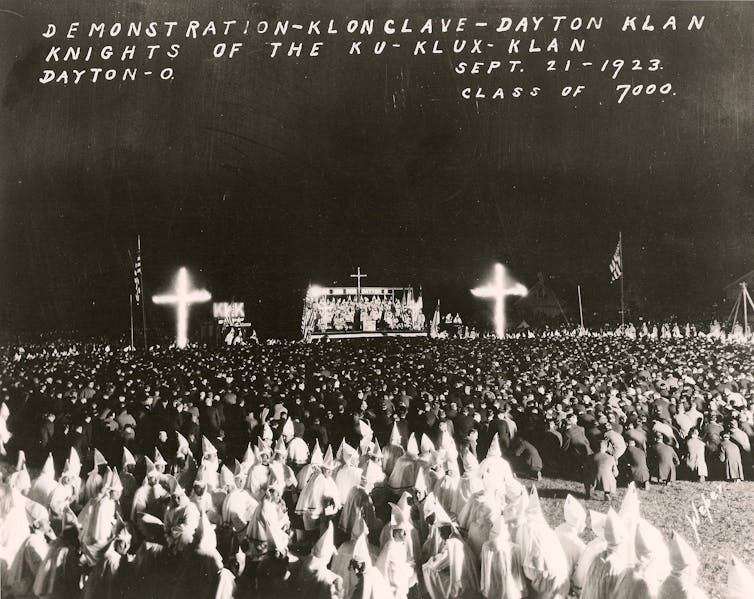
A KKK rally in Dayton, Ohio, on Sept. 21, 1923. 
Dayton Metro Library

It was Dec. 19, 1923 – 100 years ago. The first day of Christmas break at the University of Dayton, with fewer than 40 students still on campus.

At 10:30 p.m., the quiet was shattered by a series of explosions, as 12 bombs went off throughout campus. 

Frightened students discovered that, while damage was minimal, there was an eight-foot burning cross on the edge of campus. 

Running to tear it down, they were confronted by several hundred Klansmen screaming threats from 40 to 50 cars.

It wasn’t the first time Dayton’s residents had endured terror from the Ku Klux Klan. Hundreds of neighbors poured out of their houses and charged at the hooded invaders. The Klansmen sped away, and the students and others extinguished the fire and tore down the cross.

The KKK is most infamous for violently terrorizing African Americans. But in the 1920s its hatred also had other targets, especially outside the South. 

This version of the KKK, known as the Second Ku Klux Klan, harassed Catholics, Jews and immigrants – including students and staff at Catholic universities like Dayton, where I am a historian of American religion. All of this is the focus of my 2013 article, “Hearing the Silence.”

Monday, December 18, 2023

False Prophets

How Zuckerberg and Musk Mislead the Digital Economy

By UNIVERSITY OF BASEL 

How significantly do the ideas of Mark Zuckerberg and Elon Musk shape today’s digital economy? A study by an economic sociologist at the University of Basel has analyzed speeches, book contributions and articles from Silicon Valley from Silicon Valley, demonstrating the emergence of a new spirit of digital capitalism.

What justification is there for earning a lot of money? Nineteenth-century Calvinists interpreted economic prosperity as a sign that one was counted among God’s chosen. This manner of thinking, centered in Geneva, influenced liberal capitalism.

Today’s justifications for economic activity sound different. They focus on themes of flexibility or efficiency. In particular digital capitalists claim that they improve the world. Their credo: for every societal problem, from climate change to inequity, there is a technical solution that also offers the opportunity to make plenty of profit. This approach is known as solutionism.

In your hat

Don't forget


Why you need the booster

Study shows diminishing efficacy of COVID-19 vaccines over time

By SAGE 

The risk of death from COVID-19 decreases significantly after vaccination but this protection diminishes after six months, providing evidence for continued booster doses, a new study has found.

Researchers from the UK Health Security Agency (UKHSA) analyzed more than 10 million cases of COVID-19 in adults between May 2020 and February 2022. Their findings are published in the Journal of the Royal Society of Medicine (JRSM).

‘Financial Ruin Is Baked Into the System’

Costs of Long-Term Care destroy families


Thousands of readers reacted to the articles in the “Dying Broke” series about the financial burden of long-term care in the United States. They offered their assessments for the government and market failures that have drained the lifetime savings of so many American families. And some offered possible solutions.

In more than 4,200 comments, readers shared their struggles in caring for spouses, older parents, and grandparents. They expressed anxieties about getting older themselves and needing help to stay at home or in institutions like nursing homes or assisted living facilities.

Many suggested changes to U.S. policy, like expanding the government’s payments for care and allowing more immigrants to stay in the country to help meet the demand for workers. Some even said they would rather end their lives than become a financial burden to their children.

Many readers blamed the predominantly for-profit nature of American medicine and the long-term care industry for depleting the financial resources of older people, leaving the federal-state Medicaid programs to take care of them once they were destitute.

Sunday, December 17, 2023

Highway closure gave Gov. McKee a chance to shine. He still needs a moment.

McKee holds master class in bumbling and incompetence

By Nancy Lavin, Rhode Island Current

Longtime residents fondly remember the calm and reassuring authority with which a flannel shirt-wearing Gov. J. Joseph Garrahy appeared on TV in the wake of the historic 1978 blizzard.

It’s a stark contrast with how Gov. Dan McKee has handled the emergency closure of the Washington Bridge due to safety concerns, first missing the initial Dec. 11 press conference to visit a Providence pizza shop. That was mistake one, according to Mike Raia, a public relations consultant and former communications adviser to then-Gov. Gina M. Raimondo.

“Communication is as important to any crisis response as actual operational response,” Raia said. “In these moments, everything you do at the podium, on a radio interview, on your social media matters.”

Making matters worse: McKee’s testy response to a reporter’s questions two days later about potential leadership changes in the wake of the catastrophe.

“By getting emotional and getting defensive, it undermines the confidence you’re trying to build, it undermines the empathetic connection you’re trying to show to people that are actually impacted,” Raia said.

The blistering rebuke is hardly the first time Rhode Island’s otherwise mild-mannered head of state has bristled at pointed questions from the press, or turned disagreements with fellow officials into headline-making feuds. 

And some warn McKee’s thin skin may prove his downfall.

What a great time-saver!

By Mike Luckovich

The record they're running on in 2024