
Sunday, August 9, 2026
URI College of Pharmacy researcher harvests natural viruses to seek treatment for multidrug-resistant bacteria
‘Rhody Phage Cocktail’ aims to help control ‘superbugs’
 |
| URI College of Pharmacy Assistant Professor Callan Bleik displays a phage plaque spot assay demonstrating bacteriophage activity against a methicillin-resistant Staphylococcus aureus (MRSA) infection. |
But decades of overuse and
misuse have accelerated the rise of antibiotic resistance, allowing certain
bacteria to evolve into dangerous “superbugs” that evade even the most powerful
drugs.
As multidrug-resistant infections become increasingly difficult to
treat, researchers are urgently seeking new strategies to stay ahead of these
evolving pathogens.
In the University of Rhode Island College of Pharmacy, Assistant Professor
Callan Bleick is leading one such effort. Bleick’s research focuses on
improving treatment for drug-resistant bacterial infections, particularly those
caused by methicillin-resistant Staphylococcus aureus (MRSA),
one of the most prevalent and challenging superbugs in hospitals and healthcare
settings.


COVID is still here. Is the pandemic?
Getting vaccinated is still the smartest thing

CIDRAP News talked with Center for Infectious Disease
Research and Policy (CIDRAP) Director Michael Osterholm, PhD, MPH, to
understand what defines a pandemic, if we’re still in one, and what gives a
pathogen pandemic potential.
CIDRAP News: What exactly is a pandemic?
Michael Osterholm: There’s no magic answer to
that question. From my perspective, I usually say the only examples we
have in modern history are viral infections that are transmitted via the
respiratory route, like the flu and COVID, because the dynamics of transmission
make it a worldwide threat, and “worldwide threat” is important in defining a
pandemic. A pandemic is not just something that happens in one localized area.
Plagues weren’t viruses, but, in the modern world, a
pandemic is almost always a viral infection.

Michael Osterholm: Antibiotics could be an
important part of why bacterial viruses aren't as big of a threat today. But
what’s really at the heart of it is what flu and COVID represent today in terms
of risk—that is, slight changes in the virus result in increased susceptibility.
And when there's a major change in the virus, you virtually have no protection.
“A pandemic is almost always a viral infection.”
For a good example, look at influenza. Each flu pandemic was
caused when there was a major shift in the genetics of the virus, so virtually
no one was immune. If you look at COVID, it was very much the same thing.
CIDRAP News: Why were SARS (severe acute respiratory
syndrome) and MERS (Middle East respiratory syndrome) not pandemics?
Michael Osterholm: Because they are not readily
transmitted. We were able to bring them under control, basically with standard
control measures that you would use for respiratory illness. And that's good
news because the case-fatality rate for SARS and MERS is between 15% and 35%.
For COVID, the case-fatality rate was 1% to 1.5%.
CIDRAP News: So pandemics have less to do with
severity and more to do with how transmissible a virus is?
Michael Osterholm: Both how transmissible it
is and risk are important. For example, if you have a common
cold virus for which we have no previous immunity suddenly spread around the
world, most of us would not consider that a pandemic in the sense that it's not
a severe illness. So there’s an implied status of severe illness.
CIDRAP News: What’s the difference
between a pandemic and an epidemic?
Michael Osterholm: Epidemic relates back to the
issue of transmission. For example, we have a major epidemic of Ebola going on
right now, which surely has a high case-fatality rate. It's a very serious
illness, but it's not readily transmitted via the respiratory route.
First mRNA flu shot gets FDA approval, raising hopes for a more effective vaccine
Surprising decision given RFK Jr.'s disdain and funding cuts for all mRNA vaccines

Moderna's
mFlusiva is the company's fourth mRNA-based product approved in the United
States, according to a Moderna press release. The vaccine has full approval for people 50 to
64 years of age. For those over 65, the FDA granted "accelerated
approval," which is temporary: Full approval depends on the long-term
safety and real-world effectiveness of the vaccine in this age group.
Earlier this
year, it seemed that the vaccine would never make it to market. The FDA refused to review Moderna's application, saying that
instead of comparing mFlusiva to the standard-dose seasonal influenza vaccine,
the company should instead have used the high-dose vaccine, which is
recommended for adults who are 65 and older. Also, Health Secretary Robert F.
Kennedy Jr. has questioned the safety of mRNA, which is the same technology
used to produce the COVID-19 vaccines.
However, a week
later, the FDA reversed its decision and agreed to review Moderna's
application after outcry from infectious disease experts and warnings that
outright refusal to review the application could cause a chilling effect that
would deter investments in new pharmaceuticals and dampen innovation.
Why your doctors keep leaving
It's more than about money, though that is a biggie
By Lesley Henton, Texas A&M University
Edited by Robert Egan

A new study published in the Joint Commission Journal on
Quality and Patient Safety suggests the reasons go beyond staffing
shortages. Leaders from four major health systems in one of the nation's
largest metropolitan areas say generational shifts are reshaping who enters
health care, who stays and why clinicians leave.
"We've talked about clinical workforce shortages as a
numbers problem involving training and retention," said study co-author
Dr. William Sage, founding director of the Texas A&M University Institute
for Healthcare Access in Fort Worth. "What these leaders described was
something more complicated, as health care organizations are struggling to meet
growing patient needs while accommodating five distinct generations of clinicians
with different needs and perspectives about work, well-being and career
longevity."
Saturday, August 8, 2026
The League of RI Businesses made a play to sidestep campaign finance limits. Now, it’s game time.
DINOS and MAGAs supported by stealth money
By Nancy Lavin, Rhode Island Current

A first-time candidate going up against a three-term incumbent, Lopez realized she needed outside help to succeed in her Democratic primary challenge against Sen. Meghan Kallman for the District 15 seat representing Pawtucket and Providence.
“I have no one in my corner, so I was like, ‘how the heck am I going to do this,’” Lopez, 37, said in an interview.
Enter The League of RI Businesses. The political group born out of a gun rights campaign was recruiting state legislative candidates to fill open seats and challenge incumbents whose records did not align with its “pro-business” platform. And, under an unprecedented maneuver to create 40 political action committees — one for each city and town plus a statewide organization — The League advertised up to $1 million in donations per year per endorsed candidate, circumventing state campaign finance laws that cap annual donations at $2,000 per candidate.
No one has received a seven-figure donation from The League yet. But the execution of its multi-PAC strategy is coming into play for a handful of its chosen candidates, including Lopez.
EDITOR'S NOTE: Not included in this article is one candidate benefiting from LORIB's cash support. That's self-described "Sex Crime Defense Lawyer" Leah Boisclair. I'll bet a lot of people (e.g. Jim Mageau) with Boisclair signs are unaware of what she does for a living even though her website aggressively recruits clients charged with heinous crimes:

Boisclair wants to unseat Rep. Tina Spears in the September 9 Democratic Primary. Tina's history is in sharp contrast to Boisclair's. From Tina's website:
Tina has spent the last decade advocating for people with disabilities, and is currently Executive Director of the Community Provider Network of Rhode Island. Her own experience as the parent of a child with significant health challenges led her to become an ardent advocate for families of children with disabilities.While Boisclair makes her living defending pedos, Tina works to protect kids with disabilities. If you are a Democrat living in House District 36 (all of Charlestown and Block Island, plus sections of Westerly and South Kingstown) you will need to pick which side you're on come Primary day on September 9


Who stole the URI research camera at Charlestown Beach?
Charlestown Beach Camera Stolen, Town Says. It's not a Flock camera
Adriana
Vossari, RI & Local Government News

Charlestown loses a public feed of beach and water
conditions that also supported coastal research, and the town has not said what
replacement will cost or who pays.
A public beach camera installed on Charlestown Town Beach
was stolen on Thursday, the town reported in an official statement that went
well beyond the usual language of a municipal theft notice.
The camera was a live-feed unit installed for the University
of Rhode Island's Ocean-CREST project, short for Oceanfront Observatory for
Coastal Resilience, Engineering, Science & Technology. It fed a public view
of beach and water conditions and supported coastal research and education. It
replaced an earlier camera that was destroyed when its mounting pole snapped
during a severe storm, according to the town.
The town's notice, headlined "Newly Installed Public Beach Camera Stolen in Disgraceful Act Against the Community," said officials were "outraged." It described the theft as not a harmless prank but "a selfish, destructive, and criminal act that deprived the public of a resource funded, installed, and maintained for everyone's benefit."
The statement added that whoever took the camera "did not
steal from an anonymous government agency," but from "Charlestown residents,
beachgoers, students, educators, coastal researchers, and every member of the
public."
Much of the statement is devoted not to the theft itself but
to a rumor. The town said claims had circulated that the equipment was a Flock
camera — an automated license plate reader — and called those claims
"completely false" and evidence of "a basic failure to
understand, or even verify, what had actually been installed." A
"minimal amount of effort," the statement said, would have confirmed
the camera's purpose was public viewing and coastal education, "not
vehicle tracking or law enforcement surveillance."
The town did not say who spread those claims, how widely they circulated, or whether they had anything to do with the theft. The motive remains unknown, and the town has not said whether police have identified a suspect.
Two different kinds of camera
The distinction the town is drawing matters, because Rhode
Island has spent the summer arguing about surveillance cameras.
Flock Safety devices photograph passing vehicles and store
the images in a searchable database, typically for about a month. They read
license plates. The Charlestown camera was a fixed-view CR63-E with a built-in
LTE modem, an internal battery, 4K resolution and the option of solar or
hard-wired power, according to reporting by The Westerly Sun on the project's
approval. Because the camera cannot pan or tilt, town and university officials
told the council that beachgoers would not face privacy concerns.
The installation was approved in public. Rhode Island Sea Grant coastal resilience specialist Casey Tremper and URI associate professor of ocean engineering Reza Hashemi presented the re-installation request to the Charlestown Town Council in November, and the council voted to allow it, with activities coordinated through the town administrator.
URI covered the
equipment; the town handled installation. The feed was made publicly accessible
through the Web Camera Coastal Observation System, and the town maintains a live beach camera page.
A hostile season for cameras
The theft landed at the peak of a statewide backlash against license plate readers. The South Kingstown Town Council voted unanimously on July 27 to cancel its Flock Safety contract and remove the cameras. Narragansett's council did the same on Aug. 3.
The ACLU of Rhode Island, which
has campaigned against the technology, counts
at least 295 Flock cameras in the state and notes the exact figure is
unknown because some police departments have been difficult to get information
from.
Those objections are about warrantless records of drivers'
movements — a debate with no bearing on a fixed camera pointed at the surf. But
the sequence is close enough in time that the town's statement reads as an
attempt to break the association, sharply.
What the notice does not address is cost. The town has not
disclosed what the stolen camera was worth, who pays to replace it, or what
security measures might protect a third unit. It also has not said whether a
replacement is planned.
Scientists Link Heavy TV Watching to Brain Changes Decades Later
Heavy television viewing in middle age was linked to a troubling brain signature more than 20 years later.
By Margaret Crable, University of Southern California

The findings, published in Alzheimer’s and
Dementia: Journal of the Alzheimer’s Association, challenge the idea that
all sitting affects the brain in the same way. Time spent watching television
was associated with poorer brain health decades later, while sitting at work
showed a very different pattern.
“For years we’ve focused on how much people sit. Our
findings suggest we should also pay attention to what they’re doing while
they’re sitting,” says David Raichlen, professor of biological sciences and
anthropology at the USC Dornsife College of Letters, Arts and
Sciences, and a senior author of the study.
What MRI Scans Revealed Decades Later
Researchers followed about 1,700 adults who joined the
Atherosclerosis Risk in Communities (ARIC) Study between 1987 and 1989.
Participants were 53 years old on average when they reported how often they
watched television during leisure time and how much of their workday they spent
seated.
More than 20 years later, MRI scans revealed notable
differences between the brains of frequent viewers and those who said they
watched television “never” or “seldom.”
People who reported watching television “very often” had
less volume in several brain regions, including areas tied to memory and early
Alzheimer’s disease. They also had smaller frontal and occipital lobes, which
support planning, attention, decision-making, and visual processing.
The scans also showed more white matter hyperintensities.
These bright spots on MRI can reflect damage to the brain’s small blood vessels
and are commonly associated with aging, stroke risk, cognitive decline, and
dementia.
Marco Rubio uses AI to make the US look stupid
US State Department map used at international AIDS conference mislabeled every African nations
Isn't geography something the State Department should know?
Jessica Corbett for Common Dreams

Those were just some of the responses to Thursday reporting on a US Department of State map presented at
a global conference in Brazil that
mislabeled every African country it included.
“Reuters viewed a video of the presentation given at the
AIDS 2026 conference in Rio de Janeiro, which shows the errant map displayed
halfway during a presentation about the State Department’s new health agreements,” the news agency reported.
“A Reuters analysis found the image of the map included in
the presentation contained an artificial
intelligence watermark that signals it was made with OpenAI
tools,” the outlet noted. “The
company said it was investigating the report.”
Friday, August 7, 2026
RI's Flock Divide: Cameras that read your license plate and store it in a database
Another battle of privacy versus technology
Rocco Caravaggio, Civil Rights & Law Enforcement
 |
| Location of Flock cameras in South County. Source: DeFlock.org |
Rhode Island has at least 239 to 295 license-plate reading cameras operating with no state law governing who can search the data, how long it is kept, or who it can be shared with — meaning your vehicle's movements across a 37-mile-wide state are logged under rules each police department writes for itself.
Twenty-two of them are already watching.

And while that network fills in, the towns are pulling theirs out.
On Monday night the Narragansett Town Council voted unanimously to terminate its Flock contract — the second South County community to do so in eight days, following South Kingstown's unanimous vote on July 27 to cancel its own agreement and rip out the half-dozen automated license plate reader cameras already standing in town. South Kingstown's deal ran $30,300 a year for seven cameras, signed last July but not effectively live until the first pole-mounted unit went up in February.
Little Compton's council rejected
an installation request on June 4. Warren and Portsmouth turned down the state
police outright when troopers came asking to put cameras on their streets, and
both council presidents said the reason was residents' privacy — Portsmouth's
Keith Hamilton and Warren's Joseph DePasquale each pointed to constituent
objections rather than any dispute about whether the technology works.
EDITOR'S NOTE: Charlestown debated similar issues leading up to the October 2015 activation of two red-light cameras (at East and West Beach Roads). The privacy argument is certainly valid but so is the public interest in busting drivers who run through red lights. After all, we drive on public roads with state-issued licenses and registrations. Do we have the right of privacy to break the law and endanger other drivers? Flock cameras have far broader uses and there are no uniform standards regulating their use. - Will Collette


Birding hobby may boost your mental health and build community
Flocking together
Jennifer G. Andrews, Morehouse College
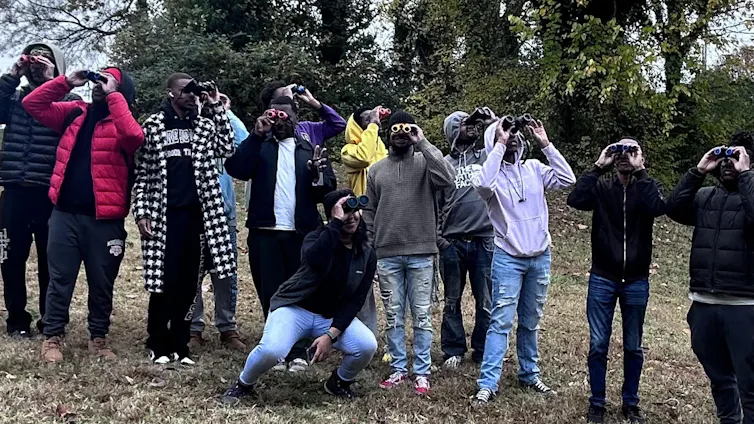 |
| Birding is a good way to practice mindfulness, psychologists report. Jennifer Andrews |
Hearing “just go outside” might sound like trivial advice, but researchers have been investigating a new, unconventional strategy to boost mental health: Seeking the company of wild birds.
You’ve probably heard them singing or noticed them flitting through the canopy, but if you’re not deliberately paying attention to their presence, they can fade into the background. A growing body of research suggests that keeping a watchful eye or attentive ear out for birds can help people from all walks of life feel more calm, present and refreshed.
Birding, the practice of observing birds in their natural habitat and also known as bird-watching, has experienced a renaissance in recent years. Birding exploded in popularity during the pandemic, and you may have even seen it popping up on your social media feeds. Newcomers to the practice discovered something seasoned birders have always known: Simply paying attention to birds can be surprisingly rewarding.
There is a wealth of data demonstrating that spending time in nature leads to health improvements. For example, reviews of scientific research have cited consistent evidence for nature’s important role in supporting health and well-being.
An increasing body of research, which my colleagues and I reviewed in 2024, also suggests that interactions with birds may play an especially important role in well-being. Encounters with birds may improve mood, reduce stress, restore attention, strengthen social connections and even encourage people to care more about the environment.
Subscribe to:
Posts (Atom)