Menu Bar

Home           Calendar           Topics          Just Charlestown          About Us

Saturday, June 1, 2024

Coalition Says Next Congress Must Overhaul Tax Code to Make Corporations Pay

If Dems re-take Congress in November, they must overhaul the tax code to make corporations and the rich pay their fair share.

JULIA CONLEY for Common Dreams

Highlighting the massive investments the federal government could make if legislators pass bold new tax reforms following next year's expiration of the Trump-era tax cuts, more than 100 public interest groups on Tuesday wrote to congressional leaders and urged them to correct the "large and costly mistake" that Republicans pushed through in 2017 over the objections of the public.

Nearly seven years after the passage of the Tax Cuts and Jobs Act (TCJA), said the coalition led by Groundwork Collaborative, the law has been proven to be "a failure on its own terms," with the average worker seeing none of the financial benefits promised by Republican Party and former President Donald Trump, who is running for the White House again.

"The Trump administration claimed that the TCJA's corporate tax cuts would lead to significantly higher wages for typical workers, but in reality, workers who earned less than $114,000—the overwhelming majority of Americans—did not experience any increase in earnings from the TCJA while the compensation of top corporate executives skyrocketed," wrote the groups, including Americans for Tax Fairness, Children's Defense Fund, and the National Domestic Workers Alliance.

The groups outlined three concrete goals that must be included in any tax reform considered by Congress in 2025:

  • ·       Make the tax code more fair by asking high-income households (those who take home more than $400,000), the extremely wealthy, large profitable corporations, and Wall Street to pay a greater share of their income in taxes than if each of the expiring TCJA provisions were simply allowed to expire, while also restoring essential supports for children and families with low or moderate income or wealth and families who've experienced discrimination;
  • ·       Raise more revenue than would be generated by letting all of the temporary TCJA provisions sunset, so that we can support much-needed investments in everyday Americans; make good on our commitments to our seniors, families, and historically underfunded communities; and reduce our fiscal risks; and
  • ·       Support greater and more inclusive economic growth by providing more financial security and opportunities for typical Americans, narrowing racial wealth gaps by boosting economic mobility, and disincentivizing economically harmful conduct by large corporations.

Vlad-bot

It really is us versus them


House OKs Rep. Spears bill to study creation of state Geographic Information System

Part of Speaker Shekarchi’s 2024 affordable housing legislative package 

The House approved legislation from Rep. Tina Spears to commission a report from the Department of Administration to study the creation of a statewide Geographic Information System.

The bill is part of House Speaker K. Joseph Shekarchi’s 15-bill package of legislation to address Rhode Island’s housing crisis. It will now go to the Senate for consideration.

“More complete information about the geography of Rhode Island means more informed and better decisions, whether for conservation or development,” said Representative Spears (D-Dist. 36, Charlestown, New Shoreham, South Kingstown, Westerly).

“This report will be the first step toward a uniform and detailed statewide GIS that will give us all a much better understanding of Rhode Island’s natural resources, open spaces and buildable land. This will help municipalities, developers, conservation groups, policy-makers and the public to make more informed decisions about their communities and the state as a whole.”

This legislation (2024-H 7985A) would instruct the Department of Administration to develop, with input from the League of Cities and Towns, a report on the creation of a comprehensive and integrated statewide GIS.

Tiny plastic particles can travel to our kidneys and instigate oxidative stress and inflammation.

Strengthening microplastic regulation to protect our kidneys

Rohan Arora, BY EHN

More than 37 million Americans have kidney disease, leading to severe swelling, fatigue, back pain, urination issues, shortness of breath and more.

Of those, roughly 808,000 Americans have subsequently developed kidney failure, after the disease progresses to the inability of filtering out waste products from blood and producing urine. These patients can become very sick and require either kidney transplants or long-term dialysis to stay alive.

Though many wait for years for a transplant or subject themselves to painful dialysis protocols, more than 250,000 people (about half the population of Wyoming) die annually from kidney disease in the Americas.

While many factors — including medical co-morbidities, age and genetics — can contribute to kidney disease, more and more research is coming out showing how tiny plastic particles that we inadvertently consume on a regular basis damage our kidneys and may predispose us to kidney failure.

Medicare payment parity key to saving independent physicians, Dr. Ashish Jha tells Congress

Dr. Jha returns to Washington, briefly

The Brown University School of Public Health dean urged members of the House Committee on Ways and Means to better support the dwindling number of doctors in private practice.

Dr. Ashish K. Jha, dean of the Brown University School of Public Health, addresses members of the House Committee on Ways and Means.

While the array of forces driving the demise of independent physicians in the United States is complex, Congress can take multiple key actions to support private health care providers and enable them to focus on patient care.

That’s according to Dr. Ashish K. Jha, dean of the Brown University School of Public health.

The top of his list? Ensure that Medicare pays private physicians the same amount that it pays health care systems for the same medical services.

Friday, May 31, 2024

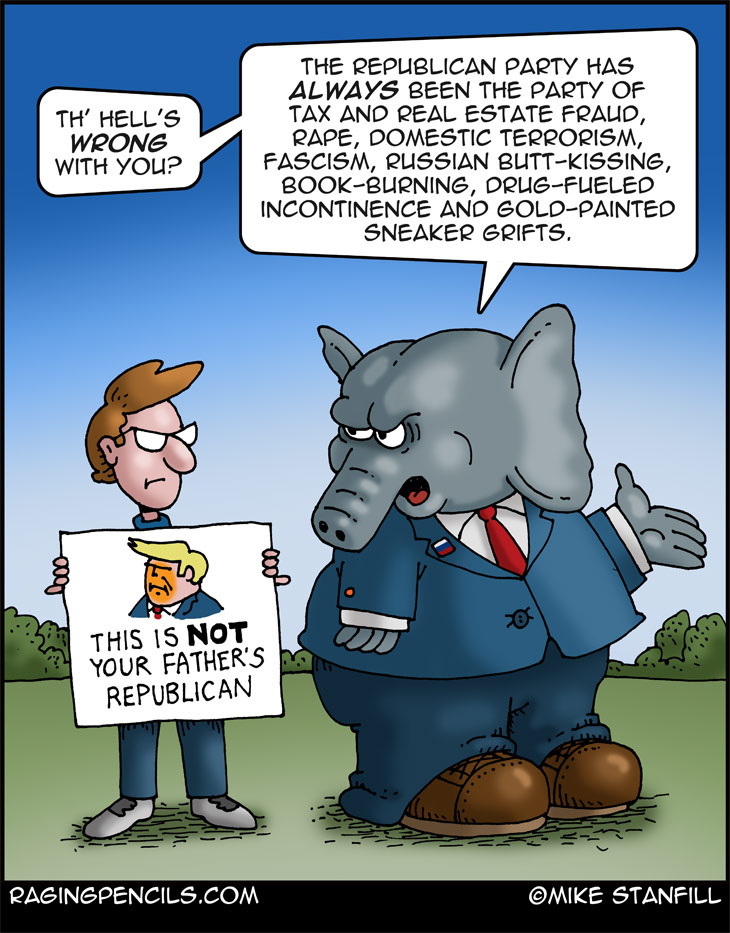
Trump Guilty Verdict Shows Wealthy and Powerful Can Be Held to Account

But it’s just the beginning

AARON REGUNBERG in Common Dreams

For weeks, the nation has watched, transfixed, as Donald Trump stood trial in the first-ever criminal prosecution of a former president. This is not the first time Trump has been the defendant in a major trial, and in many ways the potential consequences of this criminal case pale in comparison to Trump’s business fraud case and E. Jean Carroll’s defamation suit, which together exceed half a billion dollars in civil judgments.

But the significance of Trump’s criminal conviction at the hands of Manhattan District Attorney Alvin Bragg seems to dwarf Trump’s other legal entanglements.

That’s because criminal law plays a unique role, not just in our legal system, but in society at large. It is how the state takes action to protect citizens from harm, promote public safety, and hold wrongdoers accountable. It’s also how we illustrate what’s right and wrong and publicly mark that certain acts are simply not acceptable—that they are condemned by the community at large.

That's how it worked in "1984"

The Law & Order Party

NASA’s Crew Flight Test Launch Delayed Again

Another Setback for Boeing’s Starliner

By NASA  

Mission managers from NASA, Boeing, and ULA (United Launch Alliance) continue to evaluate a path forward toward launching the agency’s Boeing Crew Flight Test to the International Space Station. The teams are now working toward a launch opportunity at 12:25 p.m. ET on Saturday, June 1, with additional opportunities on Sunday, June 2, Wednesday, June 5, and Thursday, June 6.

The Boeing Crew Flight Test was scheduled for May 6, but that launch was scrubbed due to a faulty oxygen relief valve. Subsequent issues changed the targeted launch date to May 17, May 21, and May 25, before this current target of no earlier than June 1.

Researchers Warn of Toxic Chemicals in Popular Vape Flavors

Toxic vaping

By RCSI 

New research has identified potentially harmful substances produced when e-liquids in vaping devices are heated for inhalation. Published in Scientific Reports, the study underscores the urgent need for public health policies addressing flavored vapes.

The research team at RCSI University of Medicine and Health Sciences, Dublin, used artificial intelligence (AI) to simulate the effects of heating e-liquid flavor chemicals found in nicotine vapes. They included all 180 known e-liquid flavor chemicals, predicting the new compounds formed when these substances are heated within a vaping device immediately prior to inhalation.

The analysis revealed the formation of many hazardous chemicals including 127 which are classified as ‘Acute Toxic’, 153 as ‘Health Hazards’, and 225 as ‘Irritants’. Notably, these included a group of chemicals called volatile carbonyls (VCs) which are known to pose health risks. Sources for VCs were predicted to be the most popular fruit, candy, and dessert-flavored products.

Global life expectancy to increase by nearly 5 years by 2050 despite geopolitical, metabolic, and environmental threats

Hopefully, they'll be good years

Institute for Health Metrics and Evaluation

The latest findings from the Global Burden of Disease Study (GBD) 2021, published today in The Lancet, forecast that global life expectancy will increase by 4.9 years in males and 4.2 years in females between 2022 and 2050.

Increases are expected to be largest in countries where life expectancy is lower, contributing to a convergence of increased life expectancy across geographies. The trend is largely driven by public health measures that have prevented and improved survival rates from cardiovascular diseases, COVID-19, and a range of communicable, maternal, neonatal, and nutritional diseases (CMNNs).

This study indicates that the ongoing shift in disease burden to non-communicable diseases (NCDs) -- like cardiovascular diseases, cancer, chronic obstructive pulmonary disease, and diabetes -- and exposure to NCD-associated risk factors -- such as obesity, high blood pressure, non-optimal diet, and smoking -- will have the greatest impact on disease burden of the next generation.