Menu Bar

Home           Calendar           Topics          Just Charlestown          About Us
Showing posts sorted by relevance for query henry shelton. Sort by date Show all posts

Thursday, September 22, 2016

UPDATED: Henry Shelton, hero for social justice, has died.

UPDATED: Fighter for the poor, mentor to generations of activists, dies at age 86
By Will Collette

Image result for Henry shelton Rhode Island

One of Rhode Island's greatest organizers and activists for social and economic justice, Henry Shelton, died after a long illness but after a much longer life of being an inspiration to generations of Rhode Islanders.

I first met Henry while finishing up my studies at Rhode Island College at picket lines Henry organized to support the grape and lettuce boycotts called for by striking United Farm Workers. Then later, I had the honor of working with Henry in coalitions fighting for welfare and health care rights.

Nearly every organizer I knew from the 1970s to the present who ever worked in or passed through Rhode Island knew and admired Henry as one of the most passionate, hard-working champions for social justice. He was the most genuine person you could imagine, never content to be satisfied with just a half-measure of justice or a slow step forward toward progress.

Though the years took their toll and Henry could no long fire up the crowd - usually from the back of the room - he nonetheless devoted every last measure to the cause of justice for the poor.

Henry will be sorely missed.

Keep reading for Rep. Jim Langevin's statement.


Wednesday, June 4, 2014

Legendary organizer Henry Shelton to be feted

Red Bandana_web_smallEvery year he had a party. He would call it his “75th Birthday Part II” or his “80th Birthday Part 4.” 

You get the idea. And from all over Rhode Island, all over New England and even all over the country, friends and colleagues and relatives would meet, greet, drink, eat, sing and laugh the day away at Richard Walton’s hideaway, at the mouth of the Pawtuxet River, basking in the sunshine (or rain showers), reveling in each other’s company, renewing acquaintances, and hugging old friends.

By the end of the day, there was a cigar box full of checks and cash for Amos House and/or Providence Niquinohomo Sister City Project because social justice was in his blood and opportunities like this should never be wasted.


So for the first time in decades last year, there was no party at Richard Walton’s house in Warwick. Instead, a bunch of his friends got together, and produced a fund-raiser at Shea high School in Pawtucket to honor his memory and his work. And to continue that legacy, they formed The Red Bandana Fund.

But this year the party’s back! And we’re hoping to keep it going for a long, long time.

Sunday, July 3, 2011

Happy 81st Birthday, Henry Shelton!

At age 81, after more than 50 years as a community organizer, 30 of them as coordinator of the George Wiley Center, Henry Shelton got a truly wonderful birthday present last week.

Wednesday, April 22, 2015

Henry Shelton inducted into Rhode Island Heritage Hall of Fame

Long overdue honor for an inspirational figure in Rhode Island history
By Will Collette
Over the past fifty years, Henry Shelton has inspired generations of people to believe that it is possible to make this world a better place and that we must all do our share to make it happen.

On April 18, I was there to see Henry receive one of Rhode Island’s highest honors, a place in the RI Heritage Hall of Fame.

Henry had to be helped onto the stage because a severe stroke has impaired his body but as Henry’s wife Carol Shelton, an inspiration in her own right, read Henry’s statement of acceptance, we all understood that the stroke did not impair his keen mind and passion for social justice.

When Henry was still a young priest, Bishop Russell McVinney named him to be the director of the Catholic Inner City Center on Prairie Avenue in South Providence. Because Henry believed that charity is no substitute for justice, he made the Inner City Center a hub of community organizing that helped poor people find their own sense of power to fight for the things they needed for survival.

A generation of future community organizers passed through the Inner City Center and learned the craft of organizing from Henry. Later, after leaving the priesthood, Henry applied the same formula of empowering the poor and training eager and dedicated young people to be organizers in a succession of organizations.

Friday, July 29, 2011

Honoring a great Rhode Islander

Henry Shelton (l) and Carol Shelton (r)
copyright, The Pawtucket Times
Governor Chafee held a ceremonial signing of the new Henry Shelton Law yesterday at the State Capitol.

The event was more about honoring the great man whose name appears on the bill, more than anything else. The Governor had actually signed the bill into law two weeks ago. But such ceremonies are done on occasion when a piece of legislation means more than just the words on paper.

Such was the case a year ago when the Colin Foote Law, sponsored by Rep. Donna Walsh, was signed into law. Then, the point was that the Colin's Law was to be a first step in taking dangerous drivers off the road.

But the ceremony for the Henry Shelton Law was an affirmation of the lifelong work of Henry Shelton to help improve the lives of poor people in Rhode Island.

Tuesday, May 27, 2014

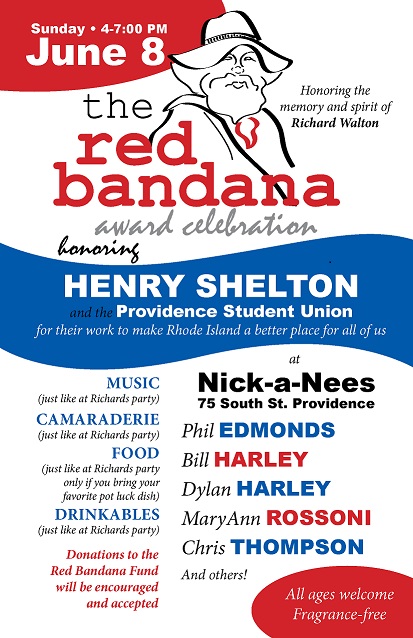
Annual "Red Bandana" tribute to Richard Walton on June 8

Henry Shelton, Providence Student Union to be honored

The Red Bandana Fund will be a legacy to help sustain Rhode Island’s community of individuals and organizations that embody the lifelong peace and justice ideals of activist Richard J. Walton.

Richard was a father, grandfather, brother, and friend. He was a social and political activist, working against homelessness, poverty, and injustice. 

In addition to his affiliation with Stone Soup, Richard had a deep personal involvement with Amos House in Providence. 

For many years Richard was an adjunct instructor in the Department of English at Rhode Island College and was the founding president of its Adjunct Faculty Union.

Richard was the heart and soul of Stone Soup Coffeehouse, serving as President of the Board for most of the 32 years of Stone Soup’s existence. For many people he was also the face of Stone Soup as its long-term master of ceremonies.

The 2013 Red Bandana Fund Award was presented to Amos House in Providence which makes a difference in the lives of others by providing basic needs, education and businesses such as the Friendship Cafe, More than a Meal Catering, and Bristol Harbor Homemade Baking Mixes.

This year, the Red Bandana Fund is proud to name Henry Shelton and the Providence Student Union as the recipients of the Red Bandana Award for 2014. The Award honors individuals and groups whose work embodies the spirit and work of Richard Walton, a longtime activist in the Rhode Island area who died in 2012. The awards will be presented on June 8 at a celebration at Nick-a-Nees, 75 South St. in Providence, from 4 to 7 pm. The event is open to the public and is family-friendly.

Saturday, April 30, 2016

Senate approves bill to make Henry Shelton Act more effective

Changes aim to help struggling families earn utility debt forgiveness

The Rhode Island Senate approved legislation sponsored by Sen. Joshua Miller (co-sponsored by Sen. Sue Sosnowski) making it easier for struggling families, particularly those transitioning from homelessness to permanent housing, to earn forgiveness for utility debt.

The legislation makes changes to the Henry Shelton Act, named after the longtime anti-poverty and social justice activist and founder of the George Wiley Center in Pawtucket, to allow people who enroll in the debt management plan to earn incremental forgiveness over the course of a year, instead of earning full forgiveness only if they successfully complete a three-year plan.

Senator Miller, who was also the sponsor of the Henry Shelton Act when it became law in 2011, said the three-year arrangement is proving to be less effective than hoped because those who are having trouble paying their monthly bills also struggle with paying down their debt on top of it, and if they cannot complete all three years of the current program, they get no relief.

The legislation passed today (2016-S 2087A) is based on Massachusetts’ utility debt forgiveness program. It will allow participants to get one-twelfth of their arrearage forgiven for every month of successful payment, for up to $1,500 of forgiveness in a year.

Friday, June 15, 2012

Happy Birthday, Henry

Happy Birthday Longtime Activist Henry Shelton
Still organizing for justice at 82!
Let us all celebrate Henry and the George Wiley Center this Friday at the East Providence Yacht Club at 6pm. On Facebook, you can register here.
A former priest who took the words of Jesus to heart (you know the ones about serving the poor) Henry quit the catholic church and became Rhode Island’s most respected hell-raiser, a community organizer of the highest degree for issues of economic justice, human rights and community empowerment since the mid 60s. 
Along the way he has forged a stellar reputation within the halls of power and in the community where he has been a determined advocate for that most neglected of populations: the poor.

Thursday, July 14, 2011

Chafee signs "Henry Shelton Law" and bills of local interest

Henry Shelton in his prime
Governor Lincoln Chafee has signed over 150 bills passed in the recently adjourned session of the General Assembly including several bills we have covered in Progressive Charlestown.
Among them is the “Henry Shelton Law,” which was thought to be in danger of a veto from the Governor only days ago. Whether that was a false alarm, or whether calls and e-mails from the bill’s supporters made a difference, the bill is now law. Named after one of Rhode Island’s greatest advocates for social justice, the bill will help low-income families, the elderly and handicapped prevent their heat and utilities from being turned off.

Sunday, April 12, 2015

Remembering Richard Walton

By Stephen R. Graham in Rhode Island’s Future
In honor of Richard Walton... And all others like him that work to improve the human condition.

It’s that time of year again. Time to recognize the unsung heroes amongst us for all the good work they do. To nominate someone, fill out a form on-line here or simply email RedBandanaAward@gmail.com to receive the nomination form via email. The deadline is April 15th.

So we’re asking you to help us decide who deserves that recognition. We are seeking nominations from the community to recognize both unsung organizations, and individuals, that embody the spirit and work of Richard Walton and for the commitment they have shown to making the world a better place. Nominations are now being accepted for anyone you feel worthy of recognition.

We’re also asking that you provide a 1 page description of why they deserve the award. Keep in mind that the committee members may have never heard of the person you nominate so the description you give will be go a long way in determining whether they win the award or not.


Monday, January 9, 2023

Fr. Ray Tetrault, organizer and activist, dies at age 88

Early advocate for immigrants and relentless fighter for the poor

By Will Collette

Cathy and I first met Ray Tetrault almost exactly 50 years ago when we walked a picket line in front of a Providence Almacs to support the United Farm Workers lettuce boycott. The UFW had just launched the lettuce boycott after the successful grape boycott forced growers across California to recognize the union and sign contracts.

It was a lively picket and I remember Ray taking his turn with the megaphone, calling out the chants and songs. Over the next decade, I saw Ray frequently at planning meetings, events and of course on the picket line.

Ray Tetrault grew up in South Providence near St. Michael’s Church and was one of a large cadre of activist priest, nuns and brothers, some in the church and some, like Ray’s friend Henry Shelton, expelled from holy orders.

In those days, many Catholics believed in what was then called “liberation theology,” a principle that grew out of Pope John XXIII’s Vatican II conference that the church had the duty to stand with the poor and oppressed. Imagine for a moment, the political philosophy of Bishop Thomas Tobin. Now think of the exact opposite, and there you have Ray.

I wasn’t a Catholic, though I worked for the Catholic Church’s Community Affairs office on strategic campaigns in the 1970s. But you didn’t need to be a Catholic to admire and respect Ray and his colleagues, including Henry Shelton, Sr. Adelaide Canelas (her specialty was organizing Portuguese immigrants), Fr. Jim Ford and many others.

Ray’s particular contribution was to recognize the needs and potential of the growing number of Spanish immigrants. He was the first priest in Rhode Island to say the Mass in Spanish. I remember Ray and Sr. Canelas working a tandem act at large events, each with a bullhorn to translate English speeches into Spanish and Portuguese respectively.

One of the hallmarks of great activists is their devotion to developing new leadership and inspiring others to stand up and fight for their rights. Ray was as good as the best organizers at doing just that within the immigrant community, as the Providence Journal article on his passing shows in detail.

His legacy lives on in the actions of the generations of people he inspired.

Tuesday, January 31, 2017

We are a great nation and we can take care of our own

By Nancy Green in Rhode Island’s Future

Image result for triageWay back in the Reagan years, in those prosperous times when the social safety net was being shredded, experts talked about triage.

Triage is a medical term for sorting level of injury in a disaster, including putting a black tag on the living who cannot be saved with present resources. Our economy was a disaster, they said. The ship of state was loaded down with poor people. How could we afford this burden?

Some writers pointed out it’s premature to throw people overboard while there’s still steak and whiskey in first class. But enough stayed comfortable that the cries of the excluded could be ignored and concentration of wealth proceed.

Now the 0.1% are living in opulence that makes steak and whiskey seem quaint, and our ship of state has been hijacked by a corrupt billionaire and his pirate crew. It’s triage time again, and the 20 million who recently got access to health care are about to be tossed.

The president who must not be named just signed an executive order that undercuts the shaky stability of the Affordable Care Act with unclear language about easing the burden of regulation. He has made it clear he intends to undo the insurance reforms of the past 6 years.

Fundamentally, insurance is about dividing up the risk. If our nation divided the risk among our 324,000,000 we could have universal health care in return for our taxes.

We are decades behind the rest of the developed world in constructing a national health program. What we have now, the Affordable Care Act, should really be called the Achievable Care Act, because it’s what survived the Congressional sausage-making factory.

We were supposed to have a Public Option, but that was triaged out as the ACA passed by single digits in both houses. It was harsh, I remember hearing Rep. Joe Wilson shout, “you lie” at President Obama as he spoke to Congress. House majority leader, Rep. John Boehner was emoting all over the place.

President Obama accomplished what a century of presidents attempted. He got us started on a track to universal access to health care.

Rhode Island has built up a working health benefits exchange that is a lifeline for many of us, middle class included. Small business owners, people whose jobs do not provide insurance, people who were hanging in there hoping to stay healthy until they qualified for Medicare are some of the people who use Obamacare.

Workers don’t have to stay in jobs they hate just to have access to insurance. Parents can decide to stay home if that’s best for their family instead of working just for the coverage.

Most Americans have coverage in the complicated system we’ve built since WWII. Most don’t fall through the holes. I think the fact that we have emergency services creates an illusion that the safety net is there when we need it. It’s true that by law no one who goes to a hospital ER in an emergency is turned away. That seems so right, so American, that most don’t know that law was only passed in 1986.

EDITOR'S NOTE: The promise to provide health care to all regardless of ability to pay pre-dated the 1986 law. The promise was a part of the 1946 Hill-Burton Act which spurred construction of health care facilities across the US. Any facility that received federal construction money had to make this pledge. But until the last 1970s, this promise was little known and had no enforcement mechanism. 

Community organizations in Rhode Island were the first to organize uninsured workers to fight for this right. Among the lead organizers were George Nee, now head of the state AFL-CIO and the late social justice hero, Henry Shelton. I served as the campaign's strategic researcher. The RI Hill-Burton campaign spread across the US and led to the passage of the 1986 law. - W. Collette

Now we won’t die outside the hospital door, but the most common cause of bankruptcy is medical debt.

I got my first inside look at the beast that is our health care ‘system’ when I answered a newspaper ad in 1985. I was hired as a nurse’s aide at Wayland Health Center. That nursing home shut down after a horrific incident where an aide put an elderly patient into a hot tub without testing the water and burned her to death. 

Subsequently the state required all aides to be trained and certified. Darn those government regulations. We can’t even tie confused people up in chairs all day like we did back then.
As a minimum wage worker I was one of those freeloaders in the 47% that didn’t pay federal income taxes.

Every two weeks I would stare at my paycheck for a few minutes, wondering how 40 hours of exhausting labor could earn me so little. I worked close to where I lived because a car was unaffordable.

I guess you could say I was one of the takers, contributing nothing except Social Security and other deductions in my paycheck plus sales taxes and the underpaid labor that made nursing homes lucrative for the job creators.

I voted to maintain the highways I couldn’t afford to drive on while seeing public transit cut year by year. I had health insurance by then because I was legally married, but many of my co-workers were uninsured or paying a big hunk of their wages to get on the company plan.

It’s risky to go without a medical safety net. Things happen. A healthy woman may have a million dollar baby. And that baby might need skilled care for many years. A car accident, an unexpected health crisis will happen to someone.

Or yourself, if the dice roll that way.

But it’s midnight in America. Must we toss some people overboard? Maybe not the grandmothers on Medicaid. They babysit so their adult children can hold down a decent middle-class job. Maybe not the disabled children, because they are innocent, unlike their exhausted parents. But the Ladd School is closed and we need the caregivers. Maybe not orphans who age out of the foster care system. 

Maybe not anyone because people who get sick for lack of care end up costing all of us at the ER or hospital.

Investing in health care for Rhode Island has costs but also advantages.

Direct health care is a job creator, one of the most labor-intensive classes of work and more needed as the population ages. Health care workers don’t put their pay into offshore accounts, they spend it locally.

During the Reagan years we heard scandalous stories about six hundred dollar toilet seats ordered for the military. During the Iraq War bundles of cash were just lost. Contractors for Halliburton risked their lives driving empty trucks through a war zone because they were paid by the run. Soldiers tried to improvise shielding on ‘thin skinned Humvees’ that left them exposed to roadside bombs.

All these billions and all those lives sacrificed to war. Why is investing in peace such a hard sell? If managed right, money spent on health care can be a job creator.

We need a living wage for the women and men who provide direct care for the elderly and disabled. Their wages for the most part will go right in to our local economy. And health care is meaningful work with opportunity for advancement. Workers who get more training and education can gain certification and better pay. 

Direct care workers have knowledge and experience they can share with the community, helping to educate the public on how to manage chronic diseases like diabetes and heart disease. That woman in scrubs riding the bus is holding it all together and she deserves a raise.

The right is better than we are at propaganda. Sneer at “government health care”, but don’t touch my Medicare. Sarah Palin’s “death panels” lie had legs because Americans feel insecure. For-profit corporations have too much power over what should be a public good. But if you don’t want the system that neglected wellness to go into overdrive when you are dying you better hope your doctor will make time to discuss an Advance Directive even if she can’t bill for it.

One great benefit of the Affordable Care Act is the provision that insurance companies can’t deny someone for a ‘pre-existing condition’. 

This makes it harder for insurance companies to ‘cherry pick’ customers who will never make a claim. Republicans want to ease the pain to big insurance by dividing Americans into the healthy and a high risk pool for those whom God has not blessed people with pre-existing conditions.

I don’t know how to find a signal word for the outrageousness of this. Maybe the word, ‘segregation’? We’ll hate on people who make expensive claims and blame them for our lousy economy. They should be grateful that they get second-class, high risk pool insurance. Segregation worked just fine for the majority for about a hundred years, after all. Let’s hear it for segregated health care.

Or we can recognize that we are a great nation and we can take care of our own. Not with a ‘system’ that puts profit ahead of the public good, but with effective, efficient and accountable health care for all. We would not be the first country to get there, so what are we waiting for? Now is the time.

Author Nancy Green is a Nurse, health care advocate, Providence citizen

Friday, September 6, 2024

Thank you, George

Rhode Island labor leader George Nee announces his retirement
By Will Collette

The day after Labor Day, RI AFL-CIO President George Nee announced that he will officially retire on October 11 after a lifetime of service. While local media is focused on his prominent leadership of the state's labor movement, George has been much more than that. Like others of his era, such as famed late community organizer Henry Shelton, George was an inspired organizer dedicated to building people power at every opportunity.
George is part of a long chain of organizers who were inspired by Saul Alinsky, including George's mentor Cesar Chavez, who sought to help the powerless gain the power to have control over their lives. Part of the model was to teach others the craft of organizing, often young college kids, as well as seasoned community leaders.

I first met George in 1974 when he was staff director of the RI Workers Association (RIWA), a group similar to the unemployed councils that sprang up during the Great Depression. I was a senior at RI College and did my social work internship at RIWA. Right after I graduated, George hired me to organize in Central Falls and Pawtucket.

I wasn't very good at it, but in the process, I learned that I am good at strategic research and campaign planning. I collaborated with George on the country's first successful grassroots organizing campaign to make non-profit hospitals honor their duty to treat patients regardless of their ability to pay.

George taught me the values of helping people speak for themselves, of accountability (i.e. don't promise what you can't deliver) and the joys of being a professional troublemaker, values I carried with me for the next 30+ years.

Thank you, George, for not only giving me a start in my career, but also for the countless others you inspired. Happy retirement!

Sunday, June 17, 2012

Support the Fund for Community Progress

Change, not just charity
By Will Collette

St. Augustine wrote “Charity is no substitute for justice withheld” over 1500 years ago. He also wrote In the absence of justice, what is sovereignty but organized robbery?”

For that reason, the Providence-based Fund for Community Progress has been one of my favorite places to give. 

Tuesday, July 12, 2011

We need to turn the heat up on Gov. Chafee

We received an urgent message from Ocean State Action that Governor Chafee is considering a VETO of the "Henry Shelton Law," recently passed by the General Assembly - Bill H6293A, a tribute to one of Rhode Island's champions for social justice. This bill will provide emergency heat and utility help to the poor, elderly and disabled. Go to this earlier article for a description of the bill.

As soon as possible - TONIGHT - please call and leave a voicemail on the Governor's line - 222-2080 and (or) e-mail the Governor. .

You can also send your messages through Ocean State Action by clicking here.

Tuesday, December 18, 2012

UPDATED: Charity Begins at Home

Giving to help others – an alternative to holiday gifts
By Will Collette

With only a week to go, I would again suggest there is an alternative to frantic Christmas shopping - give to charity in the name of family and friends.


I have updated this earlier post with some additional suggestions for non-profits that can put your holiday donations to good use - see the end of this article.

Our family started a tradition years ago that instead of exchanging gifts (hoping they will fit, wondering how much of a hassle it will be to return it), we increased our charitable giving. We compared notes on the charities we like – RI Food Bank, Amos House, Doctors Without Borders, etc. and found this to be a much more satisfying way to mark the season.

This is Progressive Charlestown’s first second Christmas with you, so we’d like to pass on this idea for alternative gift giving, but to also pass on some specific ideas.