Menu Bar

Home           Calendar           Topics          Just Charlestown          About Us

Monday, August 3, 2020

Diets high in protein, particularly plant protein, linked to lower risk of death

Findings support recommendations to increase consumption of plant proteins
BMJ

 Diets high in protein, particularly plant protein, are associated with a lower risk of death from any cause, finds an analysis of the latest evidence published by The BMJ.

The researchers say these findings "support current dietary recommendations to increase consumption of plant proteins in the general population."

Diets high in protein, particularly protein from plants such as legumes (peas, beans and lentils), whole grains and nuts, have been linked to lower risks of developing diabetes, heart disease and stroke, while regular consumption of red meat and high intake of animal proteins have been linked to several health problems.

But data on the association between different types of proteins and death are conflicting.

So researchers based in Iran and the USA set out to measure the potential dose-response relation between intake of total, animal, and plant protein and the risk of death from all causes, cardiovascular disease, and cancer.


What you should know about Trump's favorite new pandemic doctor

Stella Immanuel’s theories about the relationship between demons, illness and sex have a long history
Brandon W. Hawk, Rhode Island College


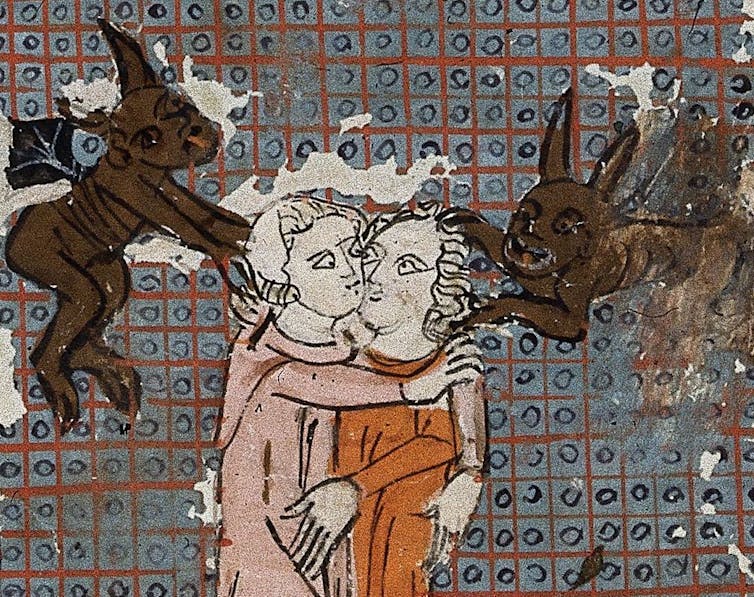
Matfre Ermengaud’s ‘Temptation by Lechery’ from a
14th-century manuscript. The British Library
Donald Trump has a new favorite doctor.

On July 27, the president and his son Donald Trump, Jr. tweeted a viral video featuring Dr. Stella Immanuel, in which the Houston pediatrician rejected the effectiveness of wearing face masks for preventing the spread of COVID-19 and promoted hydroxychloroquine to treat the disease.

Journalists quickly dug into Immanuel’s background and found that she’s also claimed that having sex with demons can cause illnesses like cysts and endometriosis.

These beliefs don’t come out of thin air, and she’s far from the only person who holds them.

As a scholar of biblical and apocryphal literature, I’ve researched and taught how these beliefs have deep roots in early Jewish and Christian stories – one reason they continue to persist today.


Sunday, August 2, 2020

“The citizens of Charlestown do not trust the CCA”

The debate over who is telling the truth about aborted land deal continues
By Kenneth Robbins

Building PhotoEDITOR'S NOTE: The Charlestown Citizens Alliance (CCA Party started lobbing spitballs at their rivals in the Charlestown Residents United (CRU) after the CRU revealed a plan to buy a small piece of property for twice its value. The details are HERE and I personally checked the back-up documentation in the records presented before the Town Council. The 1 acre property at 634 Charlestown Beach Road is assessed at $1.2 million, was appraised at $1.45 million, but Charlestown was going to pay $2.5 million. The "open space" property is dominated by a 40-year old beach house (see above), begging the question of what the town would do with it. After the CRU blew the whistle, the Council dropped the deal. - Will Collette

In the Westerly Sun’s July 24th edition, Town Councilor Bonnie Van Slyke, one of Charlestown Citizen Alliance’s (CCA) Town Council members, responded to letters from me and Tim Quillen, both members of Charlestown Residents United (CRU).

She accused CRU of publishing comments that were neither factual nor truthful about the proposed sale of a property at 634 Charlestown Beach Road to the town – “Not even close.”

She then cites only one comment made on Facebook, not by CRU or its members, which questioned whether member(s) of the Town Council had a relationship with the seller.

I do not use social media and may have missed this speculative concern from a citizen in Charlestown. But it reflects a deeper, more basic, issue that I also tried to point out in my letter to the Sun of July 19th.

The citizens of Charlestown do not trust the CCA to be open and transparent in their advocacy and in their decisions.

Their actions on any of several issues over the years, examples of which were in my earlier correspondence, support that distrust and help explain why letters and comments, such as those Ms. Van Slyke references, were made.

The fact that the Council reached an appropriate decision on this issue does not change this more basic concern and distrust.

CRU is dedicated to making Town government open and transparent for all citizen of Charlestown so our citizens can once again trust and believe that our governance is working for the best interest of all residents.
The unbelievable Trump!


For more cartoons by Tom Tomorrow, CLICK HERE.

VIDEO: We WILL vote


To watch this video on YouTube: https://www.youtube.com/watch?v=nhscswJudYM

Fisher folk, take note

New Freshwater Fishing Regulations Take Effect Today

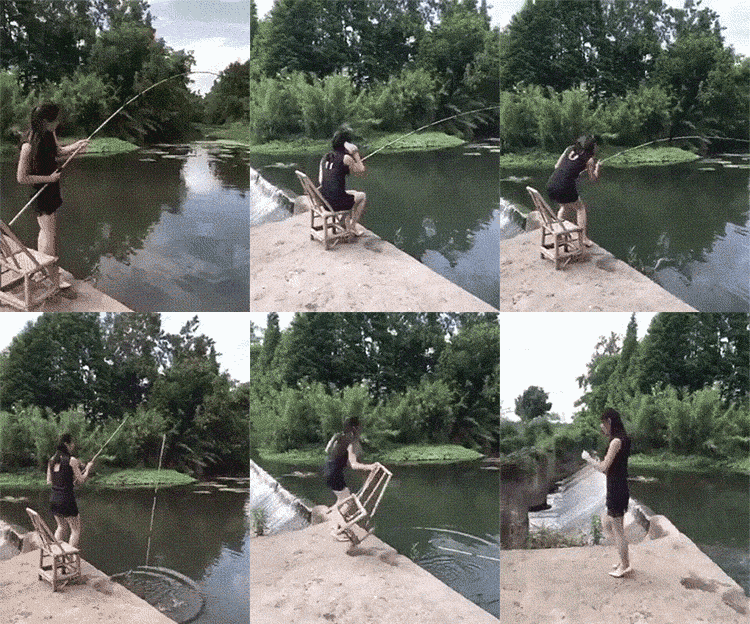
girl fishing GIFThe Rhode Island Department of Environmental Management (DEM) announces that new freshwater fishing regulations take effect statewide on August 2. The changes are as follows:

• The minimum size of all trout or charr species, taken from the waters of the state, shall be eight inches, measured from the tip of the snout to the tip of the tail. This regulation applies to both wild and stocked trout. 

• The minimum size for domestic or land-locked stocked, Atlantic salmon shall be 11 inches total length. 


• The following activities are prohibited In accordance with RI General Laws 20-11-3: the taking of any fish in the freshwaters of the state by any means other than angling, utilizing a hook(s) and fishing line, except for carp, suckers, and fall fish, which may be taken by snares, spears, or bow and arrow; and the taking of any fish in the freshwaters of the state by net, seine, trawl, or similar device except for a dip net, for the landing of a fish caught by hook and line, and the taking of baitfish. Cast nets and gills nets shall be prohibited. 


• The following waters shall be restricted to fishing by children 14 years of age and younger, annually, from the second Saturday in April: Frosty Hollow Pond, Exeter; Lapham Pond, Burrillville; Scott Evens Memorial Pond (Biscuit City), South Kingstown; Seidel's Pond, Cranston; Silvy's Pond, Cumberland. Lloyd Kenney Pond in Hopkinton is restricted to children from the second Saturday in April through Memorial Day only. Cass Pond, Woonsocket; Slater Park Pond, Pawtucket; and Pondarosa Park Pond, Little Compton are restricted to children only for the first two days of Opening Day of Trout season. All other freshwater fishing regulations are in effect as of August 2, 2020.


Moscow Mitch screws America again.

House Democrats passed a strong pandemic relief bill (The Heroes Act) TWO months ago but Moscow Mitch has sat on it, failed to come up with a workable Republican version, is not negotiating with Democrats, has no consensus even among his own Republican caucus...so of course he took a long weekend while supplemental unemployment benefits and the moratorium against evictions expire.

Pic of the Moment

Hydroxychloroquine’s chemical cousin doesn’t work on coronavirus either

Study shows that chloroquine does not block SARS-CoV-2 infection of lung cells
Leibniz Institute for Primate Research

Can Chloroquine and Hydroxychloroquine Treat Coronavirus (COVID-19)? -  GoodRxMore than 600,000 people worldwide have fallen victim to the lung disease COVID-19 so far, which is caused by the SARS coronavirus-2 (SARS-CoV-2). 

In order to obtain an effective therapy for COVID-19 as quickly as possible, drugs that are being used to treat other diseases are currently being repurposed for COVID-19 treatment. 

The Infection Biology Unit of the German Primate Center (DPZ) - Leibniz Institute for Primate Research in Göttingen, together with colleagues at the Charité in Berlin, was able to show that the malaria drug chloroquine, which has been demonstrated to inhibit the SARS-CoV-2 infection of African green monkey kidney cells, is not able to prevent infection of human lung cells with the novel coronavirus. 

Chloroquine is therefore unlikely to prevent the spread of the virus in the lung and should not be used for the treatment of COVID-19 (Nature).


Science elicits hope in Americans

Its positive brand doesn't need to be partisan
Todd Newman, University of Wisconsin-Madison


Laugh Reaction GIF by GIPHY NewsHarley-Davidson is one of the most iconic brands in the world. Harley-Davidson, however, doesn’t sell motorcycles – it sells a lifestyle. 

Look at any Harley-Davidson advertisement and you will see someone riding the open road. The Harley-Davidson brand is about freedom. Attitude. Living by your own rules.

A brand is the unspoken starting point when you first encounter any object, person or idea. It’s the emotional, sensory and cognitive reflex that shapes how subsequent information is gauged. A key to successful marketing, therefore, is understanding that starting point.

By the same token, effective science communication depends on understanding the factors that influence public perceptions of science so that those doing the communicating – such as the research community, health professionals or governmental agencies – can advance greater public understanding of the science or motivate the actions of individuals, groups or society.

Through the marketing lens, then, what is the “brand” of science as an enterprise? It’s an especially important question during the COVID-19 pandemic, when headlines around the world have shifted global attention to the science surrounding the coronavirus.

neil degrasse tyson lol GIFA March 2020 Pew Research survey asked Americans how they had felt about the coronavirus over the previous week. People reported experiencing nervousness, anxiety, depression and even physical reactions, at least a little of the time.

But despite these uneasy feelings, nearly 3 in 4 Americans indicated they felt hopeful for the future.
As my communications colleagues and I find, hope is the starting point for how the public thinks and feels about science.

Hope for the future, based in science

ScienceCounts, a nonprofit organization working to strengthen public support for science which I collaborate with, conducted a couple of polls that ask respondents a multiple choice question about what comes to mind when they hear the word “science.” What they found was clear: The U.S. public feels “hope.”


Saturday, August 1, 2020

Trump just can’t handle the pandemic

Even if he’s wearing a mask now, he’s still trying to conceal data, silence experts, and block funding.
By Matt DaviesNewsday
The Trump administration is apparently undertaking its latest effort to make 2020 more of a Kafkaesque nightmare than it already is. 

Yes, we’ve got murder hornets and a swarm of flying ants that can be seen from space over in Ireland, but maybe the scariest plague of the year is the president.

Since the start of the pandemic, Trump’s only concern has been his poll numbers. 

He wants to go back to the reality we left behind in 2019: an open economy and no mass casualties from a novel virus.

We can’t do that, so he’s done his best to pretend: downplaying the pandemic, falsely claiming his administration has it under control, urging a quick economic reopening, and inaccurately claiming the economy is strong anyway.

When he can’t pretend everything is fine, he blames the Chinese. But China is not responsible for Trump’s botched response to the pandemic.

Now the Trump administration is actively interfering with the pandemic response.

Hospitals have been instructed to send COVID data to a central database in Washington, bypassing the Centers for Disease Control (CDC). The information will no longer be accessible to the public, raising concern that the data is being hidden for political reasons and the lack of transparency will make it easier for the administration to mislead the public.


We do things differently in America


For more cartoons by Ruben Bolling, CLICK HERE.

Tomorrow, Sunday, meet one of Charlestown Gallery's featured artists


http://www.charlestowngalleryri.com/wp-content/themes/charlestowngallery/images/logo-fix-small.png


Charlestown Gallery

Meet the Artist
Antonia Tyz Peeples
Sunday August 2nd 2020
11am - 3pm


Special Discounts will be offered

Masks Please and Social Distancing
Thanks


Always Open by Appointment

Charlestown Gallery | 401-364-0120 | 5000 South County Trail, Charlestown, R| http://www.charlestowngalleryri.com

Navy vet studies ways to repel invaders

URI student assesses pathogen that kills a damaging invasive plant
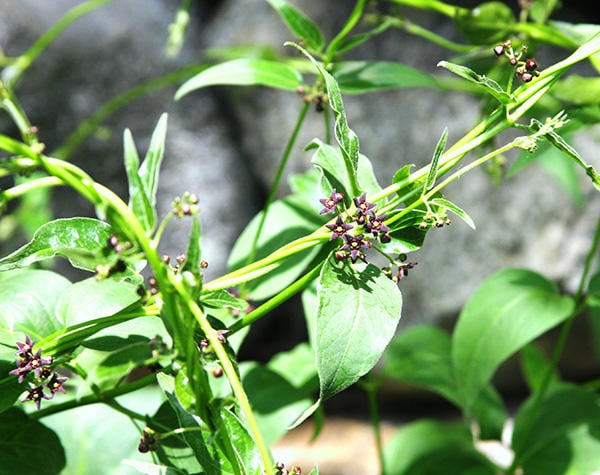
URI student Crystal Lavin collects leaf samples from invasive swallowwort plants. (Photo by Todd McLeish)
URI student Crystal Lavin collects leaf samples from invasive
swallowwort plants. (Photo by Todd McLeish)
The biggest difference between Crystal Lavin’s four years in the U.S. Navy – mostly spent standing guard at a military base in Naples, Italy – and her summer research experience at the University of Rhode Island has been her attitude about asking questions.

“In the military, everything is pretty straightforward, and you don’t question anything. But now, being in the science field, I ask questions 24/7 and it’s encouraged,” said Lavin. “This research project has been a totally new experience.”

A rising junior majoring in environmental science and management, Lavin is spending the summer studying a little-known pathogen that has been reported to kill an invasive plant called swallowwort, which takes over fields and outcompetes native plants. 


Swallowwort is also deadly to monarch butterfly caterpillars when adult monarchs mistake it for their preferred host plant, milkweed, and lay their eggs on the invader instead.

“The goal is to see if we can isolate the pathogen and then extract the DNA to identify it. To do this, I take samples from the field, bring them to the lab, and put them in moisture chambers and growth chambers to encourage the pathogen to grow,” she said,


Black Swallow-wort flowers and leaves
Swallowwort (Massachusetts Audubon photo)
“I’m also surveying different locations, looking for the pathogen to see whether it’s mostly found on swallowwort in sunny areas or shady areas or the edge of the forest.”

The pathogen is a kind of fungus that appears in several forms and was discovered in Rhode Island in 2018 and investigated last summer by fellow URI student Lexi Johnson. 

If it can be determined under what conditions it grows best, perhaps scientists can use it as a management tool against invasive swallowworts.

At South Farm Preserve in Charlestown, Lavin explored the property to collect samples, identify the areas where the pathogen was most prevalent, and note in what stage of growth it was found. She placed selected leaves in plastic bags, made notes about each sample, and returned them to the URI Biocontrol Lab for further study.


Charlestown on the bull's eye for Hurricane Isaias Tuesday night?

What COVID-19 does to the heart

Autopsies reveal surprising cardiac changes in COVID-19 patients
Louisiana State University Health Sciences Center
    
Orientações sobre as implicações cardíacas da Covid-19 (ACC, 2020)A series of autopsies conducted by LSU Health New Orleans pathologists shows the damage to the hearts of COVID-19 patients is not the expected typical inflammation of the heart muscle associated with myocarditis, but rather a unique pattern of cell death in scattered individual heart muscle cells. 

They report the findings of a detailed study of hearts from 22 deaths confirmed due to COVID-19 in a Research Letter published in Circulation, available here.