Menu Bar

Home           Calendar           Topics          Just Charlestown          About Us
Showing posts with label invasive plants. Show all posts

Tuesday, August 4, 2026

Worden Pond invasive weeds will be chemically treated on Friday

DEM says treatment will affect nothing but the weeds

The Rhode Island Department of Environmental Management (DEM) announces that Worden Pond in South Kingstown will be treated for the invasive aquatic plant hydrilla on Friday, August 7, with periodic repeated treatments through November. 

These treatments will not harm fish and will not impact boating, fishing, or swimming. The EPA-approved herbicide treatments will target hydrilla, which was first found in the pond in 2023. 

Worden Pond is RI’s largest natural lake at 1,098 acres and is popular for fishing, boating, and paddlecraft. The treatments for this federally designated noxious weed are funded by Congressionally Directed Spending secured by Senators Jack Reed and Sheldon Whitehouse through the U.S. Department of Agriculture (USDA).  

Monday, July 13, 2026

July 15 invasive weed treatment scheduled for Carolina Trout Pond

DEM says pesticide won't harm fish but wants you to keep pets away and not fish for at least three days

The Rhode Island Department of Environmental Management (DEM) announces Carolina Trout Pond in Richmond, Shippee Sawmill Pond in Foster, and Meshanticut Lake in Cranston will be treated for invasive aquatic plants on Wednesday, July 15.

Anglers and boaters should avoid using these waterbodies during treatment to not impede the licensed applicators. Temporary water use advisories will be posted where applicable and nearby residents and visitors should keep pets from drinking from these waters for at least three days. 

These EPA approved herbicide treatments will target specific invasive aquatic plants including variable water milfoil, fanwort, water chestnut, sacred lotus, and various algae species. The treatment will not harm fish. All three waterbodies are popular with anglers and boaters and are annually stocked with trout.

Monday, June 15, 2026

Aquatic Weed Treatment Scheduled for Meadowbrook Pond

No fishing on Thursday, then watch notices

The Rhode Island Department of Environmental Management (DEM) announces that Meadowbrook Pond, Richmond will receive treatments to control infestations of invasive aquatic plants on Thursday, June 18.

Anglers and boaters should avoid using the lake during the treatment. Signs will be posted with information about temporary water use advisories. 

Neighbors and other users of the pond should keep pets from drinking the water for at least three days. 

This treatment will target invasive plants in particular, variable water milfoil and curly-leaf pondweed, and it will not harm fish or other aquatic life. Meadowbrook Pond is popular with anglers and boaters and is stocked with trout several times per year.

Saturday, February 7, 2026

Rhode Island House Considers Hit List for Invasive Plants

Removing alien invaders

By Rob Smith / ecoRI News staff

Is it time for Rhode Island to ban the sale of invasive plants?

It’s one of the bills under consideration this month as the General Assembly’s annual session gets underway.

Members of the House Environment and Natural Resources Committee heard legislation (H7071) introduced by Rep. Jennifer Boylan, D-Barrington, that bans a list of nonnative invasive plants from being imported, sold, or distributed in Rhode Island.

“We’re only one of four states without a prohibited plant sale list,” Boylan told the committee. “We’re the only state in New England without such a list.”

Invasive plant species are a growing problem in Rhode Island. A plant is considered invasive if it was introduced into a region it’s not known to be native, can reproduce and spread without human effort, and actively causes harm to native species.

Invasives, whether on land or in waterbodies, typically grow much faster than their native counterparts and crowd out natives. Unlike native species, which have native predators, invasives typically have nothing to keep them from spreading.

These invaders also have knock-on effects toward animals and insects. Native milkweed plants are the primary food source for monarch butterflies in the Northeast, but black swallow-wort, an invasive species, can be mistaken by the insects as milkweed. Butterfly larvae can’t mature due to a toxin on the swallow-wort, preventing them from becoming fully grown monarchs.

Monday, July 28, 2025

Aquatic Weed Treatment Scheduled for Meadowbrook Pond

Steer clear from popular fishing spot from July 30 until DEM posts an all clear


The Rhode Island Department of Environmental Management (DEM) announces that Meadowbrook Pond, Richmond will receive treatment to control infestations of invasive aquatic plants on Wednesday, July 30. 

Anglers and boaters should avoid using the lake during the treatment. 

Signs will be posted with information about temporary water use restrictions. 

Neighbors and other users of the pond should keep pets from drinking the water for at least three days. 

This treatment will target invasive plants in particular, variable water milfoil, and it will not harm fish or other aquatic life. 

Meadowbrook Pond is popular with anglers and boaters and is stocked with trout several times per year.


Thursday, June 12, 2025

Pretty but dangerous

URI invasives expert studies a problematic plant

Kristen Curry

While fires can be caused for a variety of reasons, manmade
and natural, invasive phragmites, like these in Charlestown,
sometimes pose an overlooked risk. (URI Photos / Laura Meyerson)
Laura Meyerson was stepping through a marsh on the Housatonic River in Connecticut on a picture-perfect day as a young graduate student, when an offhand remark changed her whole outlook on the landscape in front of her.

Meyerson was observing a beautiful scenic outlook overlooking cattails. Then her professor made a comment that stopped her in her tracks. He pointed out that the scene was pretty, but that the nearby invasive reeds were going to wipe out the native muskrats. The day became a turning point in her career.

“I knew then I wanted to study this plant species,” Meyerson recalls.

Meyerson, today a professor of natural resources science at the University of Rhode Island, would like to see other New Englanders recognize the ubiquitous plant known as Phragmites australis growing by roadways and ponds for what it is.

Meyerson’s research on invasive species is global in nature, taking her to Iceland this fall. After getting her Ph.D., Meyerson worked in biosecurity for the Environmental Protection Agency and consulted with Homeland Security on pathogens that could cripple the U.S. food supply. She has served on the U.S. National Invasive Species Council Advisory Committee, is co-editor for the journal Biological Invasions, and has conducted research on invasive species at the Smithsonian Institution.

Meyerson finds many reasons to be concerned about invasive species. The fire risk posed by phragmites is just one. She says that while local fire departments are aware of the plant’s risk, those living or working near large stands of the plants may not be.

Saturday, June 7, 2025

Carolina Trout Pond gets bombed next week

Aquatic Weed Treatments Scheduled for Carolina Trout and Shippee Sawmill Ponds on June 9

The Rhode Island Department of Environmental Management (DEM) will treat Carolina Trout Pond in Richmond and Shippee Sawmill Pond in Foster on Monday, June 9 to control invasive aquatic plants. Anglers and boaters should avoid these ponds during treatment. 

Signs will be posted with temporary water use restrictions. Residents and visitors should keep pets from drinking the water for at least three days.

These treatments target invasive plants including variable water milfoil, fanwort, water hyacinth, and waterlily. It will not harm fish or other aquatic life. Both ponds are popular fishing and boating spots and are stocked with trout several times during the season.

Invasive aquatic plants are harmful to fishing, boating, swimming and impacts wildlife management. 

Tuesday, January 14, 2025

What Rhode Island can learn from the Los Angeles wildfires

URI natural resources faculty discuss L.A. wildfires, regional risks

URI faculty and alumni like Patrick MacMeekin (MESM ’22),
now at Rhode Island DEM, are assessing wildfire risks in the state.
Although fires are usually thought of as a Western problem, as seen in Los Angeles right now, wildfires do happen in Rhode Island — close to 500 acres burned near the University of Rhode Island’s Kingston Campus two years ago, in nearby Exeter and West Greenwich.

Those fires were also driven by high wind, with added fuel from dead trees and wood in Rhode Island woodlands, according to Rhode Island’s Department of Environmental Management. And fall 2024 was a historic fall fire season for the state with more than 42 wildfires burning in October and November alone.

Locally, URI faculty members predict the trend toward increased wildfires will continue, with climate change causing more forest insects and diseases to shift into Rhode Island forests, resulting in dead and dying trees and more extreme weather patterns (hotter and dryer) for longer durations.

Laura Meyerson in the department of Natural Resources Science notes that invasive plant species can worsen wildfires. The 2023 fires in Maui were fueled in part by invasive grasses introduced for forage, she said.

In southern New England, wildfires can be fueled by weather
conditions, as well as invasive, and flammable, species like
Phragmites (reeds). (URI Photo / Laura Meyerson)
“In Rhode Island, we have a heavier fuel load due to the dead standing and fallen trees from the spongy moth (formerly the gypsy moth),” she says. The state’s plentiful stands of the tall reed grass Phragmites australis, found near the coast and around ponds, are a focus of her research. “This species poses a huge fire risk because of the large amount of dead standing biomass that persists.”

She says that Rhode Island also faces increased risk from a newer invasive species outbreak that is rapidly devastating the state — beech leaf disease.

Her colleague Brett Still directs the University’s Master of Environmental Science and Management program (MESM) and frequently welcomes a recent graduate, now working in the field, to speak with undergraduates.

Still discussed the fires in California in an interview.

Sunday, January 12, 2025

Former Champlin Farm in Westerly to Become Network of Trails

Be careful near the abandoned quarry

By Rob Smith / ecoRI News staff

Jennifer Fusco, executive director of the Westerly Land Trust,
 said the plan for the land is to keep the preserve's pastures
intact, while also opening the land to the public.
(Rob Smith/ecoRI News)
At first glance, the Champlin Farm Preserve, despite its name, doesn’t really look like a farm.

The 90 acres that make up the new preserve owned by the Westerly Land Trust are full of forestland, hills, and rocky ledges. There are no vast cleared fields for crops or other markers of agricultural production. There are only a scattered few fields of pasture, ringed by ancient stone walls constructed lifetimes ago.

If anything, prior to its acquisition by the Westerly Land Trust earlier this year, the preserve was one of the few remaining slivers of wilderness left in Westerly.

“This really is a special place,” Jennifer Fusco, executive director of the Westerly Land Trust, said during a tour of the Champlin Farm Preserve last month.

Monday, September 9, 2024

Eat Up: Southern New England Offers Yummy Buffet of Invasive Plants

Massachusetts forager shares his favorites

By Frank Carini / ecoRI News staff

Autumn Olive, delicious and nutritious. Photo by Will Collette
The following statement is most likely an alternative fact, but it appears real enough: Invasive plants outnumber native species in southern New England, especially in Rhode Island.

We’re fighting them on land and in the water. It’s mostly our own fault, long ago and still introducing them into places where they don’t belong.

These unneighborly ornamentals, many brought to the United States from Japan and eastern Asia in the 1800s, can tolerate a range of site and soil conditions, which means they come to dominate the landscape.

They all crowd out native species, and some topple trees. They can easily be found along roadsides strangling diversity. For instance, both sides of the East Bay Bike Path from end to end are full of invaders.

Other popular recreational areas, such as Indian Lake in South Kingstown and Meshanticut Lake in Cranston, are teeming with aquatic invasive species.

EDITOR'S NOTE: While I also see invasive plants as a threat to our native species, I agree with Russ Cohen's comments, quoted by Frank below, that one way to attack them is to eat them. In 2012, I wrote the first of several pieces praising the Autumn Olive, an invasive plant that was imported to help reclaim strip mines because they will grow where most plants won't. Here's my first article.

We have several autumn olives that sprung up when the adjacent vacant lot was cleared by the former owners for a new home. We bought the lot to prevent that from happening and in the process inherited the autumn olive trees. Since I wrote the article in 2012, my autumn olives have slowly died back as the land regained its fertility. But still, there are harvestable amounts and using a food mill, they produced a very healthy juice. - Will Collette

Sunday, July 7, 2024

Native species cannot move fast enough on their own to avoid climate-driven chaos climate-driven chaos

Invasive species expand ranges 100 times faster than native species

Daegan Miller


Japanese knotweed. Jan Samanec, State Phytosanitary
Administration, Bugwood.org
An international team of scientists has recently found that non-native species are expanding their ranges many orders of magnitude faster than native ones, in large part due to inadvertent human help. 

Even seemingly sedentary non-native plants are moving at three times the speed of their native counterparts in a race where, because of the rapid pace of climate change and its effect on habitat, speed matters. 

To survive, plants and animals need to be shifting their ranges by 3.25 kilometers per year just to keep up with the increasing temperatures and associated climactic shifts—a speed that native species cannot manage without human help. 

Tuesday, June 18, 2024

This Year’s Environmental Hits and Misses in Legislature

PFAS ban, climate council funding bills pass; CRMC reform, bottle bill, environmental justice bills fail

Local legislators Victoria Gu, Tina Spears, Megan Cotter do well

By Rob Smith / ecoRI News staff

Victoria and Tina (Credit: The Public's Radio/Cheryl Hatch)
It’s over. While Rhode Islanders slept June 13, the General Assembly was working overtime to pass its last slate of legislation before adjourning for the year.

Lawmakers and their respective committees had been meeting daily starting last week, while the chambers wrangled over what non-budgetary bills to pass in the closing days of the session.

Environmental groups aren’t walking away from the Legislature’s session with everything on their wish list, but they aren’t walking away with nothing either. The Environmental Council of Rhode Island, a coalition of some 40 environmentally minded organizations and nonprofits, got around half of the three big named priorities passed before the end of the session.

Some high-profile misses: environmental advocates failed to secure support for reforming the Coastal Resources Management Council; a bottle deposit bill; or more stringent environmental justice requirements for the permitting industry. But environmental agencies are walking away with funding and staff increases, and the state passed a ban on forever chemicals intentionally introduced into consumer products.

A total of 34 environmental bills were considered or passed over the last week and a half of the session. Here’s the highlights of which measures made it:

Consumer PFAS Ban Act (H7356/S2152): Two years after introducing limits for per- and polyfluoroalkyl substances (PFAS) in drinking water, lawmakers returned this year to pass a thinner version of regulations barring the chemicals from consumer products. 

The ban, expected to go into enforcement in 2027, applies to most consumer products into which PFAS is intentionally introduced for its water-resistance, grease-resistance, or other notable properties. It includes certain articles of clothing, cookware, and other items. It does not include certain industrial applications, such as some consumer electronics and photography equipment.

Saturday, April 27, 2024

Senate OKs Sosnowski legislation to create Rhode Island Lake Management Program

Fighting off invaders 

Chapman Pond, Westerly (DEM)
The Senate passed legislation introduced by Sen. V. Susan Sosnowski (D-Dist. 37, South Kingstown) that would create the Rhode Island Lake Management Program.

The bill (2024-S 2153A) would create a restricted receipt account to aid with lake and pond management issues relating to the control of invasive aquatic plants.

“Local wetlands are being threatened by invasive aquatic weeds,” said Senator Sosnowski. “This bill would be a first step to start a program at the Department of Environmental Management. The situation is becoming worse with warming temperatures, and it’s creating biological imbalance in these freshwater bodies. We have to be proactive to protect our lakes, which provide us with recreation, flood mitigation and an important habitat to plants and animals.”

Conditions in many Rhode Island lakes, ponds and tributaries are threatened or degraded by the growth of aquatic invasive plants, harmful algal blooms, nutrient enrichment and other water pollution problems. Restoring conditions in the state’s freshwater resources is essential to sustaining the valuable ecosystem services they provide.

The measure now moves to the House, where similar legislation (2024-H 8093) has been introduced by House Minority Leader Michael W. Chippendale (R-Dist. 40, Foster, Glocester, Coventry).

Invasion of the (Water)Body Snatchers 

By Rob Smith / ecoRI News staff

Indian Lake doesn’t look like the site of an alien invasion.

Thursday, August 31, 2023

Ingenious art to clean pond water

Award-winning floating wetland possible remedy for blue-green algae Blooms

By Frank Carini / ecoRI News staff

The structure holds nearly 20 native wetland plant species. (Alexandra Ionescu/Rhode Island Collective)

Floating in a circle around a pond in Massachusetts is a mini-wetland built by six Rhode Islanders. Earlier this summer, the mostly natural creation was chosen as the winning installation in the seventh annual Art on the Trails outdoor art and poetry program.

But the freshwater wetland, built by a group of Ocean State artists, designers, and a botanist, wasn’t commissioned to win an award. It was designed to raise awareness about the importance of wetlands and show how they work. Mission accomplished.

Art juror Sarah Alexander, who chose “Below and Above: A Floating Wetland Supports Life” by the Rhode Island Collective as the best installation, said, “The amount of careful research and thoughtful response to the space, along with the combined efforts of its dedicated creators, blew me away.”

In the seven years of Art on the Trails, the Rhode Island-built floating wetland was the first entry to be more than just aesthetically pleasing. The wetland has been floating in Ice Pond in Southborough since June 11. It was created by sourcing native plants, and experiments with natural cordage. It shows how pollutants could be sucked from stressed waterbodies with a little help from human hands. A single anchor line keeps the wetland floating in a 15-foot circle, and not all over the popular skating pond.

Members of the Rhode Island Collective include Holly Ewald (visual artist), Maxwell Fertik (interdisciplinary artist), Alexandra Ionescu (ecological artist), Hope Leeson (botanist), and August Lehrecke and Matthew Muller (co-founders of an inflatable architecture studio), who led the project’s construction.

The members weren’t a roving gang of environmentalists who all knew each other prior to building an award-winning wetland. Ewald knew Ionescu and Leeson, who knew Fertik, who knew Muller and Lehrecke. They all brought different experiences and expertise that jelled well together.

Sunday, October 16, 2022

Brown biologist makes the case for some “invasive species”

'Non-native species aren’t the boogie man.'

Brown University

Autumn olive berries - delicious and nutritious, but
also "invasive." Photo by Will Collette
Awareness of non-native — often called “invasive” — species has vastly increased over the past half-century, to the point where anyone with a green conscience has heard of them and their negative impacts.

Less recognized are the benefits of non-native species — and according to Brown University biologist Dov Sax, that needs to change.

In a review article published on Thursday, Oct. 6, in Trends in Ecology and Evolution, Sax and two co-authors pointed out that most research on non-native species focuses on their negative consequences. 

They argued that long-standing biases against non-native species within the scientific literature have clouded the scientific process and hindered public understanding. In the article, the authors try to shift the focus to consider the benefits of non-native species for a more balanced discussion.

“Positive impacts of non-native species are often explained as serendipitous surprises — the sort of thing that people might expect to happen every once in a while, in special circumstances,” said Sax, a professor of environment and society, and of ecology, evolution and organismal biology. 

“Our new paper argues that the positive impacts of non-native species are neither unexpected nor rare, but instead common, important and often of large magnitude.”

Tuesday, February 8, 2022

Repel invaders!

Invasive Plants Have R.I.’s Native Life in StrangleholdRepel

By FRANK CARINI/ecoRI News staff

Extensive stands of Japanese barberry, which can grow up to 6 feet tall, smother native plants and don’t support pollinators. (istock)

Rhode Island is the only New England state that doesn’t have its own list of invasive species that are banned or at least identified

The intrusive plant was brought to the United States from Japan and eastern Asia in the late 1800s. The ornamental is still used in residential and commercial landscapes because of its fall coloring and deer resistance. But the prickly shrub easily spreads into woodlands, pastures and meadows, where, like many invasives imported from faraway lands, it chokes out native species.

Japanese barberry can also be popular with ticks. A multiyear study conducted in Connecticut looked at the relationship between the deciduous shrub, white-tailed deer, white-footed mice, and deer ticks, also known as black-legged ticks. It found that the larger amount of barberry in an area, the higher the prevalence of deer ticks, which can carry Lyme disease.

The hearty species, which can grow up to 6 feet tall, has denser foliage than most native species and, as a result, the invasive bush retains higher humidity levels that ticks crave, according to the study published in 2010. The shrubs also provide nesting areas for white-footed mice, which are a main source for larval ticks’ first blood meal.

Follow-up research in 2011 found that barberry-infested forests are about 12 times more likely to harbor deer ticks than forests without barberry.

This past fall Pennsylvania became the most recent state to include Japanese barberry on its list of invasive plants that can’t be legally sold or cultivated. The sale of the multi-stemmed shrub with needle-sharp spines has been banned in Massachusetts since 2009 and in New Hampshire since 2007. The sale of the plant is also prohibited in Maine and Vermont.

Connecticut recognizes it as an invasive, but nurseries there can grow and sell it. Connecticut does prohibit the sale of other plants on its invasive species list, but barberry is popular and the nursery industry lobbied against a ban. Big-box stores are still selling it, even after the Connecticut Nursery & Landscape Association agreed to phase out the most invasive barberry plants.

The sale of barberry is allowed in Rhode Island. In fact, the Ocean State is the only New England state that doesn’t have a complete list of noxious plants. While the other five states have a long list of invasive species that are banned or at least identified in Connecticut’s case, the Rhode Island Department of Environmental Management’s invasive plants webpage notes the damage inflicted by non-native species but only mentions one: phragmites, which aren’t sold at nurseries and garden centers.

Saturday, December 11, 2021

"We're hoping it will spread"

URI Meadows Serve as Living Pollinator Laboratories

By CYNTHIA DRUMMOND/ecoRI News contributor
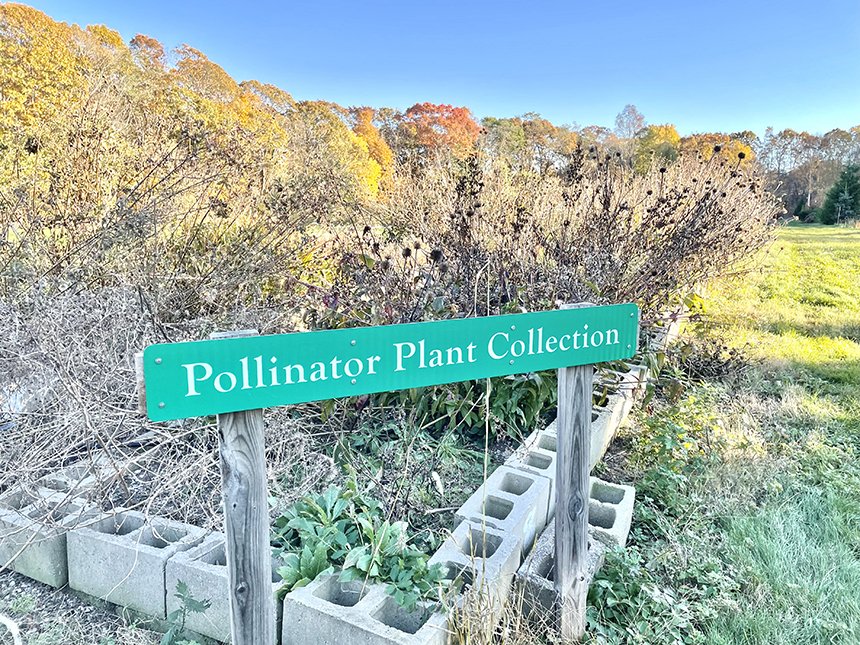
One of several wildflower meadows at the University of Rhode Island’s East Farm. A team of researchers is evaluating the performances of the plants to determine which species are best suited to Rhode Island and which are the most beneficial to pollinators such as bees. (Cynthia Drummond/for ecoRI News)

It was still warm enough on a late-November afternoon for the honeybees at the University of Rhode Island’s East Farm to be outside their hives. Throughout the summer, they, along with bumblebees, feed on and pollinate flowers in several nearby meadows.

Touring the farm in golf carts, entomology professor Steven Alm and two graduate students, Casey Johnson and Elizabeth Varkonyi, were evaluating several plantings, part of a research project that has involved the conversion of large plots, about 7 of the property’s 85 acres, into meadows.

One of the challenges, Alm said, is to find plants that bloom very early in the spring, because that is when emerging bees are most in need of nutrition.

“It’s got a lot of golden rod, there’s a lot of vetch in there,” he said, stopping his cart beside a large meadow. “It’s got a lot of asters, but we’re trying to get some more early season plants established, because the queen bumblebees, they go into hibernation and they come out early in the spring and they need some very early spring flowers to get energy and protein out of nectar to start their new colonies. That’s what I think we’re lacking a bit here in Rhode Island, early season plants for them.”

Alm moves on to another plot, which is divided into a grid to make monitoring the diverse plantings easier.

“We put in New Jersey tea, we put in joe-pye weed, there’s some boneset, just to see what would take to this particular soil type — pH, moisture conditions, rainfall — because we don’t want to baby it too much,” he said.

Further on, several larger plots are planted with red clover and wildflower seed mixes. The sunflower seed for another planting was ordinary wild bird seed from a hardware store. The flowers were gone, but birds, including a large flock of dark-eyed juncos, were still eating the fallen seeds.

The soil in the meadow plots is not amended in any way, and the plants are left to fend for themselves. Alm is trying to determine which natural conditions different plants prefer and which plants are most attractive to bees.

Because pollinators like bees are so dependent on plants, it also makes sense to study them and their roles in the meadows. Johnson, who is earning a master’s degree, has completed the first year of a project that involves treating the honeybees in the farm’s 28 hives for varroa mite, a parasite that has killed millions of bees.

Tuesday, September 21, 2021

URI Master Gardeners spruce up Trustom Pond NWS

They install native plant garden, restore habitat

Tony LaRoche

URI Master Gardeners and U.S. Fish and Wildlife Service staff restore habitat at the Trustom Pond National Wildlife Refuge. (Photo by Mark Cordle)

A team of University of Rhode Island Master Gardeners is transforming the visitor contact station garden at the Trustom Pond National Wildlife Refuge into a native plant demonstration garden and helping refuge staff restore habitat in the refuge’s meadow to be more beneficial to native wildlife.

Led by Master Gardener Mark Cordle, the project is an outgrowth of a similar effort at the nearby Kettle Pond Visitor’s Center (in Charlestown), where Master Gardeners have worked for four years to create and maintain an extensive native plant garden.

“I couldn’t be more excited about the partnership between the refuge complex and the Master Gardener program,” said Nick Ernst, a wildlife biologist with the U.S. Fish and Wildlife Service who is collaborating with the Master Gardeners on the projects. 

“The demonstration gardens they created are a wonderful way to showcase the beauty of native plants for use in home landscaping, as well as communicating the vital role they play supporting an assortment of beneficial insects and pollinators.”

Working twice a week in the warmer months since last September, as many as 10 Master Gardeners have teamed to renovate and redesign the Trustom garden by removing non-native species and planting native species such as mountain mint, bee balm, cardinal flower, goldenrod, joe-pye weed and wood aster. A two-level rain garden serves as an infiltration system for excess water runoff, where deep-rooted plants such as ironweed, boneset and milkweed now grow.

Wednesday, August 4, 2021

A new pest is on the way

The invasive spotted lanternfly is spreading across the eastern US – here’s what you need to know about this voracious pest

In seven years, the lanternfly has spread from Berks County, northwest
of Philadelphia, to large areas of Pennsylvania and New Jersey, and
 both south and north. Penn State/E. Swackhamer
Frank A. Hale, University of Tennessee

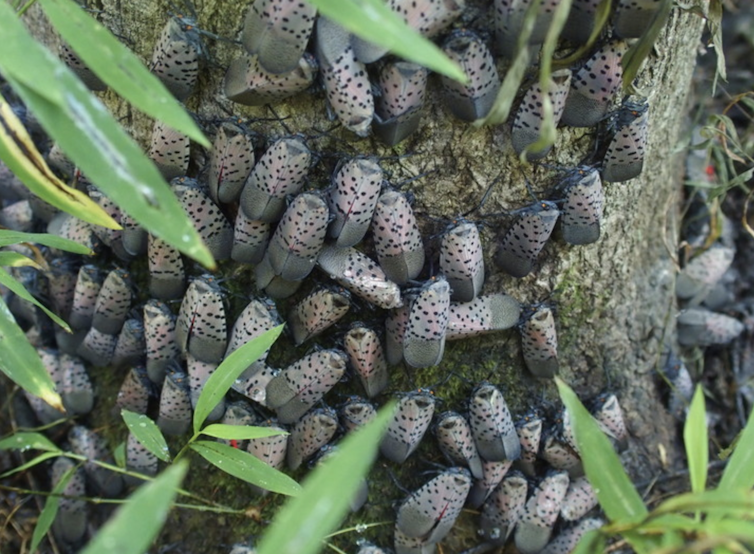
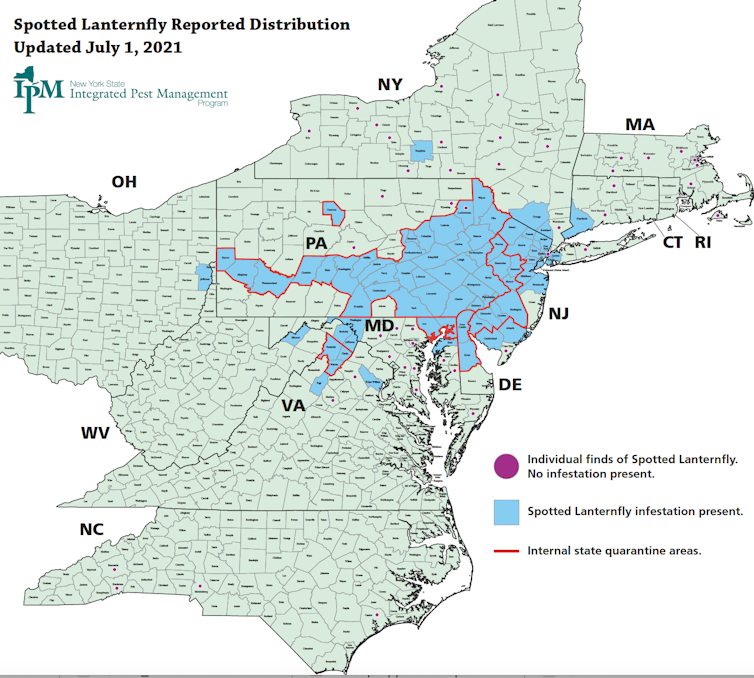
The spotted lanternfly was first detected in Pennsylvania in 2014 and has since spread to 26 counties in that state and at least six other eastern states. It’s moving into southern New England, Ohio and Indiana. 

This approximately 1-inch-long species from Asia has attractive polka-dotted front wings but can infest and kill trees and plants. We recently caught up with Professor Frank Hale, an entomologist who is tracking this species.

The Conversation: How did the spotted lanternfly get to the U.S., and how quickly is it spreading?

Frank Hale: It is native to India, China and Vietnam and probably arrived in a cut stone shipment in 2012. The first sighting was in 2014 in Berks County, Pennsylvania, on a tree of heaven — a common invasive tree brought to North America from China in the late 1700s.

By July 2021 the lanternfly had spread to about half of Pennsylvania, large areas of New Jersey, parts of New York state, Maryland, Delaware and Virginia. It also had been found in western Connecticut, eastern Ohio, and now Indiana. To give an idea of how fast these lanternflies spread, they were introduced into South Korea in 2004 and spread throughout that entire country – which is approximately the size of Pennsylvania – in only three years.

In only seven years, the spotted lanternfly has infested large areas of the Middle Atlantic and has begun to push into Connecticut. New York State Integrated Pest Management Program

Monday, July 19, 2021

Exploring the wonders of the Wood River

Two Years into Wild and Scenic Designation, Wood River Shines

Photos and text by CAITLIN FAULDS /ecoRI News staff

An angler stands in Wood River preparing a fly for a cast.

The fishermen wish us well as we unload our kayaks at The Pines access point and trundle down eroding wood steps to the water’s edge.

The river is cool, clear and fast-moving with the recent rains. My sandalled foot plunges in heavy, unbalanced by the weight of the boat. A bullfrog gulps a nervous hello from the opposing riverbank and Kassi Donnelly holds the stern as I lift myself in, push out with the paddles and glide into the current.

She grabs her blue boat from the shore and smoothly launches next to me. And just like that, we’re sitting in the Wood River — Rhode Island’s wild, scenic and biodiverse gem.

Kassi Donnelly paddles through a cleared opening in a downed tree along the Wood River.

Coastal Rhode Island steals the show when it comes to tourism. A report on Rhode Island’s ocean-based tourism economy from the 2000s concluded that 30 percent to 40 percent of the Ocean State’s tourism was marine-dependent.