Menu Bar

Home           Calendar           Topics          Just Charlestown          About Us

Thursday, December 3, 2020

New tool to combat terrorism

Dust on boots, baggage can track down suspects

Flinders University

Forensic science experts at Flinders University are refining an innovative counter-terrorism technique that checks for environmental DNA in the dust on clothing, baggage, shoes or even a passport.

The Flinders-led research, led by postdoctoral research associate Dr Jennifer Young, will developed a system to trace the source of dust on suspect articles to match a soil profile of a specific area or overseas country.

"This could help provide evidence of where a person of interest might have travelled based on the environmental DNA signature from dust on their belongings," says Dr Young, from the College of Science and Engineering at Flinders University.

Love your prunes...and raisins and dates

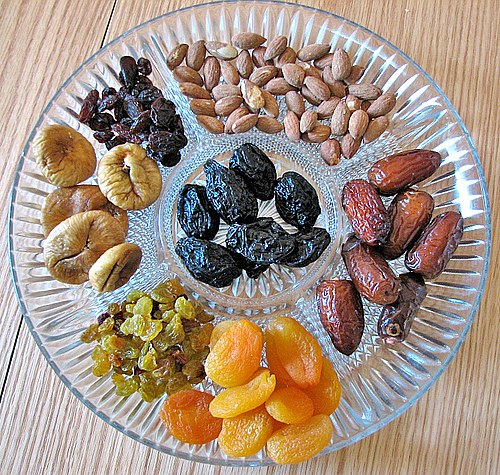
Eating dried fruit may be linked with better diet quality and health markers

Katie Bohn

Don’t be afraid to toss a handful of raisins or dried apples in your Thanksgiving stuffing this year — a new Penn State study has found that dried fruit may be connected with better health.

The researchers found that people who ate dried fruit were generally healthier than those who did not, and on days when people ate dried fruit they consumed greater amounts of some key nutrients than on days when they skipped. However, they also found that people consumed more total calories on days when they ate dried fruit.

Valerie Sullivan, postdoctoral researcher at Johns Hopkins Bloomberg School of Public Health and a Penn State grad student at the time of the study, said the findings suggest that dried fruit can be part of a healthy diet — with some caveats.

One of the costs of having no national strategy

How a Bidding War for Covid-19 Nurses Hurts the Pandemic Response

BY MARKIAN HAWRYLUK & RAE ELLEN BICHELL, KHN

In March, Claire Tripeny was watching her dream job fall apart. She’d been working as an intensive care nurse at St. Anthony Hospital in Lakewood, Colorado, and loved it, despite the mediocre pay typical for the region. But when Covid-19 hit, that calculation changed.

She remembers her employers telling her and her colleagues to “suck it up” as they struggled to care for six patients each and patched their protective gear with tape until it fully fell apart. The $800 or so a week she took home no longer felt worth it.

“I was not sleeping and having the most anxiety in my life,” said Tripeny. “I’m like, ‘I’m gonna go where my skills are needed and I can be guaranteed that I have the protection I need.’”

In April, she packed her bags for a two-month contract in then-Covid hot spot New Jersey, as part of what she called a “mass exodus” of nurses leaving the suburban Denver hospital to become traveling nurses. Her new pay? About $5,200 a week, and with a contract that required adequate protective gear.

Months later, the offerings — and the stakes — are even higher for nurses willing to move. In Sioux Falls, South Dakota, nurses can make more than $6,200 a week. A recent posting for a job in Fargo, North Dakota, offered more than $8,000 a week. Some can get as much as $10,000.

Early in the pandemic, hospitals were competing for ventilators, Covid tests and personal protective equipment. Now, sites across the country are competing for nurses. The fall surge in Covid cases has turned hospital staffing into a sort of national bidding war, with hospitals willing to pay exorbitant wages to secure the nurses they need. That threatens to shift the supply of nurses toward more affluent areas, leaving rural and urban public hospitals short-staffed as the pandemic worsens, and some hospitals unable to care for critically ill patients.

Wednesday, December 2, 2020

The End Game: Trump Turns Destructive And Vindictive, Like All Dictators

Sic Semper Tyrannis

By Dr. Bandy X. Lee

I have often dubbed “fascism” mental pathology in politics, and as a fascism scholar and author of the new book, Strongmen: Mussolini to the Present, Prof. Ruth Ben-Ghiat is as psychologically-minded as historians come.  The way mental health professionals have brought the context of our experience with patients to understanding the turbulent presidency of Donald Trump, she has brought the context of historical figures.  I interviewed her at our recent town hall.

Dr. Ruth Ben-Ghiat is a professor of History and Italian Studies at New York University; a frequent commentator on CNN; an expert on fascism, authoritarian leaders, propaganda, and threats to democracy around the world.  She is also a World Mental Health Coalition Board member who has helped guide members in applying our mental health knowledge to the political domain as well as within the currents of history, to achieve our mission of bettering societal mental health.

Lee: Your work and ideas have always impressed me for their psychological sensitivity, and here again you get straight to what many historians or political scientists miss, which are the commonalities, patterns, and personality consistencies across different leaders.  How have you come to such psychological awareness in your work?

Ben-Ghiat: I grew up in Pacific Palisades, Calif., which is an idyllic seaside town.  It might seem a strange place to start thinking about fascism and pathologies, but it was a place where many anti-Nazis, Thomas Mann and others, came to settle.  

So I was always aware of this pain of exile, and perhaps being a child of immigrants and the closest family member an eleven-hour plane ride away, perhaps I was interested in what kinds of regimes force people to flee their country.  So I started investigating individuals, Otto Klemperer or Schoenberg, who had had to resettle.  Then my first book out of my dissertation was on Italian fascist culture, but it was really a study in intellectual and cultural collaboration, how did the regime pressure people, intimidate people to work with them.

You were among the first to predict that Donald Trump would rule as an authoritarian once he gained power.  What were some early red flags for you, and what do his traits say about how dangerous he will likely be in these last 60 days of his presidency?  In other words, how does he resemble or differ from authoritarian cult leaders?

In terms of the first question, I was already writing for CNN on war, and so I had that platform—and my second book was just published in 2015, a study of fascist film propaganda.  

From a slightly different angle, I was thinking about how people are led to believe a fictional reality and the destruction that it causes.  So I turned this global lens onto my own country, and when I did that, coupled with my training in fascism, the figure of Donald Trump was very clear to me.

His demonizing the press was a big sign.  Because Trump and Berlusconi and Putin have secrets and they are criminals, they have to start demonizing the press very early so that when secrets come out, his followers would already think of the press as partisan hacks.  And then the final component was the violence.  

In the 21st century, we have fewer people with squadrons like the fascists a hundred years ago, and more people like Duterte in the Philippines who says he warned Filipinos not to vote for him, because if he won he said it would be bloody.  So here is Donald Trump who comes in and in January 2016 says, “I could shoot someone and not lose any followers.”  This is very unusual in a context of democracy.

Maybe he's ready

By Pat Byrnes


Could be worse: imagine if he actually did his job


Social Distancing Isn’t Enough to Prevent Infection

How to Detect COVID-19 Super-Spreaders

By AMERICAN PHYSICAL SOCIETY 


New fluid dynamics research reveals why social distancing alone doesn’t necessarily prevent infection indoors and how to detect COVID-19 super-spreaders.

Researchers who study the physics of fluids are learning why certain situations increase the risk that droplets will transmit diseases like COVID-19.

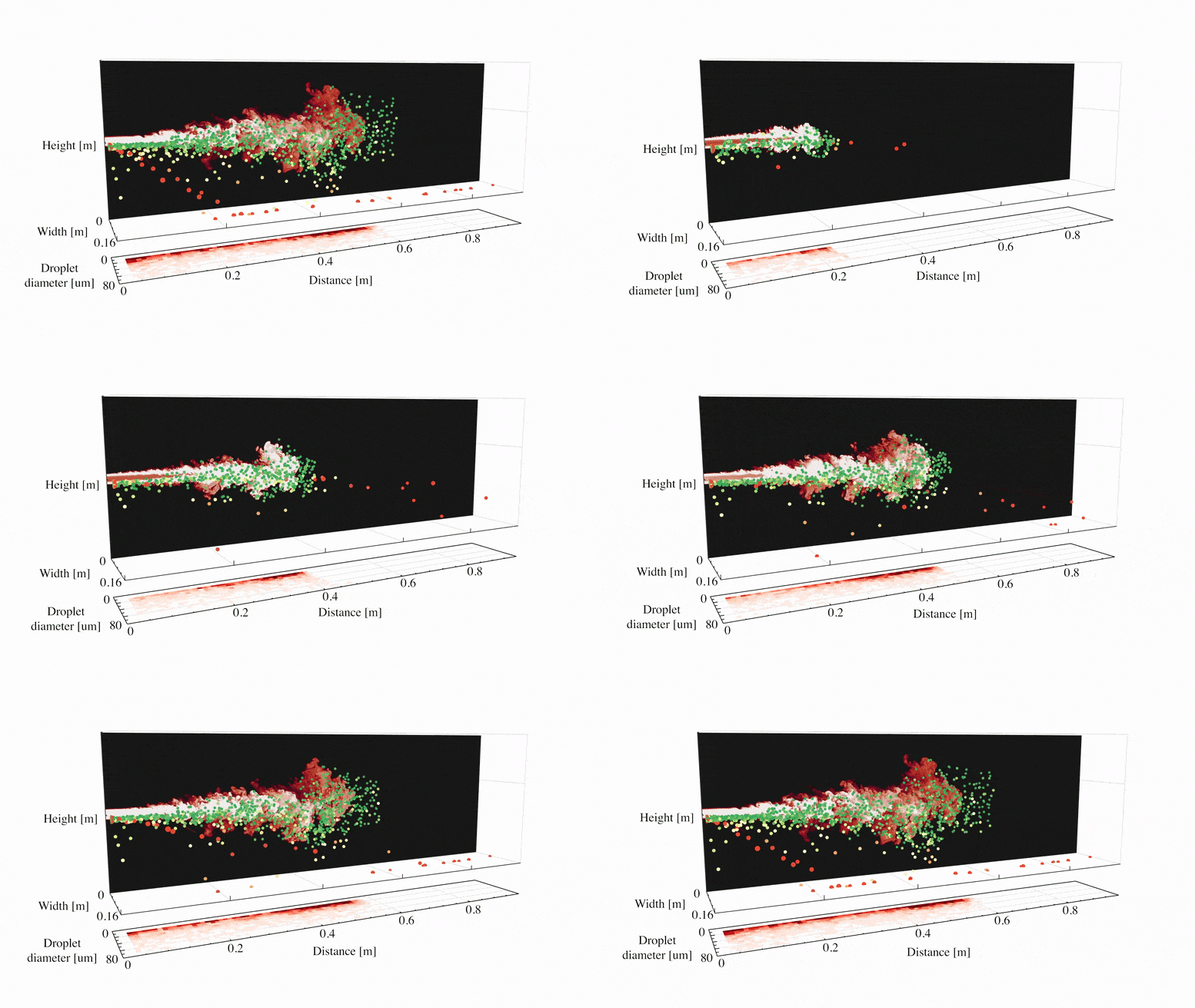
At the 73rd Annual Meeting of the American Physical Society’s Division of Fluid Dynamics, the scientists offered new evidence showing why it’s dangerous to meet indoors — especially if it’s cold and humid, and even if you’re more than six feet away from other people. They suggested which masks will catch the most infectious droplets. And they provided new tools for measuring super-spreaders.

“Present epidemiological models for infectious respiratory diseases do not account for the underlying flow physics of disease transmission,” said University of Toronto engineering professor Swetaprovo Chaudhuri, one of the researchers.

But fluids and their dynamics are critical for shaping pathogen transport, which affects infectious disease transmission, explained mathematical physicist and professor Lydia Bourouiba, Director of The Fluid Dynamics of Disease Transmission Laboratory at MIT. She gave an invited talk on the body of work she has produced over the last ten years elucidating the fluid dynamics of infectious diseases and disease transmission.

“My work has shown that exhalations are not isolated droplets but in fact come out as a turbulent, multiphase cloud. This gas cloud is critical in enhancing the range and changing the evaporation physics of the droplets within it,” said Bourouiba. “In the context of respiratory infectious diseases, particularly now COVID-19, this work underscores the importance of changing distancing and protection guidelines based on fluid dynamics research, particularly regarding the presence of this cloud.”

SENS researcher studying microplastics in surface water

How big of a problem is the issue of microplastics in our surface water?

MEGAN EVANS

University of Saskatchewan (USask) researcher Dr. Markus Brinkmann (PhD) is determined to find out.

“Most of our food today contains some small amount of plastic,” said Brinkmann, an assistant professor at USask’s School of Environment and Sustainability (SENS). “Whether it’s from yogurt cups or synthetic tea bags, there is some plastic in human food and potentially even in our water supply.”

In one of a number of water quality research projects he is working on, Brinkmann has partnered with the South Saskatchewan River Watershed Stewards (SSRWS)—a non-governmental organization focused on initiatives that help educate people about water quality and the impact of our actions on the environment—and the City of Saskatoon to determine levels of microplastics that are draining into local river systems.

Sea-level rise will have complex consequences

Looking at ancient societies to gauge the impact of sea-level rise

University of Exeter

Rising sea levels will affect coasts and human societies in complex and unpredictable ways, according to a new study that examined 12,000 years in which a large island became a cluster of smaller ones.

Researchers reconstructed sea-level rise to produce maps of coastal changes at thousand-year intervals and found that today's Isles of Scilly, off the UK's south-west coast, emerged from a single island that only became the current configuration of more than 140 islands less than 1,000 years ago.

The study, led by the University of Exeter in partnership with Cornwall Archaeological Unit, Cardiff University and 14 other institutes, found that changes in both land area and human cultures happened at variable rates, and often out of step with the prevailing rate of sea-level rise.

With climate change now driving rapid sea-level rise, the team says the effects will not always be as simple as a forced human retreat from coasts.

"When we're thinking about future sea-level rise, we need to consider the complexity of the systems involved, in terms of both the physical geography and the human response" said lead author Dr Robert Barnett, of the University of Exeter.

"The speed at which land disappears is not only a function of sea-level rise, it depends on specific local geography, landforms and geology.

"Human responses are likely to be equally localised. For example, communities may have powerful reasons for refusing to abandon a particular place."

The researchers developed a new 12,000-year sea-level curve for the Isles of Scilly, and looked at this alongside new landscape, vegetation and human population reconstructions created from pollen and charcoal data and archaeological evidence gathered. The new research extends and enhances data collected by the Lyonesse Project (2009 to 2013), a study of the historic coastal and marine environment of the Isles of Scilly.

Tuesday, December 1, 2020

Republicans and treason against democracy

They are damaging the foundations of American governance

By Mitchell Zimmerman

By Clay Bennett, Chattanooga Times Free Press
Donald Trump’s refusal to accept the judgment of the American people might just seem like denial. But in denying the legitimacy of over 77 million votes against him, 

Trump and leading Republican politicians are implementing a design more sinister than poor sportsmanship.

Trump and his party have declared war on the fundamental principle of American constitutional democracy: When an incumbent loses an election, they leave office. A peaceful transfer of power follows.

Republicans know full well that Biden won. Republican as well as Democratic election officials from across the country confirm there’s no evidence of voter fraud. The election was not stolen.

Nonetheless, Trump and Republican politicians are scheming to persuade tens of millions of Republican faithful that our elections cannot be relied on and that Joe Biden is an illegitimate president.

In doing so, they are undermining the bedrock of American democracy: trust in peaceful elections in a constitutional order. And they demonstrate their animosity to electoral democracy itself.

Passing the torch


By Matt Davies, Newsday

Yeah, that'll teach us


Beware of killers on the loose in our local woods

Wear orange in the woods or die

With Shotgun Deer Hunting Season Opening December 5th, DEM Reminds State Management Area Users to Wear 500 Inches of Solid, Daylight Fluorescent Orange for Safety Reasons

He wasn't wearing orange
The Rhode Island Department of Environmental Management (DEM) reminds all Rhode Islanders that, for safety reasons, they must wear solid, daylight fluorescent orange when in State management areas and undeveloped State parks during the shotgun deer hunting season, which opens on Saturday, December 5.

All hunters, including archers, are required to wear 500 square inches of solid, daylight fluorescent orange clothing during the shotgun season. Waterfowl hunters hunting from a boat or blind, over water or field, and when done in conjunction with decoys are exempt from the orange requirements. Archers are exempt from wearing orange in areas of the state that are limited to hunting by archery-only.

Throughout all shotgun deer seasons, all other users of State management areas and designated undeveloped State parks also must wear at least 500 square inches of solid, daylight fluorescent orange material. For all hunters and management area users, the orange clothing should include a hat and vest worn above the waist and visible in all directions. An orange vest that's 20 inches long by 25 inches wide has 500 square inches of surface area.

The shotgun season for deer in Zone 1 runs from Saturday, December 5 through Sunday, December 20. The shotgun season for deer in Zone 2 is from Saturday, December 5 through Sunday, December 13. 

From Saturday, December 26 through Saturday, January 2, 2021, hunters may hunt only on private lands for antlerless deer in Zones 1 and 2. The statewide bag limit is two antlered deer, and no more than one antlered deer can be harvested in Zone 3. The bag limit for antlerless deer is three in Zone 1, and two antlerless deer in Zone 2 and Zone 3.

The season for shotgun deer hunting in Zone 4 (Block Island) will be open on select weekdays through February 26, 2021, as published in the state's 2020-2021 Hunting and Trapping Abstract. Hunters should call the New Shoreham Police Department at 401-466-3220 for check station information. There is an unlimited bag limit for antlerless deer on Block Island.

Deer hunting hours are the same this year as in prior years: one-half hour before sunrise to one-half hour after sunset. For more information on seasons, bag limits, zones, and regulations, review the 2020-21 hunting abstract.

All deer hunters are required to obtain written permission annually for all deer hunting on private lands. DEM has developed a courtesy card, available on the DEM website, for hunters and landowners to sign that gives the dates for permissions and contains A Hunter's Pledge regarding principles of conduct. 

DEM encourages private landowners to allow hunters to hunt deer on their property, where feasible, during deer hunting seasons as this is a sound management technique that benefits deer habitats and regulates population growth. EDITOR'S NOTE: F**k that! - W. Collette

Pass the Godivas, please

Cocoa flavanols boost brain oxygenation, cognition in healthy adults

University of Illinois at Urbana-Champaign, News Bureau

The brains of healthy adults recovered faster from a mild vascular challenge and performed better on complex tests if the participants consumed cocoa flavanols beforehand, researchers report in the journal Scientific Reports. 

In the study, 14 of 18 participants saw these improvements after ingesting the flavanols.

Previous studies have shown that eating foods rich in flavanols can benefit vascular function, but this is the first to find a positive effect on brain vascular function and cognitive performance in young healthy adults, said Catarina Rendeiro, a researcher and lecturer in nutritional sciences at the University of Birmingham who led the research with University of Illinois at Urbana-Champaign psychology professors Monica Fabiani and Gabriele Gratton.

Rhode Island’s warming waters are already causing harm

Detrimental Impacts of Rising Sea Temperatures Build Up

By ROGER WARBURTON/ecoRI News contributor 


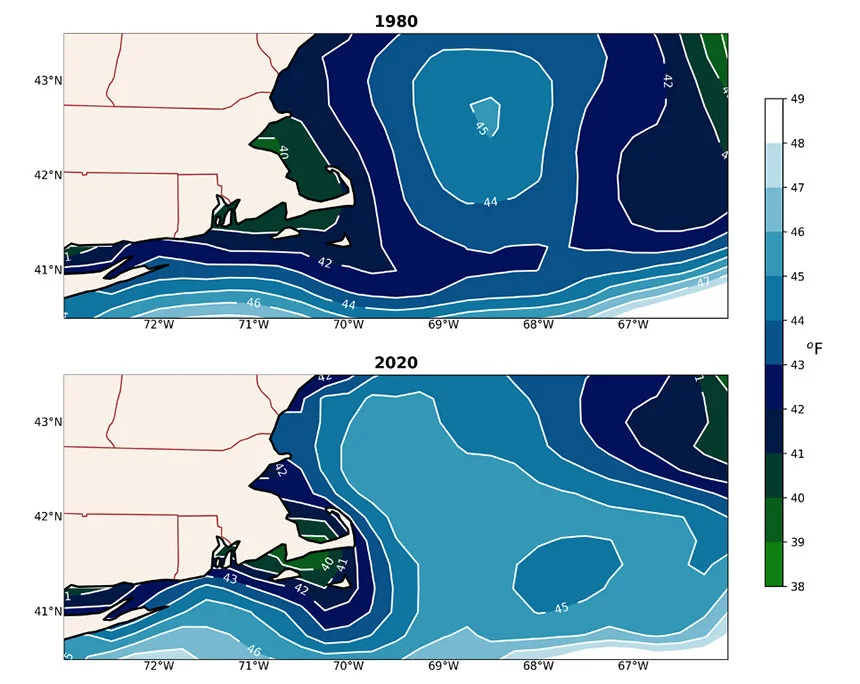
January sea surface temperatures off the coast of southern New England have risen significantly since 1980. (Roger Warburton/ecoRI News)

Living in Rhode Island, we are aware how the ocean rules our weather. What is less well known is that climate change is fundamentally altering the waters off our coast.

The image above shows how the January temperature of the ocean off the coast of southern New England has changed since 1980. For example, vast areas of dark blue — representing temperatures around 41-43 degrees Fahrenheit — have shrunk and are now a lighter blue, representing temperatures around 43-45 degrees.

The effects of a temperature rise in the ocean are significantly different from a temperature rise over land. We experience this difference when we walk across a sandy beach on a hot day. Exposed to the same sunlight, the sand burns our feet while the ocean warms gradually to the perfect temperature for a summer swim.

Rhode Island’s climate is moderated because the ocean takes longer than the land to heat up over the summer and longer to cool down during the fall.